
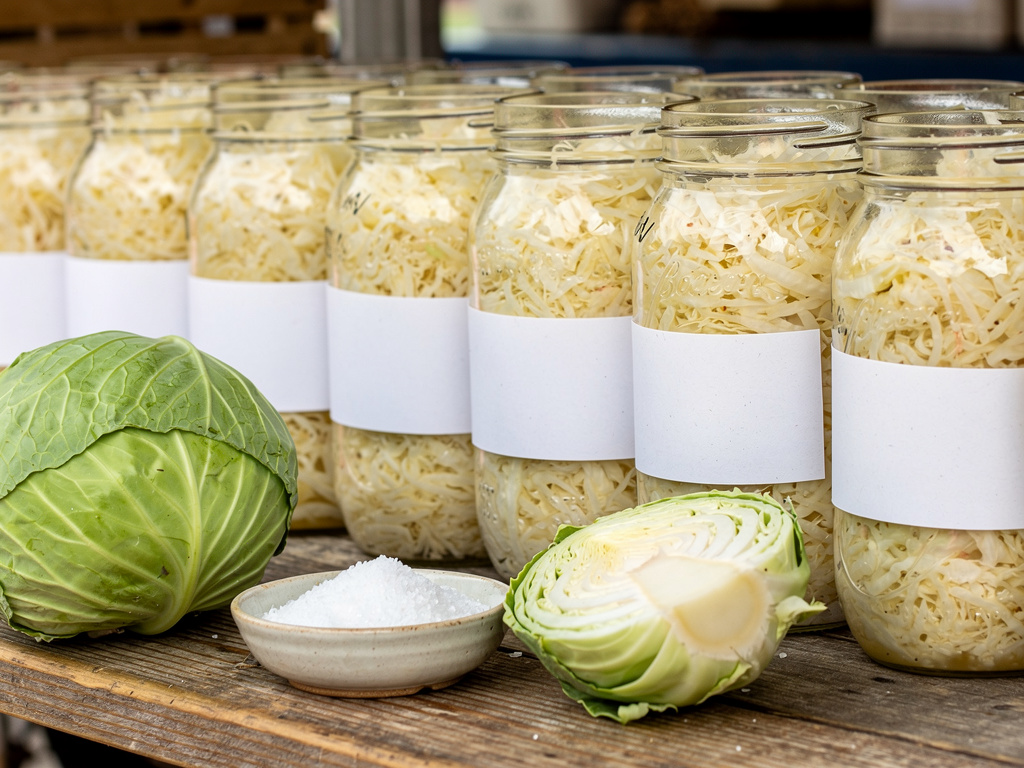


The short version: Sell a 16-ounce pint of raw sauerkraut for $10 to $12, a half pint for $6 to $7 and a quart for $18 to $20. Sauerkraut only looks expensive because the cheapest kind is sold at about what the cabbage costs: Silver Floss sells a 32-ounce jar for $2.42 at Walmart.com, 7.6 cents an ounce, and the cabbage and salt in homemade kraut run 7.8 cents an ounce. What you charge for is the $1.21 jar, 3 to 4 weeks in the crock, about 4.5 hours of hand work per 18 pints, and keeping it cold. A pint in a new jar costs you $2.63, so a $12 pint leaves you $8.72 after a 65-cent card fee.
Checked September 26, 2026: grocery sauerkraut and supply prices on Walmart.com, the websites of six sauerkraut sellers (Jersey Pickles, Southwest Ranches Farmers Market, Glaser Organic Farms, Real Pickles, Food and Ferments and Oregon Brineworks), the National Center for Home Food Preservation's sauerkraut recipe, a shared kitchen's rate page, the fee pages of the two checkout tools compared below, the Washington and Wisconsin agency pages, Homegrown's pricing on findhomegrown.com/signup and a live pull of the Homegrown catalog. The hours are our estimate. Homegrown customers create an account to place their first order, and Homegrown has no timed release or countdown feature.
A regular at your market table tasted your caraway kraut and asked if she could get a pint every other week. Her friend wants a quart for a Reuben party. You need a number to text back, and sauerkraut is an odd product to price, because the grocery store sells a whole jar for less than a latte.
If you have not made kraut to sell yet, start with how to sell sauerkraut and fermented vegetables from home, which covers the recipe, the flavors and where to sell. This guide does one job: it builds your price from numbers gathered on September 26, 2026. That means what grocery stores and small-batch brands charge, what a 25-pound batch costs you, what each jar size earns, what the weeks in the crock and a rented kitchen add, and what card fees take.
Sell a 16-ounce pint of raw sauerkraut for $10 to $12, a half pint for $6 to $7 and a quart for $18 to $20. Those prices assume plain or caraway kraut made from store-bought cabbage, fermented in a 5-gallon food-grade pail, packed in new Ball jars and sold cold by pre-order or at a farmers market.
The range sits in the middle of what the small-batch brands checked below charge, far above the big grocery brands. A 16-ounce pouch of Cleveland Kitchen's Classic Sauerkraut is $4.94 at Walmart.com, while small-batch brands charge $6.00 to $13.33 for about 16 ounces at each brand's lowest per-jar price, most of them $9.90 or more. The one vendor selling sauerkraut on Homegrown asks $20 a pint.
Scroll sideways to see every column.
| Jar size | Suggested price | Price per ounce | Your cost, new jar | Card fee, one jar per order | You keep per jar |
|---|---|---|---|---|---|
| Half pint, 8 oz | $6 to $7 | 75¢ to 87.5¢ | $1.80 | $0.47 to $0.50 | $3.73 to $4.70 |
| Pint, 16 oz | $10 to $12 | 62.5¢ to 75¢ | $2.63 | $0.59 to $0.65 | $6.78 to $8.72 |
| Quart, 32 oz | $18 to $20 | 56.3¢ to 62.5¢ | $4.03 | $0.82 to $0.88 | $13.14 to $15.09 |
Your cost is cabbage and salt, a new Ball jar with lid and band, and one waterproof label, at Walmart.com prices as of September 26, 2026. The pint and half-pint jars were marked down that day: at the $18.99 list price for 12, a pint jar is $1.58 instead of $1.21, and at the $16.21 list price a half-pint jar is $1.35 instead of $1.00. The card fee is Homegrown's 2.9% + $0.30 per order from findhomegrown.com/signup, checked the same day. Pint and quart jars are measured by volume, so a pint is counted as 16 ounces. Store jars are sold by net weight, so comparing a fluid ounce of your kraut with an ounce of weight on a store label is approximate, not exact.
Pick the top of each range if you use organic cabbage, or if your market already has a pickle vendor charging $15 a pint. Pick the bottom if you are new, if you sell mostly half pints, or if your customers mostly buy it for one recipe.
The cabbage and salt in sauerkraut cost about 7.8 cents an ounce, so the price of a $10 to $12 small-batch pint pays for the jar, the weeks, the hand work and the cold, not the cabbage. The cheap store kraut sells at roughly the cost of its cabbage, which only works at factory scale. Everything a small-batch brand adds shows up in the price:
So when a customer asks why your pint costs $12, the honest answer is that about $1.24 of it is cabbage and salt, $1.39 is the jar and label, and the rest is a month of your time and your fridge.
The four grocery sauerkrauts we compared cost $1.37 to $4.94 each at Walmart.com, from 7.6 cents an ounce for Silver Floss in a 32-ounce jar to 30.9 cents an ounce for a 16-ounce pouch of Cleveland Kitchen's Classic Sauerkraut. These are the prices your customers see when they shop, checked on Walmart.com on September 26, 2026. The same search also showed imported German kraut up to $14.02, for Hengstenberg Bavarian Style at 24.3 ounces, or 57.7 cents an ounce.
Swipe left to see the rest of this table.
| Product at Walmart.com | Size | Price | Price per ounce |
|---|---|---|---|
| Silver Floss Naturally Fermented Shredded Sauerkraut, jar | 32 oz | $2.42 | 7.6¢ |
| Vlasic Old Fashioned Sauerkraut | 32 fl oz | $2.88 | 9.0¢ |
| Great Value Sauerkraut | 14.5 oz | $1.37 | 9.4¢ |
| Cleveland Kitchen Classic Sauerkraut, pouch | 16 oz | $4.94 | 30.9¢ |
Walmart.com search results for "sauerkraut" at the default store, loaded on September 26, 2026. Prices vary by store and week.
You will not win on price against the first three, and you should not try. A shopper who buys a 14.5-ounce can for $1.37 is buying a topping for hot dogs. Your customer is paying for things the can does not give them:
Small sauerkraut vendors charged $6.00 to $13.33 for about 16 ounces on September 26, 2026, counting each brand's lowest per-jar price, with most between $9.90 and $13.33. Here is what five sellers were asking on their own sites that day, and what the one sauerkraut vendor on Homegrown asks.
Slide this table sideways for more columns.
| Seller | Where | What you get | Price | Price per ounce |
|---|---|---|---|---|
| Jersey Pickles | New Jersey pickle shop | Sauerkraut, 16 oz / quart | $6.00 / $9.99 | 37.5¢ / 31.2¢ |
| Southwest Ranches Farmers Market | Florida market store | Homemade Sauerkraut, Raw Fermented, 32 oz | $15.99 | 50.0¢ |
| Glaser Organic Farms | Organic farm, sells online | Cabbage and Carrots Sauerkraut, 16 oz | $9.90 | 61.9¢ |
| Real Pickles | Massachusetts, ships in the Northeast | Organic Sauerkraut, 15 oz jars, case of 12, shipping included | $128 ($10.67 a jar) | 71.1¢ |
| Food and Ferments | Upstate New York | Classic Sauerkraut, 16 oz jar | From $13.99 | 87.4¢ |
| ZachsGarden on Homegrown | Homegrown vendor | Sauerkraut, pint / half pint | $20.00 / $12.00 | $1.25 / $1.50 |
Prices from each seller's own product page (jerseypickles.com/products/sauerkraut, swrfmarket.com/products/homemade-sauerkraut, glaserorganicfarms.com/products/cabbage-and-carrots-sauerkraut-16-oz, realpickles.com/product/organic-sauerkraut and foodandferments.com/shop-now/classic-kraut), and for ZachsGarden from our Homegrown catalog data, all from September 26, 2026. Real Pickles also sells 4 jars for $68 ($17.00 a jar) and a 1-gallon bucket for $48, and says its prices include shipping and handling. Food and Ferments also sells a Classic 3-pack for $39.99, or $13.33 a jar, which is the lowest per-jar price used for the range above. Southwest Ranches' sauerkraut listing offers only the 32-ounce jar, which works out to $8.00 per 16 ounces.
When we pulled every Homegrown listing on September 26, 2026, 1 of the 308 vendors sold sauerkraut, out of 2,723 products. We searched product names, descriptions and size options for "sauerkraut", "kraut", "kimchi" and "ferment" outside the bakery category, then opened every listing from each vendor we found. Mountain Artisan LLC dba ZachsGarden lists "Sauerkraut (Pint)" at $20.00 and "Sauerkraut (Half Pint)" at $12.00 as size options on its Old Fashioned Pickles listing, next to pickle pints at $15.00. Immunity Artisan sells a 16-ounce spicy kimchi for $10.00. That means a sauerkraut vendor on Homegrown today would have almost no one else selling kraut there.
Set against both tables, $10 to $12 a pint is not a stretch. It is the middle of what small-batch brands charge, and it is still below the one Homegrown vendor who sells kraut. If you want a wider look at how other ferments are priced, how to sell fermented foods from home covers kimchi, kombucha and hot sauce too.
At $12 a pint you charge 75 cents an ounce, about 10 times Silver Floss and 60% of what ZachsGarden asks for a pint on Homegrown. Price per ounce is the fairest way to compare a 14.5-ounce can, a 15-ounce jar and a 32-ounce jar.
Sauerkraut price per ounce, September 26, 2026
Source: Walmart.com search results, each seller's own website and Homegrown catalog data, all September 26, 2026. The suggested pint is this guide's $12 price for 16 ounces. Pints, quarts and fluid ounces are volume and store jars are sold by weight, so the per-ounce comparison is approximate, not exact.
The gap between grocery kraut and small-batch kraut is huge, so customers who buy yours have already decided they want something the store does not sell. And inside the small-batch group, a $12 pint is ordinary, so you do not need to apologize for it.
A 25-pound batch of sauerkraut costs about $22.34 in cabbage and salt and makes about 9 quarts, which is 7.8 cents per ounce of finished kraut. The batch size comes from the tested sauerkraut recipe from the National Center for Home Food Preservation, which calls for 25 pounds of cabbage and 3/4 cup of canning or pickling salt, and gives a yield of about 9 quarts.
Drag the table left to read every column.
| Item | Amount per batch | Walmart.com price | Cost per batch |
|---|---|---|---|
| Fresh green cabbage | 25 lb | 88¢ a pound ($2.68 a head) | $22.00 |
| Morton Canning and Pickling Salt | 3/4 cup | $2.68 for 4 lb | Under $0.34 |
| Ingredients for about 9 quarts (288 oz) | $22.34, or 7.8¢ an ounce | ||
| Franklin 5-gallon FDA food storage pail (one time) | 1 | $27.27 | Reused every batch |
| Digital food pH meter (one time) | 1 | $29.99 | Reused every batch |
Walmart.com prices at the default store, seen on September 26, 2026. Salt is counted at $0.34, the price of half a pound, because 3/4 cup weighs less than that. Organic green cabbage was $1.56 a pound the same day, which would make the batch $39.34.
The pail size also comes from the Center, which says you need a 1-gallon container for every 5 pounds of fresh vegetables, so a 5-gallon crock or food-grade pail fits about 25 pounds of cabbage. Mason jars work too, but the Center warns they "may result in more spoilage losses."
The pH meter is for checking that finished kraut has reached pH 4.6 or lower, the line Wisconsin's home-canned foods rules set for sauerkraut. Like the pail, you buy it once and use it on every batch.
Notice that 7.8 cents an ounce is almost exactly what Silver Floss charges for its finished jar at 7.6 cents. The store is selling kraut at your ingredient cost. That is why comparing your price with the grocery shelf will always make you feel too expensive.
A new-jar half pint costs you $1.80, a pint $2.63 and a quart $4.03, and the half pint earns the most per batch at $7, before you count the extra time to fill 36 jars, because it sells at the highest price per ounce, 87.5 cents. Every size uses the same $22.34 batch, split across more or fewer jars.
Scroll right for the remaining columns.
| Jar size | Jars per batch | Cabbage and salt | Ball jar with lid and band | Label | Cost in a new jar | Cost as a refill (new lid only) |
|---|---|---|---|---|---|---|
| Half pint, 8 oz | 36 | $0.62 | $1.00 (12 for $11.98) | $0.18 | $1.80 | $1.20 |
| Pint, 16 oz | 18 | $1.24 | $1.21 (12 for $14.47) | $0.18 | $2.63 | $1.84 |
| Quart, 32 oz | 9 | $2.48 | $1.37 (12 for $16.44) | $0.18 | $4.03 | $3.08 |
Walmart.com, September 26, 2026: Ball Wide Mouth 16 oz jars, Ball Regular Mouth 8 oz jars and Ball Wide Mouth Quart jars, each 12 with lids and bands; Avery Waterproof Round Labels, 72 for $13.06; Ball Wide Mouth Lids without Bands, 12 for $4.97 (41 cents each) for pint and quart refills, and Ball Americana Regular Mouth Lids, 12 for $4.74 (39.5 cents each) for half-pint refills, since a wide-mouth lid does not fit the regular-mouth half pint. Both lid packs were marked down that day, from $10.87 and $7.99.
On a pint, the jar and label cost more than the kraut inside. That is the same trap pickle vendors fall into, and how much to sell pickles for walks through it for cucumber jars. The fix is either a higher price, a bigger jar, or getting your jars back.
Which size to lead with depends on your customers:
One 5-gallon pail gives you about 18 pints every 3 to 4 weeks, which is only about 4.5 to 6 pints a week, so the time in the crock limits how much you can sell. A baker can make more bread tomorrow. You cannot make more kraut until next month.
That changes your price in three ways:
Work backward from how many pints you want to sell each week. At 18 pints per pail every 4 weeks, one pail started every week gives you about 18 pints a week. To reach 20 pints a week, start a new pail about every 6 days, which keeps 4 to 5 pails going at once, so plan on 5. Five Franklin pails cost $136.35 at $27.27 each on Walmart.com, September 26, 2026.
Staggered pails only work if you know how much to start. When pre-orders for next month's pints come in before you shred a single head, you start the right number of pails. If taking those orders on one page instead of in your texts sounds useful, you can set up a Homegrown storefront for your sauerkraut pre-orders and list each jar size as its own option.
Yes: a refill price $1 lower than your new-jar price costs you almost nothing and brings customers back on a schedule. A pint refill costs you $1.84 against $2.63 in a new jar, because you only buy a new lid. At $11 for a refill instead of $12, you keep $8.54 instead of $8.72. Neither of the two state pages we checked says whether you may refill a jar a customer brings back, so ask your state agriculture or health department before you offer a refill price.
The simplest way to run it is two separate listings, one for each kind of jar:
The refill is also a quiet way to find out who your regulars are. Anyone who brings a jar back twice is a customer worth a weekly spot.
An 18-pint batch sold at $12 a pint in new jars leaves you $156.96 after jars, kraut and card fees, about $34.88 an hour for 4.5 hours of work. At $10 a pint the same batch leaves $122.04, or $27.12 an hour.
Move the table sideways to see all of it.
| How you sell the batch | Revenue | Kraut, jars and labels | Card fees, one jar per order | You keep | Per hour at 4.5 hours |
|---|---|---|---|---|---|
| 18 pints at $10 | $180.00 | $47.34 | $10.62 | $122.04 | $27.12 |
| 18 pints at $12 | $216.00 | $47.34 | $11.70 | $156.96 | $34.88 |
| 36 half pints at $7 | $252.00 | $64.80 | $18.00 | $169.20 | More hours to fill, not estimated |
| 9 quarts at $20 | $180.00 | $36.27 | $7.92 | $135.81 | Fewer hours to fill, not estimated |
Costs from the jar table above. Card fee is Homegrown's 2.9% + $0.30, checked on findhomegrown.com/signup on September 26, 2026, rounded to the cent per jar. The 4.5 hours is our estimate for a 25-pound batch: 90 minutes to core and shred, 45 to salt and pack, 30 of checks over the weeks, 60 to jar and label, and 45 to clean. Booth fees, equipment and gas are not included.
The 30-cent part of the card fee hurts small orders. On one $6 half pint, the fee is 47 cents, almost 8% of the sale. On a $24 order of two pints it is $1.00, about 4%. Encourage two-jar orders, or a pint instead of a half pint, whenever you take payment by card.
Once you pay yourself $20 an hour and cover spoilage, the pail, the pH meter and your ordering plan, a $12 pint still leaves about $3.05 toward booth fees and profit. Here is the full list, with our assumptions named:
That adds up to $8.95, leaving $3.05 of a $12 pint. At $10 the same list, with a 59-cent card fee, leaves $1.11, which is why $10 works as a starting price but $12 is where a kraut business starts paying for its booth.
Charge the same for most flavors, and add $1 only when the add-in costs more than a few cents a jar or the jar sells out first. Seeds and spices like caraway and dill go in by the spoonful, so they change your cost very little. Beets, carrots, apples, ginger and garlic cost more, but they also replace some of the cabbage in the jar.
One seller's own price list shows that flavored kraut is not automatically the pricier jar. On September 26, 2026, Oregon Brineworks listed 4 jars of its plain Sauerkraut for $80 and 4 jars of Spicy Kraut for $60. It does not state a jar size, but both 4-packs carry the same 10-pound shipping weight on its product pages. Its Beet Apple Kraut was $52 for 4 jars, with no size or weight listed. Glaser Organic Farms charges $9.90 a 16-ounce jar for its no-salt green cabbage kraut and for its carrot, garlic and radish versions alike.
Ways to price a flavor lineup:
Renting a shared kitchen for one pail of kraut adds about $9.72 to each pint, which wipes out the profit at $12. It only starts to work when you make several pails at once. We used CBG Shared Kitchen in Houston, whose rate page on September 26, 2026 listed $25 an hour on its hourly plan and $75 a month for a 4-shelf dry storage rack. The dry rack holds the fermenting pails, which sit at room temperature. The table leaves out cold storage for the finished jars, which raw kraut needs. The same page lists a cold storage shelf at $60 a month, which adds $3.33 a pint for one pail and $1.11 a pint for three.
Swipe across to see each column.
| Setup | Kitchen hours | Kitchen cost at $25 an hour | Dry storage rack, one month | Total rent | Rent per pint | You keep at $12 | You keep at $14 | You keep at $16 |
|---|---|---|---|---|---|---|---|---|
| 1 pail, 18 pints | 4 | $100.00 | $75.00 | $175.00 | $9.72 | −$1.00 | $0.94 | $2.89 |
| 3 pails, 54 pints | 10 | $250.00 | $75.00 | $325.00 | $6.02 | $2.70 | $4.64 | $6.59 |
Kitchen hours are our estimate. You keep = price minus the $2.63 new-jar cost, the card fee ($0.65 at $12, $0.71 at $14, $0.76 at $16) and rent per pint. These figures do not pay you for your time: take off about $5.00 a pint at $20 an hour, and only the three-pail row at $16 stays above zero, at $1.59. Add the $60 cold storage shelf and that row falls to $0.48 a pint, and the one-pail row at $12 loses $4.33 a pint before your time. The kitchen lists the rack under its monthly plan storage rates, so ask whether hourly renters can get one, and whether three pails fit on it. Rates vary a lot by city.
If your state requires a licensed kitchen for kraut, price the pint at $16 or more and make three pails at a time. That is still below the $20 pint ZachsGarden lists on Homegrown. Commissary kitchen vs home kitchen compares what each option costs in more detail.
Take paid orders for next month's pints before you shred a single head of cabbage. Sauerkraut is the rare product where you commit a month ahead: the pail you start today decides what you can sell four weeks from now. Guessing wrong means either turning people away or filling your fridge with pints that nobody claimed.
Homegrown gives you a storefront where customers pick a jar size and a pickup day and pay when they order, so you know next month's pint count before you start the pails. It costs $10 per month billed annually, or $12.50 billed monthly, with no percentage fees beyond standard payment processing, and card processing is 2.9% + $0.30, paid by you with nothing added to your customer's total.
Compare that with what sauerkraut vendors usually try:
What matters for kraut is simple: a separate option for each size and for refills, a pickup day for each order, payment up front so a no-show does not leave you with a jar, and one order list that tells you how many pails to start.
What Homegrown does not do: it will not keep your kraut cold between your fridge and the customer, it does not track which customer still has your jars, it does not tell you whether your state allows sauerkraut, it has no timed release or countdown feature, and customers create a Homegrown account to place their first order. Your storefront is listed on the Homegrown marketplace, but plan on most orders coming from people you send to your own link. If knowing next month's pint count before you buy the cabbage sounds better than guessing, you can start your Homegrown storefront and post your kraut sizes in an evening.
On a $24 order of two pints, Homegrown's card processing is $1.00, Hotplate's default adds $1.75 to your customer's total, and Square's Free plan takes $1.09 online or 77 cents when a card is tapped at your table. Here is the full stack for each way of taking the order.
Push the table left for the last columns.
| How you take the order | Subscription | Trial | Platform fee | Card processing | Customer pays on a $24 order | You pay on a $24 order | You pay on 30 orders in a month | Customer pays on a $20 order | You pay on a $20 order | You pay on 50 orders of $20 in a month |
|---|---|---|---|---|---|---|---|---|---|---|
| Homegrown storefront | $10/mo billed annually, or $12.50/mo billed monthly | 7 days, no charge until day 8 | $0 (0% commission) | 2.9% + $0.30, paid by you | $24.00 | $1.00 | $30.00 + $10 subscription = $40.00 | $20.00 | $0.88 | $44.00 + $10 subscription = $54.00 |
| Hotplate, default | $0 (no monthly subscription) | None needed, no plan to pay for | 5% + $0.55, paid by the customer ($1.75) | 2.9% + $0.30, paid by you | $25.75 | $1.00 | $30.00 (your customers pay another $52.50) | $21.55 | $0.88 | $44.00 (your customers pay another $77.50) |
| Hotplate, you cover the fee | $0 (no monthly subscription) | None needed, no plan to pay for | 5% + $0.55, paid by you ($1.75) | 2.9% + $0.30, paid by you | $24.00 | $2.75 | $82.50 | $20.00 | $2.43 | $121.50 |
| Square Free plan, online payment | $0 | None needed, $0 plan | $0 | 3.3% + 30¢, paid by you | $24.00 | $1.09 | $32.70 | $20.00 | $0.96 | $48.00 |
| Square Free plan, card tapped at the market | $0 | None needed, $0 plan | $0 | 2.6% + 15¢, paid by you | $24.00 | $0.77 | $23.10 | $20.00 | $0.67 | $33.50 |
| Cash at pickup | $0 | n/a | $0 | $0 | $24.00 | $0.00 | $0 (no-show risk is yours) | $20.00 | $0.00 | $0 (no-show risk is yours) |
We checked these on each company's pricing page on September 26, 2026: findhomegrown.com/signup, hotplate.com/pricing and Square's fee page for the Free plan. Card processing is figured on the order amount and rounded to the cent before multiplying. The $20 order and 50 orders a month repeat the basket the kombucha pricing guide uses, so you can compare this table with that one. Tips, taxes and delivery are left out.
At 30 orders a month, covering Hotplate's fee yourself costs $82.50, against $40.00 for Homegrown with the subscription. The $42.50 gap is almost five pints of kraut at $8.72 each.
Yes, because your state decides whether you can sell kraut from home at all, where you can sell it, and how much. Two examples show the range, both checked on the states' own pages on September 26, 2026:
Sauerkraut rules differ a lot from state to state, and some states only allow it canned, not raw from the fridge. Verify your state's current rules with your state agriculture or health department before you set a price, take an online order, or print a label.
A canned jar and a raw jar also cost you different things to make. Canning adds time at the stove, but the jar can sit on a shelf. Raw kraut stays in the fridge and is the version small-batch brands advertise: Glaser Organic Farms calls its jar "a raw, certified organic ferment."
The costliest mistake is pricing against the grocery shelf, where kraut sells at 7.6 cents an ounce, about what your cabbage and salt cost. These come up again and again:
For the general method behind these numbers, how to price food products for a farmers market walks through cost, markup and testing a price.
Most grocery sauerkraut is not expensive: on September 26, 2026, Silver Floss sold a 32-ounce jar for $2.42 at Walmart.com, 7.6 cents an ounce. Small-batch sauerkraut costs more, often $9.90 to $13.33 for 16 ounces when you take the cheapest jar price each brand offers, because it sits 3 to 4 weeks in a crock, goes into a glass jar that costs about $1.21, is made by hand in small runs, and has to stay cold.
A 16-ounce pint of homemade sauerkraut costs about $2.63 to make in a new jar with a label: $1.24 of cabbage and salt, $1.21 for a Ball jar and 18 cents for a waterproof label, at Walmart.com prices on September 26, 2026. If the customer brings the jar back, the cost falls to $1.84 because you only buy a new lid.
The tested recipe from the University of Georgia's home food preservation center turns 25 pounds of cabbage and 3/4 cup of canning salt into about 9 quarts of sauerkraut. That is about 18 pints or 36 half pints, and it fits in a 5-gallon crock or food-grade pail.
No. Small-batch brands checked on September 26, 2026 charged $6.00 to $13.33 for about 16 ounces at each brand's lowest per-jar price, most of them $9.90 or more, and the one sauerkraut vendor on Homegrown asked $20 a pint. At $10 you keep about $6.78 a pint in a new jar after a 59-cent card fee, so $10 is a fair starting price for homemade sauerkraut, not a high one.
This guide did not compare a homemade raw pint with a homemade canned pint, so there is no measured price gap between them to follow. The $10 to $12 pint range here is set for raw kraut sold cold. The raw jars we checked sold for far more than grocery kraut: 61.9 cents an ounce for Glaser Organic Farms' 16-ounce jar and 50 cents for Southwest Ranches Farmers Market's 32-ounce jar, against 7.6 to 9.4 cents for Silver Floss, Vlasic and Great Value at Walmart.com. Raw kraut has to stay refrigerated, and it is the version small-batch brands advertise: Glaser Organic Farms and Southwest Ranches Farmers Market both call their sauerkraut raw. Canned kraut takes extra time at the stove but can sit on a shelf. Price raw sauerkraut in the $10 to $12 a pint range and check which form your state allows before you pick one.
It depends on your state. Wisconsin, for example, allows home-canned sauerkraut but does not permit sales via the internet, and Washington does not allow sauerkraut under its cottage food permit at all. Where online ordering is allowed, taking pre-orders for local pickup lets you plan how many pails of sauerkraut to start.
These 6 guides cover the rest of selling sauerkraut, from the recipe to what other jars cost you to fill:
Only one vendor sold sauerkraut on Homegrown in our September 26, 2026 catalog pull, so a weekly kraut menu with pints, half pints and refills would stand out. If paid orders for next month's pints sound easier than a notebook of texts, you can set up your Homegrown storefront and list your first flavor tonight.



