
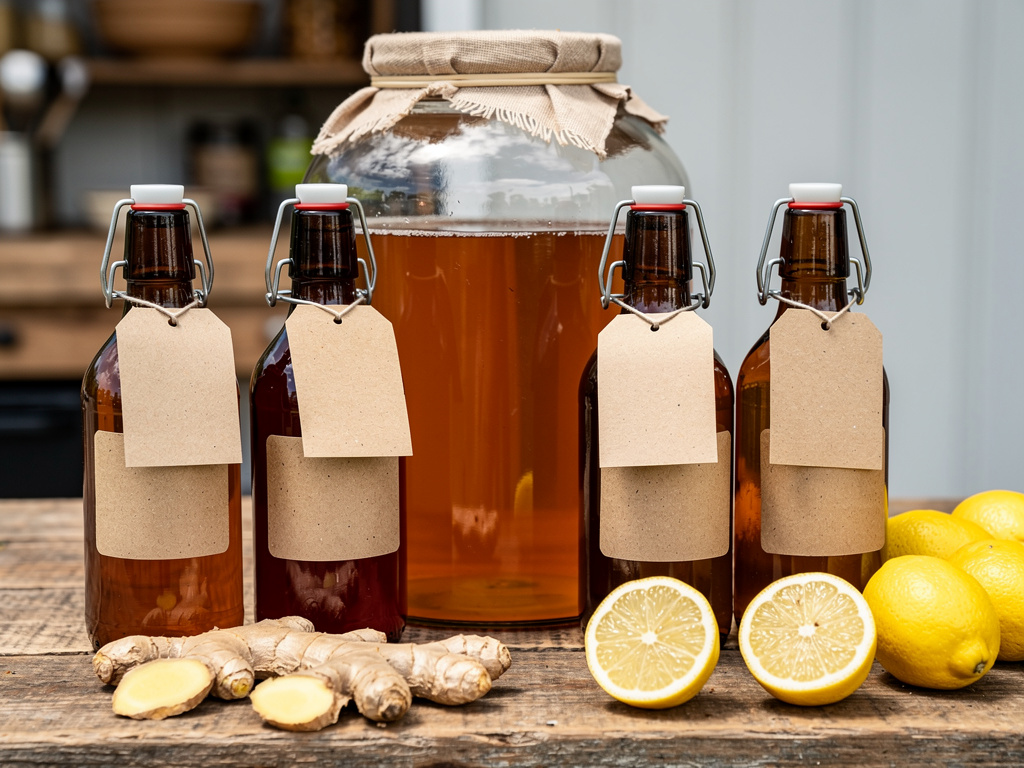


The short version: Sell a 16-ounce bottle of kombucha for $6 when the bottle comes back to you, with a $3 bottle deposit, or for $8 when the customer keeps the bottle. A new 16-ounce swing-top bottle costs $2.92 each in a 12-pack at Walmart.com, while the tea, sugar and flavoring inside it cost about 26 cents, so the bottle decides your price more than the brew does. Charge $12 to refill a 32-ounce growler and $18 for a 64-ounce one, which sits inside what local kombucha brewers charged for a filled or refilled growler on September 24, 2026. Before you set any price, check whether your state lets you sell kombucha at all, because in many states kombucha needs a licensed kitchen, and kombucha that reaches 0.5% alcohol is regulated as an alcohol beverage.
Checked September 24, 2026: kombucha prices on the websites of five brewers (BNF Kombucha, J's Kombucha, Idaho Kombucha, Fermensch Kombucha and Whalebird Kombucha), grocery kombucha and supply prices on Walmart.com, a shared kitchen's rate page, a live pull of Homegrown's catalog, and the pricing pages of Homegrown, Hotplate and Square for their platform and card processing fees. Honest bounds: store prices move weekly, and the yield and hours below are our estimates, not measurements. Homegrown customers create an account to place a first order, and Homegrown has no timed drop or countdown release feature.
A coworker tried your ginger-lemon kombucha and wants four bottles every week. Then her gym friend wants a growler. You need a price to text back, and kombucha is not like a loaf of bread: the drink inside the bottle costs pennies, and the bottle costs more than everything in it put together.
A price range on its own, even the $5 to $8 a bottle this guide tests below, hides the one decision that changes your profit the most, which is whether the bottle comes back. This guide builds the price from numbers checked the day it was written: what grocery stores and local brewers charge, what a gallon costs you, what the bottle costs, what a rented kitchen adds, and what card fees take.
Sell a 16-ounce bottle of kombucha for $6 plus a $3 refundable bottle deposit, or $8 in a bottle the customer keeps, and refill growlers at $12 for 32 ounces and $18 for 64 ounces. Those prices assume a flavored kombucha brewed in one-gallon batches, sold by pre-order or at a farmers market, and kept cold until pickup.
Here is the price ladder most part-time kombucha vendors can start from:
Scroll sideways to see every column.
| Kombucha | Size | Suggested price | Your cost | When it fits |
|---|---|---|---|---|
| Bottle, returnable | 16 ounces | $6 plus a $3 bottle deposit | $0.46 when the bottle comes back | Weekly regulars, pre-order pickup |
| Bottle the customer keeps | 16 ounces | $8 | $3.38 | Market walk-ups, gifts, first-time buyers |
| Growler refill | 32 ounces | $12 | $0.72 | Regulars who bring back your growler |
| Growler, first fill in your bottle | 32 ounces | $12 plus $8 for the bottle | $7.22 | A regular's first order |
| Growler refill | 64 ounces | $18 | $1.24 | Families, office fridges |
| Four-pack, returnable | 4 x 16 ounces | $24 plus $12 in deposits | $1.84 | Mixed flavors, weekly orders |
| Wholesale to a café | 16 ounces | $4, only if bottles come back | $0.46 | A shop that returns your empties |
The ladder is our recommendation. It is built from grocery prices on Walmart.com and five brewers' own websites, all loaded September 24, 2026, and from the cost build further down, which uses Walmart.com supply prices from the same day. Growler costs are two or four times the 16-ounce ingredient cost plus one label. The 32-ounce bottle is a 2-pack of amber Boston round bottles at $12.99, a sale price that day (regularly $14.99), which is why the bottle charge is $8 and not $7.
Three things back that ladder:
If you are still working out whether you can sell at all, how to keep your kombucha under the alcohol limit and which flavors sell, start with the companion guide on how to sell kombucha from home and stay legal. It covers the rules, the 0.5% alcohol line, equipment and flavors. For prices, use the numbers in this guide rather than its older pricing table: this guide works out the per-bottle math at prices checked September 24, 2026.
On September 24, 2026, a 16-ounce bottle of grocery kombucha cost $2.94 to $3.66 at Walmart.com, or 18 to 23 cents an ounce. That is the price your customer already knows, and every single 16-ounce grocery bottle we found on Walmart.com that day was under $4. The only 16-ounce kombucha we found there above that was sold by the case: 12-bottle cases of Health-Ade shipped to your door ran $97.11 to $100.05, or about $8.09 to $8.34 a bottle.
Swipe left to see the price per ounce.
| Grocery kombucha on Walmart.com | Size | Price | Per ounce |
|---|---|---|---|
| Health-Ade (Pink Lady Apple, Passion Fruit-Tangerine and others) | 16 oz bottle | $2.94 (Pink Lady Apple, Blueberry Pomegranate and Passion Fruit-Tangerine on Rollback, was $3.27) | 18.4 cents |
| KeVita Master Brew, Pineapple Peach | 15.2 oz bottle | $3.28 | 21.6 cents |
| GT's Synergy (Guava Goddess, Trilogy, Gingerade and others) | 16 oz bottle | $3.58 to $3.66 | 22.4 to 22.9 cents |
| GT's Synergy Mixed Pack | 6 x 16 oz bottles | $18.92 ($3.15 a bottle) | 19.7 cents |
| Humm Kombucha, Mango Passionfruit | 12 x 12 oz cans | $33.95 plus $5 shipping ($2.83 a can before shipping, $3.25 delivered) | 23.6 cents before shipping |
Prices from Walmart.com search results on September 24, 2026. Walmart prices change by store and by week, and the Health-Ade price was a Rollback. Per ounce is the price divided by the fluid ounces in the bottle or pack.
Those bottles are made by the millions, in cans and single-trip glass, and shipped by the pallet. Your kombucha cannot beat them on price, and it does not need to. What grocery prices tell you is where the floor is:
Small kombucha brewers charged $2.19 to $4 for a 12-ounce can and $10 to $18 for a 32-ounce growler on September 24, 2026. Those are the closest match to what you sell, because they are small, local and brewed in batches, and most of them sell growlers to regulars.
Scroll right for what each price works out to per ounce.
| Brewer | What they sell | Price | Per ounce |
|---|---|---|---|
| BNF Kombucha, Eugene, Oregon | 32 oz filled growler | $10 | 31.3 cents |
| BNF Kombucha, Eugene, Oregon | 64 oz filled growler | $18 | 28.1 cents |
| BNF Kombucha, Eugene, Oregon | 32 oz filled growler, infused kombucha | $18 | 56.3 cents |
| BNF Kombucha, Eugene, Oregon | 64 oz filled growler, infused kombucha | $34 | 53.1 cents |
| BNF Kombucha, Eugene, Oregon | Case of 12 x 16 oz bottles, 3-case minimum | $33 ($2.75 a bottle, with a 10-cent deposit) | 17.2 cents |
| J's Kombucha, Saint Paul, Minnesota | 64 oz growler refill | $16 (new growler $20) | 25 cents |
| J's Kombucha, Saint Paul, Minnesota | 12 x 12 oz cans | $39.99 ($3.33 a can) | 27.8 cents |
| Idaho Kombucha, Boise, Idaho | 12 x 12 oz cans | $48 ($4 a can) | 33.3 cents |
| Idaho Kombucha, Boise, Idaho | 32 oz growler with deposit | $16, with a $5 credit when the growler comes back | 50 cents with the deposit |
| Fermensch Kombucha, Huntington Beach, California | 32 oz growler | $15 | 46.9 cents |
| Whalebird Kombucha | 8 x 16 oz cans | $26.99 ($3.37 a can) | 21.1 cents |
| Whalebird Kombucha | 16 x 16 oz cans | $49.99 ($3.12 a can) | 19.5 cents |
| Whalebird Kombucha | 8 x 12 oz cans | $22.59 ($2.82 a can) | 23.5 cents |
| Whalebird Kombucha | 16 x 12 oz cans | $34.99 ($2.19 a can) | 18.2 cents |
We checked every price on the brewer's own website on September 24, 2026. BNF's growler prices carry a $100 minimum order for delivery. Idaho Kombucha credits $5 for each returned growler. Per ounce is the price divided by the fluid ounces.
BNF Kombucha's home delivery price list is a good model to study, because it shows a small brewer pricing three ways at once: bottles by the case, growlers and 5-gallon kegs. Its full 64-ounce growler, bought filled, costs $18, which is what we suggest for a refill alone.
What the brewer prices teach you:
At $6 for 16 ounces, your kombucha costs your customer 37.5 cents an ounce, which is above the grocery shelf and inside the range local brewers charge for growlers. Putting every price on a per-ounce basis is the fastest way to see where you fit.
Kombucha and local drink prices per ounce, September 24, 2026
Source: Walmart.com search results, the brewers' own websites and a live pull of the Homegrown catalog, all September 24, 2026. Juicy's Juices, a vendor on Homegrown, sells 16 ounces of juice for $10. The suggested bottle is this guide's $6 price for 16 ounces, deposit not included.
In a pull of the Homegrown catalog on September 24, 2026, none of the 2,637 products listed by 300 vendors mentioned kombucha in the name or description. The Beverages category held 40 products from 10 vendors. The bottled cold drinks with a size listed ran from a $4 two-ounce ginger and turmeric wellness shot (Immunity Artisan) and $5 for 8 ounces of juice to $10 for 16 ounces (Juicy's Juices), with a 12-ounce cold-pressed juice at $9 (Press It Juice Bar) and a 16-ounce bottled latte at $5 (Baked By Jenny). A kombucha listed on Homegrown today would have no other kombucha next to it.
Two takeaways from the chart:
A one-gallon batch of ginger-lemon kombucha costs about $1.82 in ingredients at Walmart.com prices on September 24, 2026, or about 26 cents for each of the seven 16-ounce bottles it fills. Tea and sugar are the cheap part. The flavoring costs more than both of them together.
The standard ratio, as The Kitchn and Cultures for Health both give it, is 1 cup of sugar, 8 bags of black tea and 2 cups of starter tea per gallon. The Kitchn ferments it for 7 to 10 days, and Cultures for Health allows 7 to 30 days, to taste. You keep 2 cups back as starter for the next batch, which leaves about 112 ounces, or seven 16-ounce bottles. That yield is our estimate, and yours will move a little with how much juice you add when you flavor it.
Scroll right for the cost in one gallon.
| Ingredient | Amount per gallon | Walmart.com price | Cost per gallon |
|---|---|---|---|
| Black tea (Lipton, 100 bags) | 8 bags | $4.52 | $0.36 |
| Granulated sugar (Great Value, 4 lb) | 1 cup, about 7 oz | $2.97 | $0.33 |
| Fresh ginger | 2 oz, our estimate | $3.97 a pound | $0.50 |
| Lemon juice (ReaLemon, 15 fl oz) | 4 fl oz, our estimate | $2.37 | $0.63 |
| Starter tea and SCOBY | 2 cups from your last batch | Already yours | $0.00 |
| Filtered water | About 14 cups | Tap or filter | About $0.00 |
| Total for one gallon | $1.82 | ||
| Per 16-ounce bottle (7 bottles) | $0.26 |
Supply prices from Walmart.com on September 24, 2026. Tea, sugar and starter amounts follow The Kitchn's ratio of 1 cup sugar, 8 tea bags and 2 cups starter tea per gallon. The ginger and lemon amounts are our estimate for a ginger-lemon flavor. Fruit purées and specialty teas cost more.
Now add what the drink goes into:
Use waterproof film labels, not paper. A cold bottle sweats the moment it leaves the cooler, and a paper label can wrinkle or peel before the customer gets home. The film labels cost 20 cents each against about 7 cents for paper, and that 13-cent difference is the cheapest thing you will ever do to look like a real brand.
A new 16-ounce swing-top bottle costs $2.92, which is about 11 times what the kombucha inside it costs you. With kombucha the container, not what goes in it, is the big cost, so your pricing has to start with the bottle.
Here is what the common bottle choices cost on Walmart.com on September 24, 2026:
Three ways vendors keep the bottle from eating the price:
Yes: charge a $3 deposit on every 16-ounce bottle and pay it back when the bottle comes home, because a returned bottle drops your cost from $3.38 to 46 cents. The deposit is set just above the $2.92 a new bottle costs you, so a bottle that never comes back is already paid for, within a cent if the deposit was paid by card.
Deposits are not strange to kombucha drinkers. BNF Kombucha builds a 10-cent deposit into the price of each bottle in its cases, and Idaho Kombucha gives a $5 credit toward the next order for each growler returned, both on their own sites on September 24, 2026. Your $3 deposit sits between BNF's 10 cents and Idaho Kombucha's $5, set just above the $2.92 your bottle costs.
Here is a deposit system that works for a part-time vendor:
Three details keep a deposit fair:
A deposit only works when you know who ordered what, week to week. If paid orders each week, with your flavors, sizes and pickup time on one page, sound easier than a notebook of texts, you can set up a Homegrown storefront for your weekly kombucha orders and keep the bottle list next to it.
A 5-gallon week that fills 35 bottles takes about 3 hours 35 minutes of your hands-on time by our estimate, spread across a 7 to 10 day fermentation. Most of that time is bottles: filling, washing and labeling them. The brewing itself is fast. The Kitchn puts bottling one finished gallon and starting the next batch at about 20 minutes.
Here is our estimate of a week with five one-gallon jars:
That adds up to 215 minutes, or about 3.6 hours. If you sell all 35 bottles at $6 and the bottles come back, you keep $185.15 after ingredients, labels and card fees, which is about $51.67 an hour over the full 215 minutes. At the same $6 with bottles that never come back, you keep $82.95, or about $23.15 an hour. Those numbers are before booth fees, kitchen rent, your equipment and ice for the cooler. A small bag of ice was $1.97 on Walmart.com when we checked supply prices, which is about 6 cents a bottle spread over 35 bottles.
The wait matters as much as the work. Every batch needs 7 to 10 days in the jar before you can flavor and bottle it, so you cannot brew to an order that came in yesterday. You brew next week's kombucha this week, which is why knowing next week's orders now is worth more to a kombucha vendor than to almost anyone else at the market.
At $6 a 16-ounce bottle keeps you $5.29 when the bottle comes back and $2.37 when it does not, after ingredients, the label and the card fee on a four-bottle order. The price you pick matters less than whether you get the bottle back.
Swipe to see what 35 bottles pay per hour.
| Price of a 16-oz bottle | Card fee per bottle (4-bottle order) | You keep, bottle returned | You keep, bottle kept by customer | 35 bottles, returned | 35 bottles, kept | Per hour, returned (215 min) | Per hour, kept (215 min) |
|---|---|---|---|---|---|---|---|
| $5 | $0.22 | $4.32 | $1.40 | $151.20 | $49.00 | $42.20 | $13.67 |
| $6 | $0.25 | $5.29 | $2.37 | $185.15 | $82.95 | $51.67 | $23.15 |
| $7 | $0.28 | $6.26 | $3.34 | $219.10 | $116.90 | $61.14 | $32.62 |
| $8 | $0.31 | $7.23 | $4.31 | $253.05 | $150.85 | $70.62 | $42.10 |
Card fee is Homegrown's 2.9% + $0.30 per order, checked on findhomegrown.com/signup on September 24, 2026, split across a four-bottle order. Returned-bottle cost is 46 cents (ingredients and label). Kept-bottle cost is $3.38 (ingredients, a $2.92 swing-top and a label). The 215 minutes (about 3.6 hours) is our estimate of a 35-bottle week, and each per-hour figure divides by exactly 215 minutes. Booth fees, kitchen rent, equipment, ice for the cooler and deposits are not included.
A card payment on a single $6 bottle costs 47 cents at 2.9% + $0.30, which is 7.9% of the sale. On a four-bottle order of $24 the fee is $1.00, or 4.2%. The fixed 30 cents is what hurts a one-bottle sale, so steer regulars toward a weekly four-pack or a growler instead of single bottles.
What the table tells you:
Charge $12 to refill a 32-ounce growler and $18 to refill a 64-ounce growler, plus $8 for a 32-ounce bottle or $14 for a 64-ounce bottle when a customer needs one. Those prices put the 32-ounce at the same 37.5 cents an ounce as a $6 bottle, and make the 64-ounce a better deal for your best customers.
Scroll sideways for what each refill keeps you.
| Growler | Refill price | Card fee (2.9% + $0.30) | Your cost (ingredients + label) | You keep per refill | Per ounce to the customer |
|---|---|---|---|---|---|
| 32 oz | $10 | $0.59 | $0.72 | $8.69 | 31.3 cents |
| 32 oz | $12 | $0.65 | $0.72 | $10.63 | 37.5 cents |
| 32 oz | $14 | $0.71 | $0.72 | $12.57 | 43.8 cents |
| 64 oz | $16 | $0.76 | $1.24 | $14.00 | 25 cents |
| 64 oz | $18 | $0.82 | $1.24 | $15.94 | 28.1 cents |
| 64 oz | $20 | $0.88 | $1.24 | $17.88 | 31.3 cents |
Card fee on one refill per order, at Homegrown's 2.9% + $0.30 checked September 24, 2026. Ingredients are 52 cents for 32 ounces and $1.04 for 64 ounces (twice and four times the 26-cent 16-ounce cost), plus a 20-cent label. Brewer prices for comparison: J's Kombucha refills 64 ounces for $16. BNF Kombucha's filled growlers are $10 for 32 ounces and $18 for 64 ounces ($18 and $34 for its infused kombucha), and Fermensch's 32-ounce growler, glass included, is $15. Your $12 refill plus $8 for the bottle, or $20 for a first fill, is above every filled 32-ounce growler we found ($10 to $18), so tell a new customer the $8 is a one-time cost for a bottle they keep. After that, the $12 refill sits inside the brewers' range.
A few growler rules that save headaches:
If you brew in a rented licensed kitchen, rent can add about $2.32 to each bottle in a 35-bottle week, using $25 an hour for two hours plus a $60-a-month cold storage shelf and a $75-a-month dry storage rack for the fermenting jars. In many states that kitchen is not optional for kombucha, so the rent belongs in your price from day one. Bottled cold brew has to stay cold too, and our cold brew pricing guide works the same $25 hourly rate out to about $2.67 on every 16-ounce bottle, because the overnight steep usually means two kitchen visits per batch.
CBG Shared Kitchen in Houston listed hourly rates of $18 to $25, an hourly plan at $25 an hour and, under its monthly-plan storage rates, a cold storage shelf at $60 a month and a dry storage metro rack with 4 shelves at $75 a month on its website on September 24, 2026. Five one-gallon jars sit for 7 to 10 days, so they need that rack, and the finished bottles need the cold shelf. We used the $25 rate, assumed you could add the shelf and the rack, and assumed two hours a week in the kitchen, for brewing and bottling, with the washing and paperwork done elsewhere. That is $50 a week plus the $60 shelf and the $75 rack spread over 4.33 weeks, or $81.18 a week.
Swipe left to see the week after rent.
| Price of a 16-oz bottle | 35 bottles before rent, returned | After $81.18 rent, returned | Per hour, returned | 35 bottles before rent, kept | After $81.18 rent, kept | Per hour, kept |
|---|---|---|---|---|---|---|
| $6 | $185.15 | $103.97 | $29.01 | $82.95 | $1.77 | $0.49 |
| $7 | $219.10 | $137.92 | $38.49 | $116.90 | $35.72 | $9.97 |
| $8 | $253.05 | $171.87 | $47.96 | $150.85 | $69.67 | $19.44 |
Rent is our assumption: 2 hours a week at the $25 hourly plan rate plus a $60-a-month cold storage shelf and a $75-a-month dry storage rack, both divided by 4.33 weeks, from CBG Shared Kitchen's page on September 24, 2026. CBG lists the shelf and the rack under its monthly-plan storage rates, so pairing them with the hourly plan is also our assumption. Per hour uses our 215-minute week. The $75 rack is where your jars sit for the 7 to 10 days they ferment.
The rented-kitchen week is where one-way bottles stop working. At $6 in bottles that never come back, the whole week pays $1.77. The same week with returned bottles pays $103.97.
Ask any kitchen you tour where your jars will sit for 7 to 10 days. Fermenting takes shelf space for a week or more, and some kitchens charge for it separately. The guide on how to find and rent a commissary kitchen walks through what to ask before you sign.
You can, but only at about $4 a 16-ounce bottle and only if the café returns your empty bottles, because in one-way glass a $4 wholesale bottle keeps you just 62 cents. Wholesale works best for brewers who put their kombucha in cans or sell it by the keg.
What these brewers charge for cases and kegs, from their own websites on September 24, 2026:
Here is what a café price does to your bottle:
Scroll right to compare returned and kept bottles.
| Wholesale price per 16-oz bottle | You keep, bottle returned ($0.46 cost) | You keep, bottle kept ($3.38 cost) | Café's markup at a $6 shelf price |
|---|---|---|---|
| $3.00 | $2.54 | You lose $0.38 | 100% |
| $3.50 | $3.04 | $0.12 | 71% |
| $4.00 | $3.54 | $0.62 | 50% |
Costs from this guide's build with Walmart.com prices on September 24, 2026. Wholesale orders are assumed to be paid by check or bank transfer, with no card fee. Markup is the café's $6 price minus what it paid you, divided by what it paid you.
What that means for a small brewer:
The general wholesale math, including the percentage shops expect to keep, is in how to set wholesale prices for your food products.
Brew each week's kombucha to paid pre-orders, because a batch has to start 8 to 13 days before you sell it (7 to 10 in the jar and 1 to 3 in the bottle to carbonate) and you cannot guess demand that far ahead. Kombucha that sits too long turns sour, and every extra bottle you fill ties up a $2.92 bottle that is not earning a deposit. Seven unsold bottles throw away about $3.22 of kombucha and labels, and tie up $20.44 of new glass for another week, before you count your time.
Pre-orders fix the timing problem, as long as you open orders about two weeks ahead: take orders now for pickup the week after next. When customers order and pay before you start the jars, you know how many gallons of ginger-lemon and how many of berry to brew, and every bottle you fill already has a name on it. The step-by-step setup is in how to take pre-orders for your food business.
That is the problem a Homegrown storefront is built for. It is $10 per month billed annually (or $12.50 billed monthly) with no percentage fees beyond standard payment processing (2.9% + $0.30 per order, paid by you), and it gives you one link where regulars pick a flavor, choose a 16-ounce bottle or a growler, pay, and see when to pick up. Before you start next week's jars, you open your orders and see exactly how many bottles of each flavor are already paid for.
How that compares to what kombucha vendors usually use:
What a Homegrown storefront does for a kombucha vendor:
What it does not do: it will not keep your kombucha cold between your fridge and the customer, it does not track which customer still has your bottles, it does not tell you whether your state allows kombucha, it has no timed drop or countdown release, and customers create a Homegrown account to place their first order. Your storefront is listed on the marketplace, but plan on most orders coming from people you send to your own link. If knowing next week's bottle count before you start the jars sounds better than guessing, you can set up your storefront and post next week's kombucha flavors in an evening.
Card fees take 77 cents to $1.09 from a $24 four-bottle kombucha order, depending on how the customer pays, and on one pre-order app the customer pays another $1.75 on top. Across 30 orders a month, that is $23 to $33 in fees, and it decides whether your customer sees a surprise fee at checkout.
Swipe to see the remaining columns.
| How you take the order | Subscription | Trial | Platform fee | Card processing | Customer pays on a $24 order | You pay on a $24 order | You pay on 30 orders in a month | Customer pays on a $20 order | You pay on a $20 order | You pay on 50 orders of $20 in a month |
|---|---|---|---|---|---|---|---|---|---|---|
| Homegrown storefront | $10/mo billed annually, or $12.50/mo billed monthly | 7 days, no charge until day 8 | $0 (0% commission) | 2.9% + $0.30, paid by you | $24.00 | $1.00 | $30.00 + $10 subscription = $40.00 | $20.00 | $0.88 | $44.00 + $10 subscription = $54.00 |
| Hotplate, default | $0 (no plan fee listed) | None needed, no plan to pay for | 5% + $0.55, paid by the customer ($1.75) | 2.9% + $0.30, paid by you | $25.75 | $1.00 | $30.00 (your customers pay another $52.50) | $21.55 | $0.88 | $44.00 (your customers pay another $77.50) |
| Hotplate, you cover the fee | $0 (no plan fee listed) | None needed, no plan to pay for | 5% + $0.55, paid by you ($1.75) | 2.9% + $0.30, paid by you | $24.00 | $2.75 | $82.50 | $20.00 | $2.43 | $121.50 |
| Square Free plan, online order | $0 | None needed, free plan | $0 | 3.3% + 30¢, paid by you | $24.00 | $1.09 | $32.70 | $20.00 | $0.96 | $48.00 |
| Square Free plan, card tapped at the market | $0 | None needed, free plan | $0 | 2.6% + 15¢, paid by you | $24.00 | $0.77 | $23.10 | $20.00 | $0.67 | $33.50 |
| Cash at pickup | $0 | n/a | $0 | $0 | $24.00 | $0.00 | $0 (no-show risk is yours) | $20.00 | $0.00 | $0 (no-show risk is yours) |
We checked these on each company's pricing page on September 24, 2026: findhomegrown.com/signup, hotplate.com/pricing and Square's fee page for the Free plan. Card processing is figured on the $24 order, four 16-ounce bottles at $6, and rounded to the cent before multiplying by 30. The last three columns repeat the math on a $20 order and 50 orders a month, the basket every Homegrown pricing guide uses, so you can compare this table with the others. Hotplate's own pricing example shows $1.27 in processing on a $30.00 subtotal with a $3.00 tip, which fits its 2.9% + $0.30 being charged on the subtotal plus the tip. These orders have no tip, so the Hotplate rows use 2.9% + $0.30 of the order. Deposits, tips, taxes and delivery are left out.
Three things matter more than the pennies:
In many states you cannot sell kombucha made in a home kitchen under cottage food rules, and in every state kombucha that reaches 0.5% alcohol is regulated as an alcohol beverage. That matters for price, because a kombucha you cannot brew at home usually has to be made in a licensed kitchen under a food business license from your state or county, and paying for kitchen time changes every number above.
Two rules show how tight it is:
What to check before you set a price:
The broader rules for fermented foods, including why kombucha is harder to sell than kraut or kimchi, are in how to sell fermented foods from home. Rules change and vary by state and county, so verify your state's current rules before you sell your first bottle.
Kombucha that tests under 0.5% alcohol when you bottle it can climb over the line if it sits warm. The federal rule counts any time after bottling, not just the day you filled it. Keep every bottle cold from your fridge to the customer, and tell customers on the label to keep it refrigerated.
The costliest kombucha pricing mistake is pricing the drink and forgetting the bottle, which makes a $6 bottle pay $2.37 instead of $5.29. The rest of the list is smaller, but each one shows up every single week.
Count your bottles on the first of every month. If you bought 48 bottles and only 30 are in your kitchen or on your bottle list, 18 bottles, or $52.56 of glass, walked away. That count tells you whether your deposit is high enough faster than any spreadsheet.
Charge $6 for a 16-ounce bottle of kombucha when the customer returns the bottle, with a $3 deposit, or $8 when the customer keeps it. A 16-ounce bottle costs about $3.38 to fill in a new swing-top at Walmart.com prices checked September 24, 2026, and only 46 cents when the bottle comes back. A single 16-ounce grocery bottle ran $2.94 to $3.66 at Walmart.com the same day, so do not try to match it.
A one-gallon batch of ginger-lemon kombucha costs about $1.82 in tea, sugar, ginger and lemon juice at Walmart.com prices checked September 24, 2026. That fills about seven 16-ounce bottles, or 26 cents of kombucha per bottle. The bottle itself costs $2.92 new, so packaging is the real cost of making kombucha to sell.
Sell a 32-ounce growler refill for $12 and a 64-ounce refill for $18, and charge $8 for a 32-ounce bottle or $14 for a 64-ounce bottle the first time. Small brewers charged $10 to $18 for a filled 32-ounce growler, and from $16 (J's Kombucha's refill) to $34 (BNF's infused kombucha) for 64 ounces, on their own sites on September 24, 2026. A refill in a returned growler costs you 72 cents for 32 ounces and $1.24 for 64 ounces.
Yes. A $3 deposit per 16-ounce bottle, paid back when the bottle returns, covers the $2.92 cost of a new swing-top if it never comes back. Brewers use deposits too: BNF Kombucha includes a 10-cent deposit in each bottle's price and Idaho Kombucha credits $5 toward the next order per returned growler. With bottles coming back, a $6 bottle keeps you $5.29 instead of $2.37.
Whalebird Kombucha sold a wholesale case of 36 16-ounce cans for $105, or $2.92 a can, on September 24, 2026, against $3.12 to $3.37 a can in its 16-packs and 8-packs for regular customers. A small brewer in glass should ask about $4 per 16-ounce bottle, which still leaves a café a 50% markup at a $6 shelf price. For a home-scale brewer, wholesale only pays when the café returns the empty bottles.
Selling kombucha can be profitable when bottles come back: 35 bottles at $6 keep about $185 a week before rent, or about $52 an hour by our estimate of a 215-minute week. If the bottles leave for good, the same week keeps about $83. If you need a rented kitchen, rent of about $81 a week comes off either number.
These six guides cover the rules, the market, the culture and the pricing math for other drinks:
No vendor on Homegrown listed kombucha in our September 24, 2026 catalog pull, so a weekly ginger-lemon menu would be the only one there. If a paid pre-order page for next week's bottles and growlers sounds easier than a week of texts, you can start your Homegrown storefront and post your flavors tonight.



