
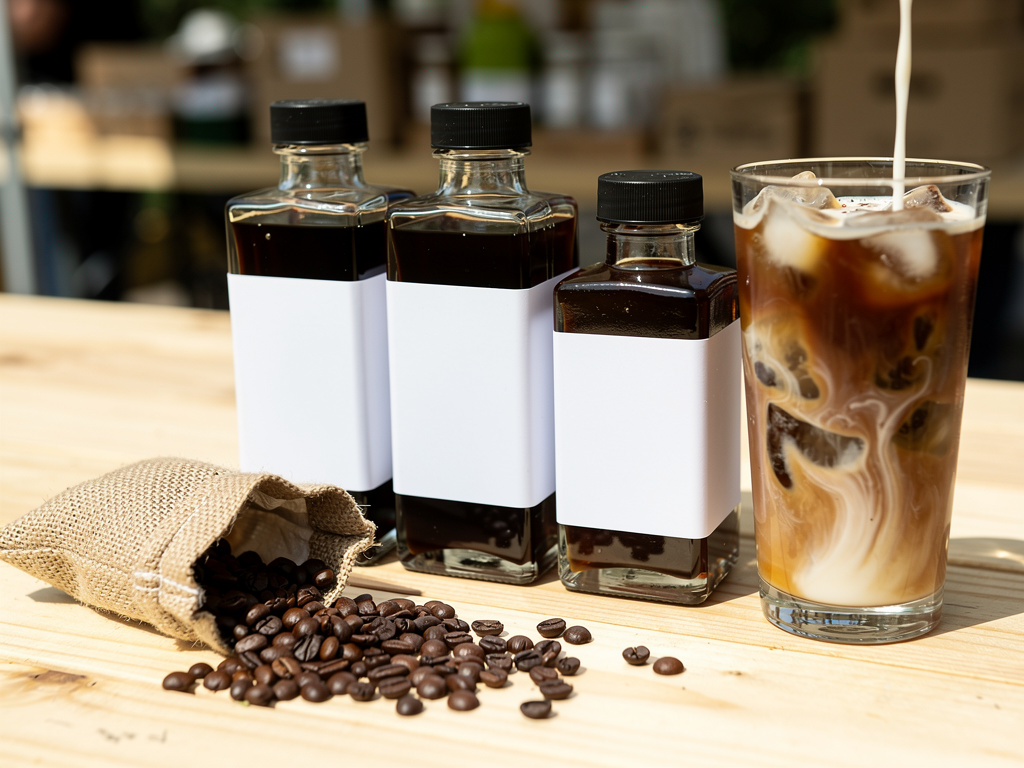


The short version: Charge $15 for a 16-ounce bottle of cold brew concentrate brewed from specialty beans, or $12 if you brew it from grocery-store coffee. Those prices sit on a full cost of $8.19 and $5.39 a bottle, counting the beans, a bottle with a tamper-evident lid, a label and two hours of your time per 5-pound batch at $20 an hour. The number that catches people out is yield: 12 ounces of coffee and 64 ounces of water make only about 45 ounces of concentrate, because the wet grounds hold on to the rest. For the other sizes, charge $9 for 8 ounces and $26 for 32 ounces with specialty beans, $7 and $20 with grocery beans, and about $5 for a poured cup at a market.
Checked September 26, 2026: Counter Culture Coffee's bulk coffee page listed 5-pound bags at $99 to $103, the Bureau of Labor Statistics (BLS) put the average U.S. price of ground coffee at $9.30 a pound for August 2026, WebstaurantStore sold 16-ounce PET juice bottles with lids at $0.68 each, and Toddy's printed brewing guide gives the 45-ounce yield. Homegrown's numbers come from findhomegrown.com/signup the same day: $10 a month billed annually or $12.50 billed monthly, no commission, and 2.9% + $0.30 card processing paid by you. Every price here assumes you are allowed to sell a refrigerated coffee drink where you live, so check your state before the first batch. Customers create a Homegrown account to place a first order, and there is no timed-release or drops feature.
You brewed five pounds of coffee on Thursday night, strained it Friday morning, and now eighteen clear bottles are lined up in the fridge with nothing written in the price box. Grady's, a New York cold brew brand, sells a 32-ounce bottle of concentrate for about $11.66 when you buy a case of six. Upstate's Cold Brew, a small-batch brewer in New York, asks $19.99 for 16 ounces. You are somewhere in the middle and you are not sure where.
The cold brew pricing advice that shows up in search is written for cafes pricing a cup, or for people brewing at home to save money. This guide does the arithmetic for somebody in between: brewing a few gallons a week and selling bottles to neighbors, a market crowd and a text list. It includes the three lines almost nobody writes down, which are the concentrate the grounds keep, your own hours, and the kitchen rent when your state sends you to one.
Charge $15 for a 16-ounce bottle of cold brew concentrate made from specialty beans, and $12 if you brew from grocery-store coffee. At those prices you keep $6.61 to $6.81 a bottle after paying for beans, packaging and your own time. If you have a waiting list, a named single-origin brew, or regulars who text you on Thursday asking whether this week's batch is ready, $16 to $18 is worth testing, starting at $16 and moving to $17. Upstate's $19.99 for 16 ounces, covered in the comparison section below, shows buyers already pay that range for a local, named brew.
Here is the whole price sheet in one place. The rest of this guide shows where each number comes from.
If you are still working out whether you can sell cold brew at all, how to brew it safely, and where to find buyers, start with our guide to selling cold brew concentrate from home. It covers the rules, the brewing and the selling. This page covers the price.
One pattern to notice before you go on: these prices land at 1.6 to 2.5 times full cost, and 2.2 to 3.9 times the cost of materials alone. The bigger the bottle and the better the beans, the lower the multiple, because coffee is most of what a bottle costs you.
A pound of coffee makes about 60 ounces of cold brew concentrate, not the roughly 85 ounces of water you pour over it at Toddy's 1 to 5.33 ratio of coffee to water. Toddy, a company that makes countertop cold brew systems, says in its printed brewing guide that 12 ounces of coarse-ground coffee and 8 cups (64 fluid ounces) of water "should yield approximately 45 fluid ounces" of concentrate. The other 19 ounces stay soaked in the grounds you throw away.
That gives you the one conversion this whole guide is built on:
Toddy's guide also says to start serving at 1 part concentrate to 2 parts water or milk, and that the concentrate "will stay fresh for up to 2 weeks" in the refrigerator. Both matter for price. The first tells your customer how many drinks a bottle makes. The second tells you how much you can brew before the unsold bottles become a cost.
The easiest cold brew pricing mistake to make is costing the concentrate off the water you poured in. If you assume 64 ounces of water makes 64 ounces to sell, a 16-ounce bottle of specialty cold brew looks like it holds $3.71 of coffee. The real figure is $5.28. That $1.57 gap on every bottle adds up to about $28 on an 18-bottle batch, and every markup you build on top of the wrong number inherits it.
Your own yield will move a little with grind size, how long you let the grounds drain, and whether you press them. Weigh the concentrate you actually bottle from your first three batches and use your number in place of 3.75.
A 16-ounce bottle of cold brew concentrate costs $8.19 to make with specialty beans and $5.39 with grocery-store coffee. Four things go into that number: coffee, the bottle, the label and your time. Coffee is the biggest line either way.
Scroll sideways to see every column.
| Line item | 8 oz | 16 oz | 32 oz | Where the number comes from |
|---|---|---|---|---|
| Specialty coffee at $0.33 per fluid ounce | $2.64 | $5.28 | $10.56 | Counter Culture 5-pound bag at $99, 3.75 ounces of concentrate per ounce of coffee |
| Grocery coffee at $0.155 per fluid ounce | $1.24 | $2.48 | $4.96 | BLS average ground coffee, August 2026, $9.30 a pound |
| Square PET bottle with tamper-evident lid | $0.45 | $0.68 | $1.08 | WebstaurantStore case prices divided by case count |
| Label | $0.10 | $0.10 | $0.10 | Estimate, printed at home |
| Your time at $0.133 per fluid ounce | $1.07 | $2.13 | $4.27 | 2 hours at $20 an hour for a 300-ounce batch |
| Full cost, specialty beans | $4.26 | $8.19 | $16.01 | |
| Full cost, grocery beans | $2.86 | $5.39 | $10.41 | |
| Materials only, specialty (no time) | $3.19 | $6.06 | $11.74 | The number a markup multiplies |
| Materials only, grocery (no time) | $1.79 | $3.26 | $6.14 |
We checked these prices on September 26, 2026. Bottles: the 8-ounce case was $142.99 for 320, the 16-ounce case $108.99 for 160, and the 32-ounce case $112.49 for 104, all on WebstaurantStore with lids included. Coffee: Counter Culture Coffee's Bulk Coffee page and the BLS average price for ground coffee. The label and your two hours are the estimates in this table; everything else is a price we checked. Water is left out because a batch uses about 3 1/3 gallons of tap water, a few cents at most.
Look at the shape of it rather than the totals. With specialty beans, coffee is 64 percent of the bottle and your time is 26 percent. The bottle and label people fuss over are 10 percent between them.
What this full cost leaves out, on purpose, because it depends on your setup: the brewing equipment and fridge space you already own, your market booth fee, any permit or registration fee, insurance, and delivery. Divide each of those by the bottles you sell in a month and add it to the table before you settle on a price.
What is inside a 16-ounce bottle that costs $8.19
Source: Counter Culture Coffee bulk price and WebstaurantStore bottle price, both read September 26, 2026; yield from Toddy's brewing guide; 2 hours per 5-pound batch at $20 an hour. Bar widths are each line divided by the largest.
Ground coffee averaged $9.30 a pound in U.S. stores in August 2026, according to the BLS average price series for 100 percent ground roast coffee. That is up from $8.87 in August 2025, a rise of about 4.8 percent in a year, and a little below the $9.72 it averaged in April 2026. It is the grocery-shelf number, all brands and sizes averaged together. It is also a price for coffee sold already ground, and Toddy's guide says cold brew needs a coarse grind so the filter does not clog, so treat the grocery tier as a floor: whole beans you grind coarse yourself can cost more.
Specialty coffee bought in bulk costs about twice that. Counter Culture Coffee, a roaster that sells 5-pound bags on its website, listed its Bulk Coffee blends at $99 to $103 for 5 pounds on September 26, 2026, which is $19.80 to $20.60 a pound. The same blends in 24-ounce bags were $36.50 to $38.50, or $24.33 to $25.67 a pound. Buying the 5-pound bag saves about $4.50 to $5 a pound, and one 5-pound bag is exactly one batch at the scale this guide assumes.
Here is what the bean price does to one 16-ounce bottle, using the 0.267 rule from above:
Every $1 a pound you save on beans takes about 27 cents off each bottle. Every $1 a pound you add takes 27 cents off your profit unless you move your price. That is why the guide gives two price sheets, one for each bean tier, instead of one number.
Ask the roaster nearest you for a wholesale price on 5 or 10 pounds a week, and offer to name them on your label. A wholesale price of, say, $15 a pound instead of $19.80 takes about $1.28 off the coffee in every 16-ounce bottle, which is $23 on an 18-bottle batch.
Sell an 8-ounce bottle for $9, a 16-ounce bottle for $15 and a 32-ounce bottle for $26 if you brew from specialty beans. With grocery-store coffee, charge $7, $12 and $20. Every one of those prices covers the full cost with your time counted and leaves at least $4 a bottle on top.
Swipe left for the price per ounce and what each bottle leaves you.
| Size and beans | Full cost | Price | Price per fluid ounce | Left after full cost | Price divided by materials |
|---|---|---|---|---|---|
| 8 oz, specialty | $4.26 | $9 | $1.13 | $4.74 | 2.8x |
| 16 oz, specialty | $8.19 | $15 | $0.94 | $6.81 | 2.5x |
| 32 oz, specialty | $16.01 | $26 | $0.81 | $9.99 | 2.2x |
| 8 oz, grocery | $2.86 | $7 | $0.88 | $4.14 | 3.9x |
| 16 oz, grocery | $5.39 | $12 | $0.75 | $6.61 | 3.7x |
| 32 oz, grocery | $10.41 | $20 | $0.63 | $9.59 | 3.3x |
Full cost is coffee, bottle and lid, label, and two hours per batch valued at $20 an hour, from the cost table above, with prices checked on September 26, 2026. "Left after full cost" is before card processing, which takes about 74 cents off a $15 bottle.
The price per ounce drops as the bottle gets bigger, so the big bottle is the better deal for your customer. That is on purpose: the 32-ounce bottle is the one your regulars buy, and a regular who buys every week is worth more than the extra dollar.
You may have read that food should sell for three times its materials. On a 16-ounce specialty bottle that rule says $18.18, and on a 32-ounce bottle $35.22. The 16-ounce figure is close to what one small-batch brand charges, as the comparison section below shows, so it is a fair ceiling once you have regulars. The 32-ounce figure is the one to distrust. The 3x rule comes from baked goods, where flour and sugar are cheap next to the labor, and coffee is the opposite: the beans are most of what the bottle costs you.
Count your time at $15 to $25 an hour, which adds $1.60 to $2.67 to every 16-ounce bottle. This guide uses $20 an hour, the middle of the range in our guide to pricing food for a farmers market, and 2 hours of hands-on work per 5-pound batch. That is $40 spread across 300 ounces of concentrate, or $2.13 a bottle.
The two hours is our estimate for one batch of 18 bottles, and it breaks down like this:
Cold brew is kind to your hours. The steep does the work overnight, so the only hands-on time is the grinding, the filtering, the bottling and the washing.
Time your first three batches with your phone, start to finish, and write the minutes on the lid of the brewing vessel. If your real number is 3 hours for 18 bottles instead of 2, your time cost is $3.20 a bottle instead of $2.13, and a $12 grocery-bean bottle is still fine while a $15 specialty bottle drops to $5.74 left over.
Your time is about a quarter of a specialty bottle's cost and about 40 percent of a grocery bottle's, and the steep does most of the work overnight. At $15, a 16-ounce specialty bottle leaves $8.94 after materials. Across the 18 bottles in a batch that is about $161, or roughly $80 for each of the 2 hours, before card fees and before the bottles that do not sell. The beans, not your hours, are what make cold brew expensive to produce.
A rented commercial kitchen adds about $2.67 to every 16-ounce bottle, based on 2 booked hours at $25 an hour for each 5-pound batch. CBG Shared Kitchen in Houston, a shared kitchen that rents by the hour, listed hourly rates of $18 to $25 and an hourly plan at $25 an hour on its website on September 26, 2026. We used the $25 rate, and we use it only as a sample hourly price: Texas itself now lets you brew cold brew at home once you register, as the section on selling from home explains.
Cold brew has one quirk in a rented kitchen: the steep takes 8 to 24 hours. That usually means two visits, one to grind and start the brew and one to filter and bottle, with the brewing vessels sitting covered in the kitchen's refrigerator or walk-in overnight in between. Toddy's guide steeps at room temperature, but section 3-501.19 of the FDA Food Code 2022, covered in the rules section below, allows a food that has to be kept cold for safety at most 4 hours out of temperature control, and only with written procedures. So a licensed kitchen will likely have you steep at 41°F or below unless your inspector approves another plan. Toddy's 45-ounce yield comes from a room-temperature steep, so weigh your first cold-steeped batch and use your own yield in the cost math. CBG listed a cold storage shelf at $60 a month under its monthly plan storage rates. If you brew weekly, check whether your kitchen charges for overnight storage and add it.
Swipe to see the rent added to each size.
| Size and beans | Full cost at home | Kitchen rent per bottle | Full cost with kitchen | Price | Left after full cost |
|---|---|---|---|---|---|
| 8 oz, specialty | $4.26 | $1.33 | $5.59 | $9 | $3.41 |
| 16 oz, specialty | $8.19 | $2.67 | $10.86 | $15 | $4.14 |
| 32 oz, specialty | $16.01 | $5.33 | $21.34 | $26 | $4.66 |
| 16 oz, grocery | $5.39 | $2.67 | $8.06 | $12 | $3.94 |
Rent is our assumption: 2 booked hours per 300-ounce batch at the $25 hourly plan rate CBG Shared Kitchen listed on September 26, 2026, or about $0.167 per ounce. Storage fees are not included. Your kitchen's rates will differ, so put your own hourly rate and booked hours in place of ours.
Two things stand out. First, rent works out to the same amount per ounce, while your price per ounce falls as bottles get bigger, so the kitchen hits the 32-ounce bottle hardest: it takes 53 percent of what that bottle kept at home, against 28 percent on the 8-ounce. If you pay rent, raise the 32-ounce to $28 or $30 before you touch the smaller sizes. Second, $15 for a 16-ounce specialty bottle still works, but it becomes the floor, so price it at $16 to $18. Our guide to moving from cottage food to a commercial kitchen covers how to pick one and what the monthly plans look like.
Price a bottle of cold brew in seven steps: find your yield, price your beans per ounce of concentrate, add the bottle and label, add your time, add rent if you pay it, pick a price, and check it against the market. It takes about 15 minutes with a calculator the first time.
Do this once per bean and bottle size, write the answers on an index card, and redo it any time your coffee price moves by more than $1 a pound.
A $15 sixteen-ounce bottle works out to $0.94 a fluid ounce of concentrate, which sits between a national cold brew brand and a small-batch one, and about $2.50 per 8-ounce cup of finished coffee. That is the same as Upstate's price per drink, but Upstate's drink holds about 2 ounces of concentrate and your cup holds about 2.67. We checked two real brands on their own websites on September 26, 2026.
Swipe to compare all four bottles side by side.
| Cold brew | Size | Price | Per fluid ounce of concentrate | Per serving, as the brand defines it |
|---|---|---|---|---|
| Grady's Cold Brew, Original concentrate | 32 oz | $11.66 a bottle ($69.95 for a case of 6) | $0.36 | $1.46 per 8-ounce serving (8 per bottle) |
| Upstate's Cold Brew concentrate | 16 oz | $19.99 | $1.25 | $2.50 per drink (8 per bottle) |
| Your bottle, specialty beans | 16 oz | $15 | $0.94 | $2.50 per 8-ounce cup (6 per bottle at 1 to 2) |
| Your bottle, grocery beans | 16 oz | $12 | $0.75 | $2.00 per 8-ounce cup |
Grady's price and serving count come from its product page and store listing on September 26, 2026; the page says "Each 32 oz bottle makes eight 8 oz servings" and the bottles must be refrigerated. Upstate's page says each 16-ounce bottle "Makes 8 drinks" and to "Mix 1 part concentrate + 2 parts water or milk." Your servings use Toddy's 1 to 2 mix: 16 ounces of concentrate plus 32 ounces of water or milk makes 48 ounces, or six 8-ounce cups.
Grady's sells by the case, is made in New York City, and has bottled concentrate since 2011, so you will not beat it on price and should not try. It is also a New Orleans-style concentrate brewed with chicory and spices, which its product page lists as ingredients, so its $0.36 an ounce is not a straight coffee-for-coffee comparison with yours. Upstate's is closer to what you are: brewed weekly in small batches, with local pickup. It shows what a local, fresh, named product can hold, and at $19.99 it leaves you room above $15.
Notice that the servings are not the same size. Upstate's 8 drinks per 16 ounces means about 2 ounces of concentrate in each, while Grady's calls 4 ounces of concentrate plus water a serving. Put your own mix ratio and drink count on your label so customers compare cups, not bottles.
In a pull of the Homegrown catalog on September 26, 2026, none of the 2,714 products listed by 306 vendors was a cold brew coffee drink. We checked every product in the Beverages category and every listing in any category whose name or description mentioned cold brew, coffee, concentrate or iced coffee, then opened each matching vendor's other listings. The only listing named "Cold Brew Coffee" was a $15 scented product in Home Goods from a shop whose 12 listings are all $15 scent names. The closest drinks were two 16-ounce bottled lattes at $5 each from Baked By Jenny and a $6 Banana Bread Latte from Brewster's Porch. Coffee to brew at home was there: Flying Carabao Coffee listed 14 single-origin coffees at $15 for 8 ounces, which is $30 a pound. Brewed into concentrate at that price, a 16-ounce bottle would hold $8 of coffee, which is why buying beans in bulk matters so much to every number in this guide.
Whether you can sell cold brew from a home kitchen depends on your state, and the answer decides whether kitchen rent goes into your price. Cold brew is a low-acid drink that is almost all water. In the FDA Food Code 2022, the model food rules FDA publishes for state and local health departments, the table for foods that are not heat-treated (Table B) says anything with water activity above 0.92 and a pH of 4.2 or higher needs a product assessment and is treated as a time/temperature control for safety (TCS) food unless that assessment shows otherwise. In plain English, TCS means it has to be kept cold to stay safe.
Cold brew sits well above that 4.2 line. A 2018 study in Scientific Reports that measured the acidity of cold brew coffee found pH values of 4.96 to 5.13 across six coffees. That puts a bottle of cold brew on the keep-it-cold side of the Food Code's table, and Grady's own product page says "MUST BE REFRIGERATED before and after opening." Your state's cottage food law has to allow foods that need refrigeration before cold brew from your kitchen is legal to sell.
Texas is one state that now does. Since September 1, 2025, the Texas Department of State Health Services says a home cottage food operation may sell TCS foods, as long as it registers with the department.
The Texas DSHS cottage food page, read September 26, 2026, says a cottage food operation may now sell any food except meat, poultry, seafood, ice products, low-acid canned goods, cannabis products, and raw milk. Operations selling TCS foods must register with DSHS, keep them at 41°F or below, put the date made on the label, and add a safe handling statement in at least 12-point type on the label or on an invoice or receipt given with the food. Every cottage food operator must also complete an accredited food handler training course. TCS foods cannot be sold wholesale to cottage food vendors or donated, and the annual gross income limit is $150,000, which Senate Bill 541 has DSHS adjust for inflation each year. Online sales are allowed only when the customer buys online from you and you, an employee or someone in your household delivers the food in person, with all the label information posted on your website before you take payment.
What that means for your price:
The Texas page does not say whether a sealed, refrigerated bottle of cold brew counts as a "low-acid canned good," the one excluded category that could catch it. Ask DSHS before your first batch and keep the answer in writing. Everywhere else, verify your state's current rules with your state health or agriculture department; our state-by-state cottage food guide is the place to start.
Card processing takes about 74 cents off a $15 bottle on Homegrown or Hotplate, 74 cents on a standard card on Shopify and about 83 cents on a premium card, and about 80 cents on Square's free plan online. On a standard card, three of the four charge the same card fee, and the bigger difference is the monthly plan and who pays the service fee.
Scroll sideways for the full fee stack on each platform.
| Platform | Monthly plan | Trial period | Platform or service fee | Card processing | Customer pays for a $15 bottle | Vendor pays per bottle | Vendor pays for 50 bottles a month |
|---|---|---|---|---|---|---|---|
| Homegrown | $10 billed annually ($12.50 monthly) | 7 days | $0, 0% commission | 2.9% + $0.30, paid by the vendor | $15.00 | $0.74 | $46.75 ($36.75 processing + $10 plan) |
| Hotplate | $0, no subscription | No plan to trial | 5% + $0.55, paid by the customer | 2.9% + $0.30, paid by the vendor | $16.30 | $0.74 | $36.75 |
| Shopify Basic | $29 billed yearly ($39 monthly) | 3 days, then $1 a month for 3 months | 0% with Shopify Payments, 2% with another provider | 2.9% + 30¢ online, 3.5% + 30¢ on premium cards | $15.00 | $0.74 standard card, $0.83 premium card | $65.75 ($36.75 + $29 plan) on standard cards |
| Square Free, online | $0 per location | Plan is free | $0 | 3.3% + 30¢ online (2.6% + 15¢ in person) | $15.00 | $0.80 online, $0.54 in person | $39.75 online |
We checked every row on the platform's own pricing page on September 26, 2026: findhomegrown.com/signup, hotplate.com/pricing, shopify.com/pricing and squareup.com/us/en/pricing. Card processing is figured on the $15 price; a platform that charges it on the full total with fees and tax runs a few cents higher. Monthly totals use the unrounded per-bottle fees of 73.5 and 79.5 cents.
At 50 bottles a month, Hotplate costs you the least, $36.75, because your customer pays its 5% + $0.55 service fee on top. That $1.30 lands on your customer's total, so a $15 bottle reads as $16.30 at checkout. Square's free plan is next at $39.75 with nothing added for the customer, Homegrown is $46.75, and Shopify is the most expensive at $65.75 because of its $29 plan.
Cold brew is a weekly reorder product with thin room for fees, so the ordering page matters more than it does for a one-time purchase. Homegrown is $10 a month billed annually with no percentage fees beyond standard payment processing, which is 2.9% + $0.30 and comes out of your side, not your customer's. On a $15 bottle that is 74 cents, and the customer sees $15.00 at checkout.
Compare that with the two options cold brew vendors usually weigh. Hotplate has no monthly plan, but its 5% + $0.55 service fee shows up on your customer's total, so the same bottle reads $16.30. Square's free plan costs you about $7 a month less than Homegrown at 50 online orders, and if you only ever sell at your booth with a card reader, it is the cheaper choice. Shopify Basic works too, at $29 a month billed yearly for a full website you have to build.
What Homegrown does for a cold brew vendor specifically:
What Homegrown does not do: it will not make cold brew legal where your state says no, it does not handle cold-chain shipping, and there is no timed-release drops feature. Customers create a Homegrown account to place a first order. Your storefront is listed on the Homegrown marketplace, but plan on most orders coming from people you send to your own link. When your price sheet is ready, you can set up a storefront for your cold brew and put all three sizes on one page.
Charge about $5 for a 16-ounce cup of cold brew poured over ice at a market. A cup with 4 ounces of concentrate and 8 ounces of water costs you $2.12 with specialty beans or $1.42 with grocery coffee, including a clear cup and dome lid at $0.27 and your brewing time. That $5 matches what Baked By Jenny charges for a 16-ounce bottled latte on Homegrown.
Here is what goes into one cup:
A 5-pound batch makes 75 cups at 4 ounces each, against 18 sixteen-ounce bottles. At $5 a cup that is $375 of cups from one batch, against $270 of bottles at $15. Cups earn more per ounce of concentrate, and they cost you standing at a dispenser all morning.
Pouring drinks to order is a different activity from selling sealed bottles. Ask your county health department what it requires for serving drinks at an event before you bring a dispenser, because that answer is separate from whatever lets you bottle at home. If it comes with a permit fee, add it to your market-day costs.
Yes to a three-bottle price, and only offer bottle returns if you use glass and your health department is fine with refilling. A three-bottle listing of 16-ounce specialty bottles at $42 leaves you $17.43 after full cost, against $20.43 for three separate $15 sales. You give up $3 in exchange for one bigger order and one pickup instead of three.
It also saves you card fees. Three separate $15 orders on Homegrown cost $2.21 in processing, while one $42 order costs $1.52, because the 30-cent part is charged once instead of three times.
Glass bottles are the other option. WebstaurantStore listed a 16-ounce clear glass juice bottle at $0.75 each in a 12-pack, and it takes a 38 lug metal lid sold separately, which came to about $0.09 each in a case of 3,600. That is $0.84 against $0.68 for the plastic bottle with its lid. A few points before you switch:
Four of the six mistakes below carry a price you can put on a 16-ounce bottle: $1.57, $1.64, $2.67 and $2.80. The one people miss most easily is pricing from the water you poured instead of the concentrate you bottled, which undercharges a 16-ounce specialty bottle by about $1.57. Leaving out kitchen rent costs even more, $2.67 a bottle.
If the beans themselves are what you love, roasting and bagging whole coffee skips the refrigeration question entirely. Our guide on how much to sell roasted coffee for runs that math, including the weight coffee loses in the roaster.
Your cold brew price is right when you sell 80 to 90 percent of each batch within a week and nobody flinches at the number. If you sell out in a day, raise the price by $1. If a third of the batch is still in the fridge on day 10, cut the batch size before you cut the price.
Watch these signals for four weeks after you set a price:
Print "Makes 6 cups: mix 1 part concentrate with 2 parts water or milk" on every 16-ounce label. A $15 bottle reads as $2.50 a cup once the customer can see the math, which is a far easier number to say yes to than $15.
When the time comes to move a price, raise it by $1 on one size first and tell your regulars two weeks ahead. Our guide to raising prices without losing customers has a sample message you can adapt.
A 16-ounce bottle brewed from specialty beans should sell for $15, and one brewed from grocery-store coffee for $12. Those prices sit on costs of $8.19 and $5.39 per bottle, counting coffee, the bottle and lid, a label, and your hours at $20 each. If you rent a commercial kitchen, raise the 16-ounce bottle to $16 to $18.
Cold brew concentrate costs about $0.33 a fluid ounce in coffee when you buy specialty beans at $19.80 a pound, and about $0.155 with grocery coffee at the August 2026 average of $9.30 a pound. That assumes 12 ounces of coffee make about 45 ounces of concentrate, the yield Toddy's brewing guide gives. Add about $0.68 for a 16-ounce bottle with a lid and $0.10 for a label.
The prices in this guide leave 38 to 59 percent of the price after full cost, time included, and a good target for the 16-ounce bottle you sell most is 45 percent or more. The 32-ounce specialty bottle runs lowest, at 38 percent of $26, because it is priced as the better deal for regulars. A 16-ounce specialty bottle at $15 that costs $8.19 to make leaves $6.81, or 45 percent. A grocery-bean bottle at $12 leaves $6.61, or 55 percent. Unsold bottles and kitchen rent both come out of that margin, so track them.
A 16-ounce cup of cold brew poured over ice at a farmers market should cost about $5. With 4 ounces of specialty concentrate, a clear cup and dome lid, and your brewing time, the cup costs you about $2.12. Pouring drinks at an event is a separate question from bottling them, so ask your county health department what it requires before your first market day.
Toddy's brewing guide says cold brew concentrate stays fresh for up to 2 weeks in the refrigerator, and that shelf life is a pricing input. Every bottle you pour out is a cost the sold bottles must cover. Brewing 18 bottles and selling 15 cuts the profit per sold 16-ounce specialty bottle from $6.81 to $5.17, so size your batches to your orders.
Roasted coffee beans are easier to sell legally because they are shelf-stable, while cold brew is a refrigerated drink that your state's cottage food law has to specifically allow. Cold brew earns well per pound of coffee: a 5-pound bag becomes about 18 sixteen-ounce bottles worth $270 at $15 each. Beans need a roaster and your roasting hours, and cold brew needs a fridge, bottles and a state that allows it.
These guides answer the questions that come right before and right after setting a cold brew price, from whether you are allowed to sell it to what to charge for the drinks you might add next.
Your cold brew prices should live on one ordering page that your regulars can open on Wednesday, pick their size, pay, and choose a pickup time before you start Thursday's batch. That way you brew what is already sold, the two-week fridge clock stops being a guessing game, and the $8.19 you put into each bottle comes back before the grounds hit the compost.
A price sheet on a chalkboard only works while you are standing next to it. Between markets, the questions come by text: which sizes you have, whether this week's single origin is the same as last week's, and when they can pick up. A Homegrown storefront answers all three on one page for $10 a month billed annually, with 2.9% + $0.30 card processing and no commission on top. You can build your cold brew storefront here, list the 8, 16 and 32-ounce bottles at the prices in this guide, and send the link to the people who already buy from your booth.



