
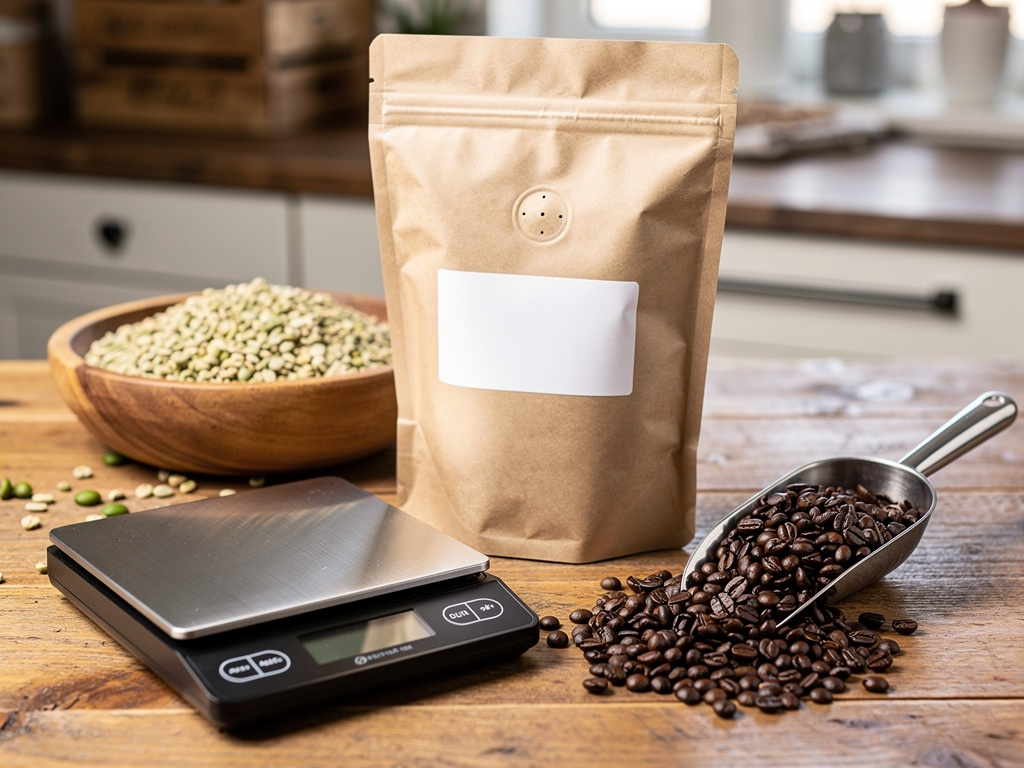


The short version: Price a 12-ounce bag of home-roasted coffee at $18, a 1-pound bag at $24, an 8-ounce bag at $14 and a 4-ounce sample at $8. A 12-ounce bag costs about $14.55 to make once you count green beans at $8.50 a pound, 16 percent roast loss, a $0.98 valve pouch, a label and three and a half hours of roasting time at $20 an hour. The number that trips people up is roast loss: one pound of green beans yields about 13.4 ounces of roasted coffee, so your real bean cost is $10.12 a roasted pound, not $8.50. Coffee is the rare food product where your materials are most of what the bag actually costs you, which is why the usual three-times-materials rule lands at $26 a bag and almost nobody gets it.
Checked September 22, 2026: green coffee that was actually in stock ran $7.75 to $10.25 a pound for most single-origin lots on Sweet Maria's green coffee listing page, and stand-up pouches with a one-way valve were $0.88 for the half-pound size and $0.98 for the pound size on the same site. Homegrown's own numbers come from findhomegrown.com/signup the same day: $10 a month billed annually or $12.50 billed monthly, no commission, card processing at 2.9% + $0.30 paid by you. Honest bounds on the prices below: they assume a countertop roaster turning out roughly 12 ounces a cycle. If you have a 1 kg drum your time per ounce drops by about 60 percent, which takes an all-in bag from $14.55 to about $11.03, though the $17.34 floor does not move because it is built on materials rather than hours. Customers create a Homegrown account to place a first order, and there is no timed-release or drops feature.
You roasted nine pounds on Saturday morning, the kitchen smells incredible, and now there are twelve kraft bags on the counter with nothing written in the price box. The grocery store sells a 12-ounce bag for $9. The craft roaster two towns over sells one for $19. You are somewhere in between and you have no idea where.
Most coffee pricing advice will hand you a margin percentage and move on. This guide does the arithmetic instead, in dollars, for somebody roasting on a countertop machine and selling nine to fifteen bags a week. It includes the two lines that almost every other coffee pricing guide leaves out: the weight that disappears in the roaster, and the cost of your own Saturday.
Charge $18 for a 12-ounce bag of single-origin coffee you roasted yourself. That covers a $14.55 cost if you buy green beans at $8.50 a pound, and leaves enough to make the Saturday worth getting up for. At the $9.40 median most in-stock lots actually sell for, the same bag costs $15.35 and this method says $19. If you have a following, a waiting list, or a roast people ask for by name, $20 to $22 holds without complaints.
Here is the whole price sheet in one place, and the rest of this guide shows where each number comes from.
If you are still working out whether you are allowed to sell roasted coffee in your state, what roaster to buy, or where to get green beans, start with our guide to selling roasted coffee from home. It answers the rules and the equipment. This page answers the price.
One thing to notice before you go further: every size above is priced between 2.0 and 2.3 times its materials cost, and just under 2.0 on the five-pound order, not the 3 times you may have read elsewhere. That is not us being generous. It is what happens when the raw material is most of the cost, and it is the single most useful thing on this page.
Because coffee loses roughly 14 to 18 percent of its weight in the roaster, mostly as water. Treat that band as this guide's working assumption rather than a published figure; the one average we can point at is 14.8 percent. You buy green beans by the pound and you sell roasted coffee by the bag, and the two weights are not the same. A 2020 UC Davis thesis on coffee postharvest mass loss puts the average roastery-phase loss at 14.8 percent of the green weight, a figure it compiled from roasting companies in Central America, Mexico and the United States, with dark roasts losing more than light ones. The bench work in that same thesis, twelve trials of Guatemalan coffee on a 1 kg Probatino at the UC Davis Coffee Center, measured the chaff that blows off during a roast rather than the total loss.
Work it at 16 percent, in the middle of that band, and the arithmetic goes like this.
That $1.62 gap between $8.50 and $10.12 is 19 percent of what you thought your beans cost. On a 12-ounce bag it is $1.21 you would have given away, and on 600 bags a year it is $726.
The most common coffee pricing mistake is costing a bag straight off the green price per pound. If you buy green at $8.50 and figure a 12-ounce bag holds three quarters of a pound, you will write down $6.38 for beans. The real number is $7.59. Every markup you build on top of that inherits the error, so a 2x price comes out $2.42 light and a 3x price comes out $3.63 light.
A 12-ounce bag of home-roasted coffee costs $14.55 to make. Four things go into that number, and two of them are the ones most vendors never write down.
Scroll sideways to see every column.
| Line item | 4 oz | 8 oz | 12 oz | 1 lb | Where the number comes from |
|---|---|---|---|---|---|
| Green coffee at $0.632 per roasted ounce | $2.53 | $5.06 | $7.59 | $10.12 | $8.50 a pound green, 16 percent roast loss |
| Stand-up pouch with a one-way valve | $0.88 | $0.88 | $0.98 | $0.98 | Half-pound pouch $0.88, pound pouch $0.98 |
| Label | $0.10 | $0.10 | $0.10 | $0.10 | Estimate, printed at home |
| Your roasting hours at $0.49 per roasted ounce | $1.96 | $3.92 | $5.88 | $7.84 | 3.5 hours at $20 an hour for 9 pounds roasted |
| Total cost | $5.47 | $9.96 | $14.55 | $19.04 | |
| Materials only, no hours | $3.51 | $6.04 | $8.67 | $11.20 | The number a markup multiplies |
Green coffee prices were read from Sweet Maria's green coffee listing page on September 22, 2026, where most in-stock single-origin lots ran $7.75 to $10.25 a pound and the median in-stock pound was $9.40. Pouch prices came from the same site's coffee bags and storage category on the same day. The label is the only estimate in this table; everything else is a checked supplier price or arithmetic on one.
Look at the shape of it rather than the totals. Beans and your time are 92 percent of a 12-ounce bag. The pouch and the label, which is what most people fuss over, are 7 percent between them.
What is inside a 12-ounce bag that costs $14.55
Source: green and pouch prices read from sweetmarias.com on September 22, 2026; roast loss at 16 percent; a 3.5-hour session producing 9 pounds roasted, valued at $20 the hour. Bar widths are each line divided by the largest.
Most single-origin green coffee you could actually buy ran $7.75 to $10.25 a pound on September 22, 2026, on Sweet Maria's green coffee listing, a green coffee importer that sells by the pound to home roasters, read the day this guide was written. That is the working band and not the whole catalog. The same listing had a Colombian Gesha in stock at $16.50 and a Hawaii Kona at $37.50 above it, and a Ugandan commercial-grade lot at $5.95 below it. Read only the first page of that collection and you will come away with a narrower range than the catalog really holds.
Some real examples that were in stock on that page the day this guide was written, so you can see what the spread buys you:
Check whether a lot is in stock before you cost a bag on it, not just the price. Of the 548 green coffee lots on that listing on September 22, 2026, only 72 had any stock at all, and the sold-out ones sit there showing the price they carried on the day they sold out.
Most of the lots you can buy do have a cheaper tier for buying more. Sixty of those 72 carried 2, 5, 10, 20 or 50 pound variants, and the price per pound falls as you climb: the Rwanda Milles Collines peaberry was $8.65 for one pound, $41.00 for five, which is $8.20 a pound, and $335.00 for fifty, which is $6.70. Check what the lot you actually buy offers before you cost a bag, because a roaster moving nine pounds a week is buying five and ten pound bags, not singles.
Use $8.50 as your working number until you know what you actually buy, and know where that number sits. It is the low end of what was buyable on September 22, 2026: the median in-stock pound was $9.40, and only 11 of the 63 lots sold by the pound were at or under $8.50. Every table on this page runs on $8.50, so read them as the cheap-bean case and then check your own price against them. At the $9.40 median your materials on a 12-ounce bag are $9.47 rather than $8.67, your all-in cost is $15.35 rather than $14.55, and a floor of two times materials lands at $18.94 rather than $17.34. That is the difference between charging $18 and charging $19. If you buy the $7.75 Mexican lot instead, your bag costs $13.88 and you have two thirds of a dollar more room. If you chase the $16.50 Gesha, your bag costs $21.69 and $18 stops working entirely.
Price the coffee you will still be able to buy in March. A micro-lot at $10.50 a pound sells out in six weeks, and then your $22 bag has nothing in it and your regulars have to be re-taught a new coffee and a new price. A Brazil or Colombia you can reorder all year at $8 to $9 is worth more to a small roaster than a rare lot with a better score.
Add $1.08 to a 12-ounce bag: $0.98 for a stand-up pouch with a one-way degassing valve and about $0.10 for a label you print at home.
Verified pouch prices from Sweet Maria's coffee bags and storage category, September 22, 2026:
The valve is not a nicety. Freshly roasted coffee gives off carbon dioxide for days, and a sealed bag with no valve either puffs up or has to be left open, which is how your freshness advantage leaks out on the shelf. The 8 cent gap between a pound tin-tie bag at $0.90 and a pound valve pouch at $0.98 is the cheapest quality decision on this whole page.
Put the roast date on the label. It is the one thing a grocery-store bag cannot match, and it is the reason a customer accepts $18 for something that sits next to a $9 bag in their head.
Price your roasting time at $20 an hour, which works out to about $0.49 per roasted ounce on a countertop machine. This is the line almost every coffee pricing guide skips, and skipping it is how people end up working a four-hour Saturday for $40.
Here is the session this guide is built on, and you should replace it with your own.
The $15 to $25 an hour band is the same one we use across every pricing guide on this site, and you can see it applied to other products in our guide to how to price food products for a farmers market. Coffee just happens to be a product where that number really bites, because throughput on a countertop roaster is low.
Notice what happens when the machine changes. A 1 kg drum takes 2.2 pounds of green a cycle and hands back about 1.85 pounds roasted at the same 16 percent loss, so the same twelve cycles turn out roughly 22 pounds roasted instead of 9. That drops your time cost from $0.49 an ounce to about $0.20. On a 12-ounce bag that is $5.88 falling to $2.36. Nothing about your beans or your skill changed. The roaster did.
Weigh the green going in and the roasted coming out for four sessions and write both numbers down. You will end up with your own loss percentage, which is what your cost sheet should use rather than the 16 percent here. A light roast on dry beans can come in at 13 percent and a dark roast on a wet-processed lot can hit 19 percent, and that six-point spread is 54 cents on every 12-ounce bag.
Use 2.0 to 2.3 times your materials cost on roasted coffee, which puts a 12-ounce bag at $17.34 to $19.94, and stretch to 2.5, or $21.68, only once people ask for you by name. What does not work on coffee is the 3 times that works on cookies and bread. The reason is structural, and once you see it you will not forget it.
On a dozen cookies, ingredients might be $2.50 and packaging $0.50. Ingredients are 83 percent of materials but materials are a small slice of the real cost, because the value you add is four hours of baking and decorating. Multiplying by 3 covers that labor plus overhead, and $9 for a dozen cookies reads as fair.
On a 12-ounce bag of coffee, green beans are $7.59 of an $8.67 materials cost, or 88 percent. Multiply by 3 and you get $26.01. That is above what all but the best-known local roasters get for 12 ounces, and a new vendor asking it at a farmers market will stand behind a full table all morning.
So the honest sequence for coffee is:
What that really means is that on coffee, your time is the margin, not an input you get paid for separately. Every hour you shave off the roast session and every ounce of throughput you add goes straight into your pocket. That is a different business from cookies, where more hours produce more product you can sell.
Price a bag in seven steps: measure your roast loss, convert the green price to a roasted price, multiply by the bag size, add the pouch and label, cost your session hours, set the floor at 2 times materials, and check that floor clears your all-in cost. Do them once with real numbers from your own kitchen and you will never have to guess again.
Sell the 4-ounce at $8, the 8-ounce at $14, the 12-ounce at $18 and the pound at $24. The per-ounce price steps down from $2.00 on the sample to $1.75 at eight ounces to $1.50 at twelve, and then it holds at $1.50 through the pound. So the break a customer can see is the one from a sample to a real bag. The pound is priced for convenience rather than for a discount: it is the same $1.50 an ounce as the 12-ounce bag, and a regular buys it because it lasts a month, not because it saves money.
Swipe across to read every column on a phone.
| Bag size | Materials | All-in cost with your hours | Shelf price | Price per ounce | Multiple of materials | Left after all-in cost |
|---|---|---|---|---|---|---|
| 4 oz sample | $3.51 | $5.47 | $8 | $2.00 | 2.3x | $2.53 |
| 8 oz | $6.04 | $9.96 | $14 | $1.75 | 2.3x | $4.04 |
| 12 oz | $8.67 | $14.55 | $18 | $1.50 | 2.1x | $3.45 |
| 1 lb | $11.20 | $19.04 | $24 | $1.50 | 2.1x | $4.96 |
| 5 lb to one customer | $56.00 | $95.20 | $110 | $1.38 | 1.96x | $14.80 |
Costs are built on green at $8.50 a pound and pouches at $0.88 and $0.98, both read from sweetmarias.com on September 22, 2026, with roast loss at 16 percent and your hours valued at $20. The 5-pound row is five 1-pound bags bought at once by a household, not a wholesale account.
Two of these sizes earn their place for reasons other than margin. The 4-ounce sample exists so a stranger at the market can say yes to $8 instead of no to $18, and the pound exists so the customer who already likes you can stop thinking about it.
In a pull of the Homegrown catalog on August 14, 2026, 17 of the 1,804 products listed had "coffee" in the name, and only one of those was coffee you brew: a mushroom coffee blend from Swiss Mountain Coffee Roasters, one of the 219 vendors in that pull. The same vendor also listed a box of biodegradable Keurig-style pods, which is brewable but does not carry the word in its name. The other 16 were coffee cake, coffee syrup, coffee-scented candles, a coffee exfoliating soap bar, a coffee salt and a coffee bean hair oil. Not one bag of whole roasted beans was listed. These are product listings, not sales figures.
That is worth knowing before you set a price, because it tells you two things. Nobody local is undercutting you on a storefront, and nobody local has trained your customers on what a bag should cost either. Your price anchor is the craft roaster's shelf, not another vendor's listing. For comparison, our sibling guide to what a two-ounce pouch of tea sells for sits in the same position: a small dry-goods category where the vendor sets the anchor.
Charge $4 for a 12-ounce cup of drip coffee at a farmers market, or $5 if you are pouring single-origin from a pour-over setup and people can watch you do it. The arithmetic is completely different from the bag, and much friendlier.
A 12-ounce cup uses about 0.75 ounces of roasted coffee at a standard brew ratio. At $0.632 an ounce that is 47 cents of coffee. Add a cup, lid and sleeve at about 25 cents and a splash of milk at 10 cents, and your materials are roughly 82 cents. A $4 cup is 4.9 times materials, which is where cafes live.
The catch is throughput, not margin. A pour-over takes three minutes of your hands and a market rush does not wait. If you are going to pour cups, brew into airpots ahead of time and pour to order. Cold brew gets around the rush a different way, because the batch steeps overnight and you only pour it over ice, and our guide to pricing cold brew by the bottle and the cup puts a 16-ounce poured cup at $5 against about $2.12 in cost.
Selling cups also does something bags cannot: it puts your coffee in the hand of somebody who was not shopping for coffee. Of American adults, 66 percent had a coffee in the past day, and the National Coffee Association's fall 2026 consumption report found that 83 percent of those past-day drinkers had it at home. The cup is how you meet them; the bag is what they take home.
An $18 twelve-ounce bag stays $18 at the booth and $18 on your ordering link, goes to $22 to $24 on a general marketplace, and drops to $13 to $16 a pound at wholesale. Only the wholesale number really moves, and it moves a long way. Holding one price across your booth and your ordering link is the simplest promise you can make, and it stops the awkward conversation where a regular finds out the booth is cheaper.
Usually not, and it is better to know that before you print a price sheet. A shop needs to roughly double what it pays you to make shelf space worth it, so it will offer 50 to 55 percent of your retail price. Take the friendly end: 55 percent of a $24 pound is $13.20, and a pound costs you $19.04 to make. That is a $5.84 loss on every bag, repeated weekly.
The reason is the time line again, not greed on the shop's part. Run the same pound through a 1 kg roaster instead of a countertop machine and your time drops from $7.84 to $3.15, which puts the pound at $14.35. Still above $13.20, but now it is close enough that a slightly higher retail anchor closes the gap.
So the honest rule is: wholesale roasted coffee starts to work when your retail pound is $28 to $30 and you have a roaster that does at least two pounds a batch. Until then, the shop account costs you money and eats the Saturday you could have spent making $4.96 a bag direct. Farm stores, offices and fundraisers are the better first accounts, and our rundown of the seven places home-roasted coffee actually sells shows which ones your state allows, since Colorado and Connecticut bar shops and restaurants outright.
If the product you want on a local counter is a baked good rather than beans, the economics are much kinder, and our guide to getting your product onto a coffee shop counter walks through the approach and the price sheet.
Between $0.82 and $2.16 per bag on an online order, or $0.62 a bag if you take the card in person on Square. Across a month of 50 bags, subscription included, the total runs from $44.70 at the cheap end to $108.00 at the dear end, a $63 spread, which is real money on a product that leaves you $3.45 a bag.
Drag the table sideways to reach the last two columns.
| Where you sell | Subscription | Trial | Platform fee or commission | Card processing | Customer pays on an $18 bag | You pay on an $18 bag | A month of 50 bags |
|---|---|---|---|---|---|---|---|
| Homegrown storefront | $10/mo billed annually, $12.50/mo billed monthly | 7 days, no charge until day 8 | $0, 0% commission, no shopper surcharge | 2.9% + $0.30, paid by you | $18.00 | $0.82 | $51.10 on the annual plan |
| Shopify Basic | $29/mo paid yearly, $39/mo paid monthly | 3 days, then $1/mo for 3 months | $0 on Shopify Payments, 2% if you use another processor | 2.9% + 30c online, paid by you | $18.00 | $0.82 on Shopify Payments | $70.10 on the yearly plan |
| Square free plan | $0/mo per location | The plan is free, so there is nothing to try | $0 | 3.3% + 30c online, 2.6% + 15c in person, paid by you | $18.00 | $0.89 online, $0.62 at the booth | $44.70 online |
| Etsy | $0 standard, Etsy Plus $10/mo if you want it | None on the standard shop | $0.20 a listing plus 6.5% of item price and shipping | 3% + 25c on a US bank account, paid by you | $18.00 plus shipping | $2.16 | $108.00 |
Every figure here was read on September 22, 2026 from each company's own page: findhomegrown.com/signup, shopify.com/pricing, squareup.com/us/en/pricing and etsy.com/legal/fees. Etsy's fee policy says payment processing fees "vary based on the location of your bank account" and points to a separate Etsy Payments Policy, at etsy.com/legal/etsy-payments, which lists the United States at 3% + 0.25 USD; Etsy's row uses that rate, so all four rows include card processing and the monthly column compares like with like. Etsy's $2.16 is $0.20 of listing fee, $1.17 of transaction fee and $0.79 of processing on the $18 item price alone, before any shipping the buyer pays.
Read that table honestly and Square's free plan is the cheapest on fees at 50 bags a month, at $44.70 against $51.10, while Etsy is the most expensive by a long way at $108.00 once its processing rate is counted. Square is a genuinely good fit if fees are the only thing you care about and you already run a card reader at the booth. What it does not do is put you in front of people browsing local vendors, calculate and remit sales tax across 50 states, or hand a customer a pickup window.
If you list coffee on Etsy, do not put a QR code to your own ordering page on the bag. Etsy's Fees and Payments Policy, read on September 22, 2026, states that any action to move a transaction off Etsy is strictly prohibited and names "directing buyers to another venue via a QR code" as an example. Vendors do this without realizing it is a shop-closing offense rather than a grey area.
$0.82 and a $10 monthly plan. When you roast to order, the thing that decides whether Saturday is profitable is knowing the bag count before you fire up the machine, and that is exactly what an ordering link gives you.
Homegrown is a storefront built for people selling locally. It is $10 a month billed annually, or $12.50 billed monthly, with no commission on your sales and no surcharge added to your customer's total, so card processing at 2.9% + $0.30 is the only per-order cost. On an $18 bag that is 82 cents. The pieces that matter for a roaster are pre-orders that close before your roast day, a pickup window your customers choose, a listing on the local marketplace, and a link you can text to a regular who missed the market.
Set against what a coffee vendor actually considers: Etsy puts you in front of people already shopping for coffee, which is worth something, but takes $2.16 on that $18 bag once processing is counted and forbids you from pointing those buyers anywhere else. Shopify Basic is a full e-commerce platform at $29 a month paid yearly, which is $19 more than you need if you are selling twelve bags a week to people in your own town. Square's free plan beats everything on raw fees and is the right answer if a card reader at the booth is the whole business.
What Homegrown does not do: it will not tell you what to charge, it does not have a timed-release or drops feature, and your customers create an account to place their first order. Your storefront is listed on the marketplace, but plan on most orders coming from the link you send people yourself.
You just worked out that a 12-ounce bag leaves you $3.45 and that every unsold bag going stale eats several of them. Pre-orders are the fix, because you roast what is already paid for. Set up your storefront and put the link on your next bag.
Price a standing order at the same $18 a bag, and sell the convenience rather than a lower number. A 12-ounce bag leaves you $3.45. Knock 15 percent off for subscribers and you are down to $0.75 a bag, which is not a business, it is a hobby with extra admin.
Coffee is the best repeat-purchase product a small food vendor can make, because a household that drinks it finishes a bag on a schedule you can predict. Use that instead of cutting the price.
What a standing order buys you is worth more than the margin you would have given away. You know the bag count on Wednesday, you roast exactly that on Saturday, and nothing goes stale. The margin math behind recurring orders is the same one we work through in our guide to subscription margin, and coffee is the product it flatters most.
Let your roast day set the cadence, not the customer. If you roast Saturday, every standing order ships or gets picked up Sunday and Monday, and nobody gets a bag roasted eleven days ago. Twelve standing orders at $18 is $216 in the door before you buy a single bean, and the 10.7 pounds of green those twelve bags need costs about $91.
Five mistakes, and the first one costs about 19 percent of your bean line on every bag.
Raise the price when the green price moves, say so in one sentence, and change it once rather than twice. Coffee gives you the cleanest excuse of any food product, because the cost of the raw material is public and your customers have read about it.
The broader playbook for this, including the wording that works and what not to say, is in our guide to raising prices without losing regulars.
You know your price is right when you sell out before the market ends and nobody argues about the number. Three signals, in order of how much they should move you:
The one number to watch is not margin percentage. It is what your roasting hours actually earn once the materials are paid for. At $18 a bag and 12 bags out of a 3.5-hour session, that is $111.96 over materials, or $31.99 an hour for your Saturday. At $22 a bag it is $159.96, or $45.70 an hour. That $13.71 an hour is the entire argument for pricing at the top of your range.
Sell a 1-pound bag of home-roasted coffee for $24. It costs about $19.04 to make: $10.12 of green beans once the roaster has taken its 16 percent, a $0.98 valve pouch, a label, and $7.84 for the roasting hours, valued at $20 each. Under $20 a pound you are working for the beans rather than for yourself, unless you have a roaster that does two pounds a batch or more.
Divide your green price per pound by your roasted yield, then multiply by the ounces in the bag. At $8.50 a pound green and a 16 percent loss in the roaster, a pound of green makes 13.44 roasted ounces, so beans cost $0.632 per roasted ounce. Add the pouch and label, then multiply materials by 2.0 to 2.3. That is how a 12-ounce bag lands at $18.
A 12-ounce bag costs about $14.55 all in. Green beans are $7.59 of that, your roasting time is $5.88, the valve pouch is $0.98 and the label is about $0.10. Materials on their own are $8.67, and that is the number a markup should multiply. The green and pouch prices here were read from Sweet Maria's on September 22, 2026.
Charge $4 for a 12-ounce cup of drip, or $5 for a single-origin pour-over. A 12-ounce cup uses about three quarters of an ounce of roasted coffee, which is 47 cents at $0.632 an ounce, and the cup, lid, sleeve and milk bring materials to roughly 82 cents. The limit on cups is how fast you can pour them, not the margin.
It is profitable per bag and ordinary per hour. An $18 twelve-ounce bag leaves $9.33 over materials, and twelve of them out of a three and a half hour session is about $32 an hour for the time you spend roasting. Count your hours at $20 as a cost and there is still $3.45 a bag left on top. It gets meaningfully better with a bigger roaster, because time is the only line you can cut, and worse if you decide how much to sell coffee for by copying the grocery shelf.
No. Charge the same price and grind for free at the market. Grinding costs you nothing but a few seconds, and ground coffee goes stale far faster than whole bean, which means a ground bag is worth less to the customer, not more. Offer it, price it the same, and put the roast date on both.
Read them in that order if you are starting from nothing. The how-to page settles whether you can legally sell roasted coffee where you live and what to roast on, this page settles the number on the bag, and the wholesale and subscription pages tell you which of the two channels beyond your own booth is worth the Saturday. Before you print a price on a single bag, check the coffee rules in your state, because an $18 bag of beans is allowed in five of the seven states we checked while cold brew is left off or banned in most of them.
On a link you own, priced at the same $18 you charge at the booth. Your $18 bag is worth exactly $18 on Saturday morning and nothing at all on Tuesday, unless the person who missed you has somewhere to place an order. A Homegrown storefront is $10 a month billed annually, costs you 82 cents in card processing on an $18 bag, and shows the customer your current roasts with a pickup window they choose.
That matters more for coffee than for almost anything else you could make. A bag has a real shelf life, your customers finish one on a schedule, and the whole freshness argument that justifies $18 falls apart if the bag sat for three weeks waiting for a market day. Orders placed in advance are how you roast nine pounds and sell nine pounds.
Start your storefront, put the link on your next batch of labels, and roast Saturday against orders that are already in.



