
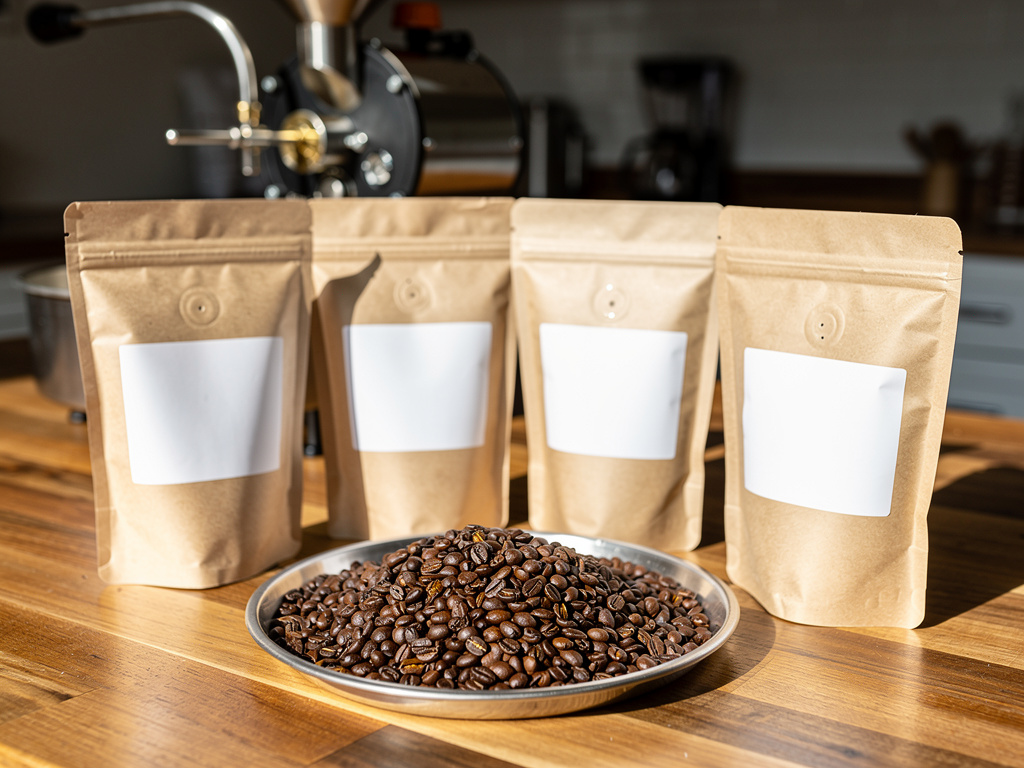


The short version: Yes, in most states you can legally sell coffee you roast at home, as long as you sell it as dry beans or grounds in a sealed, labeled bag. Of seven state rules checked for this guide, five allow home-roasted coffee: California, Colorado, Connecticut and Ohio name it outright, and Texas allows any food outside a short banned list. New York is the hard no for roasting: its home processing page lists roasting or grinding coffee beans as prohibited, though a registered home processor may repackage roasted beans or grounds. Brewed coffee, cold brew and bottled coffee drinks are a different product, and most of these states treat a drink as outside home food rules. Verify your own state's current rules with its agency before your first sale, because these pages change.
Checked September 23, 2026 on seven state agency pages, Florida Statutes section 500.80 and each platform's own pricing page, with New York's repackaging line and Colorado's 2027 law rechecked September 29, 2026. The seven states are California, Colorado, Connecticut, Florida, New York, Ohio and Texas. Homegrown customers create an account to place a first order, and Homegrown handles pickup and local delivery, not shipping.
A neighbor tried your Ethiopian light roast at a backyard cookout and asked if they could buy a pound. Now you are wondering whether handing over a bag of beans you roasted in your garage is legal. For most of the country the answer is yes, and it is one of the simpler yeses in home food law.
The complication is that "coffee" covers four different things. A sealed bag of whole beans, a bag of grounds, a jug of cold brew and a bottle of vanilla coffee syrup can each get a different answer from the same state. This guide sorts them out using what seven state agency pages said on September 23, 2026, with New York and Colorado rechecked on September 29, 2026. If you already know you are allowed and want the roasting side, our guide to selling roasted coffee beans from home covers equipment, green bean sourcing and where to sell.
Yes, in most states you can sell roasted coffee beans made in your home kitchen under your state's cottage food law. A cottage food law is the set of state rules that lets you make certain low-risk foods at home and sell them without a commercial kitchen or a restaurant license. Roasted coffee is on the low-risk side because it is dry and shelf stable.
Here is how the seven states checked for this guide split:
So 5 of the 7 states checked allow it (4 by name, Texas by exclusion), 1 needs a question and 1 says no.
Roasted coffee passes because it has almost no water in it and does not need a refrigerator to stay safe. State rules draw the line at foods that need time and temperature control, meaning foods that can grow bacteria if they sit out. Dry beans do not.
Ohio's cottage food page puts the line in plain terms. A food is potentially hazardous when it "requires temperature control because it is in a form capable of supporting the rapid and progressive growth" of harmful microorganisms. A bag of beans that has been through the heat of a roaster and cooled on a tray is nowhere near that description.
That is why all 5 states that allow home-roasted coffee treat it like any other dry cottage food. What this means for you:
In the states that address it, ground coffee is allowed right alongside whole bean, except in New York, where grinding is banned along with roasting. Ohio's list says coffee "may be whole beans or ground." Connecticut's answer covers "whole bean coffee or ground coffee." California's list says roasted coffee without splitting the two.
Colorado's list names "roasted coffee beans" and says nothing about grounds either way. When a list is silent, the safe move is an email, and Colorado gives you the address to send it to: cdphe_mfgfd@state.co.us. That makes 2 states, Ohio and Connecticut, that allow grounds by name, and 1 state, New York, that bans them by name.
A few practical notes on grinding:
Five of the seven state pages checked on September 23, 2026 allow home-roasted coffee, Florida does not name it, and New York prohibits it. None of them allow a brewed coffee drink as a cottage food by name. The table below is the whole picture in one place.
Scroll sideways to see every column.
| State | Roasted whole bean | Ground coffee | Brewed coffee or cold brew | Yearly sales cap | Where the rule lives |
|---|---|---|---|---|---|
| California | Yes, "Coffee (roasted or freeze-dried)" on the list | Not split out; listed as roasted coffee | Not on the list; only powdered beverage mixes are | $88,878 Class A, $177,756 Class B for 2026 | CDPH Approved Cottage Foods list and 2026 limit notice |
| Colorado | Yes, "Roasted coffee beans" | Not addressed; email the state | No, "Beverages" are on the ineligible list | $10,000 net revenue per product type through 2026; $150,000 gross per producer from January 1, 2027 | CDPHE Cottage Foods page and HB26-1033 |
| Connecticut | Yes | Yes | No, "beverages may not be sold" | $50,000 gross sales | DCP cottage food FAQ, dated March 20, 2026, and DCP sales-limit FAQ |
| Florida | Not named on the approved list | Not named | Not named | $250,000 gross sales | FDACS Cottage Foods page and Florida Statutes 500.80 |
| New York | No, roasting is prohibited; repackaging roasted beans is allowed | No, grinding is prohibited; repackaging roasted grounds is allowed | No, "Beverages" are prohibited | Not stated | Ag and Markets Home Processing page |
| Ohio | Yes | Yes, "whole beans or ground" | Not on the list, and only listed foods are allowed | None named on the page | ODA Cottage Food page |
| Texas | Yes, not on the excluded list | Yes, not on the excluded list | Not excluded by name; a cold drink needing refrigeration means DSHS registration first | $150,000 gross income | DSHS Cottage Food Production page |
We checked every row on the state's own page on September 23, 2026, and Colorado's 2027 changes in the signed HB26-1033 and New York's repackaging line on September 29, 2026. "Not named" means the page does not mention the product, which is a reason to ask the agency, not a yes.
New York is the clearest no of the seven states checked for home roasting. The Department of Agriculture and Markets home processing page lists "Roasting/grinding coffee beans" and "Beverages" among the prohibited products for home processors. To sell coffee you roast in New York, you roast in a licensed facility, such as a rented commercial kitchen or a co-roasting space. The same page's approved list does allow "Repackaging roasted coffee beans or grounds," so a registered home processor can bag coffee someone else roasted and sell it inside New York, including wholesale to "restaurants, cafes, grocery stores, etc." as the page's FAQ puts it.
Usually no: brewed coffee, iced coffee and cold brew are drinks, and most cottage food rules leave drinks out. Colorado puts "Beverages" on its ineligible list. Its Tamale Act lets a home kitchen sell one type of packaged food that needs temperature control, such as tamales, starting January 1, 2027. The act rules out alcohol but says nothing else about drinks, so ask CDPHE before planning a cold brew for 2027. New York prohibits beverages. Connecticut says it directly: "beverages may not be sold, so you may not sell ready-made coffee."
That is 3 states in this guide, Colorado, Connecticut and New York, that rule out drinks by name (Connecticut names ready-made coffee outright). Cold brew is the one people push back on, because it is just coffee and water. The problem is that water. Once the grounds are steeped, you have a liquid that is mostly water and only mildly acidic, and it sits in a fridge for days. That puts it in the category home food rules are written to keep out.
Texas is the exception worth knowing about. Its law allows any food outside the banned list, and it lets home kitchens sell foods that need refrigeration if they register with the Department of State Health Services first. A refrigerated cold brew could fall there, but the state has not named it. Ask DSHS directly before bottling a batch, and note that Texas bans ice and ice products from home kitchens, so do not plan on selling drinks over ice.
If you want to sell brewed coffee by the cup, the usual paths are:
For a part-time vendor, the bag of beans is the product that fits home rules. Each step past the bag brings its own permit, from a $91 Florida event license for cups to a $385 bottling permit for sealed cold brew, as our coffee business license guide shows setup by setup.
Coffee add-ons are judged on their own, and most of them fail where roasted beans pass. A syrup, a creamer and a flavored bean are three separate products in the eyes of a state rule.
Homegrown's catalog on September 29, 2026 had 2,779 products from 312 vendors. We counted a listing as coffee you brew when its category and description show beans, grounds, pods or a coffee blend sold to brew at home, and we left out ready-to-drink coffee, coffee-flavored food and anything that only mentions coffee. By that rule, 19 listings from 5 vendors are coffee you brew. 14 of them are 8-ounce bags from one vendor, Flying Carabao Coffee, each named for its origin and listed at $15.00. The other 5 are a mushroom coffee blend and Keurig-style pods from Swiss Mountain Coffee Roasters, a 12-ounce bag of Bates Beanery beans at Harvest House Foods, a 9-ounce mushroom coffee blend from a newer vendor, and Grounded Roast Coffee at Country Apple Orchard Farm Stand.
A search of product names for "coffee" finds 20 listings, and 16 of them are not coffee you brew: coffee cakes and coffee cake muffins (6), coffee syrups (4), soap, skin and hair care (3), home goods named for a coffee scent (2) and a coffee and caramel boli (1). These are listing prices, not sales, and the pull does not show which beans were roasted in a home kitchen. Coffee you brew is a small shelf on the marketplace: 19 of 2,779 listings.
It depends on the state: some require registration and training, some require nothing from the state, and New York requires a licensed facility to roast or grind coffee, though a registered home processor may repackage coffee roasted elsewhere. The license question is separate from whether coffee is allowed.
Your city may still want a general business license or a home business permit. That is about running a business from your address, not about food. Our guide to cottage food laws by state covers the registration steps for the rest of the country.
Roasting makes smoke, and darker roasts make more of it. Florida's statute bars cities from banning or regulating cottage food itself, but you still have to meet the state's home-based business conditions (section 559.955). Other states leave more to the city, and many cities have rules about smoke, odor and neighbors. Ask your city before your roaster runs every weekend in an attached garage.
Most home coffee roasters will never reach their state's cap: Florida allows $250,000 a year and Texas $150,000, while Colorado's $10,000 in net revenue per product type, which applies through December 31, 2026, is the lowest figure of the states checked. At $18 a 12-ounce bag, even the smallest cap is hundreds of bags.
Yearly sales cap for a home coffee business, by state
Source: FDACS, Texas DSHS, the CDPH 2026 limit notice, Connecticut DCP and Colorado CDPHE, all loaded September 23, 2026, and HB26-1033, loaded September 29, 2026. Ohio's page names no cap; New York does not allow home-roasted coffee. Colorado's $10,000 applies through December 31, 2026; from January 1, 2027, its Tamale Act (HB26-1033) sets $150,000 in gross revenue per producer, adjusted each year for inflation.
Here is what those caps mean in bags at $18 each:
Through December 31, 2026, Colorado's cap is counted per product type, so a light roast and a dark roast may each count separately. The page does not define product type for coffee, so confirm with the state before you plan around it. That changes on January 1, 2027. Colorado's Tamale Act, House Bill 26-1033, signed June 4, 2026, covers producers that earn "gross revenues of one hundred fifty thousand dollars or less per calendar year from the sale of food permitted under this section." That is one cap on everything you sell, counted before costs, and the state adjusts it for inflation every year. See our cottage food revenue cap guide for how other states count.
California's cottage food web page still lists $75,000 for Class A and $150,000 for Class B as the current limits. The state's own 2026 notice raised them to $88,878 and $177,756 starting January 1, 2026. We checked both on September 23, 2026.
Every state that allows home-roasted coffee requires a label, and most want the product name, your name and address (or a state ID number in Texas) and a home-kitchen statement. Ohio, Florida, California and Connecticut also require the net weight, and Ohio, California and Connecticut want it in both US and metric units. The exact wording of that statement changes by state, so copy it from your state's page letter for letter.
Swipe the label table sideways for the last two columns.
| State | Home-kitchen statement | Net weight | Everything else |
|---|---|---|---|
| Ohio | "This Product is Home Produced." in ten-point type | Required in both US and metric units | Name of the food, ingredients by weight, your name and address, allergens |
| Florida | "Made in a cottage food operation that is not subject to Florida's food safety regulations." in at least 10-point type | Net weight or net volume required | Name and address, ingredients by weight, allergens, nutrition facts if you make a nutrition claim |
| Texas | "THIS PRODUCT WAS PRODUCED IN A PRIVATE RESIDENCE THAT IS NOT SUBJECT TO GOVERNMENTAL LICENSING OR INSPECTION." | Not on the Texas list | Your name, address or DSHS ID number, the common name, major allergens |
| Colorado | A label disclaimer that it was made in a home kitchen without regulatory oversight and may contain allergens, plus a point-of-sale sign reading "This product was produced in a home kitchen that is not subject to state licensure or inspection. This product is not intended for resale." | Not on the page | The customer must get the product name, your address, phone or email, the date it was made and ingredients. From January 1, 2027, HB26-1033 requires an affixed label with your department-issued registration number, the county where the food was made in place of your address, your phone or email, ingredients and a CDPHE website for reporting illness |
| California | "Made in a Home Kitchen" in 12-point type on the front panel | Required in both US and metric units | The product name on the front panel, your name, city and zip, your registration or permit number and the county that issued it, ingredients by weight, allergens |
| Connecticut | "Made in a Cottage Food Operation that is not Subject to Routine Government Food Safety Inspection." in at least 10-point type | Net weight or net volume required, with the metric equivalent | Business name and address with city, state and zip, ingredients by weight |
Wording copied from each state's page and Florida Statutes 500.80 on September 23, 2026. Colorado's 2027 label rule comes from the signed HB26-1033, loaded September 29, 2026. A plain single-origin coffee has one ingredient, coffee, and no major allergens.
Print the roast date on every bag, even where your state does not require it. Colorado already asks for the date made, and coffee buyers read that date first. Many home roasters let beans rest 24 to 48 hours after roasting before sealing them in valve bags, so a Thursday roast is ready for a Saturday market.
For the full label walkthrough, see our cottage food labeling requirements guide.
No, not as a cottage food in most states: 5 of the 7 states checked limit home food sales to buyers inside the state, Texas requires you to deliver every order in person, and Florida's statute names no state-line limit. Coffee ships well, which makes this the rule home roasters bump into most.
If out-of-state customers keep asking, that is the signal to move into a licensed roasting space. Our guide on whether you can ship cottage food walks through the move.
Direct to the customer is allowed everywhere coffee is allowed, while selling through a coffee shop, grocery store or restaurant depends on the state. This matters because a local cafe is the first place many roasters want to sell.
If a cafe asks to carry your beans, read our guide to getting your food into a local coffee shop before you say yes.
In Colorado you can only put "organic" on the front label if the coffee is certified, and in any state you should only name an origin your green bean supplier can document. Elsewhere, federal rules let an operation with $5,000 or less a year in organic sales use the word without certification, as long as it still follows the organic production and handling standards, but not the USDA seal, under the USDA National Organic Program's rule at 7 CFR 205.101 (ecfr.gov), so check your state before you print it. Colorado's page says it plainly: cottage foods labeled "organic" have to be certified by a USDA National Organic Program accredited certifier. You may list an ingredient as organic, but not with "organic" on the main label.
What that looks like on a bag:
Certification is a real cost for a part-time roaster, so most start by naming the organic beans in the ingredient line and leave the front of the bag to the roast name and the roast date. If your sales grow past a few hundred bags a year, price out a certifier before you redesign the label. Colorado's rule applies to every bag with "organic" on the front, even a single $18 bag sold to a neighbor.
Once your state says yes, the job becomes taking pre-orders before roast day, and an ordering page handles that better than a text thread. Home coffee has a built-in timing problem: you want to know how many pounds of each roast to make on Thursday, not guess and end up with stale bags on Sunday.
Homegrown costs $10 a month billed annually, or $12.50 billed monthly, with no percentage fees beyond standard payment processing at 2.9% plus $0.30. For a home roaster, the parts that matter are:
Here is the full fee stack on an $18 twelve-ounce bag against the platforms coffee vendors usually weigh.
This fee table is wide. Drag it sideways to read all eight columns.
| Platform | Monthly plan | Trial period | Platform fee | Card processing | Customer pays on an $18 bag | Vendor pays on an $18 bag | Vendor pays in a month of 50 bags |
|---|---|---|---|---|---|---|---|
| Homegrown | $10 billed annually ($12.50 monthly) | 7 days, no charge until day 8 | None, 0% commission | 2.9% + $0.30, paid by the vendor | $18.00 | $0.82 plus the plan | $51.10 |
| Square Online Free | $0 ($49 Plus, $149 Premium) | Not needed on the free plan | None | 3.3% + 30 cents online | $18.00 | $0.89 | $44.70 |
| Shopify Basic | $29 billed yearly ($39 monthly) | 3 days, then $1 a month for 3 months | None with Shopify Payments (2% with another provider) | 2.9% + 30 cents online (3.5% + 30 cents on premium cards) | $18.00 | $0.82 plus the plan | $70.10 |
| Etsy | $0 | None; a one-time shop set-up fee may apply, with the amount shown at setup | $0.20 listing fee plus 6.5% transaction fee, 15% Offsite Ads fee on ad sales | 3% + $0.25 | $18.00 plus shipping | $2.16 | $108.00 |
Fees loaded from findhomegrown.com/signup, squareup.com/us/en/pricing, shopify.com/pricing and etsy.com/sell on September 23, 2026, and figured on an $18 bag before shipping, any delivery fee the vendor sets, and tax. Shopify's month uses the $29 yearly rate and its standard card rate. Etsy's row leaves out Offsite Ads, which is optional for most sellers, and the one-time shop set-up fee Etsy says it may charge a new shop.
Square's free plan is cheapest at 50 bags because it has no monthly plan, and it is a fine pick if you only want a checkout. Etsy reaches shoppers nationwide, but in 6 of the 7 states checked, cottage food rules keep you from mailing a bag out of state (Florida's statute names no state-line limit), which removes most of Etsy's value for a home roaster. Homegrown does not ship. Your storefront is listed on the Homegrown marketplace, but plan on most orders coming from people you send to your own link. Customers create a Homegrown account to place their first order.
If your Thursday roast is still a guess, set up a pre-order page on Homegrown and roast to real orders this week.
Experienced home roasters confirm their state's rule in writing before their first sale, then roast only to orders. The coffee itself is rarely what gets a new vendor in trouble. The details around it are.
The common thread is paperwork you can show. If a market manager or a health inspector asks whether your coffee is allowed, a saved state email and a label copied word for word from the state page settle it on the spot.
The most common trouble is selling a drink under rules written for dry food. A cold brew jug at the market or a cup of drip coffee as a sample moves you from cottage food into beverage and food service rules.
Other mistakes home coffee vendors make:
Every one of these is avoidable with the same habit: read your own state's page, not a national summary, and ask before adding a new product. A new syrup, a canned cold brew or a cafe wholesale deal each counts as a new question, even after your first 100 bags of beans sold without a problem.
You can confirm your state's coffee rule in about an afternoon by reading your agency's approved food list and sending one email. It costs $0 to do and takes 7 steps. Here they are in order.
In Connecticut, the state already answered the question: its cottage food FAQ on roasting coffee says yes to whole bean and ground, and no to ready-made coffee.
Yes, in most states it is legal to sell roasted coffee beans from home under a cottage food law. California, Colorado, Connecticut, Ohio and Texas all allowed it on September 23, 2026. New York prohibits home roasting, and Florida's list does not name coffee, so check with your state first.
Yes, a farmers market is one of the most common places to sell home-roasted coffee in states that allow it. Bring sealed, labeled bags, and display any sign your state requires, such as Colorado's point-of-sale placard. Brewing cups to sell or sample at the booth usually needs a separate temporary food permit. Texas bars local permits and fees for cottage food samples, so ask DSHS whether a brewed sample counts.
Usually not under cottage food rules, because cold brew is a drink that needs refrigeration. Colorado and New York list beverages as not allowed, and Connecticut says ready-made coffee may not be sold. Texas may allow it with state registration, so ask its health department first.
Some states require registration or training and some require neither. California requires county registration and a training course, Connecticut requires a state Cottage Food Operator license and a food safety course, Colorado and Texas require food safety training, and Florida and Ohio require no state food license for cottage foods. In Ohio and Texas, and in Colorado through 2026, you can sell coffee from home without a commercial license once any required training is done. Colorado adds a yearly state registration on January 1, 2027. Florida's list does not name coffee, so ask FDACS first. Either way, check whether your city wants a home business permit.
You can list it, but most cottage food rules stop you from shipping to buyers in other states. Etsy charges a $0.20 listing fee, a 6.5% transaction fee and 3% plus $0.25 processing, plus a 15% Offsite Ads fee on ad-driven sales and a possible one-time shop set-up fee, checked September 23, 2026. The 6.5% also applies to the shipping you charge. For a home roaster, local pickup and delivery usually fit the law better.
No commercial kitchen is needed in the states that allow home-roasted coffee. Some states define the home closely: Ohio's page means your primary residence, occupied by the owner, with one stove or oven used in an ordinary kitchen. Read your state's definition before moving the roaster into a garage or outbuilding, and plan for ventilation, since roasting makes smoke.
More on selling coffee and staying legal from a home kitchen:
Home-roasted coffee is legal in most of the country and a bag of beans is one of the simplest products a home kitchen can sell. When your state checks out and your label is ready, open your Homegrown storefront and take this week's roast by pre-order.



