
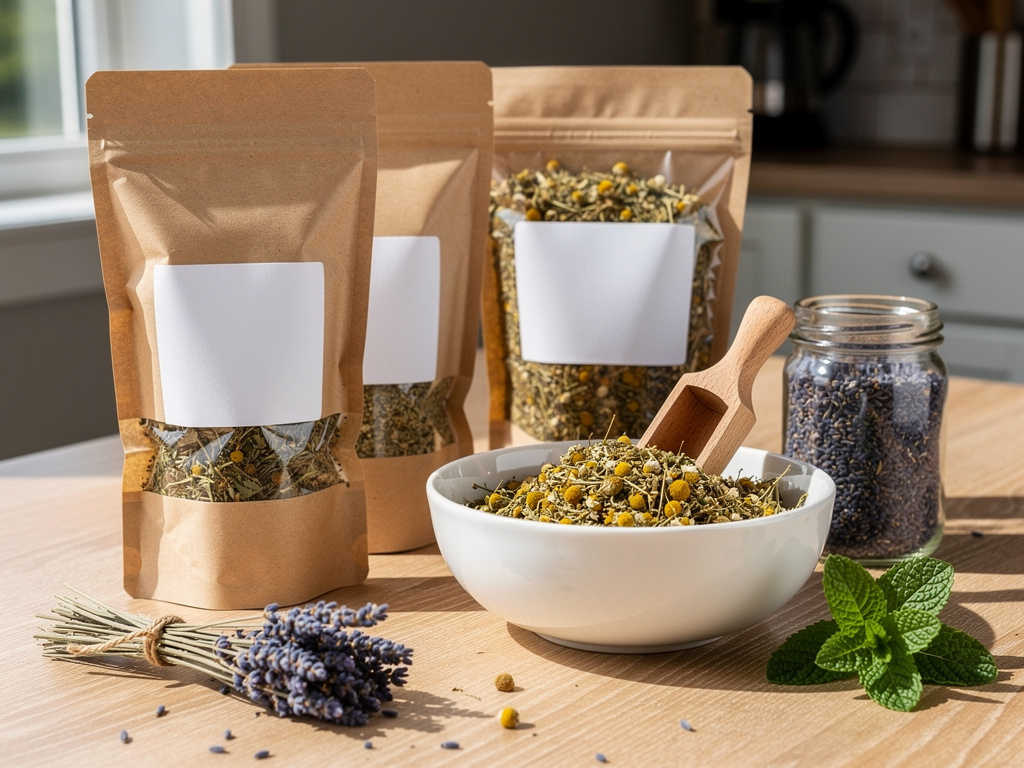


The short version: Yes, you can sell homemade tea from your own kitchen in most states, as long as it is dry. All five state rules checked for this guide allow a dried loose-leaf blend: California and Colorado name tea on their lists, Ohio names dry tea blends, Florida covers dry herb mixtures, and Texas allows any food outside a short excluded list. Brewed, bottled and iced tea is a different answer: Colorado bans beverages by name, Ohio and California allow only what their lists name and neither lists a liquid drink, and Florida and Texas need a direct question to the state first. The rule that trips up the most tea vendors is federal: a blend presented as treating, curing or preventing a condition is legally a drug, so describe flavor and ingredients, never effects.
Checked on the five state agency pages, Florida Statutes section 500.80, the federal drug and labeling rules and findhomegrown.com/signup, September 22, 2026: every list, cap and label rule below came off those sources that day, and state food law changes between legislative sessions, so verify your state's current rules on its own agency page before you sell a pouch. On the ordering side, Homegrown is $10 a month billed annually, customers create a Homegrown account to place a first order, and there is no timed drop or countdown release feature.
Somebody at the farmers market smelled your chamomile and mint blend, asked where they could buy a pouch, and you realized you are not sure you are allowed to sell it. The good news comes first. Dried tea is one of the easiest products in the country to sell from a home kitchen.
The catch is that tea is not one product. A sealed pouch of loose chamomile, a gallon of sweet tea, a jar of chai syrup and a blend named "Cold Remedy" all get called tea, and the same state rule can wave one through and stop another. This guide sorts 12 tea products into allowed, depends and not allowed. It shows what five state agency pages said about tea on September 22, 2026, and it walks through the one federal wording rule that applies no matter where you live.
Yes, in most states you can sell homemade tea from your own kitchen, as long as the tea is dry. All 5 state rules checked for this guide on September 22, 2026 allow a dried loose-leaf blend made in a home kitchen, and none of them requires a commercial kitchen to do it.
Most states handle this through a cottage food law, which is a rule that lets you make low-risk foods at home and sell them without a food license. Three questions decide your answer, and it helps to separate them before you read another word:
Everything else, the label, the cap, the places you are allowed to sell, follows from those three answers. The rest of this guide takes them in order.
This page is the permission half of a set. Once your answer is yes, the blends that sell, the equipment and the packaging are in the companion guide on how to sell herbal tea from home. The pouch math behind a $16 two-ounce pouch is in how much to sell tea for, and the markets, shops and online channels are in where to sell tea.
Because dried leaves and flowers hold too little water for the bacteria behind food poisoning to grow, and that is the exact test almost every home-kitchen law is built on. Ohio's cottage food page describes the risky group, which it calls potentially hazardous food, as food that "requires temperature control because it is in a form capable of supporting the rapid and progressive growth of infectious or toxigenic microorganisms." A properly dried tea sits on the other side of that line.
Agencies use two names for the safe group. Older rules say non-potentially hazardous. Newer rules say not a time and temperature control for safety food, often shortened to TCS. Both mean the same plain thing: the food is safe sitting in a cupboard.
Dried tea earns that status three ways at once:
The practical version: if a pouch of your blend can sit on a shelf for months and still be safe, and it has no hemp or CBD in it, all 5 states in this guide put it on the allowed side, as long as it also fits a category on the list in Ohio or California, the two states that allow only what they list. If it needs a refrigerator, or it is already a liquid, you are in a different conversation, and that conversation is state by state.
A pouch of loose chamomile and a bottle of chamomile iced tea can land on opposite sides of the same state rule, and the 12 common tea products below split along one seam: is it dry, or is it a drink? The second seam is what you say about it, which is federal and applies everywhere.
Scroll sideways to see every column.
| What you want to sell | Usual answer | Why it lands there | What to check first |
|---|---|---|---|
| Loose-leaf herbal blend, like chamomile, mint or lemon balm | Allowed | Dry and shelf-stable; California lists herbs and herb blends, Colorado lists dry teas, Ohio lists dry herb blends | Your state's label statement |
| Black, green or white tea blended with herbs or spices | Usually allowed | California lists tea, Colorado lists dry teas, Ohio lists dry tea blends | Florida's list says dry herbs and does not use the word tea, so ask its agriculture department |
| Tea bags you fill and seal yourself | Allowed wherever loose tea is | The bag is packaging; the product inside is still dry tea | Net weight per box, printed the way your state wants it |
| Matcha or another powdered tea | Usually allowed | California lists tea and powdered beverage mixes | Whether your state treats a powder as a dry tea |
| Chai or latte powder mix | Depends | California allows powdered beverage bases made from approved-source ingredients | A milk powder means a milk allergen line on the label |
| Tea with home-dried fruit or flowers | Usually allowed | Colorado lists dehydrated produce; California lists dried fruit | Drying all the way, because moisture is what spoils a blend. Ohio's list asks for commercially dried fruit and vegetables in other dry mixes, so an Ohio vendor should ask before adding home-dried fruit |
| Hemp or CBD tea | Not allowed in Colorado or Texas | Both exclude products containing CBD or THC by name | Every other state's own rule, since hemp law is its own field |
| A blend labeled to treat, cure or prevent a condition | Not allowed as a food | Federal law defines a product meant to treat or prevent disease as a drug | Your label, your sign, your captions and the blend's name |
| Bottled iced tea or sweet tea | Not allowed in 3 of the 5 states | Colorado bans beverages; the Ohio and California lists name no liquid drink, and both states permit only what is listed | Florida and Texas, where you ask the state before you bottle |
| Tea poured by the cup at your booth | Not a cottage food sale | A poured drink is food service, not a packaged food | Your county health department's temporary food permit |
| Chai concentrate or tea syrup | Not allowed in 3 of the 5 states | It is a liquid, and Colorado bans beverages outright | A dry chai blend or a powdered mix instead |
| Kombucha | Its own rules | A fermented drink, with alcohol limits on top of food rules | The rules for selling kombucha from home |
Product categories checked on the California Department of Public Health's Approved Cottage Foods list (last reviewed April 2026), the Colorado Department of Public Health and Environment's Cottage Foods Act page, the Florida Department of Agriculture and Consumer Services' Cottage Foods page, the Ohio Department of Agriculture's cottage food page and the Texas Department of State Health Services' cottage food page, all loaded September 22, 2026. State lists are written differently, so treat this as the question to ask your own agency rather than a ruling on your blend.
The pattern is simple once you see it. Anything you hand over dry and sealed, other than a hemp or CBD blend, is in the easy group in every state here. Anything you hand over wet, poured, bottled or promised as a remedy is in a harder group, and in 3 of these 5 states a bottled drink is not a cottage food at all.
In a pull of the Homegrown catalog on August 14, 2026, 6 of the 1,804 products were tea made for drinking, from 3 of the 219 vendors, after removing tea towels, tea tree soap, a worm tea kit and matcha brownies that matched the word. Three of the six were filed under Health and Wellness, two under Beverages and one under Pantry. Tea is a thin category on the marketplace, which means little competition for a new tea vendor and very few examples to copy, so the wording rules later in this guide are yours to get right.
All 5 state agencies checked on September 22, 2026 allow a dried herbal tea blend from a home kitchen, but they name it five different ways and attach five different sets of limits. The table below puts them side by side, so you can see the range before you look up your own state.
Swipe the table sideways for the rest of the columns.
| State | How tea appears | License or registration | Training | Yearly sales cap | Where you can sell | Online and shipping |
|---|---|---|---|---|---|---|
| California | "Tea" and "Herbs & herb blends" on the Approved Cottage Foods list, plus powdered beverage mixes | Register or get a permit through your local environmental health department | A cottage food operator course within three months of registering | $88,878 gross for Class A, $177,756 for Class B, effective January 1, 2026 | Class A sells direct to the public; Class B can also sell through restaurants and food markets | A direct sale may be fulfilled in person, by mail or by a delivery service, to a customer in California only |
| Colorado | "Dry teas" on the eligible list; "Beverages" on the ineligible list | No state license or inspection | A food safety course before you start, from CSU Extension, a food handlers card or your local health agency | $10,000 per product type | Direct to the person who will use it; not to restaurants or grocery stores | Internet sales allowed, Colorado only, no interstate commerce |
| Florida | "Dry herbs, seasonings and mixtures"; the word tea does not appear | No state food permit | None named on the state page | $250,000 gross | Direct, online or by mail order; no wholesale | Delivery in person, to an event venue, or by the Postal Service or a commercial carrier |
| Ohio | "Dry herbs and dry herb blends" and "dry tea blends" | No license and no inspection, though the state can sample your product | None named on the state page | No dollar cap on the state page | Your home, grocery stores, registered farm markets, farmers markets and restaurants | Sales in Ohio only |
| Texas | Any food except meat, seafood, ice products, low-acid canned goods, CBD or THC products and raw milk | No local permit or fee; state registration only for refrigerated foods, or to print an ID number instead of your address | An accredited food handler course | $150,000 gross income | Direct, plus wholesale to a registered cottage food vendor for shelf-stable foods | Online orders delivered in person by you, an employee or a household member |
Checked on each state's own agency page on September 22, 2026: the California Department of Public Health's Cottage Food Operations page, Approved Cottage Foods list and 2026 adjusted sales limit notice; Colorado's Cottage Foods Act page; Florida's Cottage Foods page and Florida Statutes section 500.80; Ohio's cottage food page; and the Texas health department's summary of Senate Bill 541. Your state will differ, sometimes by a lot.
Three patterns show up in how the five write tea into the rules:
Colorado is the clearest example of the dry-versus-drink line. Its eligible list names dry teas, dry spices and dehydrated produce. Its ineligible list names beverages, fruit and vegetable juices, and any product containing CBD or THC. Its five-question screener on the same page asks, among other things, whether your product is a beverage and whether it contains hemp. Checked on the Colorado Department of Public Health and Environment's Cottage Foods Act page, September 22, 2026. The same page says a new law, HB26-1033 (the "Tamale Bill"), begins January 1, 2027, so recheck it after that date.
Since September 1, 2025, Texas allows any food from a home kitchen except meat and poultry, seafood, ice products, low-acid canned goods, products containing CBD or THC, and raw milk. The yearly limit rose to $150,000 in gross income, and local health departments may not require a permit or charge a fee. A food that needs refrigeration is allowed but must be registered with the state and labeled with safe handling instructions. Checked on the Texas state health department's cottage food page, September 22, 2026.
Usually not under a home-kitchen rule, and in Colorado never: its ineligible list names beverages outright, right beside fruit and vegetable juices. Ohio permits only the foods on its list and California approves only the categories on its list, and neither names a liquid drink, so a jug of sweet tea is outside both. That makes 3 of the 5 states checked a clear no for bottled tea. Coffee splits along the same line, with roasted beans named on the California, Colorado and Ohio lists and cold brew left off, as our guide on selling homemade coffee from home lays out.
The other two need a direct question. Florida's approved list leaves drinks off, but its statute covers any food that is not time or temperature controlled for safety, so ask the state's agriculture department before you bottle anything. Texas does not name beverages among the six groups it excludes, and a drink that must be kept cold to stay safe counts as a refrigerated food there, which means registering with the state and printing safe handling instructions on the label.
The wet forms of tea that usually fall outside a cottage food rule:
What works instead is selling the dry version with the brewing written on the label. An herbal iced tea blend in a pouch, with a line that says how many tablespoons go in a two-quart pitcher, is a dry tea in every state here. A chai spice blend sold dry is a dry herb mixture. You keep the product your customers want and stay inside the rule.
Samples need the same care. Florida's cottage food page says samples must be prepackaged, which rules out pouring a tasting cup under that rule. Texas says a home kitchen may provide samples at any location. Where brewed samples are not an option, a small open jar of the dry blend that customers can smell does most of the selling a sip would.
No, not on a tea you sell as a food, because federal law defines a drug by what it is meant to do, and a tea meant to treat or prevent a condition meets that definition in all 50 states. The federal definition of a drug includes "articles intended for use in the diagnosis, cure, mitigation, treatment, or prevention of disease." A chamomile blend labeled for insomnia is, on paper, an unapproved drug.
The Food and Drug Administration's page on structure and function claims says it plainly: only a drug can legally claim to diagnose, treat, cure or prevent any disease. The same page says claims on a regular food focus on effects that come from its nutrition, like calcium building strong bones. That is not what a customer means when they buy chamomile for bedtime, so a softer effect line like "supports restful sleep" has little to stand on for a home tea either.
State rules add a second cost. Ohio's cottage food page says a nutrient content claim or a health claim on a cottage food means the label must carry a full Nutrition Facts panel. Florida's statute says the same for any nutritional claim. One word turns a six-line sticker into a regulated panel.
Words that describe the tea and are safe to use:
Words that make a claim and bring the rules down on you:
The claim does not have to be in a sentence on the label. Federal rules at 21 CFR 201.128 say the intended use of a product can be shown by labeling claims, advertising matter, or oral or written statements, so your booth sign, your Instagram caption, your product description and what you say across the table all count. The blend's name counts too: a pouch called "Cold Remedy" makes the same claim a sentence would. Name blends for flavor and occasion, and keep every conversation about the taste.
The herbs most tea blends are built from are ordinary food ingredients, and the federal list of spices and natural seasonings that are generally recognized as safe, at 21 CFR 182.10, includes 9 common tea herbs: chamomile (both the English or Roman and the German or Hungarian kinds), lemon balm, elder flowers, ginger, lavender, linden flowers, peppermint, rosemary and spearmint. A blend built from that list is on firm ground.
The trouble starts at the edges of the garden, and five cases are worth a pause:
None of this means a new blend needs a lab. It means building your first three blends from herbs your customers already know from the grocery store shelf, and saving the unusual ones for after you have checked them.
Usually not a license, but often a registration or a training course, and the paperwork across the 5 states in this guide ran from nothing at all to a local registration with a training course. None of the five requires a commercial kitchen for dried tea.
Here is what each path looked like on September 22, 2026:
A food permit and a business license are two separate things. The steps above are the food side. Your city or county may still want a business license, a home occupation permit or a sales tax account, and zoning is the easiest one to overlook. Florida and California limit this. Florida's statute stops cities and counties from banning a cottage food operation or regulating how you make and sell your tea, though you still have to meet the state's general home-business conditions in section 559.955. California's Government Code section 51035 bars a city or county from prohibiting one in a home, though it can require a permit, which it has to grant if you meet its local standards for things like parking, traffic and noise. The fees for the food side vary widely by state, and the cottage food license cost guide lays out what each state charges.
The caps in the five states checked run from $10,000 per product type in Colorado to $250,000 a year in Florida, and one state page shows no dollar cap at all. For a tea vendor selling $16 pouches, the high caps are far away, but the low one is closer than it looks.
Yearly sales cap for a home tea business, by state
Source: each state's agency page, checked September 22, 2026. California's figures are the 2026 adjusted limits from the state health department's adjusted gross annual sales limit notice, effective January 1, 2026. Colorado's cap applies to each product type rather than the whole business. Ohio's cottage food page names no dollar cap, so it is not charted.
How the cap is written matters as much as the number, and there are three shapes:
The math at a $16 pouch: Florida's cap is 15,625 pouches a year, about 300 a week. Colorado's $10,000 is 625 pouches of one blend a year, about 12 a week. Colorado's page heads this rule "net revenue allowance" but does not say how costs are counted, so email cdphe_cf@state.co.us before you plan on selling past $10,000 of one blend. Florida also says you must hand over written documentation of your yearly sales if the state asks, so keep a running record from your first pouch.
California's own cottage food web page still reads $75,000 for Class A and $150,000 for Class B as the current limits. The state's separate 2026 notice raises them for inflation to $88,878 and $177,756, effective January 1, 2026. Both were loaded on September 22, 2026. When two pages from the same agency disagree, the dated notice is the newer one, and a quick call to your local environmental health office settles which number it enforces.
Six things, and the one that changes most from state to state is the home-kitchen statement, whose exact wording each state writes for you. Ohio's cottage food page spells out the most detailed written list among the 5 states checked, which makes it a good template:
Colorado also wants the date you made the batch and a phone number or email for you, as part of the product information its buyers must be given. Texas asks for less: no net weight or full ingredient list, only the major allergens.
Herbal tea rarely carries a major allergen, which makes the allergen line an easy one to skip. The ones that sneak in are almond slivers (a tree nut), milk powder in a chai or latte mix (milk) and soy lecithin in some tea powders (soy). Colorado adds one rule worth knowing even if you live elsewhere: a cottage food label there cannot say "allergen free," because the label must say the food may contain common allergens.
The home-kitchen statement is where copying another state's label gets you in trouble. Here are four of them, exactly as the states wrote them:
Swipe sideways to see where each statement goes.
| State | The statement, word for word | Where it goes |
|---|---|---|
| Ohio | "This Product is Home Produced." | On the label, in 10-point type |
| Florida | "Made in a cottage food operation that is not subject to Florida's food safety regulations." | On the label, in at least 10-point type in a color that contrasts with the background |
| Texas | "THIS PRODUCT WAS PRODUCED IN A PRIVATE RESIDENCE THAT IS NOT SUBJECT TO GOVERNMENTAL LICENSING OR INSPECTION." | On the label, and on a sign wherever a registered cottage food vendor resells your food |
| Colorado | "This product was produced in a home kitchen that is not subject to state licensure or inspection. This product is not intended for resale." | On a placard, sign or card at the point of sale, with a home-kitchen and allergen disclaimer on the label itself |
Wording copied from Ohio's cottage food page, Florida Statutes section 500.80, the Texas cottage food page and Colorado's Cottage Foods Act page, all loaded September 22, 2026. California's label rules sit on its own cottage food pages and are not reproduced here.
Fill every pouch a gram or two heavy. A two-ounce pouch is 56.7 grams, and dried flowers settle and crumble between the scale and the customer's cupboard, so filling to 58 grams costs you a few cents of chamomile and means the net weight on your label is never short. Weigh on a scale that reads to a tenth of a gram, and weigh the empty pouch first so the bag is not counted as tea.
Direct to the person who drinks it, in all 5 states checked, and the rules split the moment a shop or a cafe wants to resell your pouches. That split catches tea vendors off guard, because tea is exactly the kind of shelf-stable product a gift shop wants to stock.
The channels, in rough order of how widely they are allowed:
If a shop asks to carry your tea and you live in Florida, the answer under the home-kitchen rule is no, because the statute bars wholesale. In Colorado a shop cannot buy your pouches to resell, and it can only carry them if its staff act as your designated representative and sell direct to the customer. That is a reason to look at a licensed kitchen when the wholesale demand is real, not a reason to bend the rule. The where to sell tea guide prices each channel on the same $16 pouch.
Four of the 5 states checked say outright that you can sell online, and getting the pouch to the customer is where they split: Florida's law allows mail, California allows mail but only to a customer inside California, Colorado bars interstate commerce, and Ohio, whose page does not mention online sales, keeps every sale inside Ohio. Dried tea is light and ships easily, so this is the rule most likely to shape a tea business.
What each state said on September 22, 2026:
Shipping across a state line is a second question on top of your own state's rule, because the state you ship into has its own law. A Florida vendor allowed to mail a pouch still has to think about where it lands. The guide to shipping cottage food works through that half.
If your state wants the pouch handed over locally and the label facts shown before anyone pays, that is the shape a Homegrown storefront is built around: customers order and pay on your own page, choose pickup at your porch or market booth or delivery inside the radius you set, and the ingredient list and home-kitchen statement sit in the product description where they can read them first. You can set one up in about 15 minutes at findhomegrown.com/signup.
Once your state says yes, the next problem is 20 people asking "do you still have the lavender one?" across texts, comments and direct messages, and you rebuilding the order list at 10pm the night before a market. Put the five states' rules together and a home tea business ends up the same shape: direct sales, a local handoff wherever the state limits shipping, label facts a customer can see before paying, and a record of what you sold. That shape is an ordering page, not an inbox.
Homegrown costs $10 a month billed annually, or $12.50 billed monthly, with 0% commission and no percentage fees beyond standard payment processing at 2.9% plus $0.30. What it does for a tea vendor specifically:
Here is the whole fee stack on a $16 two-ounce pouch next to the platforms a tea vendor usually considers, every row showing all four parts.
This one is wide. Drag it sideways to read every column.
| Platform | Subscription | Trial period | Platform fee | Card processing | Customer pays on a $16 pouch | Vendor pays on a $16 pouch | Vendor pays on 50 pouches at $16 |
|---|---|---|---|---|---|---|---|
| Homegrown | $10/mo billed annually, $12.50/mo billed monthly | 7 days, no charge until day 8 | $0, 0% commission | 2.9% + $0.30 | $16.00 | $0.76 | $48.20 |
| Square Online, Free plan | $0/mo per location | n/a on the Free plan | $0 | 3.3% + $0.30 online | $16.00 | $0.83 | $41.40 |
| Shopify Basic | $29/mo billed yearly, $39/mo billed monthly | 3 days, then $1/mo for 3 months | $0 with Shopify Payments, 2% with another payment provider | 2.9% + $0.30 online on standard cards, 3.5% + $0.30 on premium cards | $16.00 | $0.76 | $67.20 |
| Etsy | None required, $0.20 per listing for four months | n/a | 6.5% transaction fee on the sale price including shipping | 3% + $0.25 | $16.00 | $1.97 | $98.50 |
Fees loaded from findhomegrown.com/signup, squareup.com/us/en/pricing, shopify.com/pricing and etsy.com/sell on September 22, 2026, and computed on a $16 pouch with no shipping charged. The 50-pouch column adds the monthly subscription at each platform's annual price and assumes one Etsy listing fee per pouch sold. Shopify's figures use its standard-card rate; a premium card runs 3.5% plus $0.30 on Basic. Etsy's transaction and processing fees also apply to any shipping you charge, and Etsy adds a 15% Offsite Ads fee on sales it attributes to its own advertising, which its page says is optional for most shops and can become required based on a shop's sales over 12 months. Etsy may also charge a one-time shop set-up fee, shown only during setup. None of those extras is included above. No platform here adds a surcharge to the customer.
Square Online's Free plan is the cheapest of the four at 50 pouches a month, $41.40 against Homegrown's $48.20, because Square's extra 0.4 points of card processing costs $3.20 on $800 of sales, less than Homegrown's $10 subscription. Etsy is the expensive one, $98.50 before advertising fees, and it is a marketplace built around shipping, which is the one thing California, Colorado and Ohio will not let a home tea vendor do across a state line. Shopify gives you a full website for $29 a month on a yearly plan, which is a real store if you want one and more than an ordering page needs.
What Homegrown does not do: it will not get you a permit or register you with your state, it does not check your label wording or your health claims, it does not ship your tea, there is no timed drop or countdown release feature, customers create a Homegrown account to place a first order, and 20% of each order is held for 30 days before it pays out, per the signup page on September 22, 2026. Your storefront is listed on the marketplace, but plan on most orders coming from people you send to your own link.
They write every word on the pouch for flavor, keep the line to a few blends, and treat the cap as a number they track weekly, not a surprise at year end. At a $16 pouch those habits cost almost nothing and remove most of the ways a home tea business gets into trouble.
The habits that separate the vendors still blending in year two:
If your tea orders still arrive as a pile of messages, that is the part worth fixing next. A Homegrown ordering page lists each blend with its label facts, takes payment when the order is placed, and gives you a dated sales record you can hold up against your state's cap. Start it at findhomegrown.com/signup.
Almost never the tea itself, and almost always a claim, a channel or a missing label line, and all 6 of the triggers below are things an agency can see without ever visiting your kitchen. Florida's statute says the state inspects a cottage food operation only after a complaint, and each of these is something a complaint can point to.
The real triggers for a tea vendor:
Keep your words on flavor, your drinks dry, your channels direct and your label complete, and you have removed most of what there is to find. Check the rule as your own state writes it today before you add any new channel.
Six steps, and the 5 states behind this guide each answered these questions in one to three documents, so plan on an afternoon. Go to your own state's agency page first, because secondhand summaries of these laws go stale every legislative session.
Your state's page is the only source that counts. A state-by-state overview of where the rules sit is in the cottage food laws by state guide, and it is a starting point rather than a substitute for your own agency's page.
Yes, in all five states checked for this guide, as long as the tea is dry and packaged with the label your state requires. A farmers market is one of the most widely allowed channels for a home tea business because the sale goes straight from you to the person who drinks it. The market may ask for a copy of your registration or training certificate before it gives you a booth. Brewing tea by the cup at that booth is a separate food service question for your county health department.
In most states there is no license for dried tea, though you may need a registration or a food safety course. On September 22, 2026, Ohio and Florida required no state license or permit, Colorado and Texas required a food safety or food handler course, and California required a local registration or permit plus a course within three months. A city business license or sales tax account is a separate question for your city or county.
Usually not under a cottage food rule. Colorado bans beverages from its list by name, and the Ohio and California lists, which are the only foods those states permit, leave liquid drinks off. Texas does not exclude beverages but treats a drink that needs refrigeration as a food that must be registered and carry safe handling instructions, and Florida's law turns on whether the food needs temperature control. A dry herbal iced tea blend with brewing directions on the pouch is allowed in every state checked.
You can list it, but Etsy is built around shipping, and shipping is where home tea rules get strict. Colorado bars interstate commerce, California defines a direct sale as one within the state, and Ohio limits cottage food sales to Ohio, while Florida's statute allows mail delivery. On a $16 pouch, Etsy's listing, transaction and processing fees came to $1.97 when its selling page was checked on September 22, 2026, before any Offsite Ads fee. Check your own state's shipping rule before you list a single pouch.
Not safely. Federal law defines a drug as a product intended to diagnose, cure, mitigate, treat or prevent disease, and the Food and Drug Administration says only a drug can legally make that kind of claim. Softer wording about immunity or cleansing is still an effect claim. The FDA says an effect claim on a regular food has to come from its nutrition, which is not why anyone buys an immune blend. In Ohio any health claim also forces a full Nutrition Facts panel onto a cottage food label. Name your blend for its flavor and let customers draw their own conclusions.
Usually not. Most of the states checked want the name, net weight, ingredients, allergens, your name and address, and the home-kitchen statement on a dried tea, with no nutrition panel. Colorado also wants the date made and a phone number or email, and Texas asks for less, with no net weight or full ingredient list, only the major allergens. That changes the moment you make a nutrient or health claim, because Ohio's cottage food page and Florida's statute both require nutrition information when a claim is made. Keeping your label to flavor and ingredients keeps it to one small sticker.
These six pick up where this guide stops, from the blends to the shipping box.
Once your state says yes, the work shifts from permission to logistics: a page where regulars can reserve the lavender blend before it runs out, and a record of every pouch you sold. A Homegrown storefront runs $10 a month on the annual plan with 0% commission and no percentage fees beyond standard payment processing, and it takes about 15 minutes to set up. Start your tea storefront at findhomegrown.com/signup and keep your next market's orders in one place.



