
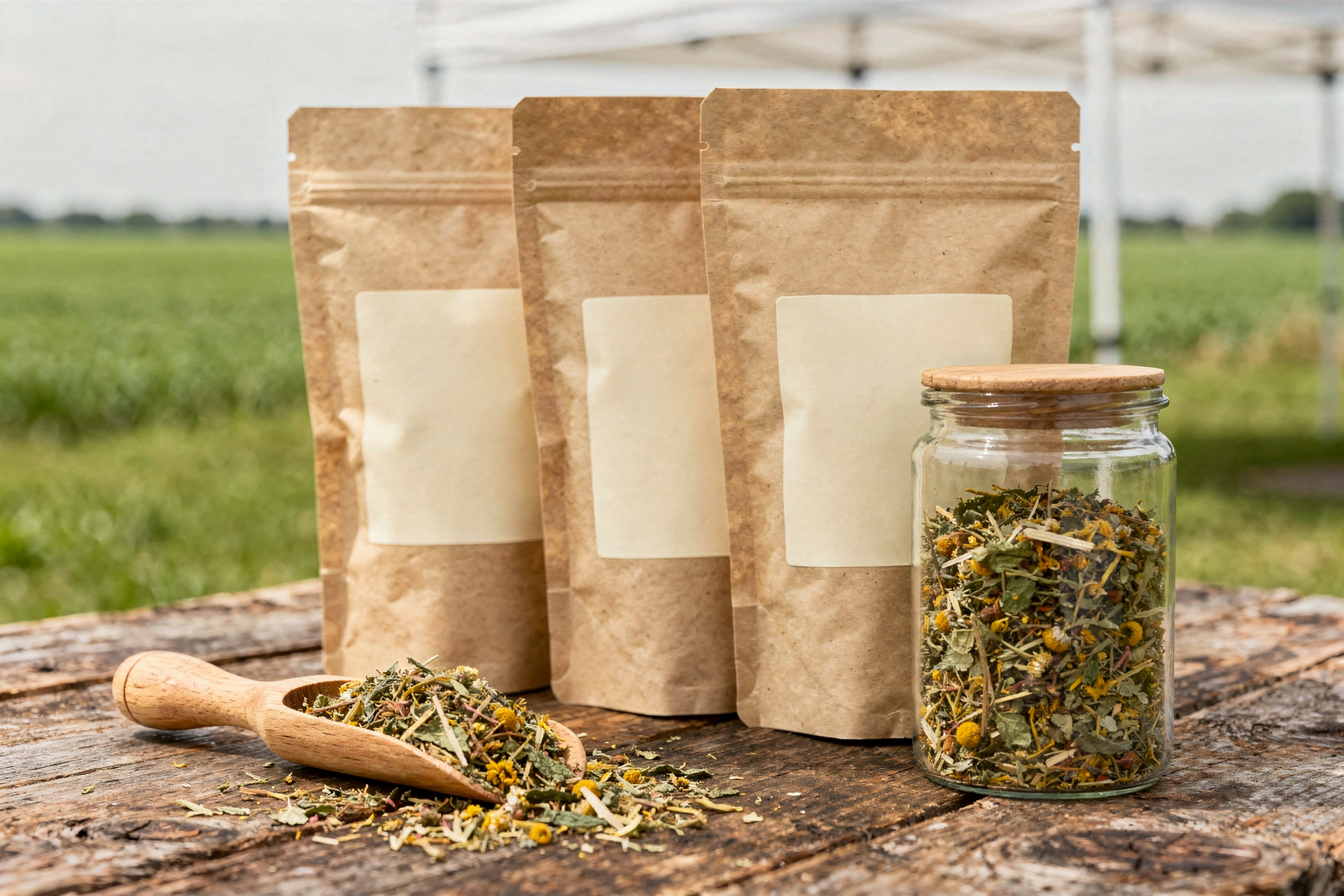


The short version: Tea sells in seven places: a farmers market booth, your own online storefront link, local shops and cafes, craft and holiday fairs, Etsy, bulk and corporate orders, and a repeat tea club. A two-ounce pouch priced at $16 keeps $15.24 when you sell it through your own link, $14.03 on Etsy, and $8.00 when a shop buys it to resell. Most part-time tea vendors do best with two places at once: one in person, where people can smell the blend, and one online, where a regular can reorder on a Tuesday.
Checked September 22, 2026: Homegrown is $10 a month billed annually or $12.50 billed monthly, $0 platform fee and 0% commission, card processing 2.9% + $0.30 paid by the vendor, with 7 days at no charge before the first bill on day 8 (findhomegrown.com/signup). Etsy charges a $0.20 listing fee, a 6.5% transaction fee and 3% + $0.25 payment processing (etsy.com/sell). Honest bounds: your customer creates a Homegrown account to place a first order, there is no countdown or timed release feature, and your storefront is listed on the Homegrown marketplace but most orders will come from the link you hand out yourself.
You blended three teas you are proud of, sealed them in kraft pouches, and now the pouches are sitting in a bin in your kitchen. The blending was the easy part. Working out which counter, table or web page they belong on is where most home tea vendors stall, because every channel takes a different cut and almost nobody prints the whole number.
This guide walks through seven places a home tea vendor actually sells, what each one costs on a single $16 pouch, and how to tell which one fits the tea you make.
Seven places take home-blended tea, and a part-time vendor can run any two of them without hiring help. Each one asks for something different from you: floor time, a pitch, photography, or nothing but a link you text to a regular.
Tea has one advantage that most cottage food products do not: it weighs almost nothing and keeps for a year. That is why it can sit in four places at once while a baker is stuck selling what comes out of the oven that morning. The tradeoff is that nobody buys tea on impulse the way they buy a cookie, so every channel here needs a taste, a smell, or a photograph doing the persuading.
If you have not worked out the legal side or the blends yet, the companion guide on how to sell herbal tea from home covers the permit, the packaging and the equipment. This article picks up after that, at the point where you have pouches and need customers.
Start with the channel that matches what you already have, not the one with the biggest audience. A vendor with 400 people on a neighborhood group has a different first move than a vendor with a garden full of chamomile and no following at all.
Scroll sideways to see every column.
| What you have right now | Start here | Add second | Why that order |
|---|---|---|---|
| A market booth you already pay for | Your own storefront link | Local shops | The booth built the customers; the link lets them reorder the other six days |
| No customers, no booth | A farmers market or craft fair | Your own storefront link | Tea needs a smell and a taste before a stranger pays $16 for a pouch |
| A following on social media | Your own storefront link | Bulk and gift orders | You already have traffic; you need a page to send it to that takes payment |
| A garden, more blend than time | Local shops and cafes | A tea club | Wholesale moves 24 pouches in one delivery with no floor time |
| Shipping ambitions and good photos | Etsy | Your own storefront link | Etsy brings national search traffic; the link keeps the repeat orders off a 6.5% commission |
Fees in this table's reasoning were checked on each company's own pricing page on September 22, 2026. Etsy's 6.5% transaction fee sits on top of its 3% + $0.25 payment processing and its $0.20 listing fee.
The trap is starting in three places at once. Each channel needs its own photographs, its own price sign and its own restock rhythm, and a part-time vendor who launches all seven in a month ends up with stale inventory in two of them.
A farmers market is the best place to make a first tea customer and a poor place to make a living from tea alone. Booth space runs $20 to $75 a week at most markets, with high-traffic urban markets charging $100 or more, and a full season often costing $400 to $800 up front, as broken down in our guide to the real cost of selling at farmers markets.
Run the arithmetic on a $40 booth. A $16 pouch that costs you $3.87 to make leaves $12.13 before card processing, so you need four pouches sold to cover the table and everything after that is yours. Four pouches is a reachable Saturday. Forty pouches, which is what a bread vendor's equivalent day looks like, is not.
What the booth gives you that no web page can:
Tea is usually the wrong product to build a whole booth around. It is a slow mover next to bread and pastry, and a market crowd walking past 40 booths does not arrive hungry for dried leaves. Tea works hardest as the shelf-stable product beside something people came to buy: eggs, syrup, sourdough, jam. Two of the three tea vendors on the Homegrown marketplace on September 22, 2026 sell it exactly that way, next to elderberry syrup and eggs in one case and next to baked macaroni and cheese in the other.
The other honest limit of a booth is the calendar. Six days out of seven your booth does not exist, and a customer who loved the peppermint blend in August has no way to buy it again in September unless they find you in person and you happen to have brought it.
Your tea needs an address online that works when you are not standing behind a table, and for a part-time vendor that address costs about $10 a month. Homegrown is $10 per month billed annually, or $12.50 billed monthly, with no percentage fees beyond standard payment processing of 2.9% + $0.30 per order, which is $0.76 on a $16 pouch. The first 7 days are not billed, so nothing is charged until day 8.
For tea specifically, four things earn the $10: listing each blend with its ounce size and price so nobody has to message you to ask, taking pre-orders on a batch before you blend it, scheduling pickup at your next market or from your porch, and getting the page live in about 15 minutes without building a website.
Compare that to the places tea vendors usually land first:
Honest bounds, so you can decide with the whole picture. Your customer creates a Homegrown account to place a first order, which is one extra step at checkout. There is no countdown or timed release feature, so a blend cannot be run as a timed drop. Your storefront appears on the Homegrown marketplace, but plan on most orders coming from the link you text, print and hand out yourself. And a storefront does not blend the tea, photograph it, or talk anyone into their first pouch.
In a live pull of the Homegrown catalog on September 22, 2026, the marketplace held 2,572 products from 291 vendors, and 7 of those products were drinkable tea, listed by 3 vendors. Country Apple Orchard Farm Stand lists Jarred Teas at $9.00. Our Hygge Homestead LLC lists three loose leaf blends, Immuni-Tea, Mo-Mint and Homestead Hush, at $13.00 each. Johnny D's lists three cold brewed iced teas at $3.00 each. Another 6 listings matched the word tea without being drinkable tea: tea tree soap, white tea candles, an Earl Grey muffin and a worm tea kit for the garden. These are product listings, not sales figures.
If you already have regulars asking when the peppermint blend is back in, that is the entire case for having a link. Set up a storefront, put your sizes and prices on it, and print the link on a card for the booth table so Saturday's customer can order on Wednesday.
You walk in with a sample, a price sheet and a case of 12, and you sell at half your shelf price. A $16 pouch becomes $8.00 wholesale, and the shop doubles it back to $16 on their own shelf to cover rent, staff and the risk of it sitting there unsold. If half of your shelf price does not leave you a profit, the shelf price is too low, not the shop's split.
Here is the same $16 pouch through the three ways a shop can take it:
Scroll sideways to see every column.
| How the shop takes it | What you get per pouch | Who holds the inventory | When you get paid |
|---|---|---|---|
| You sell it yourself | $16.00 minus your card fee | You | At the sale |
| Wholesale, half the shelf price | $8.00 | The shop, once they buy the case | On delivery, or on their 30-day terms |
| Consignment, shop keeps 30 to 40 percent | $9.60 to $11.20 | You, sitting on their shelf | Only after it sells |
Consignment is the other offer you will hear, where the shop pays you only after the pouch sells and keeps 30 to 40 percent. It looks better on paper and works worse in practice for tea, because you carry the inventory and wait for money while the shop carries nothing. Take consignment when the shop is a place your own customers already walk past, and pass when it is a storage unit with a register. Coffee makes the same call harder, because the roast date keeps moving while a bag waits, which is why the guide to where to sell home-roasted coffee caps a first shop order at six bags and pulls anything older than four weeks. The pitch itself, and what a cafe owner is actually weighing when you walk in, is laid out in our guide on how to get your food into a local coffee shop.
Craft fairs beat weekly farmers markets for tea between October and December, because the crowd is shopping for gifts and tea is a gift that does not spoil. Table fees at juried holiday fairs commonly run higher than a $20 to $75 weekly market booth, so the sale you need to cover the table is bigger, and the product mix has to change to match.
What sells at a gift fair that does not sell in July:
Two practical notes. Craft fairs take a full day, sometimes two, and a day of floor time is the most expensive thing a part-time vendor spends, so count it before you apply. And bring at least twice the gift sets you think you need, because a table that sells out by mid afternoon cannot go home and fetch more. The full application and packing side is covered in our guide to selling food at craft fairs and festivals.
Etsy is worth it when you are shipping nationally and not worth it when your customers live within 20 miles of you. On a $16 pouch, Etsy takes $0.20 for the listing, 6.5% as a transaction fee ($1.04) and 3% + $0.25 for payment processing ($0.73), which is $1.97 total, or 12.3% of the sale. Those numbers came off etsy.com/sell on September 22, 2026, along with a 15% Offsite Ads fee that applies when a sale comes from an ad Etsy placed for you.
Where Etsy earns its cut:
Where it does not:
The sane pattern is both: Etsy for the strangers who find you through search, your own link for the people who already know your name.
Amazon is the most expensive of these places for a $16 pouch and the only one with a fee that changes at a price break. Amazon's Grocery and Gourmet referral fee is 8% on a product priced at $15.00 or less and 15% above $15.00, checked on sell.amazon.com/pricing on September 22, 2026. That means your $16 pouch pays $2.40, while a $15 pouch pays $1.20, and the dollar you added to the price costs you $1.20 of fee.
On top of the referral fee you pick a selling plan: Individual at $0.99 per product sold, or Professional at $39.99 a month. Card processing is not a separate line, because Amazon takes the payment. So a $16 pouch costs $3.39 on the Individual plan, and the Professional plan only makes sense above about 40 pouches a month.
Three things make Amazon a hard fit for a home tea vendor:
Sell on Amazon when you are shipping hundreds of pouches a month of one blend at a consistent price. Skip it while you are blending on your kitchen table.
Fees on a $16 pouch run from $0.57 to $3.39 depending on where the sale happens, and over 50 pouches a month that spread is the difference between keeping $772 and keeping $631. Every row below shows the whole stack: what you pay monthly, what you pay before the first bill, the commission, the card fee, and the two totals that matter.
Scroll sideways to see every column.
| Place | Subscription | Before the first bill | Platform fee | Card processing | Fee on one $16 pouch | 50 pouches ($800) in a month |
|---|---|---|---|---|---|---|
| Your own link (Homegrown) | $10/mo billed annually, $12.50 billed monthly | 7 days, no charge until day 8 | $0, 0% commission | 2.9% + $0.30, vendor pays | $0.76 | $48.20 including the subscription |
| Square free plan, online | $0/mo | Nothing to pay up front | $0 | 3.3% + 30 cents online | $0.83 | $41.40 |
| Square reader at the booth | $0/mo | Nothing to pay up front, reader bought separately | $0 | 2.6% + 15 cents in person | $0.57 | $28.30 |
| Shopify Basic | $29/mo billed yearly, $39 billed monthly | 3 days at no cost, then $1/month for 3 months | $0 on Shopify Payments, 2% on an outside gateway | 2.9% + $0.30 online standard | $0.76 | $67.20 on annual billing |
| Etsy | None required | Nothing to pay up front, a one-time shop set-up fee may apply | 6.5% transaction fee plus $0.20 per listing | 3% + $0.25 | $1.97 | $98.50 |
| Amazon, Individual plan | None on the Individual plan, $39.99/mo on Professional | Nothing to pay up front | 15% referral above $15.00, 8% at $15.00 or less, plus $0.99 per product sold | Built in, Amazon takes the payment | $3.39 | $169.50 |
| Local shop, wholesale | None | None | The shop buys at half your shelf price | None, the shop pays you by check or transfer | $8.00 off the retail price | $400 off 50 pouches |
Every rate was read off each company's own pricing page on September 22, 2026: findhomegrown.com/signup, squareup.com/us/en/pricing, shopify.com/pricing, etsy.com/sell and sell.amazon.com/pricing. Square's free plan is the row shown, because it is the plan a part-time vendor actually uses; the paid plans run $49 and $149 a month per location. Annual billing is compared to annual billing. The wholesale row is not a fee, it is a different price, and it is in the table because a vendor comparing channels is really comparing what lands in the bank.
Read the last two columns together, because they say opposite things. Per pouch, Square's booth reader is the cheapest way to take a card anywhere. Per month, once the subscription is in the total, your own storefront link at $48.20 sits between Square online at $41.40 and Shopify Basic at $67.20, and Etsy's $98.50 is more than double Square online's $41.40, the cheapest storefront in the table. Wholesale looks worst per pouch and often wins on the month, because 50 pouches to three shops is one afternoon of deliveries instead of ten Saturdays.
Offices, studios, event planners and gift companies buy tea in runs of 20 to 200 pouches, and one of those orders can equal two months of market Saturdays. Bulk buyers care about three things you can answer in an email: the per-unit price at their quantity, the lead time in days, and whether you can put their name on the label.
The bulk buyers worth approaching, in the order they are easiest to land:
Price bulk work off your real cost, not off a discount instinct. A pouch that costs $3.87 to make can go out the door at $9 in a 100-unit run and still carry more than twice its cost, while your retail price stays where it is for everyone else.
Our Hygge Homestead LLC sells three loose leaf tea blends through a Homegrown storefront at $13.00 each, alongside 8-ounce and 16-ounce jars of locally foraged elderberry syrup at $20.00 and $40.00 and farm eggs by the half dozen at $6.00 and the dozen at $10.00. Seven listings in total, pulled live from the Homegrown catalog on September 22, 2026. That mix is the pattern worth copying, though the naming is not, because a blend called Immuni-Tea runs straight into the health claim rule further down this page. The eggs and the syrup bring people to the page, and the tea is the product that keeps for a year and travels in an envelope.
What tea actually lists for on one local marketplace
Source: live pull of the Homegrown catalog, September 22, 2026, 2,572 products from 291 vendors. The three bars are the three vendors on the platform selling drinkable tea. Listing prices, not sales.
A tea club is the cheapest channel you will ever run, because the customer already said yes and the only cost left is the card fee. Tea is a consumable that a regular drinker finishes in four to six weeks, which is the natural rhythm of a monthly standing order.
A workable club for a part-time vendor looks like this:
The honest limit is churn. Subscribers cancel when the blend stops surprising them, so a rotation that repeats itself in month four loses people in month five. Recruit continuously at the booth rather than treating the club as a one-time launch, and assume every subscriber eventually leaves.
Dried tea blends are legal to sell from a home kitchen in most states, because they are shelf-stable and are not a time or temperature controlled food. What changes by state is the paperwork: a permit that is free in 38 states, and $30 to $355 a year where a state does charge, an annual sales cap in some states, and rules about whether you can ship across state lines or only hand a pouch to someone in person. Check your own state's current rules with the agency that runs cottage food there before you book a table anywhere. Five of those agencies are compared in the rules for selling homemade tea, and they split hardest on shipping: Florida's statute allows mail delivery, while Colorado bars interstate commerce and Ohio keeps every sale inside Ohio.
Three rules apply almost everywhere, and getting them wrong is what gets a tea vendor shut down:
Two channels have rules of their own on top of your state's. Farmers markets often require proof of a cottage food permit and a liability policy before they hand you a table, and a shop that resells your pouches may ask for the same paperwork plus a commercial invoice. Ask both for their vendor requirements before you blend a case you cannot deliver, and verify your state's current rules directly with its cottage food agency, since caps and allowed product lists change most years.
Pick one channel and give it seven days, rather than opening three at once and restocking none of them. Every place in this guide can be started with three blends, 24 pouches and an afternoon.
Vendors who have sold tea for a few seasons spend their effort on the second purchase, because the first one is the expensive one to make. The habits they share are unglamorous and they compound.
Count what goes out and what comes home for six markets before you decide a channel is working. Six data points beats any forecast, and a booth that sells four $16 pouches a week is telling you plainly that tea belongs beside another product rather than alone on a $40 table.
The listed fees are the smallest cost in every channel, and the real bill is measured in hours. A market Saturday is 6 to 10 hours once you count packing, driving, setup, floor time and teardown, which dwarfs a $40 table fee and a $0.57 card charge.
The costs nobody prints:
Cost each channel at your own hourly floor before you judge it. A wholesale delivery that moves 24 pouches in two hours often pays better per hour than a ten-hour Saturday that moves 12, even though the market feels busier.
Home-blended tea sells at farmers markets, through your own online storefront link, wholesale to local shops and cafes at about half your shelf price, at craft and holiday fairs, on Etsy, in bulk to offices and events, and by monthly subscription to your own regulars. Most part-time tea vendors run two at once, one in person and one online. A two-ounce pouch priced at $16 pays $0.76 in fees through your own link and $1.97 on Etsy.
In most states a dried tea blend falls under the cottage food rules, which means a permit that is free in 38 states and costs $30 to $355 in the twelve that charge, and a label with your name, address, ingredients, allergens and net weight. The market itself usually asks for a copy of that permit and often a liability policy before it assigns you a table. Rules and caps change by state and by year, so verify your state's current requirements with the agency that runs cottage food there.
Etsy is better for strangers and worse for regulars. Etsy charges $0.20 per listing, 6.5% of the sale and 3% + $0.25 processing, which is $1.97 on a $16 pouch, in exchange for national search traffic you do not have to create. Your own storefront link costs $10 a month plus 2.9% + $0.30 processing, which is $0.76 on the same pouch, and the customer stays yours. Vendors who ship nationally often run both.
Walk in with one blend brewed, one pouch sealed and a one-page price sheet showing your wholesale price at half the shelf price, your case quantity and your lead time. Offer a starter case of 12 rather than asking for a big commitment, and set the restock date before you leave. Expect more nos than yeses, and go back to the shop that said yes on a quiet morning three weeks later with a refill.
Some states allow cottage food shipping and some restrict sales to in-person transactions inside the state, so the answer depends on where you are, not on what tea is. Dried tea itself ships easily and cheaply, since a two-ounce pouch travels in a padded envelope for $3 to $5. Check your own state's current cottage food rules before you list a shipping option, because that is the rule that decides it.
Winter is the strongest tea season in three channels: craft and holiday fairs from October through December, gift and corporate orders decided in October and November, and your own storefront link, which works in February when no market is open. Gift sets at $38 to $45 outsell single pouches in December, and a monthly tea club started in January gives you revenue in the months when no booth exists.
Five guides that pick up where this one stops, from the permit to the price on the pouch.
Tea is one of the few products a part-time vendor can sell in four places at once without anything spoiling, and the fees decide which of those places is worth your Saturday. If your regulars are already asking when the next batch is ready, give them somewhere to order it: open a storefront, list your blends with their sizes and prices, and put the link on the pouch.



