
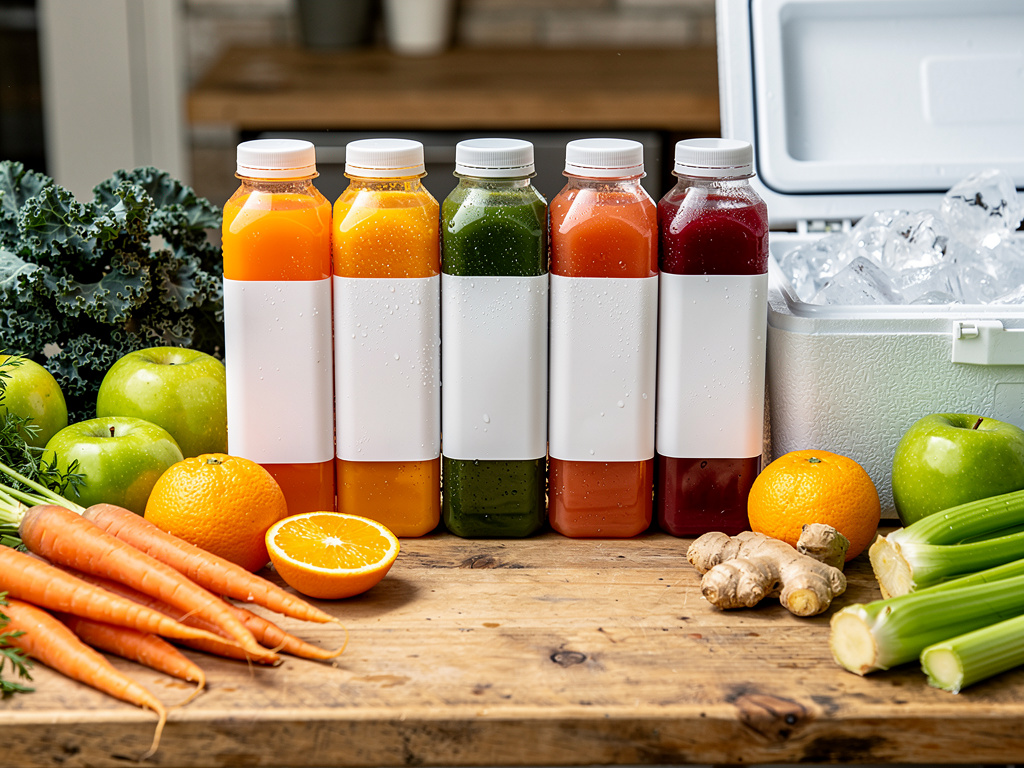


The short version: Sell a 16-ounce bottle of fresh juice for $10 to $12: start at $10 for carrot and fruit blends and $12 for green juice, which sits inside the $9 to $13 that six small juice makers listed when we looked on September 22, 2026. The produce is the big cost, not the bottle, at about $3.25 for carrot, apple, and ginger, $3.50 for a green juice, and $5.13 for straight orange juice at grocery prices. With about $1.03 for the bottle, label, and ice and $2.85 of your time, a green juice made in your own kitchen costs about $7.38. In a rented kitchen at $25 an hour with a home-style juicer, full cost climbs to $11 to $14, so raise the price or get faster equipment before you sign a kitchen contract.
Checked on September 22, 2026: juice prices come from each maker's own menu or product page, produce prices from the Bureau of Labor Statistics August 2026 averages and the USDA Economic Research Service, juicer yields from a juicer maker's measured test, and platform fees from the Homegrown, Hotplate, Shopify, and Square pricing pages. Fresh juice is not a cottage food in many states, so check your state before you price a home-made bottle. Homegrown customers create an account to place a first order, there is no countdown-timer release feature, and most of your orders will come from people you send to your own link.
You pressed forty bottles last night. They are lined up in the fridge, and fresh raw juice only keeps for a few days. Now you need a number for the chalkboard. Charge $6 because the grocery store sells a bottle of orange juice for $4, and you lose money on every green juice you make. Charge $15 and half the fridge rides home with you.
This guide gives you the number and the math behind it, bottle by bottle, so you can move it for your own produce prices and your own kitchen. It is the pricing companion to how to sell fresh juice at a farmers market, which covers permits, equipment, booth setup, and startup costs. Read that one to get legal and set up. Read this one for the price on the bottle.
Charge $10 to $12 for a 16-ounce juice, and start at $10 if you are not sure. That is the range small juice makers listed on their own menus on September 22, 2026: $9 for straight organic orange juice, $9.50 to $10 for most blends, and $13 at the top end for juice in glass bottles.
Here is what real small juice businesses listed, read from their own menus and product pages on September 22, 2026:
Swipe left to see every maker.
| Business | Where | Juice | Size | Price | How it sells |
|---|---|---|---|---|---|
| Wholota Wellness | Brooksville, FL | Organic orange juice | 16 oz glass jar | $9.00 | Local pickup only |
| Gather Juice Co. | Tacoma, WA | Cold-pressed blends | 16 oz | $9.50 to $10.00 | Juice shop, order ahead online |
| Juice Melody | Tampa Bay, FL | Cold-pressed blends | 16 oz | $10.00 | Mobile, pressed to order, 5-bottle minimum |
| Fresh Press Juice Co. | Bernardsville, NJ (3 shops) | Made on the spot | 16 oz | $11.00 | Juice shop |
| Soulshine Juice | Grand Haven, MI | Cold-pressed blends | 16 oz glass | $13.00 | Pre-order, pickup at a Saturday farmers market or its Grand Haven store |
| Living Color Juice | Los Angeles, CA | Green juice $12, other juices $10 | 15 oz glass | $10.00 to $12.00 | Delivery ($50 minimum) and two LA stockists; online menu showed every juice sold out |
Prices read from each business's own menu or product page on September 22, 2026; Fresh Press Juice Co.'s come from the November 2025 menu its site links to. Living Color's online menu showed every juice as sold out that day, and its product records were last edited in July 2020, so treat its prices as old. The Fresh Press menu also sold cold-pressed juice in 12-ounce glass bottles for $11.73, about $15.64 for 16 ounces; the $9 to $13 range in this guide uses its made-on-the-spot price. Juice Melody's minimum is 5 bottles for $50. Soulshine takes orders until Tuesday for Saturday pickup at the Holland Farmers Market and pays back $2 for each clean glass bottle returned. Crop Juice in Florida, an all-organic shop, charged $11 to $19 for 12 ounces that day, about $14.67 to $25.33 for 16 ounces, well above every price in the table.
Two numbers sit well below this range, and it helps to know why. The USDA Economic Research Service put the average store price of ready-to-drink orange juice at about $1.15 for 16 ounces in its 2023 price data. A regional bottled brand, Natalie's orange juice, listed at $3.99 for 12 ounces (about $5.32 for 16 ounces) on a Florida grocery delivery site the day we checked. Those are made at factory scale from oranges bought by the truckload. Your customer is not comparing you to them. They are comparing you to the juice shop down the street. Where you sell shapes the order size too: the places to sell juice range from a single bottle at the market to a $48 six-pack for pickup, and at 2.9% + $0.30 the six-pack loses 3.5% to card fees against 5.9% on one $10 bottle.
The produce in a 16-ounce bottle costs about $3 to $5 at grocery prices. In your own kitchen, it is usually your biggest single cost. In a rented kitchen, the rent can cost more than the produce. It is easy to assume the bottle or the equipment is the big expense, but the fruit and vegetables cost more. A 16-ounce bottle holds the juice of about 2 pounds of fruit and vegetables. Gather Juice Co. prints "About 2 lbs of produce per bottle" right on its menu, and Goodnature, a juice press maker, puts the average at about 1.6 pounds.
To build the cost sheets below, we used yields from Kuvings, a juicer maker that weighed how much of 13 fruits and vegetables it took to make one cup of juice on its own slow juicer. We priced the produce with the Bureau of Labor Statistics averages for August 2026 where they exist (oranges and lemons) and the USDA Economic Research Service's 2023 retail prices for the rest. Prices have risen since 2023, so treat those as a floor.
Drag the table to see each recipe.
| Bottle (16 oz) | What goes in | Produce weight | Produce cost |
|---|---|---|---|
| Carrot, apple, ginger | 10 oz carrot juice, 6 oz apple juice, a 2 oz knob of ginger | 2.2 lb | $3.25 |
| Green juice | 5 oz cucumber, 5 oz celery, 3 oz kale, 3 oz apple, half a lemon | 1.9 lb | $3.50 |
| Straight orange juice | About 4 large navel oranges | 3.0 lb | $5.13 |
Yields from Kuvings' measured test (for example, 1.13 pounds of carrots or 0.86 pounds of apples per cup of juice). Prices: navel oranges $1.71 a pound and lemons $2.11 a pound (BLS, August 2026); carrots $1.01, apples $1.86, celery $1.33 (whole trimmed bunches), kale $3.57, and cucumbers $1.09 a pound (USDA ERS, 2023). Ginger is figured at $5 a pound, an assumption; swap in your store's price. Both recipes fill a little over 16 ounces, about 17, once the ginger or lemon juice goes in, so these produce costs run slightly high. Checked September 22, 2026.
Your numbers will move with your juicer and your produce. A press squeezes more juice out of the same pound than a home slow juicer. Firm, fresh produce yields more than tired produce. The only way to know your real number is to weigh what goes in and measure what comes out for your first three sessions.
For the full method, including how to spread one bag of apples across three recipes, walk through how to calculate your real cost per product.
Straight orange juice costs more to make because oranges gave up less juice per pound than almost everything else in Kuvings' test, so a 16-ounce bottle takes about 3 pounds of fruit. Only pineapple, at 1.75 pounds for a cup, clearly did worse; Kuvings' watermelon entry lists two weights that do not match, so we left it out. In Kuvings' test, 2 large navel oranges weighing 1.5 pounds made a little over one cup. At $1.71 a pound that is about $5.13 of oranges in one bottle, more than the $3.50 of produce in the green juice.
That catches people off guard, because orange juice looks like the cheap everyday drink next to a premium green juice. Blending orange with carrot or apple stretches the orange flavor with produce that yields more juice for the money.
You have a few ways to handle it:
The bottle, label, and ice add about $1.03 to each 16-ounce bottle. That is small next to the produce, but it is real money across a season, and it grows fast if you switch to glass.
Glass changes the math. Glass bottles cost more than plastic ones, so shops that use glass often ask for the bottle back. Soulshine charges $13 and pays $2 for each clean glass bottle returned. Living Color's online menu lists $12 for green juice and $10 for everything else, all in glass, though every juice showed as sold out on September 22, 2026. Its bottle return policy takes $1 off the next juice for each clean bottle a customer brings back. That turns an expensive bottle into a reason for the customer to come back next week.
Every bottle of juice also needs a warning on the label unless it went through a process proven to cut harmful bacteria at least 100,000-fold, which the rule calls a 5-log reduction, such as a tested pasteurization or high-pressure step. Under the federal rule for juice that has not been processed to reduce harmful bacteria, the label must say: "WARNING: This product has not been pasteurized and, therefore, may contain harmful bacteria that can cause serious illness in children, the elderly, and persons with weakened immune systems." The word WARNING goes in capitals and bold, set off in a box. It costs nothing extra if you design it into your label from day one. Our cottage food labeling guide covers the rest of the label.
Your time adds about $2.85 to $3.30 a bottle if you pay yourself $18 an hour and use a home slow juicer. Juicing is slow work. In Kuvings' test, one cup of kale juice took 6 minutes and one cup of celery juice took 3 minutes, before you wash, cut, bottle, cap, and label anything.
Add those feed times up for a green juice and you get a little over 5 minutes of juicing per bottle. We rounded to 8 hands-on minutes per bottle to cover washing, cutting, and bottling, plus 1 hour per session to set up and clean the juicer. Those are assumptions, so time your own session and replace them.
Scroll sideways to see the full cost columns.
| Session size | Hours | Your time per bottle at $18/hr | Full cost, carrot apple ginger | Full cost, green juice | Full cost, orange juice |
|---|---|---|---|---|---|
| 20 bottles | 3.7 | $3.30 | $7.58 | $7.83 | $9.46 |
| 40 bottles | 6.3 | $2.85 | $7.13 | $7.38 | $9.01 |
Full cost = produce from the cost sheet above + $1.03 for bottle, label, and ice + your time. Hours = 1 hour of setup and cleanup + 8 minutes per bottle. This is a kitchen you already have, with no rent. Figured September 22, 2026.
Look at what that means for the price. A $10 carrot juice made 40 at a time leaves about $2.87 over full cost. A $12 green juice leaves about $4.62. Orange juice at $10 barely clears its $9.01 cost, and $11 is only about a 22% markup, below the 25% floor in the steps further down, which is why we start it at $12.
Bigger sessions help, but only a little, because the setup hour is the only part that gets spread out. The per-bottle minutes stay the same. The real jump in speed comes from equipment: a hydraulic press handles pounds of produce at a time instead of one piece at a time. The next section shows why that matters most when you pay for kitchen time by the hour.
Renting a commercial kitchen at $25 an hour adds about $4 to $4.60 a bottle with a home slow juicer, which pushes full cost to $11 to $14. At the high end, that is above the $9 to $13 the small juice makers in our first table charged, and even the cheapest bottle, $11.09, leaves less than $1 at $12. CBG Shared Kitchen in Houston charged $25 an hour on its hourly plan, and Cleveland Central Kitchen charged $25 an hour at peak times and $17 an hour overnight, plus $5 an hour for large equipment, both checked September 22, 2026.
Slide sideways for the rented-kitchen costs.
| Session size | Rent per bottle at $25/hr | Full cost, carrot apple ginger | Full cost, green juice | Full cost, orange juice |
|---|---|---|---|---|
| 20 bottles | $4.58 | $12.16 | $12.41 | $14.04 |
| 40 bottles | $3.96 | $11.09 | $11.34 | $12.97 |
Same inputs as the home-kitchen table plus kitchen rent for every hour of the session. Kitchen rates from CBG Shared Kitchen and Cleveland Central Kitchen pages, checked September 22, 2026. Overnight rates, storage shelves, and equipment fees change the numbers; use your kitchen's rate sheet.
So in a rented kitchen, a $10 carrot juice loses money at both session sizes. You have three honest fixes:
Whether you can press juice at home at all depends on your state, and it decides which table above is yours. Washington's cottage food rules list "Juices made from fresh fruits or vegetables" and "Beverages" as prohibited products. Georgia's cottage food FAQ says no beverages are allowed. Illinois Extension says fresh-pressed juice is allowed under Illinois cottage food if it is bottled and labeled at home with the warning statement, but not made to order at a market. All three were read on September 22, 2026. Check your own state and county before you price a home-made bottle.
If your state says no, the rented-kitchen table is your real cost from day one. Our guides to renting a commissary kitchen and TCS foods under cottage food law cover the options. TCS means food that needs time and temperature control to stay safe, and fresh juice is one.
Price a juice by adding produce, packaging, your time, and any kitchen rent per bottle, then adding a markup of about 25% to 40% on top. Here is the order to work in, with the green juice from this guide as the example:
The markup step is where most new vendors guess. Our farmers market pricing formula multiplies full cost by 2 to 3 so the multiplier also covers booth fees, travel, and insurance. Juice rarely supports that: 2 times the $7.38 green juice is $14.76, well above the $9 to $13 small juice makers charge. So count your booth fee per bottle directly instead and keep the markup smaller. A $50 booth fee spread over 40 bottles adds $1.25 a bottle.
A 12-ounce cup should sell for about 80% of your 16-ounce bottle price, so $8 when the bottle is $10. Fresh Press Juice Co. priced its made-on-the-spot juice at $9 for 12 ounces and $11 for 16 ounces on its November 2025 menu, which works out to about 82%.
The cup uses three quarters of the produce, but it does not save three quarters of the work. You still wash, cut, and juice for every customer, one at a time. A cup and lid cost less than a bottle and label, though.
Before you plan a cup menu, check your permit. Made-to-order juice at a market is where the rules get strictest:
If you can sell cups, they are a strong add-on. Lemonade is the cheapest cup to add: the lemons and sugar in a 24-ounce cup cost about 87 cents at August 2026 prices, and lemonade stands charge $5 to $6 for that cup. A customer who tries an $8 cup at the booth is a good person to offer a 6-bottle pre-order for next week.
Price a 2-ounce ginger shot at $3 to $6, not $2, because ginger yields so little juice. In Kuvings' test it took 2 ounces of ginger root to make a 1-ounce ginger shot. A 2-ounce straight ginger shot holds about 4 ounces of ginger, or about $1.25 at $5 a pound. Add a 2-ounce bottle at $0.38 (650 for $244.49 on WebstaurantStore on September 22, 2026), a $0.15 label, and about 2 minutes of juicing at $18 an hour ($0.60, since Kuvings timed 55 seconds for a 1-ounce shot), and one shot costs about $2.38 before you wash and peel anything. A 25% markup on that is $2.98, which is why $3 is the floor.
Gather Juice Co. charged $2.50 a shot on September 22, 2026, and $16 for a 16-ounce bottle holding 8 shots. That price covers both its Immunity shot, which blends ginger with lemon, turmeric, and cayenne, and a straight fresh ginger shot. At the costs above, Gather's $2.50 shot and its $2 a shot in the 8-shot bottle sit below that floor. Other makers charged more: Soulshine sold a ginger shot for $6.00, and Fresh Press Juice Co.'s November 2025 menu listed ginger among its $5 tonic shots. Neither page gives the shot size.
Most juice makers price a bundle or cleanse a little below their single-bottle price, so start from your bottle price times the number of bottles and check any discount against your full cost before you offer it. On the menus we read September 22, 2026, Juice Melody, Soulshine, and Living Color took about 16% to 22% off per bottle in their cleanses and 6-packs, and Gather's cleanse bottles came to about the same as its singles. Juice Melody sold a 3-day cleanse of 18 bottles for $149, about $8.28 a bottle against $10 for one, and Living Color's online menu, sold out that day, listed a 3-day cleanse of 18 juices for $171 against $204 at its single prices. Its 6-pack of any 6 juices for $60 works out to $10 a bottle, which is $2 off each $12 green juice and nothing off its $10 juices. At 17% off, a $10 carrot juice sells for $8.30, only about 16% over its $7.13 home-kitchen cost and below the 25% floor in the steps above. A cleanse also helps you plan: you know exactly how many bottles to press, and nothing goes to waste.
Fresh Press Juice Co. priced its cleanse the same way. Its November 2025 menu listed a 3-day "Fresh Start" cleanse at $110 with three named 16-ounce juices, a 1-ounce aloe shot, and a cooler tote, and its cleanse page says Fresh Start is three juices a day. That works out to about $12.22 for 16 ounces before the extras. The same menu sold its cold-pressed juice in 12-ounce glass bottles for $11.73, about $15.64 for 16 ounces, so the cleanse juice cost about 22% less per ounce. The live cleanse page now asks you to call for pricing, so $110 is the November 2025 price. Juice Melody sells single bottles at $10 each with a 5-bottle, $50 minimum order, which keeps every order worth pressing.
A simple way to set yours up:
Our guide to bundle pricing for food vendors covers how to show a bundle so it sells without cutting your margin.
You can, but selling juice to a cafe or shop usually changes which federal rules you follow, and that changes your cost. The federal juice safety rule, called juice HACCP, does not count a business that sells juice directly to consumers as a juice processor. The moment you sell juice to other businesses too, you lose that retail status. The Illinois farmers market guide puts it plainly: juice HACCP regulations must be followed if juice is sold wholesale.
A HACCP plan is a written food safety plan with steps that must cut harmful bacteria by a set amount. For raw juice that usually means a validated process, testing, and records, which is a real cost in time and often in equipment.
If you still want wholesale, run the numbers first:
Our restaurant wholesale price sheet guide shows how to build the sheet once you know your floor. With the numbers in this guide, direct sales at $10 to $12 a bottle pay better than wholesale.
Selling fees take $0.41 to $1.64 off a $10 bottle of juice, depending on where the sale happens and who pays the service fee. The biggest difference is not the card rate, which runs close to 3% plus 30 cents almost everywhere online. It is whether there is a monthly plan, and whether a service fee is added on top.
Swipe the table to compare every platform.
| Platform | Monthly plan | Trial | Service or platform fee | Card processing | Customer pays on a $10 bottle | Vendor pays on a $10 bottle | Vendor pays in a month of 50 orders at $10 |
|---|---|---|---|---|---|---|---|
| Homegrown | $10 billed annually ($12.50 monthly) | 7 days, no charge until day 8 | None, 0% commission | 2.9% + $0.30, paid by the vendor | $10.00 | $0.59 plus the plan | $39.50 ($42.00 on monthly billing) |
| Hotplate, default | $0 | No plan to try | 5% + $0.55, paid by the customer | 2.9% + $0.30, vendor pays | $11.05 | $0.59 | $29.50 |
| Hotplate, vendor covers the service fee | $0 | No plan to try | 5% + $0.55, paid by the vendor | 2.9% + $0.30, also on the vendor | $10.00 | $1.64 | $82.00 |
| Shopify Basic | $29 billed yearly ($39 monthly) | 3 days, then $1 a month for 3 months | None with Shopify Payments (2% with another provider) | 2.9% + 30¢ online for standard cards, 3.5% + 30¢ for premium cards | $10.00 | $0.59 plus the plan | $58.50 ($68.50 on monthly billing) |
| Square Free, online | $0 | No plan to try | None | 3.3% + 30¢ | $10.00 | $0.63 | $31.50 |
| Square Free, card at your booth | $0 | No plan to try | None | 2.6% + 15¢ tap, dip, or swipe | $10.00 | $0.41 | $20.50 |
We checked every fee on the Homegrown, Hotplate, Shopify, and Square pricing pages on September 22, 2026. Card processing is figured on the $10 price; a platform that charges it on the total with fees, tips, and tax runs a few cents higher. Shopify's $0.59 uses its standard online card rate. The month assumes 50 separate $10 orders; bigger orders spread the fixed cents per transaction across more bottles.
Monthly cost to the vendor at 50 orders of $10
Each bar includes the plan, any service fee the vendor pays, and card processing (2.9% + $0.30 online on Homegrown, Hotplate, and Shopify; 3.3% + 30¢ online and 2.6% + 15¢ at the booth on Square). Source: the fee table above, from each platform's pricing page checked September 22, 2026. Rounded to the dollar. Hotplate's default adds $52.50 to your customers' totals across the same month.
Hotplate's default looks like the cheapest online option for you, but your customer pays $11.05 for a $10 juice. On a product that already sits at the top of what people expect to pay, that extra $1.05 at checkout is noticeable. If you choose to cover it yourself, Hotplate becomes the most expensive line in the table.
Fees change. Every number in this table came from the platforms' own pricing pages the day this guide was checked, September 22, 2026. Load the page again before you choose, and compare annual billing to annual billing and monthly to monthly.
Taking juice pre-orders from your own link costs $10 a month on Homegrown billed annually ($12.50 billed monthly), with no percentage fees beyond standard payment processing. For a product that only keeps a few days, pressing to orders people have already paid for is what protects your price. Every bottle you press on a guess is a bottle that might end up in the compost at $8 of cost.
A Homegrown storefront gives you one link where customers see your juices, pick a size, and pay before you press. You can offer pickup at your market booth or your home, or delivery to their door. On a $10 bottle you pay $0.59 in card processing and your customer pays $10.00, with no service fee added at checkout. Card processing is 2.9% + $0.30, paid by you, with no option to pass it to the customer.
Compare that to the other ways juice vendors take orders:
Homegrown does not make your juice legal, print your warning label, or track bottle returns. Customers create a Homegrown account the first time they order. There is no countdown or timed release feature. Your storefront is listed on the Homegrown marketplace, but plan on most orders coming from people you send to your own link: your market regulars, your Instagram followers, and your email list.
If one bottle in five goes unsold, add about $2 to the real cost of every bottle you do sell. Fresh raw juice lasts only a few days in the fridge, so leftover bottles rarely make it to next week. On a green juice with a $7.38 full cost, losing 8 of 40 bottles raises the cost of each bottle sold to $9.22. Your $12 price now leaves $2.78, not $4.62.
Losing 1 bottle in 10 is much easier to live with: the same green juice costs $8.20 per bottle sold. That is why the best juice vendors press to orders first and treat walk-up sales as the extra.
Close pre-orders two days before you press, press exactly those bottles plus about 5 extra per flavor for walk-ups, and write down how many walk-up bottles you sold. After four weeks you will know your real walk-up number, and your waste can drop close to zero.
A few more ways to cut waste:
Tired of guessing how many bottles to press? Set up a Homegrown storefront and take paid juice pre-orders for your next market day, so you press to real orders instead of a hunch. For more ways to fill the order sheet, see our guide to taking pre-orders for your food business.
Juice is a small but real category on Homegrown: in our August 2026 catalog pull, 3 of 219 vendors sold fruit or vegetable juice by the bottle, not counting apple cider, and a fourth, Immunity Artisan, listed a 2-ounce ginger turmeric wellness shot. Two juice makers, Bayou Juice Plug and Juicy's Juices, listed 28 drinks and two gift baskets between them, and Frugally Bougie listed a beet juice, a 3-day cleanse, and wellness shots among other drinks. The wider Beverages category held 42 of the 1,804 products, from 7 vendors, and also includes drinks like kava refreshers and a latte.
In a pull of the Homegrown catalog on August 14, 2026, 42 of the 1,804 products listed by 219 vendors were in the Beverages category, from 7 vendors. Bayou Juice Plug listed 22 drinks, and Juicy's Juices listed red and orange juice in 8-ounce and 16-ounce sizes, green juice in two listings, and two gift baskets, 8 listings in all, 7 of them in Beverages. Only 7 products had the word "juice" in the name, all from two vendors. Juicy's Juices sells its juices in 8-ounce and 16-ounce sizes, which is one reason this guide prices smaller sizes as well as the 16-ounce bottle.
For a juice vendor, a thin category is good news. A customer looking for fresh juice nearby does not have 30 choices. It also means you should not wait for the marketplace to send you customers.
The most common mistake is pricing juice against the grocery store instead of against your own cost sheet. A $4 bottle of factory orange juice tells you nothing about what your 3 pounds of oranges cost. Here are the others to watch for:
Most small juice makers charge $10 to $12 for 16 ounces of fresh or cold-pressed juice. Start at $10 for carrot and fruit blends and $12 for green juice, then adjust for your produce costs and your market. Six small juice businesses we checked on September 22, 2026 listed $9 to $13 for about 16 ounces. One price comes from a November 2025 menu, using its made-on-the-spot price. Another comes from an online menu last edited in 2020 that showed every juice as sold out.
Aim for a markup of 25% to 40% on your full cost, which includes produce, bottle, label, ice, your time, and any kitchen rent. A green juice that costs $7.38 to make in your own kitchen and sells for $12 has a markup of about 63%, which leaves room for fees and a few unsold bottles. Markup is profit as a share of cost; margin is profit as a share of the price, so the same bottle has a margin of about 39% ($4.62 of $12). In a rented kitchen at $25 an hour, the same $12 price leaves $0.66 on a 40-bottle session ($11.34 full cost) and loses money on a 20-bottle session ($12.41 full cost).
Filling 16 ounces with fresh orange juice takes about 3 pounds of oranges, or about 4 large navel oranges. At the August 2026 average of $1.71 a pound, that is about $5.13 of fruit before the bottle and your time. Buying oranges by the case at a lower price is the fastest way to bring that down.
Start at your bottle price times the number of bottles, plus anything extra you include, like a cooler bag, then decide on a discount. Most makers take a little off: Juice Melody's 3-day cleanse of 18 bottles was $149 on September 22, 2026, about $8.28 a bottle against $10 for one. Check that the discounted bottle still clears your full cost plus your markup. Fresh Press Juice Co.'s cleanse also came in lower. Its November 2025 menu, read September 22, 2026, listed a 3-day cleanse of three 16-ounce juices a day for $110, plus a 1-ounce aloe shot and a cooler tote. That is about $12.22 for 16 ounces. Its bottled cold-pressed juice was $11.73 for 12 ounces, about $15.64 for 16. Its cleanse page now asks you to call for current pricing.
Plan on about 8 to 10 ounces of juice from a pound of mixed produce, so a 16-ounce bottle takes 1.6 to 2 pounds. Goodnature, a juice press maker, puts the average at about 10 ounces per pound. Cucumber gave the most juice in Kuvings' test, about a cup from three quarters of a pound. Leafy greens, carrots, and oranges give less. Weigh your own produce and measure your juice for your first few sessions, because every juicer is different.
It depends on your state. Washington's cottage food rules prohibit juices made from fresh fruits or vegetables, and Georgia allows no beverages under cottage food. Illinois allows fresh-pressed juice bottled and labeled at home with the federal warning statement. Check your state and county rules before you set a price, because a rented kitchen changes your cost per bottle.
More on pricing and selling drinks at the market:
Your juice prices should live on a menu customers can order from any day of the week, not just on a chalkboard on Saturday. Juice is a weekly habit for the customers who love it, and a customer who buys 2 bottles every week is worth about $1,040 a year at $10 a bottle. The easier it is to reorder, the more of those customers you keep.
Put your flavors, sizes, and prices on one page, using the numbers you worked out in this guide:
Share the link on your booth sign, your bottle labels, and your Instagram bio. When you open your Homegrown storefront, you can list every juice and size at the price you worked out here and take paid pre-orders for pickup at your next market.



