
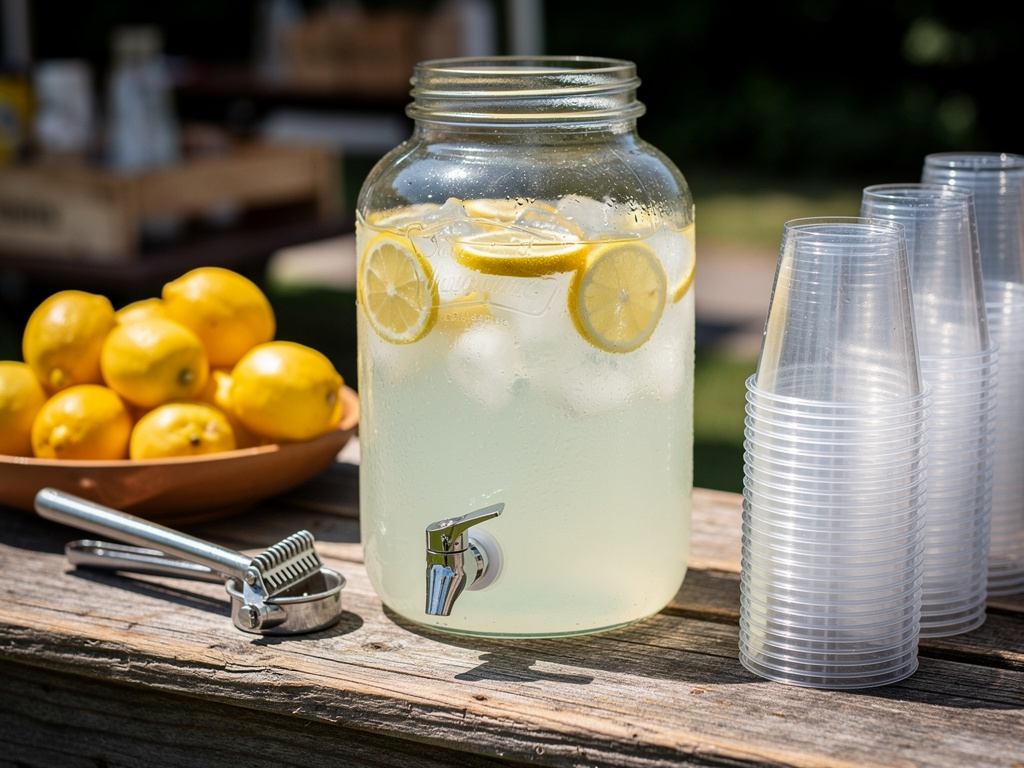


The short version: Sell fresh lemonade for $5 in a 24-ounce cup, or $6 at a big festival, and $7 to $8 in a 32-ounce cup. On September 23, 2026, the one business we checked that sells a 24-ounce cup charged $5 for it on its own menu, and 32-ounce cups ran $7 to $8. One 24-ounce cup costs about $1.40 to make: $0.87 of lemons and sugar at August 2026 grocery prices, $0.23 of supplies and ice, and $0.30 of your time. At $5, the 14th cup pays off a $50 booth fee. Party gallons ordered ahead can go for $18 to $20, and a kids' stand using real lemons should charge $1 a cup.
Checked on September 23, 2026: cup prices come from each lemonade business's own menu, lemon, sugar, and strawberry prices from the Bureau of Labor Statistics August 2026 averages, and cup and lid prices from WebstaurantStore's case prices. Platform fees come from the Homegrown, Hotplate, Shopify, and Square pricing pages. An adult lemonade booth usually needs a health permit, so check with your local health department before you set a price. Homegrown customers create an account to place a first order, there is no countdown-timer release feature, and most of your orders will come from people you send to your own link.
It is 94 degrees, the market opens in an hour, and you have a cooler of lemons and a stack of cups. Now you need a number for the sign. Charge $2 because that is what lemonade "should" cost, and you work a hot eight-hour day for very little. Charge $10 and people walk past to the snow cone truck.
This guide gives you the number and the math behind it, cup by cup, so you can move it for your own lemons, your own cups, and your own booth fee. It covers lemonade sold by the cup, by the gallon for parties, and for kids' stands. If you want to sell bottled lemonade concentrate that customers mix at home, start with how to sell lemonade concentrate from home, which covers the rules, the recipe, and storage, then come back here for the price.
Charge $5 to $6 for a 24-ounce cup and $7 to $8 for a 32-ounce cup of fresh lemonade at a market, fair, or ballgame. If you only sell one size, a 24-ounce cup at $5 is the safest start. When we checked their own menus and websites on September 23, 2026, the one business that priced a 24-ounce cup charged $5, and three businesses priced 32 ounces at $7 or $8. The $6 is our suggestion for a busy festival or fair.
Swipe left to see every lemonade business.
| Business | Where | What they sell | Size | Price | Extras |
|---|---|---|---|---|---|
| Miss Mae's Marvelous Lemonade (MMM Lemonade) | Yuma, AZ | Original, pink, and sugar-free lemonade | 24 oz and 32 oz | $5 and $7 | Add fruit for $1; frozen and specialty lemonades $7 and $10 |
| J&J Squeezed Lemonade | Not listed on its site | Lemonade squeezed and mixed to order | 32 oz | $8 | Any fruit mix-in $1; refill jar $16, then $5 refills |
| Lemonade Pick Me Up's | Park Forest, IL | Flavored lemonades from a mobile trailer | Large | $7 | Other sizes not priced on the page |
| Boo Boo's Lemonade (catering) | Frisco, TX | Fresh-squeezed, made to order at events | 32 oz | $8 classic, $9 with flavors | Price per serving, with staff, cups, and ice included |
| Miles Farmers Market (a market store) | Solon, OH | Fresh squeezed lemonade, bottled | Half gallon | $5.99 | Classic, blueberry, or strawberry |
Prices read from each business's own website on September 23, 2026. MMM Lemonade's events page listed stops at Yuma, Arizona ballfields and schools that week. Boo Boo's price is a catering package price per serving for a 3-hour event, not a walk-up price; the business also sells at the Frisco Fresh Market and the Dallas Farmers Market. Miles Farmers Market is a grocery-style market store, so its half gallon is a take-home bottle, not a cup at a booth.
A take-home half gallon from a store sells for about $6, which is about 9 cents an ounce. A 32-ounce cup from a lemonade stand sells for $7 to $8, which is about 22 to 25 cents an ounce, before ice takes up part of the cup. Customers pay more than twice as much per ounce for a cold cup handed to them on a hot day, because they are paying for the cup, the ice, and the moment, not just the lemonade.
The lemons and sugar in a 24-ounce cup of lemonade cost about $0.87 at August 2026 grocery prices. That is the biggest single cost in the cup, but it is still less than a dollar, which is why lemonade can carry a healthy markup.
We built the cost sheet from a common starting recipe: 1 cup of fresh lemon juice, 1 cup of sugar, and 6 cups of water. That makes about 60 ounces of lemonade once the sugar dissolves. Adjust it to your taste, then redo the math with your own amounts.
Drag the table to see each cup size.
| Cup size | Lemonade in the cup (two thirds, the rest is ice) | Lemons and sugar per cup | About how many lemons |
|---|---|---|---|
| 16 oz | 10.7 oz | $0.58 | 1 to 1.2 |
| 24 oz | 16 oz | $0.87 | 1.4 to 1.8 |
| 32 oz | 21.3 oz | $1.16 | 1.9 to 2.4 |
| Full batch | 60 oz | $3.27 | 5 to 7 |
One batch = 1 cup lemon juice ($2.82 of lemons at $2.114 a pound) + 1 cup sugar ($0.45 at $1.024 a pound) + 6 cups water, about 60 ounces, or about 5.45 cents an ounce. Lemon and sugar prices are BLS U.S. city averages for August 2026, pulled September 23, 2026. Juice yield from WebstaurantStore's citrus juice guide, read the same day. The two-thirds lemonade, one-third ice split is our assumption; weigh a filled cup of yours.
Lemon prices move with the season. The BLS average ran from $1.96 a pound in February 2026 to $2.13 in July 2026, so the same cup costs a few cents more at the height of lemonade season. That is small, but lemons are your biggest cost, so compare a produce wholesaler's case price with the grocery price.
For the full method of turning a bag of ingredients into a cost per item, walk through how to calculate your real cost per product.
The cup, lid, straw, and ice add about $0.23 to a 24-ounce cup of lemonade. Bought by the case, disposable cups are cheap. If you buy a small pack at a grocery store instead, work out its price per cup and compare it with the case price before you buy.
Scroll sideways for every supply cost.
| Cup size | Cup | Lid and straw | Ice | Supplies per cup |
|---|---|---|---|---|
| 16 oz | $0.06 | $0.05 | $0.07 | $0.18 |
| 24 oz | $0.08 | $0.05 | $0.10 | $0.23 |
| 32 oz | $0.17 | $0.05 | $0.13 | $0.35 |
Cup and lid prices from WebstaurantStore case prices on September 23, 2026. Straw and ice are our assumptions; swap in what you pay.
Reusable cups flip this math. J&J Squeezed Lemonade sold a refill jar full of lemonade for $16 and refilled it for $5 on September 23, 2026. A refill customer skips the new cup and lid, and comes back to your booth to use the jar.
Your time adds about $0.30 a cup if you pay yourself $18 an hour and spend about one hands-on minute per cup. That minute covers your share of cutting and squeezing lemons, mixing the batch, filling the cup, and taking payment. It is an assumption, so time your own stand for an hour and replace it.
Squeezing is the slow part. One 60-ounce batch takes 5 to 7 lemons, and a hand press gets through them in a few minutes. Squeezing to order, the way J&J Squeezed and Boo Boo's do, looks great to the line but takes longer per cup than pouring from a batch you squeezed that morning.
Your time is the cost most new vendors leave out. Over a six-hour market with 100 cups, the $0.30 a cup adds up to $30, which is real money even at a good booth.
A full 24-ounce cup of lemonade costs about $1.40 to make before your booth fee. That is 87 cents for the lemons and sugar, 23 cents for supplies and ice, and 30 cents for your labor. The table below shows all three sizes, with and without a $50 booth fee spread over 100 cups.
Swipe to see the full cost columns.
| Cup size | Lemons and sugar | Supplies | Your time | Full cost | With a $50 booth fee over 100 cups | Suggested price |
|---|---|---|---|---|---|---|
| 16 oz | $0.58 | $0.18 | $0.30 | $1.06 | $1.56 | $4 |
| 24 oz | $0.87 | $0.23 | $0.30 | $1.40 | $1.90 | $5 to $6 |
| 32 oz | $1.16 | $0.35 | $0.30 | $1.81 | $2.31 | $7 to $8 |
Built from the two tables above and 1 hands-on minute per cup at $18 an hour. The $50 booth fee and 100 cups are an example; use your market's fee and your own sales. Figured September 23, 2026.
Those prices look like a big markup, and on a good day they are. A $5 cup that costs $1.90 with the booth fee leaves $3.10. But lemonade sales swing hard with the weather. A cool, cloudy Saturday sells far fewer cups than a hot one, and your booth fee does not shrink with the crowd. The markup is what carries you through the slow days.
Price lemonade by adding up lemons and sugar, cup supplies, and your time per cup, then setting a price that covers your booth fee on a slow day and still sits near what other stands charge. Here is the order to work in, using the 24-ounce cup from this guide:
Our farmers market pricing formula multiplies full cost by 2 to 3. Lemonade clears that easily: 3 times the $1.40 cup is $4.20, so $5 leaves room for card fees, spills, and lemonade you pour down the drain at the end of the day.
At $5 for a 24-ounce cup, you need to sell 14 cups to pay a $50 booth fee. Each cup leaves $3.60 after its $1.40 cost, and $50 divided by $3.60 is 13.9, so the 14th cup is where you start making money. Drop the price to $3 and you need 32 cups just to pay for the booth.
Slide sideways for every price.
| Price for a 24-oz cup | Left after the $1.40 cost | Cups that pay a $50 booth fee | Profit on 100 cups after the booth fee |
|---|---|---|---|
| $3 | $1.60 | 32 | $110 |
| $4 | $2.60 | 20 | $210 |
| $5 | $3.60 | 14 | $310 |
| $6 | $4.60 | 11 | $410 |
| $7 | $5.60 | 9 | $510 |
Uses the $1.40 full cost of a 24-ounce cup from this guide, which already includes $0.30 of your time. Card fees are not included; see the fee section below. Figured September 23, 2026.
Going from $3 to $5 a cup more than halves the number of cups you need to cover the booth and adds $200 on a 100-cup day. Our guide to your farmers market booth's break-even point shows how to add travel, insurance, and equipment to the same math.
A kids' neighborhood stand should charge $1 for a small cup of real lemonade, or 50 cents for a cup made from store-bought mix. Michigan State University Extension's youth lemonade series puts an average price for lemonade at 50 cents to $2 a cup. Its worked example made 100 ten-ounce cups from a store-bought juice mix for $16.64, about 17 cents a cup.
Real lemons change that. Eight ounces of lemonade from our recipe costs about $0.44 in lemons and sugar. Add a 10-ounce cup at about 4 cents (MSU's example paid $2.22 for 50) and a cup of real lemonade costs about 48 cents before any ice. At 50 cents, a kid who used real lemons earns 2 cents a cup. At $1, they earn 52 cents.
A few states protect kids' stands by law. In Texas, HB 234 bars cities, counties, and local health authorities from requiring a license, permit, or fee for the occasional sale of lemonade by someone under 18 from a stand on private property or in a public park. In Illinois, Hayli's Law keeps state and local health departments from regulating lemonade sales by anyone under 16, starting January 1, 2022. That means a kid covered by those laws can price the cup without a permit fee built in.
The Texas and Illinois laws cover kids, not adult vendors, and we read both on September 23, 2026. Other states handle kids' stands their own way, and some cities have rules of their own, so verify your state's current rules and ask your city before a child opens a stand on a busy corner.
Charge $1 more for strawberry or other fruit lemonade. Two of the businesses in our first table did exactly that on September 23, 2026: Miss Mae's added fruit for $1, and J&J Squeezed charged $1 for any fruit mix-in.
The math backs up the dollar. Strawberries averaged $2.58 for a 12-ounce pint in August 2026, according to BLS price data. If you blend about 2 ounces of strawberries into a cup, that is about $0.43 of fruit, so a $1 upcharge covers the fruit and the extra minute it takes. We assumed herbs and flavor syrups cost less per cup than fresh fruit, so price yours; if that holds, the same $1 leaves more.
Keep the menu short. Three or four flavors you can make fast will outsell twelve that slow the line down. Sweet Squeeze Lemonade in Washington lists more than 30 varieties, but a first-season stand does better with a classic and two fruit flavors.
Charge $18 to $20 for a gallon of fresh lemonade ordered ahead for a party. A gallon holds the lemons and sugar of a little more than two of our batches, about $6.98 at August 2026 prices. Add a jug at about $1 and 15 minutes of your time at $18 an hour ($4.50), both assumptions, and a gallon costs about $12.48 to make.
At $18, that leaves $5.52, or 31% of the price. At $20, it leaves $7.52, or 38% of the price. A strawberry gallon uses about a pound of berries, roughly $3.44 at the August 2026 pint price, so charge $4 more for it.
A gallon for a party sells differently from a cup at the booth:
A store-made half gallon at Miles Farmers Market in Ohio sold for $5.99 on September 23, 2026, which is $11.98 a gallon. Your price is higher because you squeeze it fresh the day of the party and hand it over cold. Say that on your order page.
Price a 16-ounce bottle of lemonade concentrate at $10 to $14, the range our lemonade concentrate guide gives. A concentrate is the lemon juice and sugar without most of the water, so the customer mixes it at home.
Say your 16-ounce bottle holds the lemon juice and sugar for about 60 ounces of lemonade, one of our batches. The ingredients cost about $3.27. Add about $0.70 for the bottle, $0.15 for a label, and about 5 minutes of your time ($1.50), which are our assumptions, and one bottle costs about $5.62. At $12, you keep $6.38.
Concentrate also solves lemonade's biggest problem, the weather. A cooler of cups only sells on a hot day, but a bottle in a customer's fridge turns into lemonade on any day they want it. That makes concentrate a good product for the cool months at the start and end of market season. It also pairs well with gallon orders: a customer who liked your gallon at a party can take home a bottle for next week.
A permit adds a real cost to every cup: an adult lemonade booth usually needs one from the local health department, and its fee belongs in your cost per cup just like your booth fee. The kids' stand laws in Texas and Illinois do not cover adult vendors. Utah, Colorado and Washington limit local permits for kids' stands too, each with its own age and day limits, and the guide to selling homemade lemonade legally lays out all five rules and what an adult booth permit cost in three cities. Texas's health department, for example, treats a booth that pours drinks for sale as a temporary food establishment, which generally needs a permit.
Many state cottage food laws, the rules that let you sell some foods made at home, leave out drinks. Our guide to whether you can sell homemade juice walks through how eight states handle it, and lemonade usually follows the juice rules.
Verify your state's current rules before you buy your first case of lemons. It is much cheaper to price a permit in than to be shut down after you set up.
On a $5 cup tapped at your booth, a card reader on Square's Free plan takes $0.28, or 5.6% of the sale, and cash costs nothing. On a $20 party order placed online, fees take $0.88 to $2.43 depending on the platform and who pays the service fee, or $0.67 if the customer taps a card at your booth instead. Online card rates run 2.9% to 3.3% plus 30 cents, and a card tapped at the booth costs less on Square. The bigger differences are the monthly plan and any service fee added on top.
Swipe the table to compare every platform.
| Platform | Monthly plan | Trial | Service or platform fee | Card processing | Customer pays on a $20 order | Vendor pays on a $20 order | Vendor pays in a month of 50 orders at $20 |
|---|---|---|---|---|---|---|---|
| Homegrown | $10 billed annually ($12.50 monthly) | 7 days, no charge until day 8 | None, 0% commission | 2.9% + $0.30, paid by the vendor | $20.00 | $0.88 plus the plan | $54.00 ($56.50 on monthly billing) |
| Hotplate, default | $0 | No plan to try | 5% + $0.55, paid by the customer | 2.9% + $0.30, vendor pays | $21.55 | $0.88 | $44.00 |
| Hotplate, vendor covers the service fee | $0 | No plan to try | 5% + $0.55, paid by the vendor | 2.9% + $0.30, also on the vendor | $20.00 | $2.43 | $121.50 |
| Shopify Basic | $29 billed yearly ($39 monthly) | 3 days, then $1 a month for 3 months | None with Shopify Payments (2% with another provider) | 2.9% + 30¢ online | $20.00 | $0.88 plus the plan | $73.00 ($83.00 on monthly billing) |
| Square Free, online | $0 | No plan to try | None | 3.3% + 30¢ | $20.00 | $0.96 | $48.00 |
| Square Free, card at your booth | $0 | No plan to try | None | 2.6% + 15¢ tap, dip, or swipe | $20.00 | $0.67 | $33.50 |
We checked every fee on the Homegrown, Hotplate, Shopify, and Square pricing pages on September 23, 2026. Card processing is figured on the $20 order; a platform that charges it on the total with fees, tips, and tax runs a few cents higher. The month assumes 50 separate $20 orders.
Monthly cost to the vendor at 50 orders of $20
Each bar includes the plan, any service fee the vendor pays, and card processing (2.9% + $0.30 online on Homegrown, Hotplate, and Shopify; 3.3% + 30¢ online and 2.6% + 15¢ at the booth on Square). Source: the fee table above, from each platform's pricing page checked September 23, 2026. Rounded to the dollar. Hotplate's default adds $77.50 to your customers' totals across the same month.
For cups, the fee that matters is the one on a small sale. The fixed 15 or 30 cents hits a $5 cup much harder than a $20 gallon. That is one reason lemonade vendors often round to whole dollars and take cash at the booth.
Fees change. Every number in this table came from the platforms' own pricing pages on September 23, 2026. Load the page again before you choose, and compare annual billing to annual billing and monthly to monthly.
Taking gallon and party orders from your own link costs $10 a month on Homegrown billed annually ($12.50 billed monthly), with no percentage fees beyond standard payment processing. For lemonade, ahead-of-time orders are the steady ones: a gallon at $18 to $20 leaves $5.52 to $7.52, it is squeezed to an exact count, and it does not depend on the weather. Birthday parties, offices, churches and youth sports teams are the usual gallon buyers, and the seven places lemonade actually sells shows how gallon orders fit next to a market booth or a festival stand.
A Homegrown storefront gives you one link where customers pick a gallon, choose classic or strawberry, pick a pickup time, and pay before you squeeze a single lemon. You can offer pickup at your market booth or your home, or delivery to their door. On a $20 order you pay $0.88 in card processing and your customer pays $20.00, with no service fee added at checkout. Homegrown also makes a printable QR code for your booth sign, so the people in your cup line can order a gallon for Saturday's birthday party from their phone.
Compare that to the other ways lemonade vendors take party orders:
Homegrown does not get you a health permit, squeeze lemons, or run the walk-up line at your booth; for walk-up cups, keep cash or a card reader. Customers create a Homegrown account the first time they order. There is no countdown or timed release feature. Your storefront is listed on the Homegrown marketplace, but plan on most orders coming from people you send to your own link: your market regulars, your neighborhood group, and the parents who stop at your stand.
Only one lemonade drink was listed on Homegrown in our August 2026 catalog pull: All Natural Lemonade Slushies from Frugally Bougie. Just 4 of 1,804 products had "lemonade" in the name, which leaves the category wide open. The other three were a pink lemonade cookie, a blackberry lemonade stuffed cookie, and a strawberry lemonade sourdough focaccia.
In a pull of the Homegrown catalog on August 14, 2026, 42 of the 1,804 products listed by 219 vendors were in the Beverages category, from 7 vendors. Only 4 products had "lemonade" in the name, from 4 different vendors, and just 1 was a drink: Frugally Bougie's All Natural Lemonade Slushies. The other 3 used lemonade as a flavor in a cookie or bread.
For a lemonade vendor, a thin category is good news. A customer looking for a gallon for a party nearby does not have a page of choices. It also means you should not wait for the marketplace to send you customers.
Put a small sign next to your cup price that says "Gallons for parties, $18, order ahead" with your QR code on it. If one customer in 25 orders a gallon, that is four gallon orders from a 100-cup day, about $22 more in profit with no line and nothing left over.
The most common mistake is pricing lemonade like a kids' stand at a market that charges an adult booth fee. At $2 a cup, you need more than 80 cups just to cover a $50 booth and the cost of each cup. Here are the others to watch for:
A 24-ounce cup should sell for $5, or $6 at a busy festival. A 32-ounce cup should sell for $7 to $8. Lemonade trailers and stands we checked on September 23, 2026 listed $5 for 24 ounces, $7 to $8 for 32 ounces, and $7 for a large. Start at $5 for a 24-ounce cup and add $1 for fruit flavors.
Fresh lemonade in a 24-ounce cup costs about $1.40 to make. Lemons and sugar run about 87 cents at August 2026 grocery prices, supplies and ice about 23 cents, and your labor about 30 cents. A 16-ounce cup costs about $1.06 and a 32-ounce cup about $1.81. Add your booth fee spread over the cups you sell.
Michigan State University Extension's youth lemonade series puts an average price for lemonade at 50 cents to $2 a cup, and it figures lemonade from a store-bought juice mix at about 17 cents a cup. If the lemonade is made from real lemons, $1 a cup is a better floor, since the lemons and sugar alone cost about 44 cents for 8 ounces.
A made-to-order gallon of fresh lemonade should sell for $18 to $20. A gallon takes about $6.98 of lemons and sugar at August 2026 prices, and with a jug and your time it costs about $12.48 to make. Charge about $4 more for strawberry lemonade.
Lemonade usually has a high profit margin on a hot day. A $5 cup that costs $1.40 to make has a margin of 72%, meaning $3.60 of every $5 is left before the booth fee. On a slow day the booth fee eats into that, so price to cover the fee with the cups you sell on a bad day, not a good one.
An adult lemonade booth at a market or event usually needs a health department permit, so check with your county before you set a price. Some states protect kids' stands: Texas bars local permits or fees for occasional lemonade sales by someone under 18, and Illinois's Hayli's Law covers sellers under 16. Other states have their own rules.
More on pricing and selling drinks at the market:
Ready to sell more than cups? Open your Homegrown storefront, list your gallons and flavors at the prices you worked out here, and take paid party orders for pickup at your next market.



