


The short version: Lemonade sells in seven places: a front-yard or park stand, farmers markets, fairs and festivals, gallon orders for parties and events, farm stands, school and church fundraisers, and cafes or food trucks that buy it from you. A cup sold straight to the drinker is the simplest case under the federal juice rules, though your city may still want a permit for a booth. On a $20 party gallon, card and platform fees run from $0.48 on Venmo's business profile to $2.43 when you cover Hotplate's 5% + $0.55 service fee yourself on top of its 2.9% + $0.30 card processing, and $0.88 through your own Homegrown link plus the $10 a month plan billed annually ($12.50 month to month). Selling fresh-squeezed lemonade to a cafe is the big jump, because it pulls you under the juice safety plan rule.
Checked September 26, 2026: fees read that day on findhomegrown.com/signup, squareup.com, Venmo's fees page, hotplate.com/pricing and shopify.com/pricing. Rules read that day in Texas Local Government Code section 250.009, Colorado SB19-103, Washington's WAC 246-215-01115, the Houston Health Department's temporary food permit page, the Minnesota Department of Agriculture's juice HACCP page and 21 CFR 120.3. Homegrown customers create an account to place their first order, and Homegrown has no timed drop feature. Verify your state's current rules before you pour.
Lemonade is the first thing many people ever sell. It is also a drink adults now sell at festivals for real money. The recipe barely changes between those two. What changes is where you pour it, and that decides who can stop you, what you need to file, and how much of each cup you keep.
This guide walks through the seven places lemonade actually sells, what each one needs from you, what each way of getting paid takes from a $5 cup and a $20 gallon, and where two real lemonade vendors on Homegrown sell theirs.
If you are still working out whether you are allowed to sell at all, start with the rules for selling homemade lemonade, which covers the kids' stand laws in seven states, bottled lemonade by state, the juice warning label and fruit add-ins. For what to charge, the lemonade pricing guide works out the $1.40 cost of a 24-ounce cup from lemon, sugar and supply prices plus your time, and lands on a $5 cup and an $18 to $20 party gallon. This page is only about where the lemonade goes once it is made.
You can sell lemonade in seven places that work, and most vendors use two or three of them: one where strangers walk past thirsty, and one where people order ahead by the gallon. Here are the seven, from $1 cups to $20 gallons:
Two places come up that we left off. Shipping fresh lemonade rarely works: it is heavy, it has to stay cold, and bottled fresh lemonade brings label and safety rules that a cup does not. Selling on a busy street corner or sidewalk is possible in some towns, but it can need a vending permit from your city, so ask City Hall before you set up and treat it as a version of the event booth rather than a place of its own.
The right place depends on two things: who is selling (a kid or an adult), and whether you hand over a cup, a gallon or a case for someone else to resell. A kid pouring $1 cups in the driveway and an adult delivering fresh-squeezed gallons to a cafe are in completely different businesses. Here is how the seven places line up.
Scroll sideways to see all five columns.
| Place | Who usually sells | What changes hands | Permit you should expect | Best for |
|---|---|---|---|---|
| Front-yard or park stand | Kids, sometimes with a parent | Cups, $1 or so | Often none for kids in the seven states with kids' stand laws, within their limits; elsewhere ask your city | A first business, weekend fun |
| Farmers market | Adults | 24 to 32 ounce cups, $5 to $8 | Often a temporary or market food permit; ask your health department | Steady weekly sales and regulars |
| Fair, festival, concert | Adults | Large cups | A temporary food permit per event in many cities, Houston among them | The biggest single days |
| Party and event gallons | Adults | Gallons, $18 to $20 | Depends on your state's home food rules and your health department | Predictable orders, no leftovers |
| Farm or roadside stand | Farm families, adults | Cups or bottles | Depends on your state and county | Selling next to produce you already grow |
| School, church, fundraiser | Kids and adults | Cups | Depends on the event and your county, ask the organizer | Low cost, a good cause |
| Cafe, food truck, store | Adults with a licensed kitchen | Gallons or bottles, sold wholesale | A food license, and a juice safety plan for fresh-squeezed | Volume, if you are ready for the paperwork |
Prices come from Homegrown's lemonade pricing guide and from Homegrown lemonade listings checked September 26, 2026. The permit column is a starting point, not legal advice: rules vary by state and city, and the next few sections show where they come from.
The pattern is simple. The closer you sell to the person drinking it, the lighter the rules. The more hands the lemonade passes through before someone drinks it, the more paperwork you take on.
Where you pour changes the rules because the federal juice safety rule treats lemonade sold directly to the drinker differently from lemonade sold to another business. Under 21 CFR 120.3, a "retail establishment" is "an operation that provides juice directly to the consumers and does not include an establishment that sells or distributes juice to other business entities as well as directly to consumers."
The Minnesota Department of Agriculture's juice HACCP page spells out what that means for lemonade. HACCP is a written food safety plan built around the riskiest steps in making a product. The page says the plan applies to juice sold to other businesses, including a "Non-Juice Beverage with a juice ingredient (e.g, lemonade using fresh squeezed lemon juice)." It does not apply to juice "produced at a retail establishment and sold exclusively and directly to consumers (e.g., stores, roadside stands, farmers markets, juice bars, etc.)," and it does not apply to "lemonade produced from pasteurized lemon juice."
What that means by place:
Home kitchen laws often leave drinks out entirely. Colorado's health department lists "Beverages." among the foods that cannot be sold under its Cottage Foods Act, and Georgia's Department of Agriculture says "No beverages are allowed to be produced under the Cottage Food Regulations." We read both pages on September 26, 2026. In states like these, an adult selling lemonade usually needs a food permit or a licensed kitchen, even for cups at a market. Check your own state before you buy lemons.
Homegrown's lemonade rules guide counts seven states that limit the local permits a kid's occasional lemonade stand can be made to get, and six of them tie that protection to where the stand sits or how often it runs. Only Illinois sets neither limit. We read the two laws and one food code rule below again on September 26, 2026, along with New Hampshire's, RSA 31:102-a, which covers only kids under 14 "selling soft drinks on family owned or leased property," so a New Hampshire stand belongs in your own yard or a relative's, not in a park.
The same 2019 law also added section 202.020 to the Property Code, which stops a homeowners association from banning or requiring a permit for a kid's occasional lemonade stand in the subdivision, as long as the child has permission from a property owner there. That makes a neighbor's corner lot near the pool or the mailboxes a fair spot, if the neighbor says yes. That section took effect September 1, 2019, and it also says the association owes no duty of care to the people at the stand and is not liable for their injuries, except for willful or wanton acts or gross negligence.
The other four, Illinois (Hayli's Law, for kids under 16), Utah, New Jersey and New Hampshire, and the reasons popular online lists get New York and Louisiana wrong, are covered in the lemonade rules guide. None of these laws is written for an adult running a lemonade business, and Washington's rule leaves out special events by name.
The busiest spot for a lemonade stand is wherever people are already outside, hot and walking slowly on the day you sell, which is usually near a park, pool, sports field or garage sale rather than on a quiet street. A stand where 40 people walk past in an hour sells more than a better-looking stand where 5 cars drive past at 35 miles per hour.
Spots that tend to work for a kid's stand:
Lemonade Day, a national youth business program, gives kids one more test in its location guide: scout the spot on the same day of the week you plan to sell, since a downtown block can be full on weekdays and empty on Saturday. It also says to always ask permission before setting up in front of someone's business or property.
Count people, not cars. Stand at the spot for 15 minutes on the same day and hour you plan to sell and count everyone who walks past. If you can count the walkers on one hand, move closer to the park, pool or field before you haul the table out. At $1 a cup, $40 takes 40 buyers, and a street where people only drive past rarely sends 40 walkers to your table in an afternoon.
A farmers market is one of the best places for an adult to sell lemonade, because shoppers are outside for an hour or two and a $5 cup is an easy yes on a warm morning. Booths usually cost $20 to $75 a week, and Homegrown's lemonade pricing guide works out that at $5 a cup, the 14th cup pays off a $50 booth fee once the $1.40 it costs to make each cup is counted.
Those booth fees come from Homegrown's breakdown of what a farmers market really costs a vendor, which also puts busy city markets at $100 or more a week. Some markets sell a full 20 to 25 week season for $400 to $800 instead.
One Homegrown vendor shows how far a market lemonade business can reach. Frugally Bougie, a juice and lemonade vendor in central Florida, lists All Natural Lemonade Slushies at $8.00 each in eight flavors, from Classic Lemon to Strawberry Mint and Mango, sweetened with honey, with a 3-pack option at $20. On September 26, 2026 its storefront listed pickup at five markets: Conway Community Market at Barber Park in Orlando, a farmers market at Nona Adventure Park in Orlando, the Kissimmee Valley First Friday Farmers Market, the St Cloud Florida Farmers Market and Harmony Market.
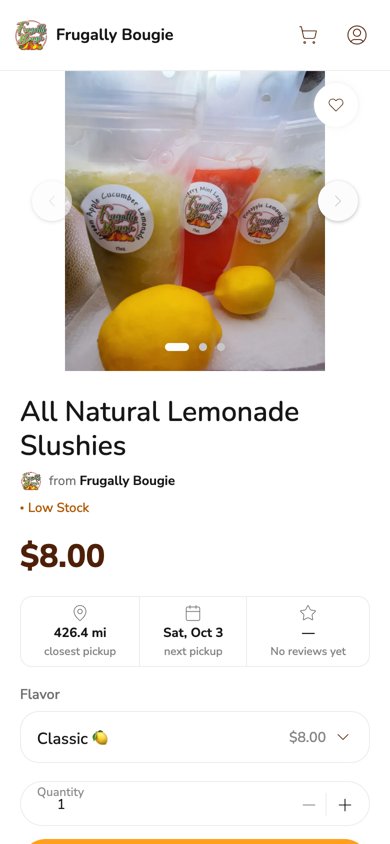
The useful detail is on the product page. The next pickup was the St Cloud Florida Farmers Market on Saturday, October 3, from 9:00 AM to 3:00 PM, with a note to "Order by Friday 9:00 AM." Customers can order ahead and pick up at the booth, and the shop's own description says its drinks are "Available at weekend markets" and at "our market stand."
What a lemonade booth needs that other booths do not:
Pouring lemonade at a market can need its own permit, even when your baked goods do not. Ask your market manager which permit their other drink vendors hold, then call the health department that issues it, before your first Saturday.
Rules differ by city, and sometimes by what is in the cup. The City of Albuquerque's special event vendor page says a lemonade stand "may be covered by the Homemade Food Act" when the lemonade is "fully prepared at home," and that vendors covered by that act do not need a city temporary food permit. The same page warns that "Lemonade with fresh fruits such as strawberries or raspberries is not permitted under the homemade food act." We read it on September 26, 2026.
You can sell lemonade at fairs, festivals and concerts, and this is where the big lemonade numbers come from, but the booth fees and permits are bigger too. In a September 5, 2024 Marketplace interview, Washington Post journalist Amber Ferguson said the adults running lemonade stands at festivals, concerts and fairs make "anywhere from $500 to $10,000 per event," in a season that usually runs from about May to the end of October.
That is a range from reporting, not a promise, and the costs climb with it. Homegrown's guide to selling food at craft fairs and festivals puts booth fees at $50 to $75 for small local events and $300 to $500 or more for large regional festivals. At a $5 cup, a $500 booth needs 100 cups sold before you count a single lemon.
The permit usually comes from the city or county where the event happens. Houston is a clear example. The Houston Health Department says that, in general, a temporary food permit is required if the event is open to the general public, publicly advertised, or you serve open-container drinks, a list that names "freshly squeezed lemonade" next to mixed drinks and smoothies. The fee is "$52 per single event, whether the event operates for 1 day or up to 14 consecutive days," and since June 1, 2026, applications must be in at least 14 days before the event starts. We read that page on September 26, 2026.
How to get into your first festival:
Families, party hosts, offices, churches and sports teams order lemonade by the gallon ahead of the day, which makes gallon orders the most predictable place to sell lemonade. Homegrown's lemonade pricing guide puts a party gallon at $18 to $20. Four gallons for a Saturday graduation party is $72 to $80 of sales known in advance, with nothing poured down the drain at closing.
The buyers who order lemonade by the gallon:
Settle four things in one message before you squeeze a lemon: the number of gallons, the flavor, the pickup or delivery time, and payment. For an order of 3 gallons or more, take payment ahead. A rained-out party should not leave you holding a bucket of squeezed lemons and an unpaid order.
A gallon is also where your state's rules matter more than they do for a cup. The lemonade leaves with the customer and gets poured hours later, so check whether your state lets you make drinks at home at all. In Colorado and Georgia, where home kitchen rules leave out beverages, gallon orders usually mean a licensed kitchen.
Gallon and pre-orders should go through one link that shows your flavors, your gallon price and your pickup days, then takes the card payment, so you squeeze for a list of paid orders instead of a pile of text messages. A cup sells itself on the spot. A gallon for Saturday's party is an order you need before you buy the lemons.
Homegrown costs $10 per month billed annually ($12.50 month to month) with no percentage fees beyond standard payment processing of 2.9% plus 30 cents, which is $0.88 on a $20 gallon. Your customer picks a flavor, a size and a pickup day, and pays by card at checkout. Each order lands in your dashboard by date, so Friday night you can see that Saturday needs 3 gallons of classic and 2 of strawberry. You can offer local delivery with your own radius and fee and keep the delivery fee, minus card processing, and the built-in QR code generator makes a code you can tape to your market sign or your dispenser.
Compare that to what most lemonade vendors try first:
What Homegrown does not do, said plainly. Your customers create a Homegrown account to place their first order, which is one more step for a neighbor who just wants a gallon. There is no countdown or drop feature for timed releases, and tipping at checkout is listed as planned, not live. It is not a card reader for walk-up cups at your booth, so keep cash, Square or Venmo for those. It does not get you a permit or squeeze the lemons. Your storefront is listed on the Homegrown marketplace, but plan on most orders coming from people you send to your own link. The 2.9% plus 30 cents of card processing is paid by you, with nothing passed on to your customer.
If your party gallon orders already come in as texts, set up a lemonade pre-order page on Homegrown and put its QR code on the front of your booth sign, where every cup buyer sees it.
A farm stand or roadside stand can sell lemonade next to produce, and it works best on a road, trail or path where people are already hot and on foot. A cooler of $2 drinks by the berries turns a stop for tomatoes into a stop for tomatoes and a cold drink.
Aliken Beach Farm in Port Angeles, Washington shows the idea. On September 26, 2026 its Homegrown storefront listed Sparkling lemonade at $2.00 alongside rhubarb, herbs, grape leaves, plums and Gravenstein apples, with pickup at the farm on the Olympic Discovery Trail, a spot the listing marks "NO VEHICLE ACCESS." Pickup was listed from 9:00 AM to 7:00 PM on each of the three days shown, Saturday through Monday. The listing has no description, and the shop also sells packaged snacks, so we cannot tell you whether that lemonade is made on the farm.
Why a stand fits lemonade:
Stands raise questions of their own: whether your state treats a farm stand drink like a market booth, how you keep the cooler cold, and how customers pay when nobody is watching. Homegrown's guide to what sells at a farm stand says to leave out products that need refrigeration, like dairy, meat and cut fruit, unless the stand has a cooler.
You can sell lemonade at school, church and fundraiser events, and they are among the cheapest places to start. Homegrown's guide to selling at school fundraisers and church events notes that most of these events charge little or no booth fee, and suggests offering 10 to 20 percent of your sales back to the organization. At the $5 cup price from the pricing guide, that is 50 cents to $1 a cup to the cause.
Events where lemonade fits:
Ask the organizer three things first: whether the event's permit covers outside food vendors, whether you can use their water and electricity, and whether they want a flat fee or a share of sales. Put the answers in a text so nobody remembers them differently in June.
Selling lemonade to cafes, food trucks and stores usually means setting up as a licensed food business first, because fresh-squeezed lemonade sold to another business falls under the federal juice safety plan rule. That rule, explained in the section on why where you pour matters, asks for a written HACCP plan and a 5-log step that knocks out 99.999% of the target germ, which a home kitchen is not built for. It also reaches past the cafe order: once you sell fresh-squeezed lemonade to any business, the cups you pour at your own booth fall under the same plan.
The same Minnesota page names one way around the treatment step. It says the rule does not apply to juice drinks made only from pasteurized juice ingredients that were produced under juice HACCP principles, and gives "lemonade produced from pasteurized lemon juice" as its example. A licensed kitchen making lemonade from pasteurized lemon juice for cafes is a different business from a kitchen squeezing fresh lemons for them. Your state and county still license the kitchen either way.
If you do get there, price for wholesale. Homegrown's guide to selling food to local restaurants and cafes puts wholesale at 40 to 50 percent below your retail price, which is $10 to $12 for a gallon you sell for $20 at your own pickup. The cafe then sells it by the glass at its own price.
A lighter route for many home vendors is a product the cafe or shop does not have to pour. Some states allow a dry lemonade mix under home food rules when fresh lemonade is left out, and Homegrown's guide to selling powdered drink mixes walks through that path. Lemonade concentrate is a harder case: Homegrown's guide to selling lemonade concentrate says it is a beverage whose legality for home sale varies by state, and Colorado's cottage food page lists fruit juices and concentrates among the foods that are not allowed. Check your state's list before you print a single label.
On a $20 gallon of lemonade, selling fees range from $0.48 on a Venmo business profile to $2.43 when you cover Hotplate's 5% + $0.55 service fee yourself on top of its 2.9% + $0.30 card processing, and over a month of 20 gallon orders that gap grows to $9.60 against $48.60. The table below shows the full fee stack for each way of getting paid.
Swipe the table sideways for every column.
| Way to get paid | Subscription | Trial | Platform fee | Card processing | Customer pays on a $20 gallon | You pay on a $20 gallon | You pay on 20 gallons a month |
|---|---|---|---|---|---|---|---|
| Venmo business profile | $0 | Not needed | None listed | 1.9% + $0.10 per payment received | $20.00 | $0.48 | $9.60 |
| Square card reader at pickup (Square Free) | $0 | Free plan | $0 | 2.6% + 15¢ in person | $20.00 | $0.67 | $13.40 |
| Hotplate, customer pays the service fee | $0 | None listed | 5% + $0.55, shown to the customer | 2.9% + $0.30 | $21.55 | $0.88 | $17.60 (customers pay $31.00 more) |
| Square online link or invoice (Square Free) | $0 | Free plan | $0 | 3.3% + 30¢ online | $20.00 | $0.96 | $19.20 |
| Homegrown | $10/mo billed annually, or $12.50/mo monthly | 7 days | $0, 0% commission | 2.9% + $0.30 | $20.00 | $0.88 | $27.60 ($30.10 on monthly billing) |
| Shopify Basic | $29/mo billed yearly, or $39/mo monthly | 3 days, then $1/mo for 3 months | $0 with Shopify Payments | 2.9% + 30¢ online (3.5% + 30¢ on premium cards) | $20.00 | $0.88 | $46.60 ($56.60 monthly) |
| Hotplate, you pay the service fee | $0 | None listed | 5% + $0.55, paid by you | 2.9% + $0.30 | $20.00 | $2.43 | $48.60 |
We checked every fee on September 26, 2026 on findhomegrown.com/signup, Venmo's fees page, Square's pricing page, hotplate.com/pricing and shopify.com/pricing. Hotplate's own page gives its service fee as $1.55 on a $20 order. Our math applies each rate to the $20 price with no tax or tip, and monthly totals include the plan fee. Hotplate's own worked example charges $1.27 of card processing on a $30.00 subtotal, more than 2.9% + $0.30 of the subtotal alone, so its processing may run a few cents higher than the $0.88 and $2.43 shown. Shopify's pricing page also lists "Earn 1% back on all sales," up to $5,000, on Basic, which would be about $4.00 on this month's $400 of sales; we left it out because the page does not say how that credit is paid. Venmo's business rate is 2.29% + $0.09 when you take the payment through Tap to Pay. The Shopify row uses its standard online card rate; its premium card rate, which covers business cards and American Express, is 3.5% + 30¢, or $1.00 on a $20 gallon. Booth, permit and delivery costs are extra.
What you pay on 20 gallons a month at $20 a gallon
Source: each company's pricing or fees page, checked September 26, 2026. Plan fees included at annual billing. Hotplate's customer-paid row leaves $31.00 of service fees on your customers.
Three things stand out:
Cups are a different story. On a $5 cup, a Square Free tap takes $0.28, a Venmo business payment about $0.20, and a Homegrown online order about $0.45. On a kid's $1 cup, a card tap takes about 18 cents, so keep a cash box at the kids' stand and save the card reader for the market.
Real lemonade listings on Homegrown are rare: 2 of the 2,715 products listed on September 26, 2026 were lemonade drinks, one at $8.00 sold through five Florida markets and one at $2.00 sold at a trailside farm stand. Here is what each storefront showed that day.
In a pull of the Homegrown catalog on September 26, 2026, 2 of the 2,715 listed products, from 2 of 307 vendors, were lemonade drinks. How we counted: we took every product with "lemonade" in its name or description (9), kept only drinks, checked the flavor options on all 2,715 listings, read all 43 listings in the Beverages category and every drink-named listing in the other categories for lemonade sold under another name, and opened every listing in both matching shops. We left out 3 lemonade-flavored baked goods, 2 lemonade-scented home goods, 2 jams or syrups that suggest adding them to lemonade, a $3.00 "Cold Brewed Ice Tea - Half and Half" whose listing has no description, so we cannot tell whether the other half is lemonade, and juices and a sea moss drink that use lemon but are not lemonade. We also left out Frugally Bougie's $6.00 lunchbox juice pack, which has a "Melon-Berry-Ade" flavor option, because the listing calls every drink in it a fruit and veggie juice with no added sugar. These are listings, not sales.
Slide the table left to see all four columns.
| Vendor | What it lists | Price | Where customers get it |
|---|---|---|---|
| Frugally Bougie (central Florida) | All Natural Lemonade Slushies, honey-sweetened, 8 flavors | $8.00 each, or a 3-pack for $20 | Pickup at five markets: Conway Community Market at Barber Park, Nona Adventure Park, Kissimmee Valley First Friday Farmers Market, St Cloud Florida Farmers Market, Harmony Market |
| Aliken Beach Farm (Port Angeles, Washington) | Sparkling lemonade, no description | $2.00 | Pickup at the farm on the Olympic Discovery Trail, 9:00 AM to 7:00 PM on the days listed, no vehicle access |
From each vendor's Homegrown storefront, captured on a phone screen on September 26, 2026. Listing prices, not sales figures.
The two listings sit at opposite ends of the lemonade business. Frugally Bougie charges $8.00 for a flavored, honey-sweetened slushy, or about $6.67 each in its 3-pack, and brings it to five markets. Aliken Beach Farm charges $2.00 for a cold drink on a trail where nobody arrives by car. Both are selling to people who are already outside and already thirsty.
Lemonade flavor also sells when the drink is not on the table. The same catalog pull found a Strawberry Lemonade Sourdough Focaccia at Pryority Sourdough ($12 for a 7-inch round, $15 for an 8x8 pan), a Pink Lemonade Cookie at Oven-Fresh Temptations ($2.00) and a Strawberry Lemonade Pound Cake at Apricake ($70.00).
Cookies, brownies and other single-serve baked goods sell well next to lemonade, because a $1 to $3 add-on turns a $5 cup into a $6 to $8 stop. The lemonade brings people to the table on a hot day. The second item is where the average sale grows.
Good partners for a lemonade table:
Every added food brings its own rules. Baked goods usually fall under your state's cottage food law and need labels, while frozen treats and cut fruit often fall outside it. Colorado's list, for one, rules out cut fresh fruit. Check each item on its own before it joins the table.
You can pick your first two places this month by choosing one walk-up spot where people taste your lemonade and one ordering channel for gallons, then letting four warm weekends of sales tell you which one to keep. A part-time lemonade vendor does not need seven places. Two is plenty.
When gallon orders start arriving before Thursday, the link is doing its job. Start your lemonade pre-order page on Homegrown and give it one pickup window this Saturday.
The best place to sell lemonade is wherever people are already outside and thirsty: a farmers market, a festival, a park, a pool or a sports field. For an adult, a farmers market booth plus a pre-order link for party gallons is a strong pair. For a kid, a park entrance or a garage sale corner usually beats a quiet street.
Yes, you can sell lemonade at many farmers markets, but pouring cups on site often needs a temporary or market food permit from your city or county, and some states leave drinks out of their home kitchen rules. Booths usually cost $20 to $75 a week, so at $5 a cup, plan on about 14 cups to cover a $50 booth once the $1.40 it costs to make each cup is counted.
In Texas, yes: state law stops cities, counties and local health authorities from requiring a permit or fee for a kid under 18's occasional lemonade stand on private property or in a public park. Six other states have kids' stand laws or rules, which the lemonade rules guide lays out. Each sets its own age limit, and every one except Illinois also limits how often the stand runs or where it sits. Elsewhere, ask your city or park office before setting up a lemonade stand in a public park.
Selling fresh-squeezed lemonade to a coffee shop puts you under the federal juice safety plan rule, which asks for a written HACCP plan and a treatment step, such as pasteurization, that cuts the target germ by 99.999% (for citrus, part of that step can be done on the surface of the whole fruit). Lemonade sold directly to the drinker at your own stand or booth is outside that rule. Once you also sell fresh-squeezed lemonade to a business, the federal definition no longer counts you as a retail establishment, so your whole operation, booth cups included, falls under the rule. Most home lemonade vendors are better off keeping cafes for later and selling cups and gallons direct.
In a 2024 Marketplace interview, a Washington Post journalist said adult lemonade vendors at festivals, concerts and fairs make anywhere from $500 to $10,000 per event, but booth fees run $50 to $500 or more and permits add to that. A $5 cup needs 100 sales just to cover a $500 booth. Start with a small local event to learn your cups per hour.
You can take lemonade orders online for local pickup or delivery, which is how party gallon orders work best. Shipping fresh lemonade is a poor fit, because it must stay cold and bottled fresh lemonade brings label and safety rules that a cup does not. A pre-order page with a pickup day keeps the lemonade fresh and the orders paid.
These 5 guides answer the questions that come up right after you pick where to sell your lemonade:
Read the lemonade rules guide first if you have not checked your state, then the pricing guide, then set up your first booth and your gallon pre-order link on the same weekend so every cup you pour can lead to a party order.



