
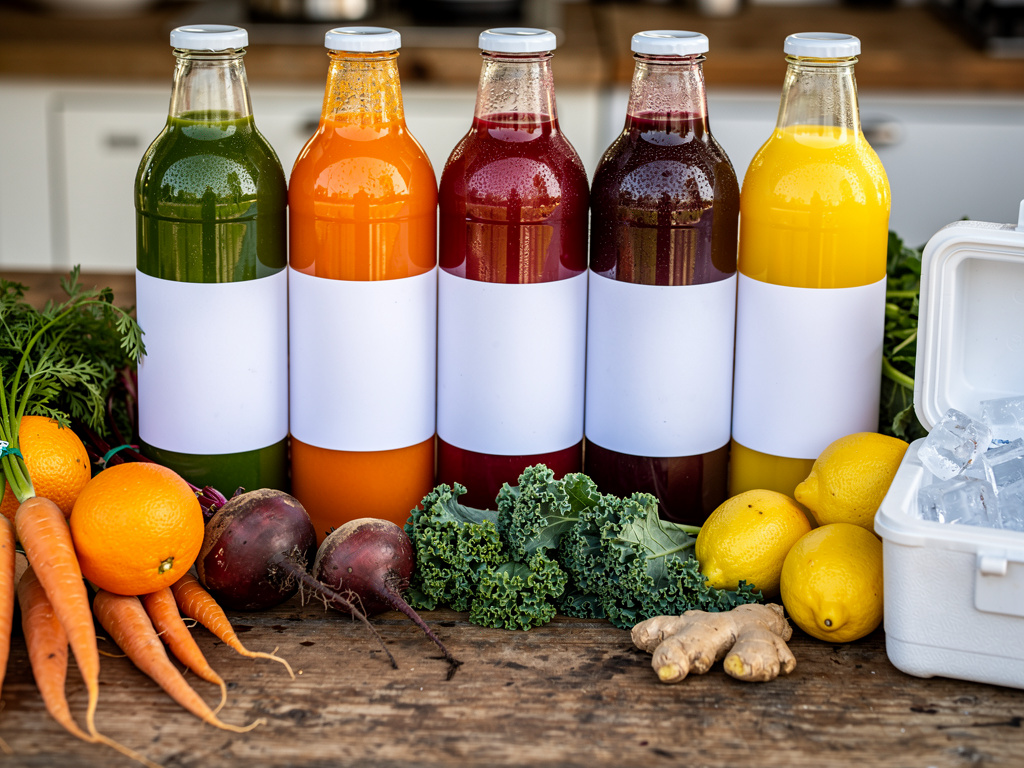


The short version: Juice sells in seven places: a farmers market booth, your own storefront link with pickup or delivery, a weekly juice club or cleanse, pop-ups at gyms and offices, events and festivals, cafes and coffee shops, and grocery stores or co-ops. The first five are the easy ones, because you hand the juice to the customer who drinks it, which federal rules treat as a retail sale with no written juice safety plan (a HACCP plan) required. Sell even one case to a cafe or a store and you become a juice processor, which means a HACCP plan and a treatment that cuts the most resistant harmful germ 100,000-fold. On a $48 six-pack, a Homegrown storefront link costs you $1.69 in card processing, while a $4 juice shot bought alone loses 10.4% to the same fee, so sell packs, not singles.
Checked September 24, 2026: Homegrown is $10 a month billed annually or $12.50 billed monthly, with 0% commission and card processing of 2.9% + $0.30 paid by the vendor (findhomegrown.com/signup). Hotplate, Square, Venmo and Shopify fees come from their own pricing pages, loaded the same day. The juice rules come from 21 CFR 120.3, the FDA's juice safety page and Minnesota's juice HACCP page, and the listings from a live pull of the Homegrown catalog that day. Verify your state's current rules before you sell. The limits: your customer creates a Homegrown account to place a first order, there is no timed release feature, and most orders will come from people you send to your own link.
You pressed a batch of green juice for yourself on Sunday, brought a few bottles to work, and by Wednesday three coworkers asked if you would make them some every week. One of them runs a spin studio and wants to know if you could stock her fridge.
Those are two very different sales, and the difference is the most important thing to know about selling juice. If you want the booth setup, the juicer and the startup costs, start with how to sell fresh juice at a farmers market. If you want to know whether your state lets you press juice at home at all, read the state-by-state rules for selling homemade juice, and for the number on the bottle, how much to sell juice for. This guide is about where: seven places small juice vendors actually sell, which rules each place triggers, and what a real $48 order costs you on each way to take payment.
You can sell juice in seven places, and a small juice vendor usually runs two or three of them at once. Five of them put the bottle straight into the drinker's hand, and two of them run through another business, which changes the federal rules you follow.
Two ideas are left off on purpose. Shipping fresh juice across the country is not a real channel for a home juice vendor, because raw juice has to stay cold the whole way, and our state-by-state juice rules guide found at least one state (Illinois) that bars shipping homemade juice outright. One vendor in our catalog pull, Frugally Bougie, does list a $20 shipping option on its 3 Day Cleanse, so check your state's rules and how long the juice can stay cold in transit before you offer it. And big online marketplaces built for shipped crafts are a poor fit for a bottle that has to be in a fridge within hours.
Start with the place that matches how you make juice today, then add one place at a time. The right first step depends on whether you press to order or bottle ahead, and whether you have a licensed kitchen or only your own.
Scroll sideways to see every column.
| Your situation | Start here | Add next | Why |
|---|---|---|---|
| You press to order and have (or can get) a market permit | A farmers market booth | Pre-orders picked up at the booth | Cups sold by the glass need no warning label, and regulars who pre-order set your floor before you load the car |
| You bottle ahead in a kitchen your state allows | Your own storefront link with pickup | A weekly juice club | You press exactly what sold, so nothing sits in the fridge past its best day |
| Your buyers are gym members or coworkers | A pop-up you staff yourself | Pre-orders delivered to the gym or office | You still sell directly to the drinker, so the retail rules still apply |
| You want summer volume | Events and festivals | A storefront link on a card at the table | One hot Saturday can sell more than a month of porch pickups |
| You have a HACCP plan, a treatment step and a licensed kitchen | One cafe or coffee shop | A co-op or grocery store | Resellers need the paperwork first and pay less than retail, but they buy by the case |
These rows are planning guides, not legal advice. Your state and county decide what kind of kitchen you need and which permit covers each place; the rules section below explains the one federal line that applies everywhere.
Most small juice vendors never need the last row. The first four rows keep a $10 bottle going straight from your hands to your customer's, which keeps you on the simpler side of the federal juice rules, and those places can keep a home or rented kitchen busy for years.
Who drinks the juice decides which federal rule you follow, and the line runs between a customer and a business. If you sell juice directly to your customer, you are a retail establishment and the Food and Drug Administration's juice safety plan rule does not apply to you. If you sell or distribute juice to another business, even once, you are a juice processor and it does.
The rule is 21 CFR Part 120, often called Juice HACCP (short for Hazard Analysis and Critical Control Point, a written plan for the steps where juice can become unsafe). Section 120.3 says processing "does not include" the operation of a retail establishment. It then defines a retail establishment as one that "provides juice directly to the consumers" and does not include a business that "sells or distributes juice to other business entities as well as directly to consumers." Read that last part twice. A juice vendor who sells 95% of her bottles at the market and one case a week to a cafe is not a retail establishment anymore.
UConn's food safety program spells out that a juice retailer is someone who sells directly to the consumer at their own farm stand, a farmers market or online, and that retailers do not need to adopt a HACCP plan. Online counts. That puts your own storefront link, a delivered juice club and a pop-up at the gym on the same side of the line as your market booth.
What changes when you cross the line:
The federal line is only half of it. Staying on the retail side keeps you out of Juice HACCP, but it does not make home juice legal in your state. Cottage food laws (the rules that let you sell low-risk foods from a home kitchen) often leave fresh juice out because it needs a refrigerator to stay safe. The homemade juice rules guide read eight states' rules on September 22, 2026: five left juice out or banned it, and three, Illinois, Texas and Wyoming, allowed it with conditions. Verify your state's current rules before your first sale.
A farmers market booth is the best first place for most juice vendors who press to order, because juice sold by the cup needs no federal warning label and the market brings the buyers to you. The FDA's juice safety page says it "does not require warning labels for juice or cider that is sold by the glass," and it names farmers markets, roadside stands and juice bars as examples.
The trade-off is the permit and the setup. Pressing at the market usually needs a temporary or mobile food permit from your county or city, a hand-washing station and cold holding, and our guide to running a fresh juice booth lists every piece with its cost. Then the booth fee comes out before you earn anything, and the real cost of selling at a farmers market walks through every line of it.
Run the math with your own numbers before you apply. Say your market charges $40 a day (booth fees vary widely; this is only an example). At $6 a cup, that is 7 cups before the booth is paid for, plus your produce, cups and ice.
What helps a juice booth sell more:
The best way to sell bottled juice is to sell the batch before you press it: post this week's blends on Sunday, close orders Tuesday night, press Wednesday morning, and hand out paid orders Wednesday afternoon. Fresh juice keeps for days, not weeks, so a pre-order is worth more than a walk-up sale, and every bottle nobody claimed is a loss by the weekend.
That is the job a Homegrown storefront does for a juice vendor who is tired of guessing how many bottles to fill. It is $10 per month billed annually with no percentage fees beyond standard payment processing, which is 2.9% + $0.30 per order. You list each blend with its sizes (an 8-ounce and a 16-ounce bottle can sit under one listing, each with its own price) and its ingredients, set how many bottles you will make, and the count goes down as people order. Regulars pay up front and pick up at your porch or your market booth, or you set a delivery radius and a delivery fee and keep all of the fee, minus card processing. Sales tax is calculated and filed for you. Payouts land the next business day, with 20% of each order held for 30 days as a reserve before it releases to you.
Here is how it compares with what most juice vendors try first:
What Homegrown does not do: your customer creates a Homegrown account to place a first order, and there is no timed release feature. It also does not bill customers automatically every week, so a juice club is sold as a prepaid package and bought again, the way Press It Juice Bar runs its Monthly Juice Club on Homegrown. Your storefront is listed on the Homegrown marketplace, but plan on most orders coming from people you send to your own link. And it does not make your kitchen legal, write a HACCP plan, print your warning label or keep your juice cold.
In a pull of the Homegrown catalog on September 24, 2026, 28 of 2,667 products were fresh juice, cider, juice shots or juice packs, listed by 4 of 303 vendors. Every 16-ounce bottle was listed at $10: Juicy's Juices sells its red and orange blends at $5 for 8 ounces and its red, green and orange blends at $10 for 16, and Frugally Bougie lists ten blends at $6 for 8 ounces and $10 for 16. Lemonade slushies, smoothie bowls, coffee, a few unlabeled drinks and an orchard stand's sparkling cider 4-pack, listed with no description to show whether it was fresh-pressed, were left out.
If you are tired of pressing juice and hoping it sells, set up a Homegrown storefront and post this week's blends before you buy a single bag of kale. Your regulars order and pay first, you press exactly what sold, and the market table gets whatever is left.
A juice club is a prepaid pack of bottles, bought weekly or monthly by people who drink juice often, and a cleanse is a fixed pack of several days of juice sold as one product. Both turn single $9 or $10 sales into one order of $64 to $160, which cuts your card fee per bottle and tells you exactly how much to press.
Two real listings show the range on Homegrown. Press It Juice Bar sells a Monthly Juice Club at $64 for eight 12-ounce bottles, $90 for twelve and $160 for twenty, delivered on set delivery days, and says plainly that it "does not automatically renew." Frugally Bougie sells a 3 Day Cleanse for $120 with twelve 16-ounce juices and three wellness shots. For turning single buyers into repeat ones, converting one-time buyers into subscribers covers the ask.
Sell the pack, not the bottle. At 2.9% + $0.30, a single $10 bottle loses $0.59 to card processing, 5.9% of the sale, while a $48 six-pack loses $1.69, which is about $0.28 a bottle. At the same $8 a bottle, you pay $8.46 a week in card fees when five regulars buy six-packs, against $15.96 when the same 30 bottles sell one at a time, a $7.50 saving every week.
A cleanse brings its own buyer: someone planning a reset for a specific week. That buyer orders for one planned week rather than every week, so treat cleanses as the way new people find you and the weekly club as the way they stay.
You can sell juice at gyms, yoga studios and offices, and the safest way is a pop-up you staff yourself: a table and a cooler for an hour after the Saturday class or during the Tuesday lunch break. When you hand each bottle to the member or coworker who drinks it, you are still selling directly to the consumer, so the retail side of the juice rules still applies.
The other version, where the gym buys a case to stock its own fridge and sells your bottles to members, is a sale to another business. Under 21 CFR 120.3 that makes you a juice processor, with the HACCP plan and 5-log treatment that come with it. Selling food at yoga studios and gyms covers how to pitch the owner, and selling food at work covers the office version.
"Just leave a few bottles in our fridge and we will collect the money" sounds like a pop-up, but the gym is now reselling your juice. If you cannot meet the processor rules yet, keep the hand-off direct: members order from your link, you deliver the paid orders to the front desk with their names on them, and the gym never sells a bottle. Ask your county health department how it reads your setup before you start.
What works at a gym or office:
Ask the owner what they want in return, whether that is a few bottles for the staff or a share of pop-up sales, and get the pop-up days in writing.
Events and festivals work well for juice when the weather is hot and the crowd is outside for hours, like a summer street fair, a 5K finish line or an outdoor concert series. Cold juice sold by the cup needs no warning label, and one good event can outsell a month of porch pickups.
The catch is the paperwork and the fee. Expect an event to ask for a temporary food permit from the county for that date, proof of insurance, and a vendor fee that can be a flat rate or a share of sales. Selling food at craft fairs and festivals walks through the application.
What to plan for at an event:
You sell juice to cafes and coffee shops by becoming a juice processor first: a written HACCP plan, a trained person to run it, a treatment step that meets the 5-log standard, a licensed kitchen, and labels that meet federal rules. Once that is in place, a cafe gives you something no market can: a standing order every week, by the case. A shop that takes two cases of 12 every Monday (an example, not a quote) is 24 bottles you never have to sell one at a time.
The shop resells your bottles, so it will pay you less than your retail price, and wholesale pricing for food products shows how to set a number that still pays you. Getting your food into a local coffee shop covers the pitch itself.
That is six steps, including a new kitchen, for one cafe. Many small juice vendors decide it is not worth it and keep every bottle on the retail side. That is a real business model, not a lesser one.
A grocery store or co-op will carry your juice once you meet the same processor rules a cafe needs, plus retail-ready labels, a steady weekly supply and usually product liability insurance. Stores sell to strangers who never met you, so they want the paperwork more than any other buyer.
Food co-ops are often the friendliest store door for a small vendor, because many already buy from local producers and have a buyer you can talk to. Selling through a food co-op covers how to reach that buyer.
What a store usually asks for before the first order:
For a one-person juice business, a store is the last step, not the first. The retail places build the regulars, the cash and the recipes that a store buyer wants to see.
On a $48 six-pack, card processing costs you between $0 in cash and $1.88 on Square's free online checkout, or $1.98 on a premium card through Shopify, and a Homegrown storefront link costs $1.69 plus the $10 plan. The bigger gap is who pays the platform fee: on Hotplate your customer pays $2.95 more at checkout by default, or you pay it and the six-pack costs you $4.64, and on Shopify, once the $1-a-month price for your first 3 months ends, you pay $29 a month or more before your first sale.
Swipe left for the full fee stack on each row.
| Way to get paid | Subscription | Trial | Platform fee | Card processing | Customer pays on $48 | Vendor pays on $48 | 50 six-packs a month (vendor) |
|---|---|---|---|---|---|---|---|
| Homegrown storefront | $10/mo billed annually, or $12.50/mo billed monthly | 7 days, no charge until day 8 | $0, 0% commission, no shopper fee | 2.9% + $0.30 | $48.00 | $1.69 | $94.60 billed annually, $97.10 billed monthly |
| Square Free, online link | $0 | None needed | $0 | 3.3% + $0.30 online | $48.00 | $1.88 | $94.20 |
| Square Free, card at the booth | $0 | None needed | $0 | 2.6% + $0.15 in person | $48.00 | $1.40 | $69.90 |
| Venmo business profile | $0 | None needed | $0 | 1.9% + $0.10 | $48.00 | $1.01 | $50.60 |
| Hotplate | $0, no subscription | None needed | 5% + $0.55 on the subtotal, paid by the customer by default, or by you if you choose | 2.9% + $0.30, paid by the vendor | $50.95 ($48.00 if you pay the fee) | $1.69 ($4.64 if you pay the fee) | $84.60 (your customers pay $147.50 more), or $232.10 if you pay the fee |
| Shopify Basic | $29/mo paid yearly, or $39/mo paid monthly, less 1% of sales back as subscription credits for your first 6 months | 3 days, then $1/mo for the first 3 months | $0 with Shopify Payments | 2.9% + $0.30 online on standard cards, 3.5% + $0.30 on premium cards | $48.00 | $1.69 ($1.98 on a premium card) | $113.60 paid yearly, $123.60 paid monthly ($24 less while the 6-month sales credit lasts) |
| Cash at the booth | $0 | None needed | $0 | $0 | $48.00 | $0 | $0 |
We checked every fee on each company's own pricing page on September 24, 2026: findhomegrown.com/signup, squareup.com/us/en/pricing, venmo.com/resources/our-fees, hotplate.com/pricing and shopify.com/pricing. Card fees are figured on the $48 subtotal and shown rounded to the cent; the monthly column multiplies the unrounded fee by 50 orders and adds one month of the plan. Hotplate shows its 5% + $0.55 fee to the customer at checkout unless you choose to pay it yourself; Square's in-person rate needs a reader or Tap to Pay on your phone. Sales tax and tips are left out.
The table hides the cost that matters most for juice: waste. A $1 difference in fees is small next to one unsold six-pack: six bottles of produce, the bottles themselves and an evening at the juicer, all poured down the drain. Whatever you use, the win is knowing your orders before you press.
Real juice listings on Homegrown charge $5 to $6 for 8 ounces, $9 for 12 ounces and $10 for 16 ounces, with packs and clubs working out to $7.50 to $8.33 a 12-ounce bottle. Two-ounce juice shots cost the most per ounce, $1 to $2, while Frugally Bougie's 4-ounce shots run 63 cents to $1 an ounce.
Drag the table to see each listing.
| Listing | Vendor | Size | Price | Per ounce |
|---|---|---|---|---|
| Red Juice (berries, watermelon, pear, pineapple, apple, ginger; the 16 oz adds beets) | Juicy's Juices | 8 oz / 16 oz | $5 / $10 | $0.63 |
| ReFresh (apple, pineapple, cucumber, lemon, mint) | Frugally Bougie | 8 oz / 16 oz | $6 / $10 | $0.75 / $0.63 |
| Ginger Glow | Press It Juice Bar | 12 oz / 32 oz / 64 oz | $9 / $25 / $45 | $0.75 / $0.78 / $0.70 |
| Mix & Match 6-pack | Press It Juice Bar | 6 x 12 oz | $48 | $0.67 |
| Monthly Juice Club, 20 bottles | Press It Juice Bar | 20 x 12 oz | $160 | $0.67 |
| 3 Day Cleanse | Frugally Bougie | 12 x 16 oz + 3 shots | $120 | $0.63 (the full price over the 192 ounces of juice, shots not counted) |
| Ginger / Turmeric Wellness Shot | Immunity Artisan | 2 oz / bundle of 7 | $4 / $20 | $2.00 / $1.43 |
| Vitamin C wellness shot | Frugally Bougie | 2 oz | $2 | $1.00 |
Prices read from the live Homegrown catalog on September 24, 2026. Per-ounce figures are the price divided by the fluid ounces in the listing, rounded to the cent. Prices change, so treat these as a snapshot, and use how much to sell juice for to build your own price from produce cost.
The order size matters as much as the price. Card processing is a percentage plus a flat 30 cents, and that 30 cents hurts most on small orders.
Share of the order lost to 2.9% + $0.30 card processing
Source: order sizes from Homegrown listings pulled September 24, 2026 (Immunity Artisan, Juicy's Juices, Press It Juice Bar, Frugally Bougie); fee of 2.9% + $0.30 from findhomegrown.com/signup, checked the same day.
That is why shots sell best as add-ons and bundles. Immunity Artisan sells a single 2-ounce shot at $4 and seven for $20, and Frugally Bougie sells four-packs of its shots at $8 and $14.
Almost every place to sell juice needs a local or state permit of some kind, and the two places that sell through another business also need a federal HACCP plan and a 5-log treatment. The table below sorts the federal rules by place; your state and county add their own on top.
Slide the table over for every permit column.
| Place | Who you sell to | Federal HACCP plan? | Warning label? | Local or state permit |
|---|---|---|---|---|
| Market booth, by the cup | The drinker | No (retail) | No, sold by the glass | Temporary or mobile food permit, usually from the county |
| Bottles from your link, porch or booth | The drinker | No (retail) | Yes, if the juice was not treated for a 5-log reduction | Your state's home food rules, or a licensed kitchen |
| Juice club or cleanse | The drinker | No (retail) | Yes, if untreated | Same as bottles |
| Gym or office pop-up you staff | The drinker | No (retail) | Yes on bottles, if untreated | Same as bottles, plus any event permit your county asks for |
| Events and festivals | The drinker | No (retail) | No by the cup; yes on untreated bottles | Temporary event permit for that date |
| Cafe, coffee shop or gym fridge that resells | Another business | Yes | No, because the juice must be treated for a 5-log reduction first | Processor license and a licensed kitchen |
| Grocery store or co-op | Another business | Yes | No, because the juice must be treated for a 5-log reduction first | Processor license, licensed kitchen, full retail label |
Federal rules from 21 CFR 120.3 and 101.17(g) on eCFR, the FDA consumer page on juice safety and Minnesota's juice HACCP page, all loaded September 24, 2026. This is a map, not legal advice. Check the rules in your own state and ask your county health department before you sell.
The warning label is a fixed sentence. Under 21 CFR 101.17(g), untreated packaged juice must say: "WARNING: This product has not been pasteurized and, therefore, may contain harmful bacteria that can cause serious illness in children, the elderly, and persons with weakened immune systems." The labeling requirements for cottage food cover the rest of the label.
States then go their own way. Virginia is a good example of how it splits by place: Virginia Cooperative Extension's Going To Market guide says bottled juice needs a home food processing permit from the state agriculture department, juice made at the farmers market goes through the health department, and untreated juices "would be limited to retail sales."
Lemonade made with fresh-squeezed lemon juice counts as juice under the federal rule, a smoothie made from whole fruit usually does not, and a juice shot is juice. Minnesota's juice HACCP page spells out all three: the rule covers "lemonade using fresh squeezed lemon juice," it does not cover "beverages using whole fruits or vegetables without juice extraction (e.g., smoothies)," and it does not cover lemonade made from pasteurized lemon juice.
What that means for where you sell:
Plenty of juice vendors end up with both: fresh juice for the market and the weekly club, and a shelf-stable product for the places juice cannot go.
To start selling juice somewhere new this week, pick one place from the retail side, confirm the permit it needs, and take your first pre-orders before you buy the produce. The steps below fit in one week if your kitchen is already legal in your state.
Sell the batch before you press it, keep the menu short, and move buyers from singles to packs. Treat every bottle that goes unsold as the real cost of the business, bigger than any fee, and build your week around knowing your numbers first.
Habits worth building:
If your state allows home juice, you can sell it anywhere you hand it straight to your customer. That means pre-orders from your own link, a weekly juice club, a gym or office pop-up you staff, a farmers market booth with the right permit, or an event. Selling to cafes or stores needs a licensed kitchen and a federal HACCP plan. Five of the eight states we checked on September 22, 2026 leave fresh juice out of their home kitchen rules or ban it, so check yours first.
No. Under 21 CFR 120.3, a business that sells or distributes juice to other businesses is a juice processor, even if it also sells directly to customers. Processors need a written HACCP plan and must treat the juice for a 5-log reduction, a 100,000-fold cut in harmful germs, before it goes to the shop. Raw, untreated juice cannot be sold to a coffee shop for resale.
You can sell juice online to local customers who pick up or get it delivered, and it still counts as a retail sale. UConn's food safety program lists online sales directly to the consumer alongside farm stands and farmers markets as retail. Bottled juice that was not treated to kill germs needs the federal warning label, and your state decides whether you can make it at home.
You need the federal warning label on packaged juice that was not treated for a 5-log reduction, such as raw juice in a sealed bottle. You do not need it on juice sold by the glass: the FDA names farmers markets, roadside stands and juice bars as places where cups poured to order need no label. States can add their own labeling rules on top, so check with your county before you print.
Sell by the cup at the farmers market and events, and by the bottle through pre-orders and a juice club. Cups need no warning label and draw a crowd, but each sale is small, so card fees take a bigger share: a $6 cup loses 5.1% on Square's tap rate of 2.6% + 15 cents ($0.31), and 7.9% through an online link at 2.9% + $0.30 ($0.47). A $48 six-pack loses 3.5% and tells you how much to press.
You can sell juice at a gym if you sell it directly to members, through a pop-up table you staff or paid pre-orders you deliver with each member's name on them. If the gym buys your bottles to resell from its own fridge, you are selling to another business, which puts you under the federal juice HACCP rule. Ask the gym owner and your county health department before your first day.
These six answer the next question most juice vendors have once they know where to sell. Each one goes deeper on a single step this guide only touched:
Fresh juice is only worth what sells before it turns, so the place you sell matters less than knowing your orders first. A six-pack that nobody claimed costs you the produce, the bottles and an evening at the juicer. A six-pack that was paid for on Tuesday costs you $1.69 in card processing on top of your plan, and none of the produce goes to waste.
Start on the retail side, where you hand every bottle to the customer who drinks it: a market booth, your own link, a weekly club, a pop-up at the gym, a summer festival. Those five places keep you outside the federal juice HACCP rule, and together they can keep a small kitchen busy all year. Move to cafes and stores only when the paperwork pays for itself, which usually means several steady accounts, not one.
When you are ready to take pre-orders, start your Homegrown storefront. It is $10 a month billed annually with no percentage fees beyond standard payment processing, and your regulars can order this week's six-pack before you buy the kale.



