
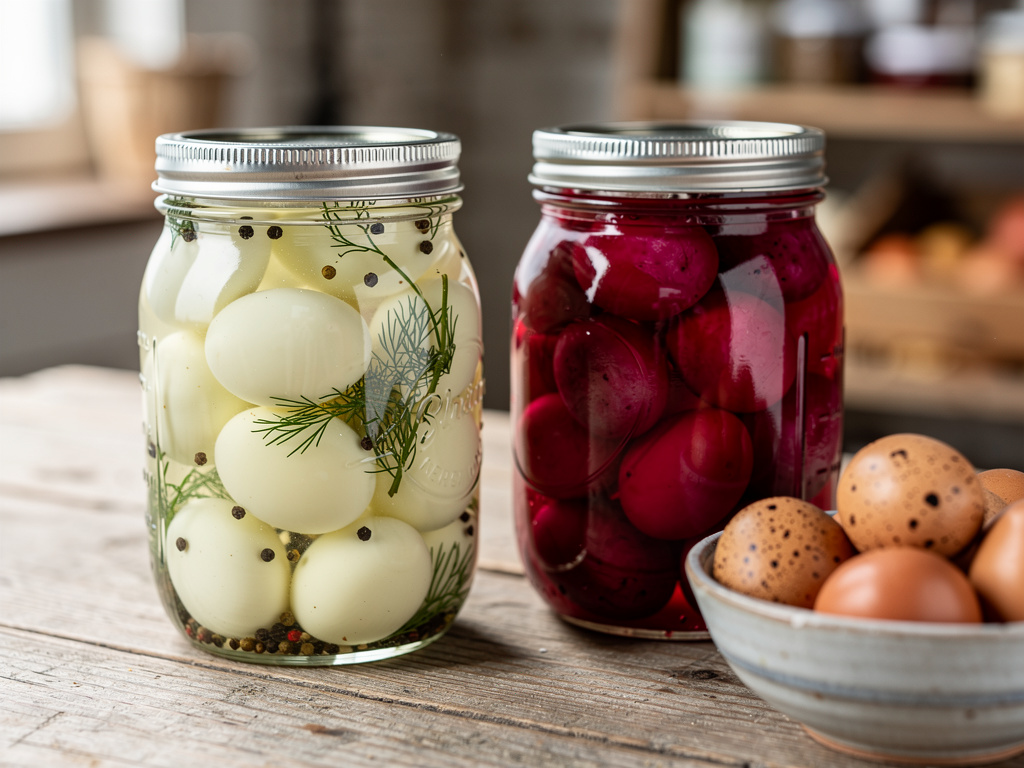


The short version: Sell a quart jar of a dozen pickled chicken eggs for $12 to $16, and start at $14, which works out to about $1.17 an egg. The farm and brand quarts we checked on September 26, 2026 were listed at $10 to $13.50, and 16-ounce jars of pickled quail eggs were listed at $10 to $14. A quart costs about $4.97 in eggs, brine, jar, and label at this summer's store egg price, $9.47 once you pay yourself for the peeling, and close to $20 if you rent a commercial kitchen by the hour for a small batch. Wisconsin, Minnesota, and Oregon all require a license for pickled eggs even though each lets people sell some foods made at home without one, so every price here assumes you make them in a licensed kitchen and keep them cold.
Checked September 26, 2026: jar prices come from each business's own product page, the egg price from the Bureau of Labor Statistics August 2026 average, the jar price from CountryMax, the jar yield from the National Center for Home Food Preservation, the kitchen rate from Shared Kitchen Locator's April 2025 guide, the Homegrown fees from its signup page, and the Hotplate, Shopify, and Square fees from their pricing pages. Homegrown is $10 a month billed annually with card processing at 2.9% + $0.30 paid by the vendor. Customers create a Homegrown account to place a first order, and plan on most orders coming from people you send to your own link. Homegrown has no drops or countdown-release feature. This is general information, not legal or food-safety advice; verify your state's current rules.
You have a dozen eggs peeled, the brine is simmering, and you know people will buy them. The regulars who ask for red beet eggs every fall are not the problem. The problem is the number on the lid. A 2010 homesteading forum thread quotes $6 a quart, and $6 does not cover the $9.47 it costs to make a quart in your own licensed kitchen.
This guide gives you the price, then walks through the math so you can move it for your own kitchen. It is the pricing companion to can you sell pickled eggs under cottage food law, which covers the botulism risk, why Wisconsin says no to home-kitchen pickled eggs, and why Idaho's cottage food rules say no while its 2026 Direct-to-Consumer Commerce Act allows direct sales inside Idaho. Read that one to find out whether you can sell them. Read this one to find out what to charge once you can.
Charge $12 to $16 for a quart of a dozen pickled chicken eggs, and start at $14 if you are not sure. The quarts we found for sale on September 26, 2026 ran $10.00 to $13.50, and a 16-ounce shelf-stable jar from a Milwaukee packer worked out to about $14 a quart. The one small farm selling chicken egg quarts sat at the bottom of that range, at $10.
Here is what real pickled egg businesses were charging that day, read from their own product pages:
Scroll sideways to see every column.
| Business | Product | Size | Price | Per quart, roughly | Kind of business |
|---|---|---|---|---|---|
| Noka Farm, Graniteville, Vermont | Pickled eggs from its own hens, 7 flavors | 1 quart | $10.00 | $10.00 | Small family farm |
| Walnut Creek Foods, sold by Amish Country Store | Red beet eggs | 1 quart | $11.99 | $11.99 | Regional jar brand |
| Dutchman's Store, Cantril, Iowa | Pickled eggs | 2 quarts | $26.59 | $13.30 | General store house brand |
| Dutchman's Store, Cantril, Iowa | Red beet pickled eggs | 2 quarts | $26.99 | $13.50 | General store house brand |
| Bay View Packing, sold by Pinconning Cheese Co. | Salt and vinegar pickled eggs, shelf stable | 16 oz | $6.99 | $13.98 | Wisconsin packing plant |
| Heavenly Acre Farm, on Homegrown | Pickled quail eggs, 22 to a jar | 16 oz | $10 to $12 | $20 to $24 | Small farm |
| Lagniappe Cajun Farm | Pickled quail eggs | 16 oz | $14.00 | $28.00 | Farm brand |
Prices read from each product page on September 26, 2026. Lagniappe Cajun Farm lists its jar at $14.00 against a $19.99 regular price. The per-quart column doubles the 16-ounce prices as a rough guide, since a 16-ounce jar counts brine in its weight. Online prices do not include shipping, and pickled eggs from a small kitchen are usually sold for pickup because they have to stay cold. The store-brand quarts are commercial jars, not small-kitchen ones: both Dutchman's product pages say "Refrigerate After Opening" and nothing about how the jars are kept before that, while the Bay View listing says its jar never needs refrigeration.
What a quart of pickled chicken eggs was listed at, September 26, 2026
Source: each business's product page, read September 26, 2026. Five chicken egg products; the Bay View 16-ounce price is doubled to compare with the quarts.
The jar brands and store house labels sell a quart for about $12 to $14. The small farm that peels its own hens' eggs sells for $10, the lowest price on the list. Noka Farm's pickled eggs come in seven flavors from the farm's own hens for $10 a quart. A $10 quart clears about 53 cents over the $9.47 it costs to make a quart in your own licensed kitchen, before any card fee, and it loses money in a rented one.
In several states, including Wisconsin, Minnesota, and Oregon, you cannot sell pickled eggs you made in your home kitchen without a license, so the price only matters once you have a licensed kitchen and the right permit. Eggs need refrigeration, and a state that lets home canners sell pickled vegetables can still require a license for pickled eggs: Wisconsin's DATCP does, regardless of pH. Minnesota's cottage food guidance says pickled eggs are not allowable cottage foods and require a license, and Oregon's farm direct FAQ (December 2023) allows shell eggs only, not pickled, boiled, dried, or cured eggs, under the same rules that let farmers sell their own pickles. We read both on September 26, 2026. The National Center for Home Food Preservation warns that home-pickled eggs stored at room temperature have caused botulism. That is why this guide prices the licensed path, not the cottage food path.
Three things decide which prices in this guide apply to you:
Wisconsin lets people sell some home-canned foods without a license, up to $5,000 a year at farmers markets, flea markets, and community or social events, direct to the customer only, but the Wisconsin Department of Agriculture, Trade and Consumer Protection's home-canned foods page lists pickled eggs among the products that need a license regardless of pH. We read that page on September 26, 2026.
The $6 quart price in a 2010 homesteading forum thread came from people selling jars they made at home, which Wisconsin, Minnesota, and Oregon do not allow without a license. Those prices leave out the license, the kitchen, and your time, all costs a legal vendor carries. Do not anchor on them.
The botulism case and the legal routes are covered in full in the permission guide linked at the top of this page, so this guide does not repeat them. Rules change, so verify your state's current rules with the agency that licenses food businesses in your state before you make a jar for sale.
A quart of 12 pickled chicken eggs costs about $4.97 in materials when you buy the eggs at the store price. That number comes from a real recipe (the NCHFP's Dilled or Dark and Spicy brine, which use 1.5 cups of vinegar and water), three prices checked September 26, 2026, plus three stated assumptions, not a guess at the total. The cider, cinnamon candy, and juice brines cost more.
Start with the recipe. The National Center for Home Food Preservation's pickled eggs page says a quart jar holds about one dozen medium eggs. Four of its six brines use 1.5 cups of vinegar, and the other two use half a cup of vinegar with 1.5 cups of apple cider or juice; water, beet juice, or pineapple juice makes up the rest of the liquid, plus salt, sugar, and spices. It also says there are no home canning directions for pickled eggs and every recipe on the page is for refrigerator storage.
Now the cost sheet for one quart:
Swipe to see the whole table.
| Input for one quart | Amount | Cost | Where the number comes from |
|---|---|---|---|
| Eggs | 12 | $2.27 | U.S. average for a dozen grade A large eggs, August 2026, Bureau of Labor Statistics |
| Vinegar | 1.5 cups | $0.38 | Assumes a $4 gallon jug of 5% vinegar. Swap in your receipt. |
| Salt, sugar, spices, garlic, onion, or beets | per recipe | $0.60 | Assumed. Beets or fresh jalapenos push this toward $1. |
| Quart jar with lid and band | 1 | $1.42 | Ball regular mouth quart 12-pack at $16.99, CountryMax, September 26, 2026 |
| Label | 1 | $0.30 | Assumes a water-resistant label. Swap in your receipt. |
| Materials total | 1 quart | $4.97 | Before your time and your kitchen |
The egg price, the jar price, and the jar yield were checked on September 26, 2026. The vinegar, spice, and label lines are stated assumptions so the math is visible; replace them with what you paid and the sheet still works. The same 12-pack of quart jars was $24.99 at Esbenshades that day, which would add about $0.67 a jar.
Eggs are the line that moves. The government's average retail price for a dozen grade A large eggs was $2.27 in August 2026, down from $3.59 in August 2025. At last year's price the same quart cost $6.29 in materials. Price your jars off what you pay this month, and look again when egg prices jump, because the jar and the brine barely move.
If the eggs come from your own flock, count them at what you could sell them for fresh, about $5 a dozen, not at zero. That turns the $4.97 quart into a $7.70 quart before your time. Every egg that goes into a jar is an egg you did not sell by the carton.
In a pull of the Homegrown catalog on September 26, 2026, 2,718 products from 308 vendors, 15 vendors had 16 listings for a dozen fresh chicken eggs, priced $3 to $10 with a median listing of $5.50. Selah homestead fl lists small and large dozens separately, so both count. Only one listing was a pickled egg: Heavenly Acre Farm's 16-ounce jar of 22 pickled quail eggs, $10 for Classic, $11 for Dill, and $12 for Spicy, Old Bay, Bourbon, or Bloody Mary. The rule: a pickled egg counted if the name, description, or a flavor option said so, in any category, and every listing from the 28 egg and dairy vendors was read for brine, vinegar, and beet words. A dozen counted only if the listing said a dozen or 12, chicken eggs only.
The fresh price is your floor for a reason. Here is how the egg line changes with where the eggs come from:
If you already sell fresh eggs, you know your number. The pricing guide for what to charge for eggs at a farm stand walks through that fresh price, and it should be the first line on your pickled egg sheet.
Plan on about 15 minutes of hands-on work per quart when you make six quarts at a time, which is $4.50 a quart at $18 an hour. The time is mostly peeling. That is an estimate from the recipe steps, not a measured stopwatch, so time your own batch and swap in your number.
Here is where the roughly 90 minutes goes on a 6-quart batch of 72 eggs:
Six quarts in 90 minutes is $27 of your time at $18 an hour, or $4.50 a quart. Add it to the $4.97 in materials and a quart costs $9.47 before any kitchen rent. Leave this line off and $8 feels fine until you count the hours.
Renting a commercial kitchen by the hour adds about $10.42 to each quart on a small 6-quart batch, more than the eggs, brine, and jar put together. The rate that drives it is the $20 to $35 an hour national average that Shared Kitchen Locator reports for shared kitchens in its April 2025 guide, which we read on September 26, 2026, and we used $25.
The math on a 6-quart batch:
None of the chicken egg quarts we found were listed at more than $13.50, and the 16-ounce shelf-stable jar works out to about $14 a quart, so a rented kitchen only works if you cut that $10.42 close to nothing. Here is what each of the three usual fixes does:
Only the first fix gets a quart near the market. Off-peak time or a 12-quart batch still leaves full cost at about $16.76 to $17.80 a quart, and both together about $15.30 to $16.14, all above $13.50, the highest chicken egg quart price in this guide's market table. A rented kitchen only pays for pickled eggs when the shift is already paid for by other products.
The full breakdown of shared kitchen contracts is in the guide to finding a commissary kitchen for your food business. For pickled eggs specifically, run the kitchen line before you print a single label.
Use full cost plus 30 percent as your floor and 3 times materials as your check, then price between them. For a licensed kitchen you already run and store-bought eggs, that is $12.31 at the floor and $14.91 at the check, which is why $14 is the starting price in this guide.
Here is the same quart under three setups:
Scroll sideways for every setup.
| Your setup | Materials | Labor at $18/hr | Kitchen | Full cost | Full cost + 30% | 3x materials | Where to start |
|---|---|---|---|---|---|---|---|
| A. Licensed kitchen you already run, store eggs | $4.97 | $4.50 | $0 | $9.47 | $12.31 | $14.91 | $14 a quart |
| B. Licensed farm kitchen, your own hens at $5 a dozen | $7.70 | $4.50 | $0 | $12.20 | $15.86 | $23.10 | $16 a quart |
| C. Rented kitchen at $25/hr, 6-quart batch, store eggs | $4.97 | $4.50 | $10.42 | $19.89 | $25.86 | $14.91 | Do not sell quarts from a rented kitchen unless other products pay for the shift |
Materials use the cost sheet above, with the egg price from the federal retail average for August 2026 and the jar price from CountryMax on September 26, 2026. Labor is the 15-minute estimate per quart. The kitchen line uses $25 an hour for 2.5 hours on six quarts.
What the table shows:
The 3x check is weak in setup B because it multiplies eggs you valued at retail. Lean on the full-cost floor there.
Price a batch of pickled eggs in seven steps, and write each number down before you print a label.
Do this once per flavor, not once per market. Red beet eggs carry beets and sugar, jalapeno eggs carry peppers, and each one gets its own sheet.
Sell pints of about 6 eggs for $8 to $9, quarts of 12 for $12 to $16, 16-ounce jars of quail eggs for more than $12.42 if you buy quail eggs near $4 a dozen (more than $21.96 near $8 a dozen), since those floors do not count your peeling yet, and single chicken eggs from a cooler for $1.50 to $2. The quart is the anchor because it is the size the recipes, the brands, and your regulars all use.
Swipe across for every size.
| Size | About how many eggs | Sell for | Materials | Per egg at the starting price |
|---|---|---|---|---|
| Pint | 6 medium chicken eggs | $8 to $9 | $3.36 | $1.33 at $8 |
| Quart | 12 medium chicken eggs | $12 to $16 | $4.97 | $1.17 at $14 |
| 16 oz jar of quail eggs | about 22 quail eggs | More than $12.42 (more than $21.96 if quail cost $8 a dozen), plus your timed peeling | $9.55 with quail eggs at $4 a dozen, $16.89 at $8 a dozen | $0.56 at $12.42, before peeling |
| Single egg from the cooler | 1 | $1.50 to $2 | about $0.30 | $1.50 to $2 |
The quart row is the cost sheet on this page. The pint row uses 6 eggs at the August 2026 average ($1.14), half the brine ($0.50), a Ball regular mouth pint jar at $1.42 (the 12-pack was $16.99 at CountryMax on September 26, 2026), and a $0.30 label. The quail row values 22 quail eggs at $4 and at $8 a dozen, the low and high ends of the fresh quail prices in the Homegrown catalog that day, with half the brine, a $1.42 jar, and a $0.30 label. Its sell-for figures are materials plus 30 percent, the floor before any peeling. No source we found gives a peeling time for quail eggs, so time 22 of your own, add that time at your wage to the materials, and add 30 percent to the total. The single-egg price is this guide's suggestion, not a surveyed price.
A pint costs you the same $1.42 in glass as a quart, so it carries a higher price per egg, and that is fine. The pint is the first-time buyer's jar. Single eggs are the best margin on the table if your license allows serving them from a cold case: a quart's worth sold one at a time at $1.75 brings in $21 in cash instead of $14, or about $16.79 if each egg is its own card sale at 2.9% + $0.30.
Put a made-on date and a ready-on date on every jar. The NCHFP says small eggs need 1 to 2 weeks and medium or large eggs 2 to 4 weeks to season. A $14 quart sold on day three tastes like a boiled egg in vinegar, and that customer does not come back for a second jar.
Yes, quail jars and flavored brines both earn more: a 16-ounce jar of quail eggs needs more than $12.42 when you pay $4 a dozen for the eggs and more than $21.96 when you pay $8, before you count the peeling, and a flavored brine earns $1 to $2 extra. Quail eggs are more expensive to buy, their peeling time is yours to measure, and flavored brines cost more to make.
The quail math is the part most vendors get wrong. Fresh quail eggs in the Homegrown catalog on September 26, 2026 were listed at $4 to $8 a dozen. A 16-ounce jar holds about 22 of them, so the eggs alone come to $7.33 to $14.67 before the brine, the $1.42 jar, and the time it takes to peel 22 tiny eggs. Heavenly Acre Farm's jar at $10 to $12 and Lagniappe Cajun Farm's at $14 show where the market sits. With $4-a-dozen quail eggs, the $9.55 in materials plus 30 percent is already $12.42 before a minute of peeling. No source we found gives a peeling time for quail eggs, so this guide does not set a quail price for you: time 22 of your own, add that time at your wage to the $9.55, and add 30 percent to the total. At $4 a dozen, a $14 jar leaves $4.45 over materials to pay for that peeling and your margin. If you pay $8 a dozen, materials alone come to about $16.89 and the floor before peeling to about $21.96, above every quail jar we found, so at those market prices a jar made from $8 quail eggs loses money before you peel one.
Flavored brines earn their bump for three reasons:
Keep the plain jar on the table anyway. It is the jar a first-time buyer picks, and the flavored jar is the one they come back for.
Keep the same price at the farmers market and on your own ordering link, and be careful with wholesale, because a store that pays half of its shelf price pays less than a quart costs you, and even the markup range in our wholesale guide leaves you little. A $14 quart at the market is a $14 quart for pickup, and a $7.00 to $10.77 quart to a store.
Scroll sideways for all the columns.
| Channel | Price on a $14 quart | You keep after card fees | Why the number moves |
|---|---|---|---|
| Farmers market, cash | $14 | $14.00 | No card fee, but you paid the booth fee, the ice, and a Saturday |
| Farmers market, card tapped on a Square reader | $14 | $13.49 | 2.6% + 15 cents per tap on the Square Free plan, read September 26, 2026 |
| Your own ordering link, pickup | $14 | $13.29 on Homegrown | Card processing at 2.9% + $0.30, plus the storefront at $10 a month on annual billing ($12.50 on monthly); the jar goes from your fridge to their hands |
| Wholesale to a store, deli, or bar | $7.00 to $10.77 | $7.00 to $10.77 | $7.00 at half of the shelf price is below the $9.47 full cost in setup A; $9.33 at a 50 percent retailer markup loses about $0.14 a quart, and $10.77 at 30 percent clears about $1.30 |
| Single eggs from a cooler | $1.50 to $2 each | Depends on the fee stack | More handling, far more per dozen |
Square's in-person rate and Homegrown's card processing rate were read from their pricing pages on September 26, 2026. The wholesale row is an assumption, not a quoted price: $7.00 is what a store pays when it doubles what it paid, so you get half of retail, and $9.33 to $10.77 is what a store pays if it marks your jar up 30 to 50 percent, the range in our wholesale pricing guide.
Pickup beats shipping for this product. A small-kitchen pickled egg has to stay cold, and mailing a refrigerated glass jar takes cold packs and fast shipping. Sell for pickup at your kitchen, your farm stand, or your market booth.
Wholesale needs a hard look. At half of the shelf price, half of $14, a store pays you $7.00 for a quart that costs $9.47 to make in setup A. If the store adds 30 to 50 percent instead, it pays $9.33 to $10.77: at a 50 percent markup you lose about $0.14 a quart, and at 30 percent you clear about $1.30. Wholesale pricing for food products walks through the trade, and for most small pickled egg vendors it does not pay until the batch is much bigger.
Selling fees take $0.51 to $0.76 off a $14 quart of pickled eggs depending on where you sell it, and a monthly plan sits on top for some platforms. Here is the full stack for each option, all read on September 26, 2026, on a $14 quart and on a month of 40 quarts.
Swipe sideways for the full fee stack.
| Platform | Monthly plan | Trial | Platform fee | Card processing | Customer pays on a $14 quart | Vendor pays on a $14 quart | Vendor pays on 40 one-jar orders a month |
|---|---|---|---|---|---|---|---|
| Homegrown | $10 billed annually ($12.50 billed monthly) | 7 days, no charge until day 8 | $0, no commission, no shopper surcharge | 2.9% + $0.30, paid by the vendor | $14.00 | $0.71 plus the plan | $38.24 on the annual plan |
| Hotplate | $0 | None, no plan to try | 5% + $0.55 on the subtotal, paid by the customer at checkout | 2.9% + $0.30, paid by the vendor | $15.25 | $0.71 | $28.24, while customers pay $50.00 in Hotplate fees |
| Shopify Basic | $29 billed yearly ($39 billed monthly) | 3 days, then $1 a month for 3 months | $0 with Shopify Payments (2% with another processor) | 2.9% + 30 cents online on standard cards (3.5% + 30 cents on premium cards), paid by the vendor | $14.00 | $0.71 plus the plan | $57.24 on the yearly plan |
| Square Free, online checkout | $0 | None, no plan to try | $0 | 3.3% + 30 cents online, 2.6% + 15 cents tapped in person, paid by the vendor | $14.00 | $0.76 online, $0.51 in person | $30.48 online |
We checked every row on the Homegrown signup page, Hotplate's pricing page, Shopify's pricing page, and Square's pricing page on September 26, 2026. Hotplate's 5% + $0.55 is added at checkout and paid by the customer, so the vendor's own cost is only the card processing. Etsy is left out because its fee page would not load for our check that day.
The fee gap on one jar is small. The real difference is who pays and who sees it. A Hotplate customer pays $15.25 for your $14 quart, and a Homegrown or Square customer pays $14.00. The 30-cent part of card processing is what hurts small orders: on a $1.75 single egg it is 17 percent of the sale, which is why card processing fees explained for food vendors recommends bundling small products into one order.
Pickled eggs suit pre-orders, because you need to know how many quarts to make one to four weeks before anyone can eat them. A pre-order page tells you that number before you book the kitchen and boil 72 eggs. Homegrown gives you that page for $10 a month billed annually ($12.50 billed monthly), with no percentage fees beyond standard payment processing, and your customer pays the $14 on the label, not $14 plus a checkout fee.
Here is how it lines up against the tools a pickled egg vendor usually tries:
What a Homegrown storefront does for this product:
What Homegrown does not do: it does not license your kitchen, review your recipe, or make pickled eggs legal where they are not. It does not ship anything or manage a cold chain; you choose pickup or your own local delivery. It has no drops or countdown-release feature; you list jars and take pre-orders for a pickup day. Customers create a Homegrown account to place a first order, and while your storefront is listed on the marketplace, plan on most orders coming from people you send to your own link. If your kitchen and license are in place and you are tired of tallying jars in your text messages, you can set up a pre-order storefront for your pickled eggs and have the next batch sold before it seasons.
Refrigerated pickled eggs are best within 3 to 4 months, according to the NCHFP, and they need 1 to 4 weeks to season before they taste right. That window is short enough that unsold jars cost you money, and long enough that you can plan batches a month ahead.
What the storage window means for your numbers:
The simplest fix for waste is to make to order. A pre-order window that closes one to four weeks before pickup, depending on egg size, matches the seasoning time almost exactly.
The costliest mistake is copying a $6 forum price from 2010, which leaves out the license, the kitchen, and your labor. Nearly every other mistake comes from the same root: pricing a pickled egg like a fresh egg with vinegar on it.
The mistakes to avoid:
Most of these show up on the first cost sheet. Fill one in before the first batch, not after the first season.
Pickled eggs are not worth selling when your only way to make them legally is a rented kitchen for small batches, because the $19.89 full cost per quart is above anything the chicken egg quarts we found were listed at ($13.50 at the top). They are also not worth it when your fresh eggs already sell out at $5 a dozen, since the jar has to clear about $12.20 just to pay you what the carton did, and $16 to earn a margin on top.
They are worth selling in three situations:
If none of those fit, put the pickling skill into a product your state allows from a home kitchen. How much to sell pickles for runs the same cost sheet on cucumbers, which Wisconsin, for one, lets people sell home-canned without a license when the pH is 4.6 or lower, and puts a pint at about $3.17 in materials.
Farms and brands listed quarts of chicken eggs at $10.00 to $13.50 on September 26, 2026, and pint-size jars of quail eggs at $10 to $14. A single shelf-stable 16-ounce jar from a Wisconsin packing plant was $6.99. For a small licensed vendor, $12 to $16 a quart is where the math works.
Sell pickled chicken eggs for about $1.17 an egg by the quart, which is a $14 jar of 12, and $1.50 to $2 an egg when sold one at a time from a cold case. Pints of 6 eggs at $8 come to about $1.33 an egg. A single egg carries more handling, so it earns more per egg than the jar does.
Selling pickled eggs is profitable when you already have a licensed kitchen, where a $14 quart costs about $9.47 to make and clears about $4.53 over full cost on a cash sale, or about $3.77 to $4.02 after card fees. It is not profitable in a rented kitchen on small batches, where the full cost reaches about $19.89 a quart. The license and the kitchen decide the profit more than the eggs do.
One quart jar holding a dozen eggs costs about $4.97 in eggs, brine, jar, and label when you buy the eggs at the August 2026 U.S. average of $2.27 a dozen. Your time adds about $4.50 at $18 an hour, and a rented commercial kitchen can add $10.42 more on a 6-quart batch. Eggs from your own hens valued at $5 a dozen push materials to $7.70.
Only with the right license in several states, including Wisconsin, Minnesota, and Oregon. Wisconsin's agriculture department (DATCP), for one, lists pickled eggs among the products that need a license to sell regardless of pH level, even though it lets home canners sell pickled fruits and vegetables without one, within limits. Check with your state's agriculture or health department, and verify your state's current rules before you price a single jar for the market.
Yes. A 16-ounce jar of pickled quail eggs needs more than $12.42 when fresh quail eggs cost you about $4 a dozen, and more than $21.96 when they cost $8, and both floors come before you pay yourself for the peeling. The 22 or so quail eggs in a 16-ounce jar would bring $7.33 to $14.67 sold fresh at Homegrown's listed quail prices, and 22 small eggs take their own peeling time, so time a jar before you price it. Flavored brines deserve $1 to $2 more on top of that.
Pages that pick up where this one stops.
A quart of pickled eggs at $14 is a fair price for a product that takes a license, a cold kitchen, and a month of patience. If you already have the kitchen, open a Homegrown storefront for pre-orders and let customers reserve next month's red beet eggs before you boil the first dozen.



