
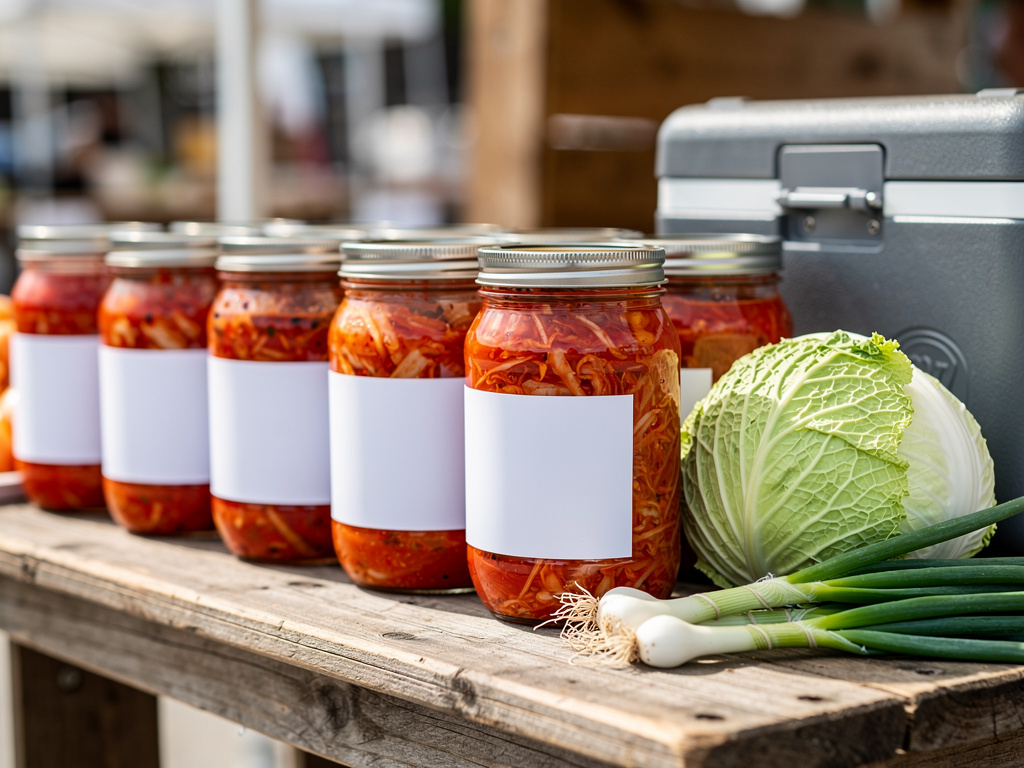


The short version: Homemade kimchi sells in seven places: a farmers market booth, your home or porch, your own online storefront link, local delivery, festivals and community events, restaurants and shops, and shipping or Etsy. Your state decides which of the first five a home kitchen can use, and restaurants, shops and shipping usually take a licensed kitchen. Texas and South Dakota let a home kitchen sell fermented vegetables direct to customers, Wisconsin allows only canned kimchi at markets and events, and Washington, Michigan and California leave kimchi out of their home food rules. On a $10 jar, cash costs you nothing, Square's free plan costs $0.41 in person, your own Homegrown link costs $0.59 plus $10 a month billed annually, and Etsy costs $1.40 before shipping. Start with one market or event and one link, where your state allows both.
Checked September 26, 2026: Homegrown is $10 a month billed annually or $12.50 billed monthly, $0 platform fee and 0% commission, card processing 2.9% + $0.30 paid by the vendor, with 7 days at no charge before the first bill on day 8 (findhomegrown.com/signup). Etsy charges a $0.20 listing fee, a 6.5% transaction fee and 3% + $0.25 payment processing (etsy.com/sell). Square's free plan charges 2.6% + 15 cents in person and 3.3% + 30 cents online (squareup.com/us/en/pricing). State rules come from the Texas, South Dakota, Wisconsin, Washington, Michigan and California agency pages, loaded the same day. Your customer creates a Homegrown account to place a first order, there is no countdown or timed release feature, and your storefront is listed on the Homegrown marketplace, but plan on most orders coming from people you send to your own link.
Your last batch of napa cabbage kimchi is bubbling in the fridge, and three coworkers have already asked if they can buy a jar. Now you need somewhere to sell it. Kimchi is harder to place than jam or cookies. Most homemade kimchi is kept cold, it keeps fermenting in the jar, and the traditional recipe uses fish sauce or salted shrimp. Each of those facts closes some doors and leaves others open.
This guide walks through seven places a home kimchi maker can sell, what each one costs on a single $10 jar, and which states open which places. It also covers what the one kimchi vendor on Homegrown does to reach customers in Snyder, Texas.
Homemade kimchi sells in seven places, and a part-time vendor making 20 to 50 jars a month can run two or three of them alone. Each place asks for something different: a Saturday behind a table with a cooler, a drive across town, or a link you text to the neighbor who keeps asking.
If you are still working out your recipe, pH, labels and first price, start with how to sell kimchi from home, which covers the recipe, safety and pricing side. If your question is whether your state treats kimchi as a home food at all, our guide to selling Korean food from home explains why most home-sold kimchi is sold fresh and kept cold, and why that decides which permit you need. This guide takes your jar and your price as given and works through where to put it.
The seven places:
Start with the place that fits your jar count, your state and whether your kimchi needs a fridge, because a 15-jar maker and a 100-jar maker need different first places. The table matches common situations to the place that fits best.
Scroll sideways to see every column.
| Your situation | Start here | Why it fits |
|---|---|---|
| Under 20 jars a month, friends keep asking | Your own link plus pickup at home, where your state allows it | No booth fee and no travel; $0.59 in card processing on a $10 jar, plus the monthly plan |
| 30 to 60 jars a month, weekends free | A farmers market booth with a cooler | Kimchi sells on the first taste, and you learn which heat level moves |
| You live in Texas or South Dakota | A market, your home and local delivery | Both states let you sell fermented vegetables direct and deliver them yourself |
| You live in Wisconsin | A farmers market, flea market or community event, with canned kimchi | Wisconsin allows home-canned kimchi at pH 4.6 or lower only at those venues, under $5,000 a year |
| You live in Washington, Michigan or California | A licensed kitchen first | Kimchi is not on the home food list in any of the three |
| Your recipe uses fish sauce or salted shrimp | Ask your state before you sell anywhere | Several states exclude fish products from home food rules |
Rules in this table come from the state agency pages listed in the next section, loaded September 26, 2026. Fees come from the Homegrown, Etsy and Square pricing pages, checked the same day.
Start with one in-person place and one link. The in-person place finds new customers. The link keeps the ones you already found, so they do not wait for next Saturday when the jar in their fridge runs out.
Some states let a home kitchen sell kimchi and some do not, and even the yes states limit where the jar can go. Of the six states we checked on September 26, 2026, Texas and South Dakota allow the most places, Wisconsin allows only canned kimchi at markets and events, and Washington, Michigan and California do not allow kimchi under their cottage food rules.
Scroll sideways to see every column.
| State | Home kimchi allowed? | Markets, events, home | Online orders and delivery | Shops and restaurants | Sales cap |
|---|---|---|---|---|---|
| Texas | Yes, fermented vegetable products, with a batch number on each jar; seafood and fish products excluded; ask DSHS in writing whether fish sauce counts | Yes, direct to the customer; samples allowed at any location | Yes, if you, an employee or a household member personally deliver it and your label details are posted before payment | Only jars that are not TCS (not kept cold for safety), through a cottage food vendor registered with the state | $150,000 gross a year (the DSHS figure; it is adjusted for inflation) |
| South Dakota | Yes, naturally fermented foods such as kimchi, kept at 41°F or below; no state license; every jar needs a label | Yes, from your home, a farmers market or another temporary sale venue, in person | You or someone in your household may deliver after the sale; internet sales count as indirect and need a state license | No, wholesale needs a state license | No monetary limit |
| Wisconsin | Home-canned kimchi at pH 4.6 or lower; fish products not allowed at any pH | Community or social events, flea markets and farmers markets in Wisconsin; not out of your home | No, not via the internet or out of state | No wholesale or consignment | $5,000 a year |
| Washington | No; canned pickled products such as sauerkraut, fish products and foods that need refrigeration are on the not-allowed list | None of these under the cottage food permit; a Food Processor's License from the Washington State Department of Agriculture is the route | n/a | ||
| Michigan | No; "No fermented foods or beverages" | No place is open to home kimchi under the cottage food rules; a licensed kitchen is the route | n/a | ||
| California | No; kimchi and fermented vegetables are not on the approved cottage food list | Only foods on the state list may be made at home | n/a | ||
Sources, loaded September 26, 2026: the Texas Department of State Health Services cottage food production page, the South Dakota Department of Health farmers market guidance (June 2022), the Wisconsin Department of Agriculture, Trade and Consumer Protection home-canned foods page, the Washington State Department of Agriculture cottage food page, the Michigan Department of Agriculture and Rural Development "What can I make" page, and the California Department of Public Health approved cottage food list (last reviewed April 2026).
South Dakota's farmers market guidance is the clearest yes. It lists "Naturally fermented foods" with kimchi as an example, marks the state license column "NO" and the labeling column "YES (if packaged)," and says there are "no monetary limits on the amount of sales." The catch is where the jar can go: from your primary residence, a farmers market or a similar temporary venue, sold in person, and not wholesale or over the internet without a state license. A vendor selling fermented foods there must also complete an approved food safety course every five years (SDCL 34-18-36.1); the option in the guidance to keep a processing authority's written sign-off on each recipe instead covers canned goods only (SDCL 34-18-36). State law adds two rules the guidance table leaves out: a fermented food that is not heat-processed must be kept at 41°F or below at all times (SDCL 34-18-36.1), and food made at a residence may not be sold without a label that includes your phone number, mailing address and a statement that it was not produced in a commercial kitchen (SDCL 34-18-37).
Wisconsin says yes to a different product. Wisconsin statute 97.29 and the state agriculture department's page let you sell home-canned foods with a pH of 4.6 or lower, and the department names "sauerkraut and kimchi" as examples. You must stay under $5,000 a year, sell only at community or social events, flea markets or farmers markets in Wisconsin, and post a sign reading "These canned goods are homemade and not subject to state inspection." A home-canned jar is sealed airtight for the shelf, which is a different product from the live, fizzy kimchi most home makers sell cold. Fish products are not allowed at any pH.
The Texas Department of State Health Services lets a home kitchen sell almost any food except a short list that includes "seafood, including seafood products, fish, fish products, shellfish, and shellfish products." Each jar of fermented vegetable products needs a unique batch number on the label, and the page lists the recipe sources it accepts for fermented foods. If your kimchi needs refrigeration for safety, Texas treats it as a TCS food (time and temperature control for safety): you register with the state, keep it at 41°F or below while storing and delivering it, put the date it was made on the label, and put a safe handling statement on the label or the receipt. See our Texas cottage food law guide for the rest of the rules.
State rules on kimchi differ a lot, and these pages change. Verify your state's current rules on your own agriculture or health department page before you book a booth or take an order. If your state is not one of the six above, start with cottage food laws by state and search your state's allowed list for "fermented."
A farmers market is the best first place for most kimchi vendors in states that allow it, because kimchi sells on the first bite and a booth is one of the few places strangers can taste before they buy. Texas lets a cottage food operation give samples at any location, and South Dakota names the farmers market as a place to sell fermented foods. Wisconsin allows farmers markets too, but only for canned kimchi.
The booth fee comes off the top. Say your market charges $30 for a Saturday. At $10 a jar, the first 3 jars you sell only pay for the table, before a single head of cabbage is covered. The real cost of selling at farmers markets walks through booth fees, insurance and the rest of the list.
What makes a kimchi booth work:
One 16 oz jar split into half-ounce tastes gives you 32 samples, enough for a busy morning. If that one tasting jar sells even 4 extra $10 jars, it has paid for itself four times over.
Before you apply, ask each market manager how many fermented food vendors they already take. A second kimchi table at a small market splits the same customers. Farmers market sampling tips covers how to run a tasting table without slowing the line.
You can sell kimchi from your home in South Dakota and Texas, but not in Wisconsin, which lists sales "out of your home" as not permitted for home-canned foods. Home pickup is the cheapest place to sell where it is allowed, because there is no booth fee and no drive.
It works best for people who already know you: neighbors, coworkers, the families on your kid's team, the friend who brings your kimchi to potlucks. A $10 jar paid in cash leaves you the full $10. The same jar paid by card through your link leaves $9.41 before the $10 a month plan.
Ways to run home pickup without answering the door all week:
Check your town's zoning and sign rules before you put a sign at the curb. A state rule that allows home sales does not override a neighborhood rule about foot traffic or signs.
Kimchi takes days to ferment, so the vendor who knows the order count before salting the cabbage wastes the least. The customer who loved your spicy napa kimchi on Saturday will want another jar in two weeks, and without a link that order turns into a text thread, a payment app request and a sticky note on the fridge.
Homegrown gives each kimchi vendor that link for $10 a month billed annually, with no percentage fees beyond standard payment processing (2.9% + $0.30, or $0.59 on a $10 jar). You can set an order prep time, the lead time a customer must order before each pickup date, so orders close with enough days left to ferment the batch. Customers pick a flavor and jar size as variants of one listing, see your ingredients and allergens (soy, fish or shellfish if you use them), pay by card, and choose pickup at your market booth, your door or local delivery. The same link goes on your jar labels, your booth sign and your Instagram bio.
Check one rule before you share that link: whether your state allows online orders for home kimchi. Texas does, as long as the jar is hand-delivered by you or someone on your staff or in your household, and your label details are posted on your storefront before the customer pays. South Dakota counts internet sales as indirect sales that need a state license, and Wisconsin bars internet sales of home-canned foods. In those two states, the link waits until you move to a licensed kitchen.
Compare that to where kimchi vendors usually start. Square's free plan costs $0 a month but charges 3.3% + 30 cents on online orders, or $0.63 on a $10 jar. Etsy costs $1.40 on the same jar before shipping and is built for mailing packages, which no state we checked allows for home kimchi. Instagram and Facebook messages cost nothing and cost you an evening every week matching messages to payments.
Homegrown is built for pickup and local delivery, not shipping. It does not check your pH, test your recipe or tell you what your state allows. It has no countdown or timed release feature. Your customer creates a Homegrown account to place a first order, and while your storefront is listed on the Homegrown marketplace, plan on most orders coming from people you send to your own link.
In a pull of the Homegrown catalog on September 26, 2026, 2 of the 2,723 products from 307 vendors were kimchi, and both came from one vendor, Immunity Artisan in Snyder, Texas. Its "Kimchi" is a 16 oz spicy jar at $10.00, made vegan with soy sauce, shiitake powder and kombu instead of fish sauce. Its "Dongchimi (water kimchi)" is a 32 oz jar at $12.00, marked out of stock that day. The same shop sells a Korean-style soy pickled garlic at $8.00 and lists local delivery within 5 miles of central Snyder for $5.00. The one other fermented cabbage in the catalog was sauerkraut from Mountain Artisan LLC dba ZachsGarden, $20.00 a pint and $12.00 a half pint. We searched product names and descriptions for kimchi, gochugaru, sauerkraut, Korean and fermented vegetables, then opened each matching vendor's other listings; pickled cabbage not sold as sauerkraut or described as fermented was left out.
Two kimchi listings in a catalog of 2,723 means few vendors are selling kimchi on Homegrown yet. If your regulars keep texting you for jars between markets, set up your kimchi storefront on Homegrown and send the link to the next person who asks, so you ferment to real orders instead of guessing.
Local delivery works well for kimchi in states that allow it, because the jar goes from your fridge to a cooler bag to the customer's fridge without sitting out. Texas allows an online sale when the operator, an employee or a household member personally delivers the food. South Dakota lets the vendor or someone living in the vendor's home deliver the jar once an in-person sale is complete, but not fill internet orders.
Immunity Artisan, the one kimchi vendor on Homegrown, runs this in Snyder, Texas: its listings include delivery within 5 miles of the town center for $5.00, and the shop contacts each customer to set a delivery time. In a small town, a delivery zone can reach customers that no booth schedule does.
How to keep delivery simple:
The cottage food delivery playbook covers routes, fees and what to do when nobody answers the door.
You can sell kimchi at festivals and community events in the states that allow direct sales at temporary venues, and these crowds came to eat. South Dakota names "other temporary sale venue" alongside farmers markets, and Wisconsin allows community or social events and flea markets for canned kimchi.
Events that tend to fit kimchi:
Events usually cost more than a weekly market and last longer. A cooler that holds 41°F for 4 hours may not hold it for 10 hours, so bring more ice than you think you need and a thermometer to prove it. Some events also require a temporary event permit from the county, separate from your state's home food rules, so ask the organizer what they require. Holiday and night markets walks through the booth setup for the busy season.
A restaurant or cafe can rarely buy kimchi from a home kitchen, because none of the six states we checked lets a home kitchen sell kimchi to a business that serves it. Texas allows wholesale only to a cottage food vendor registered with the state, who resells to consumers, and only for foods that are not TCS, the ones kept cold for safety. South Dakota and Wisconsin ban wholesale for these foods, and Washington points anyone who wants to sell through a third party to a Food Processor's License.
That leaves two real routes:
The price is the second wall. A cafe that sells your jar at $10 needs to buy it for less. Say it offers $6: that is $4 less than you get from a regular at the market, or $80 less a week on 20 jars. How to sell food to local restaurants and cafes covers the pitch and the pricing once you have a license behind you.
A grocery store, co-op or Asian market can carry your kimchi only in the narrow cases your state allows, and for most home kimchi makers that means a licensed kitchen first. In Texas, a registered cottage food vendor can sell cottage foods at "any retail store," but Texas bars wholesale of TCS foods, the ones kept cold for safety. South Dakota counts a retail store as an indirect sale that needs a state license, and Wisconsin bans consignment and wholesale.
The price has to work for the store too. If a store sells your jar at $10 on its shelf, it pays you less than $10 for it, and your cost to make the jar has to sit well under what the store pays.
What a store buyer will ask for, once you are licensed:
A food co-op is usually the friendliest first stop because it is used to small local vendors. How to sell through a food co-op walks through the buyer meeting and what co-ops expect on price.
You usually cannot ship homemade kimchi, because none of the six state pages we read allows a home-kitchen jar to go by mail. Texas requires personal delivery for online orders. South Dakota counts internet sales as indirect sales that need a state license. Wisconsin bans internet and out-of-state sales, and Washington says you "cannot ship Cottage Food Products by mail or a courier service to consumers."
Etsy's fees on a $10 jar are $0.20 to list, a 6.5% transaction fee of $0.65 and payment processing of 3% + $0.25, or $0.55: $1.40 before shipping. The transaction fee also applies to the shipping price you charge, so the real number is higher once you add postage. Kimchi adds its own trouble: live kimchi keeps making gas, so a sealed jar in a warm truck can bulge or leak, and a cold jar needs insulation and ice for the trip.
You will find homemade kimchi listed on Etsy, but a listing on Etsy does not make shipping legal for a home kitchen. If you want to ship, the route is a licensed kitchen and the license your state requires, plus packaging built for a cold, fizzy product. Can you ship cottage food? covers the state rules for mail orders.
Cash at a booth or at your door costs nothing in fees, Square's free plan costs $0.41 to $0.63 depending on in person or online, your own Homegrown link costs $0.59 plus the $10 plan, and Etsy costs $1.40 before shipping. Booth fees, gas and ice come on top wherever you sell in person.
Scroll sideways to see every column.
| Where and how you get paid | Monthly plan | Trial | Platform or listing fee | Card processing | Customer pays on a $10 jar | Vendor pays on a $10 jar | Vendor pays in a month of 50 jars at $10 |
|---|---|---|---|---|---|---|---|
| Cash at a booth or your door | $0 | n/a | $0 | None | $10.00 | $0.00 | $0.00 |
| Square Free, card in person | $0 per location | n/a on the free plan | $0 | 2.6% + 15¢ | $10.00 | $0.41 | $20.50 |
| Square Free, online or invoice | $0 per location | n/a on the free plan | $0 | 3.3% + 30¢ | $10.00 | $0.63 | $31.50 |
| Homegrown link | $10 billed annually ($12.50 billed monthly) | 7 days, no charge until day 8 | $0, 0% commission | 2.9% + $0.30, paid by the vendor | $10.00 | $0.59 plus the plan | $39.50 billed annually ($42.00 billed monthly) |
| Etsy | $0 (a one-time shop set-up fee may apply) | n/a, no plan | $0.20 listing fee plus 6.5% transaction fee | 3% + $0.25 | $10.00 plus shipping | $1.40 before shipping | $70.00 before shipping |
We checked these fees on Homegrown's signup page, Etsy's selling page and Square's pricing page on September 26, 2026. Card processing is figured on the $10 price. Etsy's transaction fee also applies to the shipping price you set, so its real cost per jar is higher once postage is added. Etsy's Offsite Ads fee (15% on sales that come from those ads; optional for most sellers, required above a sales level Etsy sets) is not included.
Here is the math for the Homegrown row: 2.9% of $10 is $0.29, plus $0.30, is $0.59 a jar. Fifty jars is $29.50 in processing, plus the $10 plan, for $39.50. For Etsy, $0.20 plus $0.65 plus $0.55 is $1.40 a jar, or $70.00 on fifty. The difference between the cheapest card option and Etsy on fifty jars is $49.50, which is about five jars of kimchi.
Yes, fish sauce or salted shrimp can change where you can sell kimchi, because several states exclude fish products from cottage food. UNESCO's listing for kimjang, the Korean tradition of making and sharing kimchi, describes kimchi as "preserved vegetables seasoned with spices and fermented seafood." That seafood is exactly what trips the rules.
What the state pages we read say about fish:
Whether a spoonful of fish sauce in a batch of cabbage makes your kimchi a "fish product" is a question for your state agency, in writing, before you sell. Immunity Artisan's recipe avoids the question: its $10.00 16 oz jar is vegan, swapping fish sauce for soy sauce, shiitake powder and kombu. A vegan kimchi also opens a sale to shoppers who skip fish, so it is worth testing even where the rules allow fish. If you use soy, fish or shellfish, list them as allergens on the label and on your storefront listing.
Kimchi sells year round because regulars eat it every week, but fall and winter give you the most reasons to sell more. UNESCO's kimjang listing says "Late autumn is Kimjang season, when communities collectively make and share large quantities of kimchi" to last through the winter.
Ways to use the calendar:
The regular who buys a jar every other week is the base of the business. At that pace one regular buys 26 jars a year, or $260 at $10 a jar. Seasonal pushes are the bonus on top.
You can start in a new place within a month if you check the rule first, then test small. Here is the order that wastes the least cabbage.
If you are also making sauerkraut or other ferments, selling sauerkraut and fermented vegetables covers the sister product, and how to sell fermented foods from home covers pH testing and labels across the whole category.
Kimchi is a repeat buy, because a regular's jar runs out every week or two, so plan your selling around that next jar. Habits worth copying:
The pattern: pick fewer places, show up at them every week, and make it easy to reorder.
For most home kimchi makers, the best place to sell homemade kimchi is a farmers market booth paired with an online storefront link for pre-orders, in states such as Texas that allow online orders with personal delivery. The market lets strangers taste before buying, and the link lets regulars reorder between markets. Check first that your state allows fermented vegetables from a home kitchen at all.
Yes, in states that allow home kitchens to sell fermented vegetables, such as Texas and South Dakota, you can sell kimchi at a farmers market directly to customers. Wisconsin allows it only for home-canned kimchi with a pH no higher than 4.6. Washington, Michigan and California do not include kimchi in their home food rules, so a licensed kitchen is required there.
You can sell kimchi from home in South Dakota and Texas, as long as you take the food safety course both states require, follow each state's label and cold-holding rules, and sell directly to the customer. Wisconsin does not allow home-canned food sales out of your home. Check your town's zoning rules too, since a state yes does not cover signs or foot traffic.
Usually not from a home kitchen. No state we checked lets a restaurant buy home-kitchen kimchi to serve, and Texas allows wholesale only of kimchi that is not a TCS food, meaning it is not kept cold for safety, through a reseller registered with the state. To sell kimchi to restaurants or stores, most vendors move production to a licensed kitchen.
In the states we checked, homemade kimchi cannot be shipped by mail. Texas requires personal delivery for online orders, Washington bans mail and courier delivery, Wisconsin bans internet sales, and South Dakota needs a state license for internet sales. Shipping kimchi takes a licensed kitchen and packaging built for a cold product that keeps making gas.
Most homemade kimchi is kept refrigerated, and each state we checked handles that differently. South Dakota requires any fermented food that is not heat-processed to be kept at 41°F or below, whatever its acidity. In Texas, a cottage food that needs refrigeration for safety must be registered, kept at 41°F or below while stored and delivered, and labeled with the date made and a safe handling statement. Washington and Michigan exclude foods that need refrigeration from their home food rules, and Michigan also excludes fermented foods other than vinegar.
More on selling kimchi and other ferments:
The hardest part of selling kimchi is not the cabbage. It is knowing how many jars to make before the ferment starts, because a batch you salt on Monday is a batch you are committed to for the next week or two. Guess high and you are left with sour jars nobody ordered. Guess low and your best customers go without.
A storefront link your regulars order from turns that guess into a count. If 18 people order a 16 oz jar before your cutoff, you ferment 18 jars plus a few for the tasting table and the walk-up shoppers, and nothing else. The orders arrive paid, with the pickup spot or delivery address already attached, so your production day is only production.
Start your kimchi storefront on Homegrown for $10 a month billed annually, list your jars with their sizes and allergens, and set the lead time your ferment needs. Then, where your state allows online orders, send the link to the coworkers who keep asking, and make your next batch to real orders.



