
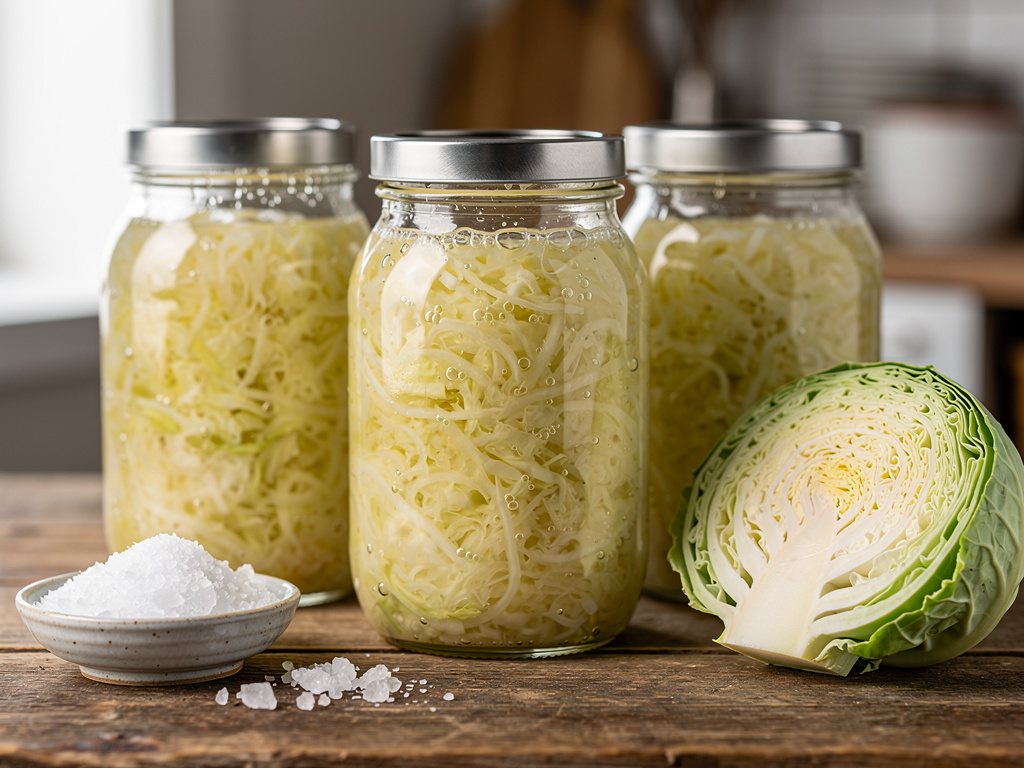


The short version: You can sell homemade sauerkraut in some states, but not in all of them, and the answer often turns on whether your jars are canned. We read the agency pages for 9 states. Texas, Wisconsin and Colorado give sauerkraut from a home kitchen a written path. Minnesota allows home-canned vegetables that test acidic enough, without naming kraut. In Oregon, the no-license path for kraut is for farmers who grow the cabbage. A home cook there can apply for the Oregon Department of Agriculture's Domestic Kitchen License, which is licensed and inspected. Washington's not-allowable list rules out canned sauerkraut by name and also excludes food products made from fresh vegetables. Michigan and California leave canned sauerkraut out of their home rules. Virginia's FAQ says canned fermented foods may not qualify for its home exemption and that the answer depends on the recipe. The limits differ a lot: Wisconsin caps home-canned sales at $5,000 a year and bans online sales, while Texas allows up to $150,000 with no permit or fee. Sauerkraut made by fermentation alone is not an "acidified food" under the federal rules, per Minnesota's agriculture department, which spares it one layer of federal paperwork but does not make it legal in your state. Where your state's home-kitchen rules say no, the legal route is a licensed kitchen, or in Virginia and Oregon a home kitchen that the state licenses or inspects.
Checked on the pages of the Texas Department of State Health Services (DSHS), the Wisconsin Department of Agriculture, Trade and Consumer Protection (DATCP), the Colorado Department of Public Health and Environment (CDPHE), the Minnesota Department of Agriculture (MDA), the Oregon Department of Agriculture (ODA) and ORS 616.683, the Virginia Department of Agriculture and Consumer Services (VDACS), the Washington State Department of Agriculture (WSDA), the Michigan Department of Agriculture and Rural Development (MDARD), the California Department of Public Health (CDPH), and 21 CFR Part 114, September 26, 2026. Rules change, so verify your state's current rules with its agency before you sell. This guide is not legal advice. Homegrown takes orders and payments; it does not test your sauerkraut or make it legal to sell. Customers create a Homegrown account to order.
Your neighbor finished the jar of caraway kraut you gave her and asked if she could buy two more. Someone at church wants a quart every month. Before you take anyone's money, you want a straight answer on whether selling sauerkraut is legal where you live.
This page gives that answer for 9 states, in each agency's own words, plus the federal line that decides why sauerkraut is treated differently from vinegar pickles. It also covers the practical part once you are allowed: permits, pH testing, labels, sales caps, and where you can and cannot sell.
Your state decides, and among the 9 states whose rules we read on September 26, 2026, 4 give homemade sauerkraut a written path from a home kitchen. Wisconsin names "sauerkraut and kimchi" as allowed home-canned foods. Texas's cottage food law sets recipe, pH and batch-number rules for home kitchens that sell "fermented vegetable products" (Health and Safety Code §437.01951). Colorado tests sauerkraut pH for home kitchens at no charge, and Minnesota allows home-canned vegetables that test acidic enough. Oregon lets cabbage growers sell it with no license and offers home cooks a licensed, inspected Domestic Kitchen License, 3 states keep it out of their home-kitchen rules, and Virginia's exemption may not cover it, depending on the recipe. Washington's home rule is itself a permit, $355 for two years with a WSDA kitchen inspection, and WSDA points anyone whose food it does not allow to a Food Processor License.
The reason the answers split comes down to two questions about your jar. First, did the sour taste come from fermentation or from vinegar? Second, is the jar canned for the shelf, or raw and kept cold? State home-kitchen laws were written around canned, shelf-stable jars, so a crock of raw, living kraut does not always fit the words on the page.
Here is what the rest of this page covers:
If your state already allows it and you want the kitchen side (making a batch, fixing a soft or moldy crock, flavors that sell), our guide on how to sell sauerkraut and fermented vegetables from home covers that. This page is the permission half.
Sauerkraut made with only cabbage and salt is a fermented food, and fermented foods are not covered by the federal acidified food rules, according to the Minnesota Department of Agriculture. An acidified food is a low-acid food that has acid added to it, like cucumbers covered in vinegar. Under 21 CFR 114.3, which we read on eCFR on September 26, 2026, acidified foods are "low-acid foods to which acid(s) or acid food(s) are added" with a finished pH of 4.6 or below, and the regulation even lists "cabbage" as an example. The same definition excludes "foods that are stored, distributed, and retailed under refrigeration."
The difference is where the acid comes from. In sauerkraut, bacteria that live on the cabbage turn its sugar into lactic acid while it sits in salt brine. Nobody pours acid in. The Minnesota Department of Agriculture's acidified foods page defines fermented foods as low-acid foods acted on by microorganisms "which produce acid during their growth and reduce the pH of the food to 4.6 or below." It then lists products that are not subject to the acidified rules, including "Fermented foods where the pH is reduced by natural fermentation and not by adding acid. Examples include sauerkraut, green olives, tempeh, natto, miso, kombucha, and some types of fermented pickles."
That matters for two reasons:
The same page says kimchi made "in the traditional manner using only fermentation" would also be exempt, but that "a product and process assessment by a Process Authority will be necessary." A process authority is a food scientist, usually at a university or a testing lab, who reviews a recipe and the way you make it and puts the verdict in writing.
None of this makes sauerkraut legal to sell from your home. Federal rules sort foods into categories; your state decides which categories a home kitchen can make.
Yes: Wisconsin's exemption covers home-canned jars and excludes "refrigerator pickles," so the same kraut can qualify canned and fall outside the rule raw. Many state home-kitchen laws were written for canned, shelf-stable jars, and several of the rules we read say "canned" in the exact sentence that decides sauerkraut. The table sorts the common kinds of kraut by what keeps them safe and how the rules we read treat them.
Scroll sideways to see every column.
| Kind of kraut | What makes it sour | How it is stored | How the rules we read treat it |
|---|---|---|---|
| Raw fermented kraut, kept cold | Lactic acid from fermentation | Refrigerated; NCHFP says fully fermented kraut keeps "for several months" covered in the fridge | Fermented, not acidified, per MDA. Wisconsin's exemption covers home-canned foods and its list says "not refrigerator pickles," so ask DATCP before selling raw kraut there. Texas's page allows refrigerated (TCS) cottage foods with DSHS registration |
| Canned fermented kraut | Lactic acid from fermentation | Shelf-stable after a boiling water canner | The form Wisconsin names ("sauerkraut and kimchi") as a home-canned food. Washington bans "canned pickled products such as ... sauerkraut," and Virginia lists "canned fermented foods" among products that may not be allowed |
| Quick kraut with vinegar | Added vinegar | Shelf-stable if canned | An acidified food under 21 CFR 114.3, so it follows your state's pickle rules instead |
| Kimchi | Lactic acid from fermentation | Usually refrigerated | Exempt from the acidified rules if made "using only fermentation," per MDA; Wisconsin and Colorado name kimchi beside sauerkraut |
| Fermented hot sauce | Lactic acid, often plus vinegar | Shelf-stable if bottled hot | Depends on the recipe; see our guide on selling fermented hot sauce from home |
Sources: 21 CFR 114.3 on eCFR, the MDA acidified foods page, the National Center for Home Food Preservation (NCHFP) sauerkraut page, and each state agency page, all read on September 26, 2026. Your recipe and your storage decide where your own jar lands; the word "sauerkraut" does not.
Most home rules we read assume a shelf-stable jar. If you sell raw, living kraut that has to stay cold, read your state's page for the words "canned," "refrigerator" and "time and temperature control," and ask the agency in writing before your first sale. Canning kills the live bacteria that many kraut buyers want, so this is a real trade-off, not a technicality.
Of the 9 states in this guide, as of September 26, 2026, 4 give sauerkraut from a home kitchen a written path. Wisconsin is the only one of these 4 whose home rule names sauerkraut as allowed. Colorado names it on its pH testing list, Texas names "fermented vegetable products" in its label rule, and Minnesota's rule covers home-canned vegetables under that same pH line without naming kraut. The table covers all 9 states in each agency's words.
Swipe left to read the whole table.
| State | Homemade sauerkraut allowed? | Yearly sales cap | Permit or fee | What the agency page says |
|---|---|---|---|---|
| Texas | Yes | $150,000 gross income | No license, permit or fee from local health departments | Allows any food except a short list that includes "low-acid canned goods"; batch number required on "fermented vegetable products" |
| Wisconsin | Yes, home-canned | $5,000 per person | No license under the Pickle Bill | Allowed examples include "sauerkraut and kimchi"; pH of 4.6 or lower |
| Colorado | Yes, if the pH tests low enough and the jar is shelf-stable; CDPHE limits cottage foods to foods that "do not require refrigeration for safety," and its eligibility check flags canned vegetables, so confirm your jar with cdphe_mfgfd@state.co.us before selling | $10,000 in net revenue per product type | Food safety training required | Eligible: "Pickled fruits and vegetables with a finished equilibrium pH of 4.6 or below"; sauerkraut is on the free pH test list |
| Minnesota | Yes, home-canned and tested | $78,000 | Registration and training; no registration fee up to $7,665 in sales, $50 from $7,666 to $78,000 | "home-processed and home-canned pickles, vegetables, or fruit with a pH of 4.6 or below"; sauerkraut not named |
| Oregon | Yes for farmers who grow the cabbage, with no license; home cooks can apply for a Domestic Kitchen License | $50,000 in the prior year for these products (Farm Direct) | No license under Farm Direct; the Domestic Kitchen License is licensed and inspected, and its prohibited list does not include fermented vegetables | Acidic foods include "lacto-fermented fruits and vegetables (e.g., sauerkraut, dill pickles, and kimchi)" |
| Virginia | Maybe not under the exemption, depending on the recipe; a VDACS-inspected home kitchen is possible ($40 a year) | $9,000, for exempt acidified vegetables only | $40 a year for a VDACS permit and inspection outside the exemption; none for exempt foods | "canned fermented foods" listed among products that "MAY NOT be allowed" |
| Washington | No. Canned sauerkraut is named, and raw kraut falls under "Food products made from fresh fruits or vegetables" | $35,000 (for allowed foods) | $355 for two years | Not allowable: "Canned pickled products such as corn relish, pickles, sauerkraut" |
| Michigan | No, for canned or pickled vegetables | $50,000 (for allowed foods) | None for allowed foods | Not allowed: "Canned fruit or vegetables" and "Pickled products" |
| California | No | Not applicable | Not applicable | Not on the Approved Cottage Foods list, whose 10 categories have none for pickled or fermented vegetables |
We loaded each agency page on September 26, 2026: Texas DSHS Cottage Food Production, the Wisconsin DATCP home-canned foods page, CDPHE Cottage Foods, the MDA Cottage Food Law Guidance and registration pages, the ODA Farm Direct Marketing FAQ, ORS 616.683 and the ODA Domestic Kitchen License page with its October 2024 licensing requirements, the VDACS Home Food Processing Exemptions FAQ (revised July 2026), WSDA Cottage Food, the MDARD cottage food one-pager dated March 2026, and the CDPH Approved Cottage Foods list (last reviewed April 2026).
The Wisconsin DATCP home-canned foods page allows "home-canned fruits and vegetables that are naturally acidic or have been acidified by pickling or fermenting," with a pH of 4.6 or lower, and lists "sauerkraut and kimchi" as examples. The limits are tight: no more than $5,000 a year per person, sold only at "community or social events, flea markets or farmers markets in Wisconsin." Sales from your home, wholesale, consignment, "via the internet or out of state" are not permitted.
Texas gets to yes by exclusion. Its cottage food page says allowable foods "now include any foods, except for the following," and fermented vegetables are not on that short list. The page then requires "a unique number for each batch of pickled fruit or vegetables, fermented vegetable products, or plant-based acidified canned goods," and lists approved "Recipe Sources to produce acidified (pickled) and fermented foods." Our Texas cottage food law guide covers the rest of the state's rules.
CDPHE offers pH testing at no charge for cottage food producers who make chutney, kimchi, pickled fruits and vegetables, pickles, relish, sauerkraut and vinegar. You can send up to 5 different products, and the page says funding is limited and "offered on a first-come, first-served basis." The results confirm whether your recipe reaches a finished pH of 4.6 or below.
Minnesota's answer needs one extra step. Its cottage food law allows "home-processed and home-canned pickles, vegetables, or fruit with a pH of 4.6 or below," which is where a canned kraut fits, but the pages we read do not name sauerkraut. Test your pH, then confirm with MDA that your jar qualifies.
Washington names canned sauerkraut as not allowed from a home kitchen, Michigan and California leave it out in other words, and Virginia's exemption flags canned fermented foods as products that may not qualify, depending on the recipe. That is 3 of the 9 states we checked on September 26, 2026, plus Virginia, where it turns on your recipe. Here is how each one puts it:
A no from these states is a no under their home-kitchen rules, not to your sauerkraut. The usual legal route in these states is a licensed kitchen, or in Virginia a permitted, inspected home kitchen, covered in the "What If Your State Says No?" section below.
One of the top search results for this question says sauerkraut is allowed as a cottage food in only 1 state. The agency pages we loaded on September 26, 2026 show a no-license home path in 4 states, plus Oregon for farmers; Virginia and Oregon also license or inspect home kitchens. That count appears to include only states whose allowed list names sauerkraut, and its Wisconsin entry shows no revenue limit, though DATCP caps sales at $5,000. Texas and Minnesota cover it without naming it, and Colorado names it only on its pH testing list, so read your own state's agency page, not a directory.
Yes, in Oregon a farmer who grows the cabbage can sell sauerkraut without a food processing license under the state's Farm Direct Marketing law. The ODA Farm Direct Marketing FAQ, loaded September 26, 2026, lists three kinds of "acidic foods," including "lacto-fermented fruits and vegetables (e.g., sauerkraut, dill pickles, and kimchi)." The same FAQ says lacto-fermentation "is the only type of fermentation allowed," which is why it turns away kombucha and homemade vinegar.
ORS 616.683 covers producer-processed fruits and vegetables that are acidic foods, labeled with ingredients and the farmer's name and address, and made by a farmer whose sales of these products "did not exceed $50,000" in the preceding calendar year. The label also needs the statement "This product is homemade and is not prepared in an inspected food establishment." Internet sales are allowed to people within Oregon.
The cabbage has to be yours. Under this no-license Farm Direct exemption, a farmer who grows cabbage and sells kraut at a Saturday market fits; a home cook who buys cabbage at the grocery store does not. Oregon's separate Cottage Food Exemption for home kitchens (ORS 616.723) does not cover it either; ODA's Cottage Food Exemption FAQ says that exemption "does not allow the sale of pickles." That home cook's Oregon route is ODA's Domestic Kitchen License, which licenses and inspects the home kitchen and does not list fermented vegetables among its prohibited activities; its October 2024 requirements say acidified foods "might be permitted" with a process authority's analysis and an operator certified at Better Process Control School. Other states have farmer programs of their own, so if you grow the main ingredient, ask your agency whether a farm path exists alongside the cottage food law.
Texas, Wisconsin and Colorado ask for no state license to sell homemade sauerkraut; Texas, Colorado and Minnesota require food safety training first, and Minnesota also wants you registered. Texas DSHS says local health departments may not require a cottage food operation to "obtain any type of license or permit" or "pay any fee" to sell directly to a consumer.
Slide the table sideways for all five columns.
| State | What you file | Training | pH testing | Cost we could confirm |
|---|---|---|---|---|
| Texas | Nothing for shelf-stable jars; optional registration lets a DSHS number replace your address on the label. If you sell kraut as a refrigerated (TCS) food, register with DSHS and add the date made and DSHS's safe-handling statement to the label | Accredited food handler course | Use an approved recipe source, a lab-tested or process-authority-approved recipe, or test each batch with a calibrated pH meter | No state or local fee |
| Wisconsin | Nothing | None named on the page | "Recommended" for acidified products; keep pH results in your records | No license fee |
| Colorado | No state license; your sign must say the kitchen is "not subject to state licensure or inspection" | One of 3 food safety training options | No-charge state lab testing for sauerkraut, while funding lasts | No state fee listed on the page |
| Minnesota | Cottage food producer registration | Training and an exam before you register | Must reach pH 4.6 or below | Free up to $7,665 in sales; a $50 registration fee from $7,666 to $78,000, plus a paid Tier 2 food safety course |
From the Texas DSHS, Wisconsin DATCP, CDPHE and MDA pages, loaded September 26, 2026. Minnesota's registration page says revisions passed in the recent legislative session take effect August 1, 2027; the callout below lists the changes.
Minnesota's cottage food rules change on August 1, 2027. The MDA registration page says the new law will have one tier, a $30 yearly fee for all, shipping allowed within Minnesota, and advanced training for everyone. Plan for the old rules now and recheck the page before that date.
A city or county can add its own rules on top of the state's, most often zoning for home businesses. Minnesota's page says a local ordinance restricting home food businesses stops you from making and selling from your home, though you may still sell as a registered producer from a commercial kitchen, so check locally too.
Not always by law, but testing (or, in Texas, following an approved recipe exactly) is how you show your kraut is under the line: all 5 states in this guide with a no-license home or farm path use 4.6 as the line your finished kraut must reach, Texas, Wisconsin, Colorado and Minnesota in their rules or agency pages, and Oregon in its Farm Direct FAQ. Wisconsin recommends a test, Colorado offers free testing, and Minnesota points unsure producers to a lab. Wisconsin and Colorado both use 4.6, Minnesota requires "a pH of 4.6 or below," and ODA's Farm Direct FAQ describes acidic foods as having "a pH at or below 4.6" (the statute, ORS 616.680, lists lacto-fermented foods as their own category). Texas's cottage food rule, 25 TAC §229.661(f), says a seller of fermented vegetable products must use a recipe from a DSHS-approved source, a recipe a certified lab has tested at pH 4.6 or less, or one a qualified process authority has approved, or else test each batch with a calibrated pH meter.
Three things decide how you test:
Salt does not replace acid. Salt keeps the wrong bacteria out while the good ones work, but the rules measure pH. A crock that stayed too cold to ferment, or a batch pulled early because it tasted sour enough, can sit above the line.
In Texas it can: DSHS lists approved "Recipe Sources to produce acidified (pickled) and fermented foods," so you can follow one exactly instead of lab testing your own recipe. The list, loaded September 26, 2026, includes the USDA Complete Guide to Home Canning (2015 revision), the University of Georgia's So Easy to Preserve (6th edition) and three Ball books. A new recipe source needs a Request for Official Determination sent to DSHS.
The NCHFP at the University of Georgia publishes the USDA's tested sauerkraut recipe, and its numbers show how specific "tested" is:
A tested recipe covers the recipe as written. Cutting the salt, adding vinegar, or packing in a bigger jar changes the result. If you change it, you are back to a lab test or a process authority's review, and in Texas that means a lab-tested recipe, a process authority's approval, or a calibrated pH meter test of every batch before you sell.
Your family's caraway and juniper kraut may taste better, but a recipe from one of the approved books, followed exactly, is the lowest-cost way to start in Texas. Save the recipe page and the edition with your batch records.
Every state in this guide that allows sauerkraut requires a label, and each one asks for its own home-kitchen statement, so print your state's wording exactly. The Texas DSHS page lists these for cottage foods:
Wisconsin wants the name and address of the person who did the canning, the date of canning, all ingredients in descending order, and "This product was made in a private home not subject to state licensing or inspection." It also wants a sign at your table: "These canned goods are homemade and not subject to state inspection." Minnesota wants your name and registration number, or your name and address, the date the food was made, the ingredients with any allergens, and its own homemade statement, which reads almost the same as the Wisconsin sign. Oregon's farm law uses "This product is homemade and is not prepared in an inspected food establishment." Colorado's page says cottage foods must be labeled with "specific information including an exact disclaimer," and its definition of an informed end consumer lists what the buyer must be given: the product name, the address where it was made, your phone or email, the date it was made, ingredients, and a disclaimer that it came from a home kitchen not subject to licensure or inspection and may contain common food allergens.
Most kraut is just cabbage and salt, so the allergen line is usually empty. Kimchi is different: fish sauce and shrimp paste are common, and some vegan versions use soy sauce instead. In Texas and Colorado, plan on a kimchi made with fish sauce or shrimp paste being out: Texas's home rules exclude "seafood, including seafood products, fish, fish products, shellfish, and shellfish products," and Colorado bars fish and shellfish products even "as ingredients or toppings." Our cottage food label checklist walks through the general rules.
Wisconsin caps home-canned sales at $5,000 a year, while Texas lets a home kitchen gross up to $150,000, so the ceiling varies thirtyfold among the states that allow kraut. At $12 a half pint, $5,000 is about 416 jars a year, or 8 a week.
Yearly sales cap for a home or farm sauerkraut maker
Source: Wisconsin DATCP, CDPHE, ORS 616.683, MDA and Texas DSHS pages, checked September 26, 2026. Colorado's figure is $10,000 in net revenue per product type, not a gross sales cap like the others; Oregon's counts the prior calendar year's sales of these products.
For most part-time vendors, the first limit is the crock, not the cap. The tested recipe takes 3 to 4 weeks at the right temperature to make 9 quarts, so a steady weekly supply means several crocks going at staggered start dates, and space somewhere that stays near 70°F.
You can sell in person in all 4 yes states, but only Texas, Colorado and Minnesota let you take orders online, and none of those 4 states' home rules lets you ship kraut to another state. Where you hand it over depends on the state:
Our guide on whether you can ship cottage food covers the general rules on mailing home-kitchen food. For sauerkraut, plan on local pickup, delivery and market tables. Those three, plus fall festivals, Oktoberfest tables and a CSA add-on, are compared jar by jar in where to sell sauerkraut, where a $12 jar costs $0.46 in card fees at a booth and $1.59 on Etsy.
In Texas, Colorado and Minnesota, most home kraut sales will be a porch pickup or a hand delivery, and a single link that collects the order and the payment keeps those handoffs straight. If your state allows it, you can set up a Homegrown storefront for sauerkraut pickup orders in about 15 minutes.
You can still sell sauerkraut legally, but not under the no-license home rules. Some states license and inspect a home kitchen: Virginia's VDACS says home food processing operations outside the exemption are "required to be inspected, have a permit to operate, and pay an annual inspection fee of $40," and Oregon issues a Domestic Kitchen License. Everywhere else, the common route is renting time in a licensed commercial kitchen and getting your own food processing license from the state. The steps usually look like this:
Fermentation time is the hard part in a rented kitchen. Kraut sits for weeks, and shared kitchens that charge by the hour may not have room for crocks that long. Ask each kitchen about storage before you sign. Our guide on renting a commercial kitchen as a cottage food vendor covers the kitchen route in more detail.
If you are a farmer, ask your agency about farm programs before you rent a kitchen. Oregon's Farm Direct law is one example of a path that skips the license for a grower.
Once your state says yes, the hard part shifts from permission to logistics: knowing how many jars are spoken for before a batch is ready, since each one takes weeks. Homegrown is $10 per month billed annually ($12.50 billed monthly) with no percentage fees beyond standard payment processing, and it gives you one storefront link where customers pick a jar size, pay, and choose pickup or delivery. The table shows what three common options cost on a $10 jar.
Drag sideways to compare every fee column.
| Platform | Monthly plan | Trial | Platform fee | Card processing | Customer pays on a $10 order | Vendor pays on a $10 order | Vendor pays in a month of 50 $10 orders |
|---|---|---|---|---|---|---|---|
| Homegrown | $10 billed annually ($12.50 monthly) | 7 days | None, 0% commission | 2.9% + $0.30, paid by the vendor | $10.00 | $0.59 plus the plan | $39.50 ($42.00 on monthly billing) |
| Etsy | None | None | 6.5% transaction fee, plus a $0.20 listing fee that renews at $0.20 each time a jar sells | 3% + $0.25 | $10.00 | $1.40 | $70.00 |
| Shopify Basic | $29 billed yearly ($39 monthly) | 3 days, then $1 a month for 3 months | None with Shopify Payments (2% with another processor) | 2.9% + 30¢ online | $10.00 | $0.59 plus the plan | $58.50 ($68.50 on monthly billing) |
Prices come from findhomegrown.com/signup, etsy.com/sell, Etsy's Fees & Payments Policy (for the listing renewal on each sale) and shopify.com/pricing, each loaded September 26, 2026. Figures assume one $10 jar per order, no shipping charge and no sales tax. Etsy's 15% Offsite Ads fee on ad-driven sales is not included, and Etsy may charge a one-time shop set-up fee.
Etsy is built for shipping, and none of the 4 home-kitchen states in this guide lets you mail kraut across state lines, so most of what you would pay Etsy for is off the table. Shopify is a full website builder at almost three times the plan price, more than a vendor with two jar sizes and a porch pickup needs. Instagram DMs cost nothing and fall apart the week 15 people want a jar from the same crock.
For a legal home sauerkraut business, the parts of Homegrown that fit are:
What Homegrown does not do: it does not test your pH, review your recipe, print labels or tell you whether your state allows your kraut. In Wisconsin, where the Pickle Bill bans internet sales, an online order page is not a fit for home-canned kraut at all. Customers create a Homegrown account to place their first order. Your storefront is listed on the Homegrown marketplace, but plan on most orders coming from people you send to your own link. There is no timed-release feature for a batch drop, and card processing of 2.9% + $0.30 is paid by you, with no option to pass it to the customer.
They treat each recipe as a fixed formula and keep a paper trail from the first crock. Five habits keep a home sauerkraut business inside the rules:
Sell by the half pint first. The tested recipe's 9 quarts come to 36 half pints, and at the $12 half-pint price one Homegrown vendor lists, that is $432 of kraut from one 25-pound batch. A smaller jar lets new customers try it, and it spreads one crock across more buyers while you learn your weekly demand.
In a pull of the Homegrown catalog on September 26, 2026 (2,727 products from 308 vendors), we searched product names, descriptions and size options for sauerkraut, kraut, kimchi and fermented, dropped sourdough, vinegar and other non-vegetable matches, then opened every listing from each matching vendor. No listing is titled sauerkraut. The one sauerkraut sits as two size options on Mountain Artisan's "Old Fashioned Pickles" listing: a half pint for $12.00 and a pint for $20.00. Mountain Artisan's description does not say how its kraut is made. Immunity Artisan, whose delivery listing names Snyder, Texas, lists a 16 oz spicy kimchi for $10.00, a 32 oz water kimchi for $12.00 (listed as out of stock on September 26, 2026) that it describes as made "in our home kitchen," and an $8.00 fermented hot sauce that it says gets "sharp apple cider vinegar" added after the ferment. We counted a vendor when a listing, or a size option on a listing, is named sauerkraut or kimchi. We left out a "Fermented-Red Onions" listing whose ingredients show a vinegar pickle. We also left out Sonkissed Shire's "Pickled Cabbage" ($8.50 a pint, $16.00 a quart, "crisp and tangy") and its "Pickled Jalapeno Cabbage," which it says to "Use in place of sauerkraut," because neither is named sauerkraut or says the cabbage is fermented.
That count shows two things. Fermented vegetables are rare on the platform: 2 of 308 vendors list a sauerkraut or a kimchi, and one more sells pickled cabbage it pitches as a kraut substitute. And a sauerkraut hidden inside a pickles listing is hard for a shopper to find, so give yours its own listing with "sauerkraut" in the name.
You can do the reading for your own state in one afternoon by going straight to the agency and asking one specific question; the agency's written reply to your email may take days. Our state-by-state guide to cottage food laws is a starting point for finding your agency.
The source note under the state table in "Which States Let You Sell Homemade Sauerkraut From Home?" names the exact page we used for each of the 9 states, so if you live in one of them, you can start at step 4.
It is legal in some states and not in others. In our September 26, 2026 check of 9 states, Texas allows homemade sauerkraut under its home rules, and Wisconsin allows it home-canned. Colorado allows shelf-stable pickled vegetables at pH 4.6 or below, so confirm your jar with CDPHE, and Minnesota allows home-canned vegetables at pH 4.6 or below without naming kraut. Oregon allows it with no license for farmers who grow the cabbage, and home cooks can apply for its licensed, inspected Domestic Kitchen License, whose prohibited list does not include fermented vegetables; confirm your kraut with ODA. Washington names canned sauerkraut as not allowed, Michigan bans pickled products and canned vegetables, California's list has no category for it, and Virginia lists canned fermented foods among products that may not be allowed under its exemption, though a permitted, inspected home kitchen is possible there for $40 a year. For raw kraut kept in the fridge, ask your agency in writing. Texas's page already allows refrigerated (TCS) cottage foods, as long as you register with DSHS.
In some states it is. Wisconsin names sauerkraut and kimchi as allowed home-canned foods, and Colorado lists sauerkraut among the cottage foods it will pH test for free. Federally, sauerkraut made by fermentation alone is not an acidified food, according to Minnesota's agriculture department, but that does not decide whether your state's cottage food law includes it.
In most states that allow it, your finished kraut must be at pH 4.6 or below. The Wisconsin, Colorado and Minnesota pages recommend or offer testing rather than require it, but testing (or, in Texas, following an approved recipe exactly) is how you show your kraut is under the line. Texas lets you skip your own lab test if you follow an approved recipe source exactly, such as the USDA Complete Guide to Home Canning. Colorado offers state lab testing at no charge for sauerkraut while funding lasts, and an electronic pH meter for your own batch checks costs around $100, per Virginia's agriculture department.
Yes, in the states that allow homemade sauerkraut, with the right label. Wisconsin allows home-canned sauerkraut only at farmers markets, flea markets and community or social events, with a sign saying the jars are homemade and not state inspected. Minnesota cottage food vendors can sell at farmers markets and community events, and Oregon farmers can sell at markets under Farm Direct. Check your market's own vendor rules too.
You can take orders online in Texas, Colorado and Minnesota, but none of those 3 states lets a home kitchen mail it to another state. Texas requires you, an employee or a household member to deliver in person, Colorado bans interstate sales, and Minnesota uses pickup or your own delivery. Oregon farmers who grow the cabbage can also sell online to people within Oregon under Farm Direct. Wisconsin does not allow internet sales of home-canned sauerkraut at all.
Often, but read your state's list. Wisconsin names "sauerkraut and kimchi" together, and Colorado pH tests both. MDA's guidance for commercial food manufacturers says kimchi made only by fermentation is exempt from the federal acidified rules, and that a process authority should assess the product and process. In Texas and Colorado, leave out fish sauce and shrimp paste, since both states bar fish and shellfish products from home kitchens. Wisconsin's page lists fish among products that need a license regardless of pH, so ask DATCP before selling kimchi made with fish sauce. Our guide on how to sell kimchi from home covers ingredients and pricing.
These 5 guides answer the next questions a home sauerkraut vendor usually asks, from making the batch to selling other ferments. Start with the first one if your state is a yes and you have never sold a jar; start with the pickles guide if your recipe uses any vinegar, since that changes which rules apply to you.
Once your state says yes and your recipe tests below pH 4.6, the only thing left is making it easy to buy. Under these rules, most home sauerkraut sales will be local: a porch pickup in Minnesota, a hand delivery in Texas, a delivery within Colorado. Because every batch takes weeks, your customers need a simple way to claim jars before the crock is ready, so you pack 36 half pints for 36 paid orders instead of guessing. A Homegrown storefront for your sauerkraut gives your customers one link to pick a jar size, pay, and choose pickup or delivery, for $10 a month billed annually ($12.50 billed monthly), with no percentage fees beyond standard payment processing. You keep your recipe, your label and your state's approval; the storefront handles the orders and the payments. If your state said no, start by pricing time in a licensed kitchen, and come back when your first licensed batch is ready.



