
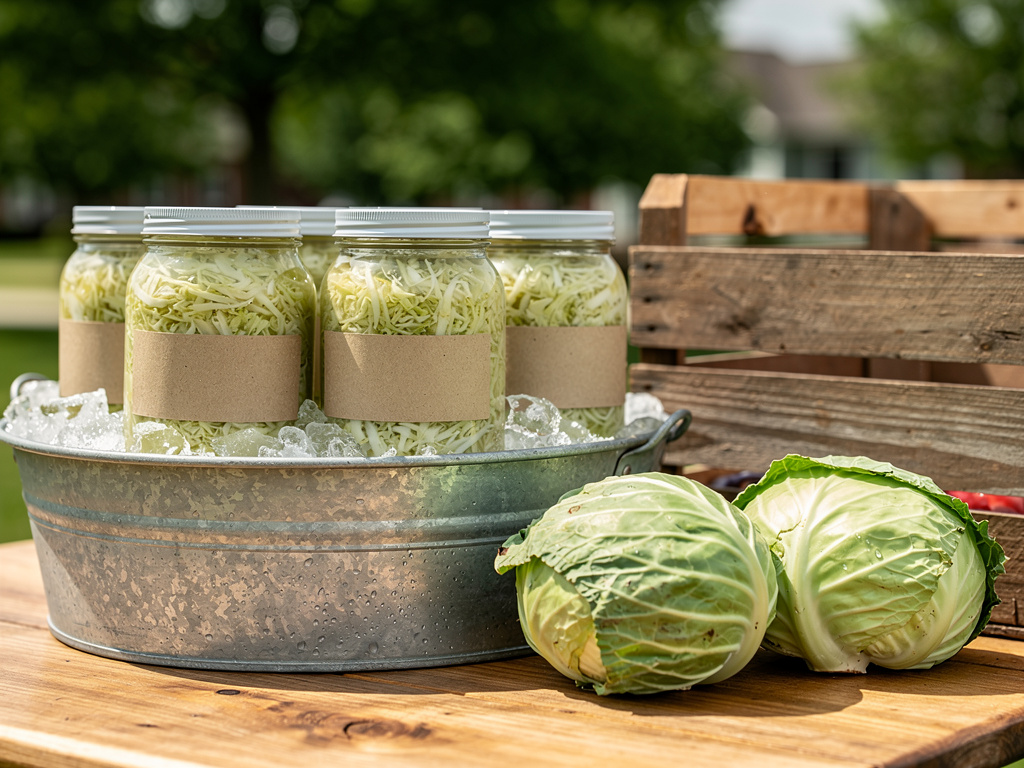


The short version: Homemade sauerkraut sells in seven places: a farmers market booth, your home or farm stand, your own online storefront link, local delivery, fall festivals and community dinners, delis and breweries, and stores or shipping. Raw kraut that has to stay cold fits a market booth, home pickup, your own link and local delivery best, while canned kraut is the kind Wisconsin allows at its markets and events. Delis, restaurants and brewery kitchens usually cannot use food from a home kitchen, because the FDA Food Code that most states build their rules on says so. Trader Joe's sells an 18-ounce jar of raw sauerkraut with pickled cucumbers for $4.49, so your jar wins where people can taste it and meet you, not on the grocery shelf. A good starting pair is a market booth plus a link regulars use to order ahead, where your state allows online orders (South Dakota and Wisconsin do not).
Checked on Trader Joe's product page and Homegrown's pricing page, September 27, 2026: Trader Joe's listed its sauerkraut at $4.49 for 18 ounces, and Homegrown was $10 a month billed annually with 2.9% + $0.30 card processing paid by the vendor. State rules in this guide come from agency pages loaded the same day. Homegrown customers create an account to place their first order. Homegrown cannot price products by the pound yet, and it has no timed release feature for a batch.
Your crock of kraut finished last week, the kitchen smells like it, and you have more jars than your family can eat before Christmas. Now you need somewhere to sell them. Sauerkraut is trickier to place than cookies. Raw kraut is alive and wants a fridge, canned kraut plays by different state rules, and the buyers who put it on their menus (delis, hot dog stands, breweries) are the ones least able to buy from a home kitchen.
This guide covers the seven places a home sauerkraut vendor can actually sell, what each one costs on a single $12 jar, which states open which places, and which times of year give kraut the most reasons to sell. If you are still working out your recipe, flavors and first batch, start with how to sell sauerkraut and fermented vegetables. If your first question is whether your state allows home kraut at all, the sauerkraut permission guide walks through nine states in each agency's own words.
Homemade sauerkraut sells in seven places, and a part-time vendor making one 25-pound batch a month can run two or three of them alone. One batch from the tested recipe of the National Center for Home Food Preservation (NCHFP) yields about 9 quarts, which is 36 half pints, so the real question is where 36 jars go before they crowd out your fridge.
The seven places:
Which one to start with depends on how many jars you make, whether your kraut is raw or canned, and your state:
Scroll sideways to see every column.
| Your situation | Start here | Why it fits |
|---|---|---|
| One batch a month, friends already ask for jars | Your own link plus pickup at home, where your state allows it | No booth fee, no travel, and $0.65 in card processing on a $12 jar plus the monthly plan |
| Two or more batches a month, Saturdays free | A farmers market booth with a cooler and a tasting jar | Kraut sells on the first bite, and the booth finds strangers your link never reaches |
| Your kraut is canned and you live in Wisconsin | Farmers markets, flea markets and community events | Those are the only venues Wisconsin's home-canned rule allows, under $5,000 a year |
| You grow the cabbage yourself in Oregon | Farmers markets, a roadside stand and your own CSA | Oregon's farm direct rules cover farmers' own lacto-fermented sauerkraut |
| A deli or brewery wants to put your kraut on the menu | A licensed or shared commercial kitchen first | Home-kitchen food cannot go into their dishes in most states |
Rules in this table come from the state agency pages and the FDA Food Code loaded September 27, 2026 and cited in the sections below. Fees come from the Homegrown pricing page checked the same day.
Yes, Trader Joe's sells Sauerkraut with Pickled Persian Cucumbers for $4.49 for an 18-ounce jar, listed under Fresh Prepared Foods on its website when we checked on September 27, 2026. The page says it is naturally fermented with "No cooking or pasteurization," made from cabbage, cucumbers, sea salt and garlic. In other words, the store version of the good stuff is raw kraut too, and it costs less than your jar.
That matters for where you sell. ZachsGarden, the one Homegrown vendor listing sauerkraut in our catalog pull, charges $12 for a half pint and $20 for a pint. The half pint costs about 2.7 times the Trader Joe's jar and holds less than half as much. Counting a half pint as about 8 ounces, that is about $1.50 per ounce for the half pint against about $0.25 at Trader Joe's, or 6 times as much. Few shoppers pay that for kraut they pick up next to the hummus. Hummus has the same gap: a 10 ounce tub of Sabra was $3.97 at Walmart on October 6, 2026, while small hummus vendors charge a median of $10 for 8 ounces. They pay it when they tasted it at your table, when they know the cabbage came from a garden a few miles away, or when your caraway or beet kraut is something the store does not make.
So the shoppers searching "does Trader Joe's sell sauerkraut" are telling you three things:
Our sauerkraut pricing guide compares more store and small-brand prices ounce for ounce if you are still setting yours.
Yes, and it is the first thing to settle before you pick among the 7 places. Raw kraut is fully fermented cabbage kept in the fridge, and the National Center for Home Food Preservation says it "may be kept tightly covered in the refrigerator for several months." Canned kraut has been heat processed in a boiling water canner, sits on a shelf, and loses the live bacteria some customers buy it for. Both start with the same weeks in the crock (about 3 to 4 weeks at 70 to 75°F); the difference is what happens after.
Scroll sideways to see every column.
| Raw kraut, kept cold | Canned kraut, shelf-stable | |
|---|---|---|
| Farmers market booth | Works with a cooler and ice | Works, no cooler needed |
| Home or farm stand | Works if you have a fridge or cooler at pickup | Works, easiest option for an unattended stand where your state allows one (South Dakota requires you to be present) |
| Local delivery | Works in a cooler bag | Works |
| Festivals and events | Works if the event has space for your cooler | Works best |
| Wisconsin venues | Not covered; the exemption is only for home-canned jars | Allowed at markets, flea markets and events |
| Texas wholesale to a cottage food vendor | Not allowed if the Texas Department of State Health Services (DSHS) treats it as a food that needs cold holding for safety (TCS) | Allowed |
| Shipping | Jars keep fermenting and can leak or bulge in a box | Travels better, but Texas, South Dakota and Wisconsin home rules do not allow it |
From the home-canned foods page of Wisconsin's agriculture department (DATCP), the Texas DSHS cottage food page and the NCHFP sauerkraut recipe, all loaded September 27, 2026.
If your customers ask for raw kraut, make raw kraut. If you want the widest set of places, keep one canned product too, so you have something for a stand or a festival table with no cooler. The fermented foods guide covers pH testing for fermented foods like raw kraut.
Your state decides which of the seven places a home kitchen can use, and in the five states we checked on September 27, 2026 the answers ran from most of them to none. Read your own state's page before you book a booth or print a label. These rules change, and county health departments can add their own.
Scroll sideways to see every column.
| State | Where home kraut can be sold | What is not allowed |
|---|---|---|
| Texas | Direct to customers; online orders if you, an employee or a household member delivers; wholesale to a registered cottage food vendor, who can resell at a farmers market, farm stand, food service establishment or retail store | Wholesale of foods that need cold holding for safety; shipping |
| South Dakota | Your home, a farmers market or another temporary sale venue, in person; you or a household member can deliver at the end of the sale | Wholesale, retail stores and internet sales |
| Wisconsin | Canned kraut at pH 4.6 or lower at community or social events, flea markets and farmers markets in Wisconsin | Sales from home, wholesale, consignment, the internet, out of state; raw kraut that is not canned; over $5,000 a year |
| Oregon (farmers only) | Your own lacto-fermented kraut at farmers markets, roadside stands, single-farmer CSA drop sites, buying clubs, church bazaars and online | Using it as an ingredient in a licensed deli product; prior-year sales of these products over $50,000 |
| Washington | Not as cottage food | Sauerkraut is on the prohibited list; a Washington State Department of Agriculture (WSDA) food processor license is the route |
Loaded September 27, 2026 from the Texas DSHS cottage food page, South Dakota's farmers market guidance, the Wisconsin DATCP home-canned foods page, the Oregon Department of Agriculture (ODA) farm direct FAQ and ORS 616.683, and the WSDA cottage food page. Verify your state's current rules before you sell.
South Dakota's farmers market guidance lists "kombucha, kimchi, sauerkraut" as naturally fermented foods that need no state license, only a label if packaged, and says "There are no monetary limits on the amount of sales." You do need an approved food safety course every five years, or written verification of each recipe from a processing authority, and sales have to happen in person from your home, a farmers market or another temporary venue. We loaded it on September 27, 2026.
Texas lets a cottage food operator sell to a registered cottage food vendor at wholesale, but the DSHS page says "TCS foods are not eligible for wholesale." TCS means a food that needs time and temperature control for safety. Before you sign up a shop to resell raw kraut, ask DSHS whether your product counts. If it does, a shop cannot resell it at all, and you can only sell it directly to customers, after registering with DSHS, printing the date the kraut was made on the label and adding DSHS's "SAFE HANDLING INSTRUCTIONS" statement on the label or receipt. Any jar that vendor resells, canned or raw, must carry the date it was made. We checked that page on September 27, 2026.
Texas also requires a food handler course, a unique batch number on the label of fermented vegetable products, and, for online orders, the full label information posted on your website before you accept payment. DSHS lists approved recipe sources for fermented foods, including the USDA Complete Guide to Home Canning.
For the full state-by-state picture, including Colorado, Minnesota, Virginia, Michigan and California, see whether you can sell homemade sauerkraut and our cottage food laws by state overview.
A farmers market is a strong first place for a sauerkraut vendor with jars to spare, because kraut sells on the first taste and a booth is where strangers can taste it. South Dakota, Wisconsin and Oregon name farmers markets outright, and Texas allows cottage foods to be sold directly to customers. ZachsGarden, the Homegrown vendor that sells kraut, says on its tomato listing that it brings "a limited quantity to the market."
The booth math is simple. Say your booth fee is $30, an example rather than a quote. That is 2.5 half pints at $12. Sell 15 half pints and the booth takes one jar in six. Sell 5 and it takes half of what you made.
What a kraut booth needs:
Sell kraut next to something it goes on. A sausage or pierogi vendor two tables down sends you customers who already have a fork in hand. Ask the manager to place you nearby, and send your tasters to their table while they send theirs to yours.
Usually not from an open crock, because the states we checked expect home kraut in closed, labeled jars. Texas says cottage foods "must be packaged and labeled," with an exception only for foods too large or bulky to package, Wisconsin requires a label on every home-canned jar, and South Dakota requires a label on anything packaged. Selling from an open crock at the booth means the kraut sits unpackaged and the tub goes out unlabeled, and Texas only allows unpackaged food when it is too large or bulky to package, which kraut is not.
If you do sell by weight, the scale matters too. South Dakota's guidance says "Any products sold by weight, must be sold from a legal for trade certified NTEP approved scale," meaning a scale approved under the National Type Evaluation Program, and the scale has to be certified every other year for a $28 fee. The simplest answer for a small vendor is to sell fixed jar sizes and print the net weight on the label. Homegrown lists products by size, not by the pound, so pint and half pint jars fit it well.
You can sell sauerkraut from home in South Dakota, which allows sales "from a primary residence," and in Texas, which allows direct sales to customers, but not in Wisconsin, which bans sales "out of your home." Where it is allowed, home pickup is the cheapest place to sell: a $0 booth fee, no drive, and customers who come to you on your schedule.
Home pickup works best when you set it up like a small shop:
A farm stand is a harder fit for raw kraut. An unattended stand in August can warm a jar well past fridge temperature by noon unless you run a fridge or a cooler with ice. Check your state first: South Dakota requires home foods to be sold in person, with you there, so an unattended stand is out there, and Wisconsin allows no sales from home. Where unattended stands are allowed, canned kraut is easier here, and our guide to cold storage for an unattended farm stand covers what works for anything that needs to stay chilled.
Take orders while the crock is still bubbling, because a batch needs about 3 to 4 weeks at 70 to 75°F before it is ready, according to the NCHFP recipe. That means you know the jar count a month ahead. If regulars claim their jars during those weeks, you jar the batch, hand it out, and almost nothing sits in your fridge waiting.
This is the problem Homegrown solves for kraut vendors. It costs $10 a month billed annually, with no percentage fees beyond standard payment processing of 2.9% + $0.30 per order, which is $0.65 on a $12 jar. You list classic, caraway and beet kraut as one product with half pint and pint sizes, each at its own price. You add your home, your farmers market and a festival date as pickup spots. You set an order prep time so nobody orders Tuesday for a Wednesday pickup of a flavor you have not jarred. If you drive jars around town, you set a delivery radius and a flat delivery fee, and you keep the full fee minus card processing.
Compare that to the alternatives many small vendors reach for first. Etsy takes a $0.20 listing fee, a 6.5% transaction fee and 3% + $0.25 processing, about $1.59 on a $12 jar, and it is mostly used for shipped orders, which a raw ferment handles badly. Instagram DMs cost nothing but turn into 20 threads of "is the caraway ready yet?" that you answer one by one. Square's free online checkout charges 3.3% + 30 cents, or $0.70 a jar, and works well if you already use it at your booth.
What Homegrown does not do: it cannot price kraut by the pound yet, it has no timed release or countdown feature for a batch, and it will not bring you customers on its own. Your storefront is listed on the Homegrown marketplace, but plan on most orders coming from people you send your link to. Customers also create a Homegrown account the first time they order. And a link cannot change your state's rules: South Dakota and Wisconsin do not allow internet sales of home kraut, and Washington does not allow home kraut at all, so the link fits vendors in states that allow online orders or those selling from a licensed kitchen.
In a pull of the Homegrown catalog on September 27, 2026, 1 of 306 vendors listed sauerkraut among 2,714 products. We searched product names, descriptions and size options for kraut, kimchi and fermentation words, dropped sourdough bread and vinegar pickles, and opened every matching vendor's full listings. ZachsGarden lists "Sauerkraut (Pint)" at $20.00 and "Sauerkraut (Half Pint)" at $12.00 as sizes of its pickles listing, made with cabbage from Zach's own garden. Two vendors of 306 sell any fermented cabbage at all: ZachsGarden's kraut and Immunity Artisan's napa cabbage kimchi. One more, Sonkissed Shire, sells pickled cabbage its listings do not call fermented, including a jalapeno cabbage it suggests using "in place of sauerkraut." So a new kraut vendor would share Homegrown with very few cabbage sellers today.
If your regulars already text you asking when the next batch is ready, a link that takes the order and the payment turns those texts into a jar count. You can set up a Homegrown storefront for your sauerkraut and have your first batch listed in about 15 minutes.
Yes, local delivery works well for sauerkraut where your state allows it, as long as you or someone in your household makes the drop. Texas allows online sales when "The operator, an employee, or a household member personally delivers the food," and South Dakota lets the seller or a household member deliver "at the completion of the sale." Both name personal delivery, so a courier service is out for home kraut in those two states. In South Dakota the sale itself has to happen in person, so delivery there means dropping off jars someone bought from you face to face, not an order placed online.
Delivery fits kraut because regulars reorder on a rhythm. A family that eats a pint a week with dinner wants it on the same day every week, and a cooler bag in your trunk keeps raw jars at fridge temperature for a short loop. The cottage food delivery playbook covers routes and scheduling.
Delivery rules that save you trouble:
Yes, if your state allows event sales and the event has room for you. Fall gives sauerkraut the most reasons to sell: cabbage is harvested, and Oktoberfest season runs right through it. The original Munich Oktoberfest runs September 19 to October 4 in 2026, according to the City of Munich's official site, so if a brewery or church near you holds its own Oktoberfest, ask for a booth by mid-August next year. For this fall, the next dates to plan for are Thanksgiving and New Year's Day. In Baltimore, Baltimore Magazine says "a helping of sauerkraut is part of a complete Thanksgiving dinner plate in these parts."
Event rules come from two places. Your state's home food rule has to allow it: Wisconsin names "community or social events," and South Dakota allows "other temporary sale venue." Then the event organizer and your county decide the rest, often with a temporary event permit. Ask both before you pay a booth fee.
What sells at a festival booth:
Church and community dinners are the other kraut event. In Pennsylvania, WVIA News reports that people commonly eat pork and sauerkraut on New Year's Day, and one Tamaqua church feeds 100 to 200 people at its New Year's dinner each year. Selling jars at a church event is its own set of rules. The guide to selling food at church events and school fundraisers explains how those usually work, and selling at craft fairs and festivals covers booth setup.
A deli, brewery or butcher usually cannot buy your kraut from a home kitchen to use in its food. The FDA Food Code is the model rule for restaurants and stores, and by FDA's 2024 count, state agencies in 36 states had adopted its 2022, 2017 or 2013 edition. Its 2026 edition, published September 17, 2026, says "FOOD prepared in a private home may not be used or offered for human consumption in a FOOD ESTABLISHMENT." A deli piling your kraut on a Reuben, a brewery serving it on brats, or a butcher shop scooping it next to its sausages is a food establishment using your food.
Oregon spells it out. Its farm direct FAQ asks whether a farmer's exempt pickles can go into a licensed deli sandwich, and the answer is "No." The same logic applies to kraut.
There are still three honest ways into this market:
A grocery store or co-op shelf usually needs a licensed kitchen, and a CSA can be an easier door for a farmer who ferments their own cabbage. South Dakota says home processed foods "cannot be sold wholesale," naming "sales from a retail store" as an example. Wisconsin rules out wholesale and consignment. Texas allows resale at a retail store through a cottage food vendor registered with DSHS, but not for TCS foods.
A CSA works differently. Oregon's farm direct rules let a single-farmer CSA sell that farmer's own processed products, including lacto-fermented sauerkraut, directly to members. If you do not grow cabbage, you can still partner with a vegetable farm: the farm sells its shares, and you offer your kraut as a separate add-on that members order and pay you for. That only works where your state lets someone else hand out your jars: of the five states we checked, only Texas does, through a farm registered with DSHS as a cottage food vendor, and only for jars that do not need cold holding for safety. Our guide to partnering with a CSA as an add-on vendor walks through that setup, and selling through a food co-op covers the co-op side once your kitchen is licensed.
Why a cabbage farm is a good partner:
Shipping homemade sauerkraut is rarely allowed for a home kitchen in the states we checked. Texas online sales require personal delivery, South Dakota bans internet sales of home processed foods, and Wisconsin bans internet and out-of-state sales. Oregon is the exception for farmers: its farm direct FAQ says a farmer's own processed products can be sold online and that Oregon does not stop them leaving the state, though the receiving state may. Etsy, whose fees come to $1.59 on a $12 jar before shipping, is mostly used for shipped orders, so it fits a licensed kraut vendor far better than a home one.
Raw sauerkraut keeps fermenting in the jar. Sealed tight and warmed in a delivery truck, it can build pressure, push brine past the lid or bulge. Even in a state that allows mail order, test a jar in a box on a warm day before you ship one to a customer. Our guide on whether you can ship cottage food covers the general rules on mailing home kitchen food.
If you do move to a licensed kitchen and ship, plan for insulated packaging, a lid that handles pressure, and a customer who opens the box within a day or two. For a home kraut vendor, local pickup, delivery and market tables earn more per jar anyway.
On a $12 jar, cash costs you nothing, a Square card tap costs $0.46, an order through your Homegrown link costs $0.65 plus the monthly plan, and Etsy costs $1.59 before shipping. The table shows the full fee stack on every row, per jar and across a month of 50 jars.
Scroll sideways to see every column.
| Where the sale happens | Monthly plan | Platform or listing fee | Card processing | Customer pays on a $12 jar | Vendor pays on a $12 jar | Vendor pays on 50 jars a month |
|---|---|---|---|---|---|---|
| Cash at a booth or porch | $0 | $0 | None | $12.00 | $0.00 | $0.00 |
| Square Free, card tapped in person | $0 (Plus is $49) | $0 | 2.6% + 15¢ | $12.00 | $0.46 | $23.10 |
| Square Free, online checkout | $0 (Plus is $49) | $0 | 3.3% + 30¢ | $12.00 | $0.70 | $34.80 |
| Homegrown storefront link | $10 billed annually ($12.50 monthly); 7-day trial, no charge until day 8 | $0, 0% commission, no shopper fee | 2.9% + $0.30, paid by the vendor | $12.00 | $0.65 plus the plan | $42.40 ($44.90 on monthly billing) |
| Etsy | $0 (a one-time shop set-up fee may apply) | $0.20 listing fee + 6.5% transaction fee; 15% on Offsite Ads sales | 3% + $0.25 | $12.00 plus any shipping you charge | $1.59 before shipping | $79.50 before shipping |
We checked these on the Homegrown, Square and Etsy pricing pages on September 27, 2026. Card processing is figured on the $12 jar price alone. Etsy's 6.5% also applies to any shipping price you set, and an Offsite Ads sale adds $1.80 on a $12 jar.
The booth has costs no pricing page shows: the booth fee, ice, gas, and a Saturday of your time. The link has the monthly plan. For a vendor selling 50 jars a month, Square's free online checkout costs $34.80, a Homegrown link $42.40 in total on annual billing, and Etsy $79.50 before a single box is packed.
Sauerkraut has the most reasons to sell from late September through New Year's Day, a stretch of about 14 weeks. Fall cabbage is in, Oktoberfest runs from late September into early October, and pork and sauerkraut is a New Year's Day meal for many Pennsylvanians. Our list of the best-selling fall farmers market products shows how fall shoppers change what they buy.
Work backward from the date, because kraut cannot be rushed. At 70 to 75°F the NCHFP recipe takes about 3 to 4 weeks, and at 60 to 65°F it may take 5 to 6 weeks. A kitchen that runs cool in winter needs a longer lead.
A simple kraut calendar:
You can add one new place in about a month, because that is how long the next batch takes anyway. Pick the place first, then time the batch to it.
The habit that matters most is selling more of each batch before it is done than after, through orders regulars place while the crock ferments. The habits below follow from that.
A farmers market booth is a strong first place for a home sauerkraut vendor with jars to spare, because people buy kraut after they taste it. Pair it with an online ordering link so regulars can claim jars from each batch before it is done. Check your state's rules first, since some states only allow certain venues.
Yes. Trader Joe's sells Sauerkraut with Pickled Persian Cucumbers for $4.49 for an 18-ounce jar, listed on its website on September 27, 2026. It is naturally fermented and not pasteurized. Its page says details may have changed since posting and asks shoppers to check the current price with the crew.
In several of the states we checked, yes. South Dakota and Wisconsin name farmers markets outright, and Wisconsin only allows the canned kind. Texas allows cottage foods to be sold directly to customers, and Oregon allows farmers markets for farmers who ferment their own cabbage. Washington does not allow sauerkraut as cottage food.
Usually not from a home kitchen. The FDA Food Code, the model most states build their restaurant rules on, says food prepared in a private home may not be used in a food establishment. To sell sauerkraut to a restaurant or deli, plan on moving production into a licensed or shared commercial kitchen first.
You can take orders online in some states, but shipping is rarely allowed. Texas allows online sales when you or a household member delivers the jar in person. South Dakota does not allow internet sales under its home food rules without a state license, and Wisconsin does not allow them at all, so check your state before you post a link.
Raw sauerkraut should stay cold, so bring a cooler with ice to markets and events. Canned sauerkraut is shelf-stable until opened. Texas says TCS foods must be stored and delivered at 41°F or below, so if DSHS treats your raw kraut as TCS, keep it that cold, and the NCHFP says raw kraut keeps several months tightly covered in the fridge.
More on selling sauerkraut and other ferments:
The hardest part of selling sauerkraut is the month it spends fermenting, not the cabbage or the salt. That month is your head start: time to line up a booth, a festival or a porch pickup, and time for regulars to claim their jars. A kraut vendor who opens orders while the crock is still bubbling ends each batch with an empty fridge instead of 20 jars nobody asked for.
Start small. One 25-pound batch of cabbage gives about 36 half pints, and at $12 each that is $432 of kraut if every jar finds a buyer. Line up the buyers first: a list of regulars, one market or festival, and a link that holds their orders while the batch ferments.
If you already have a batch going, start your Homegrown storefront, list your kraut by jar size, and send the link to the people who keep asking when the next batch is ready.



