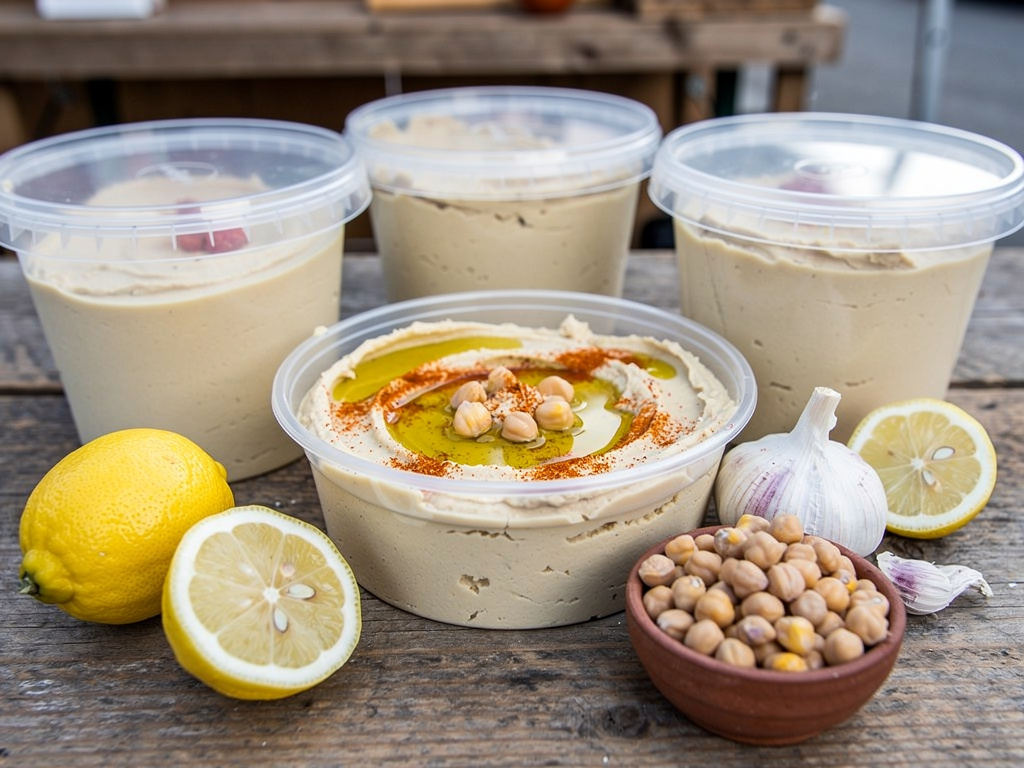


The short version: Sell an 8 ounce tub of handmade hummus for $8 to $12, which brackets the $10 median that six small vendors charged for 8 ounces on October 6, 2026, against $3.97 for a 10 ounce tub of Sabra at Walmart. The chickpeas, tahini, lemon, garlic and plastic tub in one 8 ounce container cost about $1.09 at restaurant-supply prices and $1.84 at grocery prices, and tahini is 61% to 72% of the ingredient bill. Hummus is made from cooked chickpeas, so it has to stay cold, which keeps it out of traditional cottage food laws like Minnesota's and can mean a rented kitchen that adds $1.50 to $3.30 to each tub, though Texas, Illinois and Wyoming let you make it at home under their own rules. Ithaca Hummus, which started at a farmers market in 2013, retailed a 10 ounce tub for around $7, CNBC reported in July 2025, and no sale of the company has been announced.
Checked on October 6, 2026: nine hummus vendors' own product pages, Walmart and WebstaurantStore prices, four commercial kitchens' rates (three on the kitchens' own pages, one on The Kitchen Door listing), the FDA Food Code 2026, the home kitchen rules of Texas, Illinois, Wyoming and Minnesota on each state's own website, and the fee and card processing terms on the pricing pages of Homegrown, Hotplate, Square and Shopify, so verify your state's current rules before your first sale. Homegrown customers create an account to place their first order, and Homegrown has no drops or countdown release feature.
Hummus looks like one of the cheapest things you could sell. A bag of dried chickpeas costs $1.52 at Walmart, and a tub of Sabra sits next to it for under $4. So when a shopper picks up your 8 ounce container at the farmers market, you might wonder how anyone gets $10 for it.
They do, and they have reasons. Hummus has to be kept cold from the minute you make it, it only lasts about a week, and the tahini that makes it taste good is the most expensive thing in the bowl. In a state like Minnesota, where the cottage food law covers only shelf-stable food, a licensed commercial kitchen is usually the route, and that kitchen charges rent by the hour.
This guide works out a real price with numbers loaded on one day. It lists what nine hummus vendors charge right now, runs a well-known recipe through live grocery and restaurant-supply prices, adds kitchen rent from four real kitchens, and shows what each way of selling takes off a $10 tub. It also answers a question shoppers and vendors type into search: how much did Ithaca Hummus sell for?
Price an 8 ounce tub of handmade hummus at $8 to $12, which sits around the $10 median that six small vendors charged for 8 ounces on October 6, 2026, and the $10 median is 5.4 to 9.2 times the $1.09 to $1.84 of ingredients and packaging in that tub. A big multiple is normal here. The beans are cheap, but the cold storage, the kitchen time and the tubs you cannot sell after a week are not.
Before you set any price, check that you are allowed to sell hummus from where you plan to make it. Our guide to which foods count as TCS food under cottage food laws explains why cooked chickpeas need temperature control and what that changes for a home cook. This page is about the price, and the legal section below covers the four states we checked.
Swipe sideways to see every size and price.
| Size | Your ingredients and tub, restaurant-supply prices | Your ingredients and tub, grocery prices | Suggested price | What small vendors charged |
|---|---|---|---|---|
| 8 oz tub | $1.09 | $1.84 | $8 to $12 | $7.49 to $13, median $10 (six vendors) |
| 16 oz tub | $2.09 | $3.41 | 1.5 to 2 times your 8 oz price | $8 to $12 (Little Sesame, a packaged brand, and Cryptid Kitchen) |
| Flavored 8 oz (roasted red pepper, beet, herb) | $1.09 plus the add-in | $1.84 plus the add-in | $1 more than your plain tub | Cryptid Kitchen: $5 plain, $6 red pepper |
| Party board with hummus and vegetables | Varies with the vegetables | Varies with the vegetables | Price per guest | $50 for 4 to 6 guests up to $100 for 12 to 16 (From Scratch) |
Ingredient costs come from the Ottolenghi and Tamimi basic hummus recipe run through WebstaurantStore and Walmart prices that day, with one batch filling four 8 ounce tubs. Your label, kitchen rent, booth fee and time are not in these two columns; the sections below add them. Small vendors' prices were read on each vendor's own page and in the Homegrown catalog the same day.
Three things decide where you land inside that range:
Nine US hummus vendors, eight small makers and one packaged brand sold in grocery stores (Little Sesame), charged $7.49 to $13 a container on October 6, 2026, with a median of $10, and the six selling an 8 ounce tub also landed on a $10 median. By the ounce, the nine ranged from 57 cents to $1.63, with a median of 99 cents. Every price below was read off the vendor's own website that day. Eight of the nine were shown as available to order; Grove Ladder Farm's $13 tub showed Sold Out that day.
Slide left to see the price per ounce.
| Vendor | Product | Size | Price | Price per ounce |
|---|---|---|---|---|
| Baba Small Batch (Santa Barbara, California) | Organic Classic Hummus | 8 oz | $7.49 | $0.94 |
| Glaser Organic Farms (Miami, Florida) | Sprouted Chickpea Hummus | 8 oz | $7.90 | $0.99 |
| Rose Creek Farms (Selmer, Tennessee) | Hummus | 8 oz | $10.00 | $1.25 |
| Marla Bakery | House Made Hummus | Half pint (about 8 oz) | $10.00 | $1.25 |
| Green Deelightz (Concord, California) | Golden Hummus | 8 oz | $12.00 | $1.50 |
| Grove Ladder Farm | Sprouted Garbanzo Bean Hummus | 8 oz | $13.00 | $1.63 |
| Little Sesame (Washington, DC packaged brand, also sold in grocery stores) | 16oz Smooth Classic | 16 oz | $10.00 | $0.63 |
| Brookford Farm store (Canterbury, New Hampshire) | Shovel and Spoon hummus (the listing's description names the maker Shovel and Stone) | 14 oz | $8.00 | $0.57 |
| Kahumana Organic Farms (Oahu, Hawaii) | Farm Fresh Hummus | 12 oz | $10.00 | $0.83 |
Read on each vendor's own product page on October 6, 2026. Locations are the ones each site states; no location means the page did not give one. Marla Bakery sells by the half pint, which is 8 fluid ounces, so we counted it as 8 ounces; without it, the five 8 ounce tubs still have a $10 median. This table is vendors' own websites. Homegrown's one hummus vendor, Cryptid Kitchen, charges $5 and $6 for 8 ounces and is covered in the catalog section below; counting it, the median of eight 8 ounce tubs is $8.95. Four other vendors were left out because their pages did not state a container size that day.
Price per ounce: nine vendors and two store brands
Source: each vendor's own page and Walmart.com, October 6, 2026. Ithaca is figured from CNBC's July 2025 report that a 10 ounce tub retails for around $7.
What the table tells you:
If you sell in a smaller town, start near the low end of this list and raise the price once you have regulars. If you sell in a city market where organic produce goes for top dollar, $12 is not a stretch.
A 10 ounce tub of Sabra Classic was $3.97 at Walmart on October 6, 2026, about 40 cents an ounce, while the nine vendors in the table above charged a median of 99 cents an ounce. So the median vendor charges about 2.5 times Sabra's price per ounce, and a $10 tub of 8 ounces works out to about 3.1 times. That gap is normal among the vendors we checked.
Swipe sideways for the per-ounce math.
| Store hummus | Size | Price | Price per ounce | Same price for 8 ounces |
|---|---|---|---|---|
| Marketside Classic Hummus (Walmart's brand) | 10 oz | $2.87 | $0.29 | $2.30 |
| Fresh Cravings Lemon Garlic Hummus | 10 oz | $3.92 | $0.39 | $3.14 |
| Sabra Classic Original Hummus | 10 oz | $3.97 | $0.40 | $3.18 |
| Ithaca Hummus (CNBC, July 2025) | 10 oz | About $7 | About $0.70 | About $5.60 |
| Vendors in this guide (median) | 8 oz | $10 | $0.99 (all nine) | $7.90 at the nine-vendor per-ounce median; the six 8 oz tubs have a $10 median |
Walmart prices come from Walmart.com search results at the default store on October 6, 2026. They change by store and week. One Sabra flavor, roasted red pepper, showed $1.84 that day; the $3.97 classic tub is used here as the standard tub. Ithaca was not listed at that store.
Here is how to use the comparison without letting it drag your price down:
The same pattern shows up in our salsa pricing guide, where handmade jars also sell for several times the grocery price per ounce. A refrigerated dip made in small batches simply costs more to make, keep cold and sell, and a fair price says so. Queso makes the same point with cheese: a pint costs about $3.35 in ingredients and tub but $12.21 per pint sold once rent, your time and a booth are counted, which is why our queso pricing guide lands on $12 to $14.
No sale price for Ithaca Hummus has been made public, while its hummus sells for around $7 for a 10 ounce tub in stores. We found no public announcement that Ithaca Hummus was sold, so there is no sale price to report. PitchBook's profile, which we read on October 6, 2026, lists Bush Brothers & Company as its parent with no date and no deal amount, but we found no press release or news story confirming a sale, and Cornell's business school still called Chris Kirby the founder and CEO of Ithaca Hummus in May 2026. The tub price comes from a July 2025 CNBC story, which reported that each 10 ounce Ithaca tub retails for around $7 and also said the company was on track for more than $50 million in revenue that year and had passed $150 million in lifetime sales.
The early numbers are the useful part for a small vendor, because Ithaca started where you are:
The lesson for your price: Ithaca never tried to be the cheapest tub on the shelf. It charged more for fresh lemon and garlic, handed out samples, and let the taste make the case. That is the same playbook a farmers market vendor uses at a $10 price.
In some states, yes, but not under a traditional cottage food law. The FDA Food Code 2026 counts a heat-treated plant food, like cooked chickpeas, as time/temperature control for safety food, usually shortened to TCS food, unless its acidity or water activity tests low enough to keep germs from growing. States that only allow shelf-stable foods from a home kitchen leave hummus out. Of the four states we checked on October 6, 2026, Texas, Illinois and Wyoming allow hummus from a home kitchen under their own rules, and Minnesota does not.
Slide the table left for each state's rules.
| State | Hummus from a home kitchen? | Key rules for a refrigerated food like hummus |
|---|---|---|
| Texas | Yes, as a TCS food | Register with the state health department, finish food handler training, store and deliver it at 41°F or below, label it with the date it was made and a safe handling statement, stay under $150,000 a year. TCS food cannot be sold wholesale or donated. |
| Illinois | Yes, as a TCS food | Register every year with your local health department (fee capped at $50 by law). Keep it at or under 41°F while you store, transport and sell it. TCS food cannot be shipped, and nothing ships out of state. The state's extension guide lists a food protection manager certificate as required. |
| Wyoming | Yes, under the Food Freedom Act | Sell directly to an informed end consumer, yourself or through a designated agent, only in Wyoming, up to $250,000 and 250,000 food or drink products a year. No state license or inspection. |
| Minnesota | No | Food that needs refrigeration does not qualify for the cottage food exemption, and the state lists cooked plant foods as not allowed. A food license and a licensed kitchen are the route. |
Checked October 6, 2026 on each state's own site: the Texas Department of State Health Services cottage food page, the Illinois statute 410 ILCS 625/4 and the University of Illinois Extension 2024 Cottage Food Guide, Wyoming Statutes 11-49-102 and 11-49-103, and the Minnesota Department of Agriculture's cottage food guidance and training. Check your own state's page before your first sale, because these rules change.
The Illinois cottage food statute says time/temperature control for safety foods "shall be maintained and transported at holding temperatures" and that "only food that is not a time/temperature control for safety food may be shipped." The University of Illinois Extension guide, written with the state health department, names "hummus and other dips" as an example of a TCS food and says to store, transport and sell it at or under 41°F. Registration is yearly, and the local fee cannot be more than $50.
Under Senate Bill 541, the state health department (DSHS) says a home cook "may sell time and temperature control for safety food (TCS)" other than meat, seafood and a short list of others. You register with the department, keep the food at 41°F or below, and stay under $150,000 a year. Our Texas cottage food law guide walks through the full list.
A state saying yes to TCS food is not the same as your county or your market saying yes to your setup. Ask your market manager what they need from a vendor selling a refrigerated food before you sign up for a booth. In Wyoming, the Food Freedom Act skips the state license, but the buyer still has to be told the food is not licensed or inspected. We checked these rules on October 6, 2026; they change, so call your health department before you price a first batch.
If your state is like Minnesota, the practical answer is a licensed kitchen. That is how Ithaca started, with a $250 a month rental. The kitchen section below shows what today's hourly rent does to each tub.
One 8 ounce tub of tahini-rich hummus costs about $1.09 to make when you buy by the case from a restaurant supplier, or $1.84 when you shop at Walmart, tub and lid included, on prices loaded October 6, 2026. That is for the ingredients and the container only. Rent, your booth and your time come next.
We priced the basic hummus from Yotam Ottolenghi and Sami Tamimi's cookbook *Jerusalem*, as printed on Serious Eats: 250 grams of dried chickpeas, 270 grams of light tahini, 4 tablespoons of lemon juice, 4 garlic cloves, 1 1/2 teaspoons of salt, 1 teaspoon of baking soda for cooking the beans, and 100 milliliters of ice water. The recipe says the beans cook up to about 600 grams. Add everything together and one batch weighs about 37.8 ounces, enough for four 8 ounce tubs with about 5.8 ounces left over for samples and what sticks to the bowl.
Scroll right to compare both buying levels.
| Ingredient, one batch | Amount | Grocery (Walmart) | Restaurant supply (WebstaurantStore) |
|---|---|---|---|
| Dried chickpeas | 250 g | $0.84 (1 lb bag, $1.52) | $0.52 (50 lb bag, $47.49) |
| Tahini | 270 g | $3.85 (Krinos 16 oz, $6.47) | $2.85 (Ambrosia, twelve 16 oz jars for $57.49) |
| Lemon juice | 4 tbsp | $1.16 (two fresh lemons at $0.58) | $0.20 (ReaLemon, four 1 gallon jugs for $49.99) |
| Garlic | 4 cloves | $0.24 (a third of a $0.72 bulb) | $0.24 (same bulb) |
| Salt and baking soda | 1 1/2 tsp and 1 tsp | $0.02 | $0.02 |
| Olive oil drizzle on top | 1 tbsp | $0.18 | $0.12 |
| Batch total | About 37.8 oz | $6.29 | $3.96 |
| Per 8 oz tub (four per batch) | $1.57 | $0.99 | |
| Tub and lid | $0.26 (Mainstays, 20 tubs and lids for $5.28) | $0.10 (Choice, 240 tubs and lids for $24.49) | |
| Per tub, ready to sell | $1.84 | $1.09 |
Prices from Walmart.com (default store) and WebstaurantStore search pages on October 6, 2026. The olive oil drizzle is our addition; the recipe as printed has none. The garlic count and salt weight are our estimates for "4 cloves" and "1 1/2 teaspoons." Each cell is rounded to the cent, so the restaurant-supply column adds to $3.955 before rounding. Labels are not included.
A few notes that change these numbers in real life:
Your recipe will not match Ottolenghi's exactly. Many recipes use less tahini and more water or olive oil, which lowers the cost. Run your own amounts through the same prices and you will have your real number.
Tahini is 61% of the ingredient cost at grocery prices and 72% at restaurant-supply prices in the recipe above, so the jar you buy moves your cost more than anything else. Chickpeas, the main ingredient by weight, are only 13% at either level.
Here is what different tahini choices did to one batch on October 6, 2026:
Write the tahini brand on your price sheet next to the price. If your hummus sells because it is extra smooth and nutty, a premium tahini is worth the 45 cents a tub, and you can say so on your sign. If it sells because it is garlicky and bright, the case price of 30 cents an ounce keeps about $1 more in your pocket every batch than the Krinos jar.
Check your tahini cost every few months, and if it goes up by more than about 10 cents an ounce, rerun your cost per tub before you assume your price still works.
Kitchen rent added $1.50 to $3.30 to each tub in our example of a 4-hour session that makes 40 tubs, using rates posted by four shared kitchens on October 6, 2026. If you live in a state that allows hummus from home, this line is $0, which is the single biggest reason home cooks in Texas, Illinois and Wyoming can price lower.
Slide the table to compare kitchen rates.
| Kitchen | Rate on its own page | Rent for one 4-hour session | Rent per tub at 40 tubs |
|---|---|---|---|
| Capital Kitchens, Austin, Texas | $33 an hour for main kitchen users, 12-hour monthly minimum ($396) | $132 | $3.30 |
| Rockwood Market Hall, Gresham, Oregon | $25 an hour peak, $20 off peak | $100 peak, $80 off peak | $2.50 or $2.00 |
| Kitchens at Nashville Farmers' Market | $20 an hour, 2-hour minimum (listed on The Kitchen Door) | $80 | $2.00 |
| Tampa Bay Kitchen, Florida | $120 a month including 8 hours, then $15 an hour | $60 (half the monthly package) | $1.50 |
| Ithaca Hummus's first kitchen, 2013 | $250 a month (Kirby to Forbes, 2025) | Not comparable | Not comparable |
Rates read on October 6, 2026, on three kitchens' own pages and The Kitchen Door listing for the Nashville kitchens. Capital Kitchens also asks for a $1,000,000 liability insurance certificate. The 4 hours and 40 tubs are an example; your own time will differ. Tampa Bay Kitchen's package is for one workstation and does not include sales tax.
What changes the rent per tub:
Our guide to finding and renting a commissary kitchen covers the questions to ask and the paperwork a kitchen will want from you. Read it before you price a rented-kitchen tub, because the deposit and insurance come before the first batch.
Add your ingredients, kitchen rent, booth fee, time and an allowance for unsold tubs, then check the total against the $8 to $12 that small vendors charge for 8 ounces. In our example, a vendor renting a $33 an hour kitchen who sells 32 of 40 tubs ends up with a true cost of $8.93 a tub, so $10 barely covers it. A home cook in Texas paying no rent lands near $5.74, so $10 leaves real room.
Here is the method, with the example numbers from this guide. The booth fee, the hours and your hourly pay are examples; put in your own. The example also leaves out labels, ice packs, gas to the market, insurance (Capital Kitchens asks for a $1,000,000 liability certificate) and your Homegrown plan, so add those per tub before you trust the last line.
The rented kitchen number is the one to watch. At 48 cents a tub, one slow market day wipes out your margin. If all 40 tubs sell, the same tub costs $7.14 and leaves $2.27, so selling out is worth $1.79 a tub. You have three ways to get there:
For the general method behind these steps, including how to price when you sell many different products, our guide to pricing food products for a farmers market walks through the cost-plus approach in more detail.
Unsold hummus is a direct loss, because a refrigerated tub lasts about a week. The FDA Food Code 2026, the model rule book for restaurants and food shops, limits ready-to-eat TCS food held at 41°F to a maximum of seven days and counts the day you make it as Day 1. Glaser Organic Farms tells its customers to refrigerate its hummus and "enjoy within 7 days."
Here is what throwing away 8 of 40 tubs does, using this guide's numbers:
Swipe to see the cost of each discarded tub.
| Setup | Cost of one tub you throw away | 8 tubs thrown away | Added to each of the 32 you sold |
|---|---|---|---|
| Rented kitchen at $33 an hour, restaurant-supply ingredients | $4.39 ($1.09 ingredients and tub + $3.30 rent) | $35.13 | $1.10 |
| Home kitchen, grocery ingredients | $1.84 | $14.69 | $0.46 |
Figured from the cost and rent tables in this guide, prices of October 6, 2026. The totals use unrounded costs. This table counts only the ingredients and rent inside the discarded tubs; the next paragraph adds the booth and your time.
The waste does a second thing. Your $30 booth fee and your $80 of time now spread over 32 tubs instead of 40, which adds another 69 cents to each one. All in, 8 unsold tubs out of 40 cost $1.79 per sold tub in the rented kitchen example and $1.15 at home. Guacamole runs the same math on a shorter clock, about 3 days of good color instead of a week, and our guacamole pricing guide finds that 7 unsold tubs out of 35 add $1.07 to every rented-kitchen tub you do sell.
How vendors keep this number small:
Of these, taking orders first saves the most. The section on selling out instead of throwing hummus away, later in this guide, shows how to set that up without trading 30 text messages a week.
Price a 16 ounce tub at about $15 when your 8 ounce tub is $10, a flavored tub at about $1 more than plain, and a party board by the number of guests. That 16 ounce price is 1.5 times the small tub, and a range of 1.5 to 2 times fits what small vendors charge. The 16 ounce tubs we found sold for $8 to $12, but Cryptid Kitchen prices its 8 ounce tubs at only $5 and $6, so copy its ratio, not its prices. On October 6, 2026, Cryptid Kitchen on Homegrown asked $5 for 8 ounces of plain hummus and $8 for 16, or 1.6 times, and $6 and $12 for its roasted red pepper version, or 2 times.
A bigger tub costs you less per ounce to make. At restaurant-supply prices, 16 ounces is $2.09 with the tub against $1.09 for 8 ounces, because you only buy one container. Pass some of that saving on and the big tub sells itself to families.
How to set each one:
A board is a different product from a tub. You make it to order, so it carries almost no leftover risk, and it reaches buyers who would never buy a tub of hummus at a market.
At this guide's costs, one ounce of hummus costs about 10 cents at restaurant-supply prices and 17 cents at grocery prices, so 40 half-ounce tasting spoons cost $2.10 to $3.32 a market day. That is a fifth to a third of one tub's price, and for a food people buy on taste it is money well spent.
Chris Kirby built Ithaca on samples. He told Forbes that he set up a table at the farmers market every weekend and handed out tons of free samples, and that people who tried it bought multiple containers.
A simple sample plan:
Before you sample, ask your market manager and your health department what they require, since sampling rules are set locally. Our farmers market sampling tips cover table setup, portion size and how to turn a taste into a sale.
Selling fees take 41 cents to $1.64 off a $10 tub, depending on where and how the sale happens, checked on each platform's own pricing page the same day. The difference between the rows is mostly whether the card is in your hand at the market and who pays the platform's fee.
Scroll sideways to see every fee column.
| Way of selling | Monthly plan | Trial | Platform fee | Card processing | Customer pays | You pay on one $10 tub | You pay in a month of 50 one-tub orders |
|---|---|---|---|---|---|---|---|
| Homegrown | $10 billed annually ($12.50 monthly) | 7 days, no charge until day 8 | None, 0% commission | 2.9% + $0.30, paid by you | $10.00 | $0.59 | $39.50 |
| Hotplate, default setting | $0 | No plan to try | 5% + $0.55, added to the customer's total | 2.9% + $0.30, paid by you | $11.05 | $0.59 | $29.50 |
| Hotplate, you cover the fee | $0 | No plan to try | 5% + $0.55, paid by you | 2.9% + $0.30, paid by you | $10.00 | $1.64 | $82.00 |
| Square Free, card at your table | $0 | No plan to try | None | 2.6% + 15¢ in person | $10.00 | $0.41 | $20.50 |
| Square Free, online order | $0 | No plan to try | None | 3.3% + 30¢ online | $10.00 | $0.63 | $31.50 |
| Shopify Basic | $29 billed yearly ($39 monthly) | 3 days free, then $1 a month for 3 months | None with Shopify Payments (2% with another provider) | 2.9% + 30¢ online | $10.00 | $0.59 | $58.50 |
Every fee read off the platform's own page on October 6, 2026: findhomegrown.com/signup, hotplate.com/pricing, squareup.com/us/en/pricing and shopify.com/pricing. Figured on a $10 price with no tax or tip and rounded to the cent. If a platform figures card processing on the full total with fees and tax, it runs a few cents higher. The monthly column adds the plan, billed annually where there is a choice, to 50 times the per-tub cost. Shopify Basic charges 3.5% + 30¢ on premium cards online, or 65 cents on a $10 tub.
Hotplate's pricing page says you can pay its fee yourself or pass it to customers, "your choice." Its own post "What Hotplate does" (September 1, 2025) says that by default "we charge a fee to your customer" and that "80% of Hotplate chefs keep the default as-is." So a $10 tub reads as $11.05 at checkout unless you change the setting, and changing it costs you $1.64 a tub. Either way, you also pay Hotplate's 2.9% + $0.30 card processing. The cheapest row in the table, Square at your table, only applies when the card is present; the same tub ordered online on Square's free plan pays 63 cents. We checked all of these on October 6, 2026.
On a refrigerated product, the fee is not the biggest cost of selling online. The biggest saving from online orders is the tubs you do not throw away. A few cents of difference in card processing, like Square online's 63 cents against Homegrown's 59, matters much less than knowing on Thursday that 32 people want hummus on Saturday.
Take orders before you make the hummus, so the batch size matches what people already paid for. With a one-week shelf life, the 8 tubs you throw away out of 40 cost $1.79 for every tub you sold in our rented kitchen example, which is more than any selling fee in the table above.
Homegrown is $10 per month billed annually with no percentage fees beyond standard payment processing, which on a $10 tub is 59 cents. Your regulars order from your storefront during the week, pay when they order, and pick up at your market or another spot you choose. Here is what fits hummus in particular:
How it compares to what hummus vendors usually try first. Hotplate is built for food vendors who take pre-orders and has no monthly plan, but by default it adds 5% plus 55 cents to your customer's total, so a $10 tub checks out at $11.05, and covering that fee yourself costs $1.64 a tub. Square is the cheapest option at your table at 41 cents a tub, and on its free plan an online order for the same tub pays 63 cents in processing. Shopify is built for full online stores and shipping, at $29 a month billed yearly before apps, but Illinois's cottage food law does not allow shipping TCS food at all, and shipping a refrigerated tub anywhere means cold packs and fast delivery.
What Homegrown does not do, said plainly. Your customer creates a Homegrown account to place a first order, which is one extra step. There is no drop or countdown release feature, so a vendor who sells hummus in timed weekly drops will find that on Hotplate, not here. Homegrown does not make your kitchen legal or keep your hummus cold; that is still your health department and your cooler. Your storefront is listed on the marketplace, but plan on most orders coming from people you send to your own link. And the 2.9% plus 30 cents of card processing is paid by you, with nothing passed on to the customer.
If you are tired of guessing how many tubs to make, set up a Homegrown storefront for your hummus and put the link on your table sign and your lids. The 7-day trial means you are not charged until day 8, which is enough time to list your flavors and take a first round of orders. Our guide to taking pre-orders for your food business covers order cutoffs and pickup windows.
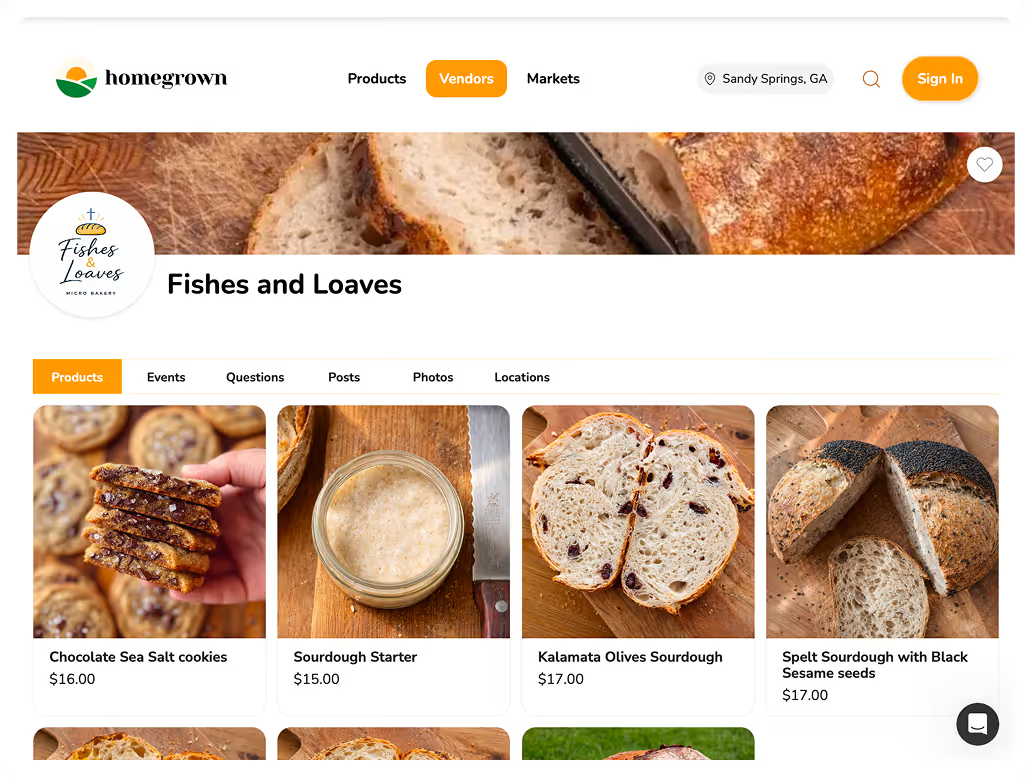
One vendor, Cryptid Kitchen, listed hummus on Homegrown on October 6, 2026, so a hummus vendor who joins would have very little competition on the marketplace. Its two hummus listings are priced well under the small vendors in our table.
In a pull of the Homegrown catalog on October 6, 2026, 2 of the 2,893 products listed by 311 vendors were hummus, both from Cryptid Kitchen: Van Helsing Hummus at $5 for 8 ounces or $8 for 16 ounces, made with house tahini, cumin and smoked paprika, and Van Helsing Hummus Red Pepper Rising at $6 for 8 ounces or $12 for 16. We searched every listing's name and full description for hummus, chickpea, garbanzo, tahini, dip, spread and related words, then read every Cryptid Kitchen listing by hand. One more listing includes hummus: From Scratch's Garden Graze Board, a vegetable board with classic hummus, beet hummus and ranch, from $50.
What that means for your price:
If you already sell at a market and want your regulars to order hummus by Thursday, start a Homegrown storefront and list your sizes and flavors. Customers order ahead and pick up at your next market, so you make what has already sold.
In Texas, a hummus label needs seven things, one of which can go on the receipt instead: your business name, your address or a registration number, the name of the product, any major allergens such as sesame, the statement "THIS PRODUCT WAS PRODUCED IN A PRIVATE RESIDENCE THAT IS NOT SUBJECT TO GOVERNMENTAL LICENSING OR INSPECTION.", the date it was made, and a safe handling statement, according to the Texas health department's cottage food page, read October 6, 2026. Other states have their own lists, so check yours.
The Texas safe handling statement for TCS cottage food is spelled out word for word and must appear on the label or on an invoice or receipt in at least 12-point type: "SAFE HANDLING INSTRUCTIONS: To prevent illness from bacteria, keep this food refrigerated or frozen until the food is prepared for consumption."
Things to put on every hummus label, whatever your state:
Our guide to the big 9 allergens on a cottage food label shows how to list sesame and the other eight clearly. Budget for labels in your cost per tub; they were not included in the ingredient table above.
The most expensive mistake is pricing against the grocery store's $3.97 tub of Sabra. A vendor who prices at $5 because Sabra is that cheap for 10 ounces leaves about $5 a tub on the table compared with the $10 median, and still carries the kitchen rent and the unsold tubs that Sabra does not.
The others that come up again and again:
If you sell another refrigerated food next to your hummus, our guide to pricing chicken salad works through the same problem for a TCS food sold by the container: kitchen rent, cold storage and a short shelf life.
Charge $8 to $12 for an 8 ounce container of handmade hummus. Six small vendors selling 8 ounce tubs charged $7.49 to $13 when we checked on October 6, 2026, and the median was $10. Start near $10 if you rent a kitchen, because rent and unsold tubs can push your true cost above $8.
Buying by the case from a restaurant supplier, a tahini-rich recipe costs about $1.09 per 8 ounce tub with the tub and lid, and buying at the grocery store it costs about $1.84, on prices checked October 6, 2026. Tahini is the biggest single cost, at roughly two thirds of the ingredients. Kitchen rent, if you need it, adds about $1.50 to $3.30 a tub.
It depends on your state, because hummus is a TCS food that has to stay cold. Texas, Illinois and Wyoming allow it from a home kitchen under their own rules, checked October 6, 2026, while Minnesota does not and points you to a licensed kitchen. Ask your market manager what they need from a vendor selling refrigerated food, and verify your state's current rules.
Plan on about a week. The FDA Food Code 2026 limits ready-to-eat TCS food kept at 41°F to seven days in food shops and restaurants, counting the day it was made as Day 1. Make only what you can sell inside that week, and date every lid.
At a $10 price, a home cook in Texas paying no rent who sells 32 of 40 tubs keeps about $3.67 a tub after ingredients, a $30 booth fee, $20 an hour of labor, the unsold tubs and Homegrown's 59 cents of card processing, or $4.82 if all 40 sell. A vendor renting a kitchen at $33 an hour keeps about 48 cents on the same tub, or $2.27 if all 40 sell. Making more tubs per kitchen session is the fastest way to raise the margin on hummus.
No sale price for Ithaca Hummus has been made public. We found no public announcement that the company was sold. PitchBook's profile, read October 6, 2026, lists Bush Brothers & Company as its parent with no date and no deal amount, but we found no press release or news story confirming a sale. Ithaca's hummus itself retails for around $7 a tub, 10 ounces, according to CNBC in July 2025.
These five guides answer the questions that come right before and right after setting a hummus price. Each one is about selling a refrigerated or prepared food, and each is worth reading before your first batch if you have not sold a food that needs a cooler before.
A $10 price only works if your tubs sell before Day 7. Once you have settled on $10 for an 8 ounce tub, $15 for a 16 ounce and $1 more for a flavor, put them where your regulars can order on Wednesday and pick up on Saturday.
A Homegrown storefront costs $10 a month billed annually, or $12.50 billed monthly, with 0% commission and 2.9% plus 30 cents of card processing paid by you. You list each size and flavor with a quantity, set a pickup spot at your market or your porch, and share one link on your table sign and your lids. Your customers create an account the first time they order. There are no drops, and the marketplace listing is a bonus, not a promise of traffic, so plan on most orders coming from people you send to your link.
When your first batch is ready to price, build your hummus storefront on Homegrown. You are not charged until day 8 of the trial.