

The short version: Sell an 8 ounce tub of handmade guacamole for $9 to $11 and a pint for 1.3 to 1.7 times your tub price ($12 to $15 if your tub is $9, $14 to $19 if it is $11), a little above the $8.50 median that six small vendors listed for 8 ounces and at or above the $12 median that six listed for a pint on October 9, 2026. One 8 ounce tub costs about $2.12 to make when avocados cost 97 cents each, the average advertised grocery price in the USDA's latest weekly report, and avocados are 77% of that ingredient bill, so your cost moves whenever avocado prices do. Guacamole has to stay cold, which keeps it out of home kitchen laws like Arkansas's Food Freedom Act and Michigan's cottage food law, so vendors there rent a licensed kitchen, which added $1.29 to $2.83 a tub in our example, while Texas and Wyoming let you make it at home under their own rules. A popular recipe says leftovers keep well for about 3 days in the fridge, so taking orders before you buy avocados protects your margin more than any difference in selling fees.
Checked on October 9, 2026: eleven guacamole sellers' own product pages, grocery prices on WebstaurantStore and on five stores' Instacart shopping pages, the USDA's weekly report of grocery store produce ads (the edition dated October 2, 2026), three commercial kitchens' rate pages, the FDA Food Code 2026, the home kitchen rules of Texas, Wyoming, Arkansas and Michigan on each state's own site, and the pricing pages of the four selling platforms in the fee table below. Rules change, so verify your state's current rules before your first sale. Homegrown customers create an account to place their first order, and Homegrown has no drop or countdown release feature.
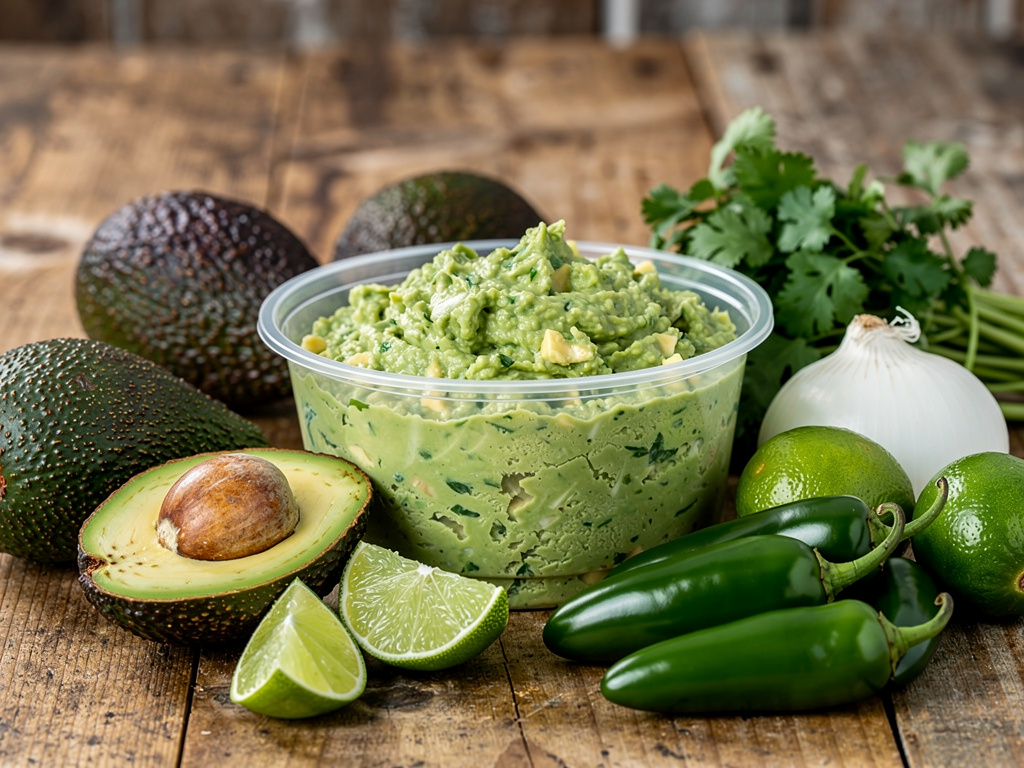
Guacamole looks like easy money. Four avocados, a lime and a half, half an onion and a handful of cilantro turn into a bowl people fight over at every party. So when you set a tub on your farmers market table, the hard part is not making it. The hard part is the price.
Price it too low and one bad avocado week wipes out your profit. Price it too high and shoppers walk to the grocery store, where a 15 ounce bowl of Wholly Guacamole was $5.37 at one Walmart on October 9, 2026. And unlike a jar of jam, guacamole turns brown in days and needs a fridge the whole way from your kitchen to the customer.
This guide works out a real number. It lists what eleven small guacamole vendors charge today, runs a well-known recipe through this week's avocado prices, adds kitchen rent from three real kitchens, and shows what each way of selling takes off a $9 tub.
Price an 8 ounce tub of handmade guacamole at $9 to $11 and a pint (16 ounces) at 1.3 to 1.7 times the tub price, which works out to $12 to $15 for a $9 tub or $14 to $19 for an $11 tub. Six small vendors who list an 8 ounce size posted $6.99 to $11.95 on October 9, 2026, with a median of $8.50. That count includes two whose 8 ounce tub was sold out or unavailable that day. Six who sold a pint charged $8 to $20.25, with a median of $12. A $9 tub is about 4.2 times the $2.12 of ingredients and container inside it.
That multiple looks big, but guacamole is expensive to sell even when it is cheap to make. Before you pick a number, check that you are allowed to sell guacamole from where you plan to make it. Our guide to which foods count as TCS food explains why foods that need a fridge get treated differently, and the legal section below covers four states.
Scroll sideways to see every size and price.
| Size | Your ingredients and tub | Suggested price | What small vendors charged on October 9, 2026 |
|---|---|---|---|
| 8 oz tub (half pint) | $2.12 with avocados at $0.97; $2.82 at $1.41 | $9 to $11 | $6.99 to $11.95, median $8.50 (six vendors) |
| 16 oz tub (pint) | $4.15 with avocados at $0.97 | $12 to $15 (with a $9 tub) or $14 to $19 (with an $11 tub) | $8 to $20.25, median $12 (six vendors) |
| Party bowl, 3 lb | About $12.10 in ingredients with avocados at $0.97, before the bowl | $30 to $36 | $29.99 (Miles Farmers Market) |
| Party bowl, 5 lb | About $20.20 in ingredients with avocados at $0.97, before the bowl | $45 to $55 | $44.95 (Miles Farmers Market) |
Ingredient costs come from the Cookie and Kate "Best Guacamole" recipe, which yields 2 1/2 cups, priced with grocery ad averages from the USDA report dated October 2, 2026. The $1.41 avocado is WebstaurantStore's regular price for a 48-count case. Party bowl costs treat a pound as about 2 cups by volume, which is our estimate. Your label, kitchen rent, booth fee and time are not in the ingredient column; the sections below add them.
Three things decide where you land in that range:
If you rent a kitchen, start at $10. The step-by-step section shows why $9 can leave a renting vendor with nothing.
Eleven small US vendors who make guacamole themselves listed $6.50 to $14.99 for their smallest container on October 9, 2026, and by the ounce they ranged from 50 cents to $1.49, with a median of 94 cents. They are farms, farm markets, delis and one caterer. Every price was read on the seller's own website that day.
Swipe left to see each vendor's price per ounce.
| Vendor | What it is | Size | Price | Price per ounce |
|---|---|---|---|---|
| Milk Pail Fresh Market | Market, guacamole "made by Maria" | Half pint (pint $20.25) | $11.95 | $1.49 |
| Glaser Organic Farms (Miami, Florida) | Organic farm | 8 oz | $9.90 | $1.24 |
| Wagshal's | Deli | Half pint | $9.00 | $1.13 |
| Linvilla Orchards (Media, Pennsylvania) | Orchard and farm market, shown Sold out that day | 8 oz | $7.99 | $1.00 |
| Farmers Fresh US (Flushing, Queens, New York) | Market | 8 oz | $7.99 | $1.00 |
| Barth's Market (New Providence, New Jersey) | Market and deli, sold by weight | Pint | $14.99 | $0.94 |
| Fresh by 4Roots (Orlando, Florida) | Organic, made to order | Half pint, unavailable that day (pint $10.99) | $6.99 | $0.87 |
| Something Homemade (San Diego County, California) | Caterer, holiday menu | Pint | $13.00 | $0.81 |
| Miles Farmers Market (Solon, Ohio) | Farm market | 1 lb pint | $9.99 | $0.62 |
| Olden Organics (Ripon, Wisconsin), sold through Poco Pizza | Farm, Saturday farm pickup | 10.5 oz | $6.50 | $0.62 |
| Edible Earth Farm (Sandy Lake, Pennsylvania) | Farm, sold frozen | 16 oz | $8.00 | $0.50 |
Every price here came from the seller's own product page, loaded October 9, 2026; Olden Organics' guacamole is sold on Poco Pizza's page. Locations are the ones each site states; no location means the page we loaded did not give one. We counted a half pint as 8 ounces and a pint as 16 ounces. Pints and deli tubs measure volume while most store tubs state net weight; we treated an ounce of each as equal, which is close for guacamole but not exact. Barth's says its price is an estimate that is adjusted to the actual weight. Linvilla's tub showed Sold out and Fresh by 4Roots' half pint showed unavailable; both prices are listed as posted.
Price per ounce: eleven small vendors and Wholly Guacamole
Source: each seller's own product page, and Wholly Guacamole Classic Mild 15 oz on Walmart's Instacart page, all loaded October 9, 2026. Smallest size listed by each vendor.
What the table tells you:
If you sell in a small town, start near $9 for 8 ounces. If your market already supports $8 sourdough and $12 jars of honey, $11 is in line with what Glaser and Milk Pail ask.
Grocery guacamole cost 36 to 67 cents an ounce on October 9, 2026, while the eleven small vendors above had a median of 94 cents, so handmade guacamole usually runs about 1.4 to 2.6 times the store price per ounce. The cheapest store guacamole by the ounce was Wholly Guacamole Classic Mild, 15 ounces, at $5.37 on Walmart's Instacart page.
Swipe sideways to compare store prices.
| Store guacamole | Where | Size | Price | Price per ounce | Same price for 8 ounces |
|---|---|---|---|---|---|
| Wholly Guacamole Classic Mild | Walmart (Instacart page) | 15 oz | $5.37 | $0.36 | $2.86 |
| Wholly Guacamole Classic Mild | Peterson's Fresh Market (Instacart page) | 15 oz | $7.99 | $0.53 | $4.26 |
| Wholly Guacamole Classic Mild | Pathmark (Instacart page) | 15 oz | $8.99 | $0.60 | $4.79 |
| Fresh Innovations Organic Mild | Sprouts (Instacart page) | 10 oz | $5.49 | $0.55 | $4.39 |
| We Guac Original Fresh Chunky (out of stock that day) | Sprouts (Instacart page) | 8 oz | $3.99 | $0.50 | $3.99 |
| Fresh Thyme Market Medium | Fresh Thyme (Instacart page) | 8 oz | $5.39 | $0.67 | $5.39 |
| Small vendors in this guide (median) | Own websites | Varies | $8.50 for 8 oz (median of six) | $0.94 | $7.50 (eleven vendors' median per ounce times 8) |
These came from each store's Instacart-run shopping page the same day, October 9, 2026. Prices on those pages can be higher than the shelf price in the store, and they change by location and week.
Three ways to use this comparison without letting it pull your price down:
Our salsa pricing guide finds the same pattern for jars of salsa, and our hummus pricing guide does the math for another dip that has to stay cold.
Only in states whose home kitchen rules allow food that needs a fridge. Traditional cottage food laws cover shelf-stable food, and guacamole has to be kept cold. The FDA Food Code 2026, the FDA's model rule book for restaurants and food shops, lists "cut tomatoes or mixtures of cut tomatoes" as time/temperature control for safety food, usually shortened to TCS food, and many guacamole recipes add diced tomato. Leaving the tomato out does not change the answer: the state health department in Arkansas puts "Fresh sauces (i.e. guacamole or refrigerator salsa)" on the not-allowed list in its July 2025 guide, because the state's home food law covers only food that does not need refrigeration. Of the four states we checked on October 9, 2026, Texas and Wyoming allow guacamole from a home kitchen under their own rules, and Arkansas and Michigan do not.
Swipe the table to read all four states.
| State | Guacamole from a home kitchen? | What the state says |
|---|---|---|
| Texas | Yes, as a TCS food | Register with the state health department, complete food handler training, keep it at 41°F or below, put the date it was made on the label and a safe handling statement on the label or the receipt, and stay under $150,000 a year. The state says TCS food is not eligible for wholesale or donation. |
| Wyoming | Yes, under the Food Freedom Act | Sell to an informed end consumer, yourself or through a designated agent, only in Wyoming. You must tell each buyer the food is not licensed, regulated or inspected. A producer can make up to 250,000 products and $250,000 a year. No state license or inspection. |
| Arkansas | No | The Food Freedom Act covers only food that does not need refrigeration. The state health department's guide lists "Fresh sauces (i.e. guacamole or refrigerator salsa)" as not allowed, and TCS food has to come from a permitted, inspected facility. |
| Michigan | No | Cottage foods must be foods that "can safely be kept at room temperature and do not require refrigeration." Salsas are on the not-allowed list. |
Checked October 9, 2026 on each state's own site: the Texas Department of State Health Services cottage food page, Wyoming Statutes 11-49-102 and 11-49-103, the Arkansas Department of Health's Homemade Food Production Guidelines dated July 28, 2025, and the Michigan Department of Agriculture and Rural Development's "What Can I Make?" page. Check your own state before your first sale, because these rules change.
Since Senate Bill 541, the Texas Department of State Health Services says a cottage food operation "may sell time and temperature control for safety food (TCS)," other than meat, seafood and a short list of others. You register with the department, keep the food at 41°F or below, and label it with the date it was made. This line goes on the label or on the receipt, in at least 12-point type: "SAFE HANDLING INSTRUCTIONS: To prevent illness from bacteria, keep this food refrigerated or frozen until the food is prepared for consumption." Our Texas cottage food law guide covers the rest.
The Michigan Department of Agriculture and Rural Development limits cottage food to non-potentially hazardous foods, "meaning foods that can safely be kept at room temperature and do not require refrigeration." Its not-allowed list for sauces and condiments includes salsas, and a tub of guacamole needs the fridge the whole time. In Michigan, guacamole means a licensed kitchen. Our Michigan cottage food law guide lists what you can make at home instead.
Arkansas calls its law the Food Freedom Act, which sounds like it covers everything. It does not. The Arkansas Department of Health's July 2025 guide names guacamole as a fresh sauce that is not allowed from a home kitchen, so read the food list in your own state's law, not just its name. Even in Texas or Wyoming, ask your market manager what they require from a vendor of a refrigerated food before you book a booth. We checked these rules on October 9, 2026.
If you live in a state like Arkansas or Michigan, the practical route is a licensed commercial kitchen you rent by the hour. The kitchen section below shows what that rent does to each tub. Our guides to the Arkansas Food Freedom Act and Wyoming's food freedom law explain what each state does let you make at home.
One 8 ounce tub of guacamole costs about $2.12 to make, tub and lid included, when avocados cost 97 cents each. That is what a Hass avocado averaged in grocery store ads, according to the USDA's weekly report of grocery store produce ads, the edition dated October 2, 2026. It covers ingredients and the container only. Rent, your booth and your time come later.
We priced Cookie and Kate's "Best Guacamole," a popular recipe that yields 2 1/2 cups: 4 medium ripe avocados, 1/2 cup finely chopped white onion, 1/4 cup chopped cilantro, 1 small jalapeño, 3 tablespoons of lime juice from about 1 1/2 limes, 1/4 teaspoon ground coriander and 1 teaspoon kosher salt. Two and a half cups is 20 fluid ounces, enough for two and a half 8 ounce tubs, so two batches fill five. Spread over 2 1/2 tubs, each tub costs $2.02 in ingredients. Samples come out of a separate batch, priced in the samples section below.
Scroll right to see what each ingredient costs.
| Ingredient, one batch | Amount | Price used | Batch cost |
|---|---|---|---|
| Hass avocados | 4 medium | $0.97 each | $3.88 |
| White onion | 1/2 cup chopped, about 80 g | $1.08 a pound | $0.19 |
| Cilantro | 1/4 cup chopped | $0.91 a bunch, a quarter bunch used | $0.23 |
| Jalapeño | 1 small, about 14 g | $1.37 a pound | $0.04 |
| Limes | About 1 1/2, for 3 tbsp juice | $0.44 each | $0.66 |
| Salt and ground coriander | 1 tsp and 1/4 tsp | Our estimate | $0.05 |
| Batch total | About 2 1/2 cups (20 fl oz) | $5.05 | |
| Per 8 oz tub (2 1/2 per batch) | $2.02 | ||
| 8 oz deli container and lid | 1 | $24.49 for 240 at WebstaurantStore | $0.10 |
| Per tub, ready to sell | $2.12 |
Produce prices are the USDA's national average advertised prices for conventional produce in its report dated October 2, 2026, loaded October 9. Onion, jalapeño and cilantro weights come from USDA FoodData Central. The quarter bunch of cilantro and the salt and coriander cost are our estimates. Labels are not included.
What changes these numbers in real life:
Avocados are 77% of the ingredient cost in this recipe at 97 cents each, and 83% at $1.41 each, so the avocado price matters more than everything else in the bowl combined. Each tub uses 1.6 avocados, which means every 10 cents on the price of one avocado moves your tub cost by 16 cents.
Here is what four real avocado prices, all loaded on October 9, 2026, do to one batch:
Buying by the case did not beat a grocery sale price that week. A case only makes sense in a week when it costs less per avocado than your store's price and you can use all 48 before they go soft, roughly 12 batches, or 30 tubs.
Price your tub off a bad avocado week, not a good one. If you set your price when avocados are 97 cents and they climb to $1.41, your cost per tub goes from $2.12 to $2.82 and 70 cents of profit disappears from every tub you sell. Write the avocado price you paid next to each batch on your prep sheet, and recheck your tub price any month it averages more than about 20 cents above where you started.
Enough to change your cost by about 14 cents a tub in a single week. In the USDA's weekly grocery ad report dated October 2, 2026, the average advertised price for a single Hass avocado was 97 cents across 3,063 store ads, up from 88 cents the week before and down 16% from $1.15 in the same week last year. A four-count mesh bag averaged $4.02 in that same report.
What those three numbers mean for one 8 ounce tub:
That is a 43 cent swing per tub between the cheapest and most expensive of those three weeks, on the same recipe.
The USDA figure is an advertised sale price, gathered from store circulars and digital promotions. It is a good sign of which way prices are moving, but the avocado on the shelf in a non-sale week can cost more. We loaded the report on October 9, 2026; check the newest edition, or your own receipts, before you reprice.
Avocados also ripen on their own schedule. A case bought on Monday for a Saturday market can be rock hard or past its best, and an avocado you throw away still costs what you paid. Buy a few days ahead, keep a couple of extra avocados per batch, and count the ones you toss in your cost.
Kitchen rent added $1.29 to $2.83 to each tub in our example of a 3-hour session that makes 35 tubs, using rates three shared kitchens posted on October 9, 2026. If your state lets you make guacamole at home, this line is $0, which is the biggest reason someone cooking at home in Texas or Wyoming can charge less.
Drag the table sideways to compare kitchen rates.
| Kitchen | Rate on its own page | Rent for one 3-hour session | Rent per tub at 35 tubs |
|---|---|---|---|
| Capital Kitchens, Austin, Texas | $33 an hour for main kitchen users, 12-hour monthly minimum ($396) | $99 | $2.83 |
| Rockwood Market Hall, Gresham, Oregon, peak hours | $25 an hour, 4 a.m. to 11 p.m. | $75 | $2.14 |
| Rockwood Market Hall, off-peak hours | $20 an hour, 11 p.m. to 4 a.m. | $60 | $1.71 |
| Tampa Bay Kitchen, Florida | $120 a month including 8 hours, then $15 an hour | $45 (3 of the 8 included hours) | $1.29 |
Each rate comes from the kitchen's own website, loaded October 9, 2026. The 3 hours and 35 tubs (seven double batches, 56 avocados) are our example. Capital Kitchens and Tampa Bay Kitchen both ask for a $1,000,000 liability insurance certificate. Rockwood rents cold storage separately at $75 a month per rack.
What moves the rent per tub:
Our guide to finding and renting a commissary kitchen lists the paperwork and questions a kitchen will expect from you.
Add your ingredients, rent, booth fee, time and an allowance for unsold tubs, then compare the total to the $9 to $11 that small vendors charge for 8 ounces. In our example, a vendor renting a $25 an hour kitchen who sells 28 of 35 tubs has a true cost of about $8.55 a tub, so $9 loses money once card fees come out. A Texas home cook in the same example lands near $5.87.
The booth fee, hours and hourly pay below are examples; use your own. The example leaves out labels, ice packs, gas, insurance, samples and your Homegrown plan, so add those per tub before you trust the last step.
That rented-kitchen line is the one to watch. If all 35 tubs sell, the same tub costs about $6.84 instead of $8.55, so selling out is worth about $1.71 a tub. Three ways to get there:
Our guide to pricing food products for a farmers market covers the cost-plus method behind these steps for the rest of your table.
By one popular recipe's count, guacamole keeps well for about 3 days, so an unsold tub turns into lost money fast. Cookie and Kate's recipe says leftovers "will keep well, refrigerated, for about 3 days" with a chunk of onion on top and plastic wrap over the container, and the browned top gets scooped off. Food safety rules give a longer outer limit: the FDA Food Code lets restaurants and food shops hold ready-to-eat TCS food at 41°F for up to seven days, counting the day it was made as Day 1. Glaser Organic Farms, which sells guacamole, lists a refrigerated shelf life of 7 to 10 days for its 8 ounce tub on its product page. Your shopper, though, buys with their eyes, and a brown top usually stays on your table.
Here is what it costs when 7 of the 35 tubs do not sell, using this guide's numbers:
Swipe to see the cost of each unsold tub.
| Setup | Cost inside one unsold tub | 7 unsold tubs | Added to each of the 28 you sold |
|---|---|---|---|
| Rented kitchen at $25 an hour | $4.27 (ingredients and tub plus rent, unrounded) | $29.86 | $1.07 |
| Home kitchen | $2.12 | $14.86 | $0.53 |
Figured from the cost and rent tables in this guide, prices of October 9, 2026. Totals use unrounded costs. This counts only what is inside the tubs; the booth fee and your time also spread over fewer sold tubs.
How guacamole vendors keep this number small:
Price a pint at $12 to $15 next to a $9 tub and $14 to $19 next to an $11 tub, a party bowl at about $10 to $12 a pound for 3 pounds and $9 to $11 a pound for 5, and a spicy or loaded version at $1 to $2 more than plain. Miles Farmers Market in Solon, Ohio, showed the bulk pattern on October 9, 2026: $9.99 for a 1 pound pint, $29.99 for a 3 pound bowl and $44.95 for a 5 pound bowl.
A pint costs you $4.15 at 97-cent avocados, with an 11 cent container, so $12 to $15 is about 2.9 to 3.6 times your cost. That ratio is lower than the 8 ounce tub's, which is fine. A pint takes one fill instead of two.
How to set each one:
At this guide's costs, one ounce of guacamole costs about 25 cents, so 40 half-ounce tasting spoons use one 20 ounce batch and cost about $5.05 a market day. That is a little more than half the price of one $9 tub, and for a food people buy on taste, it is worth it.
A simple sample plan:
Sampling rules are set locally, so ask your market manager and health department first. Our farmers market sampling tips cover table setup and how to turn a taste into a sale.
Selling fees take 38 cents to $1.56 off a $9 tub, depending on whether the card is swiped at your table or used online, and on who pays the platform's own fee. We read every fee below on each platform's own pricing page on October 9, 2026.
Swipe sideways for all eight fee columns.
| Way of selling | Monthly plan | Trial | Platform fee | Card processing | Customer pays for a $9 tub | You pay on one $9 tub | You pay in a month of 50 one-tub orders |
|---|---|---|---|---|---|---|---|
| Homegrown | $10 billed annually ($12.50 monthly) | 7 days, no charge until day 8 | None, 0% commission | 2.9% + $0.30, paid by you | $9.00 | $0.56 | $38.05 |
| Hotplate, default setting | $0 | No plan to try | 5% + $0.55, added to the customer's total | 2.9% + $0.30, paid by you | $10.00 | $0.56 | $28.05 |
| Hotplate, you cover the fee | $0 | No plan to try | 5% + $0.55, paid by you | 2.9% + $0.30, paid by you | $9.00 | $1.56 | $78.05 |
| Square Free, card at your table | $0 | No plan to try | None | 2.6% + 15¢ in person | $9.00 | $0.38 | $19.20 |
| Square Free, online order | $0 | No plan to try | None | 3.3% + 30¢ online | $9.00 | $0.60 | $29.85 |
| Shopify Basic | $29 billed yearly ($39 monthly) | 3 days free, then $1 a month for 3 months | None with Shopify Payments (2% with another provider) | 2.9% + 30¢ online | $9.00 | $0.56 | $57.05 |
Fees read on October 9, 2026 at findhomegrown.com/signup, hotplate.com/pricing, squareup.com/us/en/pricing and shopify.com/pricing. Figured on a $9 price with no tax or tip, rounded to the cent. If a platform charges card processing on the full total with fees and tax, it runs a few cents higher. The monthly column adds the plan (billed annually where there is a choice) to 50 times the per-tub cost.
Hotplate's pricing page says you can pay its fee yourself or pass it on to customers, "your choice." Its own post "What Hotplate does," dated September 1, 2025, says that by default "we charge a fee to your customer" and that "80% of Hotplate chefs keep the default as-is." So a $9 tub of guacamole checks out at $10.00 unless you change the setting, and covering it costs you $1.56 a tub. Square's 38 cents only applies when the card is at your table; the same tub ordered online on Square's free plan pays 60 cents. We checked all of these on October 9, 2026.
For guacamole, the fee is not the biggest cost of selling. Seven brown tubs in a cooler cost $29.86 in the rented kitchen example, more than a month of card processing on Square at the table. Over four Saturday markets a month, that is about $119, more than the monthly figure on any row in this table. Knowing on Wednesday that 28 regulars want guacamole on Saturday is how you avoid it.
Make guacamole for orders that are already paid, and the browning clock stops being your problem. In this guide's rented kitchen example, 7 unsold tubs out of 35 add $1.07 to every tub you did sell, which is almost twice the card fee on a $9 tub.
Homegrown is $10 per month billed annually with no percentage fees beyond standard payment processing, which on a $9 tub is 56 cents. Regulars reserve their guacamole on your storefront midweek, pay when they order, and collect it on the day and at the spot you set. What fits guacamole in particular:
How it compares to what guacamole vendors try first. Hotplate, made for pre-order food sellers, has no monthly plan, but its default setting puts 5% plus 55 cents on top of what your guacamole buyer pays, so a $9 tub checks out at $10.00, and covering that yourself costs $1.56 a tub. Square is the cheapest choice at your table, at 38 cents a tub, though an online order on its free plan pays 60 cents. Shopify costs $29 a month billed yearly before apps and is made for full online stores that ship, which suits guacamole poorly, since a tub has to stay at 41°F or below the whole way to the buyer.
Where Homegrown falls short for a guacamole vendor. First-time customers have to make a Homegrown account before they can order. Homegrown has no drop or countdown release feature, so if you want a timed weekly guacamole drop, Hotplate offers that and Homegrown does not. Pricing by the pound is still on the roadmap, which is why party bowls go in as fixed sizes. Nothing on the platform makes a home kitchen legal in Arkansas or Michigan, and it cannot keep a tub at 41°F; your health department and your cooler still handle those. Your storefront shows up on the Homegrown marketplace, but expect most orders to come from regulars you send to your own link. Card processing of 2.9% plus 30 cents comes out of your side, and there is no setting to pass it to the shopper.
Want to see how it works for a refrigerated food? Start your Homegrown storefront and set this Saturday's guacamole as a pre-order with a two-day lead time. It takes about 15 minutes, and you can see real orders before you buy a single avocado.
No Homegrown listing was called guacamole on October 9, 2026, out of 2,916 products, though one vendor makes a thick avocado salsa that comes close.
In a pull of the Homegrown catalog on October 9, 2026, none of the 2,916 products listed by 313 vendors was guacamole. We searched every product's name, description, category and sizes for "guac" and "avocado." "Guac" matched nothing. "Avocado" matched 20 listings, most of them using it as an ingredient, like avocado oil in soap or avocado in brownies. The closest thing to guacamole was Reapercussions' four thick salsas, whose ingredients are onion, cilantro, avocado, garlic, peppers, lime and salt, at $20 for a 16 ounce to 1.5 pound glass jar. The only fresh avocado was a single one for $1.79 from KairosGO, and Sunset Salsa's fresh Pico de Gallo sold for $7.49 in the Ready to Eat Food category, which held 181 products.
That gap is a chance. No Homegrown listing carries the name yet, so the first vendor to add one is the only guacamole on the marketplace, though most orders will still come from regulars you send to your own link. If you already sell salsa, adding a guacamole listing next to it takes a few minutes. List it as a pre-order only, with your prep time set, and you never make a tub nobody asked for.
Our guide to taking pre-orders for your food business walks through order cutoffs, pickup windows and what to tell regulars when you switch them over.
The most expensive mistake is setting your price in a cheap avocado week and never changing it. The others mostly come from treating guacamole like a shelf-stable product.
Charge $9 to $11 for 8 ounces of homemade guacamole. On October 9, 2026, six small vendors listing an 8 ounce or half pint size posted between $6.99 and $11.95, and the middle two averaged $8.50. If you rent a commercial kitchen, start at $10, because in our example $9 left a renting vendor 11 cents short after card fees.
A batch of Cookie and Kate's guacamole, about 2 1/2 cups, cost $5.05 with avocados at 97 cents each, the national ad average in the USDA's October 2, 2026 produce report. With avocados at $1.41, the regular per-avocado price in a WebstaurantStore case, the same batch costs $6.79. Avocados are 77% to 83% of the bill.
Sell a pint (16 ounces) of homemade guacamole for $12 to $19, or about 1.3 to 1.7 times what you charge for 8 ounces. The six small vendors we found selling pints asked $8 to $20.25 that day, and the middle two averaged $12. The pint costs you about $4.15 in ingredients and container at 97-cent avocados.
Only if your state allows foods that need refrigeration from a home kitchen, or if you make it in a licensed kitchen. Texas allows it after you register as a cottage food operation that sells TCS food, and Wyoming allows it under its Food Freedom Act. Arkansas's health department lists guacamole as not allowed from a home kitchen, and Michigan's cottage food law covers only foods that need no refrigeration.
If you follow a home recipe, plan on about 3 days of good color. Cookie and Kate's recipe says leftovers keep well in the fridge for about 3 days with onion on top and plastic wrap over the container. Glaser Organic Farms, a farm that sells guacamole, lists a refrigerated shelf life of 7 to 10 days for its tub. The FDA Food Code's outer limit for ready-to-eat TCS food held at 41°F in a restaurant or food shop is seven days, counting the day it was made, but a browned top rarely sells.
In our example, a home cook in Texas who sells a $9 tub keeps $2.57 a tub after ingredients, booth fee, an allowance for unsold tubs, card fees and $20 an hour of pay. A vendor renting a $25 an hour kitchen keeps 86 cents a tub at $10 and loses 11 cents at $9. Selling every tub you make adds about $1.71 a tub in the rented kitchen example.
Six live guides cover the next questions a guacamole vendor runs into, from the rules on refrigerated food to setting up order cutoffs. Each one is written for a small vendor selling at a farmers market or from home, and each picks up where a section of this guide stops:
The biggest number in this guide is not the avocado price or the card fee. It is the tub that goes brown before anyone buys it. A pre-order page lets your regulars reserve Saturday's guacamole on Wednesday, so you buy the right number of avocados and fill only the tubs that are already paid for.
Here is the whole plan in three moves. Set your 8 ounce tub at $9 to $11, or at $10 or more if you rent a kitchen. Recheck that price any month avocados climb. Then take orders before you buy avocados, so the short color window works for you instead of against you.
Homegrown is $10 a month billed annually, with 0% commission and card processing of 2.9% plus 30 cents, paid by you. Your customers create an account to order the first time, and you choose the pickup days, places and lead time. Set up your guacamole pre-orders on Homegrown, add your 8 ounce tub and pint, and send the link to your regulars before your next market.