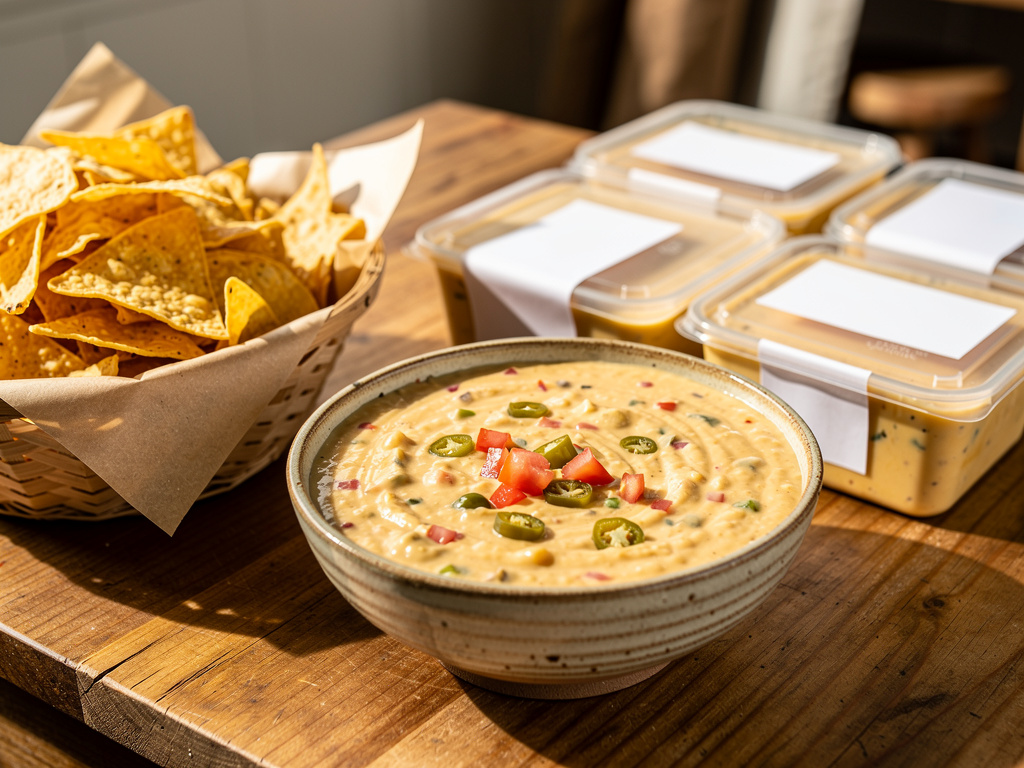


The short version: Sell a pint (16 ounces) of homemade queso for $12 to $14, an 8 ounce tub for $7 to $8 and a quart for $22 to $26, which sits inside what the five markets and restaurants we checked charged for a pint on October 9, 2026 ($8 to $16.99, median $13). A pint of the classic RO*TEL and Velveeta recipe costs about $3.35 in ingredients and container, but once you add 2 hours of rented kitchen time, your own time at $20 an hour, a $30 booth and 3 unsold pints out of 19, each pint you actually sell costs about $12.21. Queso is a dairy dip that has to be kept hot or cold, so a home kitchen is legal only in a few places, such as Utah, Wyoming and North Dakota under their food freedom laws, Texas is an open question, and in most of the other states our permission guide checked you need a licensed kitchen, which is why $14 is the safer pint price when you pay rent. Grocery tubs like Pancho's sell for under $5 a pound, so your price rests on fresh, small-batch flavor, not on beating the store.
Checked October 9, 2026: vendor prices on each vendor's own website, grocery prices on Walmart.com, Woodman's and Fresh Thyme's online stores, cheese averages in the Bureau of Labor Statistics data for August 2026, kitchen rates on three kitchens' own pages, fees on findhomegrown.com/signup and the Hotplate, Square and Shopify pricing pages, and state rules on each state's own page or statute. Rules change, so verify your state's current rules before your first sale. Homegrown customers create an account to place a first order, and Homegrown has no drops or countdown release feature.
Queso is the dip people ask about first. You bring a crockpot of it to a game-day party, it is gone by halftime, and somebody asks if you would sell them a quart. Then a coworker wants one. Then someone at your farmers market booth asks why you sell salsa but not queso.
Queso is cheap to make and expensive to sell. A pound of melting cheese and a can of tomatoes and green chiles cost a few dollars at the grocery store, but queso is a dairy food that has to stay cold or hot the whole time, and our permission guide found that 7 of the 11 states it checked leave queso out of their cottage food rules. The one home kitchen route among those 7 is California's permitted home kitchen restaurant program, in counties that opted in, and it covers queso served with a same-day meal, not tubs sold at a market. Before you set a price, read our guide on whether you can sell homemade queso, which checks the rules in 11 states.
This guide does the math the permission guide leaves out. It lists what ten real vendors charge, from a Nebraska market's $8 pint to a New Mexico restaurant's $32.99 quart. It prices two common recipes at this month's grocery costs, adds the hourly rates three real kitchens post, and compares how much each payment option keeps out of a $12 pint.
Price a pint of homemade queso at $12 to $14, an 8 ounce tub at $7 to $8, and a quart at $22 to $26. Five vendors who list a pint charged $8 to $16.99 on October 9, 2026, with a median of $13, and four who list a quart of queso on its own charged $18.75 to $32.99. A $14 pint is about 4.2 times the $3.35 of ingredients and container inside it.
That multiple sounds high until you add the costs that do not show up in the recipe. Queso needs a cooler or a warmer, a licensed kitchen in most of the states our permission guide checked, and buyers who come back within a few days, because it does not keep for weeks.
Scroll sideways to see every size and price.
| Size | Ingredients and container (RO*TEL recipe) | Suggested price | What vendors charged on October 9, 2026 | Price per ounce at the suggested price |
|---|---|---|---|---|
| 8 oz tub (half pint) | $1.72 | $7 to $8 | $8.49 and $8.99 (two restaurants) | $0.88 to $1.00 |
| 16 oz tub (pint) | $3.35 | $12 to $14 | $8 to $16.99, median $13 (five vendors) | $0.75 to $0.88 |
| 32 oz tub (quart) | $6.63 | $22 to $26 | $18.75 to $32.99 (four vendors) | $0.69 to $0.81 |
Costs use RO*TEL's own Famous Queso Dip recipe (32 ounces of Velveeta and two 10 ounce cans of RO*TEL) at Walmart.com prices on October 9, 2026, plus a microwavable deli container from WebstaurantStore. Kitchen rent, your time, your booth fee and card fees are not in this column; the sections below add them.
Three things move you up or down inside that range:
Ten US vendors listed fresh or jarred queso for $8 to $32.99 on October 9, 2026, and the six selling fresh queso by the tub ranged from 50 cents to $1.12 an ounce, with a median of about 72 cents. They are small markets, a taqueria, restaurants, two small brands that jar their queso and an online shop that sells a jarred queso. Every price was read on the vendor's own website or ordering page that day.
Swipe left for each vendor's price per ounce.
| Vendor | What it is | Size | Price | Price per ounce |
|---|---|---|---|---|
| A Full Plate (Stanton, Nebraska) | Small market, "Fresh in the Fridge" | Pint | $8.00 | $0.50 |
| Lupita's Taqueria (West Springfield, Virginia) | Taqueria, order 24 hours ahead | Quart | $18.75 | $0.59 |
| Miles Farmers Market (Solon, Ohio) | Farm market, hot or packed cold | 1 lb pint (5 lb half pan $49.95) | $9.99 | $0.62 |
| Pancho's Taqueria (Minnesota) | Restaurant, by the pint or quart | Pint (quart $26) | $13.00 | $0.81 |
| Del Pueblo Mexican Restaurant (Houston, Texas) | Restaurant, to-go sides | Half pint (pint $13.49, quart $23.49) | $8.49 | $1.06 |
| El Pinto Restaurant (Albuquerque, New Mexico) | Restaurant catering menu | Half pint (pint $16.99, quart $32.99) | $8.99 | $1.12 |
| JB's (Severna Park, Maryland) | Restaurant, game-day catering | Quart with chips | $15.00 | Not comparable (chips included) |
| Wendi's Good Things Market (Colorado) | Farm brand, jarred, shown sold out | 16 oz jar | $12.99 | $0.81 |
| TexasBestShop | Online shop, jarred | 16 oz jar | $10.99 | $0.69 |
| Holly Berry Farm (Friendsville, Tennessee) | Farm shop, jarred salsa con queso | 10 oz jar | $10.00 | $1.00 |
Each price was read on October 9, 2026, on the vendor's own page. The median, about 72 cents, is across the six fresh-queso rows with a comparable size (the smallest size each one lists). With six rows, the median is the average of the two middle prices, Miles Farmers Market at 62 cents and Pancho's Taqueria at 81 cents. Jarred queso is sold as a different product from a tub you keep cold, so the three jars are not in the median.
Fresh queso, price per ounce of the smallest size listed
Source: each vendor's own website or ordering page, read October 9, 2026, 6 vendors.
What the table tells you:
Grocery queso costs 18 to 46 cents an ounce, roughly a quarter to nearly two-thirds of the 72-cent median that markets and restaurants charge for fresh queso, and it comes out of food plants that make it at a scale no home or rented kitchen can match. The three refrigerated tubs in the table below, two from Pancho's and one from Gordo's, run 30 to 46 cents an ounce; the cheapest row, Great Value at 18 cents, is a shelf-stable jar. On October 9, 2026, a 16 ounce tub of Pancho's White Queso was $4.77 on Walmart.com, and a 15 ounce Great Value Queso Blanco was $2.72.
Swipe the table to compare grocery prices per ounce.
| Product | Store | Size | Price | Price per ounce |
|---|---|---|---|---|
| Great Value Queso Blanco Cheese Dip, shelf-stable jar | Walmart.com | 15 oz | $2.72 | $0.18 |
| Pancho's White Queso Cheese Dip, refrigerated | Walmart.com | 16 oz | $4.77 | $0.30 |
| Pancho's Original Queso Cheese Dip, refrigerated | Woodman's (online store) | 16 oz | $4.99 | $0.31 |
| Tostitos Queso Blanco Dip, jar | Walmart.com | 15 oz | $4.74 | $0.32 |
| Gordo's Original Queso Cheese Dip, refrigerated | Fresh Thyme (online store) | 16 oz | $7.29 | $0.46 |
Read on October 9, 2026. Walmart's prices are what Walmart.com showed for online orders that day; store prices vary by location. Pancho's at Walmart was on a rollback from $5.34.
You will not win on price against a $2.72 jar or a $4.77 tub, and you do not need to. A shopper who buys a $13 pint at a taqueria is paying for something a jar does not give them: queso made that week, by someone they can name, with the chiles they like.
Use the grocery price as a floor for your story, not for your price. If your pint is $12, your sign should say what makes it worth two and a half times a Pancho's tub. "Made Thursday, Hatch green chiles, no preservatives" does that in one line.
In 7 of the 11 states our permission guide checked, queso is left out of the cottage food rules because it is a dairy food that needs time and temperature control, so you sell it from a licensed commercial kitchen, or, in California counties that opted in, as part of a same-day meal under a permitted home kitchen restaurant (MEHKO) program. A few states let a home kitchen sell it under a food freedom law, which is a broad home food law that covers foods needing refrigeration as long as the customer has been told the food was not inspected. In Utah you, or a person you contract with to sell for you, can sell to that customer, but not through a store or restaurant. North Dakota requires you to sell directly to the customer, while Wyoming also lets a store or other third-party seller sell dairy products for you, and queso likely counts as a dairy product there. North Dakota's law is titled a cottage food law, but it works like a food freedom law. Where you make it changes your costs more than any ingredient does.
Drag the table left for what each route does to your price.
| Where you make it | What the rule says | What it does to your pint price |
|---|---|---|
| Home kitchen in Utah | Sold in Utah, directly to an informed final consumer, for home use; business license still required; no raw dairy, no meat | No kitchen rent; $12 works |
| Home kitchen in Wyoming | Food Freedom Act counts dairy as potentially hazardous food and still allows it to an informed end consumer, only in Wyoming; capped at $250,000 a year | No kitchen rent; $12 works |
| Home kitchen in North Dakota | Direct to an informed end consumer for home use; foods that need refrigeration are labeled as transported and maintained frozen; no uninspected meat | No rent, but freezer tubs and a freezer to hold them |
| Home kitchen in Texas | Cottage food law allows foods that need refrigeration with DSHS registration, but a separate dairy rule may require a milk plant permit | Get a written answer from the state before you set any price |
| Licensed commercial kitchen, any state | A food license from your state or county, plus a dairy permit where required | Rent of $1.58 to $3.47 a pint in our example; charge $14 |
Read on October 9, 2026: Utah Code 4-5a-104 and 4-5a-105, Wyoming Statutes 11-49-102 and 11-49-103, North Dakota Century Code 23-09.5, the Texas DSHS cottage food page and 25 Texas Administrative Code 217.71. These are examples, not every state.
The Texas DSHS cottage food page says operators who sell foods that need time and temperature control "must register with DSHS," keep them at "41ºF or below for cold items and 135ºF or above for hot items," and print a safe handling statement. Those foods are "not eligible for wholesale," so you sell every pint yourself instead of through a shop. The state's dairy rule, 25 TAC 217.71, says "Every manufacturer of dairy products located in the State of Texas, shall obtain a milk plant permit," and the cottage food page does not say whether melting cheese into a dip counts. Email DSHS with your recipe before you print a price tag.
Utah Code 4-5a-104 exempts homemade food that is "produced and sold within the state," "sold directly to an informed final consumer" and "for personal or home consumption." You still need a business license. Your label carries your name and address, a "not for resale" line and an allergen statement that covers milk. Section 4-5a-105 leaves out "raw dairy," so melt pasteurized cheese.
What this means for pricing:
Our Wyoming cottage food law guide covers the rest of the Food Freedom Act, and the Texas cottage food guide covers registration. For the full state-by-state answer on queso, the permission guide linked above is the place to start.
A pint of the classic RO*TEL and Velveeta queso costs about $3.35, which is $3.24 of queso and an 11-cent microwavable deli tub. That is the classic recipe on RO*TEL's own FAQ page: one 32 ounce block of Velveeta and two 10 ounce cans of RO*TEL Original, undrained, melted together. It makes 52 ounces of dip, or 20 cents an ounce, at the prices Walmart.com showed on October 9, 2026.
Slide the table to view each ingredient's share.
| Ingredient | Amount | Price (Walmart.com, October 9, 2026) | Share of the batch |
|---|---|---|---|
| Velveeta Original | 32 oz block | $7.48 | 71% |
| RO*TEL Original Diced Tomatoes and Green Chilies | 2 cans, 10 oz each | $3.06 ($1.53 each) | 29% |
| Batch total | 52 oz of queso | $10.54 | 100% |
| Per pint (16 oz) with a $0.11 tub | 16 oz | $3.35 | - |
| Per 8 oz tub with a $0.10 tub | 8 oz | $1.72 | - |
| Per quart (32 oz) with a $0.15 tub | 32 oz | $6.63 | - |
Tub prices are WebstaurantStore's Choice microwavable round deli containers with lids, 250 to a case: $24.99 for 8 ounce, $27.49 for 16 ounce and $36.49 for 32 ounce, read October 9, 2026. The batch weight adds the package weights and assumes no loss in the pot. A deli pint is measured by volume and the recipe by weight; we count a pint tub as 1 pound of queso, the same way Miles Farmers Market labels its "1# Pint." That is our estimate, so weigh one of your own filled tubs and redo the math if it differs.
A microwavable tub matters for queso. Your customer is going to reheat it, and a tub that can go straight into the microwave saves them a dish and saves you a complaint. It does not cost you more, either: the microwavable 16 ounce tub above works out to 11 cents, and the Choice Heavy-Duty 16 ounce deli tub on the same WebstaurantStore page was $26.99 for 240 on October 9, 2026, also about 11 cents.
The recipe is also why queso is cheap to make. Two ingredients, one pot and about 12 minutes on the stove, according to the RO*TEL page. The expensive part is everything that happens after it is made.
From-scratch queso made with block cheddar costs about $3.72 a pint, 36 cents more than the Velveeta version, and about $3.20 a pint if you use American cheese. Serious Eats, the cooking site, lays out the method: toss shredded cheese with a tablespoon of cornstarch per pound, then melt it into at least 5 ounces of evaporated milk, adding more to thin it out.
Here is a one-pound batch priced with national averages:
That batch weighs about 38 ounces and costs $8.56 with cheddar, or 23 cents an ounce. With American cheese it is $7.33, or 19 cents an ounce. Add an 11-cent tub to each pint.
So the scratch version is not a premium cost, but it can be a premium story. "Made with real cheddar and roasted chiles" is a reason to charge the top of the range. The federal average is for American processed cheese in general, not deli-counter white American specifically, so if you melt deli white American, price it at your store and run the same math.
Cheese is about 70% of your queso ingredient bill, so every $1 a pound that cheese climbs adds about 62 cents to a pint of the Velveeta recipe. That is 2 pounds of cheese per 52-ounce batch, or 62 cents for each 16 ounces.
Over the past year cheese got a little cheaper. In the Bureau of Labor Statistics averages, cheddar fell from $6.12 a pound in August 2025 to $5.98 in August 2026, down 2.3%. American processed cheese fell from $5.01 to $4.75, down 5.2%. But cheddar rose 24 cents a pound from July to August 2026, while American held flat, so keep watching it.
How to keep cheese from eating your margin:
Write your queso cost per pint on the inside of your recipe binder, not your selling price. At $3.24 of queso per pint today, you can watch it climb to $4 before you need to touch a $14 price tag. That is about $1.25 a pound of cheese increase, enough room that a price change can wait for the next season instead of next week.
A rented commercial kitchen adds $1.58 to $3.47 to every pint in our example, a 2-hour session that turns six RO*TEL batches into 19 pints plus 8 ounces for samples. That is close to the $3.24 the queso itself costs. Here is what three real kitchens charged on their own rate pages on October 9, 2026:
Move the table sideways for rent per pint.
| Kitchen | Posted rate | Cost of a 2-hour session | Rent per pint (19 pints) | Catch |
|---|---|---|---|---|
| Tampa Bay Kitchen (Florida) | $120 a month for 8 hours, then $15 an hour | $30 (2 of your 8 hours) | $1.58 | You pay the $120 even in a slow month |
| Rockwood Market Hall (Gresham, Oregon), off-peak | $20 an hour, 11 p.m. to 4 a.m. | $40 | $2.11 | Overnight hours |
| Rockwood Market Hall, peak | $25 an hour, 4 a.m. to 11 p.m., 1 hour minimum | $50 | $2.63 | Cold storage is $75 a month per rack |
| Capital Kitchens (Austin, Texas) | $33 an hour, 12-hour monthly minimum | $66 | $3.47 | The minimum is $396 a month, used or not |
Rates read on each kitchen's own page on October 9, 2026. The 2-hour session and 19-pint yield are our example, not the kitchens' figures; your recipe and equipment will change both.
The monthly minimum is the number to watch. At Capital Kitchens, a vendor who only makes queso one morning a week uses about 8 to 10 hours a month but pays for 12. That turns $3.47 a pint into about $4.80, since the $396 is spread over roughly 82 pints from four or five weekly sessions, unless you add a second product to the same booking.
Three ways to bring rent per pint down:
Our guide to finding and renting a commissary kitchen covers what a kitchen asks for before your first booking.
Price queso by adding every cost of one session, then dividing by the pints you expect to sell, not the pints you make. In our rented kitchen example that comes to $12.21 a pint, so a $14 price pays you for your time and leaves a little cushion. Here are the steps, with our example's numbers:
Here is what those two prices pay you once card processing (2.9% plus 30 cents a sale) comes out:
Swipe across for your hourly pay at each price.
| Scenario (16 of 19 pints sold) | Sales | Card fees | All other costs | Your pay for 2.5 hours | Per hour |
|---|---|---|---|---|---|
| Rented kitchen, $12 pint | $192.00 | $10.37 | $145.33 | $36.30 | $14.52 |
| Rented kitchen, $14 pint | $224.00 | $11.30 | $145.33 | $67.37 | $26.95 |
| Home kitchen (food freedom state), $12 pint | $192.00 | $10.37 | $95.33 | $86.30 | $34.52 |
| Home kitchen (food freedom state), $14 pint | $224.00 | $11.30 | $95.33 | $117.37 | $46.95 |
"All other costs" is queso, tubs, rent and the $30 booth, without your own wage. Card fees use Homegrown's 2.9% plus 30 cents per order, one pint per order. Figures are our example, worked out October 9, 2026.
The $12 rented pint is the trap. It looks fine next to a $3.35 recipe cost, and it still pays you less than $15 an hour.
Every unsold pint adds its cost to the ones you sold: in our example, 3 unsold pints out of 19 raise the full cost of each pint sold from $10.28 to $12.21. That $1.93 is about 64 cents of queso and tubs (samples included) and about $1.28 of rent, your time and the booth, each spread over 16 pints instead of 19. At a slow market where you sell 10 of 19, the fixed costs of the session are spread over 10 pints instead of 16, and the same session costs you $19.53 a pint.
Queso does not wait well. The FDA Food Code, the model food safety rulebook that many health departments adopt, says ready-to-eat food that needs temperature control and is held more than 24 hours in a food business must be marked and used within "a maximum of seven days" at 41°F or below, with the day it was made counted as Day 1. Treat that as your outer limit, and plan to sell most pints in the first two or three days.
A pint that rode home in a cooler on a 90-degree market day is not a pint you can sell next Saturday if it warmed up on the way. The Food Code's 7-day window assumes the food stayed at 41°F or below the whole time. Keep a thermometer in your cooler and toss anything that ran warm. Throwing out 3 pints costs you about $10 in queso and tubs; one sick customer costs you the business.
Ways to keep waste near zero:
Yes: price hot queso served in a cup at about $1 an ounce, the rate the two restaurants with a half pint charged ($8.49 and $8.99 for 8 ounces), which puts a 4-ounce cup at $4. The queso in that cup costs you about 81 cents with the RO*TEL recipe. The rest pays for the warmer, the fuel, the permit and the hours you stand behind it.
Hot queso is a different job from cold pints. Ladling it into cups at your booth is serving food, and it usually takes a temporary event permit from your county health department. The FDA Food Code defines a temporary food establishment as one that runs "no more than 14 consecutive days in conjunction with a single event or celebration," and it sets the hot line at 135°F or above. Queso that was cooked, cooled and reheated for hot holding has to reach at least 165°F for 15 seconds first.
What to count in a hot queso price:
If you would rather skip all of that, sell cold pints with a reheating note on the label. The customer warms it at home, and you skip the warmer, the fuel and the temperature checks.
Charge $24 to $26 for a quart next to a $14 pint (1.7 to 1.9 times the pint), or about $22 next to a $12 pint. Charge 60 to 65 cents an ounce for party pans, below your quart's price per ounce (69 cents at $22) and close to the 62 cents Miles Farmers Market charges. Bigger sizes cost you less per ounce to fill and save you tubs and labels, so share some of that with the customer. Del Pueblo charges $13.49 a pint and $23.49 a quart, 1.74 times.
The numbers from real menus on October 9, 2026:
Price add-ins by what they add to your cost, not by a flat markup. A pound of ground beef browned into a 52-ounce batch adds its own price per ounce. Run it through the same per-pint math and round up.
Card processing takes 46 to 70 cents from a $12 pint on the platforms compared here, and the bigger difference is who pays the platform fee and whether there is a monthly plan. Hotplate, a pre-order site for home food vendors, adds a 5% plus 55 cent fee to your customer's checkout by default, so their $12 pint costs them $13.15. Here is every fee, side by side, for one $12 pint and a month of 40.
Scroll the fee table sideways to reach every column.
| Platform | Monthly plan | Trial | Platform fee | Card processing | Customer pays for a $12 pint | You pay on a $12 pint | You pay in a month of 40 pints |
|---|---|---|---|---|---|---|---|
| Homegrown | $10 billed annually ($12.50 billed monthly) | 7 days, no charge until day 8 | None, 0% commission | 2.9% + $0.30, paid by you | $12.00 | $0.65 plus the plan | $35.92 ($38.42 on monthly billing) |
| Hotplate, default split | $0 | No monthly plan | 5% + $0.55 on the customer's subtotal, paid by the customer | 2.9% + $0.30, paid by you | $13.15 | $0.65 | $25.92 |
| Hotplate, you cover the fee | $0 | No monthly plan | 5% + $0.55, paid by you | 2.9% + $0.30, paid by you | $12.00 | $1.80 | $71.92 |
| Square Free, in person | $0 per location | No monthly plan | None | 2.6% + 15¢, paid by you | $12.00 | $0.46 | $18.48 |
| Square Free, online | $0 per location | No monthly plan | None | 3.3% + 30¢, paid by you | $12.00 | $0.70 | $27.84 |
| Shopify Basic | $29 billed yearly ($39 billed monthly) | 3 days, then $1 a month for 3 months | None with Shopify Payments (2% with another provider) | 2.9% + 30¢ online, paid by you | $12.00 | $0.65 plus the plan | $54.92 |
Every fee was read on October 9, 2026, on findhomegrown.com/signup, Hotplate's pricing page, Square's pricing page and Shopify's pricing page. Hotplate's pricing page calls the split "your choice"; its own post "What Hotplate does" (September 1, 2025) says "we charge a fee to your customer" and "80% of Hotplate chefs keep the default as-is," so the table gives you both splits. Processing is worked out on a $12 sale of one pint. Shopify's month uses the yearly-billed plan.
Which line matters depends on how you sell:
Queso is the rare product where the order should come in before the cheese goes in the pot, because every pint you make without a buyer is $3.35 you might throw away by next week. When regulars claim Saturday's pints on Wednesday, you cook to a real count and your "divide by what sells" number is 19 out of 19.
Homegrown gives you that page for $10 a month billed annually ($12.50 billed monthly) with no percentage fees beyond standard payment processing of 2.9% plus 30 cents, paid by you. Compare that to Hotplate, which has no monthly plan but adds a 5% plus 55 cent fee to your customer's checkout by default, or to Square Free, which costs nothing a month but charges you 3.3% plus 30 cents on online orders. Taking orders by text and Venmo has no monthly cost, but Venmo charges 1.9% plus 10 cents on payments to a business profile and 2.99% when a buyer marks a payment to a personal account as a purchase (checked October 9, 2026), and you count pints by hand and chase people at pickup.
What Homegrown does for a queso vendor:
Where Homegrown stops: it cannot answer whether your state allows queso, it will not print a label or keep a pint cold, and it cannot price queso by the pound (selling by weight is on the roadmap, not live). It has no drops or countdown release feature. Customers create a Homegrown account to place their first order. Your storefront is listed on the Homegrown marketplace, but plan on most orders coming from people you send to your own link.
If your state allows homemade queso, or your kitchen license is in hand, set up your Homegrown storefront and take queso pre-orders with a 7-day trial, no charge until day 8.
No homemade queso was listed on Homegrown on October 9, 2026, so there is no other queso on Homegrown to price against yet. The closest product is a branded nacho cheese cup that a pretzel bakery sells next to its pretzels, and its pricing is a useful model for any add-on cup.
In a pull of the Homegrown catalog on October 9, 2026 (2,916 products from 313 vendors), we searched every product's name, description, category and size options for queso, nacho, cheese dip, cheese sauce, fondue, con queso and cheese cup, then read all 14 matches. The rule: a listing counts only when the product is a cheese dip. None was a homemade queso. The only cheese dips were Retro Pretzels' "FUNacho Mild Nacho Cheese Cup (3.5oz)" and "FUNacho Spicy Nacho Cheese Cup (3.5oz)," $3.00 each and described as "FUNacho brand." The one listing with "queso" in its name is Casa Isla Mía's frozen cheese empanadillas, not a dip.
Retro Pretzels also sells the cups as an add-on on six pretzel-bite listings, with the price per cup falling as the order grows:
That ladder is the lesson for queso. A single cup carries the highest price per ounce, and the big order gets a lower one, which rewards the customer for buying more at once. Price your 8 ounce tub, pint, quart and party pan the same way: each step up costs less per ounce, and none of them drops below your full cost.
Homegrown's ready-to-eat food category held 181 of the 2,916 products in the same pull. Queso would sit there next to Sunset Salsa's medium salsa and pico de gallo, listed in that category at $7.49 each.
The costliest queso mistake is pricing off the recipe card: a $3.35 pint priced at $8 looks like a 2.4 times markup and still loses money once you count a rented kitchen. In our example, a full session costs $195.33, and 19 pints at $8 bring in $152 even if every one sells. These are the mistakes to check your price against:
If you fix only one, fix the second. Pre-orders turn "pints made" into "pints sold" before you cook.
A pint of queso made from RO*TEL's two-ingredient Velveeta recipe costs about $3.35, which is $3.24 of Velveeta and RO*TEL plus an 11-cent microwavable tub, at Walmart.com prices on October 9, 2026. A from-scratch version with a pound of cheddar, evaporated milk and RO*TEL costs about $3.72 a pint. Neither number includes kitchen rent, your time or a booth fee.
Charge $22 to $26 for a quart of homemade queso. Four vendors checked on October 9, 2026 charged $18.75 to $32.99 for a quart, and a quart of the RO*TEL recipe costs about $6.63 to fill, so $22 is 3.3 times your ingredient cost. Keep the quart below twice your pint price, about $22 next to a $12 pint and $24 to $26 next to a $14 pint, so the bigger size reads as the better deal.
Only where your state allows dairy foods that need refrigeration from a home kitchen, or when you make it in a licensed commercial kitchen. Food freedom laws in Utah, Wyoming and North Dakota cover it when the customer knows it was not inspected (in North Dakota you sell directly to that customer and label the tub as transported and kept frozen, in Utah you or a person you contract with can sell to them but not through a store, and Wyoming also lets a store sell dairy products for you), and Texas allows foods that need refrigeration with DSHS registration but has a dairy plant rule to ask about first. Serving it hot from a warmer at a market usually needs a temporary event permit too.
Plan to sell homemade queso within two or three days of making it, and never past 7 days. The FDA Food Code limits ready-to-eat food that needs temperature control, held in a food business, to a maximum of seven days at 41°F or below, counting the day it was made as Day 1. Put the date made on every lid so you and your customer can both see it.
It depends on the cheese. Velveeta queso, about 20 cents an ounce with the RO*TEL recipe, is cheaper than a scratch queso made with block cheddar at the August 2026 national average of $5.98 a pound, which comes to about 23 cents an ounce. With American cheese at $4.75 a pound, the scratch version drops to about 19 cents an ounce, a little cheaper than Velveeta. The 36-cent difference per pint between Velveeta and cheddar is small enough that you can pick the recipe your customers like better.
Aim for a pint price that covers your full cost per pint sold and pays you at least $20 an hour. In our example, a $14 pint from a rented kitchen pays the vendor $26.95 an hour after queso, tubs, rent, a $30 booth and card fees, while a $12 pint pays only $14.52 an hour. A home cook under a food freedom law makes $34.52 an hour at $12.
These six live guides answer the next questions a queso vendor runs into, from whether the dip is legal where you live to how to rent a kitchen and take orders before market day. Each is written for a small vendor who sells at a farmers market or from home:
Your queso price is three numbers: what a pint costs to make, what a pint costs to sell, and what the customer next to you is used to paying. For most vendors in this guide that lands at $12 to $14 a pint, $7 to $8 for 8 ounces and $22 to $26 a quart.
Start with these moves this week:
On Homegrown you pay $10 a month on the annual plan, keep 100% of each sale before card processing, and cover that processing yourself at 2.9% plus 30 cents an order. You set the pickup days, the lead time and the sizes, and your customers create an account to order the first time. Start your Homegrown storefront for queso pre-orders, list your three sizes, and send the link to the people who already ask you for queso.