
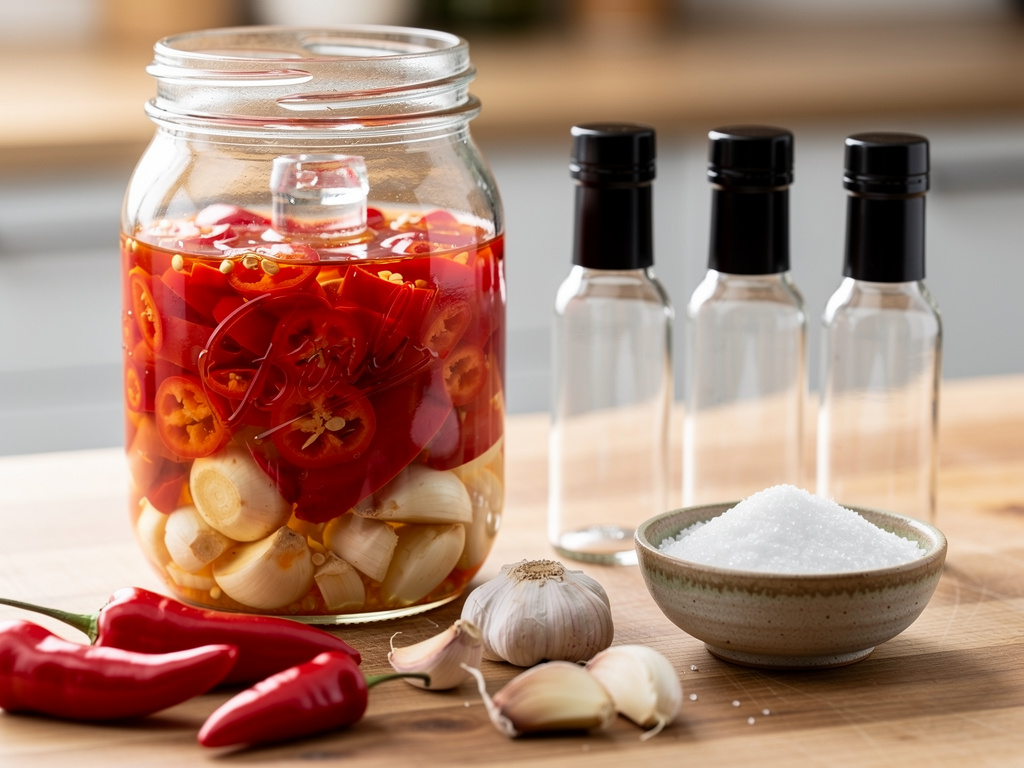


The short version: Fermented hot sauce starts as peppers soured in salt for about a week or two, and that ferment gives it a rounder, deeper taste than a straight vinegar sauce. It also changes the rules: a ferment you finish with vinegar is usually treated as an acidified food unless it stays refrigerated, and of the 7 state agency pages we read, only Texas clearly covers the cold, unheated sauce this guide recommends. Keep every batch at pH 4.6 or below, test each one unless your recipe comes from an approved source, a certified lab test or a process authority, and keep the sauce in the fridge, where Oregon State Extension puts its best quality at about 6 months. In our worked example the peppers and packaging come to about $1.44 a bottle, and fermented singles sell for $12 to $14 at Heatonist.
Checked October 14, 2026: the Texas DSHS and Minnesota MDA cottage food pages, 21 CFR 114.3 on eCFR, Oregon State Extension's fermented hot sauce recipe, USDA's FoodKeeper data, USDA's weekly retail price report, Heatonist's catalog and Homegrown's signup page ($10 a month billed annually or $12.50 billed monthly, plus 2.9% + $0.30 per order, paid by the vendor). Rules change, so verify your state's current rules before your first sale. Homegrown customers create an account to place a first order, and plan on most orders coming from people you send to your own link.
If your state lets you sell your fermented sauce, you can set up a Homegrown storefront so local customers can order ahead, and try it free for 7 days.
Fermented hot sauce has a rounder, deeper flavor than a quick vinegar-based sauce, and it has a following among people who take heat seriously: Heatonist, the shop that sells the Hot Ones lineup, carried fermented singles at $12 to $14 on October 14, 2026. Made by fermenting peppers before blending, it develops a complex, tangy, umami-rich flavor. But fermenting a hot sauce is different from mixing one, both in how it tastes and in how it's regulated, because fermentation and acidity are food-safety matters. If you love hot sauce and want to sell something distinctive, fermented hot sauce is a high-flavor product with room for a good margin, as long as you handle the safety and the rules right.
This guide covers how fermented hot sauce differs from vinegar-based, what adding vinegar does to the rules, which states allow it from a home kitchen, how to make and store it safely, what it costs, what real sellers charge, and how to reach heat-loving customers. If you want the full business setup for any hot sauce (permits, co-packers, label layout), our pillar guide on how to sell hot sauce from home covers it. This page is about what changes when the peppers ferment first.
Fermented hot sauce is different from vinegar-based hot sauce because the peppers are fermented in salt before blending, which develops complex, tangy, umami flavors rather than the sharp, simple acidity of a quick vinegar sauce. Salt pulls juice out of the peppers, and the bacteria already living on them turn sugars into lactic acid, so the mash sours on its own over a week or two. That process is what makes fermented hot sauce taste deeper and rounder. It does not make it the priciest bottle on the shelf: the three Heatonist singles whose descriptions say the peppers are fermented are priced $12 to $14, at or a little above the $12 middle of its 109 in-stock hot sauces, and on Homegrown, Immunity Artisan's fermented sauce is the lowest-priced bottled hot sauce at $8.
Here's what sets it apart:
The table below puts the three common styles side by side.
Scroll sideways to see every column.
| Style | How it's made | Time before bottling | Flavor | How it's stored | Federal category |
|---|---|---|---|---|---|
| Fermented, no vinegar added | Peppers, garlic and salt ferment, then get blended and strained | About 1 to 2 weeks | Tangy, round, savory | Refrigerated; we found no published best-by window for this style | A fermented food; Minnesota's agriculture department says foods soured only by natural fermentation are not covered by the acidified food rules |
| Fermented, finished with vinegar | Oregon State's recipe ferments a puree 5 to 7 days, stirs in sugar and vinegar, then ferments a few more days | About 1 to 2 weeks | Tangy with a brighter, sharper finish | Refrigerated, best within about 6 months (Oregon State) | Usually fits the acidified food definition in 21 CFR 114.3 because acid is added, though whether vinegar added to a finished ferment makes it acidified is a process authority's call; foods kept under refrigeration are excluded from that rule |
| Vinegar sauce, canned from a tested recipe | NCHFP's Easy Hot Sauce simmers tomatoes and serranos in vinegar, mills them, boils again and processes half-pint jars in a boiling water canner | Same day | Sharp, bright, simple | Sealed jars in a cool, dark cupboard; NCHFP says to can no more than you'll use within a year | Can be an acidified food, but because it is mostly tomatoes and vinegar it may instead count as an acid food under 21 CFR 114.3's exclusion for condiment sauces with small amounts of low-acid food; a process authority decides |
We read the Oregon State Extension fermentation recipes, the Minnesota Department of Agriculture's acidified foods page, 21 CFR 114.3 and the NCHFP Easy Hot Sauce recipe on October 14, 2026.
Fermented hot sauce takes time and care that a quick vinegar sauce doesn't. Fermentation runs days to weeks, you check the pH of the finished sauce with a meter, and you plan on keeping it cold. The bottle's life after that depends on how you finish it, and our guide to how long homemade hot sauce lasts compares a refrigerated fermented sauce, which Oregon State Extension puts at about 6 months, with vinegar and fresh sauces. It's more involved than mixing peppers and vinegar, and the flavor is the reward for anyone serious about hot sauce; the price lands in the same range as the other specialty sauces on Heatonist's shelf.
Adding vinegar usually does change it: a pepper mash soured only by fermentation is a fermented food, but once you stir in vinegar, the sauce usually fits the federal definition of an acidified food (low-acid food with acid added, finished at pH 4.6 or below). Whether vinegar added to a finished ferment makes it acidified is a call for a process authority, because the same rule also leaves out acid foods, including condiment sauces, that contain small amounts of low-acid food. For this sauce, the exclusion that matters is refrigeration: sauces kept refrigerated from production through sale are left out of that federal rule. This one choice in your recipe decides which rulebook a commercial version of your sauce answers to.
The federal definition sits in 21 CFR 114.3, which we read on eCFR on October 14, 2026. It calls acidified foods "low-acid foods to which acid(s) or acid food(s) are added," names "peppers" among its examples, and sets the line at a finished equilibrium pH of 4.6 or below. The same paragraph excludes "foods that are stored, distributed, and retailed under refrigeration." Equilibrium pH just means the pH once the pepper bits and the liquid have evened out, which Minnesota's agriculture department says "may take several hours or days."
Here is how the three versions sort out:
"Fermented" on your label does not settle the question by itself. Minnesota's page says that even a traditionally fermented food needs "a product and process assessment by a Process Authority" to confirm it is a fermented food that will be made and stored safely. A process authority is a food scientist, often at a university, who reviews your recipe and method in writing. If you plan to sell beyond a home kitchen program, budget for that review before you print labels.
For a home vendor, the practical answer is simpler than the federal one. Your state's cottage food rules (the laws that let you sell certain foods made in your home kitchen) decide whether you can sell the sauce at all, and that is the next section.
Whether you can sell fermented hot sauce under cottage food law depends on your state, because acidified and fermented products often carry specific requirements around pH and tested recipes. Across the 7 states we checked on October 14, 2026, two allow a home-made hot sauce (Texas and Minnesota), one leaves it unclear (Wisconsin), and four keep it out of their home kitchen programs (Washington, Ohio, Florida and California). Only Texas clearly covers the refrigerated sauce this guide recommends: Minnesota and Wisconsin allow home-canned foods, and Wisconsin's list says "not refrigerator pickles." Our state-by-state guide to selling homemade hot sauce legally quotes each rule in full.
Swipe left to compare all 7 states.
| State | Home-made hot sauce allowed? | What the page says about fermented or acidified foods | Yearly sales cap | Where you can sell |
|---|---|---|---|---|
| Texas | Yes | Allowed foods are "any foods, except" a short list that includes low-acid canned goods; fermented vegetable products and plant-based acidified canned goods need an approved recipe, a lab test, a process authority or a pH test of every batch, plus a batch number | $150,000 gross income | Direct to consumers, or wholesale (not TCS foods) to a cottage food vendor registered with DSHS; online only when you, an employee or a household member hands the order over in person |
| Minnesota | Yes, as a home-canned vegetable at pH 4.6 or lower; ask MDA about an uncanned live ferment | Allows "home canned pickles, vegetables, or fruits with a pH of 4.6 or lower"; its acidified foods page names hot sauces | $78,000 | From home, farmers markets, community events or online, with you or your employee present at sale or delivery; food for people cannot be shipped |
| Wisconsin | Unclear; ask DATCP | Allows home-canned vegetables "acidified by pickling or fermenting" at pH 4.6 or lower, including sauerkraut, kimchi and salsas, but never names hot sauce, and dressings need a license regardless of pH. The exemption is for home-canned foods only, and its list says "not refrigerator pickles," so an uncanned fridge ferment does not fit its wording | $5,000 per person | Only community or social events, flea markets and farmers markets in Wisconsin; no internet sales |
| Washington | No | Prohibits canned pickled products "such as corn relish, pickles, sauerkraut," food made from fresh fruits or vegetables, and barbecue sauces, ketchups and mustards | No home cap applies | A licensed kitchen or a co-packer |
| Ohio | No | A cottage food operation "is not permitted to process acidified foods," low-acid canned foods or foods not on its list | None for hot sauce | Not from the home kitchen program; through a licensed facility |
| Florida | No | Hot sauce is not on the approved list; "vinegar and flavored vinegars" are | Does not apply | Not from the home kitchen program; through a licensed kitchen or co-packer |
| California | No | Hot sauce is not on the Approved Cottage Foods list (last reviewed April 2026); the closest category is "Vinegars and Mustards" | Not relevant to hot sauce | Through a licensed facility or co-packer |
We read the Texas DSHS, Minnesota MDA, Wisconsin DATCP, Washington WSDA, Ohio ODA, Florida FDACS and California CDPH pages on October 14, 2026. We have not read the other 43 states for this guide, so check your own agency's page.
A few points to keep straight:
Minnesota passed changes that start August 1, 2027, according to its cottage food registration page as we read it on October 14, 2026. From that date the state moves to a single registration tier with a $30 yearly fee for every registrant, advanced training for everyone, and "allowed shipping." For now, sales up to $7,665 a year register at no fee with a yearly online training, and sales from $7,666 to $78,000 pay $50 and take a food safety course every three years. If you plan to ship fermented sauce from Minnesota, that 2027 date is the one to watch.
Because acidified foods carry genuine safety requirements, confirm your state's specific rules and don't guess at acidity. If your state is not one of these 7, our overview of what foods you can sell under cottage food laws and the cottage food laws by state directory point you to your state's agency, and searching that agency's page for "acidified" and "fermented" usually finds the answer fast. The National Center for Home Food Preservation is an authoritative, university-backed resource on safe fermentation and acidification.
Texas requires one of four safety checks before your first sale, a unique number on every batch, and a batch record you keep for at least 12 months. You also need a food handler course accredited under Texas Health and Safety Code Chapter 438(D) before you start selling, and the Texas DSHS cottage food page accepts a Food Manager Certification from an accredited program in its place. The Texas cottage food rule, 25 TAC §229.661(f), names "fermented vegetable products" and "plant-based acidified canned goods" by name, and it defines a fermented vegetable product as a low-acid vegetable food whose pH microorganisms reduce to 4.6 or less. A pepper ferment reads as a fermented vegetable product, a ferment finished with vinegar and kept in the fridge fits that or the rule's pickled vegetables "preserved in vinegar, brine, or a similar solution," and a canned vinegar version reads as a plant-based acidified canned good, so every version lands under the same requirements.
Before you sell, use a recipe from a DSHS-approved source, a recipe a certified lab tested at pH 4.6 or less, or one a qualified process authority approved. Otherwise, "test each batch of the recipe with a calibrated pH meter." Label each batch with a unique number and keep a record of the batch number, the recipe, its source or test results, and the date made for at least 12 months. For online orders, the Texas DSHS cottage food page says all label information must be posted on your website before you accept payment, and you, an employee or a household member must deliver the food in person. The rule lists fermented vegetable products "including products that are refrigerated to preserve quality." If your sauce needs the fridge for safety and not just for quality, DSHS treats it as a time and temperature control for safety (TCS) food: you register on its Online Licensing Registry, keep it at 41°F or below, and cannot sell it wholesale or donate it. Whether your refrigerated ferment counts as TCS is a question for DSHS or a process authority. We read both on October 14, 2026. DSHS also says it "will adopt rules" for the newer law behind the $150,000 limit, so check the page again before your first sale.
The approved recipe sources DSHS lists for acidified and fermented foods are the USDA Complete Guide to Home Canning, the University of Georgia's So Easy to Preserve, and three named Ball books. If your fermented hot sauce is your own recipe, with no lab test or process authority approval behind it, the per-batch pH test is the path left for it.
You need a pH meter in practice, because Texas makes a calibrated pH meter the rule for any batch you can't tie to a DSHS-approved recipe source, a certified lab result or a process authority's sign-off, and a fermented sauce is hard to tie to a fixed recipe, because how sour it gets depends on your kitchen's temperature, your salt and how long you wait. Apera's PH20 pocket pH tester kit was $72 on its site on October 14, 2026, the price of nine $8 bottles.
What a meter does for a fermented sauce:
Calibrate the meter before every session with fresh buffer solution, following the meter's own instructions. Federal acidified food rules, in 21 CFR 114.90, have processors standardize with a pH 4.0 buffer and check against pH 7.0, which is a good habit to borrow even when the federal rule does not apply to you.
Buy your first packaging at the pack sizes suppliers actually sell. Two cases of 12 five-ounce woozy bottles, one 100-pack of caps, one 100-pack of pour inserts and one 80-label pack came to $41.86 at the WebstaurantStore and OnlineLabels prices we loaded on October 14, 2026. The bottle case showed out of stock that day, so price a second supplier before you order. That covers your first 24 bottles and leaves 76 caps, 76 inserts and 56 labels for the next batches. Add the $72 meter and your first-batch spend outside the peppers is $113.86.
You make fermented hot sauce by fermenting peppers with salt for about one to two weeks, then blending, straining, checking the pH and bottling it into clean bottles you keep in the fridge. The process is simple, but it demands cleanliness, patience, and, critically, checking your final acidity. Oregon State Extension's recipe is a good model because it is short and published: 2 pounds of red chiles (it suggests Fresno, cherry or Hungarian wax), 4 cloves of garlic, 6 tablespoons of kosher salt, 6 tablespoons of sugar and ¾ cup of vinegar.
The basics of production, in order:
Checking your final pH with a calibrated meter is not optional, because it's what separates a safe sauce from a dangerous one. The National Center for Home Food Preservation explains that low-acid foods, which it puts at pH values above 4.6 and which include all fresh vegetables except most tomatoes, are not acidic enough to stop the bacteria that cause botulism. The FDA's guide to foodborne illness lists improperly canned foods, especially home-canned vegetables, among botulism's common sources, which is exactly the risk proper pH control prevents.
You can, but heating ends the ferment, changes the flavor a little, and turns your sauce into a canned product whose time and temperature should come from a tested recipe or a process authority, not a guess. Our guide to how long homemade hot sauce lasts notes that simmering stops the fermentation. NCHFP's hot sauce canning recipes, such as Easy Hot Sauce and Cayenne Pepper Sauce, are cooked vinegar sauces made with canned tomatoes and processed in a boiling water canner (Easy Hot Sauce in half-pints, Cayenne Pepper Sauce in pints, each for 10 minutes up to 1,000 feet), not fermented sauces in woozy bottles. For a home vendor, keeping the fermented sauce cold is the simpler and safer plan. In Minnesota and Wisconsin the home path is written for home-canned products, so confirm an uncanned, refrigerated ferment with MDA or DATCP before you sell it, and get any canning process for your sauce from a process authority.
Plan on about two weeks from chopping peppers to a sauce you can sell, and start a month before any market or holiday rush you are making it for. Oregon State's recipe ferments 5 to 7 days, then a few more days after the vinegar goes in, and a cool kitchen stretches both.
A simple production calendar for one market:
Fermenting in overlapping batches, one jar started every few days, keeps a steady supply in the fridge without a single giant production day. It also means one stalled batch never empties your table.
Plan on refrigerating fermented hot sauce from the day you bottle it. Oregon State Extension's fermented hot sauce recipe says to keep the bottles refrigerated and use them within six months, adding that the "heat will mellow with age." The live bacteria in an unheated ferment keep working at room temperature, which is why we keep the bottles cold. Our rule for anything you sell from a home kitchen is the same one our hot sauce shelf life guide uses: a fermented sauce goes in the fridge from bottling, and any sauce whose pH you have not measured gets treated as needing the fridge.
How the published numbers compare:
The refrigerator also keeps you on the right side of the federal rule's refrigeration exclusion and Minnesota's "Keep Refrigerated" labeling expectation. At a market, that means a cooler with ice packs and a thermometer, not a sunny table.
In our worked example, a 5 oz bottle of fermented hot sauce costs about $1.44 in peppers and packaging, and small-batch hot sauces sell for $8 to $15 in the Homegrown listings we checked, with fermented singles at $12 to $14 at Heatonist, close to that shop's $12 median. The one fermented sauce on Homegrown was the cheapest bottled hot sauce there, at $8. Peppers and salt are cheap, so your main costs are the bottle, the label, the meter you buy once, and your time over the fermentation period.
Here's a materials breakdown for one bottle, using Oregon State's 2-pound recipe made with jalapeños and assuming the strained batch fills five 5 oz bottles. Measure your own yield, because straining and how much vinegar you add change it.
Swipe to see the price behind each line.
| Cost line | Price we loaded | Approx. cost per bottle |
|---|---|---|
| Peppers (2 lb jalapeños) | $1.45 a pound, USDA's national average advertised price, so $2.90 a batch | $0.58 if the batch fills 5 bottles |
| 5 oz glass woozy bottle | $6.49 for a case of 12 (WebstaurantStore) | $0.54 |
| Cap with liner | $7.79 for 100 | $0.08 |
| Pour insert (the plastic plug that slows the pour) | $6.99 for 100 | $0.07 |
| 4 x 2.5 inch weatherproof label | $14.10 for 80 (OnlineLabels) | $0.18 |
| Total | $1.44 |
Prices loaded October 14, 2026 from USDA's weekly retail report (dated October 9, 2026, jalapeños per pound across 696 grocery ads), WebstaurantStore's woozy bottle page (bottle, matching cap and insert) and OnlineLabels' OL600LP page. Each line is rounded to the cent; the total adds the unrounded amounts. Garlic, salt, sugar and vinegar come on top, and so does the $72 pH meter you buy once.
That bottle costs around $1.44 in peppers and packaging. Hot sauces on Homegrown sell for $8 to $15, with the extra-hot sauces at the top end, and the fermented bottles in this guide run $8 to $14. At $10, a one-bottle order on Homegrown leaves you $8.56 before the card fee and $7.97 after the $0.59 card fee, before your pantry ingredients, your time and any booth fee.
The fermented sauces we found sell for $8 to $14 a bottle, inside a wider hot sauce market where $12 is the middle. On October 14, 2026, Heatonist, a hot sauce shop that sells the Hot Ones lineup, had 109 single bottles in stock from $4.99 to $22, with a median of $12 and 68 of the 109 priced from $10 to $15. Three of those singles say in their descriptions that the peppers are fermented: Dustin Poirier's Louisiana Style at $12 (fermented cayenne), Onima Pantry's JANG Korean-Style at $14 (fermented chilis) and Piko Peppers' Volkano at $14 (habanero fermented, roasted and ground).
In a pull of the Homegrown catalog on October 14, 2026, 6 of the 2,927 products from 322 vendors were bottled hot sauces, from 2 vendors, priced $8 to $15, plus 2 bundle listings. One of the 6 is fermented: Immunity Artisan in Snyder, Texas lists a fermented Hatch and ghost pepper table sauce at $8. Its listing says it ferments carrots, onions and roasted Hatch chilies, then adds apple cider vinegar and tart cherry juice, the ferment-then-vinegar style from earlier in this guide. Crimson Hot Sauce lists five sauces at $10 and $15 and calls its Original "vinegar forward." We searched names and descriptions for hot sauce words and "ferment," read every match, then read each counted vendor's full list, and left out pepper jams and jellies, pickled peppers and listings with no description.
A pricing structure that works:
Because fermented hot sauce is a craft product, price for the quality and process rather than competing with mass-market sauces. If pricing your work fairly feels uncomfortable, read why charging what you're worth feels wrong, and see how vendors approach pricing specialty products. On October 14, 2026, 68 of Heatonist's 109 in-stock single bottles were priced $10 to $15, so a well-made sauce does not need a grocery-store price.
We don't have sales figures that rank flavors, but the hot sauce lineups on real shelves show what a lineup looks like: a clear range from approachable to very hot, with one or two signature flavors carrying the brand. Crimson Hot Sauce's 5 sauces on Homegrown run from Original and Jalapeño Honey at $10 up to a $15 Carolina Reaper blend, and the fermented singles at Heatonist cover a Louisiana-style cayenne, a Korean-style gochujang sauce and a habanero sauce. Because your audience includes both flavor seekers and heat chasers, giving customers a spectrum to choose from drives sales and reorders.
Directions that work in a fermented lineup:
Ways to strengthen your line:
Sample at markets, since a taste sells a bottle faster than any label. Pour samples into small cups from a bottle that stays in the cooler. A distinctive, well-labeled lineup that showcases the fermented flavor is what earns a loyal following.
A fermented hot sauce label in a home kitchen state carries your name, your address or registration number, the product name, any major allergens (Minnesota also wants the full ingredient list), the state's homemade disclosure, and the lines that are specific to fermented and acidified foods: a batch number in Texas, the production date in Minnesota and "Keep Refrigerated" for a sauce that needs the fridge. Our cottage food labeling requirements guide covers the general rules; these are the fermented-specific ones we read on October 14, 2026.
Measure your bottle before you order labels. The 5 oz woozy we priced is 6 5/8 inches tall with a curved neck, so hold one printed test label against a bottle before you print the whole pack of 80.
Reach fermented hot sauce customers through hot sauce enthusiasts, foodies, and gift shoppers, using sampling and the craft-ferment story, and plan on most sales being local and in person, since none of the 3 states in our table that may allow home sauce lets you ship it. Hot sauce buyers already pay specialty prices: Heatonist had 109 single bottles in stock on October 14, 2026, with a median price of $12.
Ways to find your customers:
Because the sauce lives in the fridge and comes out in batches, the easiest system is one where customers order ahead and pick up cold bottles on a set day. Managing those through DMs still gets messy, so a real storefront where customers rebuy and browse your heat levels helps. Here's how to sell food online as a local vendor so reorders and gift sets stay organized.
A fermented hot sauce comes out of the fridge in batches of a known size, and the cleanest way to sell one is to let regulars order ahead and pick up cold bottles on a day you choose. Homegrown is $10 a month billed annually ($12.50 billed monthly) with no percentage fees beyond standard payment processing, which is 2.9% + $0.30 per order paid by you, and it gives you an order page where customers browse your sauces and heat levels, buy singles or sets, and reorder favorites. Because you list each heat level with its own price and the quantity you bottled, a 12-bottle batch stops selling at 12 instead of leaving you to apologize in DMs.
Here is what a month of 50 local orders costs on the tools a hot sauce vendor usually considers, using a $20 order of two $10 bottles:
Swipe left to see the full fee stack for each platform.
| Platform | Subscription and trial | Platform fee | Card processing | Customer pays on a $20 order | You pay on a $20 order | You pay for 50 orders a month |
|---|---|---|---|---|---|---|
| Homegrown, billed annually | $10 a month; 7-day trial (no charge until day 8) | $0, 0% commission | 2.9% + $0.30, paid by you | $20.00 | $0.88 | $54.00 ($10 + $44.00) |
| Homegrown, billed monthly | $12.50 a month; 7-day trial (no charge until day 8) | $0, 0% commission | 2.9% + $0.30, paid by you | $20.00 | $0.88 | $56.50 ($12.50 + $44.00) |
| Square Online, Free plan | $0 a month per location; no trial needed | $0 | 3.3% + 30¢ online | $20.00 | $0.96 | $48.00 |
| Shopify Basic | $29 a month paid yearly or $39 paid monthly; 3 days free, then $1 a month for 3 months | $0 with Shopify Payments (2% on third-party processors) | From 2.9% + 30¢ online | $20.00 | $0.88 | $73.00 yearly plan, $83.00 monthly plan |
| Etsy | $0 a month; a one-time set-up fee may apply | 6.5% transaction fee, plus a $0.20 listing fee for each item sold (two bottles here) | 3% + $0.25 on the total sale | $20.00 plus any shipping you charge | $2.55 | $127.50 |
| Instagram DMs and a Venmo business profile | $0 a month | $0 | 1.9% + $0.10 per payment; a customer paying by credit card skips Venmo's usual 3% card fee | $20.00 | $0.48 | $24.00 |
We checked Homegrown's signup page, Square Online's plans page, Shopify's pricing page, Etsy's fees policy with its US processing rate, and Venmo's business profile fees on October 14, 2026. Etsy's $0.20 listing fee renews each time one bottle sells, so an order of two bottles pays it twice. None of these rows include sales tax.
How it compares to the alternatives for a fermented sauce:
What Homegrown does well for a fermented hot sauce vendor: each sauce or heat level can be its own size or flavor with its own price, quantities count down as bottles sell, you choose which days customers can pick up so cold bottles go straight from your fridge to theirs, local delivery runs within a radius you set, and every listing shows allergens and ingredients, with a description where you can post the rest of your label details before a customer pays, which Texas requires for online orders. Customers can also message you from your store when they want to know when the next batch is ready.
What it doesn't do: it won't ferment or bottle your sauce, test your pH, keep your batch log, or tell you whether your state allows the sauce. Customers create a Homegrown account the first time they order. Your storefront also appears on the Homegrown marketplace, but plan on most orders coming from people you send to your own link, such as the regulars who already know your sauce. When your process and rules are set, you can set up your storefront and sell your hot sauce today.
The fermented hot sauce mistakes to fix first involve acidity, storage and the rules, followed by weak differentiation in a crowded market. Because it's a fermented product that is often finished with vinegar, the errors to fix first are the ones that affect safety and how long the sauce keeps.
Mistakes to avoid:
Getting these right keeps a distinctive craft product safe, legal and easy to sell.
Whether you can sell fermented hot sauce under cottage food law depends on your state. Among the 7 states whose agency pages we read on October 14, 2026, Texas allows a home-made hot sauce, Minnesota allows one as a home-canned vegetable at pH 4.6 or lower, Wisconsin leaves it unclear, and Washington, Ohio, Florida and California keep it out of their home kitchen programs. Only Texas clearly covers a sauce kept in the fridge and never canned, so in Minnesota or Wisconsin ask MDA or DATCP about a fridge version before you sell. Texas names fermented vegetable products in its rule and wants one of four safety checks (an approved recipe source, a certified lab test, a process authority's approval or a meter reading on every batch), plus a batch number and an accredited food handler course. Confirm your own state's current rules before selling.
Fermented hot sauce is made by fermenting peppers with salt before blending, which develops complex, tangy, umami flavors, while regular hot sauce is typically peppers cooked or blended with vinegar for a sharp, simple acidity. The fermentation, which runs about one to two weeks in Oregon State Extension's recipe, is what gives fermented sauce its depth and craft appeal. It also means some or all of the acid comes from bacteria, so you measure the pH of each batch instead of relying on a vinegar ratio.
Your hot sauce is ready to sell when a calibrated pH meter shows the finished sauce at 4.6 or below, it follows your state's rules, and you store it the way its recipe says. Because low-acid foods above pH 4.6 can support the bacteria that cause botulism, checking your final pH is essential, not optional. In Texas the alternative to testing every batch is a recipe from an approved source, a certified lab test or a process authority's approval, and a fermented sauce belongs in the fridge.
Fermented sauces we priced ran $8 to $14 a bottle: Immunity Artisan's on Homegrown at $8 and the three fermented-pepper singles at Heatonist at $12 to $14, checked October 14, 2026. Hot sauces on Homegrown as a whole ran $8 to $15 that day, with the extra-hot sauces at the top end. Since peppers and packaging came to about $1.44 a bottle in our worked example, the margin is strong, so price for the quality and process rather than competing with mass-market vinegar sauces.
Fermented hot sauce takes about one to two weeks to make before it is ready to bottle. Oregon State Extension's recipe ferments the pepper puree for 5 to 7 days, then stirs in sugar and vinegar and ferments a few more days before straining. A warmer kitchen ferments faster, and a cooler one slower, so plan your production around the fermentation window and start about a month before a market you are making it for.
A fermented hot sauce finished with vinegar keeps its best quality for about 6 months in the refrigerator, per an Oregon State Extension recipe that says to keep it refrigerated and notes the heat mellows with age. Our rule is to treat it as a fridge product from the day it is bottled, the same rule our shelf life guide uses. For comparison, USDA's FoodKeeper gives store-bought hot sauce 6 months in the pantry, and the NCHFP says to can no more tested vinegar sauce than you will use within a year. Label each bottle with its production date and "Keep Refrigerated."
Fermented hot sauce can be profitable because ingredient costs are low and well-made bottles sell at specialty-shop prices: Heatonist's fermented singles were $12 to $14 on October 14, 2026. In our worked example a $10 bottle costs about $1.44 in peppers and packaging and leaves $7.97 after Homegrown's card fee on a one-bottle order, before garlic, salt, sugar, vinegar, your time and a one-time $72 pH meter. The caps matter too: $150,000 a year in Texas, and $78,000 in Minnesota and $5,000 per person in Wisconsin for a home-canned version.
More on hot sauce and fermented foods from the Homegrown blog:
Fermented hot sauce rewards vendors who respect both the craft and the safety: ferment for real flavor, confirm a pH of 4.6 or below on every batch, follow your state's acidified-food and fermented-food rules, keep it cold, and lean into the fermented story that sets you apart. Done right, it's a distinctive product that can carry a $12 to $14 price. When your process and rules are set, set up a Homegrown storefront and start selling your hot sauce.



