
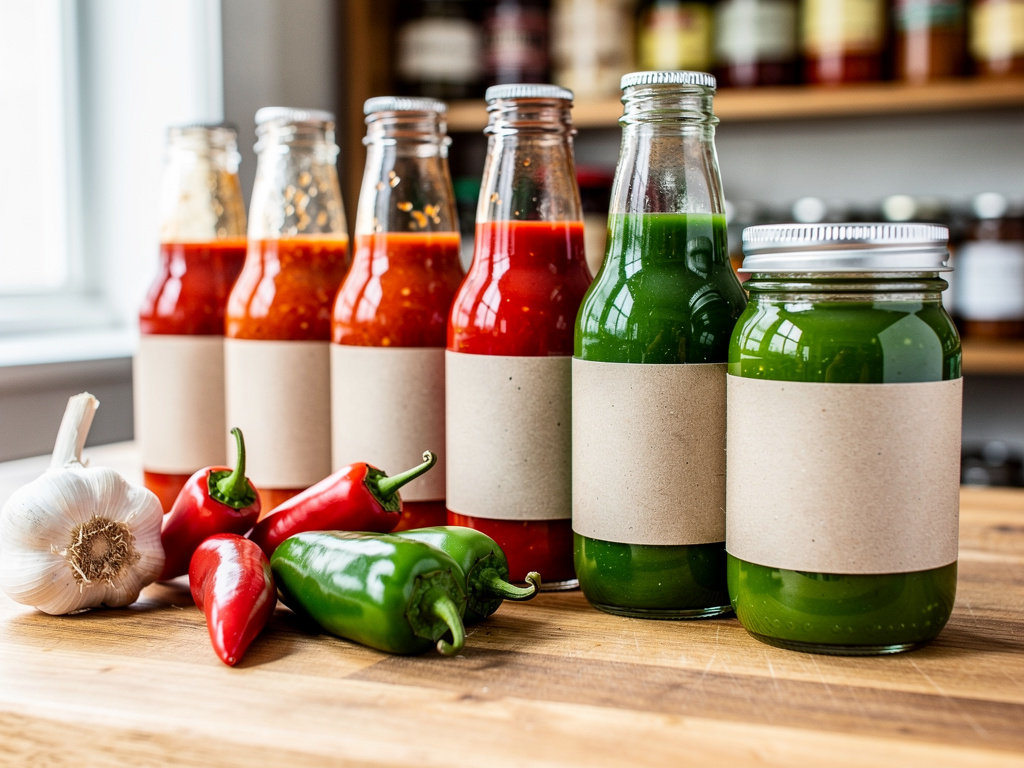


The short version: Homemade hot sauce lasts anywhere from about a week to about a year, and the kind of sauce decides which. A vinegar sauce canned from a tested recipe keeps about a year sealed in a cool cupboard, and USDA's FoodKeeper storage data gives bottled hot sauce 6 months on the shelf. A fermented sauce finished with vinegar and kept in the fridge is best within about 6 months, per an Oregon State Extension recipe. A fresh sauce made without vinegar is a fridge-only product, so plan on about a week and keep it cold.
Checked on USDA's FoodKeeper data, the National Center for Home Food Preservation, Oregon State, Ohio State and South Dakota State extension pages, and 21 CFR Part 114, October 12, 2026: no federal source publishes a shelf life for homemade hot sauce, so the numbers here come from the closest published guidance, and the ones that are our own rule are labeled. Which sauce you may sell from home depends on your state, so verify your state's current rules before you bottle a batch. Homegrown customers create an account to place their first order, and Homegrown has no drops or countdown-release feature.
Hot sauce has a reputation for lasting forever. Plenty of people have a bottle in the door of the fridge that moved with them twice. That reputation belongs to commercial sauce heavy on vinegar, tested for acid and sealed in a factory. A bottle you made in your kitchen last weekend plays by different rules, and the rules change with the recipe.
This guide is for people who sell hot sauce, or want to. It covers how long vinegar, fermented and fresh sauces keep, why the published numbers are so thin, what date goes on your bottle, how far ahead you can make a season's worth, and what to watch for at a hot market booth. If you are still deciding whether to start, our guide to selling hot sauce from home covers the pH test, the label and the price first.
Homemade hot sauce lasts about a week if it is fresh, about 6 months if it is fermented, finished with vinegar and refrigerated, and about a year if it is a vinegar sauce canned from a tested recipe. Those three numbers come from three different places, because no federal source lists homemade hot sauce at all. The closest official figure is USDA's FoodKeeper data, which gives "Hot sauce" 6 months in the pantry and notes it "will stay fresher longer if refrigerated." That entry describes a bottle you buy, not one you make. Every number in this guide is a best-quality window. Safety comes from the acid, the heat step and the seal, and a jar past its window is not automatically unsafe, just as a jar inside it is not safe if the recipe was never tested.
Here is what each kind of sauce gets, checked on October 12, 2026:
Scroll sideways to see every column.
| Kind of hot sauce | Sealed, on the shelf | In the fridge | Can you sell it from home? | Source |
|---|---|---|---|---|
| Vinegar sauce, canned from a tested recipe, sealed jar | Best within 1 year, stored at 50 to 70°F | After opening, keep it cold; we tell customers 6 months or the best-by date, whichever comes first (our rule, matched to FoodKeeper's chili sauce) | In some states, as a home-canned food at pH 4.6 or below | NCHFP, Storing Home Canned Foods; Minnesota MDA |
| Store-bought bottled hot sauce | 6 months | Stays fresher longer if refrigerated | Not your product | USDA FoodKeeper, "Hot sauce" |
| Store-bought ketchup or chili sauce, for comparison | 1 year unopened | 6 months after opening | Not your product | USDA FoodKeeper, "Ketchup, cocktail, or chili sauce" |
| Fermented hot sauce finished with vinegar, refrigerated | Not given | Best within 6 months | Depends on the state and on whether vinegar is added | Oregon State Extension fermented hot sauce recipe |
| Your own untested recipe, not canned | Not safe to store on a shelf | "Use relatively quickly," no number given | Usually not under home food laws | Ohio State Extension HYG-5365 |
| Fresh pepper sauce with no vinegar | Not safe to store on a shelf | About 1 week (our rule, matched to fresh hot peppers and fresh homemade salsa) | Usually not; Texas allows refrigerated home foods with DSHS registration and extra labeling | USDA FoodKeeper, "Hot peppers" (1 week) and "Salsa, homemade, fresh" (5 to 7 days); Texas DSHS |
We loaded each source on October 12, 2026. FoodKeeper is USDA's storage database, read from its current data file (version 128). "Our rule" marks the two rows where no source gives a number and we chose a conservative one.
USDA's FoodKeeper data has a "Hot sauce" entry of 6 months, but it has no homemade hot sauce entry, even though it lists homemade salsa, homemade canned barbecue sauce and homemade applesauce. The 6-month figure is for a store-bought bottle. A homemade sauce can be far more acidic or far less, depending on how much vinegar went in and whether you tested it.
Extension services are careful here for a reason. Ohio State's fact sheet on making and preserving barbecue and hot sauces gives two tested canning recipes, then says that for any other recipe you should freeze the sauce "or simply refrigerate and use relatively quickly." It gives no number of days, because an untested recipe has no known acid level.
The closest published numbers line up like this:
Published storage times, in months
Source: USDA FoodKeeper data file (version 128), NCHFP Storing Home Canned Foods, Oregon State Extension fermentation recipes, all loaded October 12, 2026. The barbecue bar is drawn at 9 months, the low end of its range.
So the honest answer is a range, and where your sauce falls in it depends on the next question: what is keeping it safe.
Acid keeps shelf-stable hot sauce safe, not the heat of the peppers. Peppers on their own are a low-acid vegetable, and a sealed bottle has very little air in it. That combination is what the botulism germ likes. South Dakota State's guide on how to make a safe hot sauce says the pH of a hot sauce "must be less than 4.6," because the germ cannot grow below that line.
pH is a number from 0 to 14 that measures how acidic something is. Lower is more acidic. Vinegar sits far below 4.6, and fresh peppers sit above it, so a sauce lands wherever its mix of the two puts it. Federal rules call a low-acid food with added acid an acidified food, and 21 CFR 114.3 draws the line at a finished pH of 4.6 or below.
Three things work together in a sauce that keeps:
A pH reading tells you the sauce is on the safe side of the line. It does not tell you how many months the color and flavor hold, which is why storage times come from tested recipes and storage guides, not from the meter. Salt and capsaicin, the compound that makes peppers hot, do not replace any of these. Acid is the reason a tested vinegar sauce can sit sealed for 12 months while an untested one belongs in the fridge. SDSU assumes a typical hot sauce has too much water for water content alone to stop germs.
A sealed jar of vinegar hot sauce from a tested canning recipe does not need the fridge until it is opened, and an opened bottle keeps best in the fridge. The National Center for Home Food Preservation (NCHFP), run by the University of Georgia, says to store home-canned jars between 50 and 70°F for best quality and never above 95°F.
After opening, the fridge is mostly about quality. FoodKeeper's note on commercial ketchup and chili sauce says those bottles are safe at room temperature after opening and that "quality, not safety" is why labels say to refrigerate them. It still gives them 6 months in the fridge after opening for best quality. Its hot sauce entry says the same thing in fewer words: stays fresher longer if refrigerated.
That reasoning holds for a sauce that is acidic enough. It does not hold for a vinegar sauce you never tested. If you do not know your pH, you do not know which side of the line you are on, so treat the bottle as a fridge product.
Here is how we split it for customers:
A fermented hot sauce finished with vinegar keeps about 6 months in the refrigerator for best quality. That figure comes from an Oregon State Extension fermentation recipe, which tells you to strain the finished sauce into bottles, keep it refrigerated, and use it within six months. It adds that the "heat will mellow with age." That recipe ferments a puree of red chiles, garlic and salt for 5 to 7 days, then stirs in sugar and vinegar before straining and bottling, so its 6 months applies to a fermented sauce finished with vinegar and kept cold.
Fermentation is different from adding vinegar. Salt pulls juice out of the peppers, and the bacteria already on them turn sugars into lactic acid. The sauce gets sour on its own over a week or more. Minnesota's Department of Agriculture says foods whose pH drops "by natural fermentation and not by adding acid" are not covered by the acidified food rules.
That exemption is narrower than it sounds:
Our guide to selling fermented hot sauce from home covers the recipe and pricing side of that choice.
Fresh hot sauce with no vinegar is a refrigerator product that we would sell with about a week of life, and only where your state allows refrigerated home foods. No source we found gives a number for fresh hot sauce itself. The two closest FoodKeeper entries agree: fresh hot peppers get 1 week in the fridge, and homemade fresh salsa, another raw pepper and vegetable mix, gets 5 to 7 days. A sauce blended from those peppers has no reason to outlast them. That one-week figure is our rule, built from those two entries, not an official one.
Fresh sauces also fall outside the federal acidified food rule entirely. 21 CFR 114.3 says foods "stored, distributed, and retailed under refrigeration are excluded" from it. That sounds like good news, but it cuts the other way for home vendors. Of the 7 states our guide to selling homemade hot sauce checked, only Texas lets a home kitchen sell a sauce that needs a fridge.
Texas allows home kitchens to sell some foods that need refrigeration, under rules the Texas Department of State Health Services cottage food page lists. A home operation that sells these foods must first register with DSHS on its Online Licensing Registry. The label must carry the date the food was made, the label or receipt must carry a safe handling statement in at least 12-point type, and the food must be kept at 41°F or below. The same page requires a unique number for each batch of pickled vegetables, fermented vegetable products and plant-based acidified canned foods. Checked October 12, 2026.
If your fresh sauce does qualify where you live, sell it like dairy: made to order, kept cold the whole way, and labeled with the day you made it.
Yes, and it can decide it before shelf life even comes up. A vinegar sauce at pH 4.6 or below is the clearest path, a fermented sauce depends on the state, and a fresh refrigerated sauce is the hardest to sell from a home kitchen. Our guide to whether you can sell homemade hot sauce walks through 7 states, from Texas, which allows it, to California, which does not list it.
Under the Minnesota Department of Agriculture's cottage food rules, a registered home vendor may sell "home canned pickles, vegetables, or fruits with a pH of 4.6 or lower." Every label must carry "the date on which the food was produced." Checked October 12, 2026.
In South Dakota, the SDSU Extension guide says three criteria should be followed before selling hot sauce at a farmers market or to a store:
Ohio State's fact sheet says anyone who plans to can hot sauce to sell must follow the state and federal rules for acidified foods, which live in 21 CFR Part 114. Rules change, so verify your state's current rules with your state agriculture or health department before you bottle anything for sale.
A jar processed in a canner from a tested recipe is the home method with a published best-quality window of about a year. The NCHFP's tested Easy Hot Sauce recipe uses half-pint jars, 4 cups of 5% vinegar, and 10 minutes in a boiling water canner up to 1,000 feet, 15 minutes from 1,001 to 6,000 feet, and 20 minutes above that. The recipe makes 7 to 8 half-pints, per Ohio State's copy of it.
Narrow hot sauce bottles, often called woozy bottles, are what most vendors want on the table. Commercial hot sauce companies fill them hot and cap them, and back each bottle with a process set by a qualified expert, which 21 CFR 114.83 requires for acidified foods. At home, a hot-filled bottle with no tested recipe behind it has no published shelf life, so it belongs in the fridge.
A sauce's pH can drift for hours or days after you make it, while the chunks of pepper and the liquid even out. Minnesota's acidified foods page says reaching that final "equilibrium pH" may take "several hours or days," and the product may need refrigeration until it gets to 4.6 or lower. Test the finished, settled sauce, not the pot on the stove.
Where you keep the sealed jars matters as much as the seal:
Tell customers an opened bottle of your vinegar hot sauce keeps 6 months in the fridge, or until the best-by date on the label, whichever comes first. That is our rule. FoodKeeper gives commercial sauces a range of fridge times after opening: 1 month for salsa, picante and taco sauces, 4 months for bottled barbecue sauce, and 6 months for ketchup, cocktail or chili sauce. Its hot sauce entry gives only a shelf time, not an opened-bottle time. We matched chili sauce because, in our reading, it is the closest entry: the NCHFP's tested Easy Hot Sauce is diced tomatoes and Serrano peppers simmered in vinegar and pressed through a food mill, a smooth cooked sauce rather than a chunky salsa. No extension source gives an opened-bottle time for homemade hot sauce.
The clock on a jar you sell is shared. Your shelf time and your customer's shelf time come out of the same year. A jar canned in March and sold in November has used most of its best-quality window before anyone opens it.
A storage card on the bottle or in the bag saves you the same question at every market:
Ohio State's untested-recipe advice applies here too. If the sauce in the bottle was never canned from a tested recipe, the card should say to keep it cold and use it quickly.
Homemade hot sauce loses color, heat and flavor months before it becomes unsafe to eat. Red sauces darken toward brown, solids settle and liquid separates on top, and the heat fades. Oregon State's recipe says plainly that the heat "will mellow with age." That is why FoodKeeper treats refrigeration of commercial sauces as a quality step rather than a safety step.
Warmth and light speed all of it up. Serious Eats notes that sauce kept at room temperature can mellow in flavor and oxidize in color faster than sauce kept cold. A clear bottle sitting in the sun on a market table is the fastest way to turn a bright red sauce brown.
None of these changes by themselves mean the sauce is bad:
What does matter is the list in the spoilage section further down: bulging caps, fizzing in a vinegar sauce, mold and off smells. Those are signs to throw the bottle away, not quality changes.
Put the date you made the batch on every bottle, and add a "best by" date if your state allows it. Federal law does not require a date on most food. USDA's Food Safety and Inspection Service says that except for infant formula, product dating "is not required by federal regulations," and that dates speak to quality rather than safety.
State home food laws often do require a date. Minnesota requires "the date on which the food was produced" on every cottage food label. Texas requires the date made on refrigerated home foods and a batch number on pickled vegetables, fermented vegetable products and plant-based acidified canned foods. The University of Missouri Extension suggests that even gifted preserves carry the ingredients, the processing date and storage instructions.
A clear hot sauce label carries:
Our cottage food labeling requirements guide covers the rest of what the label needs, such as your name, address and allergens.
For a tested, canned vinegar sauce, you can bottle up to a year ahead, but bottling every 4 to 8 weeks leaves more of that year for your customer. The NCHFP says to can no more than you will use within a year, and every month on your shelf is a month off your customer's. Smaller batches also let you change a flavor without being stuck with 60 jars of the old one.
Bottle to your order count, not to your hopes. The NCHFP's tested recipe makes 7 to 8 half-pints, so a weekend where you sell about 20 jars takes three batches. Keep each batch to the tested recipe's proportions: the University of Missouri Extension says to "maintain the indicated proportions" of hot peppers, onions and garlic, tomatoes and vinegar in its hot sauce recipe, because those measurements keep the pH at or below 4.6.
Fermented sauces need a longer runway. The ferment itself takes about one to two weeks before the sauce is ready to bottle: Oregon State's recipe ferments 5 to 7 days, then a few more days after the vinegar goes in, and Serious Eats puts a pepper ferment at a week or two. Start a month before the market you are making it for.
Taking orders before the batch helps here. When customers order ahead, a pre-order system for your food business tells you how many bottles to make, and nothing sits waiting for a buyer. If you are ready to try that with your next batch, you can set up a Homegrown storefront and take hot sauce pre-orders before you light the stove.
Keep canned hot sauce in the shade and under 95°F at the booth, and keep any fermented or fresh sauce in a cooler at 41°F or below. The 95°F ceiling is the NCHFP's limit for stored canned food, and the 41°F line is the cold-holding temperature Texas sets for home foods that need refrigeration.
A summer market can beat both numbers by noon. A black tablecloth in full sun, or a closed car between markets, can push a jar past 95°F long before the air feels that hot. Rotate display bottles back into a covered crate and keep only a few on the table.
Booth habits that protect the batch:
Shipping adds days in a hot truck. Whether your state lets you ship at all is its own question, and our guide on whether you can ship cottage food covers it. A sauce that needs a fridge is a poor fit for the mail in any case.
The easiest way to keep every bottle well inside its shelf life is to know how many bottles are spoken for before you make it. A hot sauce vendor who bottles 40 jars and sells 25 is now holding 15 jars whose clock is running. Taking orders first shortens that clock to days.
Homegrown is an online storefront for local vendors, $10 a month billed annually ($12.50 billed monthly) with no percentage fees beyond standard payment processing. It fits the way hot sauce sells locally:
In a pull of the Homegrown catalog on October 12, 2026, 6 of the 2,857 products from 314 vendors were bottled hot sauces, from 2 vendors, plus 2 bundle listings. Crimson Hot Sauce listed five sauces at $10 and $15, and its three original sauces come in 5 oz bottles per its value pack listing, and Immunity Artisan listed a fermented Hatch and ghost pepper sauce at $8. We counted listings whose name or description called them a hot sauce, then opened each vendor's other listings, and left out pepper jams, salsas, hot honey and chili oil.
Here is how the cost compares for a hot sauce vendor selling one $10 bottle per order:
Scroll sideways to see every column.
| Platform | Subscription | Trial | Platform or transaction fee | Card processing | Customer pays on a $10 bottle | You pay on a $10 bottle | You pay in a month of 50 bottles |
|---|---|---|---|---|---|---|---|
| Homegrown | $10/mo billed annually ($12.50 billed monthly) | 7 days, no charge until day 8 | None, 0% commission | 2.9% + $0.30, paid by you | $10.00 | $0.59 plus the plan | $39.50 annual plan ($42.00 monthly) |
| Square Online, Free plan | $0 | None needed | None | 3.3% + 30¢ online | $10.00 | $0.63 | $31.50 |
| Square Online, Plus plan | $49/mo per location | 30 days | None | 2.9% + 30¢ online | $10.00 | $0.59 plus the plan | $78.50 |
| Etsy | None; a one-time set-up fee may apply; $0.20 listing fee per listing | None | 6.5% of the price plus any shipping you charge | 3% + $0.25 on the order total | $10.00 plus shipping | $1.40, including a $0.20 relist | $70.00 |
Checked on findhomegrown.com/signup, Square's online store plans page and Etsy's fees policy and payment processing help page, October 12, 2026. Card processing is figured on the $10 price. Etsy's fees policy says a one-time set-up fee may apply when you open a shop, and it is shown during setup, so it is not in these totals. Etsy charges its processing fee on the full total including shipping and sales tax, so the real figure runs higher on shipped orders. Etsy also charges a 15% Offsite Ads fee on orders that come from its offsite ads unless a shop under $10,000 in yearly sales opts out, and it is not in these totals.
Square's Free plan costs $8 a month less than Homegrown's annual plan at 50 bottles ($10.50 less than the monthly plan), and it is a fine pick if you already run your booth on Square. Etsy reaches buyers across the country but takes at least $1.40 of every $10 bottle before shipping. Homegrown is built for vendors whose customers are local: one link for regulars, pre-orders tied to a pickup day, and a flat plan instead of a cut of each bottle.
What Homegrown does not do: it does not test your pH, approve your recipe or tell you whether your state allows your sauce. It is built for pickup and local delivery, so a business that mostly ships bottles nationwide fits Etsy better. Customers create a Homegrown account to place their first order. Your storefront is listed on Homegrown's local marketplace, but plan on most orders coming from people you send to your own link. Homegrown has no drops or countdown-release feature. If that fits how you sell, you can start your hot sauce storefront with a 7-day trial, no charge until day 8.
Throw out any hot sauce with a bulging cap, unexpected fizz, mold, or an off smell, and never taste it to check. The NCHFP's spoilage guide says, "Do not taste food from a jar with an unsealed lid or food that shows signs of spoilage." It lists the signs to look for in a home-canned jar, and they apply to bottles too.
Check a bottle in this order:
Fermented sauce needs one extra note. A live ferment can show a few bubbles and still be fine, but a fermented sauce that is fizzing hard, bulging or smells rotten is done. When a bottle is in doubt, the NCHFP's spoiled canned food guide splits the disposal in two. A suspect bottle that is still sealed goes in a heavy garbage bag, closed, in the trash. One that is open or leaking gets the guide's detox step first, boiled for 30 minutes before disposal, and every surface it touched gets cleaned with bleach while you wear gloves. The NCHFP treats spoiled low-acid food, including tomatoes, as possibly carrying botulism toxin, which is a good reason to keep your recipes on the acidic side.
Sell older bottles first, at a fair price, well before the best-by date, and never sell past it. A jar with 2 months left is a fine product. A jar with 2 weeks left is a problem you made at bottling time.
Ways to move older stock without wasting it:
The bigger fix is upstream. Every bottle that ages on a shelf is a bottle you made before anyone asked for it. Shorter runs, pre-orders and a clear date on every label keep your sauce at its best when your customer opens it.
Homemade hot sauce lasts about 6 months in the fridge if it is fermented and finished with vinegar, and we use the same 6 months, or the best-by date on the label if that comes first, for an opened jar of tested vinegar sauce. A fresh sauce with no vinegar gets about a week. Oregon State Extension's recipe, which finishes the ferment with vinegar, gives fermented hot sauce six months refrigerated, while the vinegar and fresh figures are our own conservative rules, matched to USDA's FoodKeeper numbers for chili sauce, fresh hot peppers and fresh homemade salsa.
A sealed jar of vinegar hot sauce canned from a tested recipe can sit in a cool cupboard, and should go in the fridge once opened. Fermented sauce, fresh sauce and any sauce from an untested recipe should be refrigerated from the start. If you have not measured the pH, treat the sauce as needing the fridge.
A fermented hot sauce finished with vinegar keeps its best quality for about 6 months in the refrigerator, per an Oregon State Extension recipe. The heat mellows over time. Because the sauce is still alive unless it is heated, keep it cold and watch for bulging caps.
Yes. Homemade hot sauce can grow mold, ferment when it should not, or in the worst case carry botulism if it is not acidic enough. A finished pH of 4.6 or below, a heat step and a clean seal are what keep a shelf-stable sauce safe.
No. Vinegar lowers the pH, which is what makes a sauce shelf-stable, but the NCHFP still says to use home-canned food within a year for best quality. Color, heat and flavor fade over months even when the sauce stays safe.
Yes. Ohio State Extension suggests freezing a sauce made from an untested recipe, or refrigerating it and using it relatively quickly. Our own tips, not Ohio State's: freeze it in containers with room for the sauce to expand, and expect some separation when it thaws.
Hot sauce vendors who read about shelf life usually ask about rules, pricing and platforms next. These five guides cover those questions, and each one is already live on the Homegrown blog:



