
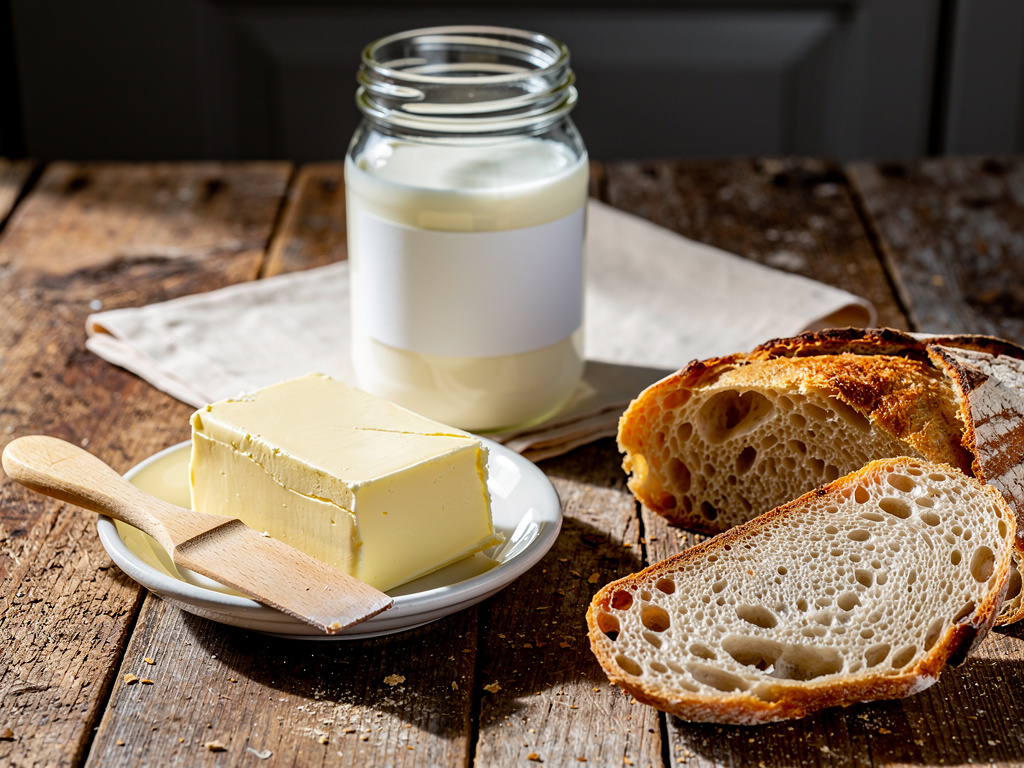


The short version: In most states you cannot sell homemade butter under the cottage food law, because butter is a dairy product and those laws leave dairy out, as Maryland, Washington and Georgia do in writing and California does by leaving dairy off its approved list. The real exceptions are Utah and Wyoming, which let a home kitchen sell dairy straight to an informed customer inside the state. Texas looks like one but is not: its cottage food law, rewritten in 2025, does not exclude butter, but its dairy rule, 25 TAC 217.71, says every maker of dairy products in the state needs a milk plant permit. Pennsylvania created a raw milk butter permit for raw milk permit holders, in rules that took effect May 23, 2026. Apple butter, nut butters and cookies baked with butter are a different question, and many states allow them.
Checked September 23, 2026: the rules here come from the cottage food pages of the health or agriculture departments of California, Georgia, Maryland, Texas and Washington, Texas Health and Safety Code chapters 435 and 437 and the Texas dairy rules in 25 TAC chapter 217, Utah Code chapter 4-5a, the Wyoming Food Freedom Act, the Pennsylvania Department of Agriculture's dairy page and 7 Pa. Code chapter 59a, the Wisconsin agriculture department's butter page and Wisconsin statutes 97.17 to 97.20, and the federal rules at 21 USC 321a and 21 CFR 1240, all loaded that day. This guide covers nine states, not fifty, and dairy rules change by statute and by rule, so verify your own state's current rules with your state health or agriculture department before your first sale.
A quart of heavy cream, a stand mixer and a little patience, and you have a batch of butter that tastes better than anything at the store. Friends ask for it. Someone at church asks if they can buy a pound. Then the question shows up: can you sell homemade butter, or is that against the rules?
In most states the honest answer is no, not from your home kitchen. Butter is made from milk, and the cottage food laws in California, Georgia, Maryland and Washington draw their line right in front of milk and dairy products. But "no" is not the whole answer. Two food freedom states cover dairy, and one state just created a raw butter permit for raw milk dairies. Texas rewrote its cottage food law in 2025 and left butter off its list of excluded foods, but its dairy rules still require a state permit to make butter.
This guide covers the federal rules, what nine states say, the three legal routes that exist, and the butter products you can sell almost anywhere. If you are still deciding what to make, our guide to what foods you can sell under cottage food laws walks through the whole allowed list, state by state, so you can see what sits next to butter.
Usually not from your home kitchen, though two of the nine states checked for this guide give you a way. Utah and Wyoming have a home kitchen route because their food freedom laws cover it. Texas leaves butter off its list of excluded cottage foods, but its dairy rules require a milk plant permit for anyone who makes butter, and the cottage food law does not exempt home kitchens from them. Three states, Georgia, Maryland and Washington, keep dairy out of their cottage food rules in writing, and California leaves it off its approved list. The last two states, Pennsylvania and Wisconsin, send butter through dairy licensing: Pennsylvania with an added butter permit for dairies that already hold a raw milk permit, and Wisconsin by requiring all butter sold at retail to be graded.
Here is what you can usually sell from a home kitchen:
Here is what you usually cannot sell from a home kitchen:
The difference comes down to which "butter" you mean. A jar of apple butter has no dairy in it at all. A stick of cultured butter is dairy from start to finish, and the rules treat it that way.
Most cottage food laws only cover foods that stay safe at room temperature, and states put milk and dairy products on the other side of that line. Georgia's agriculture department lists "Milk and dairy products" as an example of a potentially hazardous food, and its FAQ says anyone making potentially hazardous food does not qualify as a cottage food operator. A potentially hazardous food, which some states call a TCS food (short for time and temperature control for safety), is one that needs refrigeration to keep bacteria from growing.
Three states spell the dairy line out in their own words:
Most cottage food laws are built around foods that are safe on a shelf at room temperature. States file butter with the rest of the dairy case, next to milk and cheese, so it lands outside. That is also why the same Maryland list rules out buttercream made with butter unless the recipe has been tested, which we come back to below.
Federal law does four things that matter to a home butter vendor: it defines what can be called butter, it names butter as a milk product, it bans raw milk products from crossing state lines, and it sets the times and temperatures for pasteurizing. It does not license small butter vendors. That job belongs to your state.
The federal pieces, in plain terms:
That third rule is one reason raw butter programs, like Pennsylvania's, stay inside the state. The first rule matters even in states where you are allowed to sell: if your label says butter, the product has to be butter under that definition. Cheese has a federal wrinkle of its own: the raw milk rule makes room for raw milk cheeses cured at least 60 days, and our guide to whether you can sell homemade cheese explains why that still does not open a home kitchen.
Nine states, and the answers fall into four groups: cottage food says no (California, Georgia, Maryland, Washington), cottage food leaves butter off but a dairy permit rule still applies (Texas), food freedom says yes (Utah, Wyoming), and dairy licensing is the road the pages checked describe (Pennsylvania, Wisconsin). The table below puts all nine side by side, with raw butter in its own column because the rules for it are different again.
Scroll sideways to see every column.
| State | Butter made from pasteurized cream in a home kitchen | Raw butter | Limits and details worth knowing |
|---|---|---|---|
| California | No. Not on the Approved Cottage Foods list, which has no dairy category | Not addressed on the pages checked | Class A cap $75,000 a year, Class B $150,000. Buttercream made with butter is on the approved list |
| Georgia | No. "Milk and dairy products" are potentially hazardous, and a vendor of those does not qualify | No. It is dairy too | No state limit on gross sales for cottage food. Fruit butters are not allowed either |
| Maryland | No. Butter is the first dairy product on the not-allowed list | No. It is dairy too | Cottage food revenue capped at $50,000 a year, in-state sales only |
| Pennsylvania | Not addressed on the pages checked | Yes, with a raw milk permit plus the added raw milk butter permit, from your own milk, sold in Pennsylvania only | Butter tested every 6 months, raw milk twice a month. New applicants follow the May 23, 2026 rules right away |
| Texas | Not on the cottage food law's excluded list, but the state dairy rules (25 TAC 217.71 and 217.91) require every maker of dairy products in Texas, butter included, to hold a permit issued after an inspection | No. "Raw milk and raw milk products" are excluded | Dairy product manufacturer permit: $800 for two years. No DSHS page says whether a cottage food operation is exempt from it |
| Utah | Yes, under the Home Consumption and Homemade Food Act, sold directly to an informed final consumer in Utah | No. The act does not apply to "raw dairy or raw dairy products" | Label with name and address, a no-inspection statement and allergens. A local business license still applies |
| Washington | No. "Milk and dairy products" are not allowable cottage foods | No. "Raw butter sales are not allowed in the state of Washington." | Cottage food permit application fee $355 |
| Wisconsin | No home kitchen route on the pages checked. A dairy plant needs a state license | Not addressed on the pages checked | All butter sold at retail must be graded, with the grade printed in 12-point type or larger |
| Wyoming | Yes, under the Wyoming Food Freedom Act, sold to an informed end consumer inside Wyoming | The act has no raw dairy carve-out, but federal law bars raw butter across state lines | Capped at 250,000 products and $250,000 in gross revenue a year |
Every row was read on September 23, 2026, on each state's own pages: the California Department of Public Health's cottage food page and Approved Cottage Foods list (last reviewed April 2026), the Georgia Department of Agriculture cottage food FAQ, the Maryland Department of Health's Guidelines for Cottage Food Businesses (last updated November 2025), the Pennsylvania Department of Agriculture's dairy page and 7 Pa. Code chapter 59a subchapter F, the Texas Department of State Health Services cottage food page and the Texas dairy rules at 25 TAC 217.1, 217.71 and 217.91, Utah Code chapter 4-5a, the Washington State Department of Agriculture cottage food page, the Wisconsin agriculture department's butter page and Wisconsin statutes 97.17, 97.176 and 97.20, and the Wyoming Food Freedom Act at W.S. 11-49-101 to 104. "Not addressed on the pages checked" means those pages did not say, not that no rule exists. These nine are examples. Check what your own state requires right now before you sell.
If your state is not in that table, start with the cottage food page for your state and look for the words "dairy," "milk" or "butter" in the list of foods that are not allowed. Our guide to cottage food laws by state links to the rule for every state, and the butter answer is usually one line in the not-allowed list.
Not as the rules are written today. The cottage food law, Health and Safety Code 437.001 as rewritten by SB 541 in 2025, leaves room for butter, but the state's dairy rules do not. Since September 1, 2025, the Texas cottage food rules allow "any foods, except for the following": meat and poultry, seafood, ice and ice products including ice cream and gelato, low-acid canned goods, products with CBD or THC, and "raw milk and raw milk products." Butter made from pasteurized cream is not on that list.
The dairy rules are a separate set, 25 TAC chapter 217, written by the state health department (DSHS) under Health and Safety Code chapter 435. Rule 217.1 defines a "dairy product" as "Butter, cheese, dry cream" and a list of other milk products, with butter first. Rule 217.71 says: "Every manufacturer of dairy products located in the State of Texas, shall obtain a milk plant permit." Rule 217.91 sets that permit at $800 for two years, and the department inspects before it issues one. The cottage food law says a home kitchen is not a food service establishment, and it stops cities and counties from requiring a permit. It does not mention chapter 435 or the dairy rules. So as the rules are written, making butter to sell in Texas takes a dairy permit, even in a home kitchen.
The Texas Department of State Health Services (DSHS) page, loaded September 23, 2026, says a cottage food operation may sell foods that need time and temperature control, and that those foods must be held at 41°F or below. An operation that sells them must register with the state health department, put the date the food was made on the label, and include this statement in at least 12-point font: "SAFE HANDLING INSTRUCTIONS: To prevent illness from bacteria, keep this food refrigerated or frozen until the food is prepared for consumption." The cap is $150,000 in gross income a year, a figure the law has the department adjust each year for inflation; the DSHS page still showed $150,000 on September 23, 2026. Foods that need cold holding cannot be sold wholesale or donated.
What a Texas butter vendor would need under the cottage food page, if DSHS confirms in writing that butter can be sold as a cottage food:
The Texas cottage food page does not mention butter by name. No DSHS page says whether a home kitchen that makes butter is exempt from the dairy permit in 25 TAC 217.71. DSHS's own cottage food rule, 25 TAC 229.661, was last changed in 2022 and has not caught up with SB 541, and the department says it will adopt new rules. Before your first sale, email the state health department's cottage food program, ask "Can I sell butter made from pasteurized cream as a cottage food without a dairy permit under 25 TAC 217.71?", and keep the answer with the date.
Utah and Wyoming both let a home kitchen sell dairy directly to a customer who has been told the food is not inspected, as long as the sale stays inside the state. These are food freedom laws, which go further than cottage food laws: instead of a list of allowed foods, they allow almost anything and list a few exceptions. Our list of food freedom states covers the rest of them.
What each of the two actually says:
The difference that matters for butter: Utah's act excludes raw dairy in so many words, and Wyoming's does not. Wyoming's act says dairy may be sold "to the maximum extent permitted by federal law," and the federal raw milk product rule applies to interstate sales. If you plan to sell raw butter in Wyoming, ask the Wyoming Department of Agriculture first.
Among the nine states covered here, Pennsylvania is the only one whose pages name a raw butter permit, and raw butter has been legal to sell there with two permits since May 23, 2026. Federal law makes it illegal to send raw butter across any state line. Other states may have their own raw dairy rules, so check yours. Raw butter is butter made from cream that was never pasteurized. Federal rule 21 CFR 1240.61 keeps it from crossing state lines at all, so any legal raw butter sale is an in-state sale under a state program. Washington's agriculture department says it plainly: "Raw butter sales are not allowed in the state of Washington."
Pennsylvania is the newest exception. The Pennsylvania Department of Agriculture's dairy page says "A person may not produce nor sell raw milk or raw milk butter for human consumption" without a current raw milk permit, and its final Milk Sanitation Regulations, published May 23, 2026, added a raw milk butter permit. What 7 Pa. Code 59a.402, 59a.408 and 59a.409 require:
The permit holder arranges and pays for all of that testing. This is a route for a licensed dairy with a raw milk permit, not for a family cow and a kitchen churn. If you already hold that permit, butter competes with fluid milk and cream for the same milk, and our raw milk and raw cream prices from small farms show a pint of raw cream selling for $6 to $7.50 on its own. Our guide to where raw milk is legal covers the raw milk permit that comes first. That guide's dairy section covers butter made in a licensed dairy plant; the home kitchen routes in Utah and Wyoming, and the Texas dairy permit question, are covered in the sections above.
In the states where cottage food and food freedom do not cover butter, the legal road usually runs through a licensed dairy plant. Wisconsin's statute is a clear example: "no person, including this state, may operate a dairy plant without a valid license," and the license expires every April 30. A plant license covers a place, so the butter gets made in a licensed plant, not in your home kitchen. Wisconsin does exempt a licensed retail food establishment that makes dairy products only for sale at that same establishment, under statute 97.20(2)(e)3, but butter sold there at retail still has to be graded under statute 97.176.
If you are serious about it, here is the order that avoids wasted money:
Wisconsin is the only state in this guide that grades butter by law. The state agriculture department's butter page says "Butter cannot be sold in Wisconsin unless it has been graded according to Wisconsin or USDA standards," and Wisconsin statute 97.176 makes it unlawful to sell butter at retail unless it has been graded.
Butter is graded on a score: Wisconsin Grade AA at 93, Grade A at 92, Grade B at 91 to 90, and Undergrade below that, under statute 97.176. The Wisconsin butter grading page, loaded September 23, 2026, links the state's labeling guidance, which says the grade statement, such as "Wisconsin Grade AA," must be printed no smaller than 12-point type on a strongly contrasting background. Butter that already carries a U.S. Grade AA, A or B needs no other grade label.
Three pieces of Wisconsin law land on a small butter vendor:
Even a licensed dairy's butter has to be graded before it can be sold at retail there.
Only where plain butter is allowed, because a flavored butter is still butter. Honey butter, cinnamon butter and garlic and herb butter start as dairy butter with something stirred in, so the dairy rule in your state decides them. In Maryland, Washington, Georgia and California they are out for the same reason plain butter is. In Utah and Wyoming they fall under the same food freedom rules, and in Texas the same dairy permit rule applies.
What changes when you add a flavor:
Where plain butter is out, the legal version of this product is a flavored spread without dairy, or a baked good that uses the butter as an ingredient. A honey butter croissant is a baked good. A tub of honey butter is a dairy product. Biscuit bakers walk the same line, since a biscuit baked with butter is a cottage food, and the homemade biscuit rules show which fillings and spreads push it off the list in 9 states.
Yes for baked goods in every cottage food state checked here, and it depends on the state for frosting. Butter that is baked into a cookie, a loaf or a pie crust ends up in a shelf-stable food, and Maryland's own sample cottage food label lists "butter (milk, salt)" in a chocolate chip cookie. Frosting is different, because the butter is not baked.
How 3 states handle buttercream:
Washington's 3 to 1 rule counts every perishable ingredient together, by weight. A batch with 100 grams of butter needs at least 300 grams of powdered sugar. Add 20 grams of milk and the perishables come to 120 grams, so the sugar has to reach 360 grams. Weigh it on a kitchen scale once, write the recipe down in grams, and use that sheet every time.
For a home baker in a state that says no to butter, this is the legal way to sell what good butter is for. The stand mixer and the good butter go into cookies, pound cake and croissants, and those sell legally in every cottage food state checked here.
No, because apple butter and peanut butter contain no dairy, so the dairy rules do not apply to them, but each state has its own separate rule for fruit butters and nut butters. The answers swing more than most people expect. Georgia says "No" to apple butter while Washington says yes, and California allows nut butters while Maryland does not.
Scroll sideways to see every column.
| State | Dairy butter | Fruit butter (apple butter) | Nut butter (peanut, almond) |
|---|---|---|---|
| California | Not on the approved list | Yes, if it complies with 21 CFR Part 150, and only the fruits that rule lists | Yes, from roasted or pasteurized nuts only |
| Georgia | No, dairy is potentially hazardous | No. The FAQ says fruit butters have too little sugar and pectin to be safe | Not addressed in the FAQ |
| Maryland | No, butter is named | Only from apple, apricot, grape, peach, plum, prune and quince | No. Homemade nut butters are on the not-allowed list |
| Washington | No, dairy is not allowable | Yes, if it meets FDA's standard for fruit butters in 21 CFR Part 150 | Not addressed on the cottage food page |
We checked these on each state's own page on September 23, 2026: California's approved list, Georgia's cottage food FAQ, Maryland's guidelines and FAQ (both last updated November 2025), and WSDA's cottage food page. Maryland's FAQ and the body of its guidelines limit fruit butters to the seven fruits in the table, while the allowable foods list in the guidelines' appendix names more, so ask the department before you make any other fruit butter. Pumpkin butter is out in Maryland, whose FAQ says pumpkin has lower acidity, and Washington lists vegetable butters as not allowable. Check your own state's list before you sell any of the three.
In a pull of the Homegrown catalog on August 14, 2026, 62 of the 1,804 products listed by 219 vendors had "butter" in the name. Only 4 were dairy butter, all from one butter company. The rest were other kinds of butter or other foods: 18 peanut butter or cookie butter treats, 12 baked goods made with butter, 9 fruit butters from 7 vendors, 7 dog treats, 3 shea butter soaps and body butters, 6 with "butter" only in a name like Butterfinger or butterscotch, and 3 we could not place.
Homegrown products with "butter" in the name, by type
Source: Homegrown catalog pull, August 14, 2026, 1,804 products, sorted by hand. 3 products that did not fit a type are not shown.
That split shows where most butter-named products on Homegrown actually sit. For every dairy butter listing in that pull there were more than two fruit butters and exactly three baked goods made with butter. If you want to sell apple butter, our guide to selling fruit butter from home covers recipes and pricing, and the one on selling nut butter from home covers peanut and almond butter.
Once you know your butter, or your apple butter or brown butter cookies, can be sold where you live, the next problem is keeping track of who wants what. Butter is made in batches and kept cold, so it helps to know the count before you churn.
Homegrown is $10 per month billed annually, or $12.50 billed monthly, with no percentage fees beyond standard payment processing, and it gives your customers one link where they order, pay and pick a pickup time. You set how many half-pound tubs you have ready, and the count goes down as orders come in, so you churn to the number that sold instead of guessing. Local Line is built for farms and starts at $109 a month on its Core plan billed monthly, or $87 a month billed annually. Venmo moves money for a small fee but keeps no order list, and Square Online's Free plan charges more per online card payment. Homegrown does not check whether your product is legal in your state, register you with anyone, or keep your butter cold. It handles the ordering and the payment, and your customers create a Homegrown account the first time they order. Your storefront is listed on the Homegrown marketplace, but plan on most orders coming from customers you send to your own link.
Scroll right for the full fee stack on each row.
| Platform | Subscription | Trial | Platform fee | Card processing | Customer pays on an $8 half pound | Vendor pays on one $8 order | Customer pays on a $20 order | Vendor pays on one $20 order | Vendor pays on 50 orders ($400) |
|---|---|---|---|---|---|---|---|---|---|
| Homegrown | $10/mo billed annually, or $12.50/mo billed monthly | 7 days, no charge until day 8 | $0, 0% commission | 2.9% + $0.30 | $8.00 | $0.53 | $20.00 | $0.88 | $36.60 billed annually ($39.10 billed monthly) |
| Local Line (Core) | $87/mo billed annually ($1,044/yr), or $109/mo billed monthly | 7 days, no credit card needed | $0, no commissions | 2.9% + $0.30 (ACH 1.0%) | $8.00 | $0.53 | $20.00 | $0.88 | $113.60 billed annually ($135.60 billed monthly) |
| Square Online (Free plan) | $0/mo | None on the Free plan | $0 | 3.3% + $0.30 online | $8.00 | $0.56 | $20.00 | $0.96 | $28.20 |
| Venmo (business profile) | $0/mo | None | $0 | 1.9% + $0.10 per payment received | $8.00 | $0.25 | $20.00 | $0.48 | $12.60, with no order page or order list |
We checked these on each company's pricing page on September 23, 2026: findhomegrown.com/signup, Local Line's supplier pricing page, Square's pricing page, and Venmo's fees page. The $8 half pound is an example price, not a published one, and the $20 order is a bigger basket, like a pound and a quarter at that price. Vendor cost per order is the card processing on $8 or $20, and the 50-order column adds one month of subscription where there is one: $10 billed annually or $12.50 billed monthly for Homegrown, and $87 billed annually or $109 billed monthly for Local Line. Venmo charges 2.29% + $0.09 instead on a business payment taken with Tap to Pay.
A text thread works for three regulars. Past ten, the time goes into counting pounds rather than making them. If you are selling legally and your list has outgrown your messages, you can set up an order page for your butter on Homegrown and send one link instead of twenty replies.
Most trouble comes from assuming the rule for one kind of butter covers another. The rule for apple butter says nothing about dairy butter, and the rule in Texas says nothing about Maryland.
The mistakes to avoid:
Settle three questions first: which butter you are selling, whether your state allows it from a home kitchen, and what goes on the label. Everything else follows from those answers. In Texas, add one more: a written answer from DSHS on whether you need the dairy product manufacturer permit under 25 TAC 217.71.
If your state allows it and you have done those six steps, you are ready. The next question is where to sell it, and our guide to where to sell butter walks through seven places, from a Saturday pickup window to a $38 gift set, with what each costs you on an $8 half pound. If your state does not, the fruit butters and butter-rich baked goods above are the fastest legal way to put your butter-making skills in front of paying customers. If your state does allow home dairy, ghee is a natural next jar to price, and our ghee pricing guide shows a half-pint costing $6.97 in Kerrygold butter, jar and label, against $19 to $20 for small-batch jars.
Only in a state that allows homemade butter at all, and only under that state's rules for the market. In Utah the Homemade Food Act names farmers markets among its direct-to-sale locations, and Wyoming's Food Freedom Act lists farmers markets as a place sales may happen. In states like Maryland, Washington, Georgia and California, homemade dairy butter is not an allowed cottage food, so a farmers market does not change the answer.
Selling raw butter across state lines is illegal everywhere under 21 CFR 1240.61, the federal raw milk product rule. Inside a state it depends on state law: Washington says raw butter sales are not allowed, Utah's food freedom act leaves out raw dairy, and Pennsylvania allows it only with a raw milk permit plus the butter permit it added on May 23, 2026. Check your state's dairy program before selling any raw product.
Not without a dairy permit, as the rules are written. The Texas cottage food law, in effect since September 1, 2025, excludes raw milk products but not butter. But the Texas dairy rules, 25 TAC 217.71 and 217.91, require every maker of dairy products in the state to hold a permit issued after an inspection, and butter is the first dairy product the rules name. The cottage food law does not exempt home kitchens from those rules. No DSHS page answers the question directly, so get a written answer from DSHS before your first sale.
Not from a home kitchen under any rule checked for this guide. Wisconsin requires a license to operate a dairy plant and requires butter to be graded before it is sold at retail, with a grade like "Wisconsin Grade AA" printed in 12-point type or larger. The person in charge of making butter in a butter factory also needs a buttermaker license, which costs $75 under the department's rule ATCP 69.01.
Buttercream made with butter is not baked, so the butter in it stays a perishable dairy ingredient unless enough sugar holds bacteria back. Maryland does not allow butter-based buttercream without lab results for pH or water activity, Washington allows frosting at 3 parts sugar to 1 part perishable ingredients by weight, and California lists buttercream made with butter as an approved cottage food.
Body butter and shea butter lotion are cosmetics, not food, so cottage food laws do not cover them at all. The rules for them come from cosmetics law instead, which is a separate question from anything in this guide. In the August 14, 2026 Homegrown catalog pull, 3 of the 62 products with "butter" in the name were shea butter soaps and body butters.
These six guides answer the questions that usually come right after "can you sell homemade butter." Each one is a live Homegrown article, and each picks up a thread this guide only touched: the full cottage food lists, raw milk, food freedom, and the two non-dairy butters that most states let you sell from a home kitchen.
Whether you are selling permitted Texas butter, a Utah or Wyoming food freedom batch, or the apple butter and brown butter cookies that sell legally in most states, the work after the paperwork is the same: knowing how much to make and who is picking it up. Butter does not wait around the way a jar of jam does, so taking orders before you churn or bake keeps you from making 10 pounds for a week that only needed 6.
A Homegrown storefront gives your customers one link to order, pay and choose a pickup time, and it shows you the week's count as orders come in. It costs $10 a month billed annually, or $12.50 billed monthly, with card processing of 2.9% + $0.30 and no commission on top. It will not tell you whether your state allows your product, so settle that first with the steps above. When you are ready, start your Homegrown storefront, list what you are allowed to sell, and send your customers one link.



