
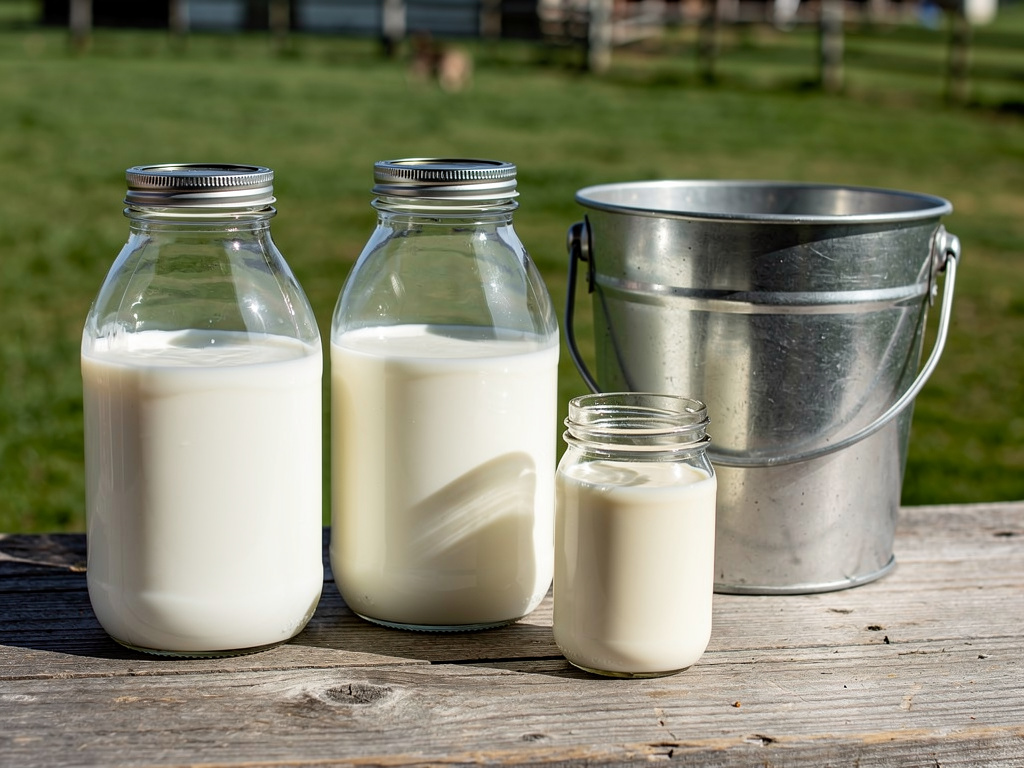


The short version: Raw cow milk sold straight from the farm goes for about $12 a gallon, the middle price across 11 farm price pages in 7 states we checked, with a range of $5 to $18. Raw goat milk runs higher, $15 to $30 a gallon with a middle price of $20 across 6 farms (two of the six goat prices come from a 2025 price list and a contract page dated 2023), because a goat gives a fraction of what a cow does. Price the milk and the glass jar separately, with a $2 to $5 jar deposit on top, and charge more per gallon for quarts than for half gallons. Your state decides whether you can sell at all, where, how much, and in what container, and those limits shape your price.
Checked on September 24, 2026: farm prices come from each farm's own price page that day, the $4.23 store gallon from the Bureau of Labor Statistics average for August 2026, state rules from the Minnesota statute and the Vermont Agency of Agriculture, and platform fees from each company's pricing page. We left out farms that sell milk labeled as pet food. Homegrown customers create an account to place their first order.
Your cow is giving four gallons a day, the family drinks one, and the neighbors keep asking if they can buy the rest. Or your goats just had their kids and the fridge is full of milk jars. The question is the same either way: what do you charge?
Most answers online are one farmer's guess on a forum. So we did the boring part. On September 24, 2026 we loaded the price pages of 17 small farms that publish what they charge for raw milk, turned every price into a price per gallon, and pulled the jar deposit out so you can compare milk to milk. This guide gives you those numbers, what moves them up or down, and how to set your own price. It does not settle whether selling raw milk is legal where you live. Our state by state guide to selling raw milk legally covers that, and you should read it first if you have not.
Raw cow milk sells for $5 to $18 a gallon at the farm, and the middle price across the 11 farm price pages we checked was $12.00 a gallon. That is nearly three times the $4.23 a shopper paid for a gallon of whole milk at the store in August 2026, according to the Bureau of Labor Statistics average price series for fresh whole milk. Eight of the 11 farms sat between $11 and $16 a gallon.
The low end is a farm where the customer brings their own jug and the farm does no bottling at all. The high end is glass bottles, pre-bottled and waiting in a farm store, in the Northeast. Here is every cow milk price we loaded, converted to a gallon.
Scroll sideways to see the container and per gallon columns.
| Farm | State | What the page lists | Container | Per gallon, milk only |
|---|---|---|---|---|
| Little Elk Organic Farm | MN | $5 per gallon, all cows tested A2A2 | Customer brings their own | $5.00 |
| Earthwise Farm & Forest | VT | $5.50 per half gallon | Mason jar, swap or pay $5 | $11.00 |
| Tussock Sedge Farm | PA | $11.99 per gallon, 4 gallons for $43.96, online store reselling a partner farm's milk | Plastic gallon | $11.99 |
| Smith's Country Cheese | MA | $6.00 per half gallon | Glass, $1.50 buyback | $12.00 |
| Rebop Farm | VT | $6 per half gallon, $4 per quart | Glass, $3 deposit | $12.00 |
| Berle Farm | NY | $10 half gallon, of which $4 is the jar | Glass, $4 deposit | $12.00 |
| Classen Land + Cattle | NE | From $6.00 per half gallon | Glass, $5 for a new jar | $12.00 |
| Honeymilk Homestead | MN | $7.50 per half gallon | Customer brings their own | $15.00 |
| Baldwin Brook Farm | CT | $8 per half gallon in plastic (another answer on the same page says $7) | Plastic, or glass with $3 deposit | $16.00 |
| The Old Road Farm | PA | $36 a month for a half gallon a week | Customer's own glass | $16.62 |
| Old Ford Farm | NY | $9.00 per half gallon, $8 if pre-ordered | Glass, $5 deposit | $18.00 |
We loaded each farm's own raw milk prices on September 24, 2026. Per gallon is the listed milk price doubled for a half gallon, with the jar deposit taken out. The Old Road Farm's $36 a month covers 52 weekly half gallons a year spread over 12 bills, which works out to $16.62 a gallon.
Raw cow milk, price per gallon at the farm
Source: each farm's own raw milk price page, loaded September 24, 2026, 11 farms; the four farms at $12.00 share one bar. Jar deposits not included.
What the price table tells you, in plain terms:
Raw goat milk sold for between $15 and $30 per gallon across the 6 farms selling goat milk we checked, with a middle price of $20, which is $8 more than the middle cow price. The reason is volume. Whey Cool Ranch near Dallas says on its price page that a goat usually gives around one gallon a day, against several gallons from a dairy cow, so every gallon carries more feed, fencing and milking time. Four of the six sell through a herdshare, where the customer owns part of the herd and pays a boarding fee instead of buying milk; the herdshare section below explains how that is priced.
Swipe the table to see how each goat dairy sells its milk.
| Farm | State | How they sell it | What the page lists | Per gallon |
|---|---|---|---|---|
| Thistlemoor Dairy Farm | IN | Herdshare | $7.50 per half gallon plus $30 one-time share, or $15 a gallon plus $50 one-time share | $15.00 |
| Carpenter Creek Ranch | OR | Herdshare | $80 a month for a gallon a week, plus $60 refundable buy-in | $18.46 |
| Whey Cool Ranch | TX | Herdshare, billed weekly | $10 per half gallon, $20 per gallon | $20.00 |
| Shalom Farms | NE | Direct sale | $10 per half gallon, 20% off weekly recurring (2025 price list; milks April or May to October) | $20.00 |
| Tussock Sedge Farm | PA | Online store reselling a partner farm's milk, farm pickup | $24.90 per gallon, $13.95 per half gallon | $24.90 |
| Growing Gardens Goat Dairy | CO | Herdshare | $15 a week for a half gallon, $9 a week for a quart (contract page dated February 2023) | $30.00 |
Loaded from each farm's page on September 24, 2026. Carpenter Creek Ranch counts its $80 as $20 a gallon on a four-week month; spread over a full year of weekly pickups it is $18.46. Growing Gardens' quart share works out to $36 a gallon.
If you keep goats, three things push you toward the top of that range:
For the rest of what a goat herd can turn into, including soap at $6 to $12 a bar, see our guide to selling goat milk products locally.
Charge more per gallon for smaller sizes, because a quart takes nearly the same bottling work as a half gallon. Rebop Farm in Vermont sells a quart for $4 and a half gallon for $6, which is $16 a gallon against $12. Berle Farm in New York does the same thing: $4 of milk in a glass quart and $6 in a glass half gallon.
Here is how the farms we checked step their sizes:
A simple rule works for most small farms: set your half gallon price first, charge about two thirds of it for a quart, and give a 5% to 10% break on a full gallon or a case. That keeps the busy work priced in and still rewards the customer who buys in bulk.
Charge a jar deposit of $2 to $5 per bottle, separate from the milk, and refund or waive it when a clean jar comes back. Seven of the 8 farms in our deposit table charged for the jar, from $2 at the low end to $5 at the high end, and the eighth, Smith's Country Cheese, charges nothing up front and buys clean bottles back for $1.50 instead.
Drag sideways to see how each deposit comes back.
| Farm | Deposit | How it comes back |
|---|---|---|
| Tussock Sedge Farm, PA | $2 per half gallon glass | Refundable, included in the $10.99 glass half gallon |
| Rebop Farm, VT | $3 per jar | Added on top of the milk price |
| Baldwin Brook Farm, CT | $3 per half gallon glass | $3 cash back at the farm stand or any store that carries the milk |
| Berle Farm, NY | $4 per jug | $4 credit on card, store credit or cash |
| Classen Land + Cattle, NE | $5 per half gallon jar | Waived when you swap a clean jar |
| Old Ford Farm, NY | $5 per jar | Deduct $5 for every extra clean jar returned |
| Smith's Country Cheese, MA | None charged up front | Buys back clean bottles for $1.50 |
| Earthwise Farm & Forest, VT | $5 per half gallon mason jar and lid | Charged only when you do not bring a clean jar to swap |
Each farm's own page, loaded September 24, 2026.
Pick a deposit close to what a replacement jar and lid really cost you, and put it on its own line so the milk price stays easy to compare. A customer who sees "$10 a half gallon" will shop you against a farm charging $6, even though $4 of your price is glass they get back.
Make the jar swap the default and the new jar the add-on. Old Ford Farm charges $9.00 for a half gallon plus a $5 bottle deposit, and nothing extra when a clean jar comes back. A customer who forgets the jar pays $14 that week instead of $9, which is a reminder nobody needs twice.
A herdshare cost the customer between $15 and $30 a gallon at the farms we checked, about the same range as buying goat milk outright, and at or above what most farms charge for cow milk sold outright ($5 to $18, with $12 the middle), plus a buy-in of $25 to $60, charged once at most farms and every year at Shalom Farms, and a required $50 to $150 yearly donation at Growing Gardens. A herdshare is an arrangement where the customer buys part ownership of your animals and pays you a monthly or weekly boarding fee to feed, house and milk them, so the milk is theirs rather than sold. Whether a herdshare is allowed depends on your state. Thistlemoor Dairy Farm runs one in Indiana, where its page says state law makes it illegal to sell raw goat milk for people. Wisconsin goes the other way: its agriculture department says owning a cow share or herd share does not count as owning the farm, so a share does not get around its rules. Ask your state's agriculture department whether it accepts herdshares before you take a buy-in.
Swipe to see the ongoing fee and the per gallon math.
| Farm | Animal | One-time fee | Ongoing fee | Per gallon |
|---|---|---|---|---|
| Thistlemoor Dairy Farm, IN | Goat | $50 full share, $30 half | $15 per gallon, $7.50 per half gallon | $15.00 |
| Our Family Farms, TX | Cow | $35 per share | From $8 a week for a half gallon, from $15 for a gallon (listed as 2025 shares) | $15.00 to $16.00 |
| Carpenter Creek Ranch, OR | Goat | $60 refundable, plus $5 per jar | $80 a month for a gallon a week | $18.46 |
| Shalom Farms, NE | Goat | $25 a year | $45 a month per share (2026); the 2025 dues included 2 half gallon jars | Not stated per gallon |
| Growing Gardens Goat Dairy, CO | Goat | $40 membership, plus a required yearly donation of $50 to $150 | $15 a week for a half gallon | $30.00, before the donation |
Each farm's own page, loaded September 24, 2026. Our Family Farms lists $9.50 and $18 for customers who pay as they go instead of joining. Growing Gardens' contract page cites Colorado law, CRS 25-5.5-117, and carries a February 2023 date.
Before you set herdshare fees, run these numbers:
Your state's raw milk law does not set a price, but it decides where you can sell, whether you can bottle, and how much you can sell each week, and those limits shape what you can charge. Federal rules already ban shipping raw milk for people across state lines (21 CFR 1240.61, from the FDA), so every price in this guide is a local, in-state price.
Two states show how much the rules move the number.
State law, Minnesota Statutes 32D.20, requires milk sold for drinking to be pasteurized unless it is "occasionally secured or purchased for personal use by a consumer at the place or farm where the milk is produced." The Minnesota Department of Agriculture adds that farmers may not bottle raw milk for sale, so customers bring their own container, and any sale off the farm breaks the law. That is why both Minnesota farms we checked ask customers to bring jars, and why Little Elk's $5 gallon has no bottle cost in it.
You can read the whole section in the Minnesota raw milk statute, 32D.20, which is short and plain.
The Vermont Agency of Agriculture draws its line at 350 quarts a week, which is 87.5 gallons. A farm that sells more than that, or delivers, must register, and its milk must be tested twice a month. Every raw milk farm still needs the required animal health tests and a sign where the milk is sold. The upper limit for those registered farms was raised to 1,400 quarts a week, and since 2014 they may deliver to customers at a farmers market.
The Vermont Agency of Agriculture's raw milk page lays out both tiers, the testing and the sign you must post where you sell. What those two states mean for your price:
Some states that allow raw milk also limit where the sale can happen. Minnesota, for one, allows raw milk sales only at the farm where the milk is produced (Minnesota Statutes 32D.20, linked above), and its Department of Agriculture says any sale off the farm breaks the law. Those rules change. Before you post a price online or take payment before pickup, check your state agriculture department's current rules. We also left out two farms that sell raw milk labeled "pet food": that is a different legal category, and its prices do not tell you what milk for people sells for.
Your cost per gallon is your monthly spend on the milking animals divided by the gallons you sell that month, and it is the floor your price should never go under. The trick is counting everything, not just feed. Use this list:
Here is an example with made-up round numbers, just to show the math. Say one family cow costs $300 a month in feed and care, you spend $40 a month on lids, labels and lost jars, and you sell 40 gallons a month after the family takes its share. That is $340 divided by 40 gallons, or $8.50 a gallon before your time. At $12 a gallon you clear $3.50 a gallon, or $140 a month, before you pay yourself anything for milking twice a day. Plug in your own numbers; the point is that a low price disappears fast once time counts.
At the middle prices in this guide, one family cow selling 10 gallons a week brings in about $520 a month, and raising the price $1 per half gallon adds about $87 a month. The table below uses the $12 cow and $20 goat middle prices and example weekly volumes.
Scroll sideways for monthly sales and the effect of a $1 raise.
| Example farm | Gallons sold a week | Price per gallon | Weekly sales | Monthly sales | Extra per month at +$1 per half gallon |
|---|---|---|---|---|---|
| One family cow | 10 | $12 | $120 | $520 | $86.67 |
| Five goats, in milk | 6 | $20 | $120 | $520 | $52.00 |
| Small herd, 4 to 6 cows | 40 | $12 | $480 | $2,080 | $346.67 |
Monthly sales are weekly sales times 52 weeks divided by 12 months. Volumes are examples, not measured farm output. The 40 gallon herd sells 160 quarts a week, under Vermont's 350 quart line.
Three things jump out of that table:
Yes, a small discount of 5% to 20% for pre-orders and weekly subscriptions pays for itself, because it tells you exactly how much to bottle and cuts spoiled milk. Most farms we checked that offered a discount tied it to buying more or ordering ahead:
Pre-orders matter for raw milk because it keeps for days or a couple of weeks, not months. On the farm pages we read, shelf life ran from 5 days after bottling at Smith's Country Cheese to a week and a half at Old Ford Farm and up to two weeks at Carpenter Creek Ranch. Berle Farm asks customers coming a long way, or buying a full case, to pre-order, because on busy days the farm store sells out. A $1 discount for ordering ahead costs you less than one dumped half gallon.
No, $12 a gallon is not too much, because raw milk customers compare you to the next raw milk farm rather than the $4.23 store gallon, and every farm we checked charged more than the store. The middle cow price of $12 is about 2.8 times the store price.
What your customers are paying for, as these farms describe it on their own pages:
If a customer pushes back on price, explain it in gallons, not half gallons. "$6 a half gallon" sounds high next to the store. "$12 a gallon, the same as most farms around here" sounds fair. For more on holding your price when a regular asks, our guide on raising prices with regular customers has scripts you can use.
Raw cream sold for $6 to $10 a pint at the farms that listed it, which is about $12 to $20 a quart, or four to nearly seven times the $3 a quart that $12-a-gallon milk works out to. Cream takes a separator or slow hand skimming, and it comes out of milk you could have sold, so it should cost far more than milk. Check your state's rules before you list it: some states that allow raw milk do not allow raw cream, and Baldwin Brook Farm's FAQ says Connecticut law stops it from selling bottles of cream.
What the farm pages listed on September 24, 2026:
Start near what the closest farms charge per pint, and raise it if you sell out every week. Cream is usually the first thing to run short, which is why two of the three farms above list it as available only some weeks. Butter from that cream is a separate product with its own rules in most states; our guide to whether you can sell homemade butter walks through them.
Taking milk orders online costs between $48 and $163 a month at 50 orders of $20 on the platforms small farms use, before any set-up fee. Card processing is the same 2.9% plus 30 cents almost everywhere; what changes is the monthly plan. Here is the full stack for each, taken from each company's own pricing page that same day.
Drag the table sideways to see every fee, down to a month of 50 orders.
| Platform | Monthly plan | Trial | Platform fee | Card processing | Customer pays on a $20 order | Farm pays on a $20 order | Farm pays in a month of 50 orders at $20 |
|---|---|---|---|---|---|---|---|
| Homegrown | $10 billed annually ($12.50 billed monthly) | 7 days, no charge until day 8 | None, 0% commission | 2.9% + $0.30, paid by the farm | $20.00 | $0.88 plus the plan | $54.00 ($56.50 on monthly billing) |
| Square Online, Free plan | $0 (Plus is $49 per location) | No plan to trial; Plus has 30 days | None | 3.3% + 30¢ online on the Free plan | $20.00 | $0.96 | $48.00 |
| Local Line, Core | $87 billed annually ($109 billed monthly) | 7 days | None, "no commissions" | 2.9% + $0.30 | $20.00 | $0.88 plus the plan | $131.00 ($153.00 on monthly billing) |
| GrazeCart, Starter | $89 a month (billing term not stated) | None listed | None listed | Not listed on the pricing page | $20.00 | Card fee rate not listed | $89.00 plus card fees at a rate not listed |
| Barn2Door, Entrepreneur | $99 billed yearly ($119 monthly), plus a $399 one-time set-up fee | None listed | None listed | 2.9% + $0.30 | $20.00 | $0.88 plus the plan | $143.00 ($163.00 monthly), plus $399 once |
Every price comes from each company's own pricing page, loaded September 24, 2026. None of the pricing pages list a fee charged to the shopper. Card processing is figured on the $20 price; sales tax, delivery fees and jar deposits are extra where they apply.
Card fees hit small milk orders harder than you would expect, because of the flat 30 cents. On a $6 half gallon, 2.9% plus 30 cents is 47 cents, or 7.9% of the sale. On a $36 monthly subscription it is $1.34, or 3.7%. Four weekly $9 charges instead of one monthly $36 bill cost you $2.24 in card fees, or 6.2%, so billing monthly is worth about $0.90 per customer per month.
Once your price is set, the hard part is knowing how many jars to fill before pickup day, and that is the job Homegrown does for $10 a month billed annually ($12.50 month to month) with no percentage fees beyond standard payment processing. Customers pre-order and pay on your storefront, pick a pickup time, and you bottle exactly what was ordered.
What it has that fits raw milk pricing:
Compared with the farm platforms, Local Line's Core plan starts at $87 a month billed annually and adds wholesale price lists, and Barn2Door's entry plan is $99 a month billed yearly plus a $399 set-up fee, with built-in subscriptions. Both do more than a one-cow homestead needs, at about nine to ten times the monthly price. Square Online's Free plan costs less at 50 orders, $48 against $54, but it charges 3.3% plus 30 cents on every online order. Homegrown does list your storefront on its marketplace, though you should plan on most orders coming from people you send to your own link.
What Homegrown does not do: it does not check your license or your state's raw milk rules, it does not run herdshare contracts, it does not bill recurring subscriptions or apply discounts, and it has no drops or countdown release feature. Customers create a Homegrown account to place their first order. Card processing of 2.9% plus 30 cents is paid by you, with no option to pass it to the customer. If your state bars taking payment off the farm, take cash at pickup instead of listing milk online. If it allows pre-orders, you can set up your Homegrown storefront and have your milk and jar swap listed in about 15 minutes.
In a pull of the Homegrown catalog on September 24, 2026, 51 of the 2,704 products listed by 305 vendors were in eggs and dairy, from 28 vendors, and 2 were fluid milk. Green Grass & Sunshine lists raw goat milk bottled in glass jars at $3.00, size not stated. Harvest House Foods lists fresh A2/A2 Jersey milk at $6.00 when you bring a clean jar to swap and $11.00 with a new jar, and fresh cream at $6.00 with a swap or $8.00 with a jar.
One costly mistake is pricing off the store and landing near $5 a gallon, well under the $12 middle price, and then having no room to cover testing, jars or a dry spell. Here are the others to avoid:
Raise it once a year by about $1 per half gallon, which is 11% to 18% on a $5.50 to $9 half gallon, with at least 2 weeks' notice, and tie it to a real cost your customers can see. A $1 raise is small next to the drive to another farm, and regulars take it better when they hear it from you before they see it on the sign.
At 40 gallons a week, $1 more per half gallon is $346.67 a month. Homegrown takes the pre-orders and payment, but it does not run subscriptions or apply discounts, so the price hold and the pre-order discount in step 5 are yours to handle outside it. When you are ready to take those pre-orders in one place instead of a text thread, you can start your Homegrown storefront and list each size and the jar swap as its own option.
The 6 farms selling goat milk we checked on September 24, 2026 charge from $15 up to $30 per gallon for raw goat milk, and $20 a gallon, or $10 a half gallon, is the middle price among them. Two of the six prices come from older published lists, Shalom Farms' 2025 price list and Growing Gardens' contract page dated February 2023. The 6 prices show no clear pattern by container or breed: Thistlemoor, which bottles to order from its Nubian and Nigerian Dwarf herd, charges $15, and Shalom Farms, where customers bring their own jar or buy one ($5 for a mason jar, $2 for a plastic jug), charges $20 on its 2025 price list. Herdshare fees ran the full range, from $15 a gallon at Thistlemoor to $30 at Growing Gardens.
Raw cow milk sold at the farm for $5 to $18 a gallon across 11 farm price pages we loaded on September 24, 2026, with $12 as the middle price. Container alone does not set the price: bring-your-own-container farms ran from $5 to $16.62 a gallon, and four farms that bottle in glass sat right at the $12 middle. Jar deposits of $2 to $5 are on top.
A half gallon of raw cow milk usually costs $5.50 to $9 at the farm, with $6 the most common price we found, plus a jar deposit if it comes in glass. A half gallon of raw goat milk ran $7.50 to $15 across the 5 entries in our goat table that price a half gallon. Set the half gallon first, then price quarts higher per ounce, and price a gallon at two half gallons or a little under.
It depends on your state, and in some states selling raw milk for people is not legal at all. Thistlemoor Dairy Farm's page says Indiana law makes it illegal to sell its raw goat milk for human consumption, which is why it runs a herdshare. Minnesota, for example, only allows occasional sales at the farm into the customer's own container, while Vermont allows bottled sales and, for registered farms, farmers market delivery. Federal law, 21 CFR 1240.61 from the FDA, bans shipping raw milk for people across state lines. Verify your state's current rules with its agriculture department before you sell.
A fair herdshare boarding fee lands close to what the same milk would cost retail, $15 to $30 a gallon for goat milk (most near $15 to $20) and $15 to $16 for cow milk at the one cow herdshare we checked, Our Family Farms in Texas, plus a buy-in of $25 to $60, charged once at most farms and every year at Shalom Farms, and Growing Gardens adds a required $50 to $150 yearly donation. Put it in a written herdshare agreement and bill monthly to keep card fees down. Herdshares are not accepted in every state, Wisconsin among them, so confirm your state allows them before you sign up members.
Yes. Seven of the 8 glass-bottling farms in our deposit table charged $2 to $5 for the jar and returned or waived it when a clean jar came back, and the eighth, Smith's Country Cheese, buys clean bottles back for $1.50. A deposit near your real replacement cost keeps jars coming home and keeps your milk price easy to compare with other farms.
Pricing is one of the decisions you make before the first $12 gallon leaves the farm, after the legal check and before the jar deposit and pickup schedule. These guides cover the decisions around it:
Whatever you charge, write it as a price per gallon with the jar listed separately, and check it against 3 nearby farms once a year. A price that sat at $12 in 2026 may need to be $13 by the time hay goes up again.



