
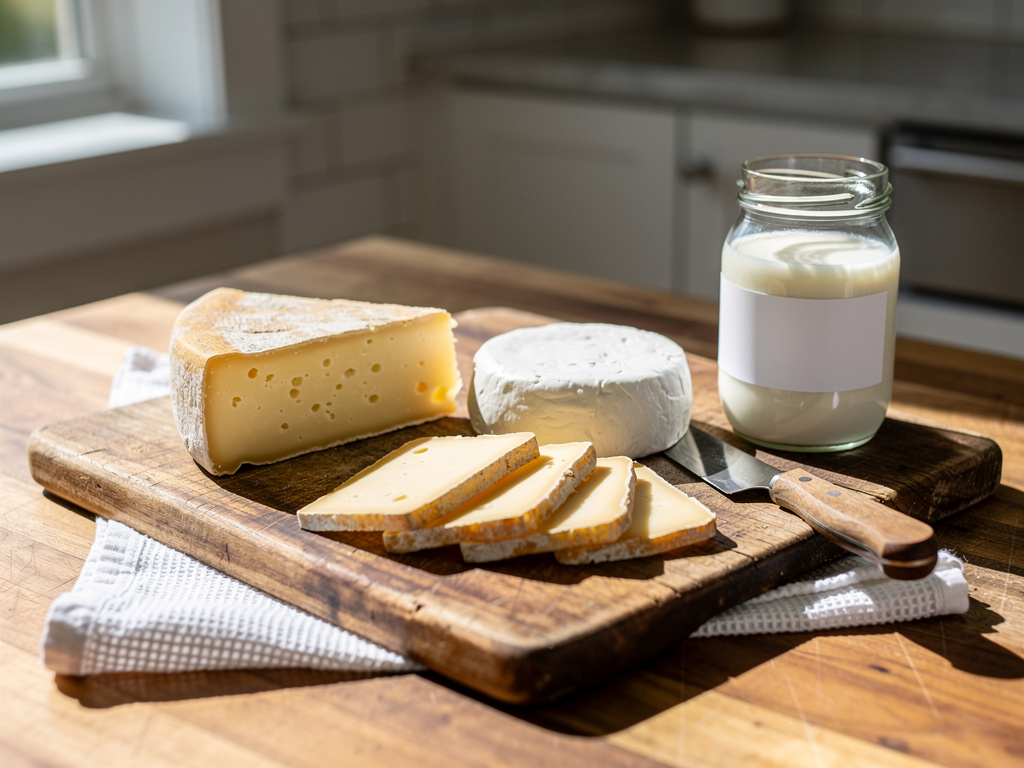


The short version: In most states you cannot sell cheese made in your home kitchen, because cheese is a dairy product and cottage food laws leave dairy out. Seven of the nine states checked for this guide give a home kitchen no route, counting Texas, where a dairy rule appears to apply. California, Colorado, Georgia, Minnesota and Washington keep dairy out of their cottage food rules. Wisconsin requires a licensed dairy plant and a licensed cheesemaker. Texas requires a milk plant permit of every dairy product manufacturer. The state has not said whether that reaches a home kitchen, so ask in writing. Utah and Wyoming are the exceptions: their food freedom laws let you sell homemade cheese straight to an informed customer inside the state, though Utah leaves out raw milk cheese. Verify your own state's current rules with its health or agriculture department before your first sale.
Checked September 23, 2026 on each state's own pages: the cottage food pages of California, Colorado, Georgia, Minnesota, Texas and Washington, the Texas dairy rules at 25 TAC 217 (read on the Cornell Legal Information Institute copy of the Texas code), Wisconsin statutes 97.17 and 97.20, Utah Code chapter 4-5a, the Wyoming Food Freedom Act, and the federal rules at 21 CFR 1240.61 and 21 CFR 133.113. Nine states are examples, not the whole country. Homegrown customers create an account to place a first order, Homegrown handles pickup and local delivery, not shipping, and there is no drop or countdown release feature.
Your goats are giving more milk than your family can drink, and the first batch of chèvre came out better than anything at the grocery store. A neighbor asks if she can buy a round. It feels like a jar of jam, but the law does not see it that way. Cheese is one of the hardest homemade foods to sell legally, and most of the confusion comes from mixing it up with foods that simply contain cheese.
This guide covers cheese as a product: a wedge, a wheel, a tub of ricotta, a bag of curds. It uses what nine state pages and two federal rules said on September 23, 2026. If your real question is about a dessert made with cream cheese, our guide to selling cheesecake from home covers that product, its refrigeration rules and its pricing. Cheese breads and other baked goods with cheese get their own section below.
Usually no: in seven of the nine states checked for this guide, with Texas counted on the strength of its dairy permit rule, cheese made in a home kitchen cannot be sold. Cheese is a dairy product, and dairy sits outside cottage food law almost everywhere. A cottage food law is the set of state rules that lets you make certain low-risk foods at home and sell them without a commercial kitchen. Cheese is not on the low-risk side.
Here is how the nine states split:
So 2 of the 9 states checked let a home kitchen sell cheese, and both limit the sale to customers inside the state. Yogurt splits the same way, and our step-by-step guide to selling homemade yogurt lists the label wording Utah and Wyoming require on a jar made at home.
Cottage food laws leave cheese out because it is a dairy food that can grow harmful bacteria, and state rules only cover foods that are safe without a refrigerator. The rules call these "potentially hazardous" or "time and temperature control for safety" foods, which means foods that need to be kept cold or hot to stay safe.
Minnesota's cottage food guidance says it directly: "meat and dairy products are considered potentially hazardous and cannot be sold as cottage foods." It then lists "cheese, yogurt, butter, ghee" among the products that "are not allowable cottage foods and require a license." Ghee gets that answer even though it barely contains any water, which is why selling homemade ghee works from a home kitchen in only two of the eight states we checked for it, Utah and Wyoming. Georgia's cottage food FAQ puts "Milk and dairy products" on its list of potentially hazardous foods. Minnesota lets a cottage food producer sell up to $78,000 a year, but no amount of sales opens that list to cheese.
A few reasons regulators treat cheese as higher risk than bread or jam:
None of that means home cheese is unsafe when you make it for your family. It means the states that wrote these laws drew the line before dairy. Yogurt sits on the same side of that line, which is why our guide to pricing homemade yogurt starts from a licensed dairy and puts a plain quart at $9 to $11.
For cottage food law, no: aged, fresh and raw milk cheese are all dairy, so they all fall outside it in the states that exclude dairy. Washington's list covers "hard, soft and cottage cheeses," which takes in almost every style. Where the type of cheese does matter is federal law and the food freedom states.
Scroll sideways to see every column.
| Type of cheese | Examples | Needs refrigeration? | Under cottage food rules | What changes it |
|---|---|---|---|---|
| Fresh, pasteurized milk | Ricotta, queso fresco, mozzarella, chèvre, paneer | Yes, the whole time | Out in CA, CO, GA, MN and WA; a dairy license blocks it in WI and a dairy permit rule appears to in TX | Food freedom in Utah and Wyoming |
| Aged, pasteurized milk | Cheddar, gouda, parmesan | Stored cold, but lower moisture | Out; Washington names hard cheeses | Food freedom in Utah and Wyoming |
| Raw milk, aged 60 days or more | Raw milk cheddar, alpine styles | Stored cold | Out; Washington's FAQ says no to aged raw milk cheese | Federal curing rule for licensed dairies; Utah's act excludes raw dairy |
| Raw milk, fresh | Fresh raw milk curds or chèvre | Yes | Out | Cannot cross state lines under 21 CFR 1240.61; Utah excludes it |
| Cheese as an ingredient | Cheese bread, cheese crackers, cheesecake | Depends on the food | Varies by state | See the section on baked goods below |
We read each rule on the state or federal page on September 23, 2026. "Out" means the state's cottage food page excludes dairy or leaves it off the approved list. Wisconsin blocks home cheese through dairy licenses instead, and a Texas dairy permit rule appears to do the same.
The takeaway: the question to ask your state is not "is aged cheese safer?" but "does any home kitchen law here cover dairy at all?" In seven of the nine states checked, the answer is no.
7 of the 9 states checked on September 23, 2026 give no home kitchen route for cheese, counting Texas as a probable no, and 2 states, Utah and Wyoming, allow it under food freedom laws. The table puts every state side by side, with raw milk cheese in its own column because it gets a different answer.
Swipe left for the other columns.
| State | Homemade cheese from pasteurized milk | Raw milk cheese | What the page says | Where the rule lives |
|---|---|---|---|---|
| California | No | No | 10 approved categories, none of them dairy | CDPH Approved Cottage Foods list, last reviewed April 2026 |
| Colorado | No | No | Eligible list has no dairy; foods that need refrigeration are ineligible | CDPHE Cottage Foods page |
| Georgia | No | No | "Milk and dairy products" are potentially hazardous and do not qualify | Georgia Department of Agriculture cottage food FAQ |
| Minnesota | No | No | "cheese, yogurt, butter, ghee" are "not allowable cottage foods and require a license" | Minnesota Department of Agriculture cottage food guidance |
| Texas | Not excluded by the cottage food list, but the dairy rules appear to require a milk plant permit; ask DSHS in writing | No, "raw milk and raw milk products" are excluded | 25 TAC 217.71: "Every manufacturer of dairy products located in the State of Texas, shall obtain a milk plant permit" | DSHS cottage food page and Texas dairy rules at 25 TAC 217 |
| Utah | Yes, sold directly to an informed final consumer in Utah | No, "raw dairy or raw dairy products" are left out | Home Consumption and Homemade Food Act | Utah Code 4-5a-104 and 4-5a-105 |
| Washington | No | No | "Milk and dairy products including hard, soft and cottage cheeses and yogurt" are not allowable | WSDA Cottage Food page |
| Wisconsin | Only from a licensed dairy plant with a licensed cheesemaker | Same | Wis. Stat. 97.20 dairy plant license, 97.17 cheesemaker license | Wisconsin statutes, chapter 97 |
| Wyoming | Yes, sold to an informed end consumer inside Wyoming | Not carved out; ask the state | Food Freedom Act names dairy products and lets a store sell them | W.S. 11-49-101 to 104 |
Every row was read on the state's own page or statute on September 23, 2026, except the Texas dairy rules, which were read on the Cornell Legal Information Institute copy of the Texas code. These nine states are examples. Cheese rules live in dairy law as well as cottage food law, so check what your own state requires right now before you sell.
Washington is the clearest no. The Washington State Department of Agriculture cottage food page lists "Milk and dairy products including hard, soft and cottage cheeses and yogurt" as not allowable, and its FAQ answers the aged raw milk cheese question with a flat "No," calling raw milk and raw milk aged cheese "high risk food products." The same list also rules out "Focaccia-style breads with vegetables or cheeses."
Probably not from a home kitchen: the Texas cottage food list no longer excludes cheese made from pasteurized milk, but the Texas dairy rules appear to require a milk plant permit for anyone who makes dairy products, cheese is a dairy product, and the state has not said whether that rule reaches a home kitchen. This is the state where the answer is easiest to get wrong.
The Texas Department of State Health Services cottage food page, rewritten after the 2025 law change, says allowable foods "now include any foods, except" a short list: meat and poultry, seafood, ice and ice products, low-acid canned goods, CBD or THC products, and "raw milk and raw milk products." Cheese made from pasteurized milk is not on that list, and the same law raised the yearly cap to $150,000. Read alone, that looks like a yes.
The Texas dairy rules say otherwise:
Some Texas guides now read the new cottage food list as allowing cheese. The cottage food list and the dairy rule were both read on September 23, 2026, and they point different ways. Before you sell a single wedge in Texas, email the DSHS cottage food and dairy programs, ask whether home-made cheese from pasteurized milk needs a milk plant permit, and keep the written answer.
If the state tells you a home kitchen qualifies, remember that soft cheese is a food that needs refrigeration. Texas requires cottage food sellers of those foods to register with DSHS, keep them at 41°F or below, and print a safe handling statement in at least 12-point type.
Utah and Wyoming let a home kitchen sell cheese directly to an informed customer inside the state, because their food freedom laws cover almost all homemade food. A food freedom law goes further than a cottage food law. Instead of a short list of allowed foods, it allows nearly everything and names a few exceptions. Other states have food freedom laws too, so search yours for "dairy" before you plan to sell cheese under it.
The Home Consumption and Homemade Food Act exempts homemade food made and sold in Utah, directly to an "informed final consumer," from state and local licensing and inspection. The one dairy limit sits in Utah Code 4-5a-105: the chapter "does not apply to the sale of: (a) raw dairy or raw dairy products." So cheese you make from pasteurized milk fits the act, and raw milk cheese does not.
What Utah requires, from sections 104 and 105 of the act:
The Wyoming Food Freedom Act (W.S. 11-49-101 to 104) names dairy products outright. Sales must happen in Wyoming and cannot involve interstate commerce, and a producer is capped at 250,000 products and $250,000 in gross revenue a year. Unlike Utah, Wyoming lets a third-party retail shop or grocery store sell your dairy products, as long as the shelf is separate from inspected food and the label says "this food was made in a home kitchen, is not regulated or inspected and may contain allergens."
The Wyoming act has no raw milk carve-out. It says producers may sell dairy products "to the maximum extent permitted by federal law." If you plan to sell raw milk cheese in Wyoming, ask the Wyoming Department of Agriculture first.
Only through a licensed dairy in most states, and across state lines only if it is a cheese the federal standards allow to be made from raw milk, cured for at least 60 days. Raw milk cheese is made from milk that has not been pasteurized, which means not heated to kill bacteria.
The federal rules work in two steps:
The 60-day rule is often quoted as "aged raw milk cheese is legal in all 50 states." It is a federal standard for how a raw milk cheese must be made. It does not replace your state's dairy license. Washington, for example, still says no to aged raw milk cheese under its cottage food law, and Utah's food freedom act leaves out raw dairy entirely.
For a home cheesemaker, the practical answer is this: raw milk cheese is a licensed dairy product in almost every state, and the only home kitchen law among the nine checked that does not exclude it is Wyoming's. Ask your state dairy program which raw milk permits it issues, if any, before you plan a raw milk cheese.
Wisconsin requires two licenses to sell cheese: a dairy plant license for the building, with a few exemptions such as a licensed retail food store that makes dairy products only to sell on site, and a cheesemaker license for the person in charge of making cheese at a cheese factory. None of the other pages checked for this guide mentions a license for the cheesemaker as a person.
The two statutes, in plain terms:
In Wisconsin, a cheese made for sale usually comes out of a licensed dairy plant, with a licensed cheesemaker in charge unless the milk comes from your own farm. Our guide to Wisconsin cottage food law covers what a Wisconsin home kitchen can sell instead.
Often yes for baked goods with cheese baked in, depending on the state, and usually no for foods that need a refrigerator, like cheesecake or mac and cheese. Queso dip lands on the same refrigerator side of the line: only 3 of the 11 states checked on September 30, 2026 clearly let a home kitchen sell homemade queso, and all 3 leave out queso made with meat. This is where most home vendors actually sell cheese: as an ingredient, not as the product. Of the 117 Homegrown products that name a cheese, 60 products are breads, bagels, biscuits or crackers with cheese baked in.
How the states checked handle foods made with cheese:
The rule that ties it together: states care whether the finished food needs a refrigerator, not whether it contains cheese. Our explainer on foods that need time and temperature control covers that line in more detail.
Outside Utah and Wyoming, selling cheese legally means making it in a licensed dairy plant, either your own or one you rent time in. Minnesota's guidance puts it simply: cheese is not a cottage food and "require[s] a license," and making dairy products may need a permit from the state dairy program.
The route most small makers take, in order:
This is a real business decision, not a weekend project. Once the plant is licensed, our guide to where to sell cheese covers which of seven places fit a small cheesemaker first and what a cheese shop or restaurant will ask to see. Our overview of commissary kitchens explains how renting licensed space works for other foods.
A cheese label needs the name of the cheese, the ingredients, the milk allergen, the weight and who made it, plus any statement your state's home food law requires. The exact list depends on whether you sell under a food freedom law or as a licensed dairy.
Slide the table to read each source.
| Where you sell | What the label or sign must say | Source |
|---|---|---|
| Utah, food freedom | Your name and address, "not for resale," "processed and prepared without state or local inspection," and an allergen statement (milk) | Utah Code 4-5a-104 |
| Wyoming, in a store | "this food was made in a home kitchen, is not regulated or inspected and may contain allergens," on a shelf apart from inspected food | W.S. 11-49-103 |
| Wyoming, direct sale | Tell the customer the food is not certified, labeled, licensed, packaged, regulated or inspected | W.S. 11-49-103 |
| Texas, a food that needs refrigeration | The date made and the safe handling statement in 12-point type, if the state confirms home cheese qualifies | DSHS cottage food page |
| Licensed dairy plant | Your state dairy program's label rules; a name like "cheddar" has to meet the federal standard for that cheese | 21 CFR part 133 |
Checked on each state's statute or agency page on September 23, 2026. Our labeling requirements guide covers the general cottage food label.
One label trap specific to cheese: the federal standards define names like cheddar, swiss and parmesan by moisture, milkfat and aging. Cheddar, for example, has at most 39% moisture and at least 50% milkfat in its solids under 21 CFR 133.113. If your recipe does not meet the standard, call it something else, like "farmhouse cheese."
You can sell cheese at a farmers market only in a state where you are allowed to sell it at all, and you cannot ship homemade cheese across state lines under either food freedom law checked. A farmers market does not change the answer to the home kitchen question. Wyoming, for example, lists a farmers market as one of the places a food freedom sale can be delivered, next to a farm, ranch, home or office.
What the rules say about where and how:
Soft cheese at a summer market has to stay cold for the whole market, often four or five hours. Use the Texas number as your own line even if you sell elsewhere: keep it at 41°F or below, with a thermometer inside the cooler, and bring half as many fresh cheeses as you think you will sell, backed by pre-orders.
Once you are licensed, or selling under Utah's or Wyoming's food freedom law, the smart way to sell cheese is by pre-order, so every wedge you cut already has a buyer and a pickup time. Cheese is expensive to make and slow to replace. A wheel you aged for 60 days cannot be remade by Saturday, and a tub of ricotta has only days to sell. That makes the price per pound worth working out before the first wedge is cut: small creameries charged $14 to $48 a pound on September 30, 2026, and the milk alone in a pound of hard cheese costs about $4.98, as our guide to how much to sell cheese for works out batch by batch.
That is the problem Homegrown solves for a small cheese vendor. It costs $10 per month billed annually, or $12.50 billed monthly, with no percentage fees beyond standard payment processing of 2.9% + $0.30, which the vendor pays. Customers open your link, pick a wedge and a pickup window, and pay before you cut. What it does for a cheese seller:
How it compares with what cheese sellers usually use, on a $12 half-pound wedge (an example price) and a month of 40 orders:
Drag right to compare all four platforms.
| Platform | Monthly plan | Trial period | Platform fee | Card processing | Customer pays on a $12 order | Vendor pays on a $12 order | Vendor pays in a month of 40 orders |
|---|---|---|---|---|---|---|---|
| Homegrown | $10 billed annually ($12.50 monthly) | 7 days, no charge until day 8 | 0% commission | 2.9% + $0.30, paid by the vendor | $12.00 | $0.65 plus the plan | $35.92 ($38.42 on monthly billing) |
| Local Line Core | $87 billed annually ($109 monthly) | 7 days, no credit card | No commission | 2.9% + $0.30 cards, 1.0% ACH | $12.00 | $0.65 plus the plan | $112.92 ($134.92 on monthly billing) |
| Square Online, Free plan | $0 (Plus is $49) | None on the Free plan | None | 3.3% + 30¢ online | $12.00 | $0.70 | $27.84 |
| Venmo business profile | $0 | Not applicable | None | 1.9% + $0.10 per payment | $12.00 | $0.33 | $13.12, with no order page or pickup times |
We checked every price on each company's own pricing page on September 23, 2026: findhomegrown.com/signup, localline.co/suppliers/pricing, squareup.com/us/en/pricing and venmo.com/resources/our-fees. Card processing is figured on the $12 price. Castiron, which some older guides still recommend, has shut down.
Square Online's Free plan costs less than Homegrown at this volume, but it charges 3.3% + 30¢ on every online order and is built for general retail, not weekly pickup windows. Local Line is made for farms and handles wholesale, which a licensed creamery selling to stores may want, at $87 to $109 a month before processing. Venmo is the cheapest, but it is a payment app, so you still track who ordered what by hand.
Homegrown's honest bounds for a cheese seller: it does not license you, check your state's dairy rules, or make home cheese legal where it is not. It does not ship. Your storefront is listed on the Homegrown marketplace, but plan on most orders coming from people you send to your own link. Customers create a Homegrown account to place their first order. Homegrown has no drop or countdown release feature; you set pickup days and take pre-orders. Once your cheese is legal to sell, you can set up your cheese pre-orders on Homegrown and open your first pickup day.
Homegrown vendors sell cheese inside other foods: 117 products in the catalog name a cheese, and none of them is cheese sold on its own. Most are breads.
In a pull of the Homegrown catalog on September 23, 2026, 117 of the 2,641 products listed by 301 vendors named a cheese, such as cheddar, mozzarella or parmesan, and they came from 58 vendors. Not one was a block, wheel, curds or fresh cheese sold as cheese (two nacho cheese sauce cups are counted as cooked dishes). Sixty were breads, bagels, biscuits or crackers with cheese baked in, most often a jalapeño cheddar sourdough. The Eggs and Dairy category held eggs, butter, raw goat milk, cream, milk and one mac and cheese, and no cheese sold on its own.
Homegrown products that name a cheese, by type
Source: Homegrown catalog pull, September 23, 2026, 2,641 products from 301 vendors; 117 products name a cheese. "Other cooked dishes" covers pizza, empanadas, burger patties, a snack stick, nacho cheese cups, egg bites, a dog treat and a few other dishes.
That pattern matches the law. A jalapeño cheddar sourdough is a baked good in most states, and cheese sold on its own is a dairy product. If you love working with cheese and live in a state that allows cheese bread, it is the legal way in. Our guide to selling sourdough from home covers that product. If you are looking for another dairy product, our guide to selling homemade butter shows how the dairy rules apply to butter.
The easiest way to get in trouble is selling cheese under a cottage food registration that never covered it. A cottage food permit or registration covers the foods on your state's list, and cheese is on almost none of them.
Mistakes the rules checked for this guide make easy:
You can get a written answer on cheese from your state by checking two programs: cottage food and dairy. Cheese falls between them, so asking only one gets you half an answer.
In most states, no. Cheese is a dairy product, and cottage food laws leave dairy out, so you can sell homemade cheese only in a state whose home food law covers it, like Utah or Wyoming, or by making it in a licensed dairy plant. Of the nine states checked on September 23, 2026, seven gave a home kitchen no route, if you count Texas, whose milk plant permit rule appears to cover cheese.
Only if you are allowed to sell it at all. Licensed cheese can be sold at farmers markets, and Utah and Wyoming allow homemade cheese at markets under their food freedom laws; in Utah that means a direct-to-sale farmers market, kept separate and signed if it shares space with a regular farmers market. In states like Washington, Minnesota, Georgia and California, homemade cheese is not an allowed cottage food, so a farmers market does not change the answer.
In most states, yes: a dairy license, not a cottage food permit. Wisconsin requires a dairy plant license and, unless the milk is from your own farm, a cheesemaker license. The Texas dairy rules call for a milk plant permit for anyone who makes dairy products. DSHS has not said on its cottage food page whether that covers a home kitchen, so ask in writing. Utah and Wyoming are the exceptions for homemade cheese sold directly to a customer inside the state.
Through a licensed dairy, often yes, if it is a cheese the federal standards allow to be made from raw milk and it is cured at least 60 days at 35°F or warmer. From a home kitchen, almost never: Washington, Utah and Texas exclude it by name. Check your state's dairy program before selling any raw milk product.
Usually only through a licensed dairy plant, even when the milk is from your own animals. Wisconsin's cheesemaker license does not apply to a person making a product from milk produced on their own farm, but the dairy plant license still does. In Utah and Wyoming, food freedom rules can cover it, with Utah limited to pasteurized milk.
In some states, yes. Of the states checked, Texas allows it, Minnesota allows dairy in baked goods that meet its water activity limit, Washington names focaccia-style breads with cheese as not allowable, and California's list does not say. Cheesecake and cream cheese frosting are different because they need refrigeration.
More on dairy, cheese and what a home kitchen can sell:
Cheese is one of the few foods where the honest answer is "probably not from your kitchen." If you are in Utah or Wyoming, or you have a licensed plant lined up, start your Homegrown storefront and sell each week's cheese by pre-order.



