
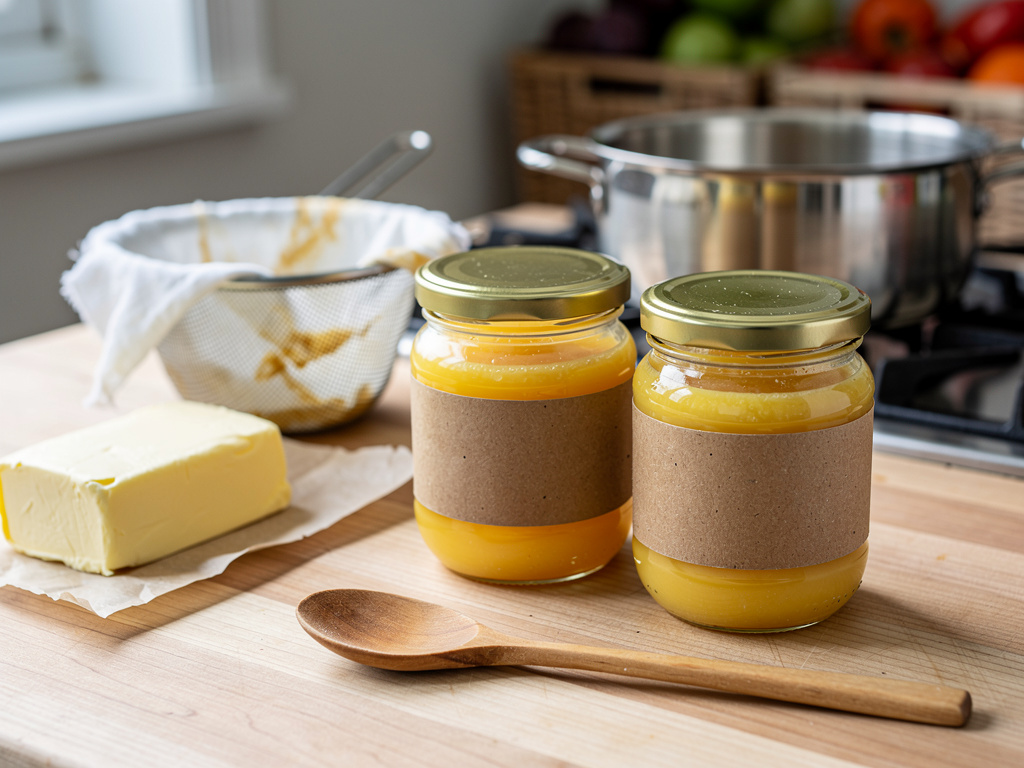


The short version: In 4 of the 8 states we checked (Minnesota, Michigan, Washington and Illinois), the cottage food law leaves out dairy, so you cannot sell ghee made in your home kitchen even though it keeps at room temperature. Of the eight states checked for this guide, Utah and Wyoming let a home kitchen sell ghee straight to customers under their food freedom laws, Minnesota names ghee as not allowed, and Texas stays unclear until its dairy program answers you in writing. In Minnesota, Michigan, Washington and Illinois the legal route runs through a licensed kitchen, often with a dairy or food processor license, and Colorado does not list ghee by the jar, so call the state office that runs cottage food and dairy (in Colorado, that is the health department, CDPHE) before you buy a case of jars. Once you have a route, start with plain ghee in dry, airtight glass jars with "milk" on the label, and send your regulars one link to order from.
Checked October 7, 2026 on each state's own page and on findhomegrown.com/signup: state rules come from the Minnesota, Michigan, Colorado, Washington, Texas, Utah and Wyoming agency pages or statutes and the Illinois Department of Public Health cottage food guide (hosted by University of Illinois Extension). Homegrown is $10 a month billed annually with no commission, customers create a Homegrown account to place their first order, and Homegrown has no drops feature and does not license you. Rules change, so verify your state's current rules before you sell.
Ghee is one of the easiest dairy foods to make and one of the hardest to sell legally. You melt butter, cook off the water, strain out the milk solids, and pour a golden fat into a jar that smells like toasted nuts. It sits happily in a pantry. So it feels like a cottage food, the same as jam or granola.
Most state laws disagree. They sort food by what it is made from before they look at how long it keeps, and ghee is made from butter. This guide walks through the rule in plain words, the eight states we checked on October 7, 2026, the two food freedom states where a home kitchen can sell ghee, the licensed route everywhere else, and then the practical part: making a jar that holds up, labeling it, finding customers and taking orders.
In 4 of the 8 states checked for this guide, the cottage food law leaves out dairy, so ghee made in a home kitchen is out. Colorado leaves ghee by the jar off its list, and Texas is unclear. A cottage food law is the set of state rules that lets you make certain low-risk foods at home and sell them without a commercial kitchen. Four of the six cottage food laws we checked carve out milk products as a group, and ghee falls inside that group.
Minnesota says it in the plainest words of any state we read. Its cottage food law guidance from the Minnesota Department of Agriculture lists "cheese, yogurt, butter, ghee" among the products that "are not allowable cottage foods and require a license." Michigan's list says "No milk and dairy products like cheese or yogurt." Washington's agriculture department puts "Meat, dairy, or seafood products" on its cottage food not-allowed list.
That leaves three ways forward:
Whatever your state says about butter is usually what it says about ghee, so our state-by-state answer on selling homemade butter legally is the fastest first check. The rest of this guide covers what is different about ghee: the shelf life, the jar, the label and the customers.
Cottage food laws treat ghee like butter because they group foods by ingredient family, and ghee is butter with the water and milk solids removed. US butter has to be at least 80% milkfat under federal law (21 U.S.C. 321a). Ghee is close to pure milkfat. The USDA's specifications for ghee call for at least 99.6% milkfat and no more than 0.3% moisture in the ghee it certifies.
That tiny amount of water is why ghee keeps. Bacteria need water to grow, and a jar that is 99.6% fat gives them almost none. Butter is typically 80 to 82% fat and 16 to 17.5% water, according to Michigan State University Extension, and it is only recommended at room temperature for 1 to 2 days. So you might expect state rules to treat ghee like honey or candy.
Here is why most do not:
"It's shelf-stable, so it's a cottage food" is the most common wrong turn with ghee. Of the eight state pages we read on October 7, 2026, none listed ghee by the jar as an allowed cottage food. Colorado mentions ghee only as an ingredient in buttercream, and Minnesota names it as not allowed. Ask your state before you sell, and keep the answer in writing.
Two of the eight states we checked, Utah and Wyoming, let a home kitchen sell ghee directly to customers, and both do it through food freedom laws rather than cottage food rules. A food freedom law allows nearly every homemade food and names a few exceptions, instead of listing the few foods that are allowed. The table shows what each state's own page said on October 7, 2026.
Swipe left to see all eight states and their rules.
| State | Ghee from a home kitchen? | What the state page says | The route that works |
|---|---|---|---|
| Minnesota | No | "cheese, yogurt, butter, ghee" are "not allowable cottage foods and require a license" | A licensed facility |
| Michigan | No | "No milk and dairy products like cheese or yogurt" | A licensed facility |
| Washington | No | "Meat, dairy, or seafood products" are not allowed under the $355 cottage food permit | Ask WSDA: a milk processing plant license or a food processor license |
| Illinois | No | Dairy is out "except as an ingredient in a non-potentially hazardous baked good or candy" or in frosting such as buttercream | A commercial kitchen under regular food rules |
| Colorado | Not on the list | Lists "Buttercream made with ghee or vegetable oil" as eligible; ghee by the jar is not listed | Ask CDPHE; ghee buttercream on cottage baked goods is allowed |
| Texas | Unclear | Cottage foods "now include any foods, except" a short list ending in "raw milk and raw milk products"; a separate dairy rule requires a milk plant permit | Ask DSHS in writing before selling |
| Utah | Yes, from pasteurized butter | The Home Consumption and Homemade Food Act "does not apply to the sale of: (a) raw dairy or raw dairy products" | Sell directly to an informed final consumer inside Utah; a local business license still applies |
| Wyoming | Yes | The Food Freedom Act covers dairy products; sales must "Occur only in Wyoming" | Sell directly to an informed end consumer in Wyoming |
Every row was read on the state's own page or statute on October 7, 2026: MDA cottage food guidance, MDARD "What can I make", the WSDA cottage food post of April 9, 2026 and WSDA dairy licensing page, the Illinois Department of Public Health 2024 Cottage Food Guide (hosted by University of Illinois Extension), CDPHE Cottage Foods Act, Texas DSHS cottage food page and 25 TAC 217, Utah Code 4-5a-104 and 4-5a-105 and Wyoming W.S. 11-49-103. These eight are examples, not all 50 states.
If your state is not in the table, our cottage food laws by state directory links each state's page. Open it and search the page for "dairy," "milk," "butter" and "ghee." If dairy is on the not-allowed list, plan on the licensed route.
Utah and Wyoming both let you make ghee at home and sell it straight to a customer who knows it was not inspected, with Utah limited to ghee made from pasteurized butter and both states limited to sales inside the state. Neither state requires a food license or cottage food permit for these sales, though Utah still requires a local business license. Both laws put the burden on you to tell the customer.
The Home Consumption and Homemade Food Act (Utah Code 4-5a) covers food made in a private home kitchen and sold to an "informed final consumer," meaning a buyer who "has been informed that the product is not certified, licensed, regulated, or inspected by the state." Section 105 leaves out "raw dairy or raw dairy products," so ghee made from pasteurized store butter fits and ghee made from raw cream or raw butter does not. If you sell at a market, the 2026 version of section 103 says a direct-to-sale area tied to a regular farmers market must be "separated" and marked with signs. Section 104 adds three more rules. The food must be "produced and sold within the state." You still have to "comply with business license requirements," so get a local business license. Your label must carry your name and address, a statement that the product is "not for resale" and "processed and prepared without state or local inspection," and a statement of whether it contains, or was made in a place that also handles, common allergens, a list that starts with milk. Checked October 7, 2026.
The Wyoming Food Freedom Act (W.S. 11-49-101 to 104) names dairy products outright. Sales must go to the informed end consumer, from you, an agent you name, or (for dairy) a shop, and must "Occur only in Wyoming" and must "Not involve interstate commerce." The act's definitions cap you at 250,000 individual products and $250,000 in gross revenue a year. Wyoming also lets a retail shop carry your dairy products, on a separate shelf from inspected food, labeled "this food was made in a home kitchen, is not regulated or inspected and may contain allergens." Checked October 7, 2026.
A few practical habits keep a food freedom sale clean:
Other states have food freedom laws too, and each one draws the dairy line in a different place. To find out whether your own state passed one, check our food freedom states list, and Wyoming vendors can read the full Wyoming cottage food law rundown for the parts that are not about dairy.
Texas widened its cottage food law on September 1, 2025, but ghee still sits in a gray zone there because a separate Texas dairy rule requires a milk plant permit for anyone who makes dairy products. The Texas DSHS cottage food page now says allowable foods "include any foods, except" six groups, and the only exclusion that names milk is "raw milk and raw milk products," though ice cream, frozen custard and gelato are out too. It also raised the yearly sales cap to $150,000.
Read alone, that looks like a yes for ghee made from store butter. Two other rules point the other way, and the cottage food page leaves a gap:
Ghee is not named in the Texas dairy product list, and DSHS has not said in writing whether making ghee at home counts as manufacturing a dairy product. The list does end with a catch-all for "such other products derived from milk," which is one more reason to get an answer in writing. Until DSHS answers, treat Texas as "ask first." Email the DSHS cottage food program and its dairy program, ask whether ghee made at home from pasteurized store butter needs a milk plant permit, and keep the reply.
When your state's cottage food law leaves dairy out, you sell ghee legally by making it in a licensed kitchen under the license your state uses for dairy or processed food, which usually means a call to the state agriculture department first. In some states that is a dairy license. Ohio's agriculture department says "A dairy processor license is for anyone making and wholesaling a dairy product," and names butter in the same sentence. Kentucky's 2026 manufacturing guide sends "all other dairy products" to its Milk Safety Branch.
Other states may license ghee as a processed food instead of a dairy product. You will not know which until you ask, and the answer decides which kitchen you can use. Here is the order that saves the most time:
Before you sign a kitchen lease, run these questions past the manager:
Our guide to renting a commissary kitchen for a food business covers hourly rates, minimums and what kitchen managers ask for. A licensed route takes longer to set up, but it opens doors a home kitchen rarely gets. Ohio's agriculture department, describing its food processing license for non-dairy foods, says "Wholesaling under a food processing facility license allows you to sell your products anywhere and to anyone; this includes grocery stores, restaurants and the internet." Ghee in Ohio goes under the Dairy Division's dairy processor license instead, but the quote shows how much wider a licensed route can be than a home one.
You make ghee that keeps by cooking unsalted butter on low heat until all the water is gone, straining out every bit of the milk solids, and pouring it into completely dry jars. Water and leftover solids are what shorten a jar's life, so the whole method is about removing both. USDA's specification sets the bar at 0.3% moisture or less for the ghee it certifies, and says it should be "practically clear" when warmed to about 140°F.
Plan your batches by weight. US butter must be at least 80% milkfat, and Michigan State University Extension puts typical butter at 80 to 82% fat, so a pound holds roughly 12.8 to 13.1 ounces of fat. Some of that clings to the foam and the strained solids, so plan on about 12 ounces of ghee per pound as a working number, then weigh your own batches and use what you get. A 4 pound batch gives you about 48 ounces, enough for six half-pint jars.
A few habits make a jar last longer once it leaves your hands:
Bubbling and color are a cook's signs, not a lab result. If your license, a shop or a customer wants proof, a food testing lab can measure moisture against USDA's 0.3% figure, and your state food program or licensed kitchen can tell you whether your best-by date needs testing behind it.
Weigh every batch of butter going in and every batch of ghee coming out, and write both numbers in a notebook. After five batches you will know your real yield, maybe 11.5 ounces per pound, maybe 12.3, and that number sets your cost per jar better than any recipe.
Glass jars with tight lids work best for ghee, and an 8 ounce wide-mouth half-pint mason jar is the easiest size to start with. USDA's ghee specification calls for ghee to be "packed in airtight containers," and a glass jar with a new lid does that for under a dollar. On October 7, 2026, a 12-pack of Mainstays 8 oz wide mouth half-pint mason jars was $10.97 at Walmart.com, about 91 cents a jar.
A few reasons the half-pint wins for a new vendor:
Once you sell more than a dozen jars a week, look at buying jars by the case from a packaging supplier, and try a 4 ounce size as a sampler. Keep the lids new for every sale, even if you reuse jars at home.
A homemade ghee label needs the product name, the ingredients with milk named as an allergen, the net weight, who made it and any statement your state's home food law requires. Milk is one of the major food allergens under federal law. The FDA allows the allergen to appear "In parentheses following the name of the ingredient," like "whey (milk)," or in a "Contains" statement next to the ingredient list, like "Contains wheat, milk, and soy."
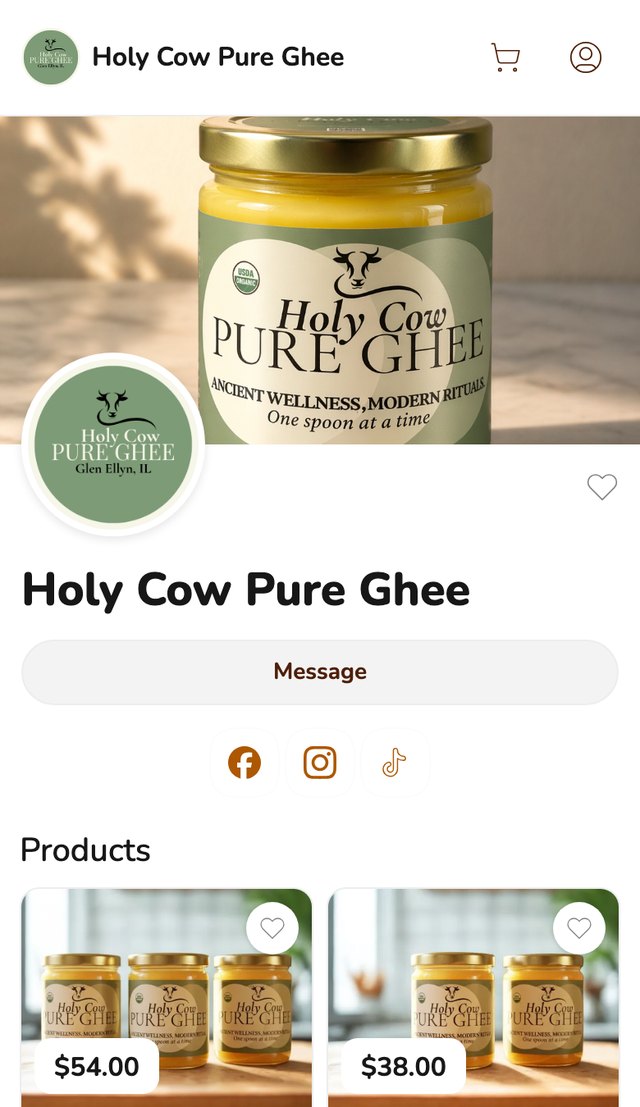
Holy Cow Pure Ghee's Homegrown listing shows the simplest version of that line: "Ingredients: Organic grass-fed butter (milk)." Its listing also says "Storage: Store at room temperature," which answers the question every new customer asks.
Here is a checklist for your jar:
On net weight, Kentucky's 2026 food manufacturing guide gives a good rule for any state: show it "in English and Metric units," place it in the lower 30% of the label, and "Always round down." If your jars weigh 7.4 to 7.7 ounces of ghee, print 7.4 oz (209 g). If you add spices, nuts or anything else to a flavored ghee, our walk-through of the big 9 allergens on a cottage food label shows how to name each one.
Ghee gets on everything, including your labels. Use waterproof film labels instead of paper, and put the batch date on the lid with a small sticker so the main label stays clean. A greasy, smudged label on a $20 jar is the fastest way to look homemade in the wrong way.
Your first jar should be plain ghee made from one butter you trust, because plain ghee is the easiest to make the same way every time and the easiest to explain to an inspector or a customer. Cultured ghee, made from cultured butter, has a tangier flavor and can sell for more: Nalwaya Foods in California listed 16 ounces of its Cultured Ghee at $45 and 16 ounces of its Original Ghee at $32 on October 7, 2026. The only change in your kitchen is the butter you buy. Flavored ghee is where the risk climbs.
Garlic and fresh herbs are the flavors to be careful with. Michigan's cottage food list bans "oils flavored with fresh herbs, fresh fruits or vegetables, or garlic (fresh or dried)," and the Illinois guide leaves out "Garlic in oil or oil infused with garlic, except if the garlic oil is acidified." Ghee is a fat, not an oil, but the concern is the same: fresh garlic and herbs bring water and a low-acid food into a sealed jar of fat. Our guide to selling infused olive oil from home explains why garlic in fat gets special treatment.
A sensible order for a new ghee vendor:
Once you have a legal route, ghee sells best at farmers markets, to regulars who order ahead for pickup, and around holidays and festivals where ghee is part of the cooking. Where you are allowed to sell depends on the route. In Utah and Wyoming, the 2 states with a home route in this guide, a food freedom sale goes to the final customer, from you or someone you name, and never to a restaurant. Utah also bars food freedom sales to shops, while Wyoming lets a shop carry home-made dairy on a separate, labeled shelf. A licensed product can go to shops and restaurants.
Places that work, and the route each one needs:
If you already sell butter, ghee fits the same table and the same customers. The booth fees, delivery math and shop terms in our guide to where butter sells best carry straight over to jars of ghee.
You usually cannot ship homemade ghee to other states, because most home food laws stop at the state line and interstate food sales bring in federal rules. Five of the 8 states in this guide say so in writing. Wyoming's Food Freedom Act says sales must "Not involve interstate commerce," and Utah's homemade food law covers food "produced and sold within the state." Colorado's cottage food page says products "may only be sold in Colorado," Washington's cottage food permit says "Online, wholesale, and out-of-state sales are not allowed," and the Illinois cottage food guide says "Cottage food laws do not allow products to be shipped out of state."
Licensed ghee is a different story. The FDA says facilities that "manufacture, process, pack, or hold food" for US consumption "must register with FDA" unless they are exempt, and it lists private residences, retail food establishments and restaurants among the exemptions. A licensed ghee business that ships across state lines should ask its state licensing office which federal steps apply, starting with that registration question.
If you have a legal route to ship, ghee is easier than most dairy:
Our guide on whether you can ship cottage food covers each state's shipping line in more detail. For most new ghee vendors, the simpler plan is to sell within driving distance through pickup and local delivery, at least for the first season.
Start by pricing a half-pint jar of ghee at two and a half to three times what the butter and jar cost you, then check it against nearby ghee prices. Butter is most of your cost, and it changes with the butter you choose. At the Walmart.com prices we loaded on October 7, 2026, the butter for one 7.5 ounce jar costs $1.91 in store-brand butter and $5.85 in grass-fed Kerrygold.
Slide the table to see supplies per jar.
| Butter | Price loaded October 7, 2026 | Butter in one jar (10 oz) | Jar and lid | Supplies per half-pint |
|---|---|---|---|---|
| Great Value Sweet Cream Unsalted Butter | $3.06 for 16 oz | $1.91 | $0.91 | $2.83 |
| Kerrygold Grass-Fed Unsalted Butter | $4.68 for 8 oz | $5.85 | $0.91 | $6.76 |
Butter per jar uses the planning yield in this guide (about 12 ounces of ghee per pound of butter, so 10 ounces of butter fills a 7.5 ounce jar). The jar is one of the Mainstays 12-pack at $10.97. Labels, gas, your time and selling fees are not in this table. Walmart.com prices were read on October 7, 2026 and change often.
At three times supplies, a store-butter jar lands near $8.50 and a grass-fed jar near $20. For a market check, Holy Cow Pure Ghee charged $20.00 for a 9 ounce jar on Homegrown on October 7, 2026, which works out to $2.22 an ounce. A $20 jar is a jar of the butter you chose and the care you took, so say both on the label and in the listing.
Things that should push your price up:
A real ghee storefront needs very little: a clear photo of the jar, a few products with prices, and the places and days customers can pick up. On Homegrown, one vendor sells ghee today: Holy Cow Pure Ghee, whose logo reads Glen Ellyn, IL. It keeps the menu to three listings, one 9 ounce jar at $20.00 and bundles of two jars at $38.00 and three jars at $54.00.
When we pulled the Homegrown catalog on October 7, 2026, ghee accounted for 3 of the 2,907 products from 310 vendors, and Holy Cow Pure Ghee listed every one of them. We searched every listing's name and description for "ghee," "clarified," "ghi," "butter oil" and "anhydrous," then opened every listing from the matching vendor. The pantry category held 367 listings from 63 vendors, so ghee is a near-empty shelf on the marketplace.
What to copy from it for your own ghee listings:
Once your ghee is legal and your regulars start asking "do you have a jar this week?", the next problem is keeping track of who wants how many jars, who paid and when they pick up. Homegrown is $10 a month billed annually with no percentage fees beyond standard payment processing, and it gives you one storefront link where customers pick a jar size or a bundle, pay by card and choose a pickup day or local delivery. You make the batch knowing exactly how many jars are spoken for.
The usual alternatives fit ghee worse. Instagram and text messages cost nothing, but a dozen jar orders across a dozen threads is where pickups get missed and payments get forgotten. Etsy is built around shipped orders, which the two home routes in this guide do not allow across state lines, and it charges a 6.5% transaction fee plus 3% + $0.25 processing and a $0.20 listing fee. Shopify Basic does the job at $29 a month billed yearly, which is heavy overhead for a few dozen jars a month.
Swipe to compare all three fee stacks.
| Platform | Monthly plan and trial | Platform or transaction fee | Card processing | Customer pays on a $20 jar | You pay on a $20 jar | You pay in a month of 50 jars at $20 |
|---|---|---|---|---|---|---|
| Homegrown | $10 billed annually ($12.50 monthly); 7-day trial, no charge until day 8 | None, 0% commission | 2.9% + $0.30, paid by you | $20.00 | $0.88 | $54.00 with the plan |
| Etsy | No required monthly plan; a one-time set-up fee may apply when you open a shop | 6.5% transaction fee, plus $0.20 listing fee renewed after each sale | 3% + $0.25 (US) | $20.00 plus shipping | $2.35 | $117.50 |
| Shopify Basic | $29 billed yearly ($39 monthly); 3 days free, then $1 a month for 3 months | None with Shopify Payments (2% with another provider) | 2.9% + 30¢ online | $20.00 | $0.88 | $73.00 with the plan |
Fees are figured on the $20 jar price only. Etsy charges its transaction fee on shipping too and its processing fee on the total with tax and shipping, and Offsite Ads can add 15% on orders they bring in for shops under $10,000 a year unless you opt out. On monthly plans, the 50-jar month is $56.50 on Homegrown and $83.00 on Shopify. We checked Homegrown's signup page, Etsy's fees and payments policies and Shopify's pricing page on October 7, 2026.
What a ghee vendor gets from it:
Where Homegrown stops for a ghee vendor: it does not license you, check your state's dairy rules or make home ghee legal where it is not. Card processing of 2.9% + $0.30 is paid by you, with no option to pass it to the customer. Customers create a Homegrown account to place their first order. Your storefront is listed on the Homegrown marketplace, but plan on most orders coming from people you send to your own link. Homegrown has no drops or countdown release feature. If that fits, you can set up a ghee storefront on Homegrown in about 15 minutes and send the link to your market regulars before your next batch.
The mistake that costs new ghee vendors the most is selling under a cottage food permit that does not cover dairy, because a complaint can end the business before it starts. The rest are smaller and fixable, but each one costs jars, money or a customer.
If you sell in a food freedom state, the paperwork is light, but the label and the "not inspected" notice still matter. If you sell under a license, keep your license number, your kitchen agreement and your insurance certificate in one folder you can hand to a market manager in 30 seconds.
Not in four of the eight states we read for this guide, and in two more it is either missing from the list (Colorado) or unclear (Texas). Cottage food laws usually leave out dairy products, and ghee is made from butter. Minnesota's Department of Agriculture names ghee directly as "not allowable" as a cottage food. Of those eight state pages, read on October 7, 2026, none listed ghee by the jar as an allowed cottage food, while Utah and Wyoming allow it under food freedom laws instead.
Yes, if your state gives you a legal route. In Utah (ghee from pasteurized butter only) and Wyoming you can sell ghee made at home directly to customers at a market, and Utah requires food freedom sales tied to a regular market to sit in a separate, signed area. In the other states we checked, ghee sold at a farmers market has to come from a licensed kitchen unless the state tells you otherwise in writing, which is still the open question in Texas and Colorado. The market will ask for your license number.
In the states we looked at, you usually need a license, and it is often a dairy or food processor license rather than a cottage food permit. Ohio, for example, issues a dairy processor license for anyone making and wholesaling dairy products such as butter. Utah and Wyoming are exceptions where food freedom laws let you sell ghee from home without a food license or cottage food permit, directly to an informed customer inside the state. Utah still requires a local business license under Utah Code 4-5a-104.
You can take orders online for pickup or local delivery in some states, but shipping ghee made at home to other states is generally not allowed. Wyoming's food freedom law says sales cannot involve interstate commerce, and Utah's law covers only food that is both made and sold inside Utah. Licensed ghee businesses have more room to sell online and ship.
Plan on about 12 ounces of ghee from a pound of butter. US butter must be at least 80% milkfat and typical butter runs 80 to 82%, so a pound holds roughly 12.8 to 13.1 ounces of fat, and some of that is lost with the foam and strained solids. Weigh your first few batches to learn your own yield before you price your ghee.
Store homemade ghee in clean, completely dry glass jars with tight lids, out of direct sun and away from heat. USDA's ghee specification calls for airtight containers and no more than 0.3% moisture. Holy Cow Pure Ghee, the ghee vendor on Homegrown, tells customers to "Store at room temperature," and a batch date on each jar helps you sell the oldest first.
These guides pick up where this one leaves off, from the dairy rules that decide whether you can sell ghee at all to the label, the kitchen and the places you will sell it. Each one was live on October 7, 2026, and each answers a question that comes up once your first jars are ready.
Ghee rewards patience twice: once at the stove, when you let the water cook all the way off, and once with your state, when you get the dairy answer in writing before your first sale. Do both and you have a pantry product that stores at room temperature, travels well across town and gives regulars a reason to come back every few weeks.
Here is the short path from your kitchen to your first ten jars:
When the rules and the recipe are settled, start your Homegrown storefront at $10 a month billed annually, with a 7-day trial and no charge until day 8, and send the link to the people who already ask you for a jar.



