
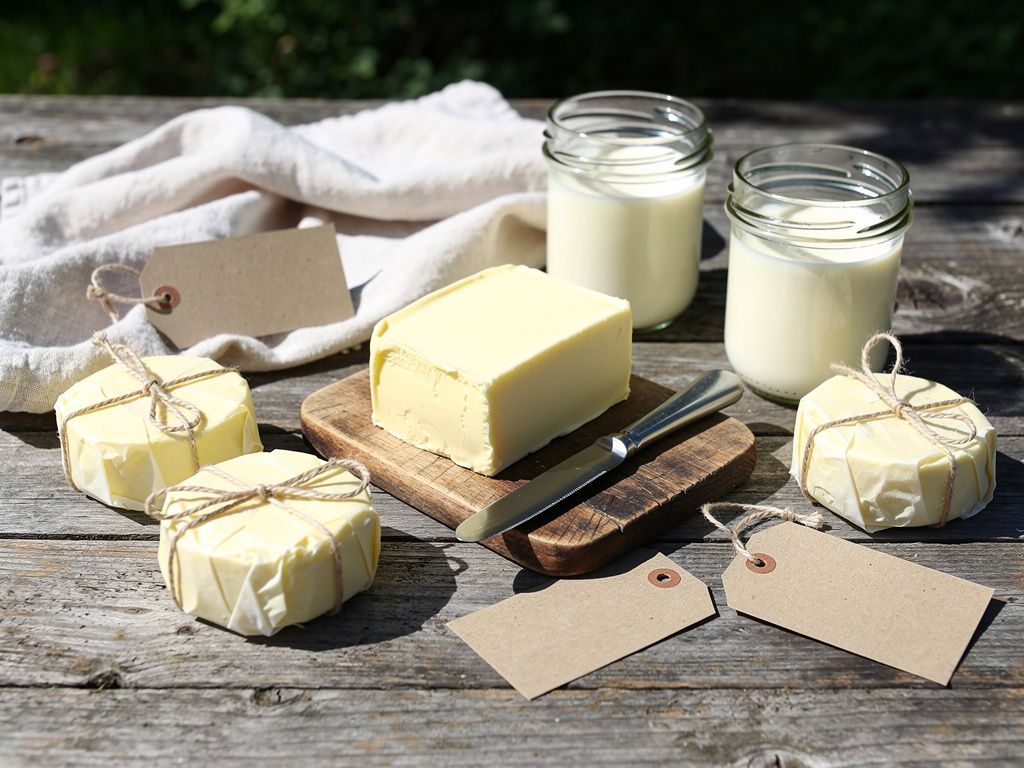


The short version: Butter sells in seven places: farmers markets, your farm or porch, pre-orders with a set pickup window, local delivery, bundles with your milk, eggs or bread, shops and restaurants, and holiday gift sets. Which of those you can use depends on how your butter is made. Restaurants can only buy butter from a source that complies with the law, under the FDA Food Code that most health departments follow, Wyoming is the one state in this guide that lets a store shelve home-kitchen butter, and sales under the Utah and Wyoming home kitchen exemptions have to stay inside the state. Raw butter can never be sold across a state line for people to eat under federal rule 21 CFR 1240.61, so shipping only works for pasteurized butter. On an $8 half pound, card processing costs you $0.53 through your own Homegrown link, $0.36 on Square in person, and nothing in cash.
Checked October 5, 2026: fees come from Homegrown's signup page and the Square, Local Line and Venmo pricing pages, and the rules come from Utah Code 4-5a, the Wyoming Food Freedom Act, 21 CFR 1240.61, the FDA's 2022 Food Code and the Maryland, Washington, Wisconsin and Pennsylvania agency pages, all loaded that day. This is a guide to places, not a fifty-state rulebook, so verify your state's current rules with your health or agriculture department before you sell. Homegrown customers create an account to place their first order, and you should plan on most orders coming from people you send to your own link.
Good butter sells itself on the first taste. The harder part is finding enough places to put it in front of people, because butter is not like jam. It has to stay cold, it is a dairy product, and the rules for dairy decide which doors are open to you before any customer does.
That is why the answer to where to sell butter starts with one question: how is your butter made? A licensed creamery can use every place on this list. A home kitchen in Utah or Wyoming can use most of them, inside the state. A home kitchen in states like Maryland and Washington cannot sell plain dairy butter under their cottage food laws, and our guide to whether you can sell homemade butter walks through the state rules, the federal definition and the permits in detail. This guide picks up where that one stops: once you are allowed to sell, where does butter actually move?
Below are the seven places, who can use each one, what four real butter vendors on Homegrown charge and how they run pickup and delivery, and what each way of getting paid costs you on an $8 half pound.
You can sell butter in seven places: a farmers market, your own farm or porch, pre-orders with a set pickup window, local delivery, a bundle with your other farm products, shops and restaurants, and holiday gift sets. You do not need all seven, and the three Homegrown butter vendors that list a size charge $8 to $11 a half pound. The market finds new customers, and the other places keep them buying between market days.
The seven places, roughly in the order a new butter vendor can add them:
Shipping to other states is the one place most butter vendors should skip. It is closed to raw butter by federal law, and butter sold under a Utah or Wyoming home kitchen exemption has to stay in that state. We cover the details further down.
Start with the place that matches how your butter is made and how many pounds you make a week. A licensed creamery making 50 pounds a week needs different first places than a Utah homestead with one Jersey cow and a churn.
Scroll sideways to see every column.
| Your situation | Start here | Why it fits |
|---|---|---|
| Under 10 pounds a week, regulars keep asking | Pre-orders with pickup at your farm or home | No booth fee, no travel, and you churn only what already sold |
| 10 to 30 pounds a week, Saturdays free | A farmers market booth plus a pre-order link | The booth finds new buyers, and the link keeps them between markets |
| You already sell milk, cream or eggs | Add butter to the same pickup or farm share | The customer is already coming, so butter is one more line on the order |
| Licensed plant, 30+ pounds a week | One or two shops, co-ops or restaurants | Steady weekly volume at a lower price per pound |
| Home kitchen in Utah or Wyoming | Farm or home pickup, a farmers market (in Utah, a direct-to-sale farmers market), and pre-orders | Both state laws allow these places for sales inside the state |
| Home kitchen in Maryland or Washington | None of them for dairy butter | Both states list dairy as not allowed for cottage food; sell butter-rich baked goods instead |
The pound ranges are planning examples, not rules. The state rows come from Utah Code 4-5a, the Wyoming Food Freedom Act, the Maryland Department of Health's cottage food guidelines (last updated November 2025) and the Washington State Department of Agriculture's cottage food page, all loaded October 5, 2026.
Whatever you start with, add a pre-order link early. It turns a one-time market buyer into someone who orders next week without waiting for you to set up the tent.
Licensed creameries can use all seven places, Utah and Wyoming home kitchens can use most of them inside the state, a Pennsylvania raw milk butter permit holder can sell only inside Pennsylvania, and a home kitchen in a state with no home kitchen route for dairy can use none of them for plain butter. The route your butter is made under decides the list, not the other way around.
Here is how the main routes line up place by place:
Swipe the table left to see each place.
| How the butter is made | Farmers market | Farm, porch or home | Shops and grocery stores | Restaurants | Customers in other states |
|---|---|---|---|---|---|
| Licensed dairy plant, pasteurized | Yes, under the market's rules and your local permits | Yes, under your license | Yes, it is a licensed source | Yes, it is a licensed source | Not blocked by 21 CFR 1240.61, which only stops raw dairy |
| Utah home kitchen (Utah Code 4-5a) | Yes, at a direct-to-sale farmers market, set apart from any regular market area | Yes, a farm, ranch, home or office counts | No, not to a commercial establishment | No | No, it must be produced and sold in Utah |
| Wyoming home kitchen (W.S. 11-49-103) | Yes | Yes | Yes, on its own shelf with the home kitchen warning label | No, not as an ingredient or served | No, sales occur only in Wyoming |
| Pennsylvania raw milk butter permit | Sales inside Pennsylvania only, of butter you make from your own raw milk; check with the PA Department of Agriculture which places your permit covers | No, raw butter cannot cross state lines | |||
| Home kitchen in Maryland or Washington | No place on this list for dairy butter. Both states keep milk and dairy products out of cottage food, and Washington bans raw butter sales outright | ||||
We read each rule on the agency or statute page on October 5, 2026: Utah Code 4-5a-102 to 105, the Wyoming Food Freedom Act at W.S. 11-49-102 and 103, 7 Pa. Code 59a.402, the Maryland Department of Health's cottage food guidelines, the WSDA cottage food page and 21 CFR 1240.61. A licensed plant still has to follow its own license, the market's rules and any state rule like Wisconsin's grading law. These are examples; check what your state requires before you sell.
Utah's food freedom law does not cover raw butter at all. Utah Code 4-5a-105 says the chapter "does not apply to the sale of: (a) raw dairy or raw dairy products," so a Utah home kitchen can only use these places with butter made from pasteurized cream. Texas is a special case with its own dairy permit question, covered in our butter permission guide.
Section 4-5a-104 of Utah's Home Consumption and Homemade Food Act sets the label, the business license and the no-restaurants rule, and the Wyoming Food Freedom Act in Title 11 of the Wyoming statutes lists every place a sale may happen, at sections 11-49-101 to 104. Utah and Wyoming are the 2 states in this guide with a home kitchen route for butter.
If your state is not in the table, the list of food freedom states is the fastest way to see whether a home kitchen route exists where you live. Where none does, plan on a dairy license before butter goes anywhere on this list.
Yes, a farmers market is the best first place for most butter vendors making 10 pounds or more a week, because butter wins on a taste and a cooler of half-pound tubs fits in one trip. A small cracker with a smear of salted butter does the selling for you. Put the price on the sign right next to the samples, so the taste and the price land at the same moment.
What makes a butter booth work:
Talk to the market manager before you apply. Ask what they need to see for a dairy product, whether your county wants a separate permit for the booth, and whether they want proof your cooler holds temperature.
Home kitchen butter sells at a "direct-to-sale farmers market," which Utah's Home Consumption and Homemade Food Act treats as a place where uninspected homemade food is sold to informed customers. Under section 4-5a-103, if that area is connected to a regular farmers market, it has to be separated from the regular market area and marked with signs showing which is which. Ask your market whether it runs a direct-to-sale section before you plan on a booth.
One booth day tells you more about which butter sells than a month of guessing at home.
Yes, if your route allows it, and for most butter vendors home or farm pickup is the cheapest place to sell, because you pay $0 in booth fees and drive 0 miles. Utah's law names "a farm, ranch, direct-to-sale farmers market, home, office" as places a home kitchen vendor can sell, and Wyoming's lists farmers markets, farms, ranches, and the home or office of the person who made the food. A licensed creamery can sell from its own farm store under its license.
Farm pickup works best when it runs like a schedule, not a favor. Harvest House Foods, a Montana vendor on Homegrown, lists two pickup spots, Full Bushel Farm in Stevensville and The Flying D Ranch West in Victor, both on Mondays from 4:30 to 7:00 PM. One fixed evening a week means customers plan around it, and you churn once for the whole week.
How to set up pickup that does not eat your week:
If you run an unattended farm stand, butter is harder than eggs or vegetables. It needs a fridge that holds temperature with the door opening all day; our guide to cold storage at an unattended farm stand covers fridges, thermometers and what to do when the power goes out.
Pre-orders work for butter by letting customers order and pay during the week, so you churn exactly what sold and hand it over at one set time. Butter is made in batches from cream that does not wait, so knowing the count before you start saves cream and money.
Moore's Organic Butter, a Georgia vendor on Homegrown, shows the pattern. Its store says "Order online and pick up locally!" and lists one pickup spot in Cobb County on Saturdays from 10:00 AM to 7:00 PM, with the next three Saturdays open on October 5, 2026. The store also says its butter is "frozen at peak freshness," which gives it room to make ahead and hand over on Saturday.
Make the pickup window long. Moore's Organic Butter runs a nine-hour Saturday window, 10:00 AM to 7:00 PM, which covers early risers, people who work Saturday mornings and people coming home from errands. A longer window costs you one afternoon near the fridge and saves you the "can I come at 4 instead?" messages.
Local delivery makes sense for butter when you set an order minimum and a fee and drive one short loop on fixed days, because a half-pound tub alone is not worth a trip. Two of the four butter vendors on Homegrown deliver.
Moore's Organic Butter's delivery terms on October 5, 2026 were: within 20 miles, a $7.00 flat fee, a $27.00 minimum order, on Wednesdays and Saturdays. That $27 minimum is exactly three $9 tubs, so the smallest delivered order is $27, which is three salted or unsalted butters, and a customer who orders that pays $27 plus the $7 fee, or $34. The minimum keeps every stop worth the gas, and the fee covers part of the drive.
How to set delivery up for butter:
Our guide to setting a delivery fee for a food business works through the gas, time and minimum math if you want to price your own loop.
Yes, and for a vendor who already sells milk, eggs or bread this is the easiest place of all, because the customer is already buying from you and butter is one more line on the same order. Butter sits naturally next to the products it is made from or eaten with.
Two vendors on Homegrown show the two versions of this. Harvest House Foods sells its salted butter on the same storefront as A2/A2 fresh milk, fresh cream, farm fresh eggs, beef and a small veggie share, so a weekly milk customer can add a tub at checkout. Sweet Savor, a Minnesota bakery, lists Hope Butter, which its listing describes as "a European-style butter made in the town of Hope, MN," at $8.00 next to its sourdough, whole wheat bread and cinnamon rolls. A bakery that carries another maker's butter gives that butter a shelf in front of every bread buyer.
In a pull of the Homegrown catalog on October 5, 2026, 9 of the 2,883 listings from 309 vendors were dairy butter, from 4 vendors: Moore's Organic Butter (6 listings), Harvest House Foods (1), Selah homestead fl (1) and Sweet Savor (1). Three more listings, from one vendor, were ghee. We counted every listing in the eggs and dairy category plus any listing whose name or description describes dairy butter, left out fruit butters, nut and cookie butters, buttercream, body butters and baked goods made with butter, and opened each vendor's other listings. All four butter vendors list a pickup spot, two also deliver, and one lists a farmers market.
Ways to bundle butter with what you already sell:
Shops, co-ops and restaurants will buy butter from a licensed source, but in most places they cannot buy home-kitchen butter. The FDA's 2022 Food Code, the model that state and local health departments build their restaurant and grocery rules on, says in section 3-201.11 that food "shall be obtained from sources that comply with LAW" and that "FOOD prepared in a private home may not be used or offered for human consumption in a FOOD ESTABLISHMENT."
The state food freedom laws match that for restaurants. Utah's act says exempt homemade food "may not be sold to, or used by, a restaurant or commercial establishment." Wyoming's says homemade food "shall not be served or utilized as an ingredient in a commercial food establishment." Wyoming is the exception for stores.
The Wyoming Food Freedom Act lets a "retail shop or grocery store" sell eggs and dairy products made in a home kitchen, as long as the sale stays in Wyoming. Under W.S. 11-49-103(k), that butter cannot sit on the same shelf as food from a licensed plant, and it must be labeled "this food was made in a home kitchen, is not regulated or inspected and may contain allergens." The act covers vendors making no more than 250,000 products and $250,000 in gross revenue a year.
For a licensed butter vendor, shops and restaurants bring steady weekly volume. What they will ask for:
Expect a lower price per pound than at your booth, since the store has to mark it up. The trade is volume and one delivery instead of fifty handoffs.
Yes, gift sets are worth it for butter because a box of several flavors is a present people buy for someone else, which can reach people who would not buy a single tub for themselves. Plan them for the week before Thanksgiving through December, when people bake, host and give food.
Moore's Organic Butter sells two $38.00 sets. The Savory Elegance Collection is "four generous 8oz. buttercups," two roasted garlic and herb and two salted. The Creamery Crown Collection is "all four" of the shop's butters: unsalted, salted, roasted garlic and herb, and honey. Bought one at a time, the four flavors cost $10 + $10 + $9 + $9 = $38, the same as the set, though the single listings do not state a size. On those listed prices, the set does not change the price. It changes the package, so the butter becomes a gift instead of a grocery.
What a butter gift set needs:
Our guide to holiday gift boxes for a food business covers packaging and pricing for the whole season.
You can ship butter to other states only if it is pasteurized, and raw butter can never be sold across a state line for people to eat. The federal rule at 21 CFR 1240.61 says no milk or milk product "in final package form for direct human consumption" may move in interstate commerce "unless the product has been pasteurized or is made from dairy ingredients (milk or milk products) that have all been pasteurized."
That rule applies in all 50 states, because it governs every sale that crosses a state line. Butter sold under a home kitchen exemption cannot ship out of state either. Utah's law covers only food "produced and sold within the state," and Wyoming's says sales must "Occur only in Wyoming" and "Not involve interstate commerce." Pennsylvania's raw milk butter permit, under 7 Pa. Code 59a.402, authorizes sale only "within this Commonwealth."
Shipping butter is also a cold chain problem, not only a legal one. A licensed creamery that ships pasteurized butter still needs insulated boxes, ice packs and a ship day that avoids weekends in transit. Starting with a pickup window and a 20-mile delivery loop avoids those costs entirely.
If your pickup windows and delivery loop are full every week, shipping pasteurized butter from a licensed plant may be the next step. Cheese runs on the same federal line, with one exception for raw milk cheese cured at least 60 days, which our guide to where to sell cheese explains place by place.
The butter vendors on Homegrown price a half pound between $8.00 and $11.00, based on the three listings that state a size in our October 5, 2026 catalog pull. Flavored butters sit $1 above plain at the one shop that sells both. Ghee sits much higher, because a half-pint jar takes about 10 ounces of butter, and our ghee pricing guide with the cost of each jar by butter type shows why small-batch brands charge $19 to $28 for an 8 or 9 ounce jar.
Slide sideways for every vendor's terms.
| Vendor on Homegrown | Butter | Listed price | Per 8 ounces | How customers get it |
|---|---|---|---|---|
| Harvest House Foods (Montana) | Salted butter | $4.00 for 4 oz, $8.00 for 8 oz | $8.00 | Monday evening pickup at two farm spots |
| Moore's Organic Butter (Georgia) | Savory Elegance set, four 8 oz tubs | $38.00 | $9.50 | Saturday pickup, or delivery within 20 mi for $7 on a $27 minimum |
| Moore's Organic Butter (Georgia) | Single tubs: salted or unsalted, honey or garlic and herb | $9.00 plain, $10.00 flavored | Size not stated on the listing | Same as above |
| Selah homestead fl (Florida) | Cultured butter | $11.00 for 8 oz, $20.00 for 1 lb | $11.00 ($10.00 in the 1 lb size) | Pickup, or delivery within 13.5 mi for $15 on a $20 minimum |
| Sweet Savor (Minnesota) | Hope Butter, made in Hope, Minnesota | $8.00 | Size not stated on the listing | Pickup at the shop's Hancock address or the Morris Area Farmers Market (no dates scheduled on October 5, 2026) |
Prices and pickup and delivery terms come from each vendor's Homegrown listing and storefront on October 5, 2026. Moore's store description calls its tubs "8oz. Buttercups," but the single listings do not state a size, so we leave them out of the per-8-ounce column. We did not check how each vendor's butter is made or licensed. These are prices, not examples of a legal route where you live. Four vendors is a small sample; check prices at your own market before you set yours.
Where you sell changes what you can charge. A booth or a pickup window can hold the listed price. A shop or restaurant will want a lower wholesale price so it can mark the butter up. A gift set holds the full price and adds packaging.
Cash at a booth or at your door costs nothing in fees, Venmo costs $0.25, Square costs $0.36 in person or $0.56 online, and your own Homegrown link costs $0.53 plus the plan. On a month of 50 half pounds, that is $0 to $113.60 depending on how you get paid.
Scroll right for the full fee stack on each row.
| How you get paid | Monthly plan | Trial | Platform fee | Card processing | Customer pays on an $8 half pound | Vendor pays on one $8 order | Vendor pays on 50 orders ($400) |
|---|---|---|---|---|---|---|---|
| Cash at a booth or your door | $0 | n/a | $0 | None | $8.00 | $0.00 | $0.00 |
| Venmo business profile | $0 | n/a | $0 | 1.9% + $0.10 per payment received | $8.00 | $0.25 | $12.60, with no order page or order list |
| Square Free plan, card in person | $0 | None on the Free plan | $0 | 2.6% + 15¢ | $8.00 | $0.36 | $17.90 |
| Square Free plan, online or invoice | $0 | None on the Free plan | $0 | 3.3% + 30¢ | $8.00 | $0.56 | $28.20 |
| Homegrown link | $10 billed annually ($12.50 billed monthly) | 7 days, no charge until day 8 | $0, 0% commission | 2.9% + $0.30, paid by the vendor | $8.00 | $0.53 plus the plan | $36.60 billed annually ($39.10 billed monthly) |
| Local Line, Core plan | $87 billed annually ($1,044 a year), or $109 billed monthly | 7 days, no credit card needed | $0, no commissions | 2.9% + $0.30 (ACH 1.0%) | $8.00 | $0.53 plus the plan | $113.60 billed annually ($135.60 billed monthly) |
We checked these fees on Homegrown's signup page, Venmo's fees page, Square's pricing page and Local Line's supplier pricing page on October 5, 2026. The $8 half pound is the Harvest House Foods 8 ounce price. Card processing is figured on the $8 price, the 50-order column uses the unrounded per-order fee, and it adds one month of the plan where there is one. Venmo charges 2.29% + $0.09 instead on a business payment taken with Tap to Pay.
The math on the Homegrown row: 2.9% of $8 is $0.232, plus $0.30, is $0.532, shown as $0.53 a tub. Fifty tubs is $26.60 in processing, plus the $10 plan, for $36.60. Local Line has the same card rate, so the gap between the two is the plan: $87 against $10 when both are billed annually.
What 50 half-pound orders at $8 cost you in fees
Source: each company's pricing page, checked October 5, 2026; annual billing where a plan exists; 50 orders at $8, or $400 in sales.
Cash and Venmo look cheapest, but neither keeps an order list or a running count of the tubs you have left. That is the job the rest of this guide is about.
Butter orders between market days should go to one link that takes the order, takes the payment and counts down your tubs, so you churn to the number that sold instead of answering texts. That is the problem a butter vendor runs into first: the booth sells out, and the next week twenty people message you separately to ask for a pound.
Homegrown is $10 per month billed annually, or $12.50 billed monthly, with no percentage fees beyond standard payment processing, and it gives your customers one storefront where they order, pay and pick a pickup time or delivery. For butter, the parts that matter are these:
Compare that with the alternatives a butter vendor usually looks at. Local Line is built for farms and does a lot more, including wholesale price lists, but its Core plan is $87 a month billed annually, or $109 monthly. Venmo moves money for a small fee and keeps no order list, so you still count pounds by hand. Square's Free plan costs $0 a month but charges 3.3% + 30¢ on online card payments, more per order than the 2.9% + $0.30 on Homegrown.
Homegrown does not check whether your butter is legal where you live, and it does not keep your butter cold. It handles pickup and local delivery orders, not shipping. It cannot sell butter by the pound yet; price by weight is on its roadmap, so list fixed tub sizes instead. Card processing of 2.9% + $0.30 is paid by you, with no option to add it to the customer's total. Your customers create a Homegrown account the first time they order, and your storefront is listed on the Homegrown marketplace, but plan on most orders coming from people you send to your own link.
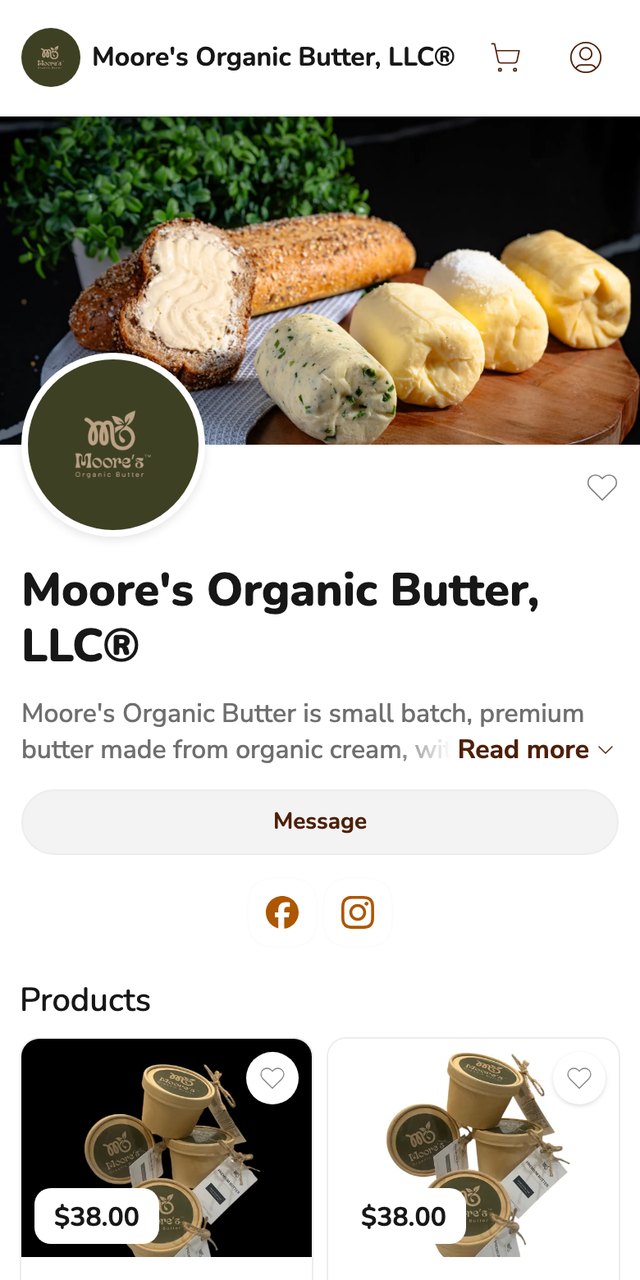
If your butter already sells out at the market and your messages are full of "can I get a pound next week?", you can set up a butter pre-order page on Homegrown and send one link instead of twenty replies.
Add one new place a month, starting with the one that fits the butter you already make, and run it for four weeks before you judge it. Give a new place four weekly cycles, because one rainy Saturday or a holiday week can make a single week look worse than the place really is.
If the first new place is pre-orders, you can open a Homegrown storefront for your butter in an afternoon and have regulars ordering by the weekend.
Experienced butter vendors sell by the week, not by the batch. They know the count before they open the cream, they keep one fixed pickup day, and they can price flavored butter above plain.
What that looks like in practice:
For most small vendors making 10 pounds or more a week, the best place to sell butter is a farmers market booth paired with pre-orders and a weekly pickup window. Under that, start with pre-orders and pickup at home. The market finds new customers with free tastes, and the pickup window keeps them buying between market days. Shops and restaurants come later, once a licensed plant can supply the same amount every week.
Yes, if your butter is made under a route your state allows, such as a licensed dairy plant or a home kitchen in Utah or Wyoming. Utah's law allows home kitchen butter at a direct-to-sale farmers market, which has to be kept separate from a regular market when the two are connected, and Wyoming's lists farmers markets among the places sales may happen. Ask your market manager what paperwork they need for a dairy product before you apply.
Usually not. The FDA Food Code, which state and local health departments build on, says food prepared in a private home may not be used or offered in a food establishment, and Utah's food freedom act bars sales to restaurants and commercial establishments. Wyoming is the exception for stores: a retail shop or grocery may sell home kitchen dairy on its own shelf with a warning label, but not use it in restaurant food.
Only pasteurized butter, never raw. Federal rule 21 CFR 1240.61 bars raw milk products in final package form from interstate commerce. A home kitchen exemption in Utah or Wyoming covers sales inside that state only, so when you work out where to sell butter beyond your state line, only pasteurized butter is in the running.
On Homegrown, the three butter listings that state a size priced a half pound between $8.00 and $11.00 on October 5, 2026, and one shop charged $1 more for flavored butter than plain. Gift sets of four tubs were listed at $38.00, and the one that states a size is four 8 ounce cups. Your own price depends on your cream cost, your market and where you sell butter, since a shop will pay less per pound than a customer at your booth.
Usually, yes. In the nine states our butter permission guide checked, only Utah and Wyoming have a home kitchen route for dairy butter, and even Utah's route still requires a local business license under Utah Code 4-5a-104(2). Maryland and Washington both list milk and dairy products as not allowed for cottage food. Our full butter permission guide covers nine states and the federal rules, and you should verify your own state's current rules before your first sale.
Six guides pick up the 6 questions this one only touches: whether you are allowed to sell butter at all, where raw milk is legal, which states have food freedom laws, how to price a delivery loop, how to pitch a shop or chef, and how to pack a gift box. Each one goes deeper on a single place or rule from the list above, so start with the one that matches the next place you want to add.



