

The short version: Sell a half-pint jar of ghee, which holds about 7.5 ounces, for $18 to $20 when it starts as grass-fed butter, $12 to $14 when it starts as regular store butter, and $28 or more when you use local farm butter. On October 7, 2026, five small-batch ghee brands priced their 7.5 to 9 ounce jars at $14.05 to $28 (median $20), while Walmart's own grass-fed ghee was $8.27 for 13 ounces. Every half-pint takes about 10 ounces of butter, because US butter only has to be 80% milkfat and the rest cooks off or gets strained out, so your butter sets most of your cost: $1.91 a jar in Great Value butter and $5.85 in Kerrygold. Ghee is a dairy product, and of the four states we checked only Utah and Wyoming clearly allow home-kitchen dairy, so check your state before you price a first batch.
Checked on October 7, 2026: six small ghee brands' own product pages and one brand's Homegrown listing, Walmart.com prices for ghee, butter, jars and labels, the federal butter standard at 21 U.S.C. 321a, the home food rules of Michigan, Colorado, Utah and Wyoming on each state's own website, one commercial kitchen's rates, and the fee terms on Homegrown's, Hotplate's and Shopify's pricing pages, Hotplate's blog and Square's fee help article, so verify your state's current rules before your first sale. Homegrown customers create an account to place their first order, and Homegrown has no drops or countdown release feature.
You melted a pound of good butter, skimmed the foam, poured off a golden jar that smells like toasted nuts, and a friend asked if you would sell her one. Then you looked up the price of a jar at the grocery store, saw $8.27, and wondered whether anyone pays $20 for ghee.
They do. Small-batch ghee sells for 1.4 to 5.8 times the grocery price per ounce in the small-brand table below, because it is made in small pots from butter people trust. The catch is that ghee is mostly butter, so your price has to start from what your butter costs, not from a guess. This guide builds the number from prices checked on October 7, 2026: what small ghee brands and one Homegrown vendor charge, what a jar costs you at three butter prices, what your time and a rented kitchen add, which states allow home-kitchen dairy, and what each way of getting paid takes from an $18 jar.
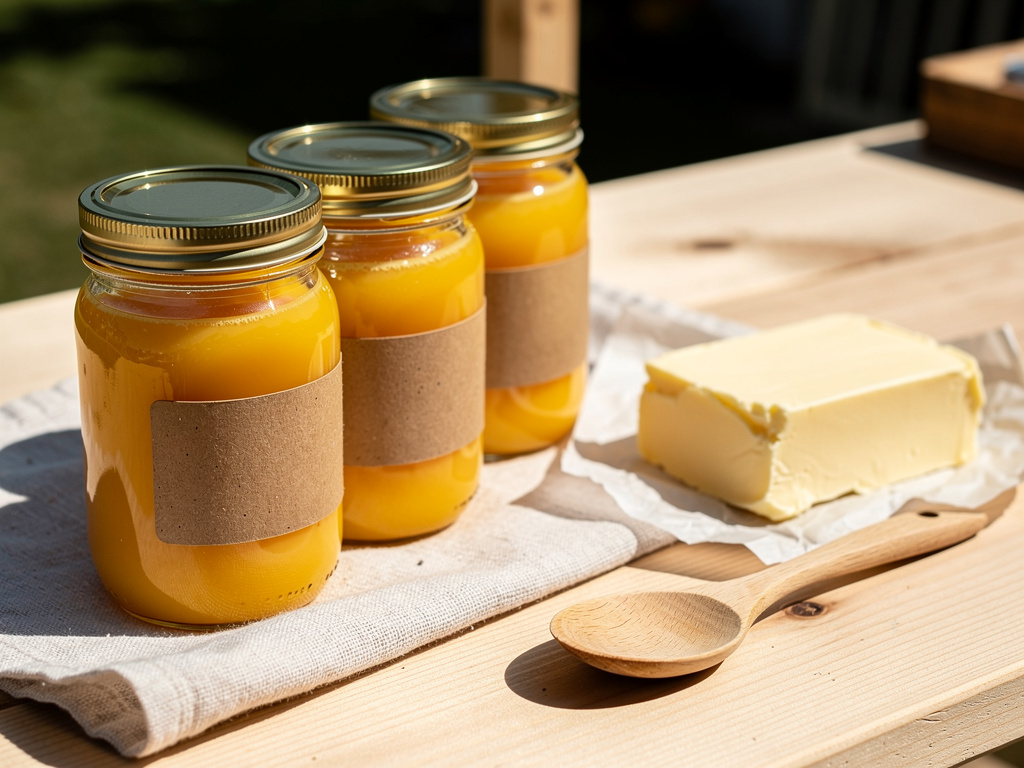
Charge $18 to $20 for a half-pint jar of ghee made from grass-fed butter, $12 to $14 for one made from regular store butter, and $28 to $34 for one made from local farm butter. A half-pint jar is the 8 fluid ounce mason jar, and it holds about 7.5 ounces of ghee by weight. Five of the seven small brands we checked sell a jar in the 7.5 to 9 ounce range, and that is where the $20 median sits.
Here is the ladder to start from, by the butter you buy and the jar you fill:
Swipe sideways to see all three butter prices.
| Jar | Ghee inside (about) | Regular store butter | Grass-fed butter | Local farm butter |
|---|---|---|---|---|
| 4 ounce jar | 3.75 oz | $7 to $8 | $10 to $12 | $16 to $18 |
| Half-pint (8 fl oz) | 7.5 oz | $12 to $14 | $18 to $20 | $28 to $34 |
| Pint (16 fl oz) | 15 oz | $22 to $26 | $32 to $36 | $52 to $60 |
Half-pint prices come from the cost per jar later in this guide (about double your full cost with your time included) and from five small ghee brands' prices checked October 7, 2026. The grass-fed row sits a little under double ($20.60), between those five brands' median per-ounce price on a 7.5 ounce fill ($2.38 x 7.5 = $17.85) and their $20 median jar price. The 4 ounce row scales each half-pint price by about the step Farmtrue uses, whose $12 four ounce jar is 0.6 of its $20 half-pint. The pint row is set from cost instead: a grass-fed pint takes about $18.57 in butter, label and your time before the jar, which doubles to about $37, and a farm-butter pint takes about $31.87, which doubles to about $64, so each sells for a little less than double its cost. That puts every pint at about 1.8 times its half-pint, above the brands' own step, where Farmtrue's 16 ounce jar is 1.6 times its 8 ounce price and Good News Ghee's is 1.36 times its 9 ounce price. To match the brands instead, price a grass-fed pint nearer $28 to $32.
A few things move you up or down that ladder:
If you are still learning cost-plus pricing in general, our guide to pricing food at a farmers market walks through the 2x to 3x rule on other products. And if you are not sure yet whether your state lets you sell dairy from home, start with whether you can sell homemade butter, because the same dairy rules usually decide ghee.
Seven small ghee brands charged $1.79 to $3.11 an ounce for the jars in the table below on October 7, 2026, and the five that sell a 7.5 to 9 ounce jar priced it at $14.05 to $28. Per ounce is the fair way to compare, because nobody uses the same jar.
Slide left to see each brand's price per ounce.
| Brand | Where | Jar | Price | Per ounce |
|---|---|---|---|---|
| Good News Ghee (Traditional) | Asheville, NC, North Asheville Tailgate Market | 9 oz | $28.00 | $3.11 |
| Farmtrue | Berkshires, MA | 8 oz | $20.00 | $2.50 |
| KNEAD Bakehouse + Provisions (cultured) | St. Louis, MO | 8 oz | $19.00 | $2.38 |
| Holy Cow Pure Ghee (on Homegrown) | Glen Ellyn, IL, Elmhurst Farmers Market | 9 oz | $20.00 | $2.22 |
| Nalwaya Foods (Original) | Ventura and Los Angeles County, CA farmers markets | 16 oz | $32.00 | $2.00 |
| Fatworks (cultured, organic butter) | Colorado | 7.5 oz | $14.05 | $1.87 |
| Golden Pure Ghee | Illinois, Winnetka and Libertyville markets | 14 oz | $25.00 | $1.79 |
Each price was loaded from the brand's own product page on October 7, 2026 (KNEAD's through a web reader, because its page draws the price with a script). Holy Cow's comes from its Homegrown listing the same day. Shipping and sales tax are extra where they apply. Not every brand says whether its ounces are weight or fluid ounces (Farmtrue says fluid ounces), so read the per-ounce column as close, not exact.
Within each brand, the bigger jars cost less per ounce. Farmtrue sells 4, 8, 16 and 24 ounce jars at $12, $20, $32 and $45, which is $3.00, $2.50, $2.00 and $1.88 an ounce. Good News Ghee runs $15, $28, $38 and $58 for 2, 9, 16 and 32 ounces. Golden Pure Ghee sells 14 ounces for $25 and 28 ounces for $40, so the big jar saves the customer 36 cents an ounce.
Watch the jar size words, too. Farmtrue's page says its old "9oz" jar is now labeled 8 oz, in the "same exact jars," because it switched to stating fluid ounces. Weigh what your jar actually holds before you print a label, and price by that weight.
Grocery ghee cost 54 cents to $1.28 an ounce on Walmart.com on October 7, 2026, so every small-batch jar in the table above cost more per ounce than every grocery jar we checked. A 7.5 ounce share of Walmart's Great Value grass-fed ghee works out to $4.77.
Drag the table to compare every grocery jar.
| Grocery ghee | Jar | Price | Per ounce | Same as a 7.5 oz jar |
|---|---|---|---|---|
| Servio Grass Fed Traditional Ghee | 10.58 oz | $5.74 | $0.54 | $4.07 |
| Great Value Grassfed Ghee | 13 oz | $8.27 | $0.64 | $4.77 |
| Carrington Farms Organic Ghee | 12 oz | $13.20 (was $14.99) | $1.10 | $8.25 |
| 4th & Heart Original Recipe Ghee | 9 oz | $11.48 | $1.28 | $9.57 |
Prices from Walmart.com search results on October 7, 2026. Per-ounce figures are Walmart's own unit prices where shown, and the price divided by the weight where not.
That gap is your whole business, and it is fine. The person who wants the cheapest fat for frying buys the Great Value jar and was never your customer. Your customer cooks with ghee on purpose, cares where the butter came from, and tastes the difference a slow, small pot makes.
So do not price against the $4.77 jar. Price against the $19 and $20 jars from other small brands, and explain on your sign what makes yours worth it: the butter, the batch size, the cooking time.
Price per ounce of ghee, small-batch jars against grocery jars
Source: each brand's own product page and Walmart.com, October 7, 2026, for jars weighing 7.5 to 13 ounces.
Plan on about 10 ounces of butter for every half-pint jar, because a pound of butter gives you about 12 ounces of ghee. Ghee is butter with the water cooked off and the milk solids strained out, so what is left is the butterfat.
Federal law sets the floor. Under the US definition of butter at 21 U.S.C. 321a, butter has to contain "not less than 80 per centum by weight of milk fat." So a 16 ounce pound of butter holds at least 12.8 ounces of fat. You lose a little in the foam you skim and the browned solids at the bottom of the pot, which is why 12 ounces is a safer planning number.
Here is how that plays out for a batch:
Butters vary above that 80% floor, so weigh your first three batches. If your pound reliably gives you 12.5 ounces, your butter cost per jar drops by about 4%, and your price sheet should use your own number.
Each half-pint of ghee costs you $3.03 in supplies with Great Value butter, $6.97 with Kerrygold grass-fed butter, and $13.62 with local farm butter at $20 a pound, at prices checked on October 7, 2026. Add your time and the totals are $6.36, $10.30 and $16.95.
Swipe to see each butter's full cost per jar.
| Cost per half-pint jar | Great Value unsalted butter | Kerrygold grass-fed unsalted | Local farm butter at $20 a pound |
|---|---|---|---|
| Butter price | $3.06 for 16 oz | $4.68 for 8 oz | $20.00 for 16 oz |
| 10 oz of butter | $1.91 | $5.85 | $12.50 |
| Half-pint jar and lid | $0.91 | $0.91 | $0.91 |
| Waterproof label | $0.20 | $0.20 | $0.20 |
| Supplies total | $3.03 | $6.97 | $13.62 |
| Your time at $20 an hour | $3.33 | $3.33 | $3.33 |
| Full cost | $6.36 | $10.30 | $16.95 |
| Double the full cost | $12.73 | $20.60 | $33.90 |
Butter, jar and label prices from Walmart.com on October 7, 2026: Great Value Sweet Cream Unsalted Butter, Kerrygold Grass-Fed Unsalted foil, a Mainstays 12-pack of 8 ounce wide mouth jars at $10.97, and Avery 2-1/2 inch waterproof film labels at 45 for $9.14. The farm butter price is Selah homestead fl's 1 pound cultured butter on Homegrown the same day. Gas or electricity for the stove, booth fees and insurance are not included, so add your own.
The butter line is the one that matters. With Great Value butter it is 63% of your supplies. With Kerrygold it is 84%, and with farm butter 92%. Jars and labels barely change from one tier to the next.
Butter prices move a lot from year to year. The national average for a pound of salted grade AA butter was $4.02 in August 2026, down from $4.83 in August 2025, in the Bureau of Labor Statistics average price series. A 17% swing in butter is an 11% to 16% swing in your supply cost per jar. Recheck your butter price every few months, and change your ghee price when your cost moves, not just once a year.
The butter you buy sets your ghee price because it is most of the cost and most of the story. A jar made from $20-a-pound farm butter costs you $13.62 in supplies, almost double the $6.97 grass-fed jar, so it has to sell for $28 or more to pay you.
Think of it as three different products:
Do not mix tiers on one price. If you switch from Kerrygold to a neighbor's farm butter for a few batches, give those jars their own label and their own price. Customers notice when the same $20 jar tastes different from week to week.
Local farm butter on Homegrown ran $8 to $11 a half pound on October 7, 2026, in the two listings that state a size, from Harvest House Foods and Selah homestead fl. If a butter vendor near you sells by the pound, ask about a bulk price for 10 pounds at a time. Even $16 a pound instead of $20 cuts your farm-butter jar by $2.50.
Your time adds about $3.33 to each half-pint jar if a 4 pound batch takes you one hour of hands-on work and you pay yourself $20 an hour. That hour covers melting, skimming, straining through cheesecloth, filling, wiping and labeling 6 jars.
The hour is our working estimate, not a rule. Time your own batch from the moment you unwrap the butter to the moment the last label is on, and then divide by the jars you filled:
Bigger batches are where ghee gets efficient. Melting 10 pounds takes longer than 4, but skimming and straining take about the same effort, so the minutes per jar drop. If 10 pounds takes you 1 hour 45 minutes for 16 jars, your time per jar falls to about $2.19.
Do not leave your time out because the stove "does the work." Somebody stands there skimming, and if you price a jar at your supply cost plus a little, you are paying to work your own booth.
Of the 4 states we checked, only Utah and Wyoming have home food laws that clearly cover a dairy product like ghee. Cottage food laws like Michigan's leave dairy out, and our guide to selling homemade butter found the same dairy line in the cottage food rules of California, Georgia, Maryland and Washington. A few states with food freedom laws allow home-kitchen dairy (the list of food freedom states linked at the end of this section shows which ones), and some states let you make it in a rented licensed kitchen instead. No state page we loaded lists ghee sold by the jar as an allowed cottage food.
Here is what the 4 states we checked said on their own pages on October 7, 2026:
Under W.S. 11-49-103, sales under the Food Freedom Act must "Occur only in Wyoming" and must not involve interstate commerce. A retail shop can sell your home-kitchen dairy products, but it has to keep them off the shelf with licensed food and label them "this food was made in a home kitchen, is not regulated or inspected and may contain allergens." Our Wyoming cottage food law guide covers the rest of the act.
A state saying yes to home dairy is not the same as your farmers market saying yes to your ghee. Ask your market manager what they need from a dairy vendor before you book a booth. We checked these rules on October 7, 2026, and dairy rules change by statute and by rule, so call your health or agriculture department before you price a first batch.
If your state says no to home-kitchen dairy, the common legal route is a licensed commercial kitchen, which the next section prices. Renting the kitchen does not license you, though. Capital Kitchens' rates page tells clients they also need a Food Enterprise Permit from the City of Austin, so plan on your own food license from your city or state, and ask your agriculture department whether a dairy permit applies too. Our list of food freedom states shows which other states have laws like Utah's and Wyoming's.
A rented kitchen adds $3.61 to $8.25 to each half-pint jar if you fill 48 to 120 jars a month at a kitchen with a $396 monthly minimum. Capital Kitchens in Austin, Texas, listed $33 an hour for its main kitchen on October 7, 2026. Its 12-hour monthly minimum comes to $396 a month.
Here is how the minimum spreads across your jars:
Slide the table for rent at each batch size.
| Jars made in a month | Kitchen hours at 16 jars per 1 hour 45 minutes | Rent for the month | Rent per jar | Grass-fed jar full cost with rent | Price that doubles it |
|---|---|---|---|---|---|
| 48 half-pints (30 lb of butter) | About 5.3 | $396.00 (the minimum) | $8.25 | $17.40 | $34.81 |
| 80 half-pints (50 lb of butter) | About 8.8 | $396.00 (the minimum) | $4.95 | $14.10 | $28.21 |
| 120 half-pints (75 lb of butter) | About 13.1 | $433.13 | $3.61 | $12.76 | $25.53 |
Rent from Capital Kitchens' rates page on October 7, 2026 ($33 an hour, 12-hour monthly minimum, $396 for equipment users). Rent is the kitchen hours times $33, never less than $396. Hours use the big-batch pace from the time section above, 10 pounds of butter into 16 jars in 1 hour 45 minutes, so 120 jars runs past the 12-hour minimum. Full cost uses the Kerrygold jar's $6.97 in supplies plus $2.19 of your time a jar at that same big-batch pace, plus rent. The same page also asks for a certificate of $1,000,000 general liability insurance, a security deposit of one month's rent, and electricity and equipment storage charges if you bring in equipment, none of which are included here.
The lesson is volume. At 48 jars a month, rent alone pushes a grass-fed jar past what most customers will pay. At 120 jars, you are back near the $20 to $28 range that small brands already charge. Ghee suits a rented kitchen better than most dairy, because small brands like Good News Ghee sell it as shelf stable, so you can make a month of jars in two long sessions.
Before you sign, read our guide to renting a commissary kitchen, which covers what kitchens ask for and how to compare hourly and monthly plans.
Sell a 4 ounce jar of grass-fed ghee for $10 to $12 and a pint for $32 to $36, so the small jar costs more per ounce and the pint costs less. The small brands step the same direction, a little more gently on the pint: Farmtrue charges $12 for 4 ounces, $20 for 8 and $32 for 16, and Nalwaya Foods charges $32 for its 16 ounce Original jar. Our pint sits a few dollars above that step because it is priced from what a grass-fed pint costs you, about $18.57 before the jar, so pricing it at $28 to $32 matches the brands but keeps less for you.
Each size has a job:
Flavored ghee, with garlic, herbs, chili or spices stirred in, should start from the plain jar's price plus what the add-in costs you, plus a dollar or two for the extra step. Garlic and fresh herbs raise food safety questions in a fat like ghee. Michigan's cottage food list, for one, rules out oils flavored with fresh herbs or with garlic, fresh or dried, so ask your health department before you add either. Dried spices are the simpler place to start.
If a customer asks for a size you do not sell, say a 32 ounce jar for a big family, price it from the pint. Good News Ghee charges $58 for 32 ounces against $38 for 16, so the second pint costs the customer $20 instead of $38.
Yes, one vendor: Holy Cow Pure Ghee, from Glen Ellyn, Illinois, sells a 9 ounce jar for $20.00, a 2-jar bundle for $38.00 and a 3-jar bundle for $54.00 on Homegrown, as of October 7, 2026. Its storefront lists pickup at the Elmhurst Farmers Market on Wednesdays from 7:00 AM to 1:00 PM and local delivery within 5 miles with a $20.00 minimum order.
In a pull of the Homegrown catalog on October 7, 2026, 3 of the 2,907 products listed by 310 vendors were ghee, all from Holy Cow Pure Ghee: Original Ghee 9 oz at $20.00, the 2-Jar Bundle at $38.00, and the 3-Jar Bundle, described as "three 9oz jars," at $54.00. We searched every listing's name and full description for ghee, clarified butter, butter oil, brown butter and tallow, then read each match by hand. The brown butter matches were cookies and blondies, and the tallow matches were skin balms and beef tallow, so none of them were counted.
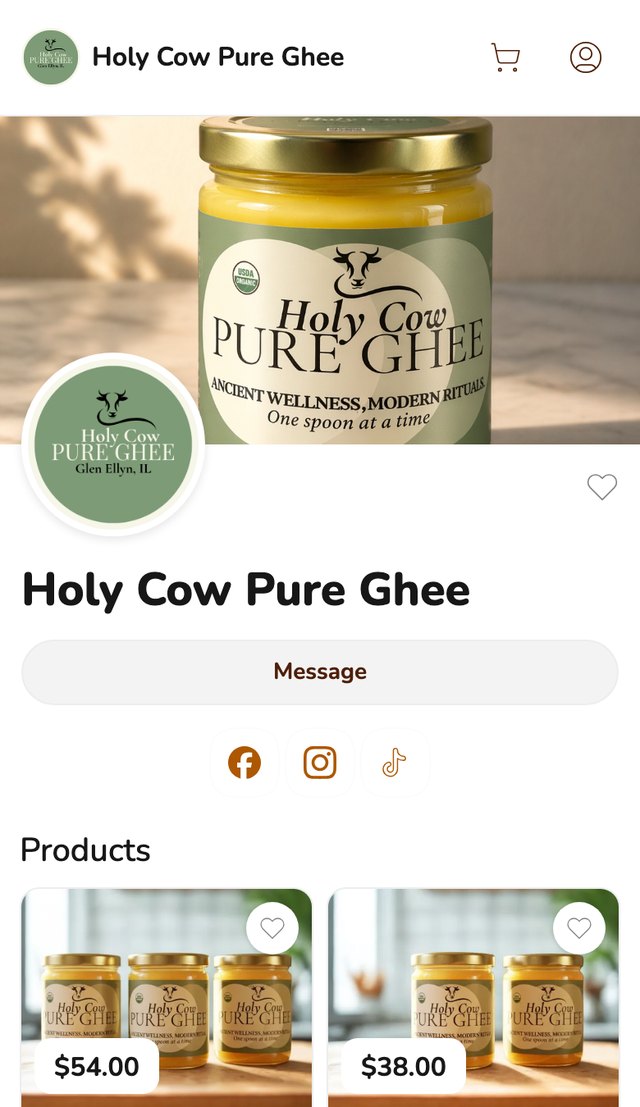
Holy Cow's $20 jar works out to $2.22 an ounce, right in the middle of the small-brand table above. Its listing describes the ghee as "100% Grass-Fed & Pasture-Raised," and its bundle listing says it is made from "organic grass-fed butter." That is the grass-fed tier, and the price matches it.
With only one ghee vendor on the marketplace, there are not many local prices to compare against yet. That cuts both ways. You will not be undercut by a neighbor on Homegrown this month, and you also cannot lean on a crowd of listings to tell you what your area pays, so your own cost table matters more.
Yes, a bundle priced a little under the singles gets a regular to take two or three jars home at once, and Holy Cow Pure Ghee shows how small that gap can be. Its listing marks the 2-jar bundle as the one that sells best. Its 2-jar bundle is $38, which is $19 a jar and $2 off two singles. Its 3-jar bundle is $54, which is $18 a jar and $6 off three.
The math works because most of your costs repeat for every jar, but a few do not:
Watch the per-jar margin, though. On a grass-fed jar that costs you $10.30 with your time, $18 a jar in a 3-jar bundle still keeps you $7.70 before card fees, while a $15-a-jar bundle would keep only $4.70.
Pair ghee with something it goes on instead of cutting its price. A half-pint of ghee next to a loaf of sourdough or a dozen eggs sells as "breakfast" without dropping either price. If you already sell butter, your ghee is the long-keeping cousin on the same table, and our guide to where to sell butter covers the gift sets and bundles that work for both.
Once you know your bundle prices, put them where regulars can reorder without texting you. A Homegrown storefront lets you list the single jar and each bundle at its own price, so a customer who finished her jar can grab two more before Wednesday's market.
Selling fees take 62 cents to $2.27 from an $18 jar of ghee, depending on how the customer pays, and on one pre-order app the customer pays an extra $1.45 on top unless you cover it. Across 40 jars a month, that runs $24.72 to $90.88, plan costs included.
Scroll right to see every fee column.
| Platform | Monthly plan | Trial | Platform fee | Card processing | Customer pays on an $18 jar | You pay on an $18 jar | You pay in a month of 40 jars |
|---|---|---|---|---|---|---|---|
| Homegrown | $10 billed annually ($12.50 billed monthly) | 7 days, no charge until day 8 | None, 0% commission | 2.9% + $0.30, paid by you | $18.00 | $0.82 plus the plan | $42.88 ($45.38 on monthly billing) |
| Hotplate, default setting | $0 | No plan to try | 5% + $0.55, paid by the customer | 2.9% + $0.30, paid by you | $19.45 | $0.82 | $32.88 |
| Hotplate, you cover its fee | $0 | No plan to try | 5% + $0.55, paid by you | 2.9% + $0.30, paid by you | $18.00 | $2.27 | $90.88 |
| Square Free plan, online order | $0 | No plan to try | None | 3.3% + 30¢, paid by you | $18.00 | $0.89 | $35.76 |
| Square Free plan, card tapped at your table | $0 | No plan to try | None | 2.6% + 15¢, paid by you | $18.00 | $0.62 | $24.72 |
| Shopify Basic | $29 billed yearly ($39 billed monthly) | 3 days, then $1 a month for 3 months | None with Shopify Payments (2% with another provider) | 2.9% + 30¢ online, paid by you | $18.00 | $0.82 plus the plan | $61.88 ($71.88 on monthly billing) |
Fees from each company's own pricing page, checked October 7, 2026: findhomegrown.com/signup, Hotplate's pricing page and its blog post "What Hotplate does," Square's processing fees help article, and Shopify's pricing page. Card processing is figured on the $18 price; Hotplate's own example charges it on the subtotal plus tip and tax, which runs a few cents higher. Shipping, sales tax and Shopify's $1-a-month promo months are not included; the Shopify row uses its regular plan price.
The cheapest row, a card tapped at your table on Square's Free plan, only applies when the customer is standing in front of you. The same $18 jar ordered online on that plan pays 89 cents. For pre-orders between market days, the real comparison is the online rows.
Hotplate's pricing page says you can pay its fee yourself or pass it on to customers, "your choice." Its own blog post "What Hotplate does" says that by default "we charge a fee to your customer" and that "80% of Hotplate chefs keep the default as-is." So an $18 jar reads as $19.45 at checkout unless you change the setting, and changing it costs you $1.45 a jar. Either way, you also pay Hotplate's 2.9% + $0.30 card processing. We checked both pages on October 7, 2026.
Forty half-pint jars of grass-fed ghee at $18 bring in $720 and leave you about $265 after butter, jars, labels, Homegrown's fees and $20 an hour for your time. That works out to about $6.63 of profit per jar after you pay yourself.
Here is the month, step by step:
Change one number and see what happens. At $20 a jar instead of $18, the same month leaves $342.78 after your time. At $14 a jar, it leaves $109.74, or about $2.74 a jar on top of your wage, which is thin enough that one ruined 4 pound batch, $37.44 of Kerrygold butter, would take about a third of it. That is why the grass-fed tier wants $18 to $20, not $14.
These numbers assume a home kitchen your state allows. If you rent a kitchen with a $396 monthly minimum, 40 jars cannot carry it at $18. Counting the card fee and Homegrown's $10 plan, you would need about 51 jars a month at the big-batch pace, or about 59 at the home pace, before rent stops eating into your $20-an-hour wage. You would need closer to 120 jars, or a higher price, before an $18 jar earns much on top of that wage: at 120 jars it leaves about $4.33 a jar.
Ghee gets used a spoonful at a time, so the customer who loved your first jar will want another one when it runs out, and the vendor who makes that reorder easy keeps her. The problem is where that reorder lands: a text, a comment, or a hope that she remembers to stop by your table.
Homegrown is $10 a month billed annually ($12.50 billed monthly) with no percentage fees beyond standard payment processing, and it gives your jars their own storefront that customers order and pay from before pickup. Compare that with what a ghee vendor usually weighs. Hotplate costs $0 a month but adds 5% + $0.55 to the customer's total by default, so your $18 jar shows as $19.45, and you still pay 2.9% + $0.30 to process each card. Square's Free plan costs $0 a month but takes 3.3% + 30¢ on each online order, 7 cents more than Homegrown on every $18 jar, though at 40 jars a month Square's $35.76 still comes in under Homegrown's $42.88 with the plan. Shopify Basic does far more than a ghee table needs at $29 a month billed yearly plus 2.9% + 30¢ a card payment.
What it gives a ghee vendor:
What it does not do: Homegrown does not check whether your state allows home-kitchen ghee. It is built for pickup and local delivery, not shipping jars across the country. It cannot sell by weight yet (price by weight is on its roadmap), so list fixed jar sizes. Card processing of 2.9% + $0.30 is paid by you, with no option to add it to the customer's total. Customers create a Homegrown account the first time they order, there is no drops or countdown release feature, and while your storefront is listed on the Homegrown marketplace, plan on most orders coming from people you send to your own link.
Your ghee label should name milk as an allergen, because ghee is made from butter and the FDA lists milk as one of the nine major food allergens. Label rules for homemade food vary by state, and Wyoming's Food Freedom Act, for one, exempts most homemade food from state labeling requirements (shop sales still need the home-kitchen label covered below), but a customer with a milk allergy still needs that line. FDA's labeling guide shows two ways to do it: name the source in the ingredient list, or add a "Contains" statement next to it, such as "Contains: milk."
Several small brands advertise their ghee as lactose and casein free, including Holy Cow Pure Ghee and Good News Ghee. You can say what is true about your ghee, but a "lactose free" claim does not remove milk from the allergen line. A customer with a milk allergy reads that line first.
Beyond the allergen line, check your own state's label list before you print. Our guide to the nine major allergens on a cottage food label shows how to write the allergen line so it is easy to read. In Wyoming, home-kitchen dairy sold through a shop must carry the exact sentence "this food was made in a home kitchen, is not regulated or inspected and may contain allergens."
A few label choices change your price, too:
Buy waterproof film labels, not paper. Ghee gets on everything when you fill jars, and a greasy paper label looks old by market day. On Walmart.com on October 7, 2026, Avery's 2-1/2 inch film labels cost 20.3 cents each against 7.6 cents for 2 inch paper ones. Spending 13 cents more a jar keeps a $20 jar looking like a $20 jar.
The costliest ghee pricing mistake is setting your price from the grocery jar, which puts a $4.77 Great Value equivalent next to a jar that costs you $6.97 in grass-fed butter, glass and a label. The rest are smaller, but they add up across a month.
If ghee is one of several dairy products on your table, our guide to how much to sell cheese for builds its prices the same way, from milk cost up.
Charge $18 to $20 for a half-pint of grass-fed ghee, which holds about 7.5 ounces. The median small-batch jar of that size sold for $20 on October 7, 2026, across five brands ranging from $14.05 to $28. If you price ghee made from regular store butter, $12 to $14 is a fair range, and ghee made from local farm butter needs $28 or more.
Making one half-pint costs about $3.03 in supplies with Great Value butter and $6.97 with Kerrygold grass-fed butter, at Walmart.com prices on October 7, 2026. That covers 10 ounces of butter, a mason jar and lid, and a waterproof label. Add about $3.33 for an hour's work spread over a 6-jar batch at $20 an hour.
Ghee is expensive because it takes about 10 ounces of butter to make 7.5 ounces of ghee. US butter only has to be 80% milkfat by law, so the water and milk solids cook off or get strained out, and you pay for butter you do not keep. Small-batch ghee adds slow cooking in small pots and, often, grass-fed or cultured butter.
A pound of butter makes about 12 ounces of ghee. Federal law requires butter to be at least 80% milkfat, so a 16 ounce pound holds at least 12.8 ounces of fat, and a little is lost in the foam and the solids you strain out. Weigh your own batches, since higher-fat butters can give you a bit more.
Only in a state that allows home-kitchen dairy, or if you make it in a licensed kitchen. Michigan's cottage food list rules out "milk and dairy products," while Utah and Wyoming allow some homemade dairy sold to a buyer who is told it is not inspected (Utah leaves out raw dairy, and Utah Code 4-5a-103 requires a separate, signed direct-to-sale area when homemade-food sales are tied to a regular farmers market), as of October 7, 2026. Ask your health department and your market manager before you price ghee for a booth.
Price ghee by the jar, but set each jar's price from a per-ounce target. Small brands priced their 7.5 to 32 ounce jars at $1.43 to $3.11 an ounce when we checked on October 7, 2026, and within each brand the smaller jars cost more per ounce. A shopper compares jars, so a sign that says "$20 half-pint, $32 pint" sells faster than a price per ounce.
Five guides pick up the questions this one only touches: whether your state allows home dairy at all, where dairy sells, how other dairy and jar products are priced, and the cost rule under every price on your table.
Small-batch ghee sells for around $20 a jar (from $14.05 to $28 for 7.5 to 9 ounces in the jars we checked) because the butter, the slow pot and your name are worth it, and you keep that money when customers can reorder the jar they just finished. Price your jars from your own butter cost, weigh what each jar holds, and give regulars a pint and a bundle to grow into. Then make the next jar easy to order, whether that is a 4 ounce jar for a first-timer or a 3-jar bundle for the family that cooks with ghee every morning. A customer who taps one link on Tuesday to reserve two half-pints for Wednesday's market is a customer you never have to chase by text, and a batch you start already knowing how many jars to fill. If taking ghee orders ahead of market day sounds easier than answering texts, you can set up your Homegrown storefront and list your first jar sizes tonight.