
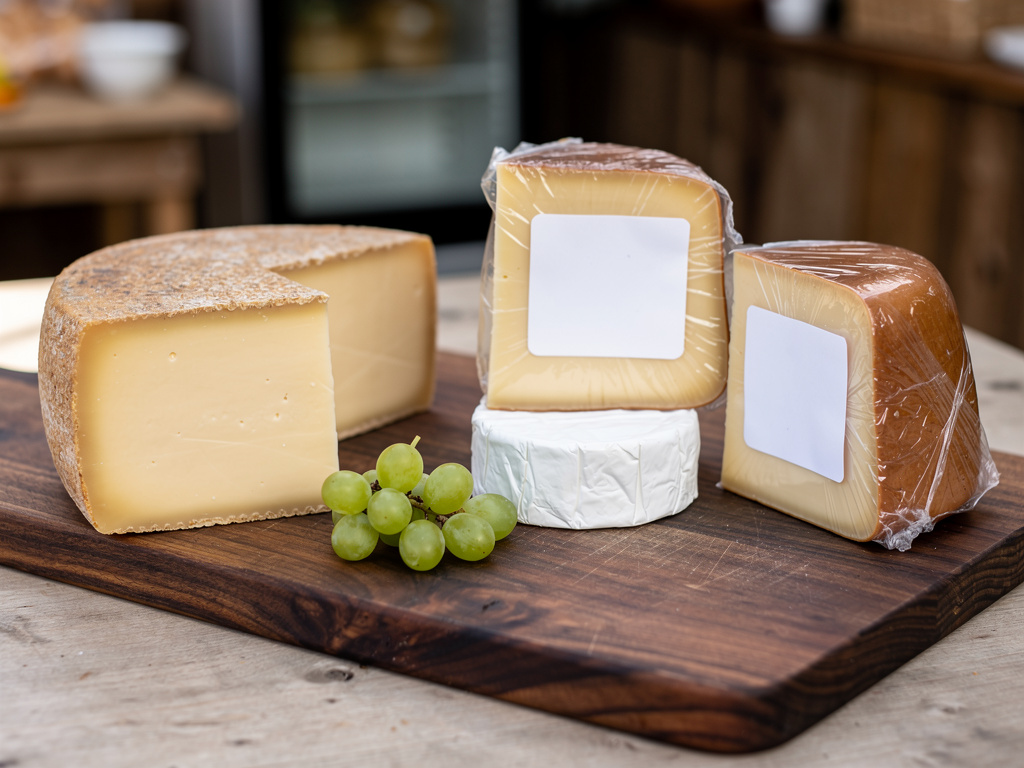


The short version: Small creameries, farm stores and cheese shops charged $16 to $30 a pound for cheddar and gouda and $14 to $48 a pound for fresh goat cheese on their shop pages on September 30, 2026, while grocery cheddar averaged $5.98 a pound in August. A pound of hard cheese takes about 10 pounds of milk, which is about $4.98 of milk at the August grocery price, and your labor usually costs more than the milk. Our worked 20-gallon batch costs $17.61 a pound, so a $12 half-pound wedge ($24 a pound) is a fair starting price for aged cheese. Smoked gouda cost the same as plain at both creameries we checked that make both in the same size. These prices assume you make cheese in a licensed make room or creamery, because 7 of the 9 states our permission guide checked, counting Texas where a dairy permit rule appears to apply, give a home kitchen no way to sell it.
Checked on each seller's shop page, September 30, 2026: the per-pound prices, the goat milk price and the fees of the four ordering platforms compared below come from pages loaded that day. Grocery prices are the Bureau of Labor Statistics averages for August 2026. Honest bounds: labor, packaging and trim in the worked batch are our planning numbers, not measurements, and prices vary by region. Homegrown customers create an account to place a first order, and Homegrown has no drops or countdown release feature.
A customer at your booth tastes the aged cheddar, nods, and asks what a pound costs. You made it from 20 gallons of milk and turned it every week for two months, and you still have no idea whether $12 or $30 is the right answer. The easiest cheese prices to find are for grocery shelves and 40-pound blocks sold by the truckload, not a few dozen wedges sold by name.
This guide builds your price from numbers loaded on September 30, 2026: what cheese costs at the grocery store, what small creameries charge per pound, how much milk a pound takes, what a batch really costs, and what selling fees take. It assumes you already have a legal place to make it. Cheese is a dairy product, and 7 of the 9 states checked in our guide to whether you can sell homemade cheese give a home kitchen no way to sell it, counting Texas, where a dairy permit rule appears to apply. That guide walks through the state rules, the license routes and the two food freedom states that allow direct sales to informed customers in the state.
Sell aged cheddar, gouda and similar hard cheeses for $20 to $26 a pound, usually as $10 to $13 half-pound wedges, and fresh goat cheese for $24 to $32 a pound. Fresh cow cheeses like ricotta and curds sit lower, around $14 to $18 a pound. Those ranges come from what 10 small cheese sellers charged on September 30, 2026, checked against what a batch costs to make.
Here is how the main types line up:
Scroll sideways to see every column.
| Cheese type | Suggested price per pound | Typical wedge or tub | What small creameries and shops charged per pound | What drives it |
|---|---|---|---|---|
| Aged cheddar, colby, gouda (cow) | $20 to $26 | Half pound for $10 to $13 | $16.00 to $21.88 | About 10 lb of milk per lb, weeks or months of aging |
| Smoked gouda or cheddar | Same as plain, or $1 to $2 more | Half pound for $10 to $14 | $18.64 to $30.00 | Smoking time and wood, a small moisture loss |
| Fresh goat cheese (chèvre) | $24 to $32 | 4 oz for $6 to $8 | $14.00 to $48.00 | Goat milk costs far more than cow milk |
| Flavored chèvre (herbs, honey, pepper) | $0 to $6 a pound over plain | 4 oz for $6 to $9 | $30.00 herbed vs $24.00 plain at one creamery; herb garlic priced the same as plain at another | Add-ins and extra handling |
| Ricotta, curds, fresh mozzarella (cow) | $14 to $18 | 8 oz for $7 to $9 | $15.98 to $20.00 (curds and farmer's cheese at two creameries) | High yield, sells within days |
Per-pound prices were loaded from each seller's shop page on September 30, 2026, and divided out from the package size shown. The suggested ranges are ours, built from those prices and the batch costs below. Flavored chèvre compares Monteillet Fromagerie's plain and herbed fresh cheese, which is a goat and sheep milk blend. Smith's Country Cheese lists its herb garlic fresh farmer's cheese, a cow milk cheese, at the same $10.00 as its traditional one.
Our hard cheese range sits a little above the $16.00 to $21.88 that the sellers in the table below charged for plain aged cheese, because a new cheesemaker buying milk pays more per pound than a larger or herd-owning creamery, as the batch math below shows. Start at the middle of the range if you are new. Move up if your cheese is aged longer than 3 months or your market already has shoppers who ask about the farm. Move down if a larger creamery sells at the same market for less, or if most of your sales will be half-pound wedges to first-time buyers.
A pound of natural cheddar cost $5.98 on average at US grocery stores in August 2026, and a pound of American processed cheese cost $4.75, according to the Bureau of Labor Statistics average price series (published on FRED, loaded September 30, 2026). That is the price your customer has in their head when they walk up to your table.
Behind the grocery shelf there is an even lower number. Wholesale 40-pound blocks of cheddar averaged $1.61 a pound for the week ending September 5, 2026, in the USDA dairy product sales report quoted in the Economic Research Service's September outlook. That is the price big plants get for cheese made by the ton.
You cannot win on price against either one, and you should not try. What a small cheesemaker sells is closer to what a cheese counter sells: a named cheese, a story about the milk, and a taste the customer can compare. The same holds one step further down the line: melted into queso, a pound of cheese becomes pints that small markets and restaurants sold for $8 to $16.99 in October 2026, and our guide to pricing queso shows why $12 to $14 a pint is the range that pays once kitchen rent is counted.
What a pound of cheese sells for, by where it is sold
Source: BLS average price for August 2026 via FRED; USDA ERS Livestock, Dairy, and Poultry Outlook, September 17, 2026; each seller's shop page loaded September 30, 2026. Each per-pound bar is the listed price scaled to 16 ounces.
Three things the grocery number is useful for:
The 10 small cheese sellers checked on September 30, 2026 charged $14.00 to $48.00 a pound, with most hard cheeses between $18 and $26. Every price below is the price on that seller's shop page that day, divided out to a pound. Six are creameries, farms or dairy stores selling cheese they make, one is a creamery that smokes a cheese made by another farm, three are stores selling cheese made by others, and the table says who made it.
Swipe left to see every column.
| Creamery or store | Cheese | Package | Price | Per pound |
|---|---|---|---|---|
| Babcock Dairy Store (University of Wisconsin-Madison) | Aged cheddar, 12 to 15 months | 1 lb / half lb | $16.00 / $9.00 | $16.00 / $18.00 |
| Tussock Sedge Farm (farm store; made by Alpine Heritage Creamery) | Raw milk mild cheddar, aged 2 to 4 months | 8 oz | $10.94 | $21.88 |
| Keystone Farms Cheese (cheese shop; made in Wisconsin) | Gouda | 12 oz | $16.00 | $21.33 |
| Marcoot Jersey Creamery | Gouda | 6 oz | $6.99 | $18.64 |
| Smith's Country Cheese | Farmstead gouda | 8 oz | $10.00 | $20.00 |
| Crooked Face Creamery (made by Springdale Farm, smoked by Crooked Face) | Applewood smoked gouda-style | Half lb | $15.00 | $30.00 |
| Julian Farms | Chèvre | 8 oz | $7.00 | $14.00 |
| Prairie Fruits Farm (price from Farmstead Foods, a retailer) | Chèvre | 6 oz | $8.95 | $23.87 |
| Stepladder Creamery | Chèvre | 6 oz | $18.00 | $48.00 |
| Monteillet Fromagerie | Fresh chèvre, goat and sheep milk | Per lb | $24.00 | $24.00 |
| Marcoot Jersey Creamery | Fresh cheese curds | 7 oz | $6.99 | $15.98 |
| Smith's Country Cheese | Traditional fresh farmer's cheese | 8 oz | $10.00 | $20.00 |
We checked each price on the seller's shop page on September 30, 2026. Tussock Sedge Farm and Keystone Farms Cheese sell cheese made by others, and the Prairie Fruits price comes from Farmstead Foods, a retailer in Benton, Illinois. Shipping, insulated boxes and sales tax are extra where they apply. Prices move with the season and the milk, so check a few cheesemakers near you before you set yours.
The pattern worth noticing is the spread inside one type. Julian Farms and Stepladder both sell plain chèvre, and one charges more than three times the other per pound. Both are goat milk cheeses, so the gap most likely comes from the market each one sells into, the awards one can point to (Stepladder's page lists three California State Fair medals) and how the cheese is packed. Your own number should come from your costs first, then from what shoppers at your market already pay.
About 10 pounds of milk make 1 pound of hard cheese, which is a little under 1.2 gallons. That rule of thumb comes from the Michigan State and Purdue extension bulletin Making Cheese at Home, which also says a gallon of milk weighs 8.5 pounds, that a moist fresh cheese like queso blanco yields about 1 pound per gallon, and that a dry, long-aged cheese like Romano yields only about 3/4 of a pound.
That makes milk the number to learn first. Here is what the milk alone costs per pound of cheese at two prices: the average grocery price of whole milk in August 2026 ($4.23 a gallon, Bureau of Labor Statistics), and the average price US dairy farmers received for their milk in August ($19.80 per hundred pounds, from the USDA's Agricultural Prices report of September 29, 2026).
Slide the table to read the farm-price column.
| Cheese style | Cheese from 1 gallon | Milk per pound of cheese | Milk cost per pound, grocery milk ($4.23/gal) | Milk cost per pound, farm price ($19.80/cwt) |
|---|---|---|---|---|
| Fresh and moist (queso blanco, farmer's cheese) | About 1 lb | 1 gallon (8.5 lb) | $4.23 | $1.68 |
| Hard cheese (cheddar, gouda, colby) | About 0.85 lb | About 1.18 gallons (10 lb) | $4.98 | $1.98 |
| Dry, long-aged (Romano style) | About 0.75 lb | About 1.33 gallons (11.3 lb) | $5.64 | $2.24 |
Yields are the rules of thumb from a 1981 home cheesemaking bulletin (Michigan State University Extension E-1617, written by two Purdue University specialists). Its archive copy is marked not for current recommendations, so treat these yields as a starting estimate. Milk prices: BLS average price of fresh whole milk for August 2026, loaded from FRED on September 30, 2026, and USDA NASS all milk price for August 2026. Your own yield depends on your milk's fat and protein, so weigh your batches.
The two columns are the most important gap in this guide. A cheesemaker buying milk at grocery prices pays about $3.00 more per pound of hard cheese than the farm average, before anything else. A small cheesemaker buying milk rarely pays as little as the farm average either, since that figure is what farmers receive on average from the plants that buy their milk, but the gap shows why cheese from your own animals or a neighbor's dairy can sell for less and still pay. If you sell fluid milk as well, our guide to pricing raw milk covers that side of the dairy.
Weigh the milk going in and the cheese coming out of your first five batches, and write both down. If 20 gallons gives you 15 pounds instead of 17, your cost per pound is about 13% higher than any rule of thumb says, and your price should follow your scale, not this table.
Our worked batch of aged cheddar-style cheese costs $17.61 a pound, or $8.81 per half-pound wedge, when you buy milk at grocery prices and pay yourself $20 an hour. The same batch costs $14.43 a pound with milk at the farm price. Milk is the biggest single ingredient, but labor is the biggest single cost.
The example is a 20-gallon batch: 170 pounds of milk, about 17 pounds of cheese, and 16 pounds you can sell after trimming rind and the odd cracked piece, cut into 32 half-pound wedges. The milk price is loaded; the other lines are our planning numbers, so swap in yours.
Swipe left to see both milk prices.
| Cost line | Grocery milk | Farm-price milk | Where the number comes from |
|---|---|---|---|
| Milk, 20 gallons (170 lb) | $84.58 | $33.66 | $4.229 a gallon (BLS, August 2026) or $19.80 per 100 lb (USDA, August 2026) |
| Cultures, rennet, salt, wax | $8.00 | $8.00 | Our estimate; the extension bulletin calls these minor next to milk |
| Labor, 8 hours at $20 | $160.00 | $160.00 | Our estimate: make day, pressing, and weekly turning while it ages |
| Packaging, 32 wedges at $0.60 | $19.20 | $19.20 | Our estimate for a vacuum bag and a label per wedge |
| Aging space and power | $10.00 | $10.00 | Our estimate for a share of a cheese fridge for two months |
| Total for 16 sellable pounds | $281.78 | $230.86 | |
| Cost per pound | $17.61 | $14.43 | |
| Cost per half-pound wedge | $8.81 | $7.21 |
Milk prices loaded September 30, 2026. Every other line is a planning estimate, not a measurement. The math: 20 gallons × 8.5 lb = 170 lb of milk, ÷ 10 = 17 lb of cheese, 16 lb sold.
Leave out your own time and the batch looks like it costs $121.78, or $7.61 a pound. That is the number that talks new cheesemakers into $12-a-pound prices. At $12 a pound, the 16 pounds bring in $192, which pays you about $8.78 an hour for the 8 hours, before card fees and the market booth.
A few costs do not fit on the batch sheet but still come out of the price:
If you want to build the same sheet for other products you sell, our guide to the real cost per item of a food business walks through the method line by line.
Divide your cost per pound by one minus the margin you want, then round to a clean wedge price. At $17.61 a pound and a 25% margin, that is $17.61 ÷ 0.75 = $23.48 a pound, which rounds to a $12 half-pound wedge. At 35% it is $27.09 a pound, about $13.50 a wedge.
At a $12 wedge, the worked batch earns $6.39 a pound, or $102.22 across 32 wedges, after paying you $160 for your time. That is a real business, but a small one, which is why the price should not drift down to meet the grocery store.
Sell plain chèvre for $24 to $32 a pound, usually $6 to $8 for a 4-ounce tub or log, and charge $0 to $6 a pound more for flavored versions. Four chèvres checked on September 30, 2026 sold for $14.00 to $48.00 a pound, with Prairie Fruits Farm's at $23.87 on a retailer's shelf and Monteillet's own $24.00 in the middle. Monteillet's fresh cheese is a goat and sheep milk blend.
Goat cheese has one cost problem cow cheese does not: the milk. A quart of Meyenberg fresh whole goat milk was listed at $6.99 on Meijer's site (read September 30, 2026), or $27.96 a gallon, more than six times the grocery price of cow milk. The chèvre culture sold by New England Cheesemaking Supply is $9.95 for five packets, one packet per gallon, and the company says each gallon makes about 2 pounds of cheese.
Here is a 5-gallon batch made from store-bought goat milk:
Slide sideways for the goat milk batch.
| Cost line | Amount | Where the number comes from |
|---|---|---|
| Goat milk, 5 gallons | $139.80 | $6.99 a quart, Meijer.com, September 30, 2026 |
| Chèvre culture, 5 packets | $9.95 | New England Cheesemaking Supply, September 30, 2026 |
| Labor, 2 hours at $20 | $40.00 | Our estimate: heating, draining, salting, packing |
| Packaging, 20 eight-ounce tubs at $0.60 | $12.00 | Our estimate for a tub and a label |
| Total for about 10 lb (20 tubs) | $201.75 | |
| Cost per pound / per 8 oz tub | $20.18 / $10.09 |
Yield uses the culture company's "approximately 2 pounds" per gallon. If you drain your chèvre firmer and get 1.5 pounds per gallon, milk and culture alone rise from $14.97 to $19.97 a pound. Prices loaded September 30, 2026.
At that cost, chèvre from store-bought goat milk needs about $27 a pound, or $13.50 for 8 ounces, to earn a 25% margin. That is above three of the four chèvre makers in the table. Two of those three, Julian Farms and Monteillet, say on their own pages that the milk comes from their own animals. Stepladder, priced well above that line, calls its chèvre farmstead goat milk. Chèvre pays when the milk costs you less than the grocery store charges. If you keep goats, our guide to selling goat milk products locally covers soap, milk and cheese side by side, and why milk, cheese and yogurt all need a state dairy license while soap does not.
Flavored chèvre can earn a bit more, but not every maker charges extra for it. Monteillet Fromagerie charged $24 a pound for its plain fresh cheese and $30 for the herbed one on September 30, 2026, a 25% step up for herbs grown on the farm. Smith's Country Cheese lists its herb garlic fresh farmer's cheese at the same $10.00 as its traditional one. Honey, cracked pepper and dried fruit work the same way: price the add-in, then add a dollar or two for the extra handling.
Charge the same for smoked cheese as for the plain version, or $1 to $2 a pound more. Both creameries checked on September 30, 2026 that make and list a smoked and a plain gouda in the same size charged exactly the same price for both. A cheese shop that sells Wisconsin-made gouda charged $1.33 a pound more for smoked.
Swipe to compare smoked and plain.
| Seller | Size | Plain gouda | Smoked gouda | Difference per pound |
|---|---|---|---|---|
| Marcoot Jersey Creamery | 6 oz | $6.99 ($18.64/lb) | $6.99 ($18.64/lb) | $0.00 |
| Smith's Country Cheese | 8 oz | $10.00 ($20.00/lb) | $10.00 ($20.00/lb) | $0.00 |
| Keystone Farms Cheese (cheese shop; made in Wisconsin) | 12 oz | $16.00 ($21.33/lb) | $17.00 ($22.67/lb) | $1.33 (6.25%) |
Prices as listed by all three sellers when we loaded their sites on September 30, 2026. Marcoot and Smith's make their own cheese; Keystone sells gouda made by cheesemakers in Southern Wisconsin. Keystone also sells an 8-ounce smoked wedge for $13.00, or $26.00 a pound, which shows how small wedges carry a higher per-pound price.
Smoking adds wood, a few hours of watching the smoker and a little moisture loss, but not enough cost to justify a big jump, and both creameries that make their own priced it as a flavor, not a premium product. The exception is a smoked cheese that is its own named product. Crooked Face Creamery sells an applewood smoked gouda-style cheese for $15.00 a half pound ($30.00 a pound). Its page says the cheese is made by Springdale Farm, then cold smoked over local Maine applewood by Crooked Face. That is one way a creamery sells a smoked cheese it did not make itself, and doing the same means checking which license your state requires for handling cheese.
Smoking a store-bought block of cheddar at home does not turn it into a cottage food. The Washington State Department of Agriculture's cottage food page lists "Milk and dairy products including hard, soft and cottage cheeses and yogurt" as not allowed, and the Minnesota Department of Agriculture's guidance says cheese is not an allowable cottage food and requires a license. Both pages were read on September 30, 2026. Verify your state's current rules with its agriculture or health department before you price a single wedge.
Price fresh cow cheeses at $14 to $18 a pound, usually $7 to $9 for 8 ounces, and sell them by pre-order because they last days, not months. Marcoot Jersey Creamery charged $6.99 for 7 ounces of fresh cheese curds on September 30, 2026, or $15.98 a pound, and Smith's Country Cheese charged $10.00 for 8 ounces of fresh farmer's cheese, or $20.00 a pound. Monteillet Fromagerie charged $22.00 a pound for its sheep milk mozzarella and for the ricotta it makes from that whey.
Fresh cheese costs less to make than aged cheese for three reasons:
The risk runs the other way. Curds are at their best within days and ricotta has a short fridge life, so every unsold tub is a loss. That is why fresh cheese pricing should assume you sell almost everything you make, and why taking orders before you heat the milk matters more here than anywhere else. Yogurt runs on the same short clock, and our guide to how much to sell yogurt for shows a plain quart costing about $2.13 in milk, starter, tub and label before your time.
For a sense of the floor, a 2015 Journal of Dairy Science study, listed by Oregon State University's Small Farms program, found that a fresh cow milk mozzarella needed a minimum retail price of $12.38 a pound to pay back its investment at 30,000 pounds a year. A small cheesemaker working at a hundredth of that volume carries more cost per pound, which is why our $14 to $18 range starts above that $12.38 floor, and why a new cheesemaker should price toward the $18 end rather than the $14 end.
Yes: longer aging should add to your price, because every month a wheel sits in the cooler is a month you have paid for milk and labor without being paid back. Age alone does not set the price: Babcock Dairy Store at the University of Wisconsin-Madison sold cheddar aged 12 to 15 months for $16.00 a pound on September 30, 2026, below most younger cheeses in this guide. For a small cheesemaker, though, each month of aging is a real cost.
What aging costs you:
Raw milk cheddar carries a built-in wait. The federal standard for cheddar at 21 CFR 133.113 says that if the milk is not pasteurized, "the cheese is cured at a temperature of not less than 35 °F for at least 60 days." A raw milk cheddar can never be sold before 60 days, so its price has to carry at least two months of holding cost.
A simple way to price age: set your 2-month price from the cost sheet, then add $1 to $2 a pound for each extra 3 months of aging. That step is our rule of thumb, not an industry standard, so test it against your own cooler and turning time. Tussock Sedge Farm's store sells Alpine Heritage Creamery's raw milk mild cheddar, aged 2 to 4 months, for $21.88 a pound in 8-ounce blocks (September 30, 2026), which is a useful marker for a young, raw milk cheddar from a small creamery.
Price by the wedge for customers and by the pound for yourself, and charge a little more per pound for small pieces. Shoppers buy a $12 wedge more easily than a $24-a-pound cheese, but you need the per-pound number to know whether the wedge pays.
Small pieces cost you more to cut, wrap and label, and sellers price them that way:
Slide the table to see each size.
| Creamery and cheese | Small piece | Larger piece | Largest piece |
|---|---|---|---|
| Tussock Sedge Farm, Alpine Heritage raw mild cheddar | 8 oz for $10.94 ($21.88/lb) | 20 oz block at $18.88/lb | 5 lb block at $17.88/lb |
| Babcock Dairy Store, aged cheddar | Half lb for $9.00 ($18.00/lb) | 1 lb for $16.00 | Not listed |
| Keystone Farms Cheese (cheese shop), smoked gouda | 8 oz for $13.00 ($26.00/lb) | 12 oz for $17.00 ($22.67/lb) | Not listed |
All three price lists were read the morning of September 30, 2026. For the small pieces, we worked out the per-pound figure from the listed weight.
A clean ladder for a small cheesemaker, using our $24-a-pound price:
Cut and weigh in advance where your license allows it, and print the weight and price on every label, so no one waits while you run a scale.
Expect a shop or distributor to pay you well under your retail price, and check whether that number still covers your cost before you agree. The same 2015 study of break-even prices for artisan cheese warned that distributors might pay as little as 35% of the retail price, and that cheesemakers selling through them need a higher retail price to make up for it.
Here is what that means for a $24-a-pound cheese:
Wholesale works for cheesemakers with lower costs per pound: their own milk, bigger batches and less hand cutting. Until you are there, direct sales at your own price are where a small cheese business earns its money. Our guide to where to sell cheese lays out those direct places, from a farmers market booth to a weekly pickup window, and what card fees take from a $12 wedge in each one. Our guide to pricing for farmers markets, wholesale and online orders walks through setting separate prices for each channel.
If a local charcuterie vendor or caterer asks to buy your cheese, their prices tell you what they can pay. Our guide to charcuterie board pricing plans boards around about 2 ounces of cheese per guest, so a board for six uses about 12 ounces. At $24 a pound, 12 ounces of your cheese is $18.00, while that guide's whole board for six costs $29.59 in food and packaging at Walmart prices and sells for $75, so a board maker buying from you is paying a premium they will need to charge for.
At $24 a pound and our worked batch cost of $17.61 a pound, selling 20 pounds a month leaves about $98 after Homegrown fees, 60 pounds leaves about $314 and 150 pounds leaves about $799. Those figures are on top of the $20 an hour already paid to you in the cost sheet.
Swipe left for all three volumes.
| Pounds sold a month | Revenue at $24/lb | Cost at $17.61/lb | Homegrown plan and card fees | Left after costs and fees |
|---|---|---|---|---|
| 20 lb (20 orders of two $12 half-pound wedges) | $480.00 | $352.22 | $29.92 | $97.86 |
| 60 lb (60 orders) | $1,440.00 | $1,056.67 | $69.76 | $313.57 |
| 150 lb (150 orders) | $3,600.00 | $2,641.69 | $159.40 | $798.91 |
Fees use Homegrown's $10 monthly plan billed annually and 2.9% + $0.30 card processing per $24 order, from findhomegrown.com/signup on September 30, 2026. The cost per pound is the worked batch with grocery milk. With farm-price milk ($14.43 a pound), each pound leaves about $3.18 more.
The takeaway: at small volume, cheese pays you mainly through the wage built into the cost sheet. The margin on top grows with volume, and it grows faster if your milk costs less.
On a $24 order, such as two $12 half-pound wedges, card processing costs you about $1.00 on all four platforms, and Hotplate adds a $1.75 service fee on top that your customer pays by default or you pay if you choose to cover it. The monthly plan is what separates them. Each platform's own pricing page was loaded on September 30, 2026, and every row shows the full stack.
Scroll right for the full fee stack on each platform.
| Platform | Monthly plan | Trial | Platform or service fee | Card processing | Customer pays on a $24 order | You pay on a $24 order | You pay in a month of 30 orders at $24 |
|---|---|---|---|---|---|---|---|
| Homegrown | $10 billed annually ($12.50 billed monthly) | 7 days, no charge until day 8 | None, 0% commission | 2.9% + $0.30, paid by you | $24.00 | $1.00 plus the plan | $39.88 ($42.38 on the monthly plan) |
| Hotplate, default | $0 | No plan to try | 5% + $0.55, paid by the customer | 2.9% + $0.30, paid by you | $25.75 | $1.00 | $29.88 |
| Hotplate, you cover the service fee | $0 | No plan to try | 5% + $0.55, paid by you | 2.9% + $0.30, paid by you | $24.00 | $2.75 | $82.38 |
| Shopify Basic | $29 paid yearly ($39 monthly) | 3 days free, then $1 a month for 3 months | None with Shopify Payments (2% with another provider) | From 2.9% + 30¢ online | $24.00 | $1.00 plus the plan | $58.88 ($68.88 monthly) |
| Local Line Core | $87 billed annually ($109 monthly) | 7 days, no credit card | None, no commissions | 2.9% + $0.30 on cards, 1.0% on ACH | $24.00 | $1.00 plus the plan | $116.88 ($138.88 monthly) |
We checked these on each company's own page on September 30, 2026: findhomegrown.com/signup, hotplate.com/pricing, shopify.com/pricing and localline.co/suppliers/pricing. Hotplate's pricing page says who pays its service fee is "your choice"; its own post "What Hotplate does" says the default is a fee charged to your customer and that "80% of Hotplate chefs keep the default as-is." Card processing is figured on the $24 price before tax.
Your $24 pound of cheese only earns its margin if every wedge you cut already has a buyer, because a cut wedge cannot go back on the wheel and a tub of ricotta has days to sell. Homegrown costs $10 a month billed annually ($12.50 billed monthly) with no percentage fees beyond standard payment processing of 2.9% + $0.30, which you pay and which is never added to your customer's total. Customers see this week's cheeses with each wedge size at its own set price, pay ahead, and pick a pickup time or local delivery.
What that looks like for a cheese vendor:
Hotplate has no monthly plan and fits vendors who take orders in set windows, but its default adds $1.75 to your customer's $24 order, and covering that fee yourself costs $82.38 a month at 30 orders. Shopify Basic is a full website at $29 or $39 a month after its 3-day trial and 3 months at $1 a month. Local Line is built for farms and food hubs with wholesale price lists, which a creamery selling to shops may want, at $87 to $109 a month.
Homegrown's honest bounds for a cheese vendor: it does not license you, check your state's dairy rules or set your prices. Your storefront is listed on the Homegrown marketplace, but plan on most orders coming from people you send to your own link. Customers create a Homegrown account to place a first order. Homegrown has no drops or countdown release feature; you set pickup days and take pre-orders. Once your cheese is legal to sell, you can open your cheese pre-orders on Homegrown with a 7-day trial and no charge until day 8.
One Homegrown listing sells cheese on its own: a fresh mozzarella at $10.00, out of 2,768 products from 311 vendors in a pull of the catalog on September 30, 2026. Almost every other listing that names a cheese is a food made with cheese, most often a jalapeño cheddar sourdough loaf.
In a pull of the Homegrown catalog on September 30, 2026, we searched the name, description and size options of all 2,768 products from 311 vendors for 25 cheese search terms, from cheddar and chèvre to curd and paneer, and read all 298 matches. We counted a listing as cheese when the thing sold is cheese, not a food made with it. One listing passed: a fresh cow milk mozzarella at $10.00, with no weight stated. A Bakery listing named "Italian Herb Cheese" with no description came from a vendor whose other listings are sourdough loaves, so we counted it as bread. The closest dairy products were butters: a cultured butter at $11.00 for 8 ounces and $20.00 for a pound, and a salted butter at $4.00 for 4 ounces and $8.00 for 8 ounces. A third vendor lists organic butters at $9.00 to $10.00 with no weight stated, plus a set of four 8-ounce cups for $38.00, about $19 a pound.
That makes the butter prices the most useful local marker. Homegrown vendors list small-batch butter at $16 to $22 a pound, which sits right beside our suggested $20 to $26 for an aged cheese. Turn that butter into ghee and the price climbs again: a pound makes only about 12 ounces of ghee, so our guide to pricing ghee by the jar puts a grass-fed half-pint at $18 to $20. If you are weighing butter as a second dairy product, our guide to whether you can sell homemade butter covers how the dairy rules apply to it.
Because almost no one sells cheese on Homegrown yet, your price should be set against the creameries in this guide and the cheesemakers at your own market, not against other listings.
The most expensive mistake is pricing without counting your own time, which can set a price at less than half of what the cheese really costs. The worked batch above costs $7.61 a pound without your time and $17.61 with it.
Other mistakes that show up again and again:
For the general method on setting a price at your booth, our guide to pricing food products for a farmers market covers markups, rounding and when to raise prices.
Sell aged cheddar or gouda from a licensed make room for $20 to $26 a pound and fresh goat cheese for $24 to $32 a pound. Small creameries and cheese shops charged $16.00 to $21.88 a pound for plain aged cheese on September 30, 2026, and $14.00 to $48.00 for chèvre. Build your own number from your cost per pound first, then check it against cheesemakers near you.
Sell smoked cheese for the same price as the plain version of that cheese, or $1 to $2 a pound more. Both creameries checked on September 30, 2026 that make a smoked and a plain gouda charged the same for each, and a cheese shop selling Wisconsin-made gouda charged $1.33 a pound more. Smoked cheese is still a dairy product, so it falls under the same state rules as any other cheese. In Washington and Minnesota, for example, cheese is not a cottage food.
Fresh goat cheese sold for $14.00 to $48.00 a pound across four chèvres from small cheesemakers checked on September 30, 2026, with the middle two at $23.87 (on a retailer's shelf) and $24.00. A 4-ounce tub or log usually sells for $6 to $8. Made from store-bought goat milk at $6.99 a quart, chèvre costs about $20.18 a pound, so it needs your own goats or a goat dairy's milk to sell at the low end.
A pound of hard cheese takes about 10 pounds of milk, which cost about $4.98 at the August 2026 grocery price of whole milk. With cultures, packaging, aging space and your time at $20 an hour, our worked 20-gallon batch costs $17.61 a pound. With milk at the August farm price of $19.80 per hundred pounds, the same batch costs $14.43 a pound.
Selling cheese can be profitable at $24 a pound if your costs stay near $17.61 a pound and you sell most of what you make by pre-order. At that price, 60 pounds a month leaves about $314 after costs and Homegrown fees, on top of the $20 an hour built into the cost. The licensing and equipment come first, so check the dairy rules in your state before you invest.
Charge a cheese shop whatever covers your cost per pound plus a margin, and ask what margin the shop needs before you quote. At half of retail, a shop pays you $12.00 on a $24 cheese. The 2015 Journal of Dairy Science study listed by Oregon State University's Small Farms program warned that distributors might pay as little as 35% of retail, which is $8.40 on a $24 cheese. Wholesale usually works only once your milk and labor cost less per pound than the $17.61 of the worked batch in this guide.
These five guides pick up where the numbers in this one stop, from the license you need before a $12 wedge is legal to the milk and board prices around it. Start with the permission guide if you have not yet confirmed that your state and your make room allow cheese sales, since every price here assumes they do:
Once your make room is licensed and your price sheet is done, the last step is making sure every wedge has a buyer before you cut it. At $24 a pound, one unsold half-pound wedge wipes out the margin on nearly three others, and a tub of ricotta that misses its pickup day is lost outright. Taking orders before make day turns your weekly count into a known number: 20 half-pound orders means 10 pounds to cut, wrap and label, not a cooler full of guesses.
Start with the three prices you already worked out here: a 4-ounce sampler, the 8-ounce wedge you quote at the booth, and a 1-pound piece for regulars. List each one as its own size with a set price, pick your pickup days, and send the link to the customers who already ask what you have this week. You can set up a Homegrown storefront for your cheese, list each wedge size at its own set price, and share one link at your booth and with your regulars.



