
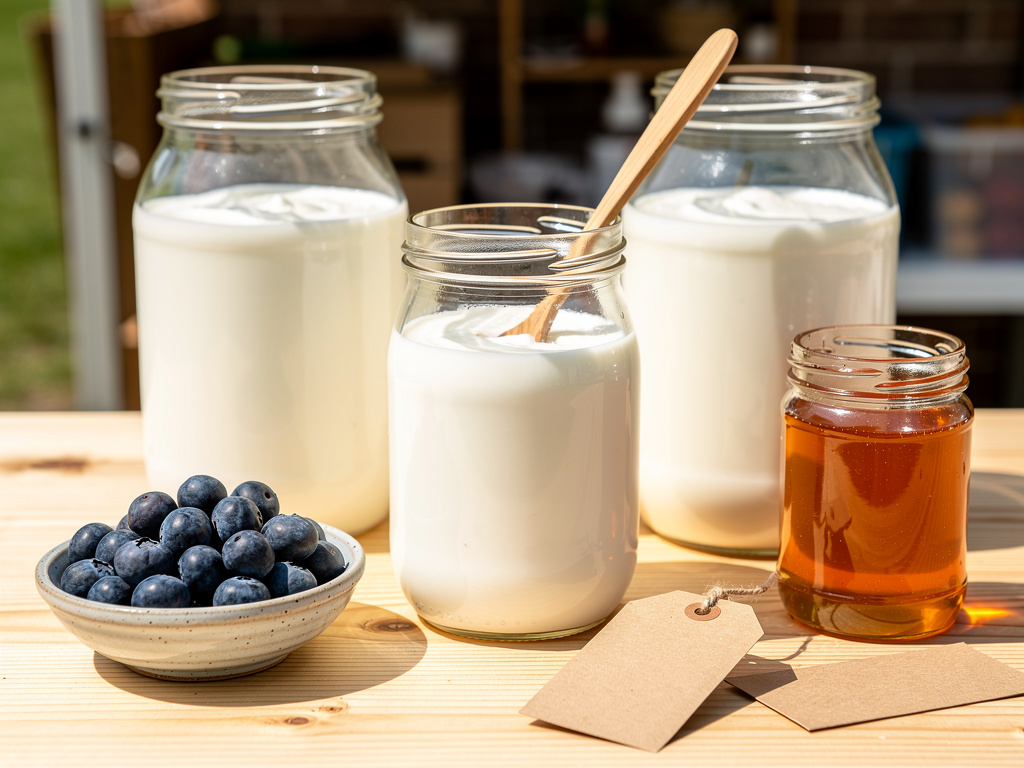


The short version: Sell plain whole milk yogurt for $9 to $11 a quart in a plastic tub, $6 to $7 a pint in a glass jar, and $14 to $17 for a pint of strained Greek yogurt. The small farms and farm stores we checked on October 8, 2026 charged $8.00 to $10.45 a quart for plain yogurt and $5.00 for a drinkable vanilla pint to $7.25 for a glass pint of vanilla, while grocery ads in USDA's October 2, 2026 report averaged $3.64 for a 32 ounce tub of regular (non-Greek) yogurt, plain or flavored. A quart costs you about $2.13 in milk, starter, a plastic tub and a label at the August grocery milk price of $4.23 a gallon, and about $7.13 once you pay yourself $20 an hour. Yogurt is a dairy product, so in Washington and Minnesota you need a licensed dairy before you sell a single tub, while Utah's food freedom law may allow home yogurt from pasteurized milk when you sell it straight to an informed customer in Utah. Noosa, the Colorado yogurt brand people ask about, has changed hands four times since 2014, and the last sale, from Campbell's to Lakeview Farms in February 2025, was for $188 million, according to Campbell's SEC filings.
Checked on October 8, 2026: the shop pages of five small yogurt farms and stores, the USDA's dairy retail report dated October 2, 2026, the Bureau of Labor Statistics milk price for August 2026, USDA's farm milk price, Walmart.com prices for jars, tubs and labels, the cottage food rules of Washington, Minnesota and Utah on each state's own website, the federal yogurt standard, Campbell's noosa press release and its SEC filings, and the plan and card processing fees on Homegrown's, Hotplate's, Square's and Local Line's pricing pages. Verify your state's current rules before your first sale. Homegrown customers create an account to place their first order, and Homegrown has no drops or countdown release feature.
You heated a gallon of good milk, stirred in a spoonful of last week's batch, and woke up to four quarts of thick, tangy yogurt with cream on top. A neighbor tasted it and asked to buy a quart every week. Now you need a number, and the grocery store says a tub costs less than four dollars.
That grocery number is the wrong place to start. A small batch of yogurt costs more to make than a factory tub costs to buy, because your milk, your jars and your hours are bought one at a time. This guide builds a yogurt price from numbers loaded on October 8, 2026: what small farms charge, what grocery ads show, how much yogurt a gallon of milk makes, what straining does to that, what a quart costs you in plastic and in glass, what selling fees take, and what the rules say before any of it matters. If you are still asking whether you can sell yogurt at all, our guide to whether you can sell homemade cheese walks through the same dairy programs state by state; ask yours whether its answer for cheese also covers yogurt.
Charge $9 to $11 for a quart of plain whole milk yogurt in a plastic tub, $6 to $7 for a plain pint in a glass jar, and $14 to $17 a pint for strained Greek. Those ranges come from two places: what small farms charged on October 8, 2026, and about 1.25 to 1.9 times your full cost with your time paid at $20 an hour. The jar swap price assumes the customer brings the jar back for you to reuse.
Here is the ladder to start from:
Swipe left to see what small farms charged.
| What you sell | Your full cost (with your time) | Suggested price | What small farms charged |
|---|---|---|---|
| Plain quart, plastic tub | $7.13 | $9 to $11 | $8.00 (Flint Hill Farm, container not stated) |
| Plain quart, glass jar | $7.72 | $10 to $12, or $9 to $11 with a jar swap | $10.45 list, $8.95 on sale (Tussock Sedge Farm) |
| Plain pint, glass jar | $4.37 | $6 to $7 | $4.00 to $5.22 a pint when sold by the quart (Flint Hill Farm, Tussock Sedge Farm) |
| Vanilla or fruit pint, glass jar | $4.37 plus flavoring | $7 to $8 | $5.00 drinkable (Flint Hill Farm, container not stated), $7.25 (Abraham's) |
| Greek (strained) pint, glass jar | $8.76 | $14 to $17 | $16.95 list, $14.95 on sale (Tussock Sedge Farm) |
| Goat milk yogurt, pint | Start from your goat milk cost | $10 to $12 | $11.00 for 16 oz, $16.00 for 26 oz (Painted Pepper Farm) |
Full costs come from the batch math later in this guide (grocery milk at $4.229 a gallon, a 2 gallon batch, 2 hours of your time at $20 an hour for plain and 2.5 hours for Greek). Farm and store prices were read on each one's own shop page on October 8, 2026. License and inspection costs are not included because they vary by state.
Notice where your cost sits. The plastic quart costs $7.13 to make with your time paid, and the glass quart costs $7.72. That $0.59 gap is the jar, and it is why the container decision comes before the price decision.
Small farms and farm stores charged $8.00 to $10.45 for a quart of plain cow's milk yogurt on October 8, 2026, which is $4.00 to $5.22 a pint, and Farmstead Foods' plain whole milk yogurt in a 24 ounce size at $5.99 works out to $3.99 a pint. Strained Greek yogurt listed at $14.95 to $16.95 a pint, and goat milk yogurt ran $9.25 to $18.67 a pint depending on the size.
Every price below is the price on that farm or store's own shop page that day:
Swipe to see every farm and its price per pint.
| Farm or store | Where | Yogurt and size | Price | Price per pint |
|---|---|---|---|---|
| Flint Hill Farm | Coopersburg, PA | Natural yogurt from its Jersey cows, quart | $8.00 | $4.00 |
| Flint Hill Farm | Coopersburg, PA | Drinkable vanilla yogurt, pint | $5.00 | $5.00 |
| Abraham's Goat Farm & Creamery | Newport, ME | Vanilla cow's milk yogurt, glass pint | $7.25 | $7.25 |
| Tussock Sedge Farm (farm store, Elmer & Sarah's yogurt) | Perkasie, PA | Whole milk yogurt, glass quart | $10.45 list, $8.95 on sale | $5.22 list |
| Tussock Sedge Farm (Swiss Villa Farms yogurt) | Perkasie, PA | Greek yogurt, glass pint | $16.95 list, $14.95 on sale | $16.95 list |
| Painted Pepper Farm | Coast of Maine | Goat milk yogurt, 6 oz / 16 oz / 26 oz / half gallon | $7.00 / $11.00 / $16.00 / $37.00 | $18.67 / $11.00 / $9.85 / $9.25 |
| Farmstead Foods (delivery service; its yogurt pages do not name the maker) | Southern Illinois and St. Louis | Plain whole milk 24 oz / plain sheep milk 16 oz | $5.99 / $9.99 | $3.99 / $9.99 |
Read on each shop page on October 8, 2026. Tussock Sedge Farm resells yogurt made by two other creameries, Elmer & Sarah's and Swiss Villa Farms. Farmstead Foods is a delivery service whose yogurt pages do not name who makes the yogurt. Flint Hill Farm, Abraham's and Painted Pepper Farm make the yogurt they sell. Sale prices are shown next to list prices where the page showed both.
Three patterns show up:
Grocery ads averaged $3.64 for a 32 ounce tub of conventional regular (non-Greek) yogurt, plain or flavored, and $5.87 for 32 ounces of Greek in the USDA report issued October 2, 2026. That works out to $1.82 a pint for regular and $2.94 a pint for Greek. For regular yogurt, that is about a third to a half of what the small farms above charged per pint for plain.
The USDA's weekly dairy retail report tracks prices that grocery chains advertise in their circulars and digital deals. That link always opens the newest week, and the figures here are from the October 2, 2026 issue. Here is what it showed for yogurt:
Swipe for the per-pint grocery column.
| Grocery yogurt (national ad average) | Size | Average advertised price | Per pint |
|---|---|---|---|
| Conventional plain or flavored | 4 to 6 oz cup | $0.61 | About $1.63 to $2.44 |
| Conventional Greek | 4 to 6 oz cup | $1.25 | About $3.33 to $5.00 |
| Conventional plain or flavored | 32 oz tub | $3.64 | $1.82 |
| Conventional Greek | 32 oz tub | $5.87 | $2.94 |
| Organic plain or flavored | 32 oz tub | $5.13 | $2.57 |
| Organic Greek | 32 oz tub | $4.66 | $2.33 |
USDA Agricultural Marketing Service, National Dairy Retail Report, Volume 93 Number 40, dated Friday, October 2, 2026, loaded October 8, 2026. These are advertised sale prices, so the everyday shelf price is usually higher.
Price per pint of regular (non-Greek) cow's milk yogurt
Source: USDA National Dairy Retail Report dated October 2, 2026, and each farm or store's shop page, October 8, 2026. Tussock Sedge Farm at its list price. Each bar is the listed price scaled to 16 ounces.
Do not try to meet the grocery price. Your customer may know the grocery price, but she is choosing yogurt from a farm she can name, made from milk she trusts, in a tub or jar from your farm. The small farms above sell at two to three times the grocery ad price per pint, and that gap is your market.
$188 million. Campbell's sold noosa to Lakeview Farms on February 24, 2025, "for $188 million, subject to certain customary purchase price adjustments," according to the quarterly report (10-Q) it filed with the SEC on March 5, 2025, and its annual report filed September 18, 2025 repeats the figure. The press releases left the price out, and none of the earlier deals that moved Noosa from owner to owner came with a public price for Noosa itself. When Campbell's agreed to sell noosa to Lakeview Farms in November 2024, its press release said "Terms of the transaction were not disclosed," and it said the business "generated net sales of $177 million for the last 12 months ending October 2024."
Here is how the brand changed hands:
Each row has its source; swipe to read it.
| Year | What happened | Price made public? | Source |
|---|---|---|---|
| 2010 | Noosa launched in the US after Koel Thomae co-founded it in 2009 with Colorado dairy farmer Rob Graves | Not a sale | Dairy Reporter, 2014 and 2018 |
| 2014 | Advent International bought a majority stake; Noosa was in 5,000 stores | No, "an undisclosed sum" | Dairy Reporter, November 25, 2014 |
| 2018 | Noosa merged into Sovos Brands, another Advent-backed company; it had grown to 25,000 stores | No price in the announcement coverage | Dairy Reporter, October 31, 2018 |
| 2024 (March) | Campbell's bought all of Sovos, including Rao's and Michael Angelo's, for $2.7 billion; noosa came with it | Only for the whole company | Campbell's press release; Nosh, November 13, 2024 |
| 2024 (November) | Campbell's agreed to sell noosa to Lakeview Farms, with its Bellvue, Colorado plant | No, terms not disclosed | Campbell's press release, November 12, 2024; Nosh, November 13, 2024 |
| 2025 (February) | Campbell's completed the sale; Lakeview Farms and noosa combined under the name Novus Foods | Yes, $188 million, subject to customary adjustments (in Campbell's SEC filings, not its press release) | Campbell's press release, February 24, 2025; Campbell's 10-Q, March 5, 2025 |
All sources loaded October 8, 2026. The $177 million is noosa's sales, not a sale price; the $188 million is the 2025 sale price before customary adjustments.
Four things are public, and one of them is a price:
The useful part for a small vendor is the start of the story. Noosa launched in 2010. By the fall of that same year, two sisters had launched Gammelgården Creamery in Pownal, Vermont, and the family took its skyr, a thick cultured dairy product the co-op's profile says is technically a cheese because it is made with rennet, to farmers markets in Dorset, Bennington and Troy each weekend, according to the Brattleboro Food Co-op's profile. The profile says Stina Kutzer chose skyr after a milk inspector's visit showed her that her cheesecloth-strained yogurt did not meet the regulatory definition of yogurt. The co-op's profile, dated March 31, 2025, says its products are now "stocked in over 80 locations throughout New England." Neither story starts with a sale price. Yours starts with the price on this week's tub.
A gallon of milk makes about a gallon of plain yogurt, which is 4 quarts or 8 pints. Strain it thick into Greek yogurt or labneh and you keep about 50% to 67% of that, or 4 to 5.3 pints, by an Extension guide's figure for yogurt strained a full 8 to 24 hours. Greek yogurt drained a shorter time keeps more.
Plain yogurt keeps almost all its volume because nothing is removed. Illinois Extension's home yogurt recipe turns 1 quart of milk into 8 half-cup servings, which is a quart of yogurt. Straining is different: it pours off the whey, the thin yellow liquid, to thicken what is left. The UC and WSU Extension guide "Yogurt Made Simple" says strained yogurt is "also called Labneh or Greek yogurt," and that after straining it 8 to 24 hours, until it is spreadable, "about 1/2 to 2/3 of the original amount of yogurt remains." The same recipe's yield line is lower, 1 1/2 to 2 cups from a quart. A Greek yogurt you stop straining sooner keeps more: Illinois Extension's "Making Yogurt at Home" drains yogurt cheese for 8 to 24 hours but Greek-style yogurt for only 2 to 4 hours, so the Greek costs in this guide are the high end.
Swipe right for the Greek yogurt column.
| Milk you start with | Plain yogurt | Greek yogurt or labneh, strained 8 to 24 hours (half to two thirds kept) |
|---|---|---|
| 1 quart | 1 quart (2 pints) | 2 to 2.7 cups |
| 1 gallon | 4 quarts (8 pints) | 4 to 5.3 pints |
| 2 gallons | 8 quarts (16 pints) | 8 to 10.7 pints |
Plain yield from Illinois Extension's "Making Yogurt at Home"; strained yield from UC ANR and WSU Extension's "Yogurt Made Simple," for yogurt strained until spreadable, both read October 8, 2026. The longer you strain, the thicker the yogurt and the closer you get to half.
This one fact explains most of the price ladder. A pint of Greek yogurt strained to half holds the milk of two pints of plain, so the dairy in it costs twice as much: $1.28 against $0.64 a pint. With the jar and label, the materials come to $2.51 against $1.87 for a plain glass pint, before you count the extra time. Before you set any price, write down three numbers from your own kitchen:
A quart of plain yogurt costs you about $2.13 in a plastic tub and $2.72 in a glass jar, using whole milk at the August 2026 grocery average of $4.229 a gallon. Pay yourself $20 an hour for a 2 gallon batch and the full cost rises to $7.13 and $7.72.
Here is where each number comes from:
Plastic and glass side by side; swipe for both.
| Cost per quart | Plastic tub | Glass jar | Where the number comes from |
|---|---|---|---|
| Milk (1 quart) | $1.06 | $1.06 | $4.229 a gallon, BLS average whole milk price, August 2026 |
| Starter (2 oz of plain yogurt) | $0.23 | $0.23 | 1/4 cup per quart (WSU), priced at the $3.64 grocery tub |
| Container | $0.64 | $1.23 | 32 oz deli tubs, 24 for $15.35; Mainstays 32 oz wide mouth jars, 12 for $14.73 |
| Waterproof label | $0.20 | $0.20 | Avery 2.5 inch round film labels, 45 for $9.14 |
| Materials | $2.13 | $2.72 | |
| Your time (2 hours per 8 quarts at $20) | $5.00 | $5.00 | Example rate; use your own |
| Full cost | $7.13 | $7.72 |
Containers and labels priced on Walmart.com on October 8, 2026. Milk from the Bureau of Labor Statistics average price series for August 2026, read through its data API the same day. License, inspection, electricity and a cooler for market day are not included.
If you milk your own cows, the milk line shrinks. US dairy farmers received $19.80 per hundred pounds of milk in August 2026, in USDA's Agricultural Prices report. Whole milk weighs 8.6 pounds a gallon in USDA's conversion table, so that is about $1.70 a gallon, or $0.43 a quart. Your plastic quart then costs about $1.50 in materials instead of $2.13.
The time line is the one most new vendors skip. Heating, cooling, culturing, filling and cleaning take real hands-on minutes even though the yogurt sets overnight on its own. Count yours for one batch and replace the $5.00.
A glass quart jar costs $1.23 against $0.64 for a plastic tub, so glass adds $0.59 to every quart before the yogurt is even in it. On a $10 quart that is the difference between $2.87 left over after materials and your time, and $2.28.
Glass sells. It looks like a farm product, it shows off the cream line, and customers keep the jar. But on a $10 quart, the extra $0.59 a glass jar costs over a tub takes about a fifth of the $2.87 you keep above your wage, unless you get the jar back. You have three ways to handle it:
One Homegrown dairy vendor already prices the jar separately. Harvest House Foods lists its A2/A2 fresh milk at $11.00 with a jar and $6.00 when the customer brings a clean jar to swap, a $5.00 difference. The same two-price setup works for a yogurt quart, and it turns your most expensive supply into a reason for customers to come back every week.
A glass pint of strained Greek yogurt should sell for $14 to $17, and one Maine goat farm sells 6 ounces of labneh for $10.50. Labneh is yogurt strained for 8 to 24 hours until it spreads like cream cheese. Straining can halve your yield, so a Greek pint costs you about $2.51 in materials and $8.76 with your time.
Here is the math on a 2 gallon batch strained down to half:
At $15 a pint you keep about $6.24 above your wage before fees, and Tussock Sedge Farm's $16.95 list price for a Greek pint shows customers pay it. Labneh can sell higher still. Painted Pepper Farm strains its goat milk yogurt for 24 hours and sells 6 ounces of the labneh for $10.50, which is $28 a pint, against $7.00 for the same 6 ounce jar of its plain yogurt. Part of that $28 is the small jar, since the farm's plain yogurt in that size is already $18.67 a pint. The UC and WSU guide calls strained yogurt, labneh and Greek yogurt one product, so the yield math above covers both.
Save the whey, the liquid you strained off, and ask your dairy program before you sell it or give it away.
Goat milk yogurt sold for $11.00 for 16 ounces at Painted Pepper Farm, and sheep milk yogurt for $9.99 for 16 ounces at Farmstead Foods, on the shop pages read October 8, 2026. Price yours from your own milk cost, because every milk price in this guide is for cow's milk.
Painted Pepper Farm's own size ladder shows how wide the range is. The farm milks its own goats on the coast of Maine and sells plain goat milk yogurt in glass for $7.00 for 6 ounces, $11.00 for 16 ounces, $16.00 for 26 ounces and $37.00 for a half gallon. That is $18.67 a pint in the smallest jar and $9.25 a pint in the half gallon. It is the same milk from the same farm, so the gap comes from the size of the jar.
If you keep goats, run the same table as the quart above with your own milk cost per gallon, and count the hours your herd takes. Goat yogurt priced like grocery cow yogurt can easily lose money on every jar.
In Washington and Minnesota, two of the 3 states checked for this guide on October 8, 2026, you cannot sell yogurt made in your home kitchen, because yogurt is a dairy product and their cottage food laws, the state rules that let you sell certain low-risk foods made at home, name it as not allowable. Utah, the third, is different: among dairy products, its food freedom law leaves out only raw dairy, so yogurt made at home from pasteurized milk and sold directly to an informed customer inside Utah may fall under it. In any state, plan on a licensed dairy unless a food freedom law covers yogurt, and get that answer in writing.
Two states say it in so many words:
Utah's food freedom law, the Home Consumption and Homemade Food Act, says in its limits section that it "does not apply to the sale of: (a) raw dairy or raw dairy products," under Utah Code 4-5a-105, read October 8, 2026. So raw milk yogurt is out. Yogurt made from pasteurized milk may qualify, because Utah Code 4-5a-104 exempts homemade food that is made and sold inside Utah, directly to an "informed final consumer." Most sellers still need a label with their name and address, a statement that the food is not for resale and was made without state or local inspection, and a statement that it contains milk. You also need a business license, must tell the buyer the food is not inspected, and cannot sell it to a restaurant or other commercial establishment. Our cheese guide covers how the act treats home dairy, and the Utah Department of Agriculture and Food can confirm it in writing.
Here is the order to ask in, so you get a full answer:
The federal yogurt standard adds one more line. Under 21 CFR 131.200, the milk "must be pasteurized or ultra-pasteurized before the addition of the characterizing bacterial culture," and yogurt has "not less than 3.25 percent milkfat," unless its label states a lower milkfat percent, down to 2.44 percent. Under that standard, a product sold as yogurt starts from pasteurized milk.
Dairy licensing lives with your state's dairy program, which is often a different office from the one that handles cottage food. Read your state's cottage food or food freedom page, search it for "dairy" and "yogurt," then email the dairy program and keep the written answer. Our list of food freedom states is a starting point for the states with broader home food laws. We checked Washington, Minnesota and Utah on October 8, 2026, so verify your state's current rules before your first sale.
No Homegrown vendor sells yogurt on its own yet. In a pull of the Homegrown catalog on October 8, 2026, 20 of the 2,910 products listed by 312 vendors mentioned yogurt, and not one was a tub or jar of yogurt for sale.
In a pull of the Homegrown catalog on October 8, 2026, 20 of the 2,910 products listed by 312 vendors mentioned yogurt in the name, description or size options, from 12 vendors. One was a yogurt parfait (Frugally Bougie, $6.00, in Blueberry Lemon or Green Apple Caramel). Ten suggested yogurt as a pairing: granola, jams, apple butter, marmalade and roasted hazelnuts. Six used yogurt as an ingredient in bagels, zucchini bread and granola, and three were dog treats. The 55 listings in the Eggs and Dairy category included raw milk, fresh milk, cream, butter, creamers and one fresh mozzarella, but no yogurt. We counted every listing where yogurt appears as a whole word and read each one.
That gap cuts both ways. There is no yogurt vendor to undercut you, and there is also no proof yet of what Homegrown shoppers pay for it. The ten granola, jam, fruit butter and nut listings that tell customers to eat them with yogurt are a hint about who buys it: the same person filling a breakfast bowl. If you sell yogurt, a granola or jam vendor at your market is a natural partner for a shared pickup table.
Selling fees take 88 cents to $2.43 from a $20 yogurt order, such as two $10 quarts, depending on the platform and who pays its fee. Across 50 orders a month, that runs $44.00 to $131.00 with any plan included on annual billing ($153.00 for Local Line billed monthly, its 2.9% + $0.30 card processing included).
Scroll right to see every fee column.
| Platform | Monthly plan | Trial | Platform fee | Card processing | Customer pays on a $20 order | You pay on a $20 order | You pay in a month of 50 orders |
|---|---|---|---|---|---|---|---|
| Homegrown | $10 billed annually ($12.50 billed monthly) | 7 days, no charge until day 8 | None, 0% commission | 2.9% + $0.30, paid by you | $20.00 | $0.88 plus the plan | $54.00 ($56.50 on monthly billing) |
| Hotplate, default setting | $0 | No plan to try | 5% + $0.55, paid by the customer | 2.9% + $0.30, paid by you | $21.55 | $0.88 | $44.00 |
| Hotplate, you cover its fee | $0 | No plan to try | 5% + $0.55, paid by you | 2.9% + $0.30, paid by you | $20.00 | $2.43 | $121.50 |
| Square Online, Free plan | $0 ($49 per location for Plus) | No plan to try (30 days on Plus) | None | 3.3% + 30¢ online, paid by you | $20.00 | $0.96 | $48.00 |
| Local Line Core | $87 billed annually ($109 billed monthly) | 7 days | None, no commissions | 2.9% + $0.30, paid by you | $20.00 | $0.88 plus the plan | $131.00 ($153.00 on monthly billing) |
Fees from each company's own pricing page, checked October 8, 2026: findhomegrown.com/signup, Hotplate's pricing page and its blog post "What Hotplate does," Square's online store plans page, and Local Line's pricing page. Card processing is figured on the $20 price. Sales tax, tips and delivery fees are not included.
Local Line is built for farms selling to many customers and to wholesale buyers, with price lists and pick lists, so its $87 plan, plus 2.9% + $0.30 card processing, makes more sense once you sell to stores as well as households. For a farm selling 50 orders a month to families, as in the table, the plan is still most of the cost: $87 of $131.00.
Hotplate's pricing page says you can pay its fee yourself or pass it on to customers, "your choice." Its blog post "What Hotplate does" says that by default "we charge a fee to your customer" and that "80% of Hotplate chefs keep the default as-is." So a $20 yogurt order reads as $21.55 at checkout unless you change the setting, and changing it costs you $1.55 an order. Either way, you also pay Hotplate's 2.9% + $0.30 card processing. We checked both pages on October 8, 2026.
At $10 a quart in plastic, 60 quarts a month leaves you about $136 after milk, starter, tubs, labels, Homegrown's fees and $20 an hour for your time. That is about $2.27 a quart on top of your wage, before any license or inspection cost.
Here is how the 60 quart month adds up:
And at three volumes:
Swipe to see all three months.
| Quarts a month | Sales at $10 | Supplies | Your time at $20 an hour | Homegrown fees and plan | Left after your wage |
|---|---|---|---|---|---|
| 20 | $200.00 | $42.55 | $100.00 | $18.80 | $38.65 |
| 60 | $600.00 | $127.65 | $300.00 | $36.40 | $135.95 |
| 120 | $1,200.00 | $255.29 | $600.00 | $62.80 | $281.91 |
Plastic quarts at the $2.13 materials cost above, two quarts per order, Homegrown's annual plan, card processing of 2.9% + $0.30 per order. Supplies are figured on the unrounded cost of $2.12744 a quart, so they run a few cents under the quart count times $2.13. A licensed dairy's fees, inspections and any kitchen rent come out of the last column.
Change one number and see what moves. At $9 a quart, the 60 quart month leaves about $78 after your wage. In glass jars at $10 with no jar swap, it drops to about $101, because 60 glass jars cost $35.28 more than 60 plastic tubs. That is why the container and the price get decided together.
Taking orders before you make the batch is how a yogurt vendor stops pouring out unsold quarts, because Illinois Extension's guide says to eat homemade yogurt within 14 days. Every quart you make without a buyer is a quart racing a date, so the fix is knowing how many quarts are spoken for before the milk goes on the stove.
Homegrown is $10 a month billed annually ($12.50 billed monthly) with no percentage fees beyond standard payment processing, and it gives your yogurt a storefront customers order and pay from before pickup. Compare that with what a small dairy usually weighs. Hotplate costs $0 a month but adds 5% + $0.55 to the customer's total by default, so a $20 order shows as $21.55, and you still pay 2.9% + $0.30 on every card payment. Square's Free plan costs $0 a month but takes 3.3% + 30¢ on each online order, 8 cents more than Homegrown on every $20 order, though at 50 orders a month its $48.00 still comes in under Homegrown's $54.00 with the plan. Local Line's Core plan starts at $87 a month billed annually, plus 2.9% + $0.30 on each card sale, which fits a farm selling wholesale more than one selling 50 orders a month to neighbors.
What it gives a yogurt vendor:
What it does not do: Homegrown does not license your dairy or check whether your state allows home yogurt. It does not ship, and it does not keep yogurt cold; that is your cooler and your pickup window. It cannot sell by weight yet (price by weight is on its roadmap), so list fixed sizes. Card processing of 2.9% + $0.30 is paid by you, with no option to add it to the customer's total. Customers create a Homegrown account the first time they order, there is no drops or countdown release feature, and while your storefront is listed on the Homegrown marketplace, plan on most orders coming from people you send to your own link.
If you already have a waitlist of neighbors asking for "a quart next week," you can set up your Homegrown storefront and turn that list into prepaid orders with a pickup time.
The costliest yogurt pricing mistake is copying the grocery price, because the $3.64 average is a sale price that major grocery chains advertise for factory-made tubs. These six mistakes come up again and again in the math above:
For the general rule under all of these, our guide on how to price food at a farmers market explains the cost multiple most vendors start from, and our guide to calculating the real cost of each product shows how to fold in the costs that hide, like electricity and a market-day cooler.
A plastic tub of plain whole milk yogurt should be $9 to $11 a quart, or $10 to $12 in a glass jar unless customers return jars. Small farm prices read on October 8, 2026 ran $8.00 to $10.45 a quart. A quart costs about $2.13 to make in plastic, and about $7.13 with two hours per 8 quarts paid at $20 an hour.
About $1.06 of milk per quart at the August 2026 grocery average of $4.229 a gallon, plus about 23 cents of starter, because a quart of milk makes about a quart of yogurt. Add a tub or jar and a label and a sellable quart costs $2.13 in plastic or $2.72 in glass. The dairy in a Greek pint costs 1.5 to 2 times as much as in a plain pint when it is strained until spreadable, because only half to two thirds remains. Illinois Extension drains Greek-style yogurt for just 2 to 4 hours, which keeps more. With the jar and label, a glass Greek pint strained to half runs about $2.51 in materials, against $1.87 for a plain glass pint.
$188 million. Campbell's sold noosa to Lakeview Farms for $188 million on February 24, 2025, according to its SEC filings, subject to customary purchase price adjustments. No price for Noosa itself came with the earlier deals: Advent bought a majority stake in 2014 for "an undisclosed sum," Noosa merged into Sovos Brands in 2018, and Campbell's got it in its $2.7 billion purchase of all of Sovos in 2024. When Campbell's sold the brand on to Lakeview Farms, its press release said the terms "were not disclosed." Campbell's did say noosa had $177 million in net sales in the 12 months ending October 2024.
Price a glass pint of strained Greek yogurt at $14 to $17. Straining 2 gallons of yogurt down to about 8 pints puts your cost near $2.51 a pint in materials and $8.76 with your time. One Pennsylvania farm store listed a Greek pint at $16.95 on October 8, 2026.
In Washington and Minnesota, only from a licensed dairy. Washington's cottage food page lists yogurt as not allowable, and Minnesota says yogurt is not an allowable cottage food and requires a license. Among dairy products, Utah's food freedom law leaves out only raw dairy, so yogurt made from pasteurized milk and sold directly to an informed customer inside Utah may qualify; get the Utah Department of Agriculture and Food's answer in writing. Ask your state dairy program and your market manager before you price yogurt for a booth.
Quarts, in either container. In glass, one quart jar of yogurt costs about $2.72 in materials against $3.74 for two pint jars, with Mainstays jars at $1.23 a quart and $1.02 a pint on Walmart.com on October 8, 2026. In plastic, a quart tub was $0.64, which makes a plastic quart the cheapest way to sell 32 ounces at $2.13. Sell quarts in plastic to regulars, and offer glass pints at $6 to $7 to first-time customers who want a smaller first buy.
These five guides pick up what this one only touches: the dairy rules that decide whether you can sell yogurt at all, what other dairy products sell for, and the products that sit next to yogurt in a customer's breakfast bowl. Start with the cheese permission guide if you have not yet asked your state, because the same dairy program answers both questions.
Small farms charged $8.00 to $10.45 for a plain quart on October 8, 2026, and this guide suggests $9 to $11 a quart and $14 to $17 for a Greek pint. Small-batch yogurt costs more to make than a factory tub, and a price that covers the milk, the jar and your hours is what pays for the next batch. Start from your own milk cost, pick plastic or a jar swap before you pick a price, and charge for straining. Then let regulars reserve their quarts before you heat the milk, so every batch starts sold. A waitlist of 10 regulars who each take two quarts a week is about 80 quarts in a four-week month, which at $10 a quart and the plastic-tub math above leaves about $185 after your wage, before license costs. That is a small, steady dairy line built one batch at a time. When you are ready to take those orders ahead of pickup day, you can start your Homegrown storefront and list your first quart and pint tonight.



