

The short version: You usually cannot sell yogurt made in your home kitchen, because yogurt is a dairy product and cottage food laws generally leave dairy out. Of the five states checked for this guide, Washington, Minnesota and Georgia give a home kitchen no route, and Utah (from pasteurized milk only) and Wyoming let you sell homemade yogurt straight to a customer inside the state under their food freedom laws. In most other states, apart from a few other food freedom states that may also cover homemade dairy, the legal path is a dairy plant license from your state. Washington's application lists yogurt by name, asks for an approved pasteurizer, a floor plan, a water test and a label review before your first sale, charges $250 for the license and says the wait from application to inspection can run 4 to 6 weeks. Once you are legal, sell by pre-order and pickup so every jar goes straight from your fridge to the customer's.
Checked on each state's own pages, October 8, 2026: the cottage food pages of Washington, Minnesota and Georgia, Washington's milk processing plant license application (form AGR-2008, revised May 2026), Minnesota's dairy plant page, Utah Code chapter 4-5a, the Wyoming Food Freedom Act, and the federal rules at 21 CFR 131.200 and 21 CFR 1240.61. Five states are examples, not the whole country, so verify your state's current rules with its agriculture or health department before you sell. Homegrown fees come from findhomegrown.com/signup the same day. Homegrown customers create an account to place a first order, and Homegrown has no drops or countdown release feature.
You have a pot of milk on the stove every Sunday, a jar of last week's yogurt for starter, and friends who keep asking if they can buy a quart. It feels like the easiest food business in the world. The law does not see it that way, and the gap between "my friends love it" and "I can legally sell it" is wider for yogurt than for almost anything else you can make in a kitchen.
This guide walks through that gap one step at a time. It covers what five states and two federal rules said on October 8, 2026, the two states where a home kitchen can sell yogurt, what a dairy license actually asks for, how labels and cold storage work, and how to take orders so nothing spoils.
Usually not from a home kitchen: most of the states checked for this guide shut that door, and a couple open it under food freedom laws. Yogurt is a dairy product, and all three states whose cottage food pages we checked leave dairy out. A cottage food law is the set of state rules that lets you make certain low-risk foods at home, like cookies and jam, and sell them without a commercial kitchen.
Here is how the 5 states split on October 8, 2026, with 3 saying no and 2 saying yes:
Cheese, butter and kefir land in the same place for the same reasons. Our guide to whether you can sell homemade cheese walks through nine states for that product, and the pattern matches what you see here: dairy is out of cottage food in most of the states checked, and food freedom states are the exception.
Yogurt is treated differently because it is a refrigerated dairy food, and dairy is regulated by its own set of rules that start long before your kitchen. Jam and bread are safe on a shelf at room temperature. Yogurt is not, and the milk it starts from can carry bacteria that only pasteurization and steady cold keep in check.
Three things put yogurt on the strict side of the line:
That last point changes the whole plan. In the eyes of a state dairy inspector, a quart of yogurt is closer to a gallon of bottled milk than to a block of cheese. Washington's own license application sorts it that way, listing "cultured Grade A milk products (sour cream, cottage cheese, yogurt)" next to fluid milk, while cheese and butter go in its non-Grade A group.
3 of the 5 states checked on October 8, 2026 say no to homemade yogurt, and 2 say yes for in-state sales to a customer who knows the food was not inspected. The table puts them side by side with the exact page each answer comes from.
Scroll sideways to see every column.
| State | Homemade yogurt from a home kitchen | What the page says | Where you can sell | Source checked October 8, 2026 |
|---|---|---|---|---|
| Washington | No | "Milk and dairy products including hard, soft and cottage cheeses and yogurt" are not allowable | Only after a milk processing plant license | WSDA cottage food page |
| Minnesota | No | Yogurt is not an allowable cottage food and requires a license | Only after a dairy plant license and permit | MDA cottage food guidance |
| Georgia | No | "Milk and dairy products" are potentially hazardous; anyone making them does not qualify | Not under cottage food; ask the GDA Dairy program | GDA cottage food FAQ |
| Utah | Yes, from pasteurized milk | Homemade food exempt when sold in Utah directly to an informed final consumer; raw dairy excluded | Home, farm, office, a direct-to-sale farmers market, or a place you and the buyer agree on | Utah Code 4-5a-102, 104, 105 |
| Wyoming | Yes | Dairy products named; sales must stay in Wyoming | Farmers markets, farms, ranches, your home or office, a place you both agree on, or a third-party shop with a sign | W.S. 11-49-102 and 103 |
Each row was read on the state's own page or statute on October 8, 2026. Five states are examples. If yours is not here, search your state's cottage food page for "dairy," "milk" and "yogurt," and our cottage food laws by state directory links to each state's program.
The takeaway is simple. If you live outside a food freedom state, the question is not "is yogurt on my cottage food list?" It almost never is. The real question is "what does my state's dairy program require to license a small plant?"
Utah lets you sell yogurt made in your home kitchen as long as you make it from pasteurized milk, sell it inside Utah, and sell it directly to a customer who has been told it was not inspected. That makes it 1 of the 2 states in this guide with a home kitchen route. The rule is Utah Code 4-5a-104, the Home Consumption and Homemade Food Act, in the version effective May 6, 2026.
The act exempts homemade food from state and local licensing and inspection when it is "produced and sold within the state" and "sold directly to an informed final consumer." The one dairy line is in Utah Code 4-5a-105: the chapter "does not apply to the sale of: (a) raw dairy or raw dairy products." Yogurt made from store-bought pasteurized milk is not raw dairy. Utah's dairy definitions in Utah Code 4-3-102 call raw milk "unpasteurized milk" and count a process as pasteurization only if it is "accepted by federal standards." Nothing there says heating your own cow's milk on a home stove counts, so ask the Utah Department of Agriculture and Food before you make yogurt from it. We read all three sections on October 8, 2026.
What Utah still asks of you:
The label rules do not apply to a sale run only by kids under 18. For everyone else, every jar carries that label.
Wyoming lets you sell homemade yogurt to an informed customer inside Wyoming, and it goes further than Utah by letting a shop sell it for you. The Wyoming Food Freedom Act (W.S. 11-49-101 to 104, in Title 11 of the Wyoming statutes) lists "dairy products" by name as a potentially hazardous food it covers.
The act says your eggs and dairy products may be sold by you, by someone you name in writing, or by "a third party vendor including a retail shop or grocery store." Sales must "occur only in Wyoming" and "not involve interstate commerce." In a shop, your yogurt cannot sit on the same shelf as licensed food and must carry the words "this food was made in a home kitchen, is not regulated or inspected and may contain allergens." We read the act on October 8, 2026.
Two more limits matter for a growing yogurt business:
Our food freedom states list compares Wyoming and Utah with the other states that have passed similar laws, so check it if you live near a state line.
You have four realistic routes, and only one of them uses your home kitchen. Which one fits depends on your state, how much yogurt you want to sell, and whether you have your own milk.
Swipe left to see all four routes.
| Route | Where it works | What it takes | Best fit |
|---|---|---|---|
| Home kitchen under food freedom | Utah and Wyoming among the five states checked | Utah: a label on every jar, pasteurized milk and a business license; Wyoming: a label only for shop sales; a warning to each buyer and in-state sales only in both | A part-time vendor selling to neighbors and a local market |
| Your own licensed dairy plant | Any state with a dairy plant license (check yours) | A state dairy license and permit; in Washington, also an approved pasteurizer, a floor plan, a water test and label review | A farm with its own milk that wants yogurt as a main product |
| A dedicated room in shared space | Where the state allows it; Washington and Minnesota both address it | The same license, with the shared space reviewed first; Washington requires a dedicated room for the pasteurizer | A vendor without a farm who can rent a room long term |
| A licensed creamery makes your yogurt | Any state, if a licensed creamery agrees to it | A creamery willing to run your recipe and label under its license | A vendor testing demand before building anything |
Only 1 of the 4 routes uses a home kitchen, and among the states checked it works in 2 states. Routes and requirements come from the state pages and Washington's license application, read October 8, 2026. A creamery arrangement is a private business deal, so terms vary by creamery.
The shared-kitchen route has a catch worth knowing early. Washington's application says dairy pasteurizers "will not be approved in shared kitchens unless they are within a dedicated room and just for that licensee." In Washington, that rules out a pasteurizer in a commissary kitchen you share with other renters. Our guide to commissary kitchens for food businesses explains how those rentals work for the foods they can hold.
You get a license to make yogurt from your state's dairy program, usually inside the department of agriculture, and the process starts with a conversation, not a form. Minnesota's dairy plant page names yogurt and asks anyone planning a plant to consult dairy inspection staff first. Washington's milk processing plant license application (form AGR-2008, revised May 2026) shows what the paperwork looks like once you are ready.
Here is the path, step by step, using those two states as the model:
Minnesota adds a cost you should budget for: plan review for new construction or a leased space is $45 per hour of staff time, and since January 1, 2025 every license and permit carries a 5% surcharge with a $5 minimum. Other states set their own fees, so ask for the fee schedule on that first call.
A dairy inspector looks at the equipment that heats and cools the milk, the water, the cleaning plan and the people running the pasteurizer. Most of it is about proving every batch of milk got hot enough for long enough and then stayed cold.
The items to have ready before that visit:
None of this means your home yogurt is unsafe. It means a licensed plant has to prove, on paper and on inspection, that it is safe every single time.
Federal law sets a recipe floor for any product sold as "yogurt," and a licensed plant has to meet it. Utah and Wyoming exempt homemade food from state licensing and inspection, so ask your state how it treats the federal standard for a food freedom jar; following it anyway, starting with pasteurized milk, is the safe habit. The rule is 21 CFR 131.200, the federal standard of identity for yogurt, which we read on October 8, 2026.
What it requires:
Federal law also controls what crosses state lines. Under 21 CFR 1240.61, no milk product in final package form can be delivered into interstate commerce unless it is pasteurized or made from ingredients that were all pasteurized.
"Contains live and active cultures" is a regulated phrase, not a description. Under 21 CFR 131.200 it may go on the label only if the yogurt has at least 10 million colony forming units per gram when it is made and is expected to hold 1 million per gram through its shelf life. If you cannot show a lab count, list the cultures in the ingredient statement and leave any live-culture claim off the label. We read the standard on October 8, 2026.
What goes on your label depends on your route: a licensed plant and a Utah home kitchen both need your name, your address and an allergen statement that covers milk, while Wyoming exempts direct sales from labeling rules but sets one sentence for jars sold in a shop. Here is what each route asks for, from the pages read on October 8, 2026.
Licensed plant in Washington (from Attachment E of the application):
Home kitchen in Utah: your name and address, "not for resale," "processed and prepared without state or local inspection," and a statement of whether the food contains milk and other common allergens.
Home kitchen in Wyoming: the act exempts these sales from state labeling rules, but a jar sold in a shop must carry the home kitchen sentence quoted above. Printing that sentence on every jar means one label works at your door and on a shop shelf.
Our guide to the nine major allergens on a cottage food label shows how to write the allergen line so it reads clearly on a small jar.
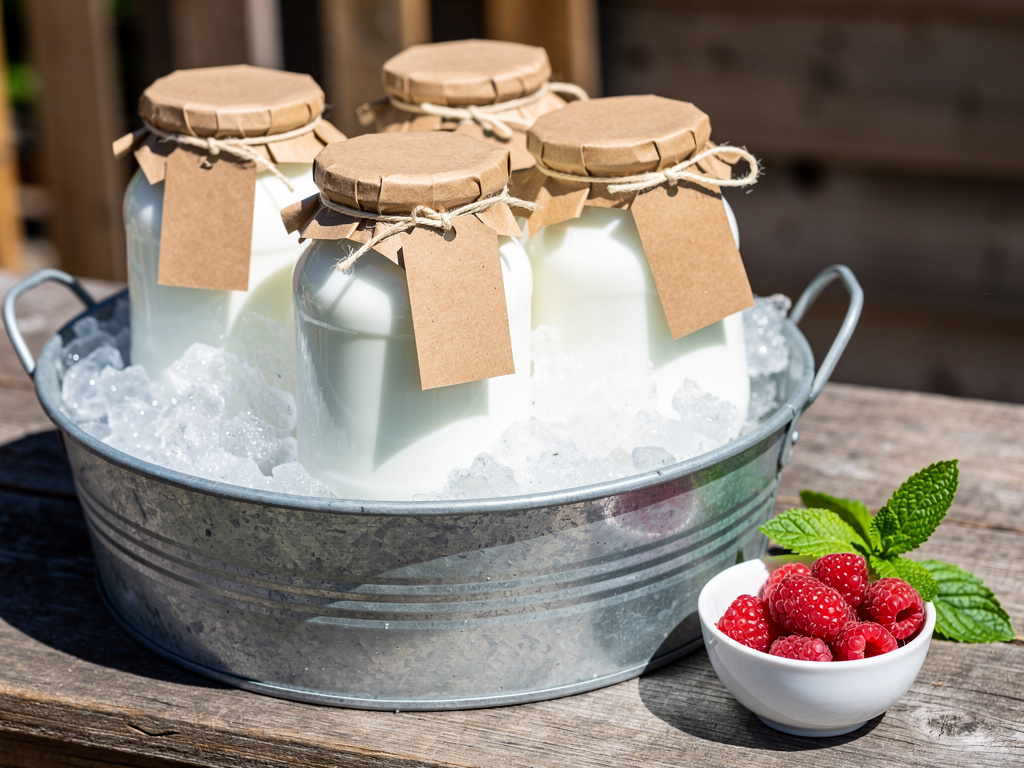
You keep yogurt cold by planning the whole trip, from the incubator to the customer's fridge, around a target of 40°F or colder. Yogurt is only safe and only good while it stays cold, and a warm afternoon at a market can undo a perfect batch.
The numbers to plan around:
Practical habits that keep jars in range:
Charge for the jar and let regulars swap it back. On Homegrown on October 8, 2026, Harvest House Foods listed its fresh milk at $11.00 with a jar or $6.00 if the customer brings a clean jar to swap, a $5.00 difference, and its cream at $8.00 or $6.00. Glass yogurt jars work the same way, and a returning jar brings a returning customer. On a licensed plant, the Pasteurized Milk Ordinance requires reusable containers to be cleaned and sanitized before each use, so ask your inspector how returned jars must be handled before you refill them.
Once you are licensed, or selling under Utah or Wyoming's law, you can sell yogurt anywhere your route allows and you can keep it cold. For a small vendor, the best places are the ones where the customer takes it home within minutes.
Places that work well:
Plan for every jar to reach a customer's fridge, at 40°F or colder, as soon as possible after pickup, and ask each market manager what they need to see before your first Saturday, such as your license number, and whether the market accepts uninspected dairy at all. A food freedom law lets you sell; it does not make a market take you.
No one sells yogurt on its own on Homegrown yet, so the first vendor who lists it would be the only one. Yogurt shows up all over the catalog, but as a pairing, an ingredient or a parfait.
In a pull of the Homegrown catalog on October 8, 2026, 20 of the 2,912 products listed by 313 vendors mentioned yogurt, from 12 vendors. Not one was yogurt sold on its own. The rule used: the word yogurt in a product's name, description or option names, with every match read by hand. One was a yogurt parfait at $6.00, ten suggested yogurt as something to eat the product with, six used yogurt as an ingredient, and three were dog treats.
Homegrown listings that mention yogurt, by how they use it
Source: Homegrown catalog pull, October 8, 2026, 2,912 products from 313 vendors. 20 listings mention yogurt.
The ten pairing listings matter for you. Granola, jam, apple butter, marmalade, jelly and roasted hazelnuts all suggest eating them with yogurt. Those vendors are natural partners for a yogurt vendor at the same market.
While your license is pending, sell the shelf-stable foods that go with yogurt, so you build a customer list before the first jar is legal. Washington's 4 to 6 week wait between application and inspection is plenty of time to start.
Good choices that show up on many states' cottage food lists (check yours first):
Each sale gives you a name, an email and a reason to tell that person when the yogurt arrives. If your real interest is fermentation and the dairy route is too much, water kefir ferments sugar water instead of milk, so it stays out of the dairy rules, though your state's rules for fermented drinks still apply. Our guide to selling milk kefir covers that water kefir path next to the dairy one.
If you run goats, also look at products from the same milk that skip dairy rules. Our guide to selling goat milk products locally explains why goat milk soap is regulated as soap, not food.
Yogurt has a two-week clock, so the safest plan is to make only what is already sold. Homegrown is $10 per month billed annually, or $12.50 billed monthly, with no percentage fees beyond standard payment processing. It gives you one link where customers see this week's yogurt, choose a size, pay, and pick a pickup time, so you know on Saturday how many quarts to culture on Sunday.
Compare that with the other ways to take yogurt orders. Instagram DMs cost nothing, but a dozen jar orders spread across a dozen chats is how a batch gets miscounted. Hotplate has no monthly plan, but by default it adds a service fee to your customer's checkout. Local Line is built for farms and food hubs, at $87 a month billed annually.
Swipe left for the fee columns.
| Platform | Monthly plan | Trial | Service or platform fee | Card processing | Customer pays on a $20 order | You pay on a $20 order | You pay in a month of 50 orders at $20 |
|---|---|---|---|---|---|---|---|
| Homegrown | $10 billed annually ($12.50 monthly) | 7 days, no charge until day 8 | None, 0% commission | 2.9% + $0.30, paid by you | $20.00 | $0.88 plus the plan | $54.00 ($56.50 on monthly billing) |
| Hotplate, default | $0 | No plan to try | 5% + $0.55, paid by the customer | 2.9% + $0.30, paid by you | $21.55 | $0.88 | $44.00 |
| Hotplate, you cover the fee | $0 | No plan to try | 5% + $0.55, paid by you | 2.9% + $0.30, paid by you | $20.00 | $2.43 | $121.50 |
| Square Online, Free plan | $0 | No plan to try | None | 3.3% + 30¢ online, paid by you | $20.00 | $0.96 | $48.00 |
| Local Line, Core | $87 billed annually ($109 monthly) | 7 days, no credit card required | None ("No commissions") | 2.9% + $0.30, paid by you | $20.00 | $0.88 plus the plan | $131.00 ($153.00 on monthly billing) |
We checked every price on each company's own pricing page on October 8, 2026: findhomegrown.com/signup, Hotplate's pricing page and its "What Hotplate does" post, Square's online store plans page and Local Line's pricing page. Card processing is figured on the $20 price; a platform that charges it on the total with fees, tips and tax runs a few cents higher.
Hotplate's pricing page says its fee can be paid by you or passed to customers, "your choice," and its own post "What Hotplate does" says "we charge a fee to your customer," which makes the customer-pays setting the default. We checked both on October 8, 2026. The $21.55 checkout in the table is what a customer sees on a $20 yogurt order under that default, and you still pay card processing of 2.9% + $0.30 on top.
What Homegrown does well for yogurt specifically: fixed sizes as options with their own prices (a pint and a quart as two choices on one listing), real-time inventory that counts down as orders come in, so a batch of 16 quarts shows how many are left, a lead time before each pickup so orders close before you culture, and pickup schedules at more than one location.
The honest bounds. Homegrown does not get you a dairy license or check your labels, and it handles pickup and local delivery, not shipping. Your customers create a Homegrown account for their first order. There is no drops or countdown release feature. Your storefront is listed on the Homegrown marketplace, but plan on most orders coming from people you send to your own link. And card processing of 2.9% + $0.30 comes out of your side, with no option to pass it to the customer.
If you already have a license or live in Utah or Wyoming, you can set up your yogurt pre-order page on Homegrown and have next week's batch spoken for before you buy the milk.
The mistakes below are the ones the rules in this guide catch, and each one comes from assuming yogurt follows the same rules as baked goods. Avoid these:
Each of these is cheaper to prevent with one email to your state's dairy program than to fix later. Keep the reply, with the date, in your files.
It is legal to sell homemade yogurt in a few states with food freedom laws. Among the states checked on October 8, 2026, Utah and Wyoming allow it under food freedom laws for in-state sales to an informed customer, and Washington, Minnesota and Georgia do not. Everywhere else, selling yogurt usually means a state dairy plant license.
Not in any of the three states whose cottage food pages we checked for this guide. Most cottage food laws cover only foods that are safe at room temperature, and yogurt is a dairy product that needs refrigeration. Washington and Minnesota both name yogurt as not allowed, and Georgia excludes all milk and dairy products.
It depends on the state. Washington's milk processing plant license is $250 a year, and Minnesota prices its dairy plant license on expected gross sales and charges $45 an hour for plan review. Equipment, such as an approved pasteurizer, is a separate cost on top of the license.
Yes, if the market allows it. Utah's act lists a direct-to-sale farmers market among the places you can sell, and Wyoming's act lists farmers markets by name. Each market sets its own vendor rules, so ask the manager before you bring a cooler.
No. A licensed plant can buy milk from a licensed dairy, and Washington's application lists the general milk market pool and contracts with a dairy farm as milk sources. In Utah, store-bought pasteurized milk is the simplest way to stay inside the Homemade Food Act, since raw dairy is excluded.
No. Utah and Wyoming's food freedom laws only cover sales inside the state, and federal law at 21 CFR 1240.61 controls milk products crossing state lines. Washington's application adds that a plant shipping Grade A products out of state must be on the FDA's Interstate Milk Shippers list.
These six guides answer what yogurt vendors ask next: the dairy rules for cheese, butter and milk kefir, which states have food freedom laws, how to take pre-orders so a batch that keeps 14 days sells before it spoils, and how to sell granola next to your jars.
Yogurt rewards vendors who know their numbers before the milk goes in the pot. Start with the legal question, because it decides everything else: email your state's dairy program this week, ask what a small plant needs, and keep the reply with its date. If you live in Utah or Wyoming, read your state's act once more and print your label before the first jar leaves the house.
Then set up how orders come in. A pre-order page with a weekly pickup window tells you exactly how many pints and quarts to culture, when each customer is coming, and who already paid. Jars go from your fridge to theirs in one trip, and nothing sits in a cooler hoping for a buyer.
Start your Homegrown storefront for $10 a month billed annually, or $12.50 billed monthly, with a 7-day trial and no charge until day 8. List your sizes, set your prep time and pickup schedule, and share the link with the people already asking for a quart.