
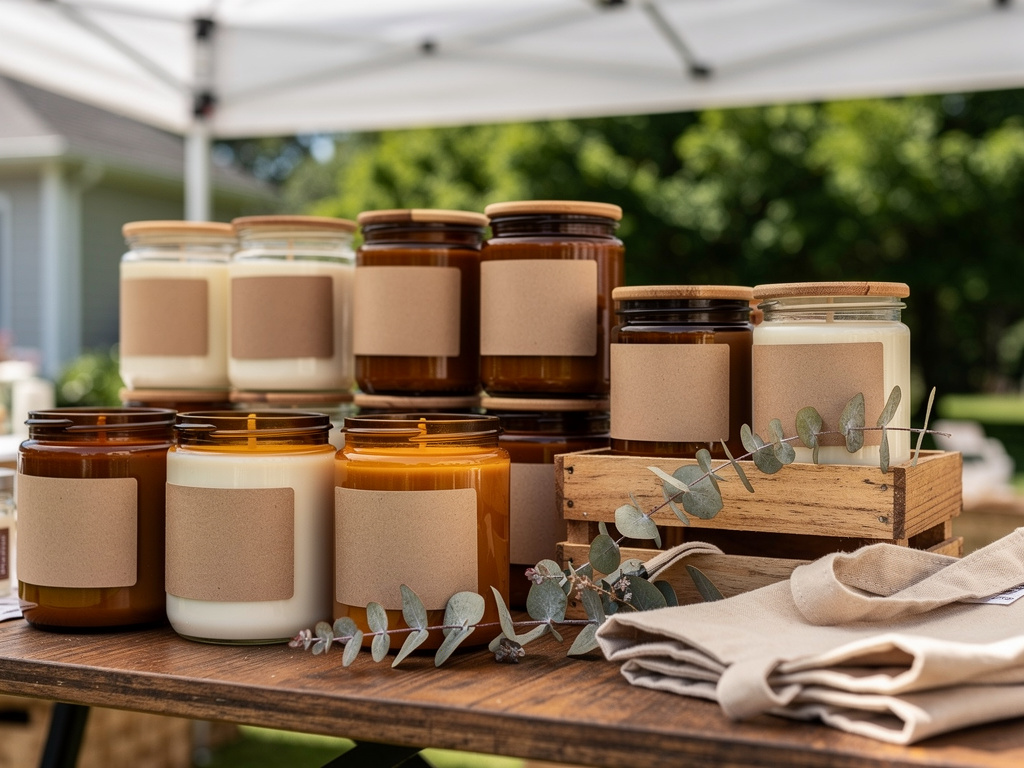


The short version: Handmade candles sell in seven places: farmers markets, craft fairs and holiday markets, your own storefront link, Etsy and Amazon Handmade, gift shops that buy wholesale, consignment shelves, and bulk gift buyers like realtors and local businesses. Candles sell on smell, so the first sale usually happens where a shopper can lift the lid, and the reorder happens on a link once they know the scent. A $15 candle reaches you as $15.00 in cash at a booth, $14.26 on a Homegrown storefront, $12.75 on Amazon Handmade before shipping and $7.50 from a gift shop paying half of retail. About 35% of the year's candle sales land in the holiday season, so plan which place you add in which month.
Checked September 25, 2026: Homegrown is $10 a month billed annually or $12.50 billed monthly, with 0% commission and 2.9% + $0.30 card processing that the vendor pays (findhomegrown.com/signup), and the Etsy, Amazon Handmade, Shopify, Square and Faire fees below came off their own pages that day. Honest bounds: customers create a Homegrown account to place a first order, the signup page lists pickup and local delivery but not shipping, there is no drops feature, and your storefront is listed on the marketplace, but plan on most orders coming from people you send to your own link.
You poured two dozen jars last weekend, the kitchen still smells like cedar and lemongrass, and the Saturday market only sold nine of them. The rest are lined up on the counter, and you are wondering where else a candle can go.
Candles have more doors open to them than most homemade products, because they are not food. No cottage food cap limits where you sell them, and a gift shop, a salon or a realtor can buy them as easily as a shopper at your table. The hard part is picking the places that pay you enough per jar and fit the hours you have. If you want the booth itself (equipment, scents, display and the open sniff jars), the guide on how to sell candles at a farmers market covers it. If you need the rules first, read whether you can sell homemade candles. This guide is about where: seven places candle vendors actually sell, what one $15 candle pays you in each, and when in the year to add each one.
You can sell handmade candles in seven places, and a part-time candle vendor can cover the bases with three of them at once: one where people can smell the jars, one link for reorders, and one shop or business account. The first four sell straight to a shopper at your retail price. The last three sell to a shop that pays you less per jar, or to a buyer who takes many jars at once.
Two ideas are left off on purpose. Big-box and grocery shelves need case pricing, barcodes and steady weekly volume, which is a production job rather than a side business. A pop-up shop of your own is a later step, once you have a list of regulars who would show up for it.
Smell decides it because a candle is bought on its scent, and a scent is hard to judge through a screen. The National Candle Association's facts and figures page says three-fourths of candle buyers call fragrance "extremely important" or "very important" when they choose a candle, more than color, cost or shape. That one fact explains why in-person places usually come first for a new candle maker.
A stranger who reads "Sage and Vetiver" in a listing has to guess. The same stranger at your table lifts the lid, breathes in and decides in five seconds. Once that person has burned your candle at home, the guessing is over, and a link does the rest.
Here is how that splits the seven places:
Use in-person places to find people who love a scent, then give every one of them a way to buy it again without waiting for the next market. Jewelry works the same way, since a pair of earrings sells on how it looks in a mirror, and where to sell handmade jewelry lays out the seven places and what a $30 pair pays you in each.
Pick the place that matches how many jars you pour, which days you are free and the price you can live with, then add one place at a time. A vendor who pours 30 jars a month on weekends starts somewhere very different from one with 200 jars cured on a shelf and a free Tuesday. The table below is the short way to choose.
Scroll sideways to see every column.
| Your situation | Start here | Add next | Why |
|---|---|---|---|
| You pour 30 to 60 candles a month and have Saturdays free | A farmers market table | Your own storefront link for reorders | The table finds people who love a scent, and the link keeps them buying between markets |
| You work weekdays and can sell only a few weekends a year | Holiday markets and craft fairs | A storefront link on a card in every bag | Gift shoppers buy in November, and the ones who liked the candle need a way to reorder in March |
| You like pouring and dislike selling | One gift shop or boutique | A second shop in the next town | A shop pays half of retail for a case once and does the selling for you |
| You have no market nearby and pack well | Etsy or Amazon Handmade | Your own link for repeat buyers | Marketplaces bring strangers, and repeat buyers cost less to serve on your own link |
| You pour one or two signature scents in volume | Bulk gift buyers | A standing holiday order from one business | One realtor or office can take 20 to 50 candles at once, with no booth fee |
These rows are planning guides built from the fee pages and catalog data in this article, all checked September 25, 2026. Your own costs, local markets and shops decide the final mix.
For most new candle vendors, yes: a farmers market is the cheapest place to learn which scents sell, because every shopper who lifts a lid is free market research. You see which three scents get picked up and which ones get put back, and that tells you what to pour next month before you spend a dollar on shipping boxes or wholesale samples.
Candles also fit a market well because they are not food. You do not need a cottage food permit to sell them, but the market still decides whether to take a non-food vendor, and some limit how many craft tables they allow. Homegrown's Market Finder, listed on its signup page on September 25, 2026 as a searchable list of more than 8,500 markets, is one way to find the ones near you. Before you apply, ask the market manager these questions:
The booth details, from scent tiers to tiered risers and the open jar for each scent, are in the farmers market guide linked above, and the guide to selling non-food products at a farmers market covers how markets handle craft tables in general. What matters for this guide is what the market does for every other place on the list: it is where you meet the people who will reorder, buy gifts in bulk, or tell you which shop downtown carries local candles.
A farmers market works best as the front door, not the whole house. The shopper who buys one jar on a Saturday in July can be the same person who wants three more in December, and whether you get that second sale depends on the places you add next.
Craft fairs and holiday markets can be the best-paying days of the year for a candle vendor, because so many candles are bought as gifts. The National Candle Association reports that about 35% of candle sales happen in the Christmas and holiday season, and 76% of candle buyers say a candle is an appropriate holiday gift. A November craft fair puts your table in front of people shopping with a list.
The catch is the table fee and the gamble on one day. A juried holiday fair can ask for an application months ahead, and a rainy Saturday can leave you with the same jars you brought. To make a fair pay:
Pour your holiday stock by early November, not the week of the fair. If about 35% of a year's candle sales land in the holiday season, a vendor who sells 400 candles a year should plan for about 140 of them in that stretch, and soy candles need a cure time after pouring before they smell their best.
If you are weighing a craft fair against a regular market, the craft fair versus farmers market comparison compares the shoppers each one draws and how to decide between them. It is written for food vendors, but the same logic holds for candles.
You sell candles from your own storefront link by putting your scents on one page, sharing that link everywhere your customers already are, and letting them pay online and pick up. This is the place that turns a one-time market buyer into a regular, because the hard part of a candle sale (the smell test) already happened at your table. A customer who burned your Cold Brew Coffee jar last month does not need to sniff it again. They need a way to order two more without waiting for Saturday.
Your storefront link works everywhere you already talk to people:
When the problem is regulars who want their scent between markets, Homegrown is built for that local reorder. It costs $10 per month billed annually with no percentage fees beyond standard payment processing of 2.9% + $0.30, which you pay rather than your customer. Customers pick their scents, pay online and choose pickup at your porch or your market booth, or local delivery on the days you drive, with a delivery fee you set and keep, minus card processing. You can list more than one pickup spot, sales tax on those orders is calculated and remitted for you, and the customer list stays yours.
Compare that with the other tools candle vendors usually try. Etsy takes a $0.20 listing fee, a 6.5% transaction fee and 3% + $0.25 processing, which is $3.50 on a $30 two-candle order before shipping and ads, against $1.17 in card processing on Homegrown, plus its plan at $10 a month billed annually. Shopify Basic costs $29 a month paid yearly, plus 2.9% + 30 cents a card payment, which is also $1.17 on the same order. Square's Free plan costs $0 a month and charges 3.3% + 30 cents on online payments, $1.29 on the same order, which is a fine choice if all you need is a payment link and you handle pickup times and sales tax yourself.
Homegrown has limits you should know before you pick it. Homegrown handles pickup and local delivery, and its signup page shows no shipping option, so a candle mailed to another state goes through a different channel. Customers create a Homegrown account to place a first order. There is no drops or countdown release feature, and it is not a wholesale tool, so shops that buy by the case still get your own invoice or Faire. Your storefront is listed on the Homegrown marketplace, but plan on most orders coming from people you send to your own link.
If you are tired of telling regulars to wait for the next market to get their favorite scent, set up your Homegrown storefront and list the candles on your curing shelf this week. Your market table keeps finding new people, and the link keeps the ones who already love a scent coming back.
Do not promise shipping on a storefront that does not ship. As of September 25, 2026, the Homegrown signup page lists pickup and local delivery, and no shipping option. If a customer three states away wants a candle, send them to your Etsy shop or ship it through a separate checkout, and say so on your page so nobody orders expecting a box in the mail.
Sell on Etsy or Amazon Handmade when you want strangers in other states to find your candles and you are willing to pack and ship every order. Both marketplaces bring shoppers you would never meet at a market. Both also take a bigger share of each sale than a local link, and both leave the smell test to your photos and scent notes.
Etsy's own seller page lists the fee stack as of September 25, 2026: $0.20 to publish a listing, which lasts four months or until the item sells, a 6.5% transaction fee and a 3% + $0.25 payment processing fee. Etsy also charges an advertising fee on sales that come from its Offsite Ads, which is optional for most sellers but may be required based on your sales over 12 months, and it may charge a one-time shop set-up fee that you see before you finish setup. On a single $15 candle with no shipping charge, that is $1.88 in fees before any ads.
Amazon Handmade takes a referral fee of 15% or $0.30, whichever is greater, on every unit shipped, per its program page as of September 25, 2026. Handmade requires the $39.99 a month Professional selling plan, but after a one-time first-month payment the monthly fee is waived for approved Handmade sellers. You have to apply and be approved before you can list. On a $15 candle, the referral fee is $2.25.
A few things to know before you list candles on either one:
For a full comparison of the online options side by side, including Square Online and Shopify, see the best platforms to sell soap and candles online.
Amazon Handmade is not open to everyone on day one. As of September 25, 2026, Amazon says you apply and get approved first, and the $39.99 Professional plan fee is charged for the first month before the waiver starts. Budget for that month even if you only sell a few candles in it.
Shipping is the hard part because a candle is heavy glass full of wax that can crack in a sorting machine and soften in a hot truck. One Homegrown shop sells its candles as 15 ounce jars at $40, and a jar that size gets heavy to ship once the glass and the padded box are added. A cookie can arrive a little broken and still be eaten. A cracked jar or a candle with a caved-in top is a refund, a lost customer and sometimes a bad review. That is why a local link with pickup is often the better second channel for a candle maker, and why marketplaces work best for vendors who already pack well.
If you do ship, run every order through the same checklist:
None of this is a reason not to ship. It is a reason to price shipping by weight, to start with the scents that sell best, and to steer local buyers to pickup where the jar goes straight from your hand to theirs.
You get candles into gift shops and boutiques by pricing a wholesale case at about half of your retail price, bringing a sample and a one-page price sheet, and asking the owner for a first order of one or two dozen jars. Gift shops are a natural home for candles. The National Candle Association names specialty and gift shops as one of the three main kinds of stores where candles are sold, next to department and home decor stores and big discount chains. Of those, specialty and gift shops and small independent home decor stores are the realistic ones for a home candle maker.
The trade-off is the price. A shop that sells your candle for $15 pays you about $7.50 for it, because it has to cover its own rent and staff. The candle pricing guide explains why wholesale has to be built from a retail price that already has room in it, never half of a price you already cut to compete. CandleScience's channel guide says wholesaling means getting comfortable with minimum order amounts, such as selling two dozen candles or more at a time. For a first shop, a minimum of one or two dozen jars is an easier yes, so be ready to pour that many of one line.
Here is a simple way to pitch your first shop:
Faire, the wholesale marketplace where shops buy from small brands, is the other route in. Faire's help center, loaded September 25, 2026, says it takes 15% commission on orders from its marketplace, plus a one-time $10 new customer fee on a shop's first order, and 0% commission on orders from shops you bring there yourself with a Faire Direct link. Payment processing is on top, from 1.9% + $0.30 to 3.5% + $0.30 depending on how fast you want to be paid. On a first marketplace order of 24 candles at $7.50 each, $180 in all, with the 30-day payout, you would keep $138.38, or about $5.77 a candle. The same order through your Faire Direct link leaves $175.38, or about $7.31 a candle. The Faire alternative guide for soap and candle makers goes deeper on when that trade is worth it.
Consignment pays off when a shop will not buy your candles outright but will put them on a shelf, and you can afford to wait to be paid. The shop sets out your jars, sells them at your retail price and pays you a share after each one sells. Splits are set shop by shop. At a 60/40 split, used here only as an example, a $15 candle pays you $9.00, which is more than the $7.50 wholesale price, but only after it sells.
Consignment makes sense for home decor shops, salons, cafes and gift corners that like local products but cannot risk buying stock. Before you drop off a box, get these answers in writing:
The risk with candles in particular is time on a shelf. A candle that sits in a sunny window for three months can fade in color, and a dusty jar is a harder sale. Visit every few weeks, swap slow scents for seasonal ones and pull anything that looks tired.
Realtors, local businesses, event planners and families planning weddings buy candles in bulk, because a candle is an easy gift for a person you do not know well. The National Candle Association reports that candle buyers see a candle as an appropriate housewarming gift (74%), a hostess or dinner party gift (66%) and a thank-you gift (61%), not only a holiday gift. Each of those occasions has someone buying for a whole list of people at once.
Places to look for bulk buyers:
Price bulk orders from your retail price, not your wholesale price, with a lower per-jar price at larger quantities only if your costs really drop. A realtor who orders 20 candles at $15 is a $300 order you pour once and hand off once. The guide to corporate gifting price tiers shows how to set quantity breaks, such as 10 to 24 units and 25 to 99 units, so the price is clear before anyone asks. Your storefront link helps here too: a business owner who bought one candle at your table can reorder 20 for December without a string of texts.
When a customer buys two $15 candles for $30, the way you take the money costs you anywhere from $0 in cash to $4.50 on Amazon Handmade. The table shows every part of the fee stack for each option, so you can compare them on the same order.
Swipe left to see all eight columns of the fee stack.
| Way to get paid | Subscription | Trial | Platform fee | Card processing | Customer pays on a $30 order | You pay on a $30 order | A month of 50 orders (you) |
|---|---|---|---|---|---|---|---|
| Homegrown storefront | $10/mo billed annually, or $12.50/mo billed monthly | 7 days, no charge until day 8 | $0, 0% commission, no shopper fee | 2.9% + $0.30 | $30.00 | $1.17 | $68.50 billed annually, $71.00 billed monthly |
| Etsy | $0 (a one-time shop set-up fee may apply) | None needed | $0.20 per listing, which lasts four months or until it sells (counted here as $0.20 per candle sold), plus 6.5% transaction fee; Offsite Ads fee on sales from those ads | 3% + $0.25 | $30.00 plus shipping | $3.50 before shipping and ads | $175.00 |
| Amazon Handmade | $39.99 for the first month, then waived for approved Handmade sellers | None; approval required | 15% referral fee per candle, or $0.30 if greater | No separate fee listed | $30.00 plus shipping | $4.50 before shipping | $225.00 after the first month ($264.99 in the first month) |
| Shopify Basic | $29/mo paid yearly, or $39/mo paid monthly | 3 days, then $1/mo for the first 3 months | $0 with Shopify Payments (2% with another processor) | 2.9% + $0.30 online on standard cards, 3.5% + $0.30 on premium cards | $30.00 | $1.17 ($1.35 on a premium card) | $87.50 paid yearly, $97.50 paid monthly |
| Square Free, online link | $0 | None needed | $0 | 3.3% + $0.30 online | $30.00 | $1.29 | $64.50 |
| Square Free, tap at your table | $0 | None needed | $0 | 2.6% + $0.15 in person | $30.00 | $0.93 | $46.50 |
| Cash at your table | $0 | Not applicable | $0 | $0 | $30.00 | $0.00 | $0.00 |
Fees read on each company's own page on September 25, 2026: findhomegrown.com/signup, etsy.com/sell, sell.amazon.com/programs/handmade, shopify.com/pricing and squareup.com/us/en/pricing. The 50-order column is 50 orders of two $15 candles plus the monthly plan. Etsy's and Amazon's columns leave out shipping charges and ads. Card processing is figured on the $30 price before sales tax. Market table fees are not in the cash and Square rows.
At 50 two-candle orders a month, Square's Free plan is the cheapest way to take cards at your table, and Homegrown costs $4 more a month than Square's online link. Square's online rate is 12 cents an order higher than Homegrown's, so on these $30 orders the two cost about the same at 83 orders a month. At that volume Etsy costs you $175.00 a month and Amazon Handmade $225.00, about 2.6 and 3.3 times Homegrown's $68.50, which is the price of reaching strangers who have never smelled your candles.
One $15 candle reaches you as anything from $15.00 in cash at a market table to about $5.77 inside a first Faire marketplace order. The table below runs the same candle through all seven places, so the trade-off between price per jar and effort per jar is plain.
Drag the table sideways to follow one $15 candle through every place.
| Place | Shelf price | What reaches you | Who does the selling | When you are paid |
|---|---|---|---|---|
| Farmers market, cash | $15.00 | $15.00, before your table fee | You, in person | On the spot |
| Farmers market, card tap on Square Free | $15.00 | $14.46 | You, in person | On Square's deposit schedule |
| Your Homegrown storefront, one-candle order | $15.00 | $14.26, plus the $10/mo plan billed annually | You, through your link | At checkout, paid out the next business day |
| Etsy, one-candle order | $15.00 plus shipping | $13.12 before shipping costs and ads | Etsy search and you | After the sale, on Etsy's payout schedule |
| Amazon Handmade | $15.00 plus shipping | $12.75 before shipping costs, plus the one-time $39.99 first-month plan payment before the plan fee is waived | Amazon search | After the sale, on Amazon's payout schedule |
| Gift shop, your own wholesale invoice | $15.00 in the shop | $7.50 | The shop | When the shop pays your invoice |
| Consignment at a 60/40 split (example) | $15.00 in the shop | $9.00 | The shop | Only after the candle sells |
| Faire marketplace, first order of 24 at $7.50 | $15.00 in the shop | About $5.77 a candle | Faire and the shop | 30 days after shipping on the 30-day payout |
| Faire Direct link, 24 at $7.50 | $15.00 in the shop | About $7.31 a candle | The shop, after you bring it | 30 days after shipping on the 30-day payout |
Fees from each company's page on September 25, 2026. Square Free in person is 2.6% + $0.15. Homegrown is 2.9% + $0.30. Etsy is $0.20 per listing, 6.5% and 3% + $0.25. Amazon Handmade is 15% or $0.30, whichever is greater. Faire is 15% commission plus a one-time $10 new customer fee on marketplace orders, 0% on Faire Direct, and 2.4% + $0.30 processing on the 30-day payout. The consignment split is an example; splits are set shop by shop. Bulk gift buyers pay your retail price, less any quantity price you set.
The closer the candle goes straight from your hands to the person who burns it, the more of the $15 you keep. Shops and marketplaces pay you less per jar but sell jars you would never have sold yourself, so they earn a place once your own table and link are full.
Candles on Homegrown sell at two price points right now: $15 for a scent-named candle from one shop and $40 for a 15 ounce soy candle from another. That is 29 candles out of 2,706 products, about 1% of the catalog, from just two shops.
In a pull of the Homegrown catalog on September 25, 2026, 29 of 2,706 products were candles, listed by 2 of 306 vendors. We counted every listing in the Home Goods, Arts and Crafts, and Health and Wellness categories whose name or description mentions candle, soy, wax or wick, then read every other listing from each matching vendor and checked the ones named only by scent against the vendor's own website. One shop lists 17 soy candles in 15 ounce jars at $40. The other lists 12 candles named only by scent, such as Aloha Jasmine and Cold Brew Coffee, at $15, and its own website lists 39 products, including $6 wax melts and $40 to $45 sets of three that are not on its Homegrown storefront. We left out a $1 honeysuckle massage candle sold as skin care, an $8 car diffuser, a $3 block of raw beeswax and two decorations that are not candles.
The $40 shop shows a smart way to fill a storefront. It sells 19 scents in up to three formats: a 15 ounce soy candle at $40, a 6 fluid ounce reed diffuser at $40 and a small .25 fluid ounce diffuser at $12.50. Thirteen of the 19 scents come in all three and the other six in two, which turns 19 scents into 51 listings, and it gives a shopper who loved a candle at the market a cheaper way to try a second scent. A clamshell of wax melts does the same job at a lower price point, and the guide to selling wax melts from home shows how to pour your best candle scents as melts from one 10 pound bag of wax.
Listings from the two candle shops on Homegrown, by format
Source: Homegrown catalog pull, September 25, 2026. 63 listings from the two vendors with candles: 29 candles and 34 diffusers. Counted by category and description, then each vendor's full listing read by hand.
What the two shops have in common is a clear line. Every candle in each shop sells at one price, so a shopper chooses a scent, not a price. If you are just starting, that is the easiest storefront to run: one jar, one price, your five or six best scents, and one new seasonal scent at a time.
Add places in the order the candle year asks for them: markets in spring and summer, shops and bulk buyers in late summer, fairs in November and December, and your own link all year. Because the holiday season holds about 35% of the year's candle sales, the months before it matter more than the months in it. Reach gift shops in late summer or early fall, so your candles can be on the shelf before the holiday season starts.
Swipe left for the full candle-year plan.
| Months | Where to focus | What to pour | What to set up for the next season |
|---|---|---|---|
| January to March | Your storefront link and a few regulars | Fresh, clean scents and the best sellers from the holidays | Apply to spring and summer markets, and print cards with your link |
| April and May | Farmers markets open, Mother's Day orders | Florals and small gift sizes | Take a count of which scents sell out |
| June to August | Farmers markets, pickup orders | Citrus and fresh scents, and keep jars out of the sun | Build a wholesale price sheet and visit two gift shops |
| September and October | Gift shops, consignment, bulk gift buyers | Fall scents and the first holiday pour | Apply to holiday craft fairs and contact realtors and offices about December gifts |
| November and December | Holiday markets and craft fairs, bulk orders, your link | Holiday scents in volume, sets of three | Hand a card with your link to every fair buyer |
The 35% holiday share is from the National Candle Association's facts and figures page, read September 25, 2026. The month-by-month plan is a guide for a part-time vendor, not a measured schedule; local market seasons vary.
The quiet months are not wasted. January through March is when a person who got your candle as a gift may want one for themselves, and a link is the only place they can find you until the markets open again.
You add a new place by choosing one, setting it up in a week and giving it 4 weeks before you judge it. Adding three at once spreads your pouring too thin and leaves you guessing which one worked. Here is a plan you can run this month:
After one month you will know more than any guide can tell you, because you will have your own numbers for your own town.
A few plain habits help candle vendors sell out: they keep the line short, they make every buyer a reorder, and they plan the holidays in summer. None of it needs a big budget. Here are the habits worth copying:
You can sell homemade candles locally at farmers markets, craft fairs and holiday markets, gift shops and boutiques, consignment shelves in home decor shops and salons, and through your own storefront link with pickup or local delivery. Realtors and small businesses that buy gifts in bulk are local buyers too. A good start is one market and one link, then a shop.
Local is usually better for a new candle vendor, because shoppers can smell the candle before they buy and you skip shipping heavy glass. Etsy's fees on a $30 two-candle order came to $3.50 before shipping on September 25, 2026, against $1.17 in card processing on a Homegrown storefront plus its plan, $10 a month billed annually or $12.50 billed monthly. Etsy makes sense once you pack well and want buyers in other states.
Gift shops usually pay about half of your retail price, so a candle that sells for $15 in the shop pays you about $7.50. Wholesale usually means a minimum order, and CandleScience's channel guide gives selling two dozen candles or more at a time as the example. Through Faire's marketplace, every order from a shop it finds for you carries a 15% commission, and the first order adds a one-time $10 fee, which left about $5.77 a candle on a 24-candle, $180 order in our example.
Candles are not food, so you do not need a cottage food permit to sell them at a farmers market. You may still need a local business license, a sales tax permit and the market's own approval, and some markets ask for liability insurance. Check your market's current rules and your state's sales tax rules before your first sale.
The holiday season is the busiest time to sell candles, with about 35% of US candle sales falling in the holiday season, according to the National Candle Association. Spring and summer markets are where you find new customers, and late summer is the time to pitch gift shops and bulk buyers so your candles are ready before December.
Yes, you can list candles next to food on one Homegrown storefront, so a regular can add a candle to a bread or jam order. Your food still follows your state's cottage food rules, and the candles follow the rules for candles, so keep the labels separate. A candle beside a jar of honey also makes an easy gift set at a holiday market.
This page maps the seven places to sell candles, and these six guides go deep on the parts of a candle business it only touches, from the rules on your label to the price on your jar:
The simplest candle business is a table where people smell your scents and a link where they buy them again. Every other place on this list is worth adding once those two are working, and each one pays you less per jar than a regular who reorders straight from you.
That is the real answer to where to sell candles: sell them where people can smell them, as often as you can, and give every person who loved a scent an easy way to buy it again. A $15 candle at your table or on your link pays you about twice what the same candle pays through a gift shop, and a regular who burns your candle every week runs out and comes back to your link for the next one.
If your regulars keep asking when your next market is just to restock a scent, start your Homegrown storefront and list the candles on your shelf tonight. It is $10 a month billed annually with 0% commission and 2.9% + $0.30 card processing that you pay, not your customer. Your regulars pick their scents, pay online and pick up on your schedule, and your market table stays free for the people smelling your candles for the first time.



