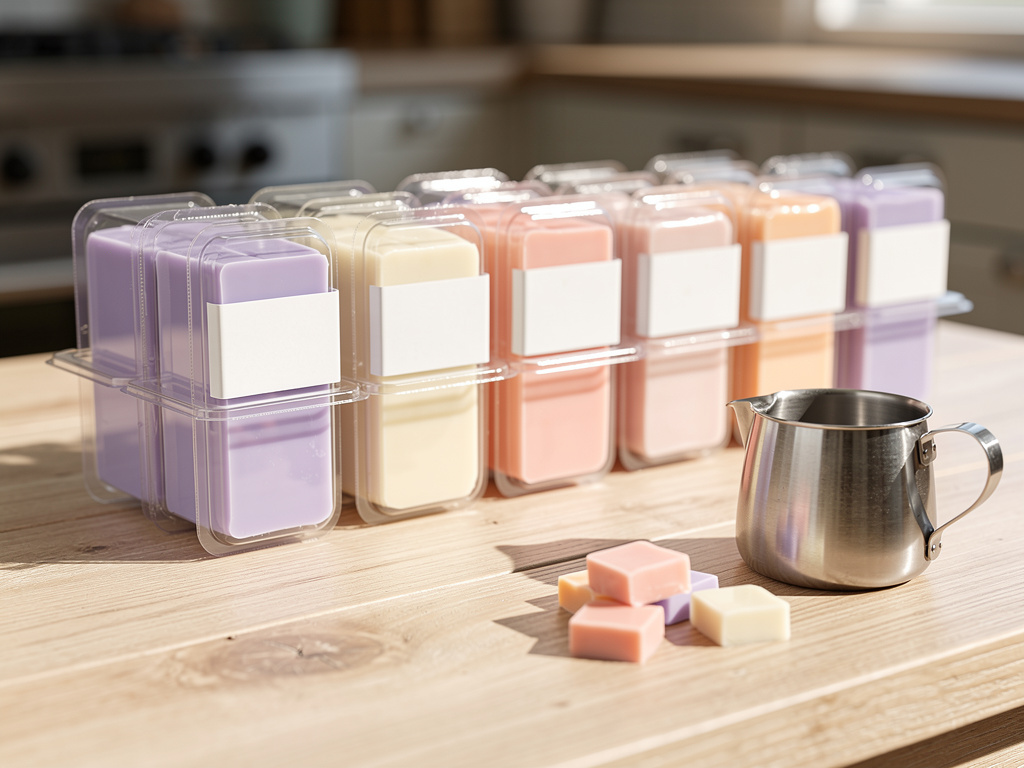


The short version: To sell wax melts from home, pour a pillar or melt wax such as a soy and coconut blend into clamshells, add about 1.5 ounces of fragrance oil per pound of wax (the 9% rate in CandleScience's clamshell guide), let the melts cure 1 to 2 weeks, and test each scent in a warmer before you sell it. A starter order from CandleScience that makes about 60 standard clamshells in four scents cost $171.89 on October 5, 2026, before shipping, including a pitcher, a thermometer and a scale. Melts are a household product, not a food, so no cottage food permit applies, but each clamshell label still has to say what it is, carry your business name and address, and show the net weight of the melts in ounces and grams. Start with a farmers market or craft fair table where people can smell the scents, then give your regulars one link to reorder between markets.
Checked October 5, 2026: supply prices on CandleScience's product pages, cure and fragrance guidance in its wax melt guides and lab notes, label rules on the FTC's packaging rule page, and fees on Homegrown's signup page plus Etsy's fees policy and the Shopify and Square pricing pages. Homegrown storefronts are built for pickup and local delivery, not shipping. A customer makes a Homegrown account before a first order, Homegrown has no drop or countdown release feature, and you should expect most orders to come from people you point to your own link.
Your friend asked for a second clamshell of the vanilla melts you made for her birthday. Then her neighbor asked. Now you have a pound of wax left, three people waiting, and a craft fair two months out. You want to know what it takes to turn this into something you sell on purpose.
This guide is for vendors in the United States, and it walks you through the work in the order you will actually do it. It starts with the supply order, with prices loaded on one day, then covers the wax, the fragrance, the pour, the cure and the testing. After that it covers the label, the heat problem, where to sell, what each checkout keeps, and how many clamshells to pour for your first month.
You start selling wax melts from home in five moves: buy one starter order of wax, fragrance and clamshells, pour a test batch, cure and test it for 1 to 2 weeks, label it, and sell your first 60 clamshells to people who can smell them. Most of your effort goes into the scents, not the paperwork.
Here is the whole path at a glance:
Pricing is its own job. Our wax melt pricing guide found nine small shops charging a $6 median price for a standard clamshell on September 30, 2026, and works out a price for snap bars, minis and bundles. This page uses that $6 figure for its examples and covers everything else.
Plan on $171.89 for your first order, the CandleScience total we added up on October 5, 2026, not counting shipping or sales tax. It buys 10 pounds of wax, four 4 ounce bottles of fragrance, 90 clamshells, 100 warning labels and three tools you keep.
Scroll sideways to see every column.
| Item | Size you buy | Price | What it covers |
|---|---|---|---|
| CocoSol Soy Pillar Wax (coconut, sunflower and soy) | 10 lb bag | $40.88 | About 60 clamshells |
| Fragrance oil, four scents | 4 x 4 oz bottles at $12.85 | $51.40 | 16 oz, enough for 15 clamshells of each scent |
| Standard 6 pc. Clamshell (holds 2.75 oz) | 90 pc box | $30.78 | 60 for this batch, 30 for the next |
| Wax melt warning labels | 100 pc roll | $4.15 | One inside every lid |
| Small pouring pitcher | Holds 1 lb | $7.99 | Tool, reused |
| 8 inch glass thermometer | 1 | $5.98 | Tool, reused |
| Small stainless steel scale | Up to 4.4 lb | $30.71 | Tool, reused |
| Total | $171.89 | $127.21 of supplies, $44.68 of tools |
We loaded every price on CandleScience's product pages on October 5, 2026. Fragrance prices vary by scent; the 4 ounce price is Moroccan Cashmere, the scent in CandleScience's clamshell guide. Shipping, tax, dye and your front label are not included. You also need a pot for a double boiler, which most kitchens already have.
The yield comes from CandleScience's clamshell guide, which says "half a pound of wax will fill approximately 3 clamshell wax molds." Ten pounds is 20 half pounds, so about 60 clamshells.
At a full 2.75 ounce fill, which is 2.51 ounces of wax and 0.24 ounces of fragrance (the pricing guide's split), your materials come to about $1.80 a clamshell ($1.796 before rounding): $0.64 of wax, $0.77 of fragrance, $0.34 for the clamshell and $0.04 for the warning label, each rounded to the cent, which is why the four parts add to $1.79. Filled that full, 10 pounds of wax makes about 63 clamshells; if you pour the guide's 60 instead, spreading the $40.88 of wax and $51.40 of fragrance across 60 comes to about $1.92 a clamshell with the clamshell and label. The pricing guide's $1.55 assumes one 16 ounce bottle of fragrance, which costs $2.24 an ounce instead of the 4 ounce bottle's $3.21. Starting with four small bottles costs about 25 cents more a clamshell. That is the price of finding out which scents your customers want before you buy a pound of any of them.
If all 60 sell at $6, that is $360 from a $171.89 order, or $188.11 left before your booth fees, front labels, card fees and time. The $44.68 of tools pour your next batch too, so a second order of the same supplies costs $127.21 and still leaves you spare clamshells and labels from the first.
The best wax for melts you sell is a pillar or melt wax, not the soft container wax used in jar candles, because a melt has to hold its shape out of the mold and survive a warm day. CandleScience's wax guide lists which of its waxes are made for melts and tarts, with each one's fragrance limit and melt point.
Swipe the table to see all five columns.
| Wax | What it is | Most fragrance it holds | Melt point | 10 lb price |
|---|---|---|---|---|
| CandleScience CocoSol | Coconut, sunflower and soy blend | 4 oz per lb (25%) | 128 to 136°F | $40.88 |
| Blended Waxes BW-921 | Soy pillar wax | 1.6 oz per lb (10%) | 135°F | $30.54 |
| IGI 6028 | Paraffin and soy blend | 1.5 oz per lb (9%) | 133°F | $36.42 |
| Golden Brands 464 (for comparison) | Soy container wax for jars | 1.6 oz per lb (10%) | 113 to 119°F | Not a melt wax |
Fragrance limits and melt points come from CandleScience's wax guide, and prices from its wax order page, both loaded October 5, 2026. 464 is shown only to compare its melt point; CandleScience lists it for containers and tealights, not melts.
How to pick between them:
Whatever you pick, use one wax for your first season. Changing wax changes how every scent smells, and you want your test results to stay true.
Start with 0.75 ounces of fragrance oil for every 8 ounces of wax, which is 1.5 ounces per pound, the rate in CandleScience's clamshell guide (the guide rounds it to 9%). That is exactly IGI 6028's listed limit and under the limits of BW-921 and CocoSol, so it is within the listed limit of every melt wax in the table above; check each oil's own limit too. Only CocoSol leaves you much room to go higher once you have tested a scent; BW-921 allows just 0.1 ounce more per pound.
You weigh fragrance, never measure it by the spoon. Put the pitcher on the scale, tare it, and weigh both the wax and the oil. For a half pound pour that fills about 3 clamshells:
You can go higher with CocoSol, but more is not always better. CandleScience's lab notes on CocoSol found visible frosting, a white bloom on the surface, was "much more common in wax containing fragrance loads of 15% or greater," and that higher loads make melts "more crumbly" with "less snap" when you break a cube off.
If you pour CocoSol, stay between 1.5 and 2 ounces of fragrance per pound (about 9% to 12%) for clamshells that sit on a table under bright light; with BW-921 or IGI 6028, stay at the guide's 1.5 ounces per pound. In a clear clamshell, frosting reads as a flaw, and CandleScience's own tests saw it far more often at 15% and above. Save the heavy loads for a "strong" version you sell in a box, where nobody sees the surface.
Every fragrance oil has its own limit, and it is not always the wax's limit. Moroccan Cashmere's page listed "Wax Melt Safe usage: 5.0% - 25.0%" on October 5, 2026, but another oil can top out lower. Check the usage line on each oil's own page before you raise the rate, and recheck when you reorder.
Start with the standard 6 cube clamshell, because it is the mold and the package in one piece, it holds 2.75 ounces, and CandleScience calls it "the most common size in the market." You pour straight into it, snap the lid, and it is ready for a label.
Here is how the main options compare for a home seller:
The clamshell also solves a heat problem you will meet in summer. CandleScience's CocoSol lab notes recommend "packaging that is self-contained, such as clamshells" when you ship high-fragrance melts in hot weather. A melt in a sealed clamshell that softens a little is still a sellable melt. A loose melt in a paper bag is a stain.
One more reason to start simple: if you make one format in four scents, you have four products to track. If you make three formats in four scents, you have twelve. Add the snap bar once you know which scents sell.
You make a batch of wax melts in about an hour of hands-on time: weigh, melt, add fragrance at 185°F, pour at about 170°F, and let it set overnight. The temperatures below come from CandleScience's soy wax melt guide (which uses CocoSol) and its clamshell guide; if you use a different wax, use the pour temperature on that wax's page.
Pour one scent at a time and clean the pitcher between scents. A pitcher that held cinnamon will make your next batch of lemon smell faintly of cinnamon. CandleScience's tip is to remelt the leftover wax, wipe it out with a paper towel, then wipe the inside with rubbing alcohol.
Keep a batch log from day one: the date, the wax, the scent, the fragrance weight and how many clamshells you got. When a customer says the last clamshell of Sea Salt was weaker, the log tells you why.
Wax melts need to cure for 1 to 2 weeks before you sell them, the range CandleScience gives in its soy wax melt guide: "For best fragrance throw, let your wax melts to cure for 1-2 weeks before use." Curing is the time the fragrance needs to settle into the wax, and a melt sold the day after pouring often smells weaker in a warmer than the same melt a week later.
That cure time changes how you plan. It means:
Curing is also free quality control. Look at the clamshells at day 7. Frosting, cracks or melts pulling away from the plastic show up in that window, and you would rather find them in your closet than at your table.
If a customer asks how long a cured melt lasts on the shelf, give them the honest answer: keep it closed and cool and it holds its scent for a long time, but a clamshell that sat open in the sun loses scent fast. Tell people to store spares with the lid shut.
You test scent throw by melting one cube of each cured scent in the kind of warmer your customers own, in a normal room, and judging it after 30 minutes and again after 2 hours. "Throw" is how far the scent travels into the room. "Cold throw" is how it smells in the package, and "hot throw" is how it smells melted, which is what your customer paid for.
A simple home test:
A scent you only notice standing next to the warmer is not ready to sell. Try a higher fragrance rate in the next test pour, or drop that oil.
Size matters too. CandleScience's clamshell guide warns that "some scents may overpower a small room like a bathroom." If a scent is very strong, say so on the label or the listing. A customer who melts all six cubes of a heavy scent in a small room will not come back for more.
Ask two or three friends to test your top scents in their own homes and warmers. Their warmers run at different heat, and that is closer to what a buyer will see.
Start with four scents, one from each of four families, so every shopper at your table finds one they like: a sweet bakery scent, a clean or fresh scent, a fruity or floral scent, and a warm woody or spicy scent. Four 4 ounce bottles add up to $51.40, the fragrance line in the starter order above.
A balanced first line might look like this:
Then add one seasonal scent at a time. A pumpkin or pine scent in the fall, a citrus in the spring. When the season ends, the scent goes away until next year, and the regulars who loved it have something to wait for.
Keep a simple tally at every market: which clamshells people pick up and sniff, and which they buy. After three markets you will know your top two. Order those in the 16 ounce bottle next time, which cost $2.24 an ounce against $3.21 for the 4 ounce size on October 5, 2026, and drop the scent that never sold.
Scent names are part of the product. "Porch Swing" or "Sunday Pancakes" is easier to remember and ask for than "Fragrance #4." Write the name big on the label so a customer can text you "two more Porch Swing" without looking it up.
Selling wax melts from home needs no cottage food permit and no commercial kitchen, and it does need a label with three things on it, because a melt is a scented household product like a candle, not a food. The FDA's aromatherapy page puts "air fresheners, scented candles" under the Consumer Product Safety Commission rather than the FDA. On the selling side, Homegrown's signup page lists "No food license required for non-food products."
What still applies:
Weigh the melts, not the clamshell, for the net weight. Subtract an empty clamshell's weight from a filled one, check a few, and print the lowest honest number.
If your melts look like food, such as cookie or candy shapes, a child may try to eat one, so put "Do not eat" where it shows and keep the warning label in every package, the way Forever Red Candle Co.'s cookie melt listing on Homegrown ends with "Do not eat." For the full label and the line between law and voluntary standards, read whether you can sell homemade candles, since the same agencies cover candles and melts.
A melt made from a pillar or melt wax handles summer heat far better than one made from jar wax, but a melt point is not a promise. The three melt waxes in the wax table have melt points of 128°F or higher, yet a heavily scented melt can soften well below that. The risk is time and fragrance load. CandleScience's CocoSol lab notes found no damage to the wax after 3 months at 104°F, but melts with 25% fragrance came out softened and needed time at room temperature before they would release from the clamshell.
The same tests found that "fragrance loads above 15% also caused slight softening of the plastic clamshell after 3 months of 104°F exposure." That did not ruin the melts, but it tells you where the weak point is: heavy fragrance plus long heat.
A jar candle wax with a 113 to 119°F melt point is a poor choice for melts you carry to summer markets or leave in a car between stops. Use a melt wax rated above 128°F, keep the fragrance near the guide's 1.5 ounces per pound in summer, and never leave a box of melts on a dashboard or in a trunk in direct sun.
Practical habits for warm months:
You can sell wax melts from home in six main places: farmers markets, craft fairs and holiday markets, pickup orders from your own link, local delivery, gift shops that buy wholesale, and online marketplaces that ship. A part-time vendor usually does best with two of them at once: one table where people can smell the melts and one link where they reorder.
Smell sells melts. A shopper reading "Porch Swing" online has to guess. The same shopper at your table opens a clamshell and decides in seconds. That is why the first sale of a scent usually happens in person, and the second one can happen on a link.
If you also pour jars, our breakdown of where to sell candles compares these places one by one, and melts can go anywhere your candles go.
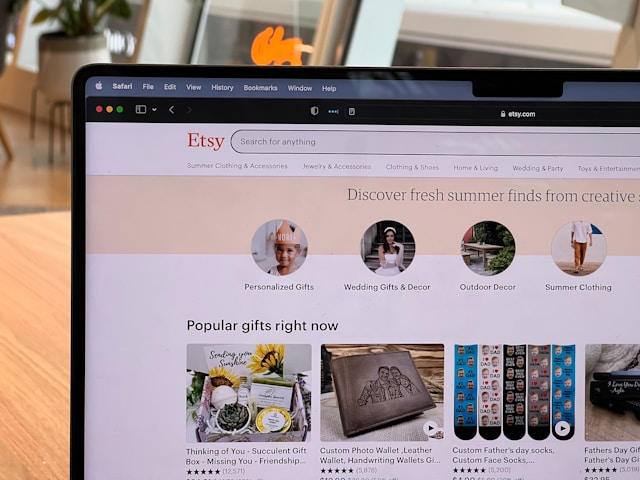
On an $18 order of three clamshells picked up locally, a Homegrown storefront kept $0.82 in card processing, Square's free plan $0.89, Shopify Basic $0.82 on a standard card, and Etsy $2.16, on fees loaded October 5, 2026. Homegrown's plan adds $10 a month and Shopify's adds $29, both on annual billing. The monthly plan is what separates the cheap options once you sell 50 orders a month.
Scroll sideways to see every column.
| Where you take the order | Monthly plan | Trial | Platform fee | Card processing | Customer pays on $18 | You pay on $18 | 50 orders a month, all in |
|---|---|---|---|---|---|---|---|
| Homegrown storefront | $10/mo billed annually, or $12.50 billed monthly | 7 days, no charge until day 8 | $0, 0% commission | 2.9% + $0.30, paid by you | $18.00 | $0.82 | $51.10 (annual) or $53.60 (monthly) |
| Etsy | $0; a one-time set-up fee may apply | None | $0.20 listing renewal + 6.5% transaction fee | 3% + $0.25 | $18.00 | $2.16, or $4.86 if the sale came from an Offsite Ad (an ad Etsy buys on other sites, charged only on orders it brings in) at 15% | $108.00 before any Offsite Ads |
| Shopify Basic | $29/mo billed yearly, or $39 billed monthly | 3 days, then $1/month for 3 months | $0 on Shopify Payments (2% if you use another processor) | 2.9% + $0.30 online on standard cards, 3.5% + $0.30 on premium cards | $18.00 | $0.82, or $0.93 on a premium card | $70.10 (yearly) or $80.10 (monthly) on standard cards |
| Square, free plan | $0 per location | None | $0 | 3.3% + $0.30 online | $18.00 | $0.89 | $44.70 |
We checked these on Homegrown's signup page, Etsy's fees policy and Sell page, Shopify's pricing page and Square's pricing page on October 5, 2026. The $18 order is three $6 clamshells sold as one 3-pack listing, picked up locally, before sales tax. Etsy's processing applies to the order total including tax and shipping, so a shipped order costs more than the row shows.
What the numbers mean for a melt vendor:
The fee is only part of the choice. The next section covers what each one does for a shopper who wants the same scent again.
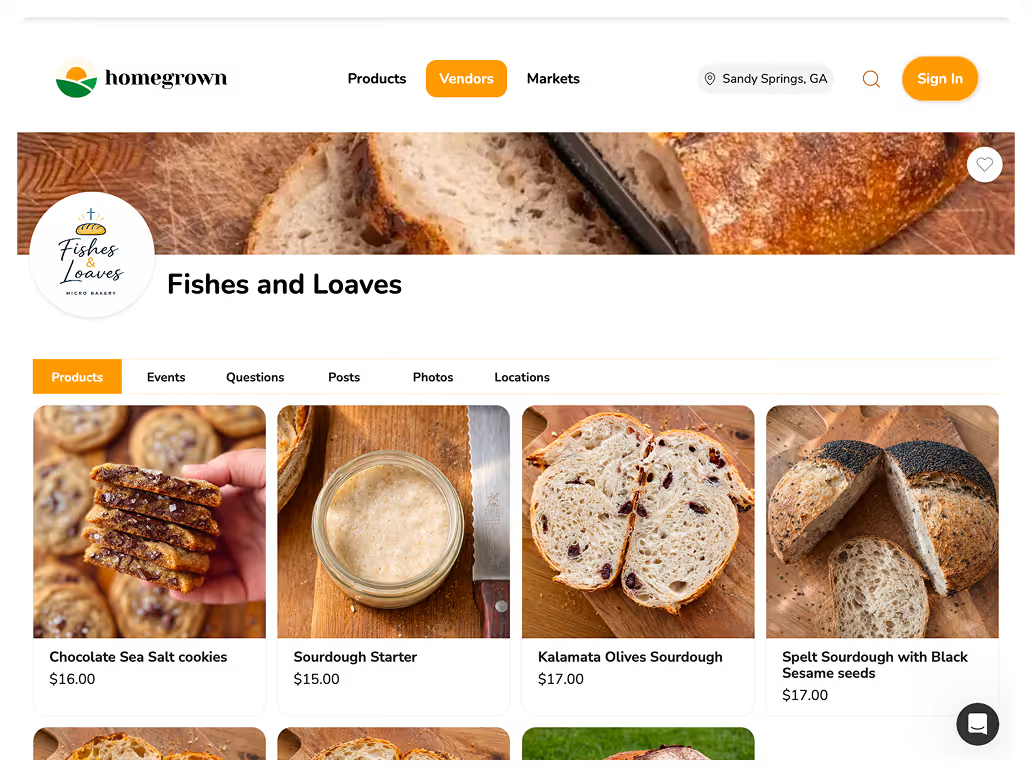
The hardest part of selling wax melts from home is not the first sale at your table, it is the second one, when a customer runs out of Porch Swing on a Tuesday and has to message you to get more. Homegrown gives each scent its own spot on one storefront link for $10 a month billed annually ($12.50 billed monthly) with no percentage fees beyond standard payment processing, so that customer can order and pay without a single back-and-forth.
What it does for a melt vendor:
How it compares: Etsy is the better fit when your melts go by mail to buyers you will never meet, but it kept $2.16 of the $18 order in the fee table, and shipping comes on top. Instagram DMs cost nothing but can lose an order in a busy week. Square's free plan is excellent at the table and its online page costs a little more per order, while Shopify starts at $29 a month on annual billing.
What Homegrown does not do: it does not ship, so if most of your melts go out by mail, Etsy or Shopify fits better. Customers create a Homegrown account to place a first order. There is no drop or countdown release feature for timed scent launches. Your storefront is listed on the marketplace, but plan on most orders coming from people you send to your own link. You cover the card processing of 2.9% plus 30 cents yourself, and no card fee is added to your customer's total.
If your regulars already text you for refills, start a Homegrown storefront for your wax melts and list all four scents with a pickup day in one afternoon.
Make about 60 clamshells for your first month, 15 in each of four scents, which is one 10 pound bag of wax and the starter order above. That is enough for two or three market days plus a handful of pickup orders, and small enough that a scent nobody likes does not leave you with 40 unsold clamshells.
A sample first month:
Homegrown's catalog held 2,883 products from 309 vendors when we pulled it on October 5, 2026, and just 2 were wax melts sold on their own, and both came from one shop, Forever Red Candle Co.: a $4.00 cookie-shaped melt in three scents and a $10.00 mystery box of three jumbo cookie melts. The same shop lists 17 other products around them, including 6 candle warmer lamps (one says it also takes wax melts). We searched every non-food listing's name and description for wax, melt, tart, snap bar, clamshell and warmer, read each match, and then read all 19 of that shop's listings. We left out 12 scent-named $15 listings from another shop whose descriptions do not say whether they are candles or melts.
What the one Homegrown shop with labeled wax melts sells, by type
Source: Homegrown catalog pull, October 5, 2026, all 19 Forever Red Candle Co. listings read by hand. The 8 candles include 3 wickless candles. The 6 candle lamps warm a candle from above, and one of them says it also takes wax melts. The fragrance set is a $30.00 bundle that packs a wax shot (a single wax melt, which the listing says to melt in another room) with a matching candle and room spray.
That shop shows where melts fit in a home fragrance line: next to the candles and the candle lamps, as the low-price way to try a scent. If you pour jars too, put your melts in the same scents, and the guide to how much to sell candles for prices the jar side.
The mistakes that cost new wax melt vendors the most are buying a pound of a scent before testing it, selling melts before they cure, and using a soft jar wax that sags in summer. None of them need a permit to fix, just a little patience. The common ones:
Most of these come from rushing the first batch. Pour small, cure fully, test honestly, then scale the two scents that sell.
The last mistake is the easiest one to fix before your first market. If you want every clamshell you sell at the table to lead to a reorder, put your wax melt scents on a Homegrown storefront and print its QR code on your label, so a customer who runs out can order the same scent for pickup without hunting for you.
You do not need a cottage food license or a commercial kitchen to sell wax melts from home, since food rules were never written for wax. You may still need a sales tax permit or a business registration where you live, and some cities limit home businesses. Verify your state's current rules before your first sale.
A melt or pillar wax works best for wax melts you plan to sell, such as CandleScience's CocoSol soy and coconut blend, BW-921 soy, or IGI 6028 paraffin and soy. These melt at 128°F or higher, well above jar wax, though heavily scented melts can still soften in long heat. CocoSol is rated for up to 25% fragrance, the highest of the three on CandleScience's wax guide on October 5, 2026.
Expect to spend about $171.89 on your first supply order, the total of CandleScience's prices on October 5, 2026, before you pay shipping or tax. It covers 10 pounds of wax, four fragrance oils, 90 clamshells, warning labels, a pitcher, a thermometer and a scale. If you already own a kitchen scale and thermometer, you start closer to $135.
Wax melts should cure for 1 to 2 weeks before selling, according to CandleScience's soy wax melt guide, so the fragrance has time to settle and the melt smells full in a warmer. Plan your pour day about two weeks before each market. Keep a few cured clamshells of your best-selling scent on hand so reorders do not wait.
Farmers markets that accept non-food crafts can take wax melts, but every market writes its own vendor rules, and some limit non-food stalls. Ask the market manager before you apply and bring labeled clamshells with a warning label inside each lid. A table where shoppers can open and smell a clamshell is the best place to sell wax melts from home.
Selling wax melts from home can be profitable on materials: about $1.80 of supplies in a full clamshell from a small first order (about $1.92 if you spread the order across the guide's 60), against a $6 median price across nine small shops on September 30, 2026. Your time, booth fees and the scents that do not sell come out of that gap. Buying your best two scents in larger bottles lowers your cost as you grow.
These 5 guides pick up where this one stops, from clamshell prices to candle rules to online checkouts. Start with the pricing guide if you have not set your clamshell price yet, since this page's sales examples use its $6 median, and read the candle rules guide before you print 100 labels:
Selling wax melts from home comes down to a few habits: one wax, four tested scents, a full cure, an honest label and a way for the people who loved a scent to buy it again. Pour your first 60, learn which two sell, and build from there.