
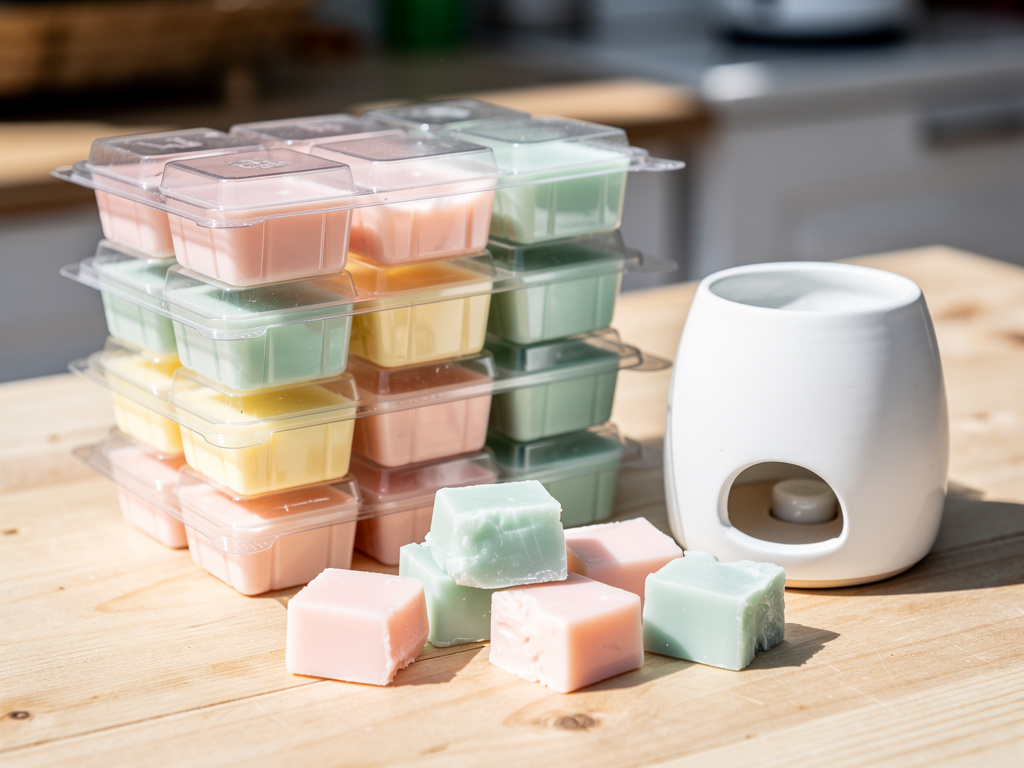


The short version: Sell a standard six-cube clamshell of wax melts, about 2.5 to 3 ounces, for $5 to $7, and a 1.5 ounce snap bar or mini square for $3 to $4.50. Nine small shops we checked charge a median of $6 for a standard clamshell, or about $2 an ounce, and Scentsy and Yankee Candle both charge $2.12 to $2.31 an ounce for theirs. The wax, fragrance, clamshell and warning label inside one standard clamshell cost about $1.55 when you buy supplies at small-batch sizes, so $6 is close to four times your materials. On a Homegrown storefront the only per-order cost on a $6 clamshell is 47 cents of card processing, on a plan of $10 a month billed annually, and selling three at a time cuts that to 27 cents a clamshell.
Checked on September 30, 2026: CandleScience's supply prices and clamshell guide, nine small shops' own product pages, Scentsy's and Yankee Candle's product pages, and the pricing pages of Homegrown, Etsy, Shopify and Square. Homegrown customers create an account to place their first order, and Homegrown has no drop or countdown release feature.
Wax melts are the easiest thing on a candle table to make and the hardest to price. There is no wick to test and no jar to buy, so a clamshell looks like it costs pennies. Then you add up the plastic, the fragrance and the label, and you are not sure whether $4 is a bargain or a loss.
This guide works it out with numbers loaded on one day. It uses live supplier prices for a standard clamshell, what nine small shops charge right now, what the big brands charge per ounce, and what each way of selling takes off a $6 sale. By the end you will have a price for every size you pour.
Price a standard six-cube clamshell at $5 to $7, which is 3.2 to 4.5 times the $1.55 of materials inside it and brackets the $6 median that nine small shops charged on September 30, 2026. Smaller formats cost you less but not half as much, because the plastic and the label cost nearly the same at any size.
If you also pour jar candles, the companion guide on how much to sell candles for prices tins, jars and double wicks the same way. This page is only about melts.
Scroll sideways to see every format.
| Format | Wax inside | Your materials at small-batch prices | Suggested price | Price per ounce | Multiple of materials |
|---|---|---|---|---|---|
| Standard 6 pc. clamshell, 1 inch cubes | 2.75 oz | $1.55 | $5 to $7 | $1.82 to $2.55 | 3.2x to 4.5x |
| 5 pc. snap bar clamshell | 1.5 oz | $0.97 | $3 to $4.50 | $2.00 to $3.00 | 3.1x to 4.6x |
| 10 pc. mini square clamshell | 1.5 oz | $0.97 | $3 to $4.50 | $2.00 to $3.00 | 3.1x to 4.6x |
| Three standard clamshells sold as one bundle | 8.25 oz | $4.65 | $15 to $18 | $1.82 to $2.18 | 3.2x to 3.9x |
Fill weights and supply prices come from CandleScience's product pages on September 30, 2026, figured at the 10 pound wax bag, the 16 ounce fragrance bottle, the 90-piece clamshell box (50-piece bag for snap bars and mini squares) and the 100-count warning label roll. The fragrance rate is the one in CandleScience's clamshell guide, 0.75 ounces per 8 ounces of wax. Your front label is not included.
Where you land inside each range depends on things a customer can smell and see:
The median price of a standard clamshell is $6 across nine small shops that sell 2.5 to 3 ounce clamshells on their own websites, with prices from $5 to $9.99 on September 30, 2026. By the ounce, the median was $2.00. Five of the nine sit between $5 and $6, so $6 is a normal price, not a brave one.
Slide the table sideways to see all nine shops.
| Shop | Clamshell | Size the shop states | Price | Price per ounce |
|---|---|---|---|---|
| Forever Enchanted Candle Co. | Cashmere Plum | 2.75 oz | $5.00 | $1.82 |
| Meowza & Barkley Candles | Fur Mom Escape, soy | 2.62 oz | $5.00 | $1.91 |
| LeaBee Naturals | Old Georgia Pine, beeswax and soy | about 2.5 oz | $5.00 | $2.00 |
| D SCENT | Abundance, soy | 3 oz | $6.00 | $2.00 |
| Good Vibes Apothecary | Soy clamshell, any scent | 3 oz | $6.00 | $2.00 |
| Mystic Melts Candle Co. | 6-cube soy clamshell, most scents | 3 oz | $6.66 | $2.22 |
| Chickpea Creations, Arlington, TX | Southern Belle, soy | 2.6 oz | $6.50 | $2.50 |
| Plumeria Scents | Pink Pansy soy clamshell tart | 2.5 oz | $8.00 | $3.20 |
| Hawk Stash | Honeysuckle Jasmine, soy blend | about 2.8 oz | $9.99 | $3.57 |
We read every price off the shop's own site on September 30, 2026, and every clamshell was in stock. Mystic Melts charges $6.66 for most scents, $5.55 for six others and $3.33 for a few on clearance; the table uses $6.66. Sizes are as each shop states them; "about" stands in for the shop's own "approximately". We found the shops with a web search for small candle shops selling clamshell melts on their own websites, and kept the US shops whose page stated a clamshell size between 2.5 and 3 ounces and a stated price for the scent we picked rather than a "from" price, so this is a sample of nine, not a national survey.
What nine small shops charge for a standard clamshell
Source: each shop's product page, September 30, 2026, nine in-stock clamshells of 2.5 to 3 ounces. Bar widths are each price divided by $9.99.
What the spread tells you:
Two of the best-known wax melt brands, Yankee Candle and Scentsy, charged $2.12 to $2.31 an ounce on September 30, 2026, which is a little above the $2.00 median of the nine small shops, by 12 to 31 cents an ounce. That is different from candles, where handmade often sits below the brands. With melts, the brands set a fair middle, not a ceiling.
Drag the table left to see every column.
| Brand and product | Size | Wax the brand names | Price | Price per ounce |
|---|---|---|---|---|
| Yankee Candle Wax Melts, 6-pack (Vanilla Cupcake) | 2.6 oz | Premium paraffin blend | $5.50, or 3 for $12 that day | $2.12 ($1.54 at 3 for $12) |
| Scentsy Bar, 8 cubes (Barefoot Beach) | 2.6 oz net | Paraffin | $6.00 | $2.31 |
| Happy Wax 2 oz pouch (Flannel & Cashmere) | 2 oz | Soy | $8.95 | $4.48 |
Prices and sizes come from Yankee Candle's, Scentsy's and Happy Wax's own listings, loaded September 30, 2026. Yankee Candle's page was running 3 for $12 on wax melts that day, which drops its price per ounce well below every small shop in the table above.
How to use those numbers:
One standard clamshell costs $1.55 in materials when you buy wax in 10 pound bags, $2.13 when you buy everything in the smallest sizes, and $1.27 at bulk sizes. That clamshell holds 2.75 ounces, which works out to about 2.51 ounces of wax and 0.24 ounces of fragrance oil at the rate CandleScience uses in its guide.
Swipe the table to see all three buying levels.
| What goes in | Starter sizes (1 lb wax, 1 oz fragrance, 10 clamshells) | Small batch (10 lb wax, 16 oz fragrance, 90 clamshells) | Bulk (45 lb wax, 5 lb fragrance, 700 clamshells) |
|---|---|---|---|
| CocoSol soy pillar wax, 2.51 oz | $0.86 | $0.64 | $0.54 |
| Fragrance oil, 0.24 oz | $0.82 | $0.53 | $0.45 |
| Standard 6 pc. clamshell | $0.41 | $0.34 | $0.26 |
| Wax melt warning label | $0.04 | $0.04 | $0.03 |
| Materials per clamshell | $2.13 | $1.55 | $1.27 |
Supply prices from CandleScience on September 30, 2026: CocoSol Soy Pillar Wax (a coconut, soy and sunflower blend, per its page) at $5.46 for 1 pound, $40.88 for 10 pounds and $154.01 for 45 pounds; Moroccan Cashmere fragrance oil (the scent in its clamshell guide) at $3.49 for 1 ounce, $35.86 for 16 ounces and $152.57 for 5 pounds; Standard 6 pc. Clamshells at $4.06 for 10, $30.78 for 90 and $180.25 for 700; wax melt warning labels at $4.15 per 100 and $29.38 per 1,000. Fragrance prices vary by scent. Each line is rounded to the cent, so the bulk column's lines add to $1.28 against its $1.27 total.
Three things stand out:
The 2.75 ounce fill comes from CandleScience's listing for the Standard 6 pc. clamshell, which says it holds 2.75 ounces of wax. As a rough cross-check, CandleScience's guide to making clamshell wax melts says half a pound of wax fills about three clamshells, which is about 2.7 ounces of wax each, or about 2.9 ounces once the fragrance is in.
The plastic clamshell costs 34 cents at small-batch prices, more than half of the 64 cents of wax it holds, because a mold with a snap lid costs about the same whether you fill it with cheap wax or expensive wax. On the smaller 1.5 ounce formats the plastic is 30% of your materials, against 22% on a standard clamshell.
Scroll sideways to compare the three clamshells.
| Clamshell | Wax it holds | Cube or bar size | Price per clamshell: small pack | Mid pack | Case |
|---|---|---|---|---|---|
| Standard 6 pc. | 2.75 oz (78 g) | 1 inch cubes | $0.41 (10 for $4.06) | $0.34 (90 for $30.78) | $0.26 (700 for $180.25) |
| 5 pc. snap bar | 1.5 oz (42.5 g) | 1.58 by 0.8 by 0.5 inch bars | $0.38 (10 for $3.76) | $0.29 (50 for $14.65) | $0.23 (250 for $57.78) |
| 10 pc. mini square | 1.5 oz (43 g) | 0.8 by 0.8 by 0.5 inch squares | $0.38 (10 for $3.76) | $0.29 (50 for $14.65) | $0.23 (250 for $57.78) |
Capacities, sizes and prices come from CandleScience's listing for each clamshell, checked the same day as the cost table. All three were in stock. CandleScience's snap bar page also says 2 oz in its short product description; we used its 1.5 oz (42.5 g) spec line, which is repeated in the page's details.
What that means for your price:
Price by the wax you actually pour, not by the name on the clamshell. A standard clamshell holds 2.75 ounces when filled to the top, and the shops in the table above state anything from 2.5 to 3 ounces. Weigh a few of your own, put that number on your label, and price from it. We checked the clamshell capacities on CandleScience's product pages on September 30, 2026.
Raising your fragrance from about 9% to 15% of the wax weight adds about 25 cents to a standard clamshell at small-batch prices, taking materials from $1.55 to $1.80. Scent throw is the reason people buy melts, so that is usually the best 25 cents you can spend.
Slide sideways to see every fragrance level.
| Fragrance load (share of wax weight) | Fragrance in one clamshell | Fragrance cost | Materials per clamshell | Materials at a $6 price |
|---|---|---|---|---|
| 6% | 0.16 oz | $0.35 | $1.40 | 23% |
| About 9%, the rate in CandleScience's guide | 0.24 oz | $0.53 | $1.55 | 26% |
| 12% | 0.29 oz | $0.66 | $1.67 | 28% |
| 15% | 0.36 oz | $0.80 | $1.80 | 30% |
| 25%, the most CocoSol says it holds in melts | 0.55 oz | $1.23 | $2.18 | 36% |
Figured on a 2.75 ounce fill at small-batch prices from CandleScience on September 30, 2026: wax at $40.88 for 10 pounds and Moroccan Cashmere fragrance at $35.86 for 16 ounces. CocoSol's product page says it holds 25% fragrance in wax melts. Every wax has its own limit, so check yours before you go past the guide's rate.
How to use it:
Add up your materials, your time and your selling costs, then set a price that covers all three about one and a half times or more and still lands near the market. On a standard clamshell that works out to $6. Here is the whole process with example numbers you can swap for your own.
The two example lines are where your price really gets decided. A vendor who melts 60 clamshells in the same hour has a time cost of 33 cents, not $1. A vendor at a $75 market needs to sell more clamshells to spread the fee. Put your own numbers in. The example also leaves out your front label, the shipping on your supply orders and the test pours you melt at home, so treat $3.55 as a floor, not the full cost.
Snap bars and mini squares should sell for $3 to $4.50 each, samplers for about $2, and a standard clamshell for $5 to $7. Snap bars and mini squares hold 1.5 ounces, and a sampler holds 1 ounce. Going from a standard clamshell down to a snap bar should cost the customer more per ounce, because your plastic and label cost the same at any size. The $2 sampler is the one deliberate exception: it is priced to get a first scent into someone's hands, not to earn its share.
A simple size ladder at a farmers market table:
The ladder does two jobs. It gives a shy customer a $2 way in, and it makes the bundle look like the smart buy, which it is.
Yes, because card processing has a fixed 30 cents in it, and on a $6 clamshell that fixed part is most of the fee. One $6 clamshell loses 47 cents to card processing, 7.9% of the sale. One $15 order of three loses 74 cents, 4.9% of the sale, or 25 cents a clamshell.
Here is the math on a Homegrown storefront, at 2.9% plus 30 cents per order:
List the bundle as its own product, such as "3 clamshells, $15," with each set of three scents as its own variant, like a fall trio and a fresh trio. Homegrown's signup page lists multiple variants per product, each with its own price, under one listing. One order with three clamshells pays the 30-cent fixed fee once instead of three times, and a customer who came for one scent goes home with three.
The bundle does give up money on paper. Three clamshells at $6 each bring in $18, and the bundle brings in $15. That trade is worth it only if the bundle sells three where you would otherwise have sold one. Try it for a month and count.
Selling fees take between 26 cents and $1.02 off a $6 clamshell sold on its own, depending on where you sell it, before any monthly plan. Etsy takes the most because it stacks a listing fee, a transaction fee and payment processing on a small price. Here is the fee stack for every platform, and Etsy's set-up and Offsite Ads fees are listed under the table.
Scroll sideways for the rest of each row.
| Platform | Subscription | Trial length | Platform fee or commission | Card processing | Customer pays on a $6 clamshell | Vendor pays on that clamshell | Vendor cost, 50 one-clamshell orders a month |
|---|---|---|---|---|---|---|---|
| Homegrown | $10/mo billed annually, $12.50 billed monthly | 7 days, no charge until day 8 | $0, 0% commission, no shopper fee | 2.9% + $0.30, vendor-paid | $6.00 | $0.47 | $33.70 |
| Etsy | $0 | None | 6.5% transaction fee on the price plus any shipping you charge, plus a $0.20 listing fee, charged again when a listing renews after a sale | 3% + $0.25 for a US bank account | $6.00 plus any shipping | $1.02 | $51.00 |
| Shopify Basic | $29/mo paid yearly, $39/mo paid monthly | 3 days, then $1/mo for 3 months | $0 with Shopify Payments, 2% with any other processor | 2.9% + 30 cents online on standard cards (3.5% + 30 cents on premium cards), 2.6% + 10 cents in person | $6.00 | $0.47 on a standard card, $0.51 on a premium card, $0.26 in person | $52.70 on standard cards, $54.50 on premium cards, $41.80 in person |
| Square, Free plan | $0 | Not applicable | $0 | 2.6% + 15 cents in person, 3.3% + 30 cents online | $6.00 | $0.31 in person, $0.50 online | $15.30 in person, $24.90 online |
Every fee read off the platform's own page on September 30, 2026: findhomegrown.com/signup, etsy.com/sell, shopify.com/pricing and squareup.com/us/en/pricing. Etsy's page also says you may be charged a one-time shop set-up fee, shown only during setup, and a 15% Offsite Ads fee on sales that come from those ads; neither is in the table. The 50-order column adds the monthly plan, billed annually where there is a choice, to 50 times the per-clamshell cost. Etsy's figures assume no shipping is charged.
On a candle, those fees are a small slice. On a $6 melt they are not: Etsy's $1.02 is 17% of the sale, and even the lowest online rate in the table is 47 cents, or 7.9%. That is why the bundle section above matters more for melts than for anything else you sell.
The cheapest rows are cheap for different reasons. Square's 2.6% plus 15 cents is its rate when the card is present at your table. The same clamshell ordered on Square's free online page on Tuesday for pickup Saturday pays 3.3% plus 30 cents, or 50 cents. Etsy's cost climbs when you charge shipping, because its 6.5% fee also applies to the shipping price you set. We checked all of these on September 30, 2026.
A customer who finished your cinnamon clamshell on Wednesday wants two more by Saturday, and a $6 order is exactly the size that selling fees hurt most. Homegrown is $10 a month billed annually ($12.50 billed monthly) with no percentage fees beyond standard payment processing, so a $6 clamshell costs you 47 cents per order, and 50 of those a month cost $33.70 all in, against $24.90 on Square's free online page and $51.00 on Etsy. The extra $8.80 over Square pays for the monthly plan, which includes sales tax calculated and remitted for you and a listing on Homegrown's local marketplace.
What that looks like for a wax melt vendor:
How it compares to what melt vendors usually try first. Etsy is the right tool if your melts ship to strangers across the country, but it takes $1.02 of every $6 clamshell sold on its own. Square is excellent at your table at 31 cents a clamshell, and its free plan also includes an online ordering page, where a $6 clamshell costs 50 cents at 3.3% plus 30 cents, three cents more than Homegrown's 47 cents before Homegrown's monthly plan. Shopify covers shipping and in-person sales, at $29 a month billed yearly before any apps.
What Homegrown does not do, said plainly. Your customer creates a Homegrown account to place a first order, which is one extra step. There is no drop or countdown release feature, so a vendor who launches seasonal scents in timed drops will not find that here. Homegrown is built for pickup and local delivery, so if most of your melts ship across the country, Etsy or Shopify fits that better. Your storefront is listed on the marketplace, but plan on most orders coming from people you send to your own link. And the 2.9% plus 30 cents of card processing is paid by you, with nothing passed on to the customer.
If your melt prices are set and your regulars keep asking how to reorder between markets, you can set up a Homegrown storefront and put every scent and bundle on one link in an afternoon.
No vendor on Homegrown lists wax melts as their own product today. In a pull of the catalog on September 30, 2026, the only wax melt of any kind was a wax shot sold inside a $30 candle set, which means a vendor who adds melts is not competing with anyone else's inside the catalog.
In a pull of the Homegrown catalog on September 30, 2026, 0 of the 2,766 products listed by 314 vendors were standalone wax melts. We searched every listing's name and full description for wax melt, wax tart, snap bar, clamshell, wax cube, wax shot, melts and warmer, read every non-food listing that mentions wax, and opened every listing from the four home fragrance shops. The only melt of any kind is in Forever Red Candle Co.'s $30.00 Whipped Different set, which pairs a 10 ounce candle, a 1 ounce room spray and a coordinating wax shot. The search also turned up Forever Red's $7.00 room spray, which tells buyers to layer it with "your matching candle and wax melt," and its two candle warmer lamps, but none of those is a melt. Exclusively Aromas lists 51 products (candles at $40, mini diffusers at $12.50 and reed diffusers at $40) and Mrsworthy.com lists 12 candles at $15, with no melts from either. Pine & Wick LLC lists one product, hanging car diffusers at $8.00, and no melts.
What that tells you if you are thinking about adding melts:
A wax melt label should say what the product is, who made it and where, and the net weight in both ounces and grams. The Federal Trade Commission's summary of the Fair Packaging and Labeling Act asks for exactly those three things on the household products the act covers, which for a small maker means melts sold or shipped across state lines, and says the measurement "must be in both metric and inch/pound units." We loaded that page on September 30, 2026.
What that means for your price:
Melts you sell only inside your state fall under your state's weights and measures packaging rule instead. NIST's packaging and labeling FAQ says the model rule it publishes for states, in Handbook 130, is law in 45 of the 50 states and asks for the same three lines, so verify your state's current rules before you print a batch of labels. The guide to whether you can sell homemade candles walks through the full label, which rules are law and which are voluntary, and what your state may add.
Keep one retail price everywhere a customer can see it, and use a wholesale price of about half of retail for shops that resell your melts. A clamshell that is $6 at your table should be $6 on your storefront, and a gift shop that buys it to resell would pay you about $3.
Why one price matters with melts in particular:
If you do sell wholesale, set a minimum order of a case or two and price it from a healthy retail number, never from a price you already cut to compete. The guide to where to sell candles walks through gift shops, markets and online options, and melts can go everywhere your candles go.
Set your holiday prices before November and change prices at most once a year after that, unless your supplies move by a lot. The National Candle Association's facts and figures page says about 35% of candle sales happen during the Christmas and holiday season, and small melts ride along as gifts: 2121 Candle Co. pitches its $2 one-ounce singles as stocking stuffers.
Times to look at your prices:
The costliest mistake is pricing from the wax alone, which misses the fragrance, plastic and label that make up almost 60% of the materials in a clamshell. Five times the 64 cents of wax is about $3, which covers the $1.55 of materials but falls under the $3.55 true cost in the step-by-step example, before any card fee.
The others:
If you already sell candles, the guide to upselling at the farmers market puts melts in the spot where they sell: right next to the candles people came for.
A standard six-cube clamshell of about 2.75 ounces costs $1.55 in materials when you buy wax in 10 pound bags, fragrance in 16 ounce bottles and clamshells by the 90-piece box, based on CandleScience prices checked September 30, 2026. At the smallest supply sizes it is $2.13, and at bulk sizes it is $1.27. Fragrance oil is the biggest cost after the wax.
On a $6 clamshell with $1.55 of materials, the materials margin is about 74%. Once you add an example $1.00 for your time and $1.00 of booth fee, the true cost is $3.55 and the margin is about 41%, before card fees. That is why pricing from materials alone makes melts look richer than they are.
Charge $5 to $7 for a standard clamshell and offer a bundle, such as three for $15, when you sell wax melts at a craft fair or farmers market. Nine small shops checked on September 30, 2026 had a median of $6 for a 2.5 to 3 ounce clamshell. A round number is easier to make change for and easier to add up.
Charge $3 to $4.50 for a snap bar or a set of mini squares, each holding 1.5 ounces of wax. At small-batch supply prices one costs about 97 cents to make, and the plastic is almost a third of that, so a snap bar should cost more per ounce than a standard clamshell.
Per sale, no, because a $6 clamshell keeps fewer dollars than a $17.50 jar candle. By materials they are close: the candle pricing guide puts its $17.50 median 8 ounce candle at about five times its $3.46 of materials, and a $6 clamshell is about four times its $1.55. Many candle vendors sell both, with melts as the low-price add-on next to the jars.
Sell wax melts on Etsy if most of your buyers are strangers who want them shipped. On a $6 clamshell Etsy's listing, transaction and processing fees came to $1.02 on September 30, 2026, before shipping, so bundle your melts there too. For local regulars, a pickup storefront or a card reader at your table keeps more of each sale.
These guides cover the parts of selling wax melts this one only touches. Start with the candle pricing guide if you pour both, since the same buyers pick up a jar and a clamshell at the same table, and read the guide to selling homemade candles before you print your first 100 labels:
The melt vendors who make money decide their numbers before the market, not at the table. If you have not poured your first batch yet, the guide to selling wax melts from home adds up a $171.89 starter order that makes about 60 clamshells in four scents, and covers the 1 to 2 week cure before any of them sell. Weigh your fill, add up your materials at the sizes you really buy, put a price on your time, and land on $5 to $7 for a clamshell with a bundle beside it.
A simple starting menu for your next market looks like this: a $2 sampler, a $4 snap bar, a $6 standard clamshell and three clamshells for $15. Write the net weight on every label, keep the same prices on your table sign and online, and buy your next round of wax, fragrance and clamshells at the small-batch sizes in the cost table so each clamshell costs you about $1.55 instead of $2.13.
When those prices are set, a Homegrown storefront puts every scent, size and bundle on one link for $10 a month billed annually, with a 7-day trial and no charge until day 8. Then take your next month of orders at those prices and count how many bundles sell before you change anything.



