
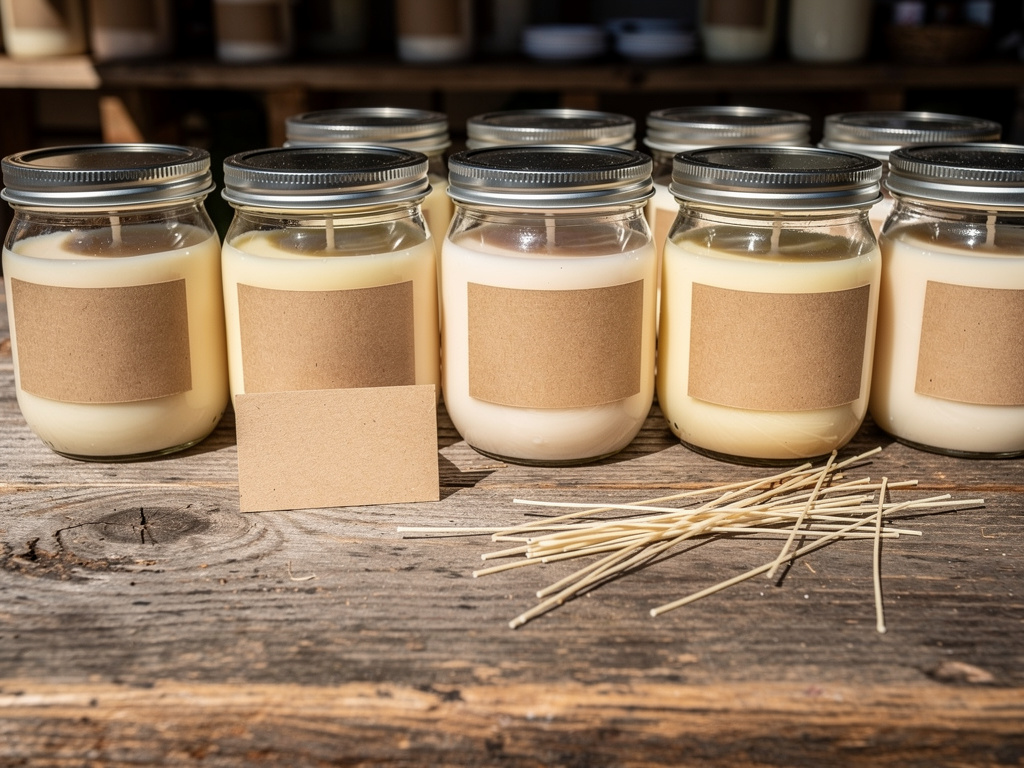


The short version: Sell an 8 ounce soy jar candle for $16 to $22 at a farmers market, a 4 ounce tin for $9 to $12, and a 15 ounce double-wick candle for $28 to $40. Eight small shops we checked charge a median of $17.50 for an 8 ounce candle, with prices running from $8.74 to $25. The wax, fragrance, wick, jar and labels inside that candle cost about $3.46 at supplier prices when you buy wax 10 pounds at a time, so $17.50 is about five times your materials. On a Homegrown storefront the only per-order cost on an $18 candle is 82 cents of card processing, on a plan of $10 a month billed annually.
Checked on September 23, 2026: supplier prices on CandleScience, eight small shops' own product pages, and the pricing pages of Homegrown, Etsy, Shopify, Square and Faire. Homegrown customers create an account to place their first order, and Homegrown has no drop or countdown release feature.
Candles are the rare product where your costs are easy to add up and your price is hard to pick. A pound of soy wax costs a few dollars, and then you are standing at your table wondering whether your jar is a $12 candle or a $24 one. Somebody two rows over sells at $10, and the gift shop in town sells a brand candle for $44.
This guide works from real numbers checked on one day. It uses live supplier prices for wax, fragrance, wicks and jars, the prices eight small shops charge right now, what national candle brands charge per ounce, and what each way of selling takes off the top. By the end you will have a price for every size you pour and a way to check it.
Price a soy candle in an 8 ounce jar at $16 to $22, which is about four and a half to six and a half times the $3.46 of materials inside it and brackets the $17.50 median that eight small shops charged on September 23, 2026. Every other size follows the same rule: work out what is inside the container, then price at about four to six times your materials.
If you are still sorting out your market application and your booth, the companion guide on how to sell candles at a farmers market covers licensing, insurance and display. This page is only about the number on the tag.
Swipe left on the table to see every size.
| Candle size | Wax inside, to the fill line | Your materials | Suggested price | Price per ounce of candle | Multiple of materials |
|---|---|---|---|---|---|
| 4 oz tin | 2.70 oz | $2.06 | $9 to $12 | $3.33 to $4.44 | 4.4x to 5.8x |
| 8 oz tin | 5.00 oz | $2.97 | $12 to $16 | $2.40 to $3.20 | 4.0x to 5.4x |
| 8 oz mason jar | 7.90 oz | $3.46 | $16 to $22 | $2.03 to $2.78 | 4.6x to 6.4x |
| 15 oz double wick | about 15 oz | $4.98 before the vessel | $28 to $40 | $1.87 to $2.67 | depends on the vessel |
Fill weights and wax, fragrance, wick and container prices come from CandleScience's product pages on September 23, 2026, figured at the 10 pound wax bag, 16 ounce fragrance bottle, 100-count wick bag and 12-piece container case. Materials include wax, fragrance oil, wick, container, a warning label from Fillmore Container and a front label, which is our estimate. The 15 ounce row leaves out the vessel because large vessels vary from a few dollars to much more. The 15 ounce row assumes about 15 ounces of candle, since no vessel was priced. The tin prices sit below the 2.5 to 3 times rule in the step-by-step section if a tin is charged the same $1.67 for your labor and $1.50 toward the market fee as a jar. On those numbers a 4 ounce tin costs $5.23 all in, so $9 to $12 covers it 1.7 to 2.3 times, and an 8 ounce tin costs $6.14, so $12 to $16 covers it 2.0 to 2.6 times. At these prices tins work as a lower-margin add-on next to your jars. At the full 2.5 times, a 4 ounce tin would be about $13 and an 8 ounce tin about $15.
Where you land inside each range depends on things a customer can see and smell:
Eight small shops selling 8 to 8.5 ounce soy or soy-blend candles on their own websites charged between $8.74 and $25 on September 23, 2026. The median was $17.50. Four of the eight are farms selling candles next to what they grow, which makes them a closer match for a farmers market vendor than any national brand.
Slide the table sideways for all eight shops.
| Shop | Candle | Size | Price | Price per labeled ounce |
|---|---|---|---|---|
| Homeplace Market | Hand-poured soy | 8 oz | $8.74 | $1.09 |
| Abiding Acres Farm | Creamy chai latte soy tumbler | 8 oz | $13.00 | $1.63 |
| Foote Family Farm | Fig soy | 8 oz | $13.00 | $1.63 |
| The Fed-Up Farmer | Handmade soy | 8 oz | $15.00 | $1.88 |
| Linen & Clove (home decor shop) | Poured Goods fresh floral soy blend | 8 oz | $20.00 | $2.50 |
| Batchelor Mountain Farm | Hand-poured soy | 8 oz | $22.00 | $2.75 |
| Ten Acres Candles | Cozy farmhouse soy | 8 oz | $22.00 | $2.75 |
| Caruso Candle Co. | Tomato leaf soy, frosted glass | 8.5 oz | $25.00 | $2.94 |
Every price was read off the shop's own product page on September 23, 2026, and every candle was in stock that day. Homeplace Market had 11 of its 19 scents available. Lain Candle Co.'s 8 ounce candle at $18 was sold out, so it is left out of the table and the median. Linen & Clove is a home decor shop, and the candle it sells is made in small batches by Poured Goods in St. Augustine, Florida. Caruso's site banner says the first candle is $25 and each extra candle is $20.
What eight small shops charge for an 8 ounce candle
Source: each shop's product page, September 23, 2026, eight in-stock 8 to 8.5 ounce candles. Bar widths are each price divided by $25.
Two shops from different parts of the range are useful to look at. Abiding Acres Farm's 8 ounce chai latte candle sells for $13 on a farm's own website, which is what a candle priced as a side product looks like. Ten Acres Candles' Cozy Farmhouse sells for $22 from a candle company whose product page explains its North Dakota pour, its soy wax, its cotton wicks and its fragrance oils. From the product pages alone, the biggest visible difference is how much the shop tells you about its candle.
What the spread tells you as a vendor:
National candle brands charged between $2.18 and $7.36 per ounce of candle when we checked on September 23, 2026. Four of the eight small shops in the table above charge less per ounce than even the cheapest brand. That gap is your room to move up, not a reason to copy brand prices.
Drag the table left to see burn time and price per hour.
| Brand and candle | Size | Price | Burn time the brand states | Price per ounce | Price per burn hour |
|---|---|---|---|---|---|
| Homesick, Evening Unwind mini | 1.85 oz | $9.95 | 15 hours | $5.38 | $0.66 |
| Brooklyn Candle Studio, Palo Santo travel tin | 4 oz tin (volume; net weight not stated) | $22.00 | up to 30 hours | $5.50 per ounce of tin volume | $0.73 |
| P.F. Candle Co., standard candle | 7.2 oz | $24.00 | 40 to 50 hours | $3.33 | $0.48 to $0.60 |
| Homesick, Great Outdoors | 7.5 oz | $19.95 | 30 to 35 hours | $2.66 | $0.57 to $0.67 |
| Brooklyn Candle Studio, Montana Forest jar | 7.5 oz | $34.00 | up to 50 hours | $4.53 | $0.68 |
| Keap, Cotton Magnolia (coconut wax) | 7.4 oz | $54.50 | 45 hours | $7.36 | $1.21 |
| Boy Smells, Herbaceous | 8.5 oz | $44.00 | 50+ hours | $5.18 | $0.88 or less |
| Homesick, Sunday Morning | 13.75 oz | $29.95 | 60 to 80 hours | $2.18 | $0.37 to $0.50 |
Prices, sizes and burn times read off each brand's own product page on September 23, 2026, at full price. Price per burn hour divides the price by the brand's own burn time claim, which nobody tested for this guide.
Here is how to use those numbers without getting fooled by them:
One 8 ounce soy candle in a mason jar costs $3.46 in materials when you buy wax in 10 pound bags, $5.39 when you buy everything in the smallest sizes, and $2.90 at 45 pound bulk. That jar holds 7.90 ounces to the fill line, which works out to about 7.3 ounces of wax and 0.6 ounces of fragrance oil.
Swipe the table to see all three buying levels.
| What goes in | Starter sizes (1 lb wax, 1 oz fragrance, 12 wicks) | Small batch (10 lb wax, 16 oz fragrance, 100 wicks) | Bulk (45 lb wax, 5 lb fragrance, 1,000 wicks) |
|---|---|---|---|
| Soy wax, 7.3 oz | $2.19 | $1.32 | $1.00 |
| Fragrance oil, 0.6 oz | $2.09 | $1.10 | $0.94 |
| Pretabbed wick | $0.17 | $0.10 | $0.06 |
| 8 oz mason jar | $0.76 | $0.76 | $0.73 |
| Warning label | $0.04 | $0.04 | $0.02 |
| Front label (our estimate) | $0.15 | $0.15 | $0.15 |
| Materials per candle | $5.39 | $3.46 | $2.90 |
Supply prices from CandleScience on September 23, 2026: SimplySoy wax at $4.79 for 1 pound, $28.93 for 10 pounds and $98.14 for 45 pounds; fragrance oil at $3.49 an ounce, $29.35 for 16 ounces and $125.37 for 5 pounds; ECO pretabbed wicks at $2.06 for 12, $9.72 for 100 and $63.18 for 1,000; 8 ounce mason jars at $9.06 for 12. Warning labels from Fillmore Container at $3.50 per 100 and $19.99 per 1,000. The front label is our estimate for a sticker you print yourself. Each line is rounded to the cent, so a column can sit a penny off its total.
Three things jump out of that table:
The cost table uses SimplySoy because it was the cheapest of the four soy waxes in the wax table below on September 23, 2026, at $28.93 for 10 pounds on CandleScience. If your recipe is built on a different wax, such as Golden Brands 464, test any replacement wax before your holiday pour, because a new wax can need a different wick size.
Soy wax is the cheapest place to start, at $1.32 to $1.46 of wax per 8 ounce jar when you buy 10 pound bags, while coconut apricot wax adds about 55 cents a candle and beeswax adds about $3.63. Your wax choice changes your materials by a few dollars at most, so it matters less to your price than your scent and your jar.
Slide sideways to see every wax.
| Wax | Price and bag size | Price per pound | Wax cost in one 8 oz jar (7.3 oz) |
|---|---|---|---|
| SimplySoy | $28.93 for 10 lb | $2.89 | $1.32 |
| Golden Brands 444 soy | $31.03 for 10 lb | $3.10 | $1.42 |
| Golden Brands 464 soy | $31.97 for 10 lb | $3.20 | $1.46 |
| Golden Brands 454 coconut soy | $32.92 for 10 lb | $3.29 | $1.50 |
| Coconut apricot | $46.35 for an 11.3 lb slab | $4.10 | $1.87 |
| Beeswax | $54.21 for 5 lb | $10.84 | $4.95 |
All from CandleScience's wax pages on September 23, 2026. The beeswax cost uses the same 7.3 ounces for a fair comparison. Most beeswax candles are poured without fragrance, so a full 7.90 ounce beeswax jar is $5.35 of wax.
How that should change your price tag:
Fragrance oil adds $0.94 to $2.09 to an 8 ounce candle, depending on whether you buy it by the 5 pound jug or the 1 ounce bottle. It is also the reason people buy: the National Candle Association reports that about three out of four candle buyers call fragrance extremely or very important when they choose a candle.
The math on a 7.9 ounce fill with 0.6 ounces of fragrance:
Sample bottles are how you find your scents, and they are also the most expensive way to make a candle you sell. If you price a candle off a sample bottle cost and then switch to 16 ounce bottles, your margin goes up by a dollar without you doing anything. If you price off the 16 ounce cost while you are still buying 1 ounce bottles, you are losing that dollar on every candle.
Buy only your three best-selling scents in 16 ounce bottles and keep testing new ones in 1 ounce bottles. Dropping from $3.49 to $1.83 an ounce takes 99 cents off every 8 ounce candle, which on 40 candles of your top scents is almost $40 back each time you pour.
A candle tin sold as 8 ounces holds only five ounces of wax to its fill line, because the size in a container's name is a trade size, not the weight of candle it holds. CandleScience lists its 8 ounce tin at 5.00 ounces of wax, its 8 ounce mason jar at 7.90 ounces, and its 4 ounce tin at 2.70 ounces.
Scroll the table left for the case prices.
| Container as sold | Wax to the fill line | Price for 12 | Price per container |
|---|---|---|---|
| 4 oz candle tin | 2.70 oz | $11.38 | $0.95 |
| 8 oz candle tin | 5.00 oz | $13.91 | $1.16 |
| 8 oz mason jar | 7.90 oz | $9.06 | $0.76 |
Fill weights and case prices from CandleScience's container pages on September 23, 2026.
This matters twice. First, your price. An 8 ounce tin at $16 is $3.20 an ounce of candle, while the mason jar at the same $16 is $2.03 an ounce, so the tin customer is paying more for less without knowing it. Second, your label. The weight on your label should be the weight of the candle, not the size printed on the supplier's box, and your state's weights and measures office can tell you exactly how it wants net weight written. Federal packaging law asks for that net weight in both ounces and grams, next to your business name and city, and the guide to selling homemade candles legally shows a full candle label line by line.
Every candle you sell should also carry a safety label. The National Candle Association says every candle should carry a cautionary label with three rules: burn within sight, keep away from things that can catch fire, and keep away from children. A roll of 100 candle warning labels from Fillmore Container costs $3.50, which is 3.5 cents a candle, so there is no reason to skip it.
What to put on every candle, at minimum:
Add your materials, your time and your share of booth costs, then multiply that total by 2.5 to 3 and check the answer against what other candle vendors charge. For a soy candle in an 8 ounce mason jar, that walk lands at $16.58 to $19.89, which rounds to an $18 tag. The general version of this formula for every product on your table is in the guide to pricing products for a farmers market; here it is with candle numbers.
The two numbers vendors skip are the time and the market costs. Materials alone say a $10 candle is a 189% markup and feels fine. Add $1.67 of your time and $1.50 of booth fee, and that same $10 candle leaves you $3.37, before a single test burn. That is why pricing off materials alone keeps candle vendors busy and broke.
Things that should push your multiplier toward 3 rather than 2.5:
Price mainly by the ounces of candle inside, then add a dollar or two for a vessel people keep after the wax is gone. Burn time is a good way to explain your price to a customer, but it is a poor way to set it, because nobody can check your number at the table.
What the brand numbers above show about each approach:
A simple way to set up your size ladder is to keep your price per ounce falling as the candle gets bigger. At the suggested prices on this page, a 4 ounce tin at $10 is $3.70 an ounce of candle, an 8 ounce jar at $18 is $2.28 an ounce of candle (or $2.25 per labeled ounce, the basis the shop table uses), and a 15 ounce double wick at $32 is $2.13. That tells a customer the big one is the better deal, which is true, and it is the one that makes you the most per sale.
If you print a burn time on your label, burn-test your own candles in your own container before you do. A burn time you copied from a wax supplier or a brand is a number you cannot back up if a customer asks.
The 32 candle listings counted on Homegrown on September 27, 2026 come from three shops. Seventeen are $40 for a 15 ounce double-wick soy candle, which works out to $2.67 an ounce, close to the per-ounce price of the priciest small-shop candles in the table above. Twelve are $15 candles that the shop's own website sells as 8 ounce candles, about $1.88 an ounce, and three are $25 candles, two of them labeled 10 ounces, or $2.50 an ounce.
In a pull of the Homegrown catalog on September 27, 2026, 32 of the 2,721 products listed by 307 vendors were candles, from three shops. Exclusively Aromas lists 17, each a 15 ounce hand-poured soy candle with a double wick in a reusable vessel, priced at $40.00. Mrsworthy.com lists 12 at $15.00 each; the Homegrown listings are named by scent and do not give a size, but the shop's own website sells all 12 scents as candles, at $15 for 8 ounces. Forever Red Candle Co. lists 3 candles at $25.00, two of them labeled 10 ounces. Not counted: a massage candle from another shop at $1.00, which reads like a placeholder price, and Forever Red's $30 home fragrance set, which bundles a candle with a room spray and a wax shot.
What that tells you if you are thinking about selling candles on Homegrown:
Keep one retail price everywhere a customer can see it, and use a separate wholesale price of about half of retail for shops that resell your candles. A jar candle that is $18 at your table should also be $18 on your storefront, while a shop that buys it to resell would pay you about $9.
Swipe sideways to see every place you can sell.
| Where you sell it | Price of an 8 oz jar | What you keep per candle after selling fees | What else to know |
|---|---|---|---|
| Market table, card through Square Free | $18.00 | $17.38 | $0 plan with no trial needed and no platform fee. Booth fee comes on top |
| Your Homegrown storefront, pickup | $18.00 | $17.18 | Plus the $10 a month plan billed annually ($12.50 billed monthly) after a 7-day trial, with no platform fee |
| Etsy, shipped | $18.00 plus shipping | $15.84 before shipping costs | $0 plan with no trial needed. The 6.5% fee also applies to shipping you charge |
| Wholesale to a gift shop, your own invoice | $9.00 | $9.00 | The shop sells it at $18 |
| Consignment at a 60/40 split (example) | $18.00 shelf price | $10.80 | You are paid only after it sells |
Fees read on each platform's pricing page on September 23, 2026: Square Free at 2.6% + 15 cents in person, Homegrown at 2.9% + $0.30, Etsy at a $0.20 listing fee, a 6.5% transaction fee and 3% + $0.25 processing. The consignment split is an example; consignment terms are set shop by shop. Which of those places to add first, and in which month, is laid out in seven places to sell candles and when to add each one, since about 35% of the year's candle sales land in the holiday season.
Why one retail price matters for candles in particular:
Faire, the wholesale marketplace where gift shops buy from small brands, takes 15% commission on orders that come from its marketplace, plus a one-time $10 fee on a shop's first order, and 0% commission on orders from shops you bring there yourself through a Faire Direct link. Payment processing comes on top of either one, at 1.9% to 3.5% plus 30 cents depending on how fast you want to be paid.
Here is a first wholesale order of 12 candles at $9 each, $108 in all, using Faire's 30-day payout at 2.4% plus 30 cents:
Drag the table sideways to see what you receive.
| How the order came in | Commission | New customer fee | Payment processing | You receive on $108 | Per candle | Per candle after $3.46 materials |
|---|---|---|---|---|---|---|
| Faire marketplace, a shop's first order | $16.20 | $10.00 | $2.89 | $78.91 | $6.58 | $3.12 |
| Faire marketplace, a reorder | $16.20 | $0 | $2.89 | $88.91 | $7.41 | $3.95 |
| Faire Direct, a shop you brought | $0 | $0 | $2.89 | $105.11 | $8.76 | $5.30 |
| Your own invoice, paid by check | $0 | $0 | $0 | $108.00 | $9.00 | $5.54 |
Rates from Faire's help center page for North American brands, read on September 23, 2026: 15% marketplace commission, a $10 new customer fee on a shop's first marketplace order, 0% on Faire Direct orders, and payment processing of 3.5% + $0.30 for next-day payout, 2.4% + $0.30 for 30-day payout or 1.9% + $0.30 for 60-day payout. The next-day option would make processing on this order $4.08 instead of $2.89.
The first marketplace order leaves you $3.12 a candle after materials and before your time, which is thin. That is normal for wholesale, and it is why the wholesale price has to be built from a retail price that already has room in it. A candle you retail at $14 wholesales at $7, and on a 12-candle first order through Faire you would keep $1.46 a candle over materials, less than the $1.67 of time it took to make it.
Three ways to keep wholesale worth doing:
The longer comparison of Faire and selling direct is in our Faire alternative guide for soap and candle vendors, and the guide to wholesale pricing walks through three ways to build a wholesale price sheet for shops.
Selling fees take between 62 cents and $2.16 off an $18 candle depending on where you sell it, before any monthly plan. Etsy takes the most per candle because it stacks a listing fee, a transaction fee and payment processing. Here is the complete fee stack for every platform, with nothing left out of any row.
Scroll sideways for the rest of the row.
| Platform | Subscription | Trial length | Platform fee or commission | Card processing | Customer pays on an $18 candle | Vendor pays on that candle | Vendor cost, 50 candles a month |
|---|---|---|---|---|---|---|---|
| Homegrown | $10/mo billed annually, $12.50 billed monthly | 7 days, no charge until day 8 | $0, 0% commission, no shopper fee | 2.9% + $0.30, vendor-paid | $18.00 | $0.82 | $51.10 |
| Etsy | $0 | none | 6.5% transaction fee on price plus shipping, plus a $0.20 listing fee, charged again when a listing renews after a sale | 3% + $0.25 for a US bank account | $18.00 | $2.16 | $108.00 |
| Shopify Basic | $29/mo paid yearly, $39/mo paid monthly | 3 days, then $1/mo for 3 months | $0 with Shopify Payments, 2% with any other processor | 2.9% + 30 cents online on standard cards (3.5% + 30 cents on premium cards), 2.6% + 10 cents in person | $18.00 | $0.82 on a standard card, $0.93 on a premium card | $70.10 on standard cards, $75.50 on premium cards |
| Square, Free plan | $0 | not applicable | $0 | 2.6% + 15 cents in person, 3.3% + 30 cents online | $18.00 | $0.62 in person, $0.89 online | $30.90 in person, $44.70 online |
Every fee read off the platform's own page on September 23, 2026: findhomegrown.com/signup, etsy.com/sell, shopify.com/pricing and squareup.com/us/en/pricing. Etsy's page also says you may be charged a one-time shop set-up fee and shows the amount only during setup, so it is not in this table, and its 15% Offsite Ads fee applies only to sales that come from those ads. The 50-candle column adds the monthly plan, billed annually where there is a choice, to 50 times the per-candle cost. The Etsy figures assume no shipping is charged, since Etsy's 6.5% fee also applies to any shipping you charge.
What 50 candles a month at $18 cost the vendor
Computed from the fee table above, all rates read on September 23, 2026. Bar widths are each figure divided by $108.00.
The cheapest rows are cheap for different reasons. Square's in-person rate is low because it is a card reader at your table, not an ordering page, so it does nothing for the customer who wants to order a candle on Tuesday and pick it up Saturday. Square's online rate of 3.3% plus 30 cents on the Free plan is higher than the in-person rate. Etsy's cost also climbs if you charge shipping, because its 6.5% transaction fee applies to the shipping price you set, and a sale that comes through its Offsite Ads carries a 15% fee on top. We checked all of these on September 23, 2026.
A customer who loved your candle on Saturday and wants two more by Friday should have somewhere to order them that does not take $2.16 of every $18. Homegrown is $10 a month billed annually ($12.50 billed monthly) with no percentage fees beyond standard payment processing, so on an $18 candle your only per-order cost is 82 cents of card processing, and 50 candles a month costs you $51.10 all in, against $108.00 on Etsy.
What that looks like for a candle vendor:
How it compares to what candle vendors usually try first. Etsy is the right tool if your candles ship to strangers across the country, but on a local pickup order it takes $2.16 of every $18 candle once its listing, transaction and processing fees are added up. Square is excellent at your table at 62 cents a candle, but it is a card reader, not a page where a customer can browse your scents on a Wednesday night. Shopify can do everything, at $29 a month billed yearly before any apps.
What Homegrown does not do, said plainly. Your customer creates a Homegrown account to place a first order, which is one extra step. There is no drop or countdown release feature, so a vendor who sells candles in timed drops will not find that here. Homegrown is built for pickup and local delivery, so if most of your candle orders ship across the country, Etsy or Shopify fits that better. Your storefront is listed on the marketplace, but plan on most orders coming from people you send to your own link. And the 2.9% plus 30 cents of card processing is paid by you, with nothing passed on to the customer.
If your candle prices are set and your regulars keep asking how to order between markets, you can set up a Homegrown storefront and put your whole candle line on one link in an afternoon.
Set your holiday candle prices before November and keep them the same through December, because the National Candle Association estimates that about 35% of all candle sales happen in the Christmas and holiday season. That is the stretch where your prices matter most, and changing them mid-season confuses the customers who come back for gifts.
What to do before the season starts:
The guide to holiday pricing covers the season as a whole, and the guide to bundle pricing works through how to price a set against the single products inside it.
The most expensive candle pricing mistake is pricing off materials alone, which skips $3.17 of time and booth costs on an 8 ounce jar. A $10 candle priced that way leaves you only $3.37 once those are paid. The others are close behind.
When you do raise prices, do it once, by a real amount, at the start of a season. Moving an 8 ounce jar from $16 to $18 is a 12.5% change, and it lands best when you tell regulars early and plainly. The guide to raising prices without losing regulars has the exact wording, and charm pricing covers whether $18 or $17.99 reads better on a tag.
Charge $9 to $12 for a 4 ounce candle tin. A 4 ounce tin holds 2.70 ounces of candle to its fill line and costs about $2.06 in materials at small-batch supplier prices, so $9 to $12 is about four and a half to six times materials. Small candles usually cost more per ounce than big ones, so do not price a tin at half of your 8 ounce jar.
An 8 ounce soy candle that sells for $18 and costs $3.46 in materials has a materials margin of about 81%. Once you add $1.67 of your time and $1.50 of booth fees, the true cost is $6.63 and the margin on that $18 candle is about 63%. That second number is the one to watch.
An 8 ounce soy candle costs $2.90 to $5.39 in materials, depending on how much you buy at once, based on CandleScience supplier prices on September 23, 2026. At the common small-batch level, with a 10 pound bag of wax and 16 ounce fragrance bottles, it is $3.46 for wax, fragrance, wick, jar and labels.
Sell candles wholesale at about half of your retail price, so an $18 candle wholesales at $9. On Faire, a shop's first marketplace order carries 15% commission plus a $10 new customer fee and payment processing, which leaves about $6.58 a candle on a 12-candle $108 order. Orders from shops you bring yourself through Faire Direct carry no commission.
For local customers, your own storefront is cheaper per candle, and at $18 a candle the $10 a month plan pays for itself against Etsy's fees once you sell about 8 candles a month. On an $18 candle Etsy takes $2.16 in listing, transaction and processing fees, while a Homegrown storefront takes 82 cents of card processing on a $10 a month plan billed annually. Etsy is the better fit if most of your candles ship to buyers you would never meet.
Cure time depends on the wax. CandleScience says two weeks for the best scent throw on its Golden Brands soy waxes, at least two days on its SimplySoy wax and one to two days on its coconut apricot wax. If you pour a two-week wax, your holiday candles need to be poured by mid-November for early December markets. Follow your own wax's instructions, and test-burn one before you sell. Selling a candle the day after you pour it usually means a weaker scent when it burns.
These guides pick up where this one stops, from setting up your candle table to the wholesale and holiday questions that come after you have your prices.
Your candle prices should live on a page your customers can open any day of the week, not only on the tags at your Saturday table. Once you have set an $18 jar, a $10 tin and a $32 double wick, the next step is making sure a customer who ran out of their favorite scent can reorder it without waiting for your next market.
A storefront link does that. You text it to regulars, print it on a card that goes in every bag, and add it to your social profiles. A customer taps it, picks their scent and size, pays, and picks up at your next market or at a time you set. You see every order before you pour, so you know you need eight lavender and three cedar instead of guessing and melting too much wax.
Start a Homegrown storefront for $10 a month billed annually, put your candle sizes and prices on it, and send the link to the customers who already know your scents. Card processing is 2.9% plus 30 cents per order, with no commission on your candle sales.



