
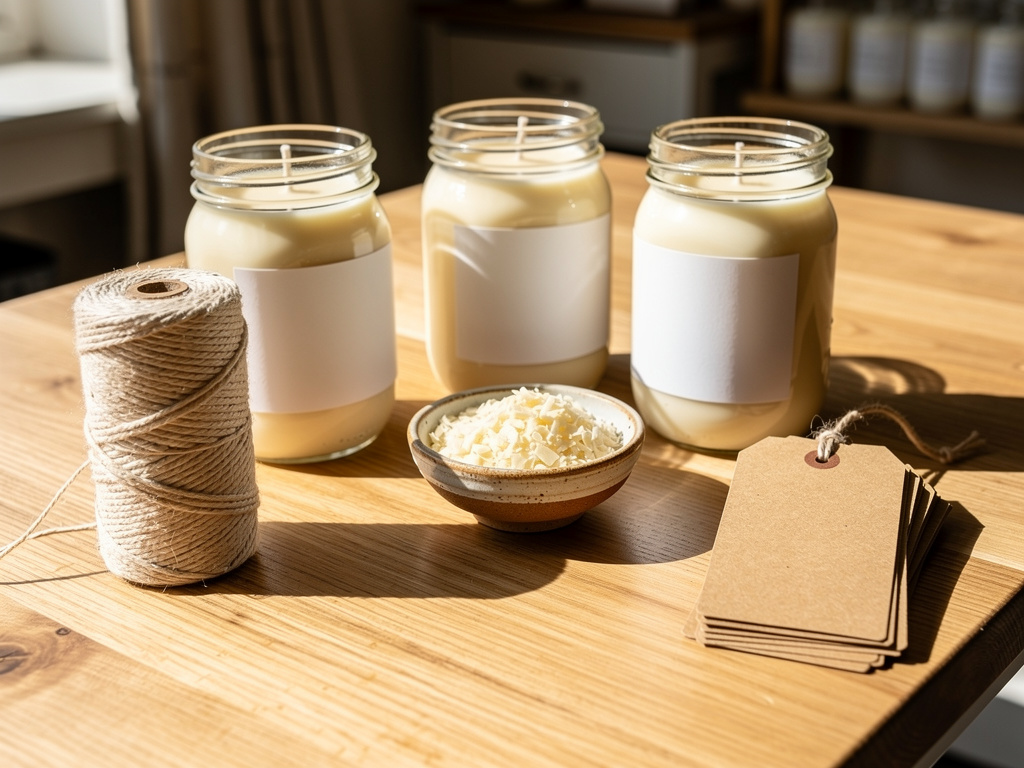


The short version: Yes, you can sell homemade candles from your own home, and because a candle is not food, no cottage food permit or health department kitchen inspection applies to it. There is no federal candle license either, but three federal rules still touch your jars: a lead limit of 0.06% for metal-cored wicks, a label that names the product, your business and place of business, and the net weight of the wax in both ounces and grams (federal law for candles sold across state lines, with your state's packaging rule covering local sales), and extra warning labels only if the candle contains a hazardous substance under federal law. The three familiar fire warnings (burn within sight, keep away from things that catch fire, keep away from children) come from a voluntary industry standard, and every candle should carry them anyway. Your city and state add the ordinary home business layer: a business license where your city requires one, a sales tax permit, since candles are taxed in places where food is not, and the rules of each farmers market you apply to.
Checked on the CPSC's candle business guidance page, the FTC's Fair Packaging and Labeling Act page, 15 U.S.C. 1459, the FDA's aromatherapy page, the Texas Comptroller's sales tax pages, Alabama's certified farmers market rule and findhomegrown.com/signup, September 25, 2026: the key rules below came off those pages that day, the other figures name their own sources where they appear, and because product and tax rules change, verify your state's current rules on its own agency page before you sell a jar. On the ordering side, Homegrown is $10 a month billed annually, customers create a Homegrown account to place a first order, it is built for pickup and local delivery, and there is no timed drop or countdown release feature.
Your coworkers bought six jars of your cedar and sage candle last month, your sister wants a dozen for holiday gifts, and the Saturday market has an open table. Before you order 50 more jars and a roll of labels, you want to know whether this is legal and what paperwork is real.
It is legal, and the good news is that candles skip the food rules that trip up bakers. The catch is that candles pick up a different set of rules instead: a federal wick rule, a federal label rule, sales tax, and whatever your farmers market writes into its vendor agreement. This guide sorts every candle rule into three piles, the ones the law requires, the ones the industry expects, and the ones a market can set for itself, so you know which ones you can skip and which ones you cannot.
Yes, you can sell homemade candles from your own home in the United States, and there is no federal license or registration for making candles in a home kitchen. The Consumer Product Safety Commission, the federal agency that covers candles, lists one mandatory candle rule on its candle business guidance page: the lead limit for metal-cored wicks. Everything else on that page is either a labeling duty that applies only in certain cases or a voluntary industry standard.
That does not mean you can print anything on a jar and sell it anywhere. Three questions decide what you owe:
This page is the permission half of selling candles. For wax choices, scents, the pouring process and booth setup, the companion guide on how to make and sell candles at the farmers market covers the making side once you know which rules you are under.
Food rules do not apply to candles because a candle is not food, so the cottage food laws that govern home-baked bread and jam never reach your wax. Cottage food laws let a home kitchen sell low-risk food without a commercial kitchen, and they come with permits, sales caps, training and label disclaimers. A candle answers to product safety law instead. The FDA's aromatherapy page says it plainly: some fragrance products, including scented candles, are regulated by the Consumer Product Safety Commission, not the FDA.
Here is what that swap means for a home candle vendor:
If you already sell food at the same table, keep the two paperwork trails apart. Your bread answers to your state's cottage food office, and your candles answer to product and tax law. The Homegrown signup page, checked September 25, 2026, says it the same way: no food license is required for non-food products. On that date, 439 of the 2,694 products in the Homegrown catalog sat in seven categories outside the food aisles, such as Home Goods, Arts and Crafts, and Plants and Flowers, next to 1,429 Bakery products that answer to food law. Those seven categories still hold some food, such as honey, loose-leaf tea and dog treats, so not every one of the 439 is a non-food product.
Of the 9 rows of rules and standards a home candle vendor runs into in the table below, 3 are federal law, 2 are voluntary industry standards (three ASTM standards across the two rows), and 4 come from your state, your city or your market. The CPSC's candle page, read on September 25, 2026, names six ASTM standards and calls all six "industry consensus standards (also known as voluntary standards)." That includes the fire safety labeling standard, ASTM F2058, which some candle guides describe as required. It is not a federal law. It is still the label your customers and your market manager expect to see.
Scroll sideways to see every column.
| Rule | Who sets it | Required? | What it asks of you |
|---|---|---|---|
| Lead limit in metal-cored wicks, 16 CFR 1500.17(a)(13) | CPSC (federal) | Yes, if you use metal-cored wicks | No more than 0.06% lead by weight in the metal core, plus a certificate of compliance |
| Cautionary labeling under the Federal Hazardous Substances Act | CPSC (federal) | Only if the candle contains a hazardous substance under that law | The warning wording that law spells out |
| Fair Packaging and Labeling Act label | FTC (federal) | Yes, for candles sold or shipped across state lines | Product name, your name and place of business, net weight in ounces and grams |
| State weights and measures packaging rules | Your state | Yes, where your state adopted them | The same three label lines, checked by state inspectors |
| ASTM F2058 fire safety labeling | ASTM (industry) | Voluntary | Burn within sight, keep away from things that catch fire, keep away from children |
| ASTM F2417 fire safety and F2179 glass containers | ASTM (industry) | Voluntary | Test burns and heat-rated glass |
| Business license or home occupation permit | Your city or county | Where your city requires one | A registration and a fee |
| Sales tax permit | Your state tax agency | Yes, in states with a sales tax | Collect and file tax on candle sales |
| Market vendor rules | Each farmers market | Yes, to sell at that market | Application, product approval, fees, sometimes insurance |
Federal rows come from the CPSC's candle business guidance page, the eCFR text of 16 CFR 1500.17 and the FTC's federal packaging law summary, all loaded September 25, 2026. State, city and market rows vary; the sections below show real examples.
The practical read is simple. If you pour soy wax around a cotton wick, sell jars with a proper label and say nothing about health, the federal side of this table asks very little of you. Most of your real paperwork sits in the bottom three rows, which is where the rest of this guide spends its time.
The federal lead wick ban means any metal-cored wick in your candle can contain no more than 0.06% lead by weight in its metal core, a rule that has applied to candles made or imported since October 15, 2003. It sits in the Code of Federal Regulations at 16 CFR 1500.17(a)(13), and the CPSC's candle guidance page repeats it as the one hard rule for candles.
Most home candle makers never touch this rule, and here is why:
If you are not sure what is inside a wick, look at the supplier's product page before you buy 100 of them. A wick sold as cotton, cotton-paper or wood keeps you out of this rule entirely, and it is the easiest compliance decision you will make. The CPSC also runs a Small Business Ombudsman line at (888) 531-9070 for questions like this one.
A packaged candle needs three things on its label: what the product is, the name and place of business of the business that made or packed it, and the net quantity, stated in both metric and US units. The federal Fair Packaging and Labeling Act requires those three lines on candles sold or shipped across state lines. A candle you sell only at local markets in your own state falls under your state's weights and measures packaging rule instead, and the model rule NIST publishes for states to adopt, in Handbook 130, asks for the same three lines. That law covers "consumer commodities," and the definition in 15 U.S.C. 1459 reaches products sold at retail for use in the household that are usually used up as you use them, which is exactly what a candle does as it burns. The FTC, which enforces the law for products that are not food, drugs or cosmetics, says states apply their own weights and measures rules to packages too.
On top of the law, the National Candle Association says every candle should carry a cautionary label with three rules. Here is how the two layers stack up on one 8 ounce jar:
Swipe the table to read all three columns.
| Label line | Why it is there | Example on a jar |
|---|---|---|
| What the product is | Federal packaging law | Hand-poured soy candle, Cedar and Sage |
| Name and place of business | Federal packaging law | Juniper Lane Candles, 123 Main St., Dayton, OH 45402 (the street can be left off only if it is publicly listed, such as on your website) |
| Net weight in US and metric units | Federal packaging law | Net Wt. 7.9 oz (224 g) |
| Burn within sight | ASTM F2058, voluntary | Never leave a burning candle unattended |
| Keep away from things that catch fire | ASTM F2058, voluntary | Keep away from drafts and things that can catch fire |
| Keep away from children | ASTM F2058, voluntary | Keep out of reach of children and pets |
| Trim the wick, burn time | Good practice | Trim wick to 1/4 inch before each burn |
Federal lines from the FTC's summary of the packaging law, checked September 25, 2026. The three warnings follow the National Candle Association's label guidance, read the same day, which names them as burn within sight, keep away from combustibles and keep away from children. Drafts and pets in the example column are optional wording many makers add. The business name and address are an example, not a real shop. The street address rule is in the FTC's regulation at 16 CFR 500.5, read on eCFR the same day.
Notice what is not on that list. Most candles need no ingredient list and no nutrition label, because the packaging law asks for identity, name and net quantity only. The exception is a candle with an ingredient that counts as hazardous under the Federal Hazardous Substances Act: its cautionary label must name that substance, or each part of the candle that adds substantially to the hazard, under 15 U.S.C. 1261(p). Check the safety data sheet for each fragrance oil you use to see whether it lists a hazard. Some candle guides say the law requires every ingredient and the country of manufacture; the FTC's own summary of the rule lists neither.
Weigh the wax, not the jar. CandleScience lists its 8 ounce mason jar at 7.90 ounces (223.96 grams) of wax to the fill line, checked September 25, 2026, so that candle's label reads Net Wt. 7.9 oz (224 g), not 8 oz. The model packaging rule that NIST publishes for states to adopt, in Handbook 130, leaves containers, labels and wrappers out of net weight. The candle pricing guide walks through fill weights for tins and jars when you set your prices.
The "8 oz" in a jar's name is its size, not the weight of the candle inside it. Printing the jar size as your net weight overstates what the customer gets, which is exactly what weights and measures inspectors check for. Weigh a few finished candles and print the lowest honest number.
You can say a candle smells like lavender, but once you say it helps you sleep, eases anxiety or relieves pain, you are using the kind of words federal law treats as a drug claim. The FDA's aromatherapy page gives those exact examples, and it gives them for soaps, lotions and massage oils made with essential oils: claims that a product will "relieve colic, ease pain, relax muscles, treat depression or anxiety, or help you sleep are drug claims." The same page says scented candles are regulated by the CPSC, not the FDA, and that advertising claims are regulated by the Federal Trade Commission, so it never applies the drug test to a candle by name. Our reading is that the same intended-use test is why a health claim on a candle is risky, and the FTC can still look at what your ads promise. A drug has to meet requirements such as FDA approval for safety and effectiveness before it goes on the market, which is not a realistic path for a home candle business.
The FDA decides what a product is by its intended use, and it reads that from "claims made in the labeling, on websites, and in advertising, as well as what consumers expect it to do." Our reading is that your social posts and booth signs count as advertising, and for candles the FDA points to the CPSC for safety and the FTC for ad claims. So the same lavender candle can be fine or a problem depending on the words around it:
A chalkboard sign at your booth counts too. The FDA reads claims from labeling, websites and advertising together, a point on its aromatherapy page (content current as of September 8, 2023, read September 25, 2026). Read your booth sign and your product descriptions with the "sleep, stress, pain" test before market day.
The check is quick, a few minutes per product by our rough guess rather than a measured time: read the label, the listing and the sign, and circle any word about sleep, stress, pain or health. The scent names are the fun part of selling candles, so keep them fun. "Sunday Morning," "Porch Swing" and "Cedar and Sage" give customers a scent to remember, and none of them turns a jar of wax into an unapproved drug.
You probably need the same general business paperwork any home business files, but there is no federal license for making candles and no cottage food permit to get. The CPSC's candle page, read September 25, 2026, lists no registration step for a candle business. The licensing that does apply comes from where you live and how you set up the business, not from the candles.
Here is the usual stack, from most to least likely to apply:
The same questions come up for food vendors, and the guide on whether you need a business license to sell food from home separates the three things people mean by a license and lists what you need before a first sale. The general business steps are the same for candles, minus the cottage food permit. Our rough guess, not a measured figure, is an afternoon of about 3 hours for the calls and forms, plus whatever fee your city sets, and write down every registration number you get, because a market application may ask for them.
Yes, in states with a sales tax you should expect candles to be taxable, even where the bread on the same table is not. Food is often exempt, and candles are not food. The Texas Comptroller's guide for grocery and convenience stores makes the split easy to see: it says food products such as flour, sugar, bread and eggs are not taxable, and it lists "Candles" among the taxable products. Texas charges a 6.25% state rate, and cities, counties and special districts can add up to 2% more, for a combined rate of up to 8.25%.
The Comptroller says you need a sales tax permit if you are engaged in business in Texas and sell tangible personal property there, which a $20 candle is. It tells applicants to allow 2 to 3 weeks for the permit to arrive. At the full 8.25% combined rate, a $20 candle carries $1.65 in sales tax. Checked on the Comptroller's sales tax and permit pages, September 25, 2026.
What that means in practice:
If you also sell food, the split gets real at the register: the loaf may be exempt and the candle beside it is not. The guide to sales tax at farmers markets covers getting the permit, collecting tax at your booth and filing it.
Yes, you can sell candles at most farmers markets, but a market is allowed to limit, review or refuse non-food vendors, and each one writes its own rules. Candles do not need a food permit to sell at a market, so the real gate is the market's application. Some state rules cap crafts too. Alabama's rule for certified farmers markets, 350-X-1-.05, lets a market allow arts and crafts "as long as the number of non-food vendors (arts and crafts) does not exceed 30% of the total vendors."
At a market certified under Alabama's rule, non-food vendors such as candle makers can be no more than 30% of the vendors, and allowing them at all is the market's choice. A 40-vendor certified market has room for 12 craft and non-food tables at most. Read in the rule as filed, September 25, 2026.
Here is what two real markets' 2026 rules say about handmade goods like candles, next to the Alabama state rule that covers every certified market there:
Drag this table sideways to compare all three rows.
| Market | Are candles allowed? | Approval step | Booth fee | One rule worth knowing |
|---|---|---|---|---|
| Downtown Franklin Farmers Market, Ohio | Yes, "handmade items such as soaps, lotions, candles" are on the list of what may be sold | Register with and be approved by the market committee | No charge for a space | Selling by a stated weight needs scales inspected by the Ohio Division of Weights and Measures |
| High Point Farmers Market, North Carolina | Handmade arts and crafts allowed; candles are not named, so ask the manager | Meet the Farmers Market Review Committee; apply 7 days before | $15 a Saturday, $50 for four, $200 a season | Selling store-bought merchandise means immediate dismissal |
| Any certified market in Alabama | At the market's discretion | Market's own application | Set by the market | Non-food vendors capped at 30% of all vendors |
From the Downtown Franklin Farmers Market 2026 rules and FAQ (updated February 4, 2026), the High Point Farmers Market 2026 arts, crafts and other vendors application, and Alabama Administrative Code 350-X-1-.05, all read September 25, 2026. Rules change each season; read your own market's current packet.
The Franklin scale rule matters for candles. That market's FAQ says you can weigh at home and sell "1 bag for $5," but if you mention the weight, you must have scales inspected and approved by the Ohio Division of Weights and Measures. A net weight on a candle label is a stated weight, so ask your market whether its scale rule reaches your labels, and weigh on an accurate scale either way. For booth setup, scent testers and display once you are in, the guide to selling candles at the farmers market has the details.
No law requires insurance to sell candles, but you should carry product liability coverage, because candles are an open flame in someone else's home. The National Fire Protection Association estimates that candles started an average of 5,830 US home fires a year from 2019 to 2023, with an average of 70 deaths, 570 injuries and $270 million in direct property damage each year.
Your homeowners policy is probably not the answer. The Insurance Information Institute says a typical homeowners policy may cover business equipment only up to $2,500 in the home and $250 away from it, and usually does not cover business-related liability at all. The same page says you may be able to add an endorsement to your homeowners policy, and that some insurers offer property and liability coverage for small "incidental" businesses run from home, so ask the agent whether any of those options covers the products you sell. Coverage for the products themselves is what a candle vendor actually needs.
Where insurance shows up in practice:
Ask for a quote that covers products you sell away from your home, and tell the agent the products are candles. The guide to farmers market vendor insurance covers the policy types, how much coverage to carry and what it means when a market asks to be named as an additional insured.
Yes, you can sell homemade candles online, and the rules you follow at the market follow you onto the internet: the same label, the same claim limits and the same sales tax. There is no separate online candle license. What changes online is who handles checkout, who files the tax and how the candle reaches the customer.
Three things to plan before you list your first candle:
If most of your buyers are people who already know you, from the market, your neighborhood or your coworkers, you do not need a national marketplace. You need a link they can order from and a pickup time. A Homegrown storefront gives candle makers that link for $10 a month billed annually: customers pick their scents, pay online and choose pickup or local delivery, and sales tax on those orders is calculated and filed for you. Start with your three best sellers and the regulars who keep asking. Once that link is working, the other places to sell candles each pay differently, from $15.00 in cash at a market table to about $7.50 from a gift shop buying at half of retail.
On a $20 candle, the fees in this table run from 67 cents to $2.35 per order, and the right one depends on whether your buyers are local regulars or strangers searching a marketplace. The $20 price sits inside the $16 to $22 range the candle pricing guide lands on for an 8 ounce soy jar, and every row shows every fee.
This one is wide. Drag it sideways to read every fee.
| Platform | Subscription | Trial period | Platform fee | Card processing | Customer pays on a $20 candle | Vendor pays on a $20 candle | Vendor pays on 50 candles at $20 |
|---|---|---|---|---|---|---|---|
| Homegrown | $10/mo billed annually, $12.50/mo billed monthly | 7 days, no charge until day 8 | $0, 0% commission | 2.9% + $0.30 | $20.00 | $0.88 | $54.00 |
| Square Online, Free plan | $0/mo per location | n/a on the Free plan | $0 | 3.3% + $0.30 online | $20.00 | $0.96 | $48.00 |
| Square reader at the market, Free plan | $0/mo per location | n/a on the Free plan | $0 | 2.6% + $0.15 tap, dip or swipe | $20.00 | $0.67 | $33.50 |
| Shopify Basic | $29/mo billed yearly, $39/mo billed monthly | 3 days, then $1/mo for 3 months | $0 with Shopify Payments, 2% with another payment provider | 2.9% + $0.30 online, standard cards | $20.00 | $0.88 | $73.00 |
| Etsy | None; $0.20 per listing, renewed after each sale and every four months | n/a | 6.5% transaction fee on the price plus shipping, and an Offsite Ads fee on sales Etsy's ads bring in | 3% + $0.25 | $20.00 plus any shipping you charge | $2.35 | $117.50 |
Homegrown, Square, Shopify and Etsy figures come from each company's own pricing or fee page, checked on September 25, 2026. The 50-candle column uses annual billing where there is a choice; on monthly billing Homegrown is $56.50 and Shopify Basic is $83.00. Etsy's column assumes no shipping charge and no Offsite Ads sale, and Etsy says it may also charge a one-time shop set-up fee shown at signup. Card processing is figured on the $20 price, and the customer column is before sales tax.
At 50 candles a month, Square's Free plan costs the least, both online and at your table, and Homegrown costs $6 more a month than Square Online. Square's online rate is 8 cents a candle higher than Homegrown's, so that gap closes at 125 candles a month.
Homegrown earns its place with local buyers: it handles sales tax on pickup and local delivery orders for $10 a month. Etsy also calculates, collects and remits sales tax for orders shipped to US buyers, according to its Fees and Payments Policy checked September 25, 2026, so on tax alone the two match; the difference is that Homegrown does it for the regulars who pick up at your door or your market. It is $10 a month on annual billing, with no percentage fees beyond standard payment processing, and on orders placed through your storefront, sales tax is calculated at checkout and Homegrown files and remits it, according to the signup page checked September 25, 2026. Your candles and your bread or jam sit on one ordering page, so a customer picking up a sourdough loaf adds a cedar candle without a second checkout. Pre-orders let regulars reserve holiday scents before you pour the batch, and they choose pickup or local delivery. Etsy takes 6.5% of each sale plus 3% + $0.25 processing and a $0.20 listing fee, $2.35 of every $20 candle, and it makes sense mainly if strangers across the country are your buyers. Shopify Basic starts at $29 a month on yearly billing, the biggest fixed cost here.
What Homegrown does not do matters too. It does not review your labels, your wicks or your scent claims, and it does not file sales tax on the candles you sell at your own market table. It is built for pickup and local delivery, not for shipping candles across the country. Customers create a Homegrown account to place their first order. Your storefront is listed on the Homegrown marketplace, but plan on most orders coming from people you send to your own link.
Candles are a small, real slice of the Homegrown catalog: 29 of the 2,694 products listed on September 25, 2026 were candles, from two shops. That tells you two things at once. Candle makers already sell through Homegrown storefronts, and candles have far fewer listings than the Bakery category's 1,429.
In a pull of the Homegrown catalog on September 25, 2026, we counted candles two ways: products with "candle" in the name, then a check of each vendor's other listings. Of the 2,694 products listed by 303 vendors, 18 had "candle" in the name. Seventeen were 15 ounce soy candles from a single shop, each priced at $40.00 and filed under Home Goods. A second shop lists 12 more candles under Home Goods at $15.00 each, named by scent only, such as Luna Love and Sage and Vetiver; that shop's own website sells all 12 as candles. That makes 29 candle listings from two shops. The eighteenth "candle" name was a massage candle at $1.00 that melts into a massage oil, filed under Health and Wellness and sold as a skin care product, so we left it out of the candle count. For comparison, Bakery held 1,429 of the 2,694 products.
The categories outside the food aisles are bigger than candles alone. Seven of them held 439 of the 2,694 products in the same pull, or about 16%, though they still carry some food, such as honey in Arts and Crafts, elderberry syrup and loose-leaf tea in Health and Wellness, and dog treats in Pet Supplies:
Products in seven Homegrown categories outside the food aisles
Source: Homegrown catalog pull, September 25, 2026, 2,694 products from 303 vendors, grouped by the category each vendor chose.
The two price points are worth noticing too. The $40 jars are 15 ounce soy candles, and the listings describe a double wick in a reusable vessel, which puts them at the top of the $28 to $40 range the pricing guide gives for a 15 ounce double-wick candle. The $15 candles sit just under the guide's $16 to $22 range for an 8 ounce jar, and those listings do not state a size. If you sell 8 ounce jars at $16 to $22, you land between the two shops already on Homegrown, and a size on your listing tells buyers what they get for the price.
Experienced candle vendors treat paperwork as part of the product, and the habit that sets them apart is keeping a written record of every batch. When a customer asks what is in a candle, or a market manager asks for proof of insurance, they answer in one minute instead of one week.
Here is what that looks like in practice:
Weigh 5 finished candles from every new batch and print the lowest weight on the label. If your 8 ounce mason jars come out between 7.9 and 8.0 ounces of wax, the label says 7.9 oz (224 g), and every jar meets or beats it.
Once the templates exist, our rough guess is that this adds about 15 minutes a batch, and it turns every rule in this guide into a habit instead of a scramble.
The rules above point to 6 avoidable mistakes that can get a home candle maker in trouble, and none of them is about the wax itself. They are about words on a label, numbers on a sign and paperwork that never got filed.
One more to watch: a wick you cannot identify. If a bargain bundle of wicks does not say what the core is, skip it. A labeled cotton or wood wick is cheap and keeps you clear of the lead rule entirely. Wax melts skip the wick question altogether, but a cookie-shaped cube picks up a different federal test, and the rules for selling homemade wax melts cover the line that counts a child eating the product and the 2% bergamot oil limit.
If you also sell soap, lotion or body oils, the rules shift again, because those products answer to the FDA as cosmetics rather than to the CPSC. The guide on whether you can sell homemade soap sorts that out, including the label words that turn a bar of soap into a drug.
You can go from your first test pour to your first legal candle sale in 7 steps, and the sales tax permit can be the longest wait: Texas tells applicants to allow 2 to 3 weeks for it. Here is the order that avoids redoing anything:
You can file steps 5 and 6 as soon as you decide to sell. Do steps 1 through 4 while those applications are pending, so the wait for paperwork costs you no pouring time.
No federal agency licenses candle making and no cottage food permit applies, but most candle vendors still need general business paperwork. Expect a local business license in many cities, a sales tax permit from your state tax agency, and a trade name registration if you sell under a business name. Candles need no cottage food permit because they are not food.
You do not need a food permit to sell homemade candles at a farmers market, but you do need the market's approval and usually a sales tax permit. Each market sets its own rules for non-food vendors. Alabama's certified market rule caps non-food vendors at 30% of all vendors, and High Point, North Carolina charges crafts vendors $15 a Saturday in 2026 once its review committee approves them.
Selling homemade candles online takes the same paperwork as selling them in person: local business registration, a state tax permit and a proper label. The difference online is who handles the tax. Some platforms calculate and file sales tax on the orders they process, and others leave it to you, so ask before you list.
No nutrition label, and usually no ingredient list. Candles are not food, and packaging law asks for three label lines only: what the product is, the name and place of business, and the net quantity in US and metric units. If an ingredient in the candle counts as hazardous under federal law, the warning label must name it. Most candle makers add the three fire warnings too, because the industry standard and customers expect them.
No law requires it, but a small candle business should carry product liability coverage. The NFPA estimates that candles started an average of 5,830 US home fires a year from 2019 to 2023. A typical homeowners policy usually does not cover business liability, and a market application may request a certificate of insurance.
Yes, you can sell candles made with essential oils, as long as you describe the scent and not a health effect. The FDA says claims that a product will ease pain, treat anxiety or help you sleep are drug claims, and it gives those examples for soaps, lotions and massage oils made with essential oils. Applying the same test to a candle is our reading. "Lavender essential oil candle" is a product description, and "sleep aid candle" is a risky health claim.
These guides pick up where this one stops, from pricing your jars to the booth itself:
Once your labels are printed and your permit is in hand, the next question is how regulars order between markets. Set up your Homegrown storefront for $10 a month billed annually, list your best three scents with pickup times, and send the link to the people who already buy your candles.



