


The short version: Yes, you can sell homemade jewelry, and because jewelry is not food, no cottage food permit applies and the SBA's list of federally licensed business activities does not include jewelry making. Your everyday paperwork is the same any vendor files: a sales tax registration in states with a sales tax, a local business license where your city requires one, and approval from each market you apply to. The federal rules that catch home jewelers most often: pieces made for kids 12 and under can contain no more than 100 ppm lead and need a Children's Product Certificate, words like "sterling" and "gold filled" should match the FTC's definitions, since the FTC can act against a claim that does not, and a 925 or 14K stamp on a piece you mail, or ship to another state, needs your name or trademark beside it. Some states go further, such as Minnesota, which caps lead at 90 ppm and cadmium at 75 ppm in jewelry sold there, adult pieces included.
Checked on the CPSC's lead and small batch pages, the eCFR text of 16 CFR Part 23 and 16 CFR 1500.91, 15 U.S.C. 297, Minnesota Statutes 325E.3892, California DTSC's jewelry page, the U.S. Fish and Wildlife Service, the IRS, Virginia Tax, Etsy's and Shopify's fee pages and findhomegrown.com/signup, September 30, 2026: rules and fees change, so verify your state's current rules on its own agency page before you sell. On the ordering side, Homegrown is $10 a month billed annually, customers create a Homegrown account to place a first order, it is built for pickup and local delivery, and it has no timed drop or countdown release feature.
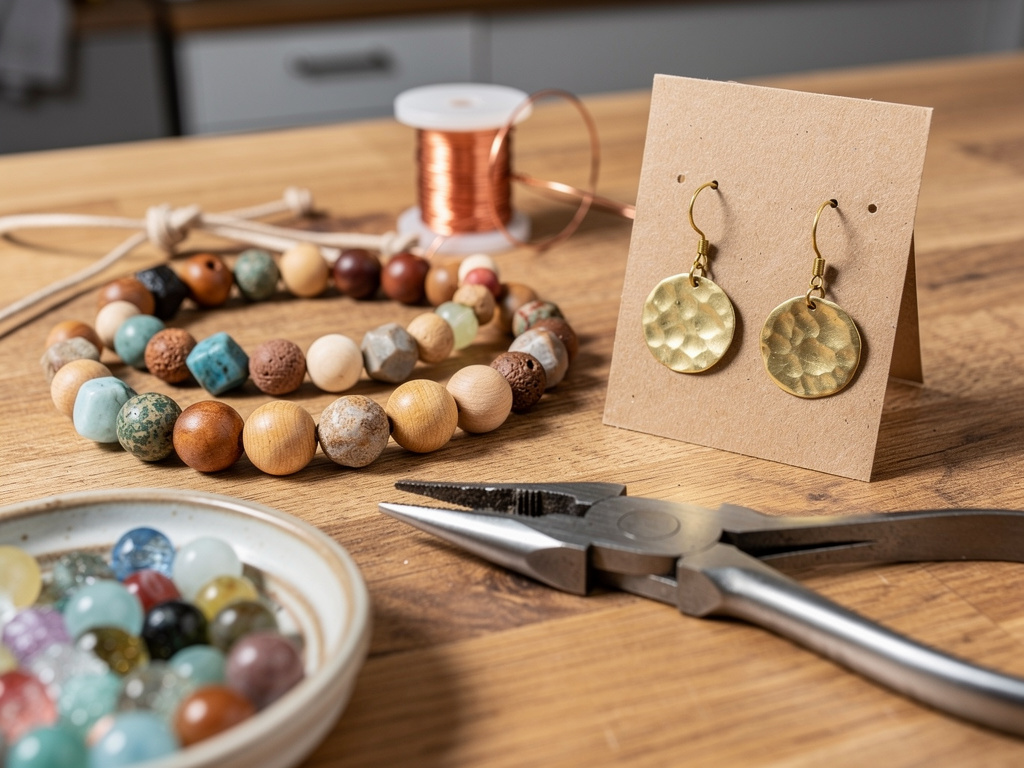
Your coworker bought two pairs of your hammered brass earrings, your cousin wants beaded bracelets as party favors for a 7-year-old's birthday, and a craft fair two towns over has a table open in November. Before you order a spool of wire and 200 earring cards, you want to know whether any of this needs a license.
Mostly, it does not. Jewelry skips the food rules that bakers deal with, and there is no jewelry permit to apply for. What jewelry does have is a short list of rules that most craft guides skip: a federal lead law for anything made for kids, federal definitions for the metal words on your tags, a stamping law for 925 and 14K marks, and a few state laws that reach every piece sold there. This guide walks through each one with its numbers, then covers taxes, market rules and where to sell.
Yes, you can sell homemade jewelry in the United States, and there is no federal license for making it. The Small Business Administration's page on licenses and permits, read September 30, 2026, lists the business activities that need a federal license, such as alcohol, firearms, aviation and wildlife imports, and jewelry making is not on it. The federal rules below apply in all 50 states, and your city and state add the ordinary paperwork any vendor files, which is covered further down.
Which jewelry rules apply to you comes down to three questions:
This page is the permission half of selling jewelry. For booth setup, pricing and which non-food products move at a market, the guide on selling soap, candles and other non-food products at farmers markets covers the selling half once you know which rules you are under.
No, jewelry does not need a cottage food permit, because cottage food laws cover food made in a home kitchen and jewelry is not food. Those laws exist so a baker can sell cookies or jam without renting a commercial kitchen, and they come with permits, sales caps and label rules. None of that reaches a necklace. Homegrown's signup page, checked September 30, 2026, says the same thing in its FAQ: "No food license required for non-food products," and it names jewelers among the vendors it is built for.
Here is what skipping food law means in practice:
If you sell jewelry and bread or cookies at the same table, keep two sets of paperwork. The bread answers to your state's cottage food office, and the jewelry answers to product safety and tax law. Mixing them up is how a vendor ends up asking the health department about earrings, which wastes a phone call and gets you no answer that applies. Pottery is the craft that breaks this split, because a mug or bowl that could hold food falls under FDA's lead rules, which the pottery rules and permits guide covers piece by piece.
Of the 10 rules in the table below, 4 are federal laws, 1 is federal guidance the FTC enforces through its power to stop deceptive claims, 2 are state laws that cover every piece sold in that state, 1 is a voluntary industry standard, and 2 come from your tax agency, your city and your market. A home jeweler making adult pieces deals with the bottom rows every week and the top rows only when selling to kids, using precious metal words or shipping.
Scroll sideways to see every column.
| Rule | Who sets it | When it applies | What it asks of you |
|---|---|---|---|
| Lead limit for children's products, 15 U.S.C. 1278a | CPSC (federal law) | Pieces designed or marketed for kids 12 and under | No more than 100 ppm lead in any reachable part and 90 ppm in paint or coatings, plus a Children's Product Certificate |
| Third-party testing, 15 U.S.C. 2063 | CPSC (federal law) | Children's jewelry, with testing exemptions for some materials | Tests at a CPSC-accepted lab for the rules that apply |
| National Gold and Silver Stamping Act, 15 U.S.C. 294 to 300 | Federal law | Gold or silver quality marks on pieces you mail, or ship to another state | A true fineness mark, plus your name or trademark next to it |
| Migratory Bird Treaty Act | U.S. Fish and Wildlife Service (federal law) | Any piece with feathers or parts of native wild birds | Do not sell them, apart from narrow exceptions |
| FTC Jewelry Guides, 16 CFR Part 23 | FTC (federal guidance) | Any time you describe metal, stones, pearls or "handmade" | Use words that match the definitions |
| Minnesota Statutes 325E.3892 | Minnesota | Jewelry sold in Minnesota, adult pieces included | Lead at or below 90 ppm, cadmium at or below 75 ppm |
| California Metal-Containing Jewelry Law | California DTSC | All jewelry sold in California | Adult pieces: listed materials only, with lead caps on some of them. Pieces for kids under 15: 100 ppm lead in every component, 90 ppm in coatings, plus cadmium limits. Plus a written certification of compliance you keep on file |
| ASTM F2923 children's jewelry standard | ASTM (industry) | Children's jewelry | Voluntary checks for cadmium, nickel, magnets, batteries and strangulation |
| Sales tax registration and business license | State tax agency, city or county | Vendors in states with a sales tax; a license where your city requires one | Register, collect and file |
| Market vendor rules | Each farmers market or fair | To sell at that event | Application, approval, fees and a handmade share |
Federal rows come from the U.S. Code on uscode.house.gov, the eCFR, the CPSC's business pages and the Fish and Wildlife Service, and state rows from Minnesota's statute and California DTSC's lead in jewelry page, all read September 30, 2026. Tax and market rows vary; the sections below show real 2026 examples.
The quick read: an adult pair of $25 earrings made from copper wire and glass beads, described honestly and sold outside Minnesota and California, touches almost none of the top rows. Its paperwork lives in the last two. Add a kids' line, a sterling stamp or a feather and the top rows start to matter. For that $25 pair, what is left is the selling itself, and the guide on how to sell jewelry from home prices a pair at materials plus your time, doubled twice, then shows a $40 pair keeping $38.54 through a storefront against $35.75 on Etsy.
Your jewelry counts as children's jewelry when it is designed or intended mainly for kids 12 and younger, and federal law weighs four factors to decide. The definition sits in 15 U.S.C. 2052, read September 30, 2026, and the four factors are:
The law counts your own statement only when it is reasonable, so labeling a unicorn charm bracelet "for adults" does not move it out of the children's category if everything else about it says kid. The reverse holds too, by our reading of the factors. A sterling stacking ring sold from an adult display, with nothing aimed at kids, does not become a children's product just because a 12-year-old might buy one.
In California the line sits higher. California's DTSC says a 2019 update to the state's jewelry law changed the definition of a child from age six and younger to anyone under 15. A piece aimed at a 13-year-old is children's jewelry there even though it is not under the federal definition.
Children's jewelry can contain no more than 100 parts per million (ppm) of lead in any part a child can reach, and paint or coatings on it are capped at 90 ppm. The 100 ppm limit comes from the Consumer Product Safety Improvement Act, now at 15 U.S.C. 1278a, and the CPSC's Total Lead Content page, read September 30, 2026, says a children's product over that limit is "a banned hazardous substance." The paint limit is written as 0.009% in 16 CFR 1303, which is the same 90 ppm.
The good news is that common jewelry materials have already been judged to fall under the limit. In 16 CFR 1500.91 the CPSC determined that these do not exceed the lead limits, as long as nothing containing lead was added to them:
The same rule says paint, coatings or electroplating do not count as a barrier, so a leaded part does not become legal because something is painted or plated over it.
The metal list does not cover what sits under a plating. 16 CFR 1500.91, read on the eCFR September 30, 2026, says the exempt metals do not include "solder or base metals in electroplate, clad, or fill applications." A gold-filled or gold-plated chain has a base metal core, and that core is not on the list. Neither are the base-metal jump rings, clasps and ear wires that come in bulk findings packs.
Yes, children's metal jewelry has to be tested for lead at a CPSC-accepted third-party lab unless every component is a material the CPSC has already cleared, and registering as a small batch manufacturer does not change that. The CPSC's small batch page, read September 30, 2026, lists "Lead in children's metal jewelry" among its Group A rules, which small batch manufacturers must always test at an accepted lab. Lead in paint and small parts sit on the same Group A list. Small batch status itself has limits: the page says your prior-year gross revenue from all consumer products must be $1,436,864 or less, you made no more than 7,500 units of the product, and you register with the CPSC every year.
There is one real break. The materials on the 16 CFR 1500.91 list are exempt from testing for total lead content. The CPSC's Total Lead Content page puts the catch in capital letters: the exemption does "NOT" excuse the piece from meeting the limit, and firms are "still expected to certify compliance" on a Children's Product Certificate.
If you want to sell a kids' line, here is the order that keeps it manageable:
Testing runs per component and per rule, so a kids' line built from two or three cleared materials is far simpler to certify than one built from a mixed findings kit. The other clean choice is to make adult and teen pieces only and say so plainly on your booth sign and listings.
Minnesota limits lead to 90 ppm and cadmium to 75 ppm in jewelry sold in the state, adult pieces included, and California limits the materials adult jewelry sold there can be made from, caps the lead in some of those materials, and sets its own lead and cadmium limits for children's jewelry. These state laws matter because the federal 100 ppm limit stops at children's products. California first passed a lead limit for jewelry, and DTSC says that afterward "some manufacturers replaced lead with cadmium, which is also toxic," so the state added cadmium limits for children's jewelry too.
Minnesota's lead and cadmium law, Statutes section 325E.3892, bars selling any covered product containing lead at more than 0.009 percent (90 ppm) or cadmium at more than 0.0075 percent (75 ppm) by total weight. Its list of covered products starts with "jewelry" and also names "jewelry-making supplies," with no age limit, so it reaches adult earrings and the findings you buy. Its other exemptions cover lead in solder inside internal components, keys and some pots and pans, so for jewelry the one that matters is where federal law preempts it. We read the statute on the Revisor of Statutes site on September 30, 2026.
The Metal-Containing Jewelry Law bars selling adult jewelry in California unless it is made entirely from materials the law lists, and it sets a separate lead and cadmium limit for children's jewelry. DTSC's page says the law covers "people who make and sell their own jewelry." For adult pieces the list works as a set of lead caps: under Health and Safety Code 25214.2, plated or unplated metal, dyes, surface coatings and any material the list does not name must stay under 500 ppm lead, and plastic or rubber under 200 ppm. DTSC says a 2019 bill, SB 647, "updated the lead and cadmium limits for children and adult jewelry," effective June 1, 2020. Children's jewelry there, meaning pieces for anyone under 15, must keep every accessible component at 100 ppm lead or less and any surface coating at 90 ppm lead or less, and must stay at or below 300 ppm cadmium by weight and 75 ppm soluble cadmium in surface coatings, under subdivisions (c) and (d) of the same section. Anyone who makes jewelry sold in California must also prepare a written certification that it meets the lead and cadmium limits, and hand DTSC the technical documentation within 28 days if it asks, under section 25214.3.1. We read that on DTSC's lead in jewelry page and the California Legislative Information site on September 30, 2026.
Outside those two states, the voluntary guide for kids' pieces is ASTM F2923, the children's jewelry standard, though some states set binding limits of their own for children's products. The CPSC lists it on its voluntary standards page (dated February 23, 2012) and says it addresses cadmium, chemicals in paints and coatings, nickel sensitization, magnets, batteries and strangulation. Federal law does not make you follow it, but it is the checklist a careful kids' line is built against. Other states run their own children's product chemical laws. Washington is one: RCW 70A.430.020, read September 30, 2026, bars selling a children's product or component with more than 90 ppm lead or 40 ppm cadmium, and the chapter's definitions list children's jewelry, meaning jewelry made or marketed for kids under 12, as a children's product. Verify your state's current rules before you sell.
The practical move is at the supplier. Ask for a written lead and cadmium statement on every base-metal component before you buy 500 of them. Minnesota's law names jewelry-making supplies, so a supplier selling findings into Minnesota is held to the same 90 and 75 ppm numbers there.
You can call a piece sterling silver only when its metal is at least 925 parts per thousand (92.5%) pure silver, which is where the "925" stamp comes from. That definition sits in the FTC's Jewelry Guides, 16 CFR 23.5, as published on the eCFR when we checked it September 30, 2026. The guides set out the FTC's view of what is deceptive. They do not bind anyone on their own, but the FTC can act under the FTC Act when a claim breaks them.
The silver words and what each one needs:
The mistake to avoid is passing a supplier's word along without checking it. A bulk listing that says "silver tone" or "silver color" is describing a color, not a metal. If your supplier cannot tell you the fineness, describe the color on your tag: "silver-tone brass ear wires" is honest, and "silver ear wires" is a metal claim you cannot back up.
Gold filled means a layer of 10 karat or better gold, mechanically bonded to a base metal, that makes up at least 1/20 (5%) of the piece's total metal weight, while gold electroplate can be as thin as 0.175 microns. Those numbers come from 16 CFR 23.3 and 23.4 (eCFR text checked September 30, 2026), and every gold term needs the karat right before the word gold, at least as large.
Swipe the table to read all three columns.
| Word on your tag | What the metal has to be | Example marking |
|---|---|---|
| Gold, with no karat | Solid 24 karat gold throughout | 24K gold |
| Karat gold | Solid gold alloy of that karat throughout | 14K gold, 14 Kt. |
| Gold filled | 10 karat or better gold bonded by a mechanical process, at least 1/20 of the metal weight | 14K Gold Filled |
| Rolled gold plate or gold overlay | The same bonding at 1/40 of the metal weight, with the fraction shown | 1/40 12 Kt. R.G.P. |
| Gold electroplate or gold plated | 10 karat or better gold electroplated at least 0.175 microns thick | 12K Gold Electroplate |
| Heavy gold electroplate | 10 karat or better gold electroplated at least 2.5 microns thick | 14K Heavy Gold Electroplate |
| Vermeil | Sterling silver base coated with 10 karat or better gold at least 2.5 microns thick | Vermeil |
Definitions from the FTC's Jewelry Guides, 16 CFR 23.3 and 23.4, as published on the eCFR September 30, 2026. Mechanically bonded gold at 1/40 of the weight may also be called gold plate. If a nickel or other base metal layer sits between the sterling and the gold, the guides say to disclose it before you call the piece vermeil.
One detail catches first-time vendors: the guides give examples as low as 9 karat ("9 Kt. Gold"), so a lower karat is not banned. It just has to be stated. What you cannot do is write "gold" alone on anything under 24 karat, or "gold" on a plated chain without saying it is plated. The safe habit for a part-time vendor is to copy the supplier's spec sheet wording onto your tag and listing, karat and plating type included, and to keep that spec sheet on file.
You need your name or a registered trademark next to a 925 or 14K stamp once you mail the piece or ship it to another state, under 15 U.S.C. 297, which we read on September 30, 2026. The law applies when a jeweler stamps a gold or silver quality mark on a piece and then sends it by mail, by carrier or across a state line. Before it goes, the piece needs either a trademark "duly registered or applied for registration" within 30 days of the piece entering commerce, or "the name of such person."
The same section says how the name or mark goes on:
Nothing in that section requires you to stamp a piece in the first place; it sets rules for when you do. Whether initials alone count as "the name of such person" is a question for a trademark attorney, so your full name or a registered mark is the reading the text supports. If you want the registered route, the guide on trademarking a small business name walks through what registration takes. Either way, the fineness under the mark has to be true, because the Stamping Act also bars marks that overstate the gold or silver in a piece.
A $30 pendant set with a lab-grown or imitation stone needs "laboratory-created," "lab-grown," "imitation" or "simulated" right before the stone's name, in letters just as large, under 16 CFR 23.25. The FTC's guides add that "faux" is not an adequate disclosure. The same guides cover the other words that show up on handmade jewelry tags:
That last definition surprises beaders. Stringing store-bought beads on a store-bought chain with a store-bought clasp is real work, but under the guide's wording it is assembly rather than making by hand from raw materials. Our suggestion is "hand-assembled" or "designed and strung by hand," which describe what you did without borrowing the legal meaning of handmade. A pendant you forged from sterling wire is handmade in the guide's sense.
You can sell a $15 pair of earrings made with shell, bone or feathers from birds the law does not protect, such as domestic chickens, but not jewelry made with feathers of native wild birds, even ones you found on the ground. Chickens are not native wild birds, so by our reading the federal bird law below does not reach their feathers. Found feathers of wild birds look free and harmless, which is why this rule surprises crafters.
The U.S. Fish and Wildlife Service's forensics lab says possessing feathers of native North American birds without a permit is prohibited by the Migratory Bird Treaty Act, and "there is no exemption for molted feathers or those taken from road- or window-killed birds." Its "Can I sell it?" fact sheet says the act protects more than 1,000 wild bird species and that selling migratory bird feathers is prohibited regardless of age, with limited exceptions for certain captive-reared and sport-taken waterfowl. We read both on fws.gov on September 30, 2026.
Shell, bone and coral raise a different question: which animal. The same fact sheet says the Endangered Species Act can decide whether an item made from an endangered or threatened species may be sold across state lines, and that the CITES treaty requires permits or other paperwork to import or export certain species. The SBA's federal license page lists the import or export of wildlife products as an activity licensed by the Fish and Wildlife Service. For a small vendor, four habits cover it:
Plan on a state sales tax registration and, depending on your city or county, a business license, because jewelry is taxed like most other products in the states we checked. Virginia Tax, read September 30, 2026, says anyone who meets the definition of a dealer registers to collect sales tax on "tangible personal property," and the Texas Comptroller describes a 6.25% state sales tax on "most goods," with local add-ons up to a combined 8.25%.
Virginia shows how the rate depends on where the sale happens: 7% in Williamsburg, James City County and York County, 6.3% in eight other localities, 6% across Central Virginia, Hampton Roads and Northern Virginia, and 5.3% everywhere else. Sell a $40 necklace at a market in the city of Fredericksburg, which falls in the 5.3% group, and you collect $2.12 in tax. The 1% grocery rate for food and personal hygiene products does not apply to your jewelry.
Online marketplaces change who collects. Etsy's Fees and Payments Policy, read the same day, says Etsy will "calculate, collect and remit sales tax on your behalf for orders shipped to customers residing in US locations." Virginia Tax says vendors on a marketplace facilitator's platform generally do not collect that tax themselves but "may still need to register" for their own sales outside the platform. Cash and card sales at your market table are your own sales. The plain-language guide to sales tax at farmers markets walks through registering, collecting at your table and filing.
Local licenses vary more than tax rules. Fredericksburg requires every vendor at its city-run market to hold a City of Fredericksburg business license, according to its 2026 craft vendor handbook, with an exception only for qualifying farm vendors. Your city may require a general license, a home occupation permit or neither. Your first-month paperwork usually runs in this order:
Once your sales tax registration is in place, the next question is where regulars order between markets without texting you. A Homegrown storefront gives your jewelry customers one link to order and pay for pickup at your table, for $10 a month billed annually.
Expect every market to ask whether you made the piece yourself, and expect some to cap, schedule or jury craft vendors before they approve you. Three 2026 vendor handbooks, all read September 30, 2026, show the range:
Those three rules share one idea: the market is selling local, handmade work, and resold findings or ready-made pieces break that promise to shoppers. Keep your materials sheet in your booth bin, because a manager who questions a piece wants to know what you made and what you bought.
Apply before the early deadline. Fredericksburg's 2026 application fee is $25 if paid by March 23 and $35 after that date. At a juried market, bring a sample of each type of piece: Bloomington's coordinator reviews samples of every craft type and in most cases confirms eligibility the same day, with up to a week for harder calls.
Jewelry income is reportable on your federal return from the first sale, and once your net earnings from self-employment reach $400 in a year, you file Schedule SE and owe self-employment tax, according to the IRS self-employment tax page read September 30, 2026. That $400 is profit after costs such as wire, beads, findings and booth fees, not total sales.
If you sell pieces now and then with no intent to profit, the IRS may see a hobby rather than a business. Its hobby fact sheet, FS-2022-38, says hobby income still goes on Schedule 1 (Form 1040), line 8. The questions it asks include:
The hobby versus business guide runs through the full IRS list with examples. Platforms report too. The IRS says a payment app or online marketplace, including a "craft or maker marketplace," must send you a Form 1099-K when you receive over $20,000 in more than 200 transactions in a year, and it may send one at lower amounts. The form changes whether the IRS already has a copy of your sales, not whether they count as income.
Sell your first pieces in person, at markets and craft fairs, and give repeat buyers an online link, where fees on a $40 necklace run from $1.46 to $4.25 per order before any monthly plan. Craft fairs, boutiques, consignment cases and trunk shows each pay you a different share of the price, and the guide to where to sell jewelry works out what one $30 pair of earrings brings in at all seven places. A market table puts your pieces in people's hands, and the people who come back already own one of them. The question is where those repeat buyers place an order. Here is the full fee stack on a $40 necklace picked up at your next market:
Scroll sideways to see every column.
| Platform | Monthly plan | Trial or start-up | Platform fee | Card processing | Customer pays on a $40 order | You pay on a $40 order | You pay for 20 orders in a month |
|---|---|---|---|---|---|---|---|
| Etsy | None, but a $0.20 listing fee per item, and a one-time shop set-up fee may apply | No plan to try | 6.5% transaction fee | 3% + $0.25 | $40.00 plus sales tax | $4.25 | $85.00 |
| Shopify Basic | $29 billed yearly ($39 billed monthly) | 3 days at no cost, then $1 a month for 3 months | None with Shopify Payments (2% with another processor) | 2.9% + $0.30 online | $40.00 plus sales tax | $1.46 plus the plan | $58.20 |
| Homegrown | $10 billed annually ($12.50 billed monthly) | 7 days, no charge until day 8 | None, 0% commission | 2.9% + $0.30 | $40.00 plus sales tax | $1.46 plus the plan | $39.20 |
Fees read on Etsy's Fees and Payments Policy and Etsy Payments Policy, Shopify's pricing page and findhomegrown.com/signup, September 30, 2026. The monthly column uses the annual or yearly plan price. Card processing is figured on the $40 price; Etsy charges its processing fee on the total including tax and shipping, so real Etsy orders run a few cents higher. The Etsy row assumes one $0.20 listing fee per necklace sold. Etsy's Offsite Ads fee of 15% (12% for good once a shop reaches $10,000 in sales over the prior 365 days) applies only to orders that come from those ads and is not in the table.
Here is the arithmetic behind those rows. On Etsy, the $0.20 listing fee, 6.5% of $40 ($2.60) and 3% of $40 plus $0.25 ($1.45) add up to $4.25, and 20 orders cost $85.00. On Shopify Basic and Homegrown, 2.9% of $40 plus $0.30 is $1.46, so 20 orders cost $29.20 in card fees, plus $29 for Shopify's plan ($58.20) or $10 for Homegrown's ($39.20).
What you pay for 20 orders of a $40 necklace in one month
Source: Etsy, Shopify and Homegrown fee pages read September 30, 2026. Plan prices on annual or yearly billing; card fees figured on the $40 price.
The per-order gap comes from Etsy's 6.5% transaction fee and listing fee, which pay for Etsy's search traffic. If strangers in other states find you on Etsy, those fees buy something real. If the buyer is a regular who already knows your booth, you are paying marketplace fees on a customer you brought in yourself.
In a pull of the Homegrown catalog on September 30, 2026, none of the 2,766 products from 314 vendors was a necklace, pair of earrings, bracelet or ring. We read all 97 Arts and Crafts listings (from 14 vendors) and all 6 Apparel listings by name and description, and searched every other listing for jewelry words. The closest listings were a jewelry holder that doubles as a coaster, keychains, floral fairy crowns and pacifier clips. A jewelry vendor joining now would be the first in the catalog as of that pull, so plan on most orders coming from people you send to your own link rather than shoppers browsing for jewelry.
The customers most likely to buy your next pair of earrings are the ones who bought the last pair, and Homegrown gives them one link to order and pay before they pick up at your next market. It costs $10 per month billed annually, with no percentage fees beyond standard payment processing of 2.9% + $0.30 that you pay, so the $40 necklace in the table above costs you $1.46 in fees instead of Etsy's $4.25. Etsy's 6.5% transaction fee and listing fees pay for a national marketplace your local regulars do not need, and Shopify's $29 a month billed yearly buys a full online store with shipping and pickup settings, which is more store than a vendor selling at markets needs.
What fits a jewelry vendor:
The honest limits: Homegrown is built for pickup and local delivery, so if most of your jewelry ships to buyers in other states, Etsy or Shopify fits that side of the business better. Customers create a Homegrown account to place a first order. There is no timed drop or countdown release feature for a new collection. Your storefront is listed on the Homegrown marketplace, but plan on most orders coming from people you send to your own link. And Homegrown does not test your pieces, write your Children's Product Certificate or handle tax on sales you make outside your storefront, such as cash at your table.
The trouble new jewelry vendors run into usually starts with a word on a tag or a part in a findings pack, not a missing license. Check your table against these seven mistakes:
You do not need a special jewelry license, and the SBA's list of federally licensed business activities does not include jewelry making. Most sellers of homemade jewelry still need a state sales tax registration, and some cities and counties require a general business license or home occupation permit. A market may ask to see both before it approves your application.
Yes, you can sell homemade jewelry at farmers markets that accept crafts, and each market sets its own rules. Fredericksburg, Virginia lists handmade jewelry as a craft category and requires at least 75% of a vendor's goods to be self-made, while Bloomington, Indiana allows registered crafts only in April, May, October and November, and only for vendors who sold at eight of its June to September markets. Expect a handmade requirement, an application fee and a request for your sales tax number.
Yes, children's metal jewelry must be tested for lead at a CPSC-accepted lab unless every component is a material the CPSC has already cleared, and small batch registration does not remove that requirement. Cleared materials, such as sterling silver, 10 karat or better gold, stainless steel (except the leaded 303Pb grade), natural stones not based on lead, and untreated wood, are exempt from total lead testing but must still meet the 100 ppm limit. The maker still certifies each kids' piece on a Children's Product Certificate.
No. A 925 stamp says the metal is 925/1,000 pure silver, which a plated piece is not. The FTC's guides call "sterling" misleading on any piece under 925/1,000 silver, and the National Gold and Silver Stamping Act bars marks that overstate fineness and bars the word "sterling" on plated articles sent by mail or across state lines. Describe a plated piece as silver plated. A real sterling piece you stamp also needs your name or registered trademark next to the 925 before it goes in the mail or out of state.
Usually not on the Etsy order itself. Etsy's Fees and Payments Policy says Etsy calculates, collects and remits sales tax for orders shipped to US customers, and Virginia Tax says vendors on a marketplace facilitator's platform generally do not collect that tax but may still need to register. Sales at your market table or through a storefront you run are your own sales to collect on.
You can sell feather earrings made with feathers from birds the law does not protect, such as domestic chickens, but not with feathers from native wild birds. The U.S. Fish and Wildlife Service says the Migratory Bird Treaty Act covers feathers of native North American birds, with no exemption for molted or road-killed finds. Buy craft feathers from a supplier that names the bird they came from.
These guides pick up where this one stops, from the booth to the platforms and the tax return:
Once your tags say exactly what your metal is and your tax registration is filed, the last step is making reorders easy. Set up your Homegrown storefront, list your three best-selling designs with a pickup spot at your next market, and print the link on your earring cards.



