


The short version: You can sell jewelry from home by picking one line you can make well, pricing it with a simple formula (materials plus your time, doubled for wholesale, doubled again for retail), photographing it by a window, and giving buyers one link to order and pay. On a $40 pair of earrings, card processing on a Homegrown storefront or Shopify takes $1.46, Etsy takes $4.25 before shipping, and cash at your door takes nothing. Mailing a small boxed piece starts at $7.33 with a commercial USPS Ground Advantage label, so local pickup keeps the most money in your pocket. The legal words to get right are "sterling" (925 silver or better), "gold plated", and anything sold for kids 12 and under.
Checked on findhomegrown.com/signup, October 8, 2026: Homegrown is $10 a month billed annually or $12.50 billed monthly, 7 days with no charge until day 8, 0% commission, and 2.9% + $0.30 card processing paid by the vendor. Etsy, Shopify and Square fees and USPS Notice 123 postage (effective October 4, 2026) were loaded the same day. Limits to know: the Homegrown signup page lists pickup and local delivery but no mail shipping, customers create a Homegrown account to place a first order, there is no drops feature, and your storefront is listed on the marketplace, but plan on most orders coming from people you send to your own link.
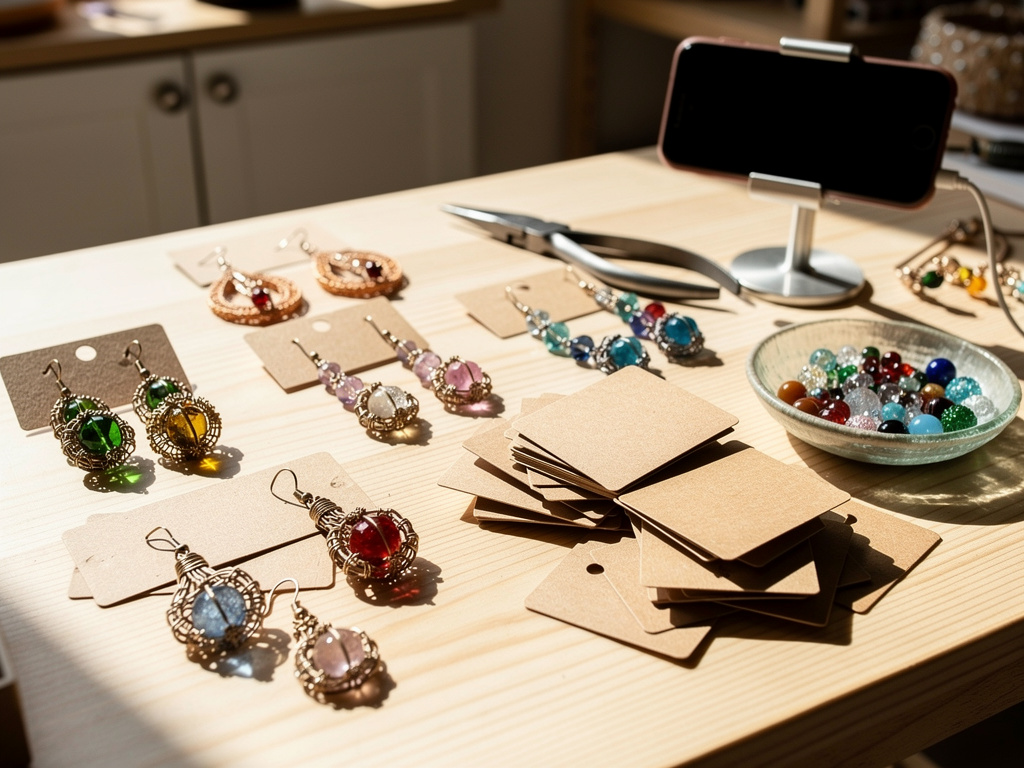
You made a pair of wire-wrapped earrings for yourself, a coworker asked where you bought them, and now there are twelve more pairs on your kitchen table. That is a common way for a home jewelry business to start. The hard part is not making the pieces. It is turning "can I buy one?" into a simple way to price, show, sell and hand over jewelry without it eating every evening.
This guide walks through it in order, from your first product line to your first ten customers. It is written for the part-time maker selling a few dozen pieces a month, not a brand with a warehouse. It is also only about jewelry you make: selling a ring or chain you already own is a different job (appraisals, gold buyers) that this page does not cover. Every fee and postage number below was loaded on October 8, 2026, and the math is shown so you can redo it with your own prices.
You can sell jewelry from home without a cottage food permit, kitchen inspection or yearly sales cap, because those rules cover food, not jewelry. What you do need is the same thing any small vendor needs: your state's sales tax registration where it applies, any local business license your city or county asks for, and honest words about your metals. The SBA's guide to licenses and permits, read on October 8, 2026, says the licenses you need from your state, county or city depend on what you sell and where, and it lists retail among the activities local governments commonly regulate, so verify your state's current rules before your first sale. Those rules are covered in full in the guide on whether you can sell homemade jewelry, so this page only touches them where they change how you sell.
The money side is where new vendors often lose track. Here are the three numbers that matter most on a typical $40 pair of earrings.
Those three numbers explain most of the advice in this guide. Fees are small. Postage is not. A home jewelry vendor who can hand most pieces over in person keeps far more of each sale than one who mails every order.
In a pull of the Homegrown catalog on October 8, 2026, none of the 2,920 products from 313 vendors was a necklace, earring, bracelet or ring. We searched every listing's name and description for jewelry words, then read all 95 Arts and Crafts, 6 Apparel and 87 Home Goods listings by hand. The closest item was a $12 jewelry holder and coaster from June Bug's Market. Arts and Crafts listings ran from $3 to $125 across 13 vendors, mostly crochet toys, glass and resin art, wreaths and shadow boxes.
Start with one line you can make in under 30 minutes a piece and sell for $20 to $60. That price band is easy for a friend, a coworker or a market shopper to say yes to without thinking hard, and it leaves room for a real profit once you price it properly.
Good first lines for a home vendor:
Pick one, not six. A table or storefront with 25 pieces in one clear style sells better than 25 pieces in six styles, because a buyer can tell in two seconds what you make. You can add a second line once the first one sells without you explaining it.
A small, well-lit table, 3 basic tools, and a way to keep findings sorted is enough for most first lines, and the first 3 tools below cover earrings, bracelets and simple wire work. You do not need a separate studio. Many home vendors work from a corner of the kitchen table or a folding table in a spare room.
A basic home setup:
Keep your finished stock separate from your supplies. When a customer messages about a pair, you want to find it in seconds, not dig through a box of half-finished work.
Add up materials and your time, double it for the wholesale price, then double that for the retail price. It is a simple formula many handmade vendors start with, and it works because it builds in room for fees, mistakes, packaging and the day a shop wants to buy at wholesale.
Here is how it plays out on three example pieces. These are worked examples with round numbers, not supplier prices. Put in your own materials cost and the hourly rate you want to earn.
Scroll sideways to see every column.
| Example piece | Materials | Your time at $24 an hour | Cost (materials + time) | Wholesale (cost x 2) | Retail (wholesale x 2) |
|---|---|---|---|---|---|
| Stretch bracelet | $3.00 | 10 minutes = $4.00 | $7.00 | $14.00 | $28.00 |
| Beaded earrings | $4.00 | 15 minutes = $6.00 | $10.00 | $20.00 | $40.00 |
| Wire-wrapped pendant | $9.00 | 45 minutes = $18.00 | $27.00 | $54.00 | $108.00 |
Worked examples only. Swap in your own materials cost and hourly rate. The $40 earrings are the example used for every fee and postage number later in this guide.
Two checks before you lock a price:
If the formula gives you a price that feels too high, do not cut your hourly rate first. Look for a faster way to make the piece, or a cheaper finding that looks the same.
Only call a piece "sterling" if the silver is at least 92.5% pure (925 parts per thousand), and only call a piece "gold plated" if the karat comes first, like "14K gold plated", and the plating is thick enough to last. Both rules come from the Federal Trade Commission's Jewelry Guides in 16 CFR part 23, which we loaded on October 8, 2026. A copper ear wire under a silver plating is "silver plated", not "silver".
What that means on your tags and listings:
If you stamp a quality mark like "925" or "14K" into a piece and then mail it or ship it to another state, federal law asks for one more thing. Under 15 U.S.C. 297, the piece must also carry your registered (or applied-for) trademark or your name. The law covers a quality mark applied "by stamping, branding, engraving, or otherwise", so do not assume a "925" printed on a tag instead of stamped into the metal falls outside it. The jewelry rules guide covers the stamping question in more detail. Rules like these change and states add their own, so verify your state's current rules before you print a batch of tags.
Jewelry designed mainly for children 12 and younger cannot have more than 100 parts per million (0.01%) of lead in any part a child can touch, so a kids' line needs extra care. That limit is in 15 U.S.C. 1278a, and the Consumer Product Safety Commission's total lead content page, read on October 8, 2026, says makers must also certify compliance in a Children's Product Certificate.
The CPSC's 2025 guide on reselling children's products says children's metal jewelry must be tested for compliance. It lists pieces made entirely of sterling silver (925), gold of at least 10 karat, surgical steel, precious and semi-precious gemstones (except stones that occur in nature with lead), or natural or cultured pearls as OK to sell. That list is written for resellers. As the maker, you still certify every kids' piece on a Children's Product Certificate. If your kids' line uses mixed base-metal findings, have the metal parts tested at a CPSC-accepted lab, which the same guide says even small batch makers must use for children's metal jewelry, or keep the line aimed at adults. Some states go further than the federal rule: Minnesota Statutes 325E.3892, read on October 8, 2026, caps lead at 90 ppm and cadmium at 75 ppm in all jewelry sold there, adult pieces included. The jewelry rules guide covers the other state limits and tracking labels. Check the current CPSC rules and verify your state's current rules before you list anything as a kids' piece.
The simple rule for a home vendor: do not market a piece "for girls", "for toddlers" or "party favors" unless you have done the work above. A bracelet sold to an adult who later gives it to a child is a different product, legally, from one designed and sold for kids.
Shoot by a window in the morning or late afternoon, on a plain background, with the phone on a stand and the flash off. Jewelry is small and shiny, so harsh light and a shaking hand ruin more photos than a cheap camera ever does.
A photo session works best as a weekly habit. Shoot everything you finished that week in one sitting, in the same light (20 pieces at 4 shots each is 80 photos, so plan on about 60 minutes), and listing new pieces takes minutes instead of an evening.
Every listing should answer the 5 questions a buyer would ask if she were holding the piece: what metal, what size, how it closes, how to care for it, and how she gets it. If those answers are missing, she messages you, and you spend your evening on replies instead of making. A buyer deciding on a $40 pair wants those answers before she pays, not after.
A listing checklist:
Never write "hypoallergenic" or "nickel free" unless your supplier states it for that exact component. If a buyer reacts, that word is the one she will quote back to you.
Give buyers one link where they can see what is in stock, pick a piece, pay and choose a pickup time. Many home jewelry vendors start in Instagram or Facebook messages, and it works until three people ask about the same pair and you have to remember who asked first, who said "I'll take it", and who actually paid.
Your options are usually five. Etsy brings shoppers who already search for handmade jewelry, but on a $40 pair it takes $4.25 in fees before shipping, and those buyers belong to Etsy's search more than to you. Shopify Basic gives you a full website at $29 a month billed yearly, which is more site than most part-time jewelry vendors need. Square's Free plan costs $0 a month and takes cards online at 3.3% + 30¢ or at a table at 2.6% + 15¢, checked October 8, 2026. Instagram DMs cost nothing and lose orders. The fifth is a simple storefront built for local vendors.
Homegrown is that fifth option, at $10 a month on annual billing ($12.50 on monthly billing) with no percentage fees beyond standard payment processing. For jewelry, the parts that matter are these:
The honest limits: Homegrown is built for pickup and local delivery. The signup page, checked October 8, 2026, lists no mail shipping or postage labels, so if most of your buyers live out of town, Etsy or Shopify is the better fit for those orders. Customers create a Homegrown account the first time they order. There is no drops or countdown release feature. And your storefront is listed on the Homegrown marketplace, but plan on most orders coming from people you send to your own link.
If your regulars already message you about new pieces, set up a storefront link and send it to them the next time you finish a batch. You stop tracking who claimed what, and they can order without waiting for you to reply.
On a $40 pair of earrings picked up locally, you keep $38.54 on Homegrown or Shopify, $38.38 on Square's online checkout, $35.75 on Etsy, and $40.00 in cash. The monthly plan is what separates the low-fee options once you sell more than a handful of pieces.
Swipe sideways for all nine columns of the fee stack.
| Way to take orders | Subscription | Trial | Platform fee | Card processing | Customer pays on $40 | You pay on $40 | You keep on $40 | 50 orders a month, all fees |
|---|---|---|---|---|---|---|---|---|
| Homegrown | $10/mo billed annually or $12.50 monthly | 7 days, no charge until day 8 | $0 (0% commission) | 2.9% + $0.30, paid by you | $40 plus sales tax | $1.46 | $38.54 | $83.00 annual billing ($85.50 monthly billing) |
| Shopify Basic | $29/mo billed yearly or $39 monthly | 3 days at no cost, then $1/month for 3 months | $0 with Shopify Payments (2% with another processor) | 2.9% + 30¢ standard cards (3.5% + 30¢ premium cards) | $40 plus sales tax | $1.46 | $38.54 | $102.00 yearly billing ($112.00 monthly billing) |
| Square Free plan, online checkout | $0/mo | Not needed on a $0 plan | $0 | 3.3% + 30¢ online (2.6% + 15¢ in person) | $40 plus sales tax | $1.62 | $38.38 | $81.00 |
| Etsy | $0, plus a one-time set-up fee where Etsy charges one | None | $0.20 listing fee + 6.5% transaction fee (15% Offsite Ads fee on attributed orders) | 3% + $0.25 on the order total | $40 plus sales tax | $4.25 | $35.75 | $212.50 before any Offsite Ads fee |
| Cash or check at pickup | $0 | n/a | $0 | $0 | $40 | $0 | $40.00 | $0 |
We checked these fees on findhomegrown.com/signup, Etsy's Fees and Payments Policy and Etsy Payments Policy, Shopify's pricing page and Square's pricing page on October 8, 2026. One $40 order, no shipping charged, before sales tax. Etsy's processing fee also applies to tax and shipping, and its 6.5% transaction fee applies to shipping, so a mailed order costs a little more. The Etsy row assumes a new listing for each piece, which is normal for one-of-a-kind jewelry.
The math, so you can redo it at your price: Homegrown is 2.9% of $40 ($1.16) plus $0.30, which is $1.46. Etsy is the $0.20 listing fee plus 6.5% of $40 ($2.60) plus 3% of $40 ($1.20) plus $0.25, which is $4.25. If an Etsy Offsite Ad brings the sale, add 15% of $40, another $6.00.
Before any monthly plan, you keep between 89% and 97% of a $40 sale on every card option, and exactly half when a shop buys at wholesale. The chart below shows what reaches you from one pair in each case.
What reaches you from one $40 pair of earrings
Source: fee pages for Homegrown, Square, Shopify and Etsy, checked October 8, 2026. One $40 order, no shipping, before sales tax and before any monthly plan. Wholesale uses the half-of-retail price from the pricing section.
Per order, Square's $0 plan online costs $0.16 more than Homegrown ($1.62 against $1.46). Homegrown's $10 plan pays for itself against Square's online checkout at 63 orders a month on annual billing (79 on monthly billing, at $12.50). Below that, Square's online checkout costs less in total. Square's pricing page lists pickup, local delivery and inventory tracking too, so those are not the difference. What you weigh against the per-order savings is what Homegrown's signup page, checked October 8, 2026, includes in the plan: it calculates and files the sales tax on each order for you, and it lists your storefront on the Homegrown marketplace.
Buyers order and pay online, then collect at a time and place you set, such as your front porch, your market booth or your workplace. Jewelry is small, does not spoil and fits in an envelope, so it is one of the easiest products to hand over this way.
Ways home vendors set up pickup:
Pick one or two and stick to them. The guide to the best platform for porch pickup orders was written for food vendors, but the setup (pickup windows, bagging by name, a reminder message) works the same for earrings.
For safety, do not post your home address publicly. Share it only with buyers who have paid, and keep valuable pieces in a locked box or inside until the window opens.
A small package up to 4 ounces costs $7.33 to $8.95 with a commercial USPS Ground Advantage label, or $8.40 to $10.20 at the post office counter, depending on distance. Those prices come from USPS Notice 123, effective October 4, 2026, which we loaded on October 8, 2026. Commercial prices are what you get when you buy the label online through a shipping service or a selling platform.
Scroll sideways to see every column.
| USPS Ground Advantage, up to 4 oz | Closest (zone 1) | Middle (zone 5) | Farthest (zones 8 and 9) | Share of a $40 pair |
|---|---|---|---|---|
| Commercial (label bought online) | $7.33 | $8.24 | $8.95 | 18% to 22% |
| Retail (post office counter) | $8.40 | $9.35 | $10.20 | 21% to 26% |
USPS Price List Notice 123, effective October 4, 2026, checked October 8, 2026. USPS prices by zone, from zone 1 (closest) to zone 9. The same notice charges the same commercial price for any package up to 15.999 oz, and the same counter price up to 8 oz, so most jewelry mailers land in this row. Weigh yours anyway, because the counter price rises above 8 oz and the commercial price rises at 1 pound. Your mailer, box and tissue are extra.
What to pack for a mailed piece:
Price "free shipping" before you promise it. A $7.33 to $8.95 commercial label is 18% to 22% of a $40 pair, but 37% to 45% of a $20 pair. On low-priced pieces, either charge shipping, set a minimum order for free shipping, or steer buyers to local pickup.
Two things change when you mail. A piece stamped "925" or "14K" that you mail anywhere, even across town, or ship to another state by carrier, also needs your trademark or name on it under 15 U.S.C. 297. And on Etsy, the 6.5% transaction fee and the 3% processing fee both apply to the shipping you charge, so an $8.00 shipping charge adds about $0.76 in fees.
Yes, once your regular line sells, and only with a deposit, a written description and a firm finish date. Custom orders (a name, a birthstone, a matching set for a wedding party) often pay more per piece, but they also cause most of the stress in a home jewelry business.
A custom order process that works:
If you use a storefront, list the custom piece as its own product with a deposit price, so the money and the order details live in one place instead of a message thread.
Many handmade jewelry vendors make pierced earrings final sale for hygiene, and accept returns or exchanges on other pieces within a short window if they are unworn. Whatever you choose, write it in every listing and on your packing slip, so it is never a surprise.
A clear, fair policy covers:
These are common choices, not rules. Check whether your state has its own requirements for posting a refund policy, and follow the policy of any platform you sell through.
Start with people who already know you, give each of them a link and a card, and ask each buyer to tell one friend. Your first ten buyers usually come from the people who already asked "where did you get those?"
If you want to sell at a farmers market, ask the manager first. Many markets limit craft vendors or ask that everything be handmade. The guide to selling soap, candles and other non-food products at farmers markets covers what managers usually ask before they say yes.
Plan to narrow your line, raise your prices once, and move repeat buyers from messages to a link during your first year. For a part-time maker, evenings are the scarce thing, so each habit below saves time as well as money.
Habits worth building in your first year:
None of these need a big budget. They need a notebook, a steady link and the habit of asking each buyer what she would buy next.
Jewelry does not need a cottage food permit, because those permits cover food. Most home jewelry vendors need their state's sales tax registration where it applies, and some cities or counties ask for a general business license. Check with your state revenue office and your city or county clerk before your first sale.
A common starting formula is materials plus your time, doubled for wholesale and doubled again for retail. Earrings with $4 in materials and 15 minutes of work at $24 an hour come to a $10 cost, a $20 wholesale price and a $40 retail price. Compare that to similar handmade pieces near you before you settle.
Etsy brings shoppers who search for handmade jewelry, but on a $40 pair it takes $4.25 in fees before shipping, as of October 8, 2026. Your own storefront costs less per order and keeps the buyer coming back to you. One workable split when you sell jewelry from home: Etsy for out-of-town buyers, and a storefront link for local regulars.
For a package up to 4 ounces, a commercial USPS Ground Advantage label costs $7.33 to $8.95 depending on distance, under the USPS prices effective October 4, 2026. Buying the label through a shipping service or a selling platform costs less than the post office counter, where the same package is $8.40 to $10.20. Local pickup costs nothing.
Only if you say it is plated, and say it the way the FTC Jewelry Guides ask. The Guides treat a bare "gold plated" as misleading: the karat has to come right before it, like "14K gold plated", and the plating has to be thick enough to last. If you cannot confirm both with your supplier, name the base metal on the tag and in the listing instead. "Sterling" is only allowed on silver that is at least 925 parts per thousand pure.
Yes. A Homegrown storefront is $10 a month billed annually, with 0% commission and 2.9% + $0.30 card processing per order, checked October 8, 2026. It is built for pickup and local delivery, not mail shipping, and customers create an account to place their first order.
These guides on the Homegrown blog pick up where this one stops. Read the rules guide before you print tags, and the places guide before you book your first fair.
Selling jewelry from home comes down to three habits: price every piece with the same formula, hand over as many pieces as you can in person, and give every buyer a way to order the next one without messaging you. The fees are small. On a $40 pair, card processing takes $1.46 and a mailing label takes $7.33 or more. The lost follow-up orders are bigger than either, because a buyer who loved her first pair will buy a second one only if it is easy.
Start this week with the steps above: one line, 20 to 30 pieces, one photo spot, one link.
If your buyers are mostly local, a Homegrown storefront gives them one link to see what is in stock, pay, and pick a pickup time, for $10 a month billed annually ($12.50 billed monthly) with no percentage fees beyond standard payment processing. Put the QR code on your earring cards, and the next pair sells while you are making it.



