
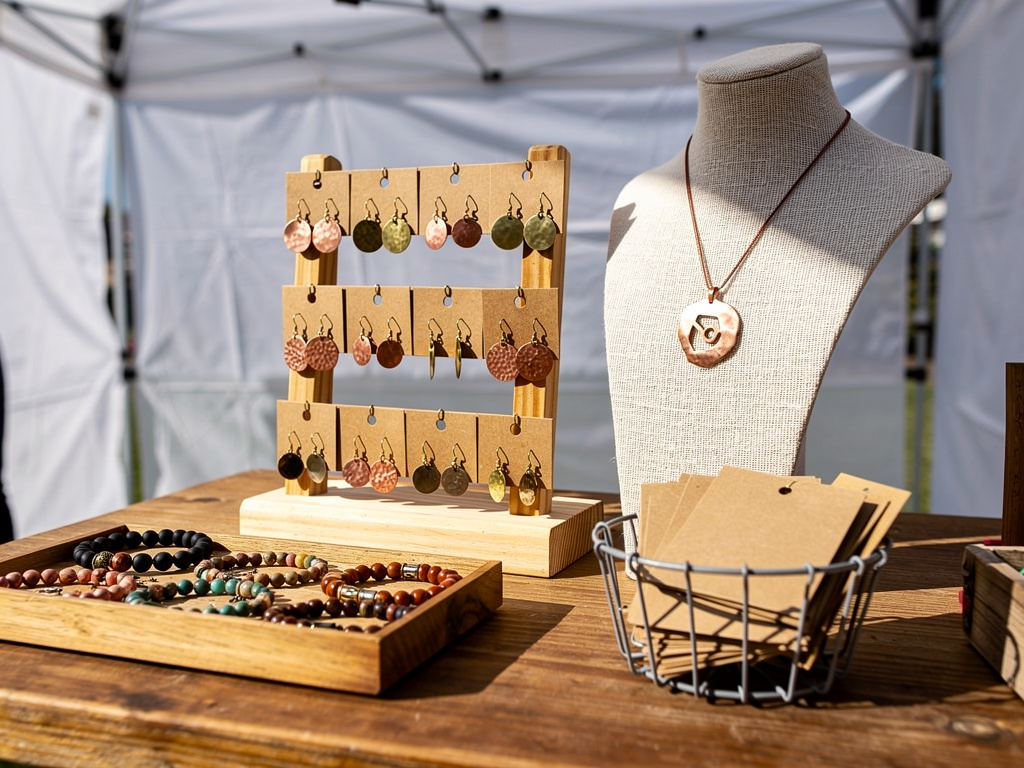


The short version: Jewelry you make sells in seven places: craft and art fairs, farmers markets that take crafts, your own storefront link, Etsy and Amazon Handmade, boutiques that buy at wholesale, consignment cases, and trunk shows at a friend's home or a salon. Start where people can try a piece on, then give every buyer a link to order the next one. On a $30 pair of earrings, $29.07 reaches you through a card reader at your table on Square's Free plan, $28.83 through a Homegrown storefront before its monthly plan, $26.70 on Etsy and $25.50 on Amazon Handmade before shipping, $18.00 on a 60/40 consignment split and $15.00 from a boutique paying half of retail. A juried craft fair can charge $300 to $850 for a small booth, so count how many pairs cover the fee before you apply.
Checked October 6, 2026: Homegrown is $10 a month billed annually or $12.50 billed monthly, with 0% commission and 2.9% + $0.30 card processing that the vendor pays (findhomegrown.com/signup). The Etsy, Amazon Handmade, Square, Shopify, Faire and American Craft Council figures below came off their own pages the same day. Limits to know: the Homegrown signup page lists pickup and local delivery but no shipping, customers create a Homegrown account to place a first order, there is no drops feature, and your storefront is listed on the marketplace, but plan on most orders coming from people you send to your own link.
You have 40 pairs of hammered copper earrings on kraft cards, a tray of beaded bracelets, and a handful of friends and coworkers who already bought from you. The next step is selling to people who do not know you yet, and the internet is full of advice that starts and ends with "open an Etsy shop."
Etsy is one answer. It is not the only one, and for a part-time jewelry vendor with a few dozen pieces it is often not the first. If you need the rules before you sell (licenses, what "sterling" has to mean, and the lead limit on kids' pieces), start with the guide on whether you can sell homemade jewelry. This guide is about where: the seven places jewelry vendors actually sell, what one $30 pair of earrings pays you in each, and how to add one place at a time.
One note before we start. If you are trying to sell a ring or a gold chain you already own, this guide will not help much. It is written for jewelry you make yourself.
You can sell jewelry you make in seven places, and a part-time jewelry vendor can run three of them at once: one place where people try pieces on, one link for reorders, and one shop or event that sells for you. The first three sell to a shopper at your full price. Etsy and Amazon Handmade bring you strangers for a share of each sale, and the last three trade a bigger share, or a thank-you to the host, for someone else's customers.
Instagram and Facebook are not on the list as their own places. They are where you show new pieces, and the sale works better when the post points to a link where someone can pay.
In-person places tend to make the first sale because a buyer is judging how a piece looks on her, not how it looks on a card. A $30 pair of earrings is a small decision about her own face, and a mirror at your table answers it in five seconds. A photo has to answer the same question with no face in it.
Three things are hard to judge through a screen:
That is why the in-person places on the list usually come first for a new vendor. Each one turns a stranger into someone who owns your work, knows your sizing and trusts your metal.
After that first sale, the hard part is over. A buyer who wore your copper hoops all summer does not need to try on the brass pair. She needs a way to order it without waiting for the next fair, which is what a storefront link or an Etsy shop is for.
Bring a hand mirror and a bracelet sizing chart to every in-person sale. The mirror sells the earrings, and the chart lets a buyer order the right bracelet size from your link later.
Pick the place that matches your price, your hours and how many pieces you can finish in a month, then add a second place once the first one runs on its own. A vendor with 150 pairs of $25 earrings and free Saturdays starts somewhere different from one making six $140 silver rings a month. The table below is a quick way to choose.
Scroll sideways to see every column.
| Your situation | Start here | Add next | Why it fits |
|---|---|---|---|
| Earrings and bracelets from $15 to $40, Saturdays free | A farmers market or local craft fair | Your own storefront link for reorders | Low prices sell on impulse at a table, and the link keeps those buyers coming back |
| Silver or gold pieces from $80 up | A juried art fair or a gallery consignment case | Trunk shows for past buyers | Higher prices need a setting where buyers expect to spend more and can see the work up close |
| A full-time job and a few free weekends a year | Holiday fairs and one trunk show | Etsy for the months between | A few big days carry the year, and a shop online keeps selling while you work |
| You like making and dislike selling | One boutique buying at wholesale | A second boutique in the next town | A shop buys at half of retail, so you are paid whether or not each piece sells, and the shop does the selling |
| Buyers who already follow you online | Your own storefront link | Etsy or Amazon Handmade for strangers | The people who know you do not need a marketplace to find you |
These rows are planning guides built from the fee pages and fair prices in this article, all checked October 6, 2026. Your local fairs, shops and costs decide the final mix.
A juried craft fair is worth it when the booth fee is a small share of what you can sell in a weekend, and for a $30 piece that math is easy to run. At American Craft Made Baltimore 2027, the American Craft Council's 10 by 5 foot booth costs $850 and a 10 by 10 costs $1,500, plus a $45 application fee, for a show that draws more than 10,000 shoppers to 380+ exhibitors. Artists in the council's Early Career Artist Program could apply for a subsidized 10 by 5 booth at $400 on the same page, and members get half off application fees. Applications for the 2027 fair closed June 5, 2026, so treat those as a guide to what the next cycle may cost. Its smaller American Craft Fest St. Paul, which is open to early-career artists, charged $300 for a 10 by 5 booth and $15 to apply in 2026, with 80+ early-career artists and more than 3,000 visitors.
"Juried" means a panel scores your photos before you get a booth, so you pay the application fee whether you get in or not. The American Craft Council lists jewelry as its own medium in three groups (enamel, metal and non-metal), and wooden or glass jewelry goes under non-metal. American Craft Made Baltimore's 2026 application page said the fair gets about 600 applications a year and picks about 400 artists.
What makes a fair pay off for jewelry:
Count every booth fee in pairs before you apply. At $30 a pair, a $300 booth takes 10 pairs of sales and an $850 booth takes 29 pairs just to cover the fee. Take out materials and the math gets tighter: if each pair costs you $8 to make, it leaves $22 toward the booth, so the $300 booth takes 14 pairs and the $850 booth takes 39, before the application fee, gas, a hotel and card fees. If your best fair last year sold 25 pairs, the $850 booth is a loss until your sales grow. By the half-your-best-fair rule in the steps below, even the $300 booth is a stretch, since 14 pairs is more than half of 25.
If you are new to juried shows, the guide to getting accepted into a juried craft fair is written for food vendors, but its advice on photos, jury scoring and booth shots works the same way for jewelry.
Yes, you can sell jewelry at a farmers market that accepts craft vendors. Cottage food permits cover food, so they are not the paperwork that matters for jewelry; sales tax registration and the market's own rules are. The market still decides whether to take you. Some markets cap the number of craft tables or require everything on your table to be made by you, so a market that already has three jewelry tables may have no spot open.
A weekly market does something a once-a-year fair cannot: it lets the same buyers see you 20 or 30 Saturdays in a row. A regular who buys a $25 pair of earrings in June may come back for a gift in November, and that second sale depends on her seeing you again. Homegrown's own list of farmers markets, on its signup page on October 6, 2026, counts more than 8,500 markets in its Market Finder, which is one way to find markets near you to ask about craft tables.
Ask the market manager these questions before you apply:
The guide to selling soap, candles and other non-food products at farmers markets covers how markets handle craft tables in general, including which ones label themselves artisan or maker's markets and welcome more craft vendors.
You can take cards at your table with just your phone through Square's Tap to Pay on iPhone or Android, or with a Square card reader, and Square's hardware starts at $59. On Square's Free plan, each in-person payment costs 2.6% + 15 cents, or $0.93 when a buyer pays $30 for earrings. Square's pricing page, checked October 6, 2026, lists the Free plan at $0 a month. Its Plus plan costs $49 a month and lowers the in-person rate to 2.5% + 15 cents, which only pays off at high volume.
Cash still costs nothing, and some buyers at a fair prefer it. Take both, and post a small sign that says you take cards, because a buyer who thinks you are cash only may walk off to find an ATM and not come back.
A jewelry table has two problems a bread table does not have: small pieces walk away, and expensive pieces need a closer look. A few habits handle both:
The card fee is small next to a booth fee. On 30 pairs sold by card at $30 each, Square's Free plan costs $27.90, which is less than a tenth of a $300 booth.
Regulars reorder between shows when you give them one link to order and pay, and pick up at your next fair, your market table or your porch. The buyer who loved your copper hoops in May wants the matching bracelet in July, and if the only way to get it is to wait for a fair or send you a message, some of those orders never happen.
When the problem is past buyers who want a second piece before your next show, Homegrown is built for that local reorder. It costs $10 per month billed annually with no percentage fees beyond standard payment processing of 2.9% + $0.30, which you pay rather than your customer, so a $30 pair of earrings costs you $1.17 in fees. On Etsy, the same pair costs you $3.30 in fees before shipping or ads, because Etsy's 6.5% transaction fee pays for buyers it finds for you, which a regular who already knows your table does not need. If you join Etsy's Share & Save program and send a regular through your own shop link, Etsy refunds 4% of the order, $1.20 on $30, per its Share & Save help page on October 6, 2026, so that order costs you about $2.10 in fees, against $1.17 plus the $10 monthly plan on Homegrown, which comes out cheaper once your regulars place about 11 orders a month (14 on monthly billing). Shopify Basic charges the same 2.9% + 30 cents on standard cards (3.5% + 30 cents on premium cards) but starts at $29 a month billed yearly, which buys a full online store with shipping that a vendor selling locally may not use.
What fits a jewelry vendor on Homegrown, per its signup page on October 6, 2026:
Homegrown has limits you should know first. Its signup page lists pickup and local delivery, with no shipping option, so a buyer three states away still needs your Etsy shop or another checkout. A first-time customer makes a Homegrown account before ordering. There is no drops or countdown release feature for a new collection. Your storefront is listed on the Homegrown marketplace, but plan on most orders coming from people you send to your own link, and no jewelry vendor was listed there yet in our October 6, 2026 catalog pull.
If your best buyers keep asking when your next show is, set up your Homegrown storefront and list your three best-selling earring designs with a pickup spot at your next fair. The trial is 7 days, with no charge until day 8.
Do not promise mail orders from a storefront that does not ship. As of October 6, 2026, the Homegrown signup page offers pickup and local delivery only, with no shipping option. Say "pickup or local delivery only" on your storefront, and send buyers who live far away to the place you do ship from.
List your jewelry on Etsy or Amazon Handmade when you want buyers in other states to find you and you are ready to pack and mail every order. Jewelry is small and light, which makes it one of the easier handmade products to mail. Both marketplaces bring shoppers you would never meet at a fair, and both take a bigger share of each sale than a local link.
Etsy's Fees and Payments Policy, read October 6, 2026, charges a $0.20 listing fee per listing, which lasts four months and renews at $0.20 each time a piece from a multi-quantity listing sells. It adds a 6.5% transaction fee on your price plus whatever you charge for shipping and gift wrap, and Etsy Payments charges 3% + $0.25 on the total, including tax and shipping. Etsy may also charge a one-time shop set-up fee. If a sale comes from Etsy's Offsite Ads, Etsy charges 15% of that order (12% once your shop passes $10,000 in sales over the prior 365 days), and a shop under $10,000 can opt out.
Amazon Handmade takes a referral fee of 15% or $0.30, whichever is greater, on every unit, per its program page on October 6, 2026. Amazon's selling fees page figures that fee on the total the buyer pays, including shipping. Handmade needs the $39.99 a month Professional selling plan, but after a one-time first-month payment Amazon waives the monthly fee for approved Handmade shops. You have to apply to Amazon Handmade and pass its review before you can list, and Jewelry and Watches is one of its open categories.
A few things decide whether jewelry sells online:
A new shop with no reviews is hard for strangers to trust, so ask the buyers you meet at a table to order online once and leave a review when the piece arrives.
On one $30 pair of earrings, the online options cost you between $1.17 and $4.50 per order in fees, before any monthly plan, and the gap grows fast with volume. At 20 orders a month, that is $25.80 on Square's Free plan, $33.40 on Homegrown with its annual plan, $52.40 on Shopify Basic, $66.00 on Etsy and $90.00 on Amazon Handmade. Here is the full stack for each one.
Swipe sideways for all eight columns of the fee stack.
| Way to get paid | Subscription | Trial or start-up | Platform fee | Card processing | Customer pays on a $30 order | You pay on a $30 order | 20 orders a month, you pay |
|---|---|---|---|---|---|---|---|
| Homegrown storefront | $10 a month billed annually ($12.50 billed monthly) | 7 days, no charge until day 8 | None, 0% commission, no shopper fee | 2.9% + $0.30, paid by you | $30.00 plus sales tax | $1.17 plus the plan | $33.40 ($35.90 on monthly billing) |
| Etsy | None; $0.20 listing fee per listing; a one-time shop set-up fee may apply | No plan to try | 6.5% transaction fee on price plus shipping; Offsite Ads 15% on orders from those ads | 3% + $0.25 on the total with tax and shipping | $30.00 plus shipping and sales tax | $3.30 | $66.00 |
| Amazon Handmade | $39.99 Professional plan, waived after a one-time first-month payment for approved shops | Application and review required | 15% referral fee on price plus shipping, or $0.30 if greater | No separate fee listed on the Handmade page | $30.00 plus shipping and sales tax | $4.50 | $90.00 ($129.99 in the first month) |
| Shopify Basic | $29 a month billed yearly ($39 billed monthly) | 3 days at no cost, then $1 a month for 3 months | None with Shopify Payments (2% with another provider) | 2.9% + 30 cents online on standard cards (3.5% + 30 cents on premium cards) | $30.00 plus shipping and sales tax | $1.17 plus the plan | $52.40 ($62.40 on monthly billing) |
| Square Free plan, online payment link | $0 a month | None needed on a $0 plan | None | 3.3% + 30 cents online | $30.00 plus sales tax | $1.29 | $25.80 |
We checked these fees on findhomegrown.com/signup, Etsy's Fees and Payments Policy and Etsy Payments Policy, Amazon's Handmade program page, Shopify's pricing page and Square's pricing page on October 6, 2026. Card processing is figured on the $30 price; Etsy charges processing on the total with tax and shipping, so real Etsy orders run a few cents higher. The Etsy row assumes one $0.20 listing fee per pair sold and no Offsite Ads order, and it is the case where the buyer did not come through your own Share & Save link, which would refund 4% ($1.20 on $30). Monthly columns use annual or yearly billing unless noted.
Here is the arithmetic behind the "you pay" column. Homegrown and Shopify: 2.9% of $30 is $0.87, plus $0.30, is $1.17, or $1.35 on a premium card at Shopify's 3.5% + 30 cents. Etsy: $0.20 plus 6.5% of $30 ($1.95) plus 3% of $30 and $0.25 ($1.15) is $3.30. Amazon Handmade: 15% of $30 is $4.50. Square's online rate: 3.3% of $30 is $0.99, plus $0.30, is $1.29. Multiply each by 20, then add the plan where there is one.
At 20 orders a month, Square's Free plan is the cheapest line on the table, and it is a fine choice if all you need is a payment link. Homegrown's lower per-order fee ($1.17 against Square's $1.29 online) catches up at about 84 orders a month on annual billing, or 105 on monthly billing. Square's pricing page also lists a customer directory and pickup and local delivery. Square can calculate the rate for you, but its sales tax help page, read October 6, 2026, says it is "solely your responsibility" to charge, collect and remit the tax. Homegrown costs $7.60 more at 20 orders on annual billing and also files the sales tax on storefront orders for you. Etsy and Amazon cost more because they bring buyers, so the right question is whether the buyer was already yours.
You get jewelry into boutiques by selling at wholesale, usually half of your retail price, because the shop needs room to cover its rent and staff. Faire, a wholesale marketplace where shops order from brands, says in its pricing policy that a retailer's margin is "typically" 50%, "or 2x the wholesale price." So a pair you sell for $30 at your table goes to a boutique for about $15.
Half sounds low until you count what you skip: no booth fee, no Saturday at a table, and one payment for 12 pairs instead of 12 small sales. A shop can also reorder every few weeks without you being there.
You can sell wholesale two ways. The first is your own line sheet and invoice, where the shop pays you directly. The second is Faire, which charged brands in North America, on its help page read October 6, 2026, a 15% commission on orders from its marketplace, plus a one-time $10 fee on a new retailer's first order. Orders from shops you bring yourself through your Faire Direct link pay 0% commission. Every Faire order also has a payment processing fee set by how fast you want to be paid: 3.5% + $0.30 for next-day payout, 2.4% + $0.30 at 30 days, or 1.9% + $0.30 at 60 days. If you use both, Faire's pricing policy says your Faire wholesale and retail prices must be the same as or lower than your prices anywhere else, including your own line sheet. Those Faire fees hit heavier handmade products the same way: on a shop's order of six $18 mugs, a first marketplace order leaves a potter $78.91 and a Faire Direct order leaves $105.11, as the guide to where to sell pottery works out.
Swipe the table to see what reaches you.
| How a boutique orders 12 pairs at $15 ($180) | Commission | Processing (30-day payout) | Reaches you |
|---|---|---|---|
| Your own invoice, paid by check | $0 | $0 | $180.00 |
| Faire Direct, a shop you brought | $0 | $4.62 | $175.38 |
| Faire marketplace, reorder | $27.00 | $4.62 | $148.38 |
| Faire marketplace, a new shop's first order | $27.00 plus the $10 new customer fee | $4.62 | $138.38 |
Faire's commission and processing rates from its North America brand pricing page, checked October 6, 2026. Processing is 2.4% of $180 ($4.32) plus $0.30. Shipping costs and any free-shipping program are not included.
Before you walk into a shop, bring these:
Consignment can pay more per piece than wholesale, because the shop keeps a share only after a piece sells, and the split jewelry vendors see most often is 60/40, with 60% to you. The Jewelry Making Journal calls 60/40 "the most common consignment percentage" for jewelry and says splits run from 80/20 to 50/50. On a $30 pair, 60% is $18.00, against $15.00 at wholesale.
On consignment you are lending the shop your stock. You get paid later, usually once a month for what sold the month before, and unsold pieces can sit in a case for a season. A sample gallery contract published by Ganoksin, an online jewelry community, shows the terms worth asking for: the gallery keeps 40% of the retail price, it may buy pieces outright at 50% of retail, and it is liable for loss, damage or theft while your work is in its care.
Put these in writing before you leave a single pair:
A consignment shop that closes can take your stock with it. Visit every few weeks, count your pieces against the signed inventory sheet, and pull jewelry from any shop that pays late twice. If a shop wants to keep 50% or more, ask it to buy at wholesale instead, since at that split you are taking the risk without being paid up front.
Consignment works best for one-of-a-kind or higher-priced pieces, such as a $140 silver ring or a statement necklace, where a shop owner will not risk buying at wholesale but will gladly put it in a case. For $20 earrings that sell in volume, wholesale is usually simpler.
Trunk shows work well for jewelry because a host fills a room with people who already trust her taste, and every guest can try on your whole line in one evening with no booth fee. A trunk show is simply a sales event where you bring your stock to someone else's space: a friend's living room, a hair salon, a yoga studio or a boutique on a slow weeknight.
The host does the inviting, and you do the selling. Thank the host with a free piece or store credit, and if a business hosts, agree before the night whether it gets a share of the sales.
How to run one:
Salons and boutiques make good hosts because their own customers come in all week. A salon that hosts you on a Thursday evening gets a reason to invite its clients in, and you get 20 new people trying on earrings.
Out of one $30 pair of earrings, between $15.00 and $30.00 reaches you depending on where it sells, before booth fees, shipping or monthly plans. Cash at your own table keeps the whole price. A boutique buying at wholesale keeps half. Everything else falls in between.
What reaches you from one $30 pair of earrings
Source: Square, Homegrown, Etsy and Amazon Handmade fee pages and Faire's pricing policy, checked October 6, 2026, and the Jewelry Making Journal's consignment split. Booth fees, shipping, ads and monthly plans not included.
The chart is per piece, and a per-piece number can mislead. The $30.00 at your table carries a booth fee, a tent and a Saturday of your time. The $15.00 from a boutique arrives as $180 for 12 pairs with no table at all. The $28.83 on a storefront link carries a $10 monthly plan, which is $0.50 a pair if you sell 20 pairs a month that way.
Use the chart to see the trade, not to pick one winner. A vendor who sells 20 pairs at a fair, 15 through a link and 24 to two boutiques in a month is running three of these bars at once.
No, not yet: the Homegrown catalog had no necklaces, earrings, bracelets or rings in our October 6, 2026 pull, though handmade crafts were already listed there. That matters for where you put your effort. A jewelry vendor joining now would be the first in the catalog, so plan on orders coming from the buyers you send to your link, not from shoppers browsing for jewelry.
In a pull of the Homegrown catalog on October 6, 2026, none of the 2,893 products from 311 vendors was a necklace, pair of earrings, bracelet or ring. We searched every listing's name and description for jewelry words, then read all 95 Arts and Crafts listings (from 13 vendors), all 6 Apparel listings and all 86 Home Goods listings one by one. The word matches were all something else, such as "charm" in bakery copy, freeze-dried candy rings, glass beads set into canvas art and a $12 jewelry holder that doubles as a coaster. The Arts and Crafts listings that are there run from $3 to $125 and include crocheted animals, glass and resin art on canvas, shadow boxes and wreaths.
Those craft listings are the useful part. They show that Homegrown already carries non-food handmade work, such as crochet, glass art, shadow boxes, wreaths and soap, from 9 of those 13 vendors (the other 4 list honey, chocolate, raw beeswax, or an art class and collage paper under Arts and Crafts), so a jewelry listing would sit next to crochet and glass art rather than alone among the bread. A jewelry vendor who also sells at a farmers market can list both kinds of products under one link, the same way Farmstand on Shalimar Lane lists its handmade boo boo bags next to 13 bakery listings in the October 6, 2026 catalog pull.
Homegrown is a reorder tool for jewelry, not a discovery tool. Your fairs, markets and trunk shows find the buyers. The link keeps them.
Five federal rules can follow your jewelry into any place on this list, whether you sell at a fair, on Etsy or through a boutique. They matter more as you add places, because shipping and wholesale put your words and stamps in front of more people. Verify your state's current rules too, since some states go further.
The permission guide linked at the top of this article covers each of these in depth, including what "handmade" has to mean, plus the state lead laws in Minnesota and California and how to describe stones and plating. A boutique buyer or an Etsy reviewer who sees "sterling" on cheap wire will ask, so get the words right before you add a place that ships.
Add one new place a month, and give each one at least three tries before you judge it, because the first fair or the first week on a shelf rarely shows what a place can do. A vendor who opens Etsy, two boutiques and a fair in the same month cannot tell which one is working. Here is a simple order that fits a part-time schedule:
The order matters less than the habit. A place you try once and judge on a rainy day is a place you never really tested.
Three changes are worth making after a first season: cut your line down, reprice or drop your slowest designs, and stop treating each fair as the whole business. A table with 200 designs makes buyers work harder to decide, and a buyer who cannot decide often leaves without buying. Repricing goes faster with one formula for every piece, and the guide on selling jewelry from home turns $4 of materials and 15 minutes of work into a $20 wholesale and $40 retail price.
Lessons worth knowing before your second season:
The vendors who last also keep their buyers' contact details. A list of 150 past buyers you can text when a new collection is ready can be worth more than any single fair.
The best place to sell handmade jewelry for a new vendor is a craft fair or a farmers market that takes crafts, because buyers can try pieces on before they pay. For a $30 sale, about $29.07 reaches you through a card reader on Square's Free plan, against $26.70 on Etsy. Pair the in-person place with a storefront link so buyers can order again between events.
Etsy is easier to start, because you can open a shop without an application and pay $0.20 a listing, plus a possible one-time set-up fee, while Amazon Handmade requires an application and approval first. For $30 earrings, Etsy's fees come to $3.30 and Amazon Handmade's 15% referral fee comes to $4.50, both checked October 6, 2026. If you want both, start on Etsy and apply to Amazon Handmade once you have steady sales and a full set of photos.
Boutiques usually pay wholesale, which is about half of the retail price, so a pair of earrings that sells for $30 earns you about $15. Faire's pricing policy says a retailer's margin is typically 50%, or 2x the wholesale price. On consignment you earn more per piece, often 60% of retail, but only after each piece sells.
Yes, you can sell jewelry at a farmers market that accepts craft vendors, if it has a spot open. A cottage food permit is not the paperwork that matters, since those permits cover food. Each market sets its own rules, such as a cap on craft tables or a rule that every piece must be handmade by you. Ask the manager before you apply, and check whether the market needs a sales tax number from craft vendors.
Selling jewelry you make is not on the SBA's list of business activities that need a federal license, checked October 6, 2026, unless your pieces use wildlife materials such as shell or bone: the SBA lists "any wildlife-related activity," including the import or export of wildlife, under the U.S. Fish and Wildlife Service. That agency's "Can I sell it?" fact sheet says sea turtle shell, including tortoiseshell jewelry, generally cannot be sold across state lines, and pieces from a U.S. endangered or threatened species cannot be sold across state lines without a permit. For whale teeth or bone, it sends you to the National Oceanic and Atmospheric Administration. Feathers from birds protected by the Migratory Bird Treaty Act, which covers more than 1,000 native species, are a separate case: the U.S. Fish and Wildlife Service says they cannot be sold, apart from narrow exceptions. Your county or city may require its own license, the SBA notes, and your state tax agency can tell you whether you need to register to collect sales tax. Juried craft fairs also charge an application fee, such as $15 to $45 at the American Craft Council's shows, before you are accepted. Verify your state's current rules with your state tax agency before your first event.
Yes, you can list jewelry on a Homegrown storefront for $10 a month billed annually, with 2.9% + $0.30 card processing on each order and no commission. The signup page, checked October 6, 2026, lists pickup and local delivery but no shipping, so it fits jewelry vendors who sell to local buyers at fairs, markets and trunk shows. A buyer needs a Homegrown account to place a first order.
These guides on the Homegrown blog go deeper on the rules, places and switches that come up when you decide where to sell jewelry.
The places that pay you best for jewelry are the ones where a buyer tries a piece on, and the places that keep paying are the ones where she can order the next piece without waiting for you. For a part-time jewelry vendor, that means one in-person place, one link for reorders, and one boutique, gallery or trunk show host who sells for you. Add a juried fair once the booth fee math works and your photos are ready.
A Homegrown storefront is $10 a month billed annually, with no percentage fees beyond standard payment processing of 2.9% + $0.30 per order, and a 7-day trial with no charge until day 8. List your designs with lengths and colors as variants, add the fairs and markets where buyers can pick up, and print the QR code on your earring cards. First-time buyers make a Homegrown account before they order, and orders are for pickup or local delivery, since the signup page shows no shipping, so keep Etsy or another checkout for buyers far away. When you are ready to turn this season's buyers into regulars, create your Homegrown storefront before your next show.



