
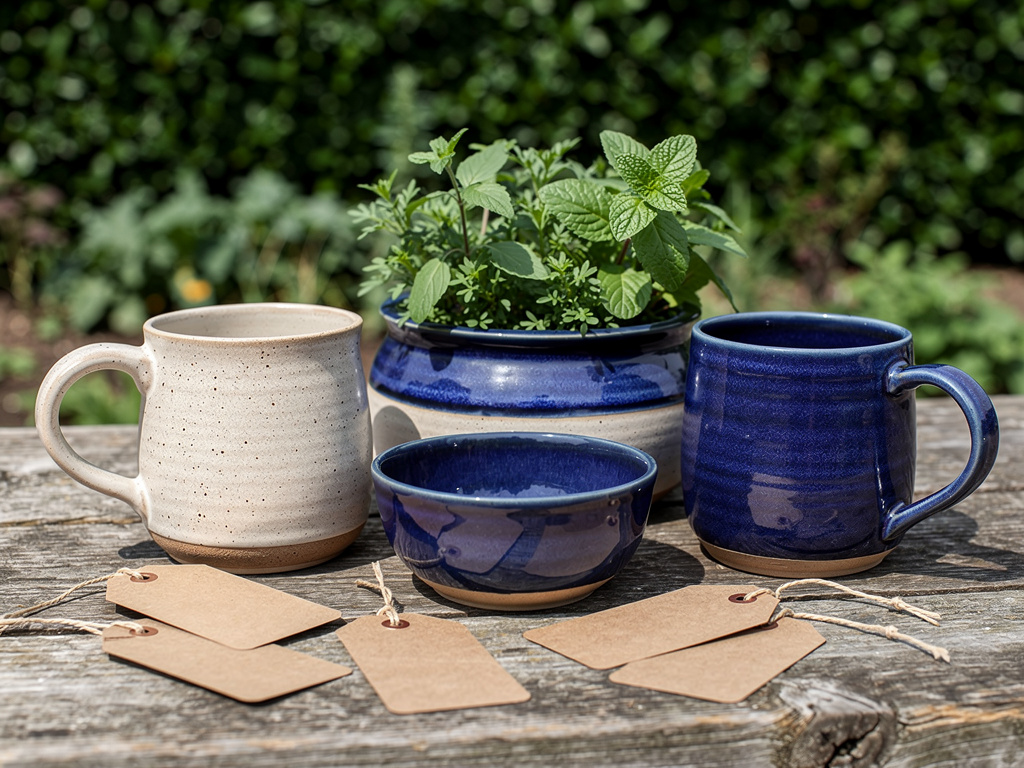


The short version: Pottery you make sells in seven places: craft and art fairs, farmers markets that take crafts, studio sales and kiln openings, your own storefront link for local pickup, Etsy and Amazon Handmade, galleries and gift shops, and cafes or restaurants that order tableware. Start local, because pots are heavy and break, and selling face to face or for pickup takes shipping off the table. On a $36 mug, $34.91 reaches you through a card reader at your table on Square's Free plan, $34.66 through a Homegrown storefront before its monthly plan, $32.13 on Etsy and $30.60 on Amazon Handmade before any shipping, $21.60 on a 60/40 consignment split and $18.00 from a shop buying at half of retail. Under federal rules for pottery sold across state lines, anything that looks like it could hold food is treated as food ware, so use glazes labeled food safe, or lab test your own recipes, before you sell mugs, bowls or plates.
Checked October 7, 2026: Homegrown is $10 a month billed annually or $12.50 billed monthly, with 0% commission and 2.9% + $0.30 card processing paid by the vendor (findhomegrown.com/signup). The Etsy, Amazon Handmade, Square, Shopify, Faire, American Craft Council and FDA figures below came off their own pages the same day. Limits to know: the Homegrown signup page lists pickup and local delivery but no shipping, customers create a Homegrown account to place a first order, there is no drops feature, and your storefront is listed on the marketplace, but plan on most orders coming from people you send to your own link.
You have two shelves of mugs out of the last glaze firing, a stack of small bowls, and a few planters that came out better than you expected. Friends have bought what they can. The next question is where strangers will pay a fair price for the rest, without you spending half your profit on bubble wrap and booth fees.
Most advice starts and ends with "open an Etsy shop." For pottery that is often the hardest place to start, because a 14-ounce stoneware mug is heavy, fragile and expensive to ship. If you also want the basics on which farmers markets take craft vendors and how to price and display handmade work, the guide on selling non-food products at farmers markets covers that ground. This guide is about where: the seven places potters actually sell, what one $36 mug pays you in each, and the food safety rule that follows your pots everywhere.
One note first. If you are trying to sell a vintage Roseville vase or a set of old dishes you inherited, this guide will not help much. It is written for pottery you throw or hand-build yourself.
Potters sell in seven places, and a part-time potter can usually run three at once: one in-person place where people pick up and feel the work, one link for local reorders, and one shop or event that sells for you. Here are the seven, in the order we suggest adding them.
The first four places sell to a shopper at your full price. Etsy and Amazon Handmade bring you strangers for a cut, and the last two trade a bigger share of the price for someone else's customers and shelf space.
Pottery sells best where the buyer carries it home, because every mile a mug travels in a box adds cost and a chance it arrives in pieces. A potter paid in cash face to face keeps the full $36, and $34.91 on a card through Square's Free plan. A potter who ships the same mug pays for a box, padding and a label, and on Etsy or Amazon Handmade also pays the marketplace's percentage fees on whatever shipping charge the buyer covers.
That shapes the order we suggest:
Touch matters too. People buy mugs by holding them: the weight, the handle, how the rim feels on the lip. A photo cannot do that, which is why pottery sells best where people can pick it up. Online sales work best once a buyer already owns one of your mugs and wants a second.
The seven places differ most in three things: what you pay upfront, the share of a $36 mug you keep, and how many hours each takes. The table below lines them up so you can match a place to the time and inventory you have. Every figure comes from the source company or organizer, checked October 7, 2026.
Scroll sideways to see every column.
| Place | Upfront cost | What a $36 mug pays you | Time it takes | Best for |
|---|---|---|---|---|
| Juried craft or art fair | $45 application plus $850 for a 10x5 booth (American Craft Council, Baltimore 2027) | $34.91 on Square's Free plan, card in person | 2 to 3 show days plus setup | Potters with 150+ finished pieces and a booth display |
| Farmers market | Weekly booth fee set by each market | $34.91 on Square's Free plan, card in person | One morning a week | Mugs, small bowls and planters people collect |
| Studio sale or kiln opening | Nothing beyond signs and a card reader | $36.00 in cash, $34.91 by card on Square Free | One day, a few times a year | Potters with a garage, porch or shared studio |
| Your own storefront link (Homegrown) | $10 a month billed annually, $12.50 billed monthly | $34.66, pickup or local delivery | A few minutes per order | Regulars who want a second mug or a matching set |
| Etsy | $0.20 per listing, possible one-time set-up fee | $32.13 before shipping and ads | Packing and shipping every order | Small, sturdy pieces that ship well |
| Amazon Handmade | Application, then the $39.99 Professional plan fee for the first month only | $30.60 before shipping | Packing and shipping every order | Potters making the same form in volume |
| Gallery or gift shop | Nothing, but you deliver the work | $21.60 at 60/40 consignment, $18.00 at wholesale | Restocking and paperwork | Potters with a consistent line and a good price sheet |
| Cafe or restaurant | Samples and a test order | $18.00 at wholesale, more on custom work you quote | Weeks per custom order | Potters who can repeat a form exactly |
Fees from Square's pricing page (Free plan, 2.6% + 15¢ in person), Homegrown's signup page (2.9% + $0.30), Etsy's fees page (6.5% transaction, 3% + $0.25 processing, $0.20 listing) and Amazon's Handmade page (15% referral), all checked October 7, 2026. Consignment and wholesale splits are common industry terms, not fixed rules.
If you have 30 pieces and Saturday mornings free, the market and your own link are the right start. If you have 150 pieces and a van, a juried fair is worth the application.
A juried craft fair is worth it when you can sell at least the booth fee in pieces on the first day, and for a big national show that is about 25 mugs before you earn anything. The American Craft Council's 2027 American Craft Made show in Baltimore charges a $45 application fee and $850 for a 10x5 booth, or $1,500 for a 10x10. Its Early Career Artist booth, open only to artists in ACC's Early Career Artist Program, is $400 and includes pipe and drape, electricity, a table and a chair. We checked those numbers on the council's application page on October 7, 2026.
Here is the break-even math on a $36 mug:
Local fairs run by a church, a school or a downtown business group set their own fees, usually far below a national show, and they are a cheaper place to learn your booth before you apply to a juried one. The Baltimore show took applications through ZAPP, an online application system other juried art and craft shows also use, and asked for 6 images, including a photo of your booth. Applications for the February 19-21, 2027 show closed June 5, 2026, after opening April 20, 2026, so watch the council's site for the next round in spring. The guide to juried craft fair applications walks through what jurors look for and how to photograph a booth.
Bring three price points to a fair: something under $20 (a small cup, a ring dish or a spoon rest), the $30 to $40 mug that most people come for, and one or two pieces over $100. The small piece sells to the browser who would otherwise walk away, and at $18 it takes 50 of them to cover an $895 booth, so the middle and top tiers do the real work.
Bring sturdy bags and more newspaper or tissue than you think you need. Buyers at a fair want to carry a wrapped mug to the next booth without worrying about it.
Many farmers markets accept handmade crafts like pottery, but each market sets its own rules, and some limit non-food vendors to a share of the booths or require that you make everything you sell. Ask the market manager before you apply. A weekly booth costs less than most fairs and puts your mugs in front of the same shoppers every week, which is how a casual buyer becomes the person who owns six of your mugs.
Questions a manager will usually ask a potter:
Card payments matter at a pottery booth because $36 to $80 purchases are bigger than a loaf of bread, and few people carry that in cash. Square's Free plan charges 2.6% + 15¢ per in-person card payment, which is $1.09 on a $36 mug, and Square says you can take payments with Tap to Pay on an iPhone or Android phone without buying hardware. The guide on taking payments at a farmers market compares the readers.
Keep your display at hand height. A mug on a tablecloth at knee level does not get picked up, and a mug that does not get picked up does not sell.
A studio sale or kiln opening is a one-day sale at your own space, timed right after a firing, and it is the one in-person place with nothing to pay to be there, so a cash sale reaches you whole. There is no booth fee and no commission. A potter with a home studio, a garage or a spot in a shared community studio might run one two to four times a year, for example before the winter holidays.
How potters run one:
Some shared community studios run a group holiday sale for members and keep a share of each sale to cover the space. Ask the studio what percentage it keeps and when it pays members before you sign up.
The weak spot of a studio sale is the buyer who could not make it that Saturday. That is where a storefront link earns its keep.
Local customers order between sales from a storefront link you text, post and print, then pick up at your porch, studio or market booth, so the pot never goes in a shipping box. That solves the problem this whole guide keeps coming back to: pottery is heavy, fragile and expensive to ship, and most of your best buyers live within a short drive.
Homegrown gives you that link for $10 per month billed annually ($12.50 billed monthly), with no percentage fees beyond standard payment processing of 2.9% + $0.30, which is $1.34 on a $36 mug. Here is what it does that fits pottery:
Compare that with Etsy, Square Online and Shopify. Etsy reaches shoppers nationwide, but it charges $3.87 in fees on that $36 mug before shipping, and nearly every sale ships. Square Online works and costs $1.49 per online order on the Free plan, 15 cents more per order than Homegrown, though Square has no monthly plan to cover. Shopify Basic charges the same $1.34 per order plus $29 a month billed yearly, which buys a full online store you have to set up and run.
Honest limits: Homegrown has no shipping, so it is a local tool. Customers create a Homegrown account to place their first order. Payouts land the next business day, but 20% of each order is held for 30 days and then released automatically. There is no drops feature for a timed release of a firing. Your storefront is listed on the Homegrown marketplace, but plan on most orders coming from people you send to your own link. If most of your regulars live near you and you are tired of holding mugs aside through text messages, set up your pottery storefront on Homegrown and put the link on the card that goes in every bag.
In a pull of the Homegrown catalog on October 7, 2026, 1 of the 2,906 products listed by 310 vendors described itself as ceramic: ceramic red chili peppers on a wood paddle for $45 from Jody's Glass & Resin Art. No listing was a handmade mug, bowl, plate, planter or vase. We searched every product name and description for clay, pottery, ceramic, stoneware, porcelain, glaze, kiln, mug, planter, vase and bowl, then read all 95 Arts and Crafts listings from 13 vendors by hand. A local potter on Homegrown would be close to alone in the category.
Etsy is worth it for small, sturdy pieces that ship well, and Amazon Handmade suits a potter who makes the same form over and over, but both cost more per sale than selling locally and both mean every order ships. On a $36 mug, Etsy takes $3.87 and Amazon Handmade takes $5.40 before shipping. We read both fee pages on October 7, 2026.
How Etsy charges a potter:
How Amazon Handmade charges a potter:
Amazon's Handmade page lists no separate card processing charge, so the referral fee is the per-sale cost. On Etsy, processing is its own charge on top of the transaction fee. Neither has a monthly subscription once you are set up, which is why they feel cheap until you add up a month of orders.
The real cost for potters is what happens after the sale: wrapping, boxing, a trip to the post office and the occasional broken mug you replace at your expense. If you already sell on Etsy and want your repeat local buyers ordering from your own link, the guide to switching from Etsy to your own storefront covers how to move them over without breaking Etsy's rules.
A $36 mug costs a potter $1.09 in fees through a card reader at a booth, $1.34 through Homegrown or Shopify, $1.49 through Square Online, $3.87 on Etsy and $5.40 on Amazon Handmade, before any monthly plan or shipping. The monthly plan changes the picture once you count a month of orders, so the last column shows 20 online orders.
Swipe left to see the rest of the fee columns.
| Platform | Monthly plan | Trial | Platform fee | Card processing | Customer pays on a $36 mug | Potter pays on a $36 mug | Potter pays in a month of 20 orders |
|---|---|---|---|---|---|---|---|
| Homegrown | $10 billed annually ($12.50 monthly) | 7 days, no charge until day 8 | None, 0% commission | 2.9% + $0.30, paid by the potter | $36.00 | $1.34 plus the plan | $36.80 ($39.30 on monthly billing) |
| Square Free, card at your booth | $0 | None needed, Free plan is $0 | None | 2.6% + 15¢ in person | $36.00 | $1.09 | $21.80 |
| Square Free, online order | $0 | None needed, Free plan is $0 | None | 3.3% + 30¢ online | $36.00 | $1.49 | $29.80 |
| Shopify Basic | $29 billed yearly ($39 monthly) | 3 days, then $1 a month for 3 months | None with Shopify Payments (2% with another provider) | 2.9% + 30¢ online standard card (3.5% + 30¢ premium) | $36.00 | $1.34 plus the plan | $55.80 ($65.80 on monthly billing) |
| Etsy | $0 (possible one-time set-up fee) | No trial, no monthly plan | $0.20 listing + 6.5% transaction fee | 3% + $0.25 on the full sale | $36.00 plus any shipping you charge | $3.87 before shipping and ads | $77.40 before shipping and ads |
| Amazon Handmade | $39.99 the first month, then waived after approval | No trial | 15% referral fee (minimum $0.30) | No separate charge listed; the referral fee is the per-sale cost | $36.00 plus any shipping | $5.40 before shipping | $108.00 ($147.99 in the first month) |
Card processing is figured on the $36 price with no tax or shipping. Etsy and Amazon Handmade also charge their percentages on any shipping you charge, so a shipped order costs more on both. Prices from each company's own pricing page, checked October 7, 2026. The Square booth row assumes 20 card payments in person.
Three things stand out for potters:
Shipping adds two costs to a pottery sale: the label and packing materials you pay for, and the marketplace fees charged on the shipping amount itself. Etsy charges its 6.5% transaction fee and its 3% processing fee on the shipping you charge the buyer. On a $36 mug with $14 of shipping, Etsy's fees rise from $3.87 to $5.20, and $1.33 of that is fees on the shipping alone. Amazon Handmade's 15% referral fee also applies to the shipping charge, because Amazon's seller pricing page counts shipping as part of an item's total price, so the same $50 order costs $7.50 in referral fees, $2.10 of it on the shipping.
Say your $14 shipping charge only covers the label. You still pay for the box and padding, and you replace any mug that arrives broken. If the order came from an Etsy Offsite Ad, the 15% fee on the $50 total adds another $7.50.
How potters pack so a mug arrives whole:
Homegrown has no shipping option. The signup page, checked October 7, 2026, lists pickup and local delivery within 1 to 25 miles, and nothing that mails a package. If you plan to sell to buyers in other states, you need Etsy, Amazon Handmade, Shopify or another tool for those orders, and Homegrown only for the local ones.
A simple rule to start with: ship cups, ornaments and small dishes, and keep anything over a pound and a half or wider than a dinner plate for local buyers.
Sell wholesale when a shop will pay upfront, and consign only when the split is at least 60/40 in your favor and the contract says who pays for breakage. Under a common consignment split, a $36 mug pays you $21.60 when it sells; at wholesale, a shop buys it outright for half of retail, or $18.00. The craft business site Craft Professional lays out these splits in its guide to what a fair consignment percentage is: 60% to the artist and 40% to the shop on consignment, and 50% of the retail price up front at wholesale.
The Ceramic School, a pottery education site, wrote in July 2024 that the most common consignment split for shops is 60/40, while galleries lean toward 50/50. At 50/50, consignment pays the same $18.00 as wholesale, but you carry all the risk until it sells.
What to put in writing before a pot leaves your studio:
Pottery can chip or break on a shop shelf when customers handle it. A consignment agreement that is silent on breakage usually means the loss is yours, because the piece was still yours until it sold. Get a breakage line in the contract before the first delivery.
Your wholesale price has to cover clay, glaze, two firings and your time with room left over. If half of $36 does not do that, raise the retail price everywhere before you approach a shop.
Faire is a wholesale marketplace where shop owners order from brands, and it is worth it for potters who can fill repeat orders of the same form, as long as you count its 15% commission on every order from shops it finds for you, plus $10 on a new shop's first order. Faire is free to join. On orders from shops it finds for you, it charges a 15% commission, plus a one-time $10 fee on a new shop's first order. On orders from shops you bring yourself through your own Faire Direct link, the commission is 0%. Every order also pays a processing fee that depends on how fast you want to be paid. Those are Faire's own numbers as of October 7, 2026.
Here is what a shop ordering 6 mugs at $18 wholesale ($108) leaves you, using Faire's 30-day payout at 2.4% + $0.30:
Slide the table sideways to see what you keep.
| How the shop found you | Commission | New shop fee | Processing (30-day payout) | You keep on $108 |
|---|---|---|---|---|
| Faire marketplace, first order | 15%, $16.20 | $10.00 | 2.4% + $0.30, $2.89 | $78.91 |
| Faire marketplace, reorder | 15%, $16.20 | None | 2.4% + $0.30, $2.89 | $88.91 |
| Faire Direct (a shop you brought) | 0% | None | 2.4% + $0.30, $2.89 | $105.11 |
| Your own invoice, paid by check | None | None | None | $108.00 |
Faire's other payout choices: next day at 3.5% + $0.30 ($4.08 on $108) or 60 days at 1.9% + $0.30. Figures from Faire's help page on selling costs for North American brands, checked October 7, 2026.
Packing the order is still on you, and six mugs in one box need the same double-box packing as a single one. When you ship a Faire order yourself, Faire's payout adds the shipping cost back on top of the Faire figures above, so postage does not come out of them. The math works when your wholesale price was set high enough to absorb a 15% cut on every marketplace order. Faire also makes it easier for a small shop to say yes, because its help page says eligible shops get 60-day payment terms, while you still get paid on the payout schedule you picked.
If a shop near you already wants your work, invoice them directly or send your Faire Direct link. The marketplace commission is the price of a stranger finding you.
Cafes and restaurants buy pottery two ways: a coffee shop sells your mugs at the counter on consignment or wholesale, and a restaurant orders a full set of plates or bowls made to its own spec. Both are steady accounts once they work, and both put your pots in front of people who eat and drink from them every day.
What changes when a business is the buyer:
Price custom tableware from the wholesale side. If your retail dinner plate is $40, a restaurant ordering 60 of them will expect something close to the $20 wholesale price, and 60 plates at $20 is $1,200 of work you need to fire perfectly. Charge more for a custom glaze or a custom form, and put the price in writing with the deposit.
A cafe selling your mugs is simpler: agree on the split, deliver a dozen, and restock monthly.
Federal rules for pottery sold across state lines count any piece that looks like it could hold food as food ware, so a mug, bowl or plate you sell has to be safe to eat and drink from unless it is clearly marked decorative. Under 21 CFR 109.16, the federal rule on ornamental and decorative ceramicware, a decorative piece that "appears to be suitable for food use will be considered to be for food use" unless it carries both a stick-on label and a permanent fired or molded statement such as "Not for Food Use. May Poison Food," in letters at least 3.2 millimeters (0.125 inch) tall (the fired statement can drop to 1.6 millimeters, or 0.062 inch, on a base too small to fit it), or has a hole bored through the food-contact surface. We read the rule on October 7, 2026.
For pieces meant for food, FDA's Compliance Policy Guide on lead in pottery sets the leaching levels at which FDA staff consider legal action against a piece or detaining an import. FDA's guide lists ASTM method C738 among its accepted tests and examines 6 units of the same piece.
Swipe sideways for the lead and cadmium columns.
| Kind of piece | What counts | Lead guideline (micrograms per mL) | Cadmium guideline (micrograms per mL) |
|---|---|---|---|
| Flatware (plates, saucers) | Inside depth of 25 mm or less | 3.0, average of 6 units | 0.5, average of 6 units |
| Small hollowware (bowls), not cups or mugs | Deeper than 25 mm, holds under 1.1 liters | 2.0, any one of 6 units | 0.5, any one of 6 units |
| Cups and mugs | Small drinking vessels, usually about 8 fl. oz. with a handle | 0.5, any one of 6 units | 0.5 (as small hollowware) |
| Large hollowware (serving bowls), not pitchers | Holds 1.1 liters or more | 1.0, any one of 6 units | 0.25, any one of 6 units |
| Pitchers | Large, with a handle and spout | 0.5, any one of 6 units | 0.5 under 1.1 liters, 0.25 at 1.1 liters or more |
From FDA Compliance Policy Guide Sec. 545.450 (lead) and Sec. 545.400 (cadmium), both loaded from fda.gov on October 7, 2026. The cadmium guide uses only flatware, small hollowware and large hollowware.
What that means for a part-time potter:
This section covers the federal rules only, and they are written for pottery that moves in interstate commerce. Sales tax, local business licenses and any state rules on ceramicware vary by state and city, so verify your state's current rules before your first sale. The license, sales tax, kids' dishware and home kiln questions are sorted, with a primary source for each, in the rules and permits guide for selling homemade pottery. If you sell through Homegrown, sales tax is calculated at checkout and filed and remitted for you in all 50 states, per the signup page checked October 7, 2026.
Out of a $36 mug, between $36.00 and $18.00 reaches you depending on where it sells, before booth fees, monthly plans and shipping. Cash at your own studio sale keeps all of it. Wholesale to a shop keeps half.
How much of a $36 mug reaches you
Source: fee pages for Square, Homegrown, Etsy and Amazon Handmade checked October 7, 2026; consignment and wholesale at common industry splits. One $36 mug per order, no tax or shipping.
The chart hides three costs that matter. A fair booth or a market fee comes off the in-person rows, and an $895 booth spread over 60 mugs is about $15 a mug. Shipping comes off the Etsy and Amazon rows. Homegrown's $10 monthly plan comes off the pickup link row, which is about $0.50 a mug at 20 orders a month. That is why a studio sale with no booth fee pays a potter best per piece, and a pickup link comes close once you have regular orders.
Test one new place at a time for a full season, with a number you decide on before you start, so you know whether to keep it. Adding three places at once leaves you unable to tell which one sold the mugs.
The craft fair booth checklist lists what to pack for your first fair, from the tablecloth and risers to the cash box and small bills.
A first big show teaches a potter three things fast: which pieces people actually picked up, which price points sold, and how long packing and unpacking really take. Those lessons decide where you sell next.
What to track after your first show, and what to do about it:
None of this means skipping the big show. It means walking in with a plan to collect contacts and a place for those contacts to order.
The best place to sell pottery as a beginner is a local farmers market or craft fair that accepts handmade work, because buyers can pick up the piece and nothing has to ship. Booth fees at local events usually cost far less than a national juried show like the American Craft Council's in Baltimore, which charges $850 for a 10x5 booth. Add a storefront link for pickup orders once you have regulars.
Yes, you can sell pottery on Etsy, and it works best for small, sturdy pieces that ship well. Etsy charges $0.20 to list, a 6.5% transaction fee on the price plus shipping, and 3% + $0.25 in payment processing, which comes to $3.87 on a $36 mug before shipping. Heavy or fragile pieces cost more to pack and ship safely.
Yes, any mug, bowl or plate sold across state lines that looks usable for food counts as food ware under 21 CFR 109.16, so your glazes need to be food safe. FDA's lead guideline for cups and mugs is 0.5 micrograms per mL of leaching solution, measured by a lab test such as ASTM C738, tied with pitchers for its strictest line. Decorative pieces need a stick-on label and a fired-on statement reading "Not for Food Use. May Poison Food." (or one of the rule's two other messages), in letters at least 3.2 mm tall (1.6 mm on a small base), or a hole drilled through the food surface.
Galleries and gift shops that sell pottery on consignment commonly keep 40% to 50% of the sale price, so a $36 mug pays the potter $21.60 at a 60/40 split or $18.00 at 50/50. Shops that buy outright at wholesale usually pay half of retail upfront. Get the split, payment date and breakage terms in writing.
You can sell pottery near you at farmers markets, craft fairs, studio sales, local gift shops and cafes, and through a storefront link that lets buyers pick up at your porch or studio. Homegrown charges $10 per month on annual billing, with no commission, plus 2.9% + $0.30 card processing paid by the vendor ($1.34 on a $36 mug), and offers pickup and local delivery within 1 to 25 miles, but no shipping.
Selling pottery at craft fairs is worth it when your expected sales clear the booth fee by a wide margin. At the American Craft Council's Baltimore show, an $850 booth plus a $45 application takes 25 sales of a $36 mug to cover, before travel. Local fairs with lower fees are the better first test.
These guides on the Homegrown blog cover the next questions potters ask after deciding where to sell: the rules at a market, how other non-food vendors split their sales, and how to choose between a fair and a weekly market.
The best places to sell pottery are the ones where buyers can hold a mug before they buy it, and the places that keep paying are the ones where they can order the next one without waiting for your next fair. For a part-time potter, that usually means one in-person place, one shop or cafe account, and one link for local pickup orders.
Your link does the quiet work between firings. A buyer who took home a $36 speckled mug in May can order the matching bowl in November, pay by card, and pick it up at your porch on Saturday. On Homegrown that costs a $10 monthly plan (billed annually) and $1.34 in card processing on that mug, with no commission, and nothing goes in a shipping box.
If most of your buyers live within a short drive and you are ready to stop holding pieces aside through text messages, start your pottery storefront on Homegrown. It takes about 15 minutes to set up, and the 7-day trial means no charge until day 8.



