
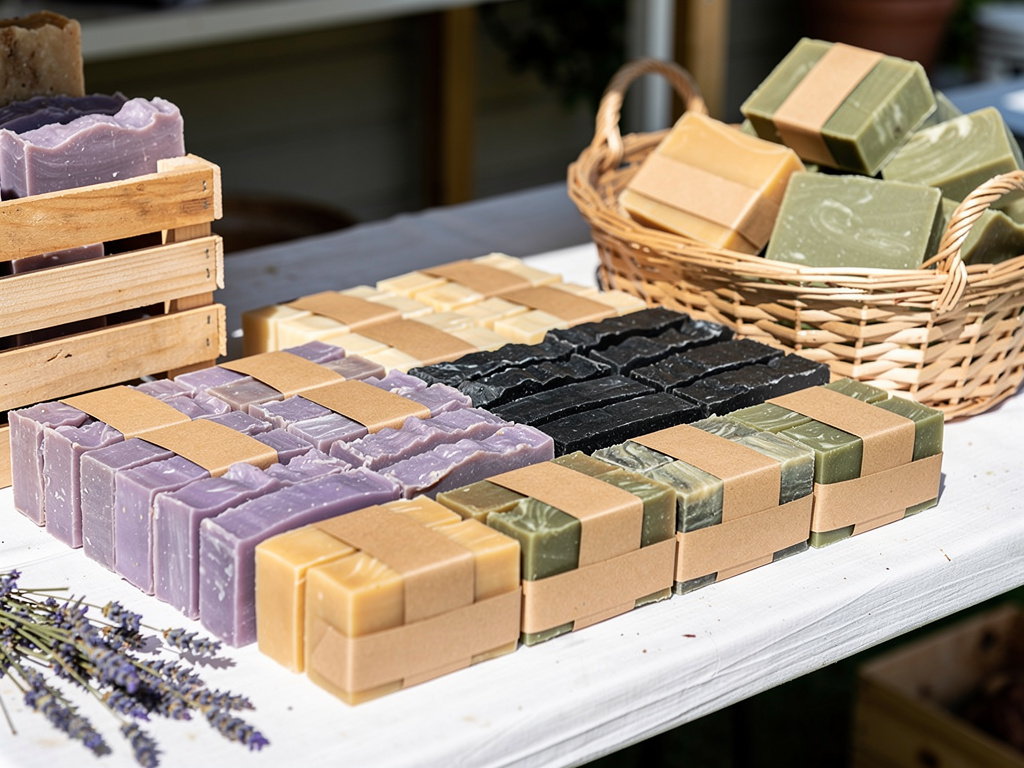


The short version: Handmade soap sells in seven places: a farmers market booth, craft fairs and holiday markets, your own storefront link with pickup or local delivery, online marketplaces like Etsy and Amazon Handmade, boutiques and gift shops, consignment shops, and salons, spas, inns and rental hosts that buy guest bars by the case. The first four sell to the person who will use the bar at your full retail price, and the last three sell through a business that pays you less per bar, often about half. On Homegrown, the 40 single soap bars listed on September 25, 2026 had a middle price of $7, and that bar reaches you as $7.00 in cash at a booth, $6.70 inside a three-bar order on a Homegrown storefront, $5.95 on Amazon Handmade and $3.50 from a gift shop paying wholesale. Soap is not food, so cottage food rules do not decide where it can go, but the words on your label, sign and listing still can.
Checked September 25, 2026: Homegrown is $10 a month billed annually or $12.50 billed monthly, with 0% commission and card processing of 2.9% + $0.30 paid by the vendor (findhomegrown.com/signup). The Etsy, Amazon Handmade, Shopify, Square and Faire fees come from their own pages, the soap rules from the FDA's soap FAQ, and the prices from a live pull of the Homegrown catalog, all loaded that day. Verify your state's current rules before you sell. The limits: your customer creates a Homegrown account to place a first order, Homegrown does not ship and has no timed release feature, and most orders will come from people you send to your own link.
You have three racks of cured bars in the spare room, a Saturday market that sells about half of them, and a friend who keeps asking whether the gift shop downtown would carry your lavender oatmeal. Every bar on that rack is a sale waiting for the right place.
Soap is an easy product to place. It keeps for months, it ships without melting, and people buy it for themselves and as gifts. The hard part is picking places that pay you enough per bar and fit the hours you have. If you want the rules first (what makes a bar true soap, and which label words turn it into a cosmetic or a drug), read whether you can sell homemade soap. If you want the number on the tag, the goat milk soap pricing guide walks through cost per bar. This guide is about where: seven places soap vendors actually sell, what a real $7 bar pays you in each one, and how to get started in each this month.
You can sell handmade soap in seven places, and a common setup for a part-time soap vendor is two or three of them at once: one in person, one online, and one shop or business account. Four of the seven sell straight to the person who will wash with the bar. Three sell to a business that puts it on its own shelf or in its own guest rooms.
Two ideas are left off on purpose. Grocery store shelves are rarely the right start for a one-person soap business, because a store buys at wholesale, reorders by the case and expects the same bar every week, which is a production job rather than a side business. And your own retail shop is a later step: Soap Queen's guide to selling notes that soap businesses that open their own shop often start by building customers at fairs and online.
Pick the place that matches your batch size, your free days and the price you can live with, then add one place at a time. A vendor who makes 40 bars a month on weekends starts somewhere very different from a vendor with a curing rack of 300 and a Tuesday free. The table below is the short way to choose.
Scroll sideways to see every column.
| Your situation | Start here | Add next | Why |
|---|---|---|---|
| You make 40 to 80 bars a month and have Saturdays free | A farmers market booth | Your own storefront link for reorders | The booth finds your regulars, and the link keeps them buying in the weeks between |
| You work weekdays and can only sell a few weekends a year | Holiday markets and craft fairs | A storefront link on a card in every bag | Gift shoppers buy sets in November, and the ones who liked the bar need a way to reorder in March |
| You like making and hate selling | One boutique or gift shop | A second shop in the next town | A shop pays you half your retail price for a case once and sells the bars for you at full price |
| You have no market nearby and ship well | Etsy or Amazon Handmade | Your own link for repeat buyers | Marketplaces bring strangers; repeat buyers are cheaper to serve on your own link |
| You make large batches of one or two plain scents | Salons, spas, inns and rental hosts | A standing monthly order | One account can take a full case every month with no booth and only a simple paper band on each bar |
These rows are planning guides built from the fee pages and catalog data in this article, all checked September 25, 2026. Your own costs, local markets and shops decide the final mix.
You may never need the last three rows. A booth plus your own link keeps every bar at the full $7 retail price, and that pair keeps a weekend soap vendor busy all year.
Soap has more places to sell than a jar of jam because it is not a food, so the cottage food laws that keep most home bakers selling inside their own state do not decide where it can go. The FDA's soap FAQ, loaded September 25, 2026, says a bar that meets its definition of true soap is regulated by the Consumer Product Safety Commission, not the FDA. That opens doors a home baker cannot walk through:
The catch is the words. The same FDA page says a bar sold to moisturize, deodorize or make you smell nice is a cosmetic, with the FDA's labeling rules, and a bar sold to kill germs or treat acne or eczema is a drug. Those claims follow you into every place on this list, from the chalkboard at your booth to the description on a shop's website. The section on label words further down shows which words close which doors, and a few states add their own permit rules, so read your own state's agency page before your first sale.
A farmers market is a strong first place for a new soap vendor, because a $7 bar sold for cash reaches you as the full $7.00 and every visitor can pick up a bar and smell it. People who came for tomatoes buy soap on impulse, and the ones who like it come back to the same table the next week. That weekly return is what turns a hobby batch into a small business.
The USDA's farmers market directory lets you search every listed market in your state, or within 10, 30, 100 or 250 miles of your ZIP code, which is the fastest way to build a short list. Then call or email each market manager with these questions before you apply:
Once you are in, set the table so people can touch and smell. A tester bar for each scent on a small dish, bars stacked by color, and a clear price card do more than a long sign. Our guide to selling soap and bath products at the farmers market covers curing times, display and what to bring to a first market.
Take cards as well as cash. At Square's in-person rate of 2.6% + 15 cents, checked September 25, 2026, a single $7 bar costs you 33 cents to take by card, so $6.67 reaches you. That is a small price for the buyer who only carries a phone.
Craft fairs and holiday markets are worth it for soap when you arrive with gift sets and enough stock, because November and December shoppers are buying gifts, and a boxed set of three bars at $21 is an easy one. A good holiday fair can be the biggest selling day of your year, and the table fee is paid once instead of every week.
Soap takes planning for these dates. Our farmers market soap guide puts cold process curing at 4 to 6 weeks, so bars for a December fair need to be made by October at the latest. What sells at a fair is different from what sells at a market:
Juried fairs choose their vendors from photos and an application, and they judge the whole presentation: the bar, the wrap, the label and the table. A clean, honest label with no health claims is part of what gets you in. If you are weighing a fair against a weekly market, craft fairs versus farmers markets compares the fees and crowds, and the same trade-offs apply to soap.
You sell soap from your own storefront link by listing every scent once with a price and a count, sharing the link with the people who have already bought from you, and letting them order and pay before they pick up. A bar lasts a regular customer a few weeks, so the same people come back for more, and a link saves them from waiting for your next market day.
That is the job a Homegrown storefront does for a soap vendor whose regulars keep texting "do you have any of the lavender left?" It is $10 per month billed annually with no percentage fees beyond standard payment processing, which is 2.9% + $0.30 per order, so three $7 bars in one $21 order cost you $0.91. Customers pick up at your porch, your booth or a farm stand on the days you choose, or you turn on local delivery from 1 to 25 miles with your own fee and minimum, and you keep the whole delivery fee minus card processing. Inventory counts down as bars sell, sales tax is calculated and filed for you, and the built-in QR code generator can point at one scent's page instead of your whole store.
Here is how it compares with what soap vendors usually try first:
What Homegrown does not do: your customer creates a Homegrown account to place a first order, and there is no timed release feature. Homegrown does not ship, so it is a pickup and local delivery tool, not a way to reach buyers three states away. Your storefront is listed on the Homegrown marketplace, but plan on most orders coming from people you send to your own link. And it does not check your labels or make health claims legal.
In a pull of the Homegrown catalog on September 25, 2026, 48 of 2,699 products were soaps (counting listings that say soap in the name, the description or the photo, but not a soap deck or a soap saver), listed by 7 of 304 vendors. The 40 single body bars among them ran $2.00 to $12.00, with a middle price of $7.00, and 36 of the 40 were priced at $7 or more. One of the seven is a homestead farm that lists two goat milk soap bars at $8 each beside five bakery listings, sourdough loaves among them, so its regulars can add a bar of soap to a bread order.
Where to send people to your link, closest circle first:
If your regulars keep asking when the next market is so they can restock, set up a Homegrown storefront and list the scents already on your curing rack. They reserve bars from the batch you have, pick up on your schedule, and the market table keeps the walk-up crowd.
Sell soap on Etsy or Amazon Handmade when you want buyers beyond your town and you are ready to pack and ship, because neither one charges a monthly fee once you are set up (Amazon Handmade charges its $39.99 plan for the first month only), but both take more per order than your own link. For a three-bar order at $21, Etsy's fees come to $2.45 and Amazon Handmade's referral fee comes to $3.15, against $0.91 in card processing on a Homegrown storefront. That gap is the price of being found by strangers.
Here is how the two compare, from their own pages on September 25, 2026:
Shipping is where both marketplaces get expensive for soap. A 4 ounce bar is light, but the box, padding and label cost money on every order, and both Etsy's 6.5% and Amazon Handmade's 15% apply to the shipping you charge as well. Selling sets of three instead of single bars keeps the shipping cost per bar down. Our breakdown of Etsy fees for small vendors shows how the fees stack as orders grow.
Amazon Handmade's first month is not free: you pay the $39.99 Professional plan once before the waiver starts, and you must be approved as a handmade business first. And on Etsy, a listing that says "great for eczema" or "kills bacteria" is a drug claim under the FDA's soap rules no matter what the wrapper says. We checked both fee pages and the FDA soap FAQ on September 25, 2026.
You get soap into a boutique or gift shop by walking in with three sample bars, a one-page wholesale price sheet and a case minimum, and asking for the person who buys new products. Shops pay wholesale, which Soap Queen's guide to where to sell products online, at markets and in retail shops puts at typically 50% of retail, so your $7 bar sells to the shop for $3.50 and on its shelf for $7. The upside is that the shop pays for the whole case and sells it for you. Bath bombs sell to the same shops at the same half-of-retail price, $3.50 on a $7 bomb, but on a six-month clock, so where to sell bath bombs adds dating every case and rotating stock before the fizz fades.
Before you pitch, make sure half of your retail price still covers your full cost. The soap cost-per-bar guide walks through ingredients, packaging and your time, and a bar that costs you $4 all in cannot go to a shop at $3.50.
A 12-bar mixed case at $3.50 a bar is $42.00 per order. Two shops that each reorder once a month move 24 bars and pay you $84 without a single Saturday at a booth, which is why one or two shop accounts sit well beside a market table instead of replacing it.
Some shops will ask whether you are on Faire, a wholesale marketplace where retailers order from brands. Faire's help page for North American brands, loaded September 25, 2026, says joining is free, orders from retailers who find you on Faire carry a 15% commission plus a one-time $10 fee on each new retailer's first order, and orders from shops you bring through your own Faire Direct link carry 0% commission. Card processing runs 3.5% + $0.30 for next-day payout, 2.4% + $0.30 for 30 days and 1.9% + $0.30 for 60 days. So if a shop you found yourself wants to order through Faire, send it your Faire Direct link. The Faire alternative guide for soap and candle vendors goes deeper on when the marketplace is worth its commission.
Selling soap on consignment pays off when a shop gives you shelf space you could not get any other way, but you only get paid after each bar sells and the shop usually keeps 30 to 50 percent, according to The Craft Map's guide to selling handmade products locally. On a $7 bar, that leaves you $3.50 to $4.90, which can beat a straight wholesale sale at $3.50. The cost is that the unsold bars are still yours.
Consignment suits a new soap vendor who cannot yet get a boutique to buy a case, and a shop that wants to test your soap before it commits. Get these answers in writing before you leave a single bar:
Keep your own count of every bar you leave and every bar the shop reports sold. A simple sheet with scent, date and quantity is enough. Soap keeps for months, so a slow shelf costs you shelf time, not spoiled stock, but a shop that sells 3 bars a month is tying up bars that could sell at your booth for $7.
Yes, salons, spas, bed and breakfasts and short-term rental hosts buy soap in bulk for their guests, and one account can take a full case every month without a booth or a Saturday of your time, and with only a simple paper band on each bar. Soap Startup, a soapmaking blog, tells how its founders listed their bars as wholesale salon and spa soap and sold more to spas in 1 week than in 2 months on Etsy, delivering by hand on a 15 minute drive.
What these buyers want is different from what a gift shopper wants:
Price these accounts by the case, not the bar, and work out the case price from your cost per bar before you quote. A rental host with four units that turn over twice a week goes through soap every week, which makes a standing monthly order an easy yes. Put your storefront link or a card in each room if the host allows it, because a guest who loved the bar is a customer you would never have met at a market.
When a customer buys three $7 bars for $21, the way you take the money costs you anywhere from $0 in cash to $3.15 on Amazon Handmade. The table shows every part of the fee stack for each option, so you can compare them on the same order.
Swipe left to see all eight columns of the fee stack.
| Way to get paid | Subscription | Trial | Platform fee | Card processing | Customer pays on a $21 order | You pay on a $21 order | A month of 50 orders (you) |
|---|---|---|---|---|---|---|---|
| Homegrown storefront | $10/mo billed annually, or $12.50/mo billed monthly | 7 days, no charge until day 8 | $0, 0% commission, no shopper fee | 2.9% + $0.30 | $21.00 | $0.91 | $55.50 billed annually, $58.00 billed monthly |
| Etsy | $0 (a one-time shop set-up fee may apply) | None needed | $0.20 listing fee, plus 6.5% transaction fee on the sale price and shipping; 15% on Offsite Ads sales | 3% + $0.25 | $21.00 plus shipping | $2.45 before shipping and ads | $122.50 |
| Amazon Handmade | $39.99 for the first month, then waived for approved Handmade businesses | None; approval required | 15% referral fee per bar, or $0.30 if greater | No separate fee listed | $21.00 plus shipping | $3.15 before shipping | $157.50 after the first month ($197.49 in the first month) |
| Shopify Basic | $29/mo paid yearly, or $39/mo paid monthly | 3 days, then $1/mo for the first 3 months | $0 with Shopify Payments (2% with another processor) | 2.9% + $0.30 online on standard cards, 3.5% + $0.30 on premium cards | $21.00 | $0.91 ($1.04 on a premium card) | $74.50 paid yearly, $84.50 paid monthly |
| Square Free, online link | $0 | None needed | $0 | 3.3% + $0.30 online | $21.00 | $0.99 | $49.50 |
| Square Free, card at the booth | $0 | None needed | $0 | 2.6% + $0.15 in person | $21.00 | $0.70 | $35.00 |
| Cash at the booth | $0 | None needed | $0 | $0 | $21.00 | $0 | $0 |
We checked every fee on each company's own page on September 25, 2026: findhomegrown.com/signup, etsy.com/sell, sell.amazon.com/programs/handmade and sell.amazon.com/pricing, shopify.com/pricing and squareup.com/us/en/pricing. Each fee is figured on the $21 order and rounded to the cent; the monthly column multiplies the per-order fee by 50 and adds one month of the plan. The Etsy row assumes one listing for a three-bar set, no shipping charge and no Offsite Ads sale. Amazon's referral fee is charged on each bar, 15% of $7 or $1.05, so $3.15 for three, and like Etsy's fee, Amazon's referral applies to any shipping you charge, because Amazon's pricing page counts shipping in an item's total price. Shipping, packing materials and sales tax are left out.
The table hides the cost that matters most for marketplaces: the box. An order that ships needs a mailer, padding, a label and a trip to the post office, and none of that is in these numbers. A pickup order on your own link, or a sale at your booth, skips all of it. That is a good reason to keep marketplaces for strangers and move repeat buyers to a pickup link.
A $7 bar reaches you as $7.00 at your booth in cash and about $3.50 through a gift shop, and every other place on this list lands in between. This is the table to check before you say yes to a new place.
Drag the table sideways for the rest of each row.
| Place | What the buyer pays | What comes off | What reaches you from one bar | What it takes to get in |
|---|---|---|---|---|
| Farmers market, cash | $7.00 | Nothing at the sale | $7.00, less your booth fee | An application and a weekly or season fee |
| Farmers market, card on Square Free | $7.00 | 2.6% + 15 cents = $0.33 | $6.67, less your booth fee | A card reader or tap to pay on your phone |
| Craft fair or holiday market | $7.00 | Cash or card, as above | $6.67 to $7.00, less the table fee | An application, sometimes juried |
| Homegrown storefront, one bar of a $21 order | $7.00 | A third of $0.91 = $0.30 | $6.70, plus the $10 a month plan billed annually ($12.50 billed monthly) | Photos, prices and a pickup day |
| Etsy, one bar of a $21 set | $7.00 plus shipping | A third of $2.45 = $0.82 | $6.18, before shipping and packing | A shop and listings, shipping set up |
| Amazon Handmade | $7.00 plus shipping | 15% = $1.05 | $5.95, before shipping and packing | An application and approval, $39.99 first month |
| Consignment shop | $7.00 | The shop keeps 30 to 50 percent | $3.50 to $4.90, after it sells | A written consignment agreement |
| Gift shop, direct wholesale | $3.50 to the shop, $7.00 on its shelf | Nothing if paid by check | $3.50 | Samples, a price sheet, a case minimum |
| Gift shop through Faire Direct, 12-bar case | $42.00 for the case | 3.5% + $0.30 = $1.77 | About $3.35 | A Faire account and your Faire Direct link |
| Gift shop through the Faire marketplace, first order | $42.00 for the case | 15% ($6.30), $10 new customer fee, $1.77 processing | About $1.99 | A Faire account |
Fees from each company's own page, checked September 25, 2026: Square, Homegrown, Etsy, Amazon Handmade and Faire's help page for North American brands. Wholesale at half of retail follows Soap Queen's guide; the consignment range follows The Craft Map's guide. Faire rows use next-day payout; a Faire marketplace reorder skips the $10 fee and pays about $2.83 a bar. Booth and table fees, shipping and sales tax are left out.
Read the table from the top when you have more time than stock, and from the bottom when you have more stock than time. The booth rows pay the most per bar but cost you a day each week. The shop rows pay half but sell while you are making the next batch.
Single soap bars on Homegrown were listed at $2.00 to $12.00 on September 25, 2026, and 28 of the 40 bars were priced between $7.00 and $7.99, for a middle price of $7.00. That $7 middle price is why this guide runs its numbers on a $7 bar.
Single soap bars on Homegrown, by listed price
Source: Homegrown catalog pull, September 25, 2026. 40 single body bars from 6 vendors, counted when the listing name, description or photo says soap; sets, liquid and whipped soap, hair and dish bars, a custom breast milk soap loaf, a soap deck and a soap saver were left out.
Three things stand out in those listings:
If your price is well under $6, check it against your cost before you add a place that pays half. A $5 bar sold wholesale pays you $2.50.
A bar made from fats or oils and lye, with nothing else doing the cleaning, and sold only to clean is true soap, the simplest category to sell anywhere; the words "moisturizing", "deodorizing" or a fragrance claim make it a cosmetic with the FDA's labeling rules; and "antibacterial", "for acne" or "for eczema" make it a drug. The FDA's soap FAQ, loaded September 25, 2026, draws those three lines, and each one changes where your bars can go:
The words count wherever they appear: the wrapper, the sign at your booth, your Etsy description and a gift shop's shelf card. A shop that writes "great for eczema" on its own card is making a drug claim about your bar, and the FDA's soap FAQ ties a soap's category to how it is labeled and marketed. Give every shop a short description in your own words to use. The full rules, including the state permits in a few states, are in whether you can sell homemade soap, and your state's own agency page has the last word on permits.
Add one new place a month, starting with the one that pays the most per bar for the time you have, and give it four weeks before you judge it. A common setup for a part-time soap vendor is a booth or fair for new customers, a storefront link for reorders, and one or two shop accounts for the bars the booth does not sell.
Holiday timing changes the order. If it is September or October, start your holiday batches now for 4 to 6 weeks of curing, and apply to fairs before their deadlines fill. If it is January, shops are planning spring shelves and markets are taking applications for the season.
To sell out, plan your batches around what already sold, not around the scents you want to make, and give every buyer a way to buy again. Five habits help you avoid being the vendor who hauls the same bars home every week:
The last habit protects the others. When your price is the same everywhere you sell at retail, a customer can buy at the booth, reorder on your link and pick up a gift set at a fair without ever feeling they paid too much.
The best places to sell homemade soap locally are farmers markets, craft fairs and holiday markets, boutiques and gift shops, consignment shops, and salons, spas, inns and rental hosts that buy guest bars. Start with one booth for new customers and add a pickup link so regulars can reorder between market days. When people ask where to sell soap near home, those five local places plus your own link cover most of the answer.
You do not need a cottage food permit to sell soap, because soap is not food, and true soap is regulated by the Consumer Product Safety Commission according to the FDA's soap FAQ. The market itself may ask for a certificate of liability insurance, a sales tax permit or a look at your labels, and some states and cities require a business license. Verify your state's current rules and ask the market manager what the application needs.
Etsy is easier to start, with nothing to pay each month and $2.45 in fees when three $7 bars sell together, checked September 25, 2026. Amazon Handmade needs an application, charges the $39.99 Professional plan for the first month before waiving it, and takes a 15% referral fee, or $3.15 on the same order. Both are built around shipping, so they suit vendors who want buyers outside their town.
Boutiques and gift shops usually pay wholesale, which Soap Queen puts at typically 50% of retail, so a $7 bar sells to the shop for $3.50. A 12-bar case at that price is $42. Consignment works differently: the shop pays you only after a bar sells and usually keeps 30 to 50 percent, which leaves $3.50 to $4.90 on a $7 bar.
Yes. One vendor on Homegrown lists goat milk soap next to sourdough bread. Keep the soap on its own table or at one end if your market asks, and keep the two sets of labels separate, since food and soap follow different rules. On a single storefront, a customer can add a bar of soap to a bread order in one checkout.
Most single soap bars on Homegrown were priced at $6 to $8 on September 25, 2026, with a middle price of $7 across 40 bars. One of the 40 is a $5 black soap its vendor resells rather than makes; leave it out and the middle price is still $7, with 36 of the other 39 priced at $6 to $8. Price from your full cost per bar, then check that half of your retail price still covers that cost before you sell wholesale. Where to sell soap and what to charge go together, since a shop pays about half of the price on the tag.
This page maps the seven places to sell soap, and these six guides go deep on the parts of a soap business it only touches, from the rules on your label to the price on your tag:
The simplest soap business is a booth that finds new customers and a link that keeps them. Every other place on this list is worth adding once those two are working, and each one pays you less per bar than a regular who reorders from you directly.
That is the real answer to where to sell soap: sell it where you can hand the bar to the person who uses it, as often as you can, and let shops, marketplaces and guest accounts take the bars you cannot sell that way. A $7 bar at your booth or on your link pays you about twice what the same bar pays through a gift shop, and a regular who reorders every few weeks keeps paying you long after a single fair is over.
If you are tired of telling regulars to wait until the next market for their favorite bar, start your Homegrown storefront and list the scents on your curing rack tonight. It is $10 a month billed annually with 0% commission and 2.9% + $0.30 card processing that you pay, not your customer. Your regulars reserve bars and pick them up on your schedule, and your booth stays free for the walk-up crowd.



