
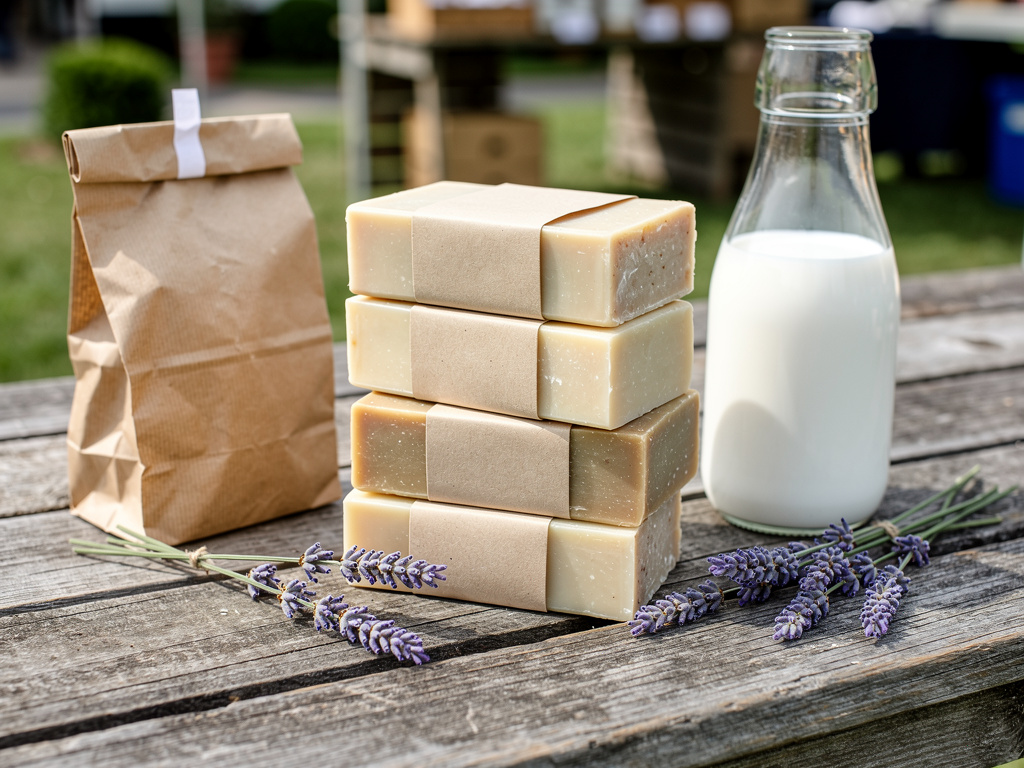


The short version: Sell a 4.5 ounce bar of cold process goat milk soap for $8 to $10, a 4 ounce bar for $7 to $9, a small guest bar for $3.50 to $4.50, and a three-bar set of 4.5 ounce bars for $24 to $25. Eight small goat farms we checked charge a median of $7.51 for a 4 to 5 ounce bar, with prices from $7.00 to $10.50. The oils, lye, fragrance and box in one bar cost about $1.74 at supplier prices when the milk comes from your own goats, and about $4.74 once you pay yourself $20 an hour and cover your booth, so $9 to $10 is about double your full cost. On a Homegrown storefront the only per-order cost on an $8 bar is 53 cents of card processing, on a plan of $10 a month billed annually.
Checked on October 12, 2026: supplier prices on Wholesale Supplies Plus and Nurture Soap, eight goat farms' own product pages, four soap brands, the Homegrown catalog, and the pricing pages of Homegrown, Etsy, Shopify, Square and Faire. Homegrown customers create an account to place their first order, and Homegrown has no drop or countdown release feature.
Goat milk soap is easy to underprice. The milk comes out of your own barn, the oils cost a few dollars a pound, and a $6 bar can look like plenty. It is easy to price off the oils alone and wonder a year later why the soap money never adds up.
This guide works from real numbers checked on one day. It uses live supplier prices for a real goat milk recipe, the prices eight small goat farms charge right now, what goat milk soap brands charge per ounce, what goat milk soap sells for on Homegrown, and what each way of selling takes off the top. By the end you will have a price for every bar size you cut and a way to check it.
Price a cold process goat milk soap bar at $8 to $10 when it cures to 4.5 ounces. That is about double the $4.74 it really costs you once your time and booth fee are counted, and it sits just above the $7.51 median that eight small goat farms charged on October 12, 2026. Every full-size cold process bar follows the same idea: $1.75 to $2.25 per ounce of cured soap, with most sizes near $2. Small guest bars are the exception: they sit at the top of that band or just above it, at $2.25 to $2.33 an ounce in the table below.
If you are still working out whether you can sell soap at all, how to make it, and what licensing covers goat milk, the companion guide on how to sell goat milk products locally covers the rules, the recipe and the product line. This page is mostly about the number on the tag, plus the cost and process behind it.
Swipe the table left to see every bar size.
| Bar or set | Cured weight | Suggested price | Price per ounce | Multiple of your $1.74 materials |
|---|---|---|---|---|
| Guest bar | 1.5 to 2 oz | $3.50 for 1.5 oz to $4.50 for 2 oz | $2.33 (1.5 oz) and $2.25 (2 oz) | about 4.3x to 4.7x on $0.81 to $0.96 of materials, since it still takes a full box |
| Standard bar | 4 oz | $7 to $9 | $1.75 to $2.25 | 4.0x to 5.2x |
| Large bar | 4.5 oz | $8 to $10 | $1.78 to $2.22 | 4.6x to 5.8x |
| Three-bar set | 13.5 oz (three 4.5 oz bars) | $24 to $25 | $1.78 to $1.85 | 4.6x to 4.8x on three bars |
| Melt and pour goat milk bar | 4 oz | $6 to $8 | $1.50 to $2.00 | depends on the base, see below |
Materials of $1.74 come from the cost table further down: a 32 ounce oil recipe priced on Wholesale Supplies Plus and lye priced on Nurture Soap on October 12, 2026, with milk from your own goats and a kraft window soap box. The multiples are figured against a large bar's materials, so a 4 ounce bar that uses a little less oil sits slightly higher. The price per ounce uses the cured weight, not the wet weight you poured.
Where you land inside each range depends on what a customer can see, smell and hold:
Eight small goat farms selling 4 to 5 ounce goat milk soap bars on their own websites charged between $7.00 and $10.50 on October 12, 2026. The median was $7.51, counting Little Goaty Goat Farm at its pre-tax soap price of about $8.02. Half of them sat at exactly $7.00. That looks more like a price farms match from each other's tables than one worked out from costs, though none of the pages says how the price was set.
Slide the table sideways for all eight farms.
| Farm | Bar | Stated size | Price | Price per ounce |
|---|---|---|---|---|
| Rustic Edge Soaps | Vanilla bean | about 4.5 oz | $7.00 | $1.56 |
| Jollity Farm Goat Dairy | Lemongrass | 4 oz net | $7.00 | $1.75 |
| When Goats Fly | Oatmeal and honey | 4 oz | $7.00 | $1.75 |
| Bloom 'n Goat | Lavender | about 4 oz | $7.00 | $1.75 |
| One Blessed Acre Farm | Victorian rose, in a muslin bag | 4.5 oz | $8.50 | $1.89 |
| Little Goaty Goat Farm | Any scent | about 4.5 oz | $8.50 with sales tax | $1.78 before tax |
| Free Spirit Farm | Lavender | 4.75 to 5 oz | $10.00 | $2.00 to $2.11 |
| Goat-N-Soap | Honey and oat | 4 oz | $10.50 | $2.63 |
Every price was read off the farm's own product page on October 12, 2026. Seven of the eight pages showed the bar in stock or with a stock count that day; Little Goaty Goat Farm's soap page lists its bars by scent with no stock count, and marks a few scents as limited availability. Little Goaty Goat Farm's page says its prices include Idaho's 6% sales tax, so the soap itself is about $8.02. Goat-N-Soap's $10.50 was a marked-down price from $13.00 that day. Jollity Farm also sells 3 bars for $20.00 and 6 bars for $36.00. Price per ounce uses the size each farm states.
What eight goat farms charge for one bar
Source: each farm's product page, October 12, 2026, eight 4 to 5 ounce bars. Little Goaty Goat Farm's $8.50 includes sales tax. Bar widths are each price divided by $10.50.
Two farms show how the same $7 can be packaged differently. Jollity Farm's lemongrass goat milk soap is $7.00 for a 4 ounce bar, and the same page offers 3 bars for $20.00 and 6 for $36.00, so a regular who buys six pays $6.00 a bar. Bloom 'n Goat's lavender bar is also $7.00 for about 4 ounces, sold on its own page by a small Tennessee farm that makes it with milk from its own goats.
What the spread tells you as a vendor:
Goat milk soap brands charged between $1.28 and $2.50 per ounce on October 12, 2026. That overlaps the $1.56 to $2.63 an ounce the small farms charged, which means a farm bar at $2 an ounce is not overpriced next to the brands checked here.
Drag the table left to see each brand's price.
| Brand and bar | Size | Price | Price per ounce |
|---|---|---|---|
| Bend Soap Co., unscented goat milk | 4 to 4.5 oz | $5.75 | $1.28 to $1.44 |
| Bend Soap Co., travel size | 1.5 oz | $2.25 | $1.50 |
| Beekman 1802, goat milk bar soap | 9 oz | $16.00 regular price | $1.78 |
| Little Seed Farm, milk bar | 4.75 oz | $9.99 | $2.10 |
| Adirondack Fragrance Farm, goats milk, 16 oz boxed | 16 oz | $37.00 | $2.31 |
| Adirondack Fragrance Farm, goats milk, unwrapped | 4 oz | $10.00 | $2.50 |
Prices and sizes read off each brand's own product pages on October 12, 2026. Beekman 1802's product page was showing a 25% off Friends and Family sale that day, $12.00 for the same bar; the table uses the regular price shown beside it. Adirondack Fragrance Farm charges $11.00 for the same 4 ounce bar wrapped.
Here is how to read those numbers as a small vendor:
One boxed bar of scratch-made goat milk soap costs $1.74 in materials when you buy oils in 5 to 8 pound sizes, about $2.37 at starter sizes with 1 pound oils, and $1.39 at 27 to 28 pound bulk sizes. Those numbers assume you milk your own herd. The recipe is a 32 ounce oil batch that makes about 10 bars.
The recipe behind the table, so you can swap in your own:
Swipe the table to see all three buying levels.
| What goes in one bar | Starter sizes (1 lb oils, fragrance at the 1 oz bottle rate, 50 boxes) | Small batch (5 to 8 lb oils, 16 oz fragrance, 100 boxes) | Bulk (27 to 28 lb oils, 112 oz fragrance, 1,200 boxes, 10 lb lye) |
|---|---|---|---|
| Olive oil, 1.2 oz | $0.54 | $0.36 | $0.34 |
| Coconut oil, 0.9 oz | $0.32 | $0.22 | $0.20 |
| Palm oil, 0.8 oz | $0.31 | $0.25 | $0.19 |
| Shea butter, 0.2 oz | $0.10 | $0.09 | $0.09 |
| Castor oil, 0.1 oz | $0.03 | $0.02 | $0.02 |
| Lye, 0.455 oz | $0.21 | $0.21 | $0.19 |
| Fragrance oil, 0.15 oz | $0.49 | $0.25 | $0.23 |
| Goat milk from your herd | $0.00 cash | $0.00 cash | $0.00 cash |
| Kraft window soap box | $0.36 | $0.34 | $0.13 |
| Materials per bar | $2.37 | $1.74 | $1.39 |
Supply prices from Wholesale Supplies Plus on October 12, 2026, all at their regular prices with no sale running: pomace olive oil at $7.16 for 1 pound, $33.68 for 7 pounds and $125.34 for 28 pounds; 76 degree coconut oil at $5.76, $30.71 for 8 pounds and $100.18 for 28 pounds; palm oil at $6.28, $40.12 for 8 pounds and $108.72 for 28 pounds; ultra refined shea butter at $8.30, $36.12 for 5 pounds and $198.25 for 27 pounds; castor oil at $4.39, $20.97 for 7 pounds and $78.27 for 28 pounds; Oatmeal Milk and Honey fragrance oil at $3.25 an ounce, $26.35 for 16 ounces and $169.00 for 112 ounces; rectangle window kraft soap boxes at $17.95 for 50, $33.95 for 100 and $161.45 for 1,200. Lye is Nurture Soap's sodium hydroxide at $14.99 for 2 pounds in the first two columns and $67.45 for 10 pounds in the bulk column. Fragrance is priced by the fluid ounce as sold. Each line is rounded to the cent, so a column can sit a penny off its total.
On October 12, 2026, Wholesale Supplies Plus showed its pomace olive oil out of stock in the 1, 7 and 28 pound sizes, and its castor oil out of stock in every size, so the table uses their listed prices. If pomace is still out when you order, the in-stock extra virgin olive oil was $70.39 for 7 pounds that day, which adds about 39 cents a bar. Castor is 2 cents a bar, so any castor you can get barely moves the total. Oils and lye go in and out of stock at soap suppliers, so keep one spare jug and one spare bag of lye on the shelf before a holiday batch.
Three things jump out of that table:
Yes, your own goat milk is the cheapest way to make goat milk soap, since you already feed the herd whether or not you make soap. Buying goat milk powder adds about 40 cents a bar, and switching to a melt and pour goat milk base costs $1.84 a bar in base alone at the 2 pound size.
Here is what each way of getting milk into the bar costs per bar on October 12, 2026:
That last line surprises people. A melt and pour bar from the 2 pound tray costs about $2.34 once you add about 0.1 ounce of fragrance (16 cents) and a 34 cent box, which is more than the $1.74 scratch bar. Melt and pour saves you the lye and the weeks of curing, not money. Price a 4 ounce melt and pour bar at $6 to $8, about a dollar under your 4 ounce cold process bars, and say on the label which kind it is.
Weigh your bars after the cure, not the day you cut them. A bar that goes into the rack at about 4.85 ounces in this recipe comes out closer to 4.5 ounces by our estimate, weeks later, as the water leaves. Silly Goat Farm's product page, checked October 12, 2026, says its bars cure for 6 weeks before they sell. If you print a weight or price by the ounce, use the cured number so the bar in the customer's hand matches the label.
You make cold process goat milk soap by freezing the milk, stirring lye into the frozen milk slowly, blending that into your melted oils, pouring it into a mold, and letting the bars cure for several weeks before you sell them. The whole hands-on part takes about an hour for the 10-bar recipe above, by our estimate. The waiting is what sets your price calendar: soap you pour this week is soap you sell next month.
These are the steps, in the order you do them, with the recipe above:
What each step means for your price:
Charge yourself at least $20 an hour, which adds about $2.00 to every bar in a 10-bar batch. Add $1.00 a bar toward your booth fee and a $1.74 bar becomes a $4.74 bar. That $4.74 is the number your price has to cover, not the $1.74.
How the full cost of one bar adds up, using small-batch supplier prices:
A bigger batch is the fastest way to bring that number down. Doubling the recipe to 64 ounces of oil takes a little more stirring but not double the hours, so by our estimate your labor per bar can fall toward $1.00 to $1.25 once you are comfortable. The materials stay about the same per bar.
For the general version of this math that works for any soap, not just goat milk, the guide to cost-per-bar soap pricing math walks through ingredient cost per ounce of oil.
Price a goat milk soap bar by working out your full cost, doubling it, and checking the result against what other farms charge per ounce. At the $4.74 full cost in this guide, that lands at $9 to $10 for a 4.5 ounce bar.
Price by the bar at your table and think by the ounce when you set it. Customers at a farmers market compare bars, not ounces, but $1.75 to $2.25 per cured ounce is the check that keeps a small bar from being a bad deal for you and a big bar from being a steal for them.
Slide the grid sideways to see all three prices per ounce.
| Cured weight | At $1.75 per ounce | At $2.00 per ounce | At $2.25 per ounce |
|---|---|---|---|
| 2 oz guest bar (price it in the $2.25 column) | $3.50 | $4.00 | $4.50 |
| 3.5 oz bar | $6.13 | $7.00 | $7.88 |
| 4 oz bar | $7.00 | $8.00 | $9.00 |
| 4.5 oz bar | $7.88 | $9.00 | $10.13 |
| 5 oz bar | $8.75 | $10.00 | $11.25 |
Straight multiplication, rounded to the cent. The $1.75 to $2.25 band is the middle of what the eight farms and four brands charged on October 12, 2026, most of which sit between $1.56 and $2.31 an ounce.
A few rules of thumb from that grid:
On Homegrown, goat milk soap was listed at $5.00 to $8.00 a bar on October 12, 2026, and other handmade bar soaps were listed at $6.00 to $12.00, most of them at $7.00. Three goat milk soap vendors sell on the marketplace, and between them they show the whole low-to-middle band of goat milk soap prices.
In a pull of the Homegrown catalog on October 12, 2026, 21 of the 2,847 products listed by 313 vendors were goat milk soap, from 3 vendors. We counted a listing when its name, its description or the ingredient label in its photos named goat milk, then read every other listing from those vendors. Sudsy Daisy lists 15 bars, 12 at $5.00 and 3 at $6.00, one of them a shampoo bar, and the ingredient label in each listing's photos names goat milk. Aya's Garden Potions lists four goat milk bars at $5.00, $6.00, $7.00 and $8.00, including a 3.5 to 4 ounce lavender and tea tree bar at $6.00. Mothers Love Homestead & Regenerative Farmstead lists two bars made with fresh goat milk, Sweet Tobacco and Activated Charcoal, at $8.00 each. Another 25 handmade bar soaps from three other soap vendors, Elodie Handmade Soap, TheMintyBoutique and Food Soap?, were listed at $6.00 to $12.00, and 17 of them were $7.00. One of Food Soap?'s $8.00 bars, Move Mosquito!, includes goat milk fat in its oil list but is not sold as goat milk soap, so it is counted with the other bars.
Goat milk soap listings on Homegrown by price, October 12, 2026
Source: Homegrown catalog pull, October 12, 2026, 21 goat milk soap listings from 3 vendors. Bar widths are each count divided by 13.
What that spread means for you:
Keep one retail price at your table and on your own online storefront, and sell to shops at about half of it. A $9 bar sells for $9 at the market and $9 online, and a gift shop pays about $4.50 a bar and resells it at $9.
Swipe left to see what reaches you from each channel.
| Where you sell | Price for a 4.5 oz bar | What comes off | What reaches you on one bar |
|---|---|---|---|
| Farmers market, cash | $9.00 | Nothing at the sale | $9.00 |
| Farmers market, card on Square Free | $9.00 | 2.6% + 15 cents = $0.38 | $8.62 |
| Your Homegrown storefront, pickup | $9.00 | 2.9% + 30 cents = $0.56 | $8.44, plus a $10 monthly plan |
| Etsy, one bar | $9.00 plus shipping | $0.20 listing, 6.5% transaction, 3% + 25 cents processing = $1.31 | $7.69 before shipping |
| Gift shop, direct wholesale | $4.50 | Nothing if they pay by check | $4.50 |
| Faire Direct wholesale (orders from shops you send to Faire yourself), next-day payout | $4.50 | 3.5% + 30 cents on the order | about $4.32 on a 12-bar order |
Fees from each company's pricing page on October 12, 2026: Square Free charges 2.6% + 15 cents in person; Homegrown charges no platform fee and 2.9% + $0.30 card processing on a plan of $10 a month billed annually or $12.50 billed monthly; Etsy charges $0.20 to list, a 6.5% transaction fee on the sale price including shipping, and 3% + $0.25 processing; Faire charges 0% commission on Faire Direct orders plus 3.5% + $0.30 processing for next-day payout. The Etsy row leaves out shipping, so the 6.5% on shipping is not shown. Customers on a Homegrown storefront create an account the first time they order.
The two rules that keep this simple:
A 12-bar wholesale order at $4.50 a bar is $54.00, but a first order through the Faire marketplace pays you only $33.71 of it, or $2.81 a bar. Faire charges 15% commission plus a one-time $10 fee on a new retailer's first marketplace order, and card processing on top, according to its fee page on October 12, 2026.
Drag the table sideways to see what each order pays you.
| How the shop orders a 12-bar case at $4.50 | Commission | New customer fee | Processing | You receive | Per bar |
|---|---|---|---|---|---|
| Faire marketplace, first order, next-day payout | $8.10 (15%) | $10.00 | $2.19 (3.5% + $0.30) | $33.71 | $2.81 |
| Faire marketplace, reorder, next-day payout | $8.10 (15%) | $0 | $2.19 | $43.71 | $3.64 |
| Faire Direct, next-day payout | $0 (0%) | $0 | $2.19 | $51.81 | $4.32 |
| Faire Direct, 60-day payout | $0 (0%) | $0 | $1.33 (1.9% + $0.30) | $52.67 | $4.39 |
| Shop pays you by check | $0 | $0 | $0 | $54.00 | $4.50 |
Rates from Faire's help page for North American brands, checked October 12, 2026: 15% commission on marketplace orders, a one-time $10 new customer fee on a retailer's first marketplace order, 0% commission on Faire Direct orders from retailers you bring, and processing of 3.5% + $0.30 for next-day payout, 2.4% + $0.30 for 30-day and 1.9% + $0.30 for 60-day. Joining Faire is free.
A wholesale bar skips your booth, so its full cost in this guide is about $3.74. Faire Direct at $4.32 a bar and a check at $4.50 clear that. A reorder through the marketplace, at $3.64 a bar, falls about 10 cents under it. A first marketplace order, at $2.81 a bar, pays about 93 cents less than the bar costs you to make. Wholesale goat milk soap only works when your full cost is well under half your retail price. Bigger batches that cut your labor per bar, or a $10 retail price with $5.00 wholesale, are the two ways to get there: at $5.00 a bar, a 12-bar marketplace reorder pays $48.60, or $4.05 a bar. Price it out before you say yes to a shop.
If a shop asks to carry your soap, here is the order to work it in:
The guide to the Faire alternative for soap and candle makers covers other ways to reach shops.
On an $8 goat milk soap bar, selling fees take about 53 cents on Homegrown or Shopify, 56 cents on Square's online checkout, and $1.21 on Etsy. On Homegrown, Shopify and Square that is all card processing. Etsy's $1.21 is a 20 cent listing fee, a 52 cent transaction fee of 6.5%, and 49 cents of processing at 3% + 25 cents. The fixed 25 to 30 cents in every online processing fee is why soap, with its small ticket, loses a bigger share to fees than a $20 candle does.
What you pay in fees on one $8 bar
Source: each platform's pricing page, October 12, 2026. Per-order fees only; monthly plans are in the table below. Bar widths are each fee divided by $1.21.
A month of steady online orders is where the plan prices show up. This table uses a $20 order, which is about two bars or a small gift set:
Scroll the fee table sideways to see a full month of orders.
| Platform | Monthly plan | Trial | Platform or transaction fee | Card processing | Customer pays on a $20 order | You pay on a $20 order | You pay in a month of 50 orders at $20 |
|---|---|---|---|---|---|---|---|
| Homegrown | $10 billed annually ($12.50 billed monthly) | 7 days, no charge until day 8 | None, 0% commission | 2.9% + $0.30, paid by you | $20.00 | $0.88 plus the plan | $54.00 ($56.50 on monthly billing) |
| Etsy | $0 | No plan to try | $0.20 listing fee plus 6.5% transaction fee | 3% + $0.25 | $20.00 plus shipping | $2.35 | $117.50 |
| Shopify Basic | $29 billed yearly ($39 billed monthly) | 3 days, then $1 a month for 3 months | None with Shopify Payments (2% with another provider) | 2.9% + 30 cents online on standard cards, 3.5% + 30 cents on premium cards ($1.00 on a $20 order) | $20.00 | $0.88 plus the plan | $73.00 ($83.00 on monthly billing) |
| Square Online, Free plan | $0 | No plan to try | None | 3.3% + 30 cents online | $20.00 | $0.96 | $48.00 |
Checked on each pricing page on October 12, 2026: findhomegrown.com/signup, etsy.com/sell, shopify.com/pricing and squareup.com/us/en/pricing. Card processing is figured on the $20 price. Etsy also charges its 6.5% and 3% on any shipping you charge, and a 15% Offsite Ads fee only on sales that come from those ads, neither of which is counted here. The Etsy row assumes the $20 order is one listing, such as a gift set. Etsy's sell page also says a new shop may be charged a one-time set-up fee, shown before you finish opening the shop; it is not counted here.
Three honest takeaways from that table:
The soap customers who come back are the ones who can reorder in between markets, and Homegrown gives them a storefront for that at $10 per month on annual billing ($12.50 billed monthly) with no percentage fees beyond standard payment processing. A regular who buys a bar every month is worth far more than the stranger who buys one bar at a craft fair, but only if reordering is easy.
Here is how that works for a goat milk soap vendor. You list each scent and each size as its own product, including your three-bar set, and share one link on your table sign, your soap boxes and your social posts. Customers order and pay ahead, then pick up at your next market day or at your farm, or you deliver within a radius you choose. On an $8 bar you pay 53 cents of card processing and nothing else per order, and Homegrown handles sales tax for you.
Compare that with the other paths soap makers usually try:
Honest bounds: customers create a Homegrown account to place their first order. Homegrown is built around pickup and local delivery, so if most of your soap ships to other states, Etsy or Shopify fits that better. There is no drop or countdown release feature. Your storefront is listed on the Homegrown marketplace, but plan on most orders coming from people you send to your own link. Card processing of 2.9% + $0.30 is paid by you and is not passed to the customer. For a wider look at every place a soap vendor can sell, the guide on where to sell soap lines up markets, shops and online options.
If your regulars keep asking whether you will have lavender next week, set up a Homegrown storefront and let them order the bars before you load the truck. You will know which scents to pack instead of guessing.
Yes, the words on your label decide which agency regulates your soap, and that limits the claims you can use to justify a $10 price. Under the FDA's definition of soap in 21 CFR 701.20, a bar made mostly of fats or oils turned into soap by lye, that cleans only because of that soap and is sold only as soap, is regulated by the Consumer Product Safety Commission, not the FDA. Say it moisturizes, makes you smell nice, or deodorizes, and the FDA treats it as a cosmetic; say it treats eczema or kills germs, and it is a drug, according to the FDA's Frequently Asked Questions on Soap page, checked October 12, 2026.
That matters for pricing because the claims that make goat milk soap sound worth $10 are the same claims that can move it into a different set of rules. Here is what the FDA page says, in plain terms:
Treatment words are the easiest ones to slip onto a soap sign. The FDA page, as read on October 12, 2026, says a product intended to treat skin conditions such as acne or eczema is a drug. Sell on scent, your own herd's milk, size and how the bar is made, and leave treatment claims off your sign, your label and your product page. Check your state's labeling and sales tax rules for soap too, and verify your state's current rules before you print labels; the guide to whether you can sell homemade soap sets Florida's permit beside California's ingredient reporting program and both federal label checklists.
Florida's law leaves soap out of its definition of a cosmetic: Florida Statutes section 499.003(12), checked October 12, 2026, defines a cosmetic as "an article, with the exception of soap." Its permit rules still name soaps that are "not otherwise exempt from the definition of cosmetics," so a bar sold with a cosmetic claim may need Florida's cosmetic manufacturer permit. Ask the Division named below whether yours does. Under Florida Statutes section 499.01(2)(p), checked October 12, 2026, a maker with annual gross sales of $25,000 or less is exempt, but the exempt maker may only "manufacture and sell cosmetics that are soaps, not otherwise exempt from the definition of cosmetics, lotions, moisturizers, and creams." The statute's paperwork rule counts "all sales of cosmetic products at any location, regardless of the types of products sold," so a maker who also sells food or candles should ask Florida's Division of Drugs, Devices and Cosmetics (850-717-1800, the number on its permit form) whether those sales count toward the $25,000. Exempt makers must also sell only prepackaged, labeled products stored where they are made, and print "Made by a manufacturer exempt from Florida's cosmetic manufacturing permit requirements." on each unit in contrasting color, at least 10-point type. Florida will not issue its permit to a home: the state's permit FAQ says a place of residence may not receive one.
You can still charge $9 or $10 without a single claim. The customer can see the weight, smell the scent, and read that the milk came from goats you raise. The $8.50 and $10 farms in this guide all list weight and scent on their pages, and Little Goaty Goat Farm and Free Spirit Farm also say the milk comes from their own farm.
The biggest mistake is pricing off the ingredient cost alone, which leaves your time and your booth out of the price. The next biggest is copying the $7 price everyone else uses without checking whether it covers your $4.74 full cost twice.
The mistakes that show up most, and what to do instead:
If you pour candles next to your soap, the guide on how much to sell candles for runs the same math for an 8 ounce jar candle, from wax cost to the fee on an $18 sale. If your herd's milk also goes into lotion, the guide on how to sell lotion from home covers that second product.
Homemade goat milk soap sells for about $7 to $10.50 for a bar that weighs 4 to 5 ounces. Eight small goat farms checked on October 12, 2026 charged a median of $7.51, and goat milk soap brands charged $1.28 to $2.50 per ounce. On Homegrown the same day, 21 goat milk soap listings from 3 vendors ran $5.00 to $8.00, and a homestead with its own herd listed its goat milk bars at $8.00.
A single cold process bar costs about $1.39 to $2.37 in oils, lye, fragrance and a box, depending on how much you buy at once, with milk from your own herd. Goat milk powder adds about 40 cents a bar. With $20 an hour for your time and a share of your booth fee, the full cost is about $4.74 a bar.
A good target is a price about double your full cost, which leaves roughly half of every sale as profit after your time is paid. On a $4.74 full cost, a $9 bar keeps about $4.26 a bar before card fees. Against materials alone the margin looks like 80% or more, which is why a vendor who only counts ingredients thinks the soap is doing better than it is.
Sell goat milk soap to shops at about half your retail price, so $4.50 for a bar that sells for $9 at your table. Check that half still covers your full cost first. Through the Faire marketplace, a first 12-bar order at $4.50 pays you $2.81 a bar after commission, the $10 new customer fee and processing.
In the prices checked for this guide, goat milk soap sits in the same range as other handmade bars, not far above it. On Homegrown on October 12, 2026, goat milk soap was listed at $5.00 to $8.00 and other handmade bar soaps at $6.00 to $12.00, most of them $7.00. Milk from a herd you raise is a real reason to sit at the top of your market's range.
Price a three-bar goat milk soap set of 4.5 ounce bars at $24 to $25, a little under three $9 bars. Jollity Farm's own page priced a three-pack at $20.00 and a six-pack at $36.00 on October 12, 2026, against $7.00 for one bar. A set also cuts the card fee per bar, since the 30 cent fixed part of processing is paid once per order.
Premium goat milk soap from a brand runs about $10 to $16 a bar. On October 12, 2026, Adirondack Fragrance Farm charged $10.00 for a 4 ounce unwrapped bar, Little Seed Farm $9.99 for 4.75 ounces, and Beekman 1802 $16.00 at its regular price for a 9 ounce bar. Per ounce that is $1.78 to $2.50, so a $9 to $10 farm bar of 4.5 ounces is priced like premium soap, not above it.
These six guides answer the questions that come right before and right after you set a price on your goat milk soap. Start with the first one if you have not made a batch yet, and with the last two if you are planning holiday gift sets:
If you only read one, make it the goat milk products guide, since the labeling rules there decide which claims you can put next to your price.
Your soap prices should live on a storefront your regulars can open any day of the week, not only on the sign at your table. A customer who ran out of your oatmeal and honey bar on a Tuesday should be able to order two more for Saturday pickup in under a minute.
That is the job a Homegrown storefront does for a goat milk soap vendor, at $10 a month billed annually with 2.9% + $0.30 card processing and no commission. Put each scent, each size and your three-bar set on it at the same prices as your table. When your regulars order ahead, you pack the bars they want and bring home fewer you guessed wrong on. A three-bar set listed at $24 on your storefront carries one 30 cent fixed fee, about $1.00 in card processing in all, where three separate $9 orders would carry about $1.68. That makes the set a cheaper way to sell soap by card than single bars: about 33 cents a bar in card fees, against 56 cents on a single $9 order. Start your Homegrown storefront before your next market and put the link on every soap box you hand over.



