
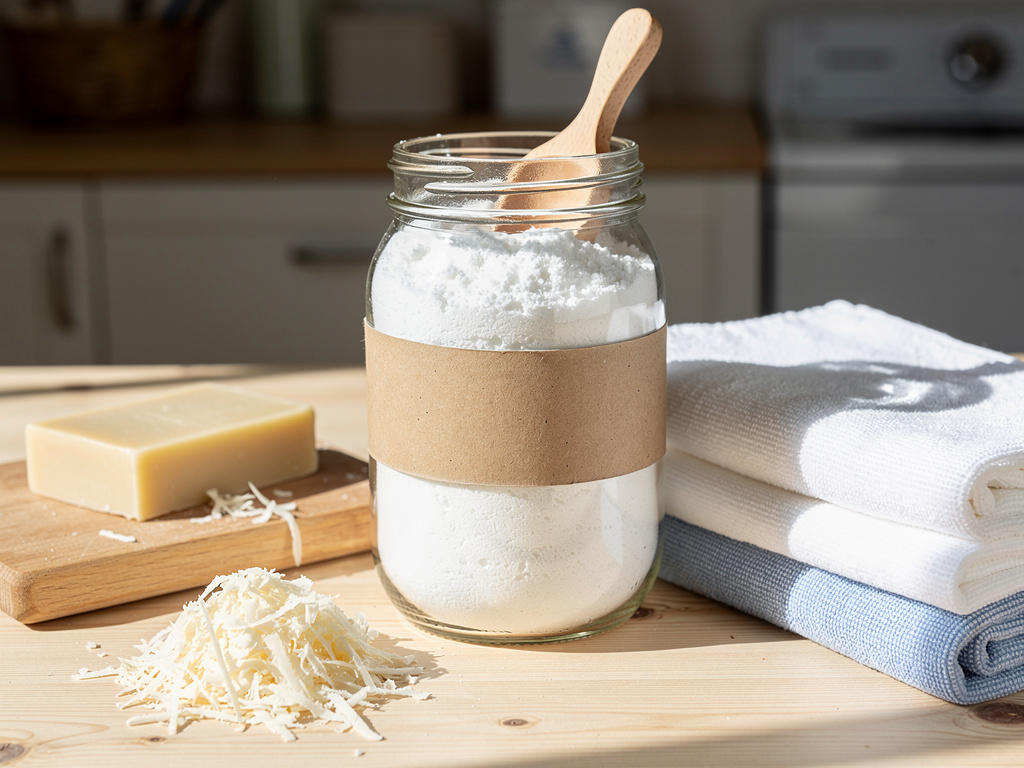


The short version: You can sell homemade laundry soap from home, and because it is a household cleaner and not food, your state's cottage food law does not cover it, while federal and state household product rules do. Federal and state packaging rules want the product name, your name and address, and the net weight in both ounces and grams on every jar (the FTC's rule for jars sold across state lines, your state's weights and measures rule for jars sold at home), and the CPSC wants a boxed caution warning when your mix can irritate eyes or harm a child who swallows it, which is exactly what your washing soda box already says. The EPA treats any "antibacterial" or "kills germs" claim as a pesticide that must be registered before you sell it, so keep those words off the jar and the listing. A classic powder of Fels-Naptha, washing soda and borax costs about 13 cents an ounce at Walmart prices, so a 16-ounce jar costs about $3.59 in materials and $6.93 with 10 minutes of your time, and $14 is a fair price. At $14 your customer pays about 44 cents a load against 23.5 cents for Tide's unscented powder, so sell the short ingredient list and the no-fragrance option, never the savings.
Checked September 27, 2026: ingredient, jar, label and store detergent prices come from Walmart.com search results sold by Walmart that day. The rules come from the FTC's packaging rule page, 16 CFR 1500.121, the CPSC's soap and hazardous substance guidance, and the EPA's pesticide definition, all loaded that day. Homegrown's numbers come from findhomegrown.com/signup the same day: $10 a month billed annually or $12.50 billed monthly, no commission, and 2.9% + $0.30 card processing paid by you. Customers create a Homegrown account to place a first order, and there is no timed-release or drops feature. Business license and sales tax rules differ by state and city, so verify your state's current rules and your city's home business rules before the first jar.
Your friends have been asking for a jar of the laundry powder you make for your own house. You grate a bar of Fels-Naptha on Sunday afternoon, stir it into washing soda and borax, and your towels come out clean with no perfume smell. Now a neighbor wants two jars, a coworker wants one for her mom, and you are wondering whether you can sell it at the Saturday farmers market without getting in trouble.
Most of what shows up for this question is forum threads and a few cottage food group posts, and most of them guess at the rules. This guide gives you the real federal rule set for a homemade cleaner, the exact words that turn laundry soap into a product that has to be registered with the EPA, what a jar costs to make at today's prices, what to charge, and where to sell it.
Yes, you can sell homemade laundry soap from home in the United States, and none of the three federal rule sets that cover it asks you to register, get a permit or pass an inspection before you sell a plain laundry powder with no germ-killing claims. Laundry soap sits under a different set of rules than the jam and bread many home vendors start with: a jar holding 16 ounces of powder that you sell at a Saturday market answers to the same label rules as a box holding 55 ounces of washing soda on a store shelf. Those are the federal rules, plus your state's weights and measures rules, which nearly every state bases on NIST Handbook 130 and which ask for the same three things: what the product is, who made it and where, and how much is inside by weight, in ounces and grams.
Your state's cottage food law is written for food made in a home kitchen, and laundry soap is not food. It is not a cosmetic either: the FDA's definition of a cosmetic covers products "applied to the human body," and you put laundry soap on clothes. A soap for clothes is a household product, and household products answer to three federal rule sets:
If you also make bar soap for skin, that is a separate rule set with the FDA in the picture, and our guide to selling homemade bar soap and the FDA's soap and cosmetic rules walks through it. This page stays with laundry soap.
Your city or county may still want a business license or a home business permit, and your state may want a sales tax permit. Those rules change from place to place, so verify your state's current rules, including your state or county weights and measures office, and call your city's business office before your first market.
Three federal agencies cover homemade laundry soap: the FTC for the label basics, the CPSC for caution warnings, and the EPA only if you make germ-killing claims. The FDA's cosmetic rules are written for products used on the body, so they do not reach a powder you put on clothes. For a plain unscented jar you sell for $14 with no germ claims, only 2 of the 4 rule sets in this table apply: the FTC's label rule or your state's matching weights and measures rule, and the CPSC's caution rule when the mix contains an irritant like washing soda. This table puts each rule next to what it asks you to do.
Scroll sideways to see every column.
| Rule | Who enforces it | When it applies to your laundry soap | What it asks of you |
|---|---|---|---|
| Fair Packaging and Labeling Act (16 CFR Part 500) | FTC | Household products sold across state lines; jars sold only in your state follow your state's weights and measures packaging rule (NIST Handbook 130), which asks for the same label items | Product name, your name and place of business, net weight in ounces and grams |
| Federal Hazardous Substances Act (16 CFR 1500.121) | CPSC | When the mix can irritate, burn, or harm a child who swallows it | Signal word and main hazard boxed together on the front, plus the ingredient, first aid and "Keep out of reach of children" on the label |
| Pesticide registration (40 CFR 152.15) | EPA | Only when your label or ads claim to kill or stop germs, bacteria, viruses, mold or mildew | Register the product before you sell it, or drop the claim |
| Cosmetic and soap rules | FDA | Not for laundry soap; only for soap and cosmetics used on the body | Nothing for a laundry powder |
We read each rule on its agency's own page on September 27, 2026: the FTC's packaging rule summary, the CPSC's soap and hazardous substance business guidance, eCFR for 16 CFR 1500.121 and 40 CFR 152.15, and the FDA's soap questions page, which says that if a product meets its definition of soap, "it's regulated by the Consumer Product Safety Commission (CPSC), not by FDA." That definition is about true bar soap, where most of the product is soap made from fats and lye. A laundry powder that is mostly washing soda and borax is a household cleaning product, and the FDA stays out because it goes on clothes, not on the body.
The CPSC's own soap guidance, written about true bar soap, says it "does not have specific requirements for soaps" and that soaps "would be subject to the Federal Hazardous Substances Act (FHSA) and the Consumer Product Safety Act (CPSA)." Your laundry powder is a household cleaner, and the hazardous substance rule covers household products the same way. In practice that means no form to file and no approval to wait for. It also means nobody checks your label before you sell, so getting it right is on you.
A homemade laundry soap label needs four things at minimum: what the product is, your business name, your business address (city, state and ZIP, plus the street address unless it is publicly listed), and the net weight in both ounces and grams. The FTC's summary of the Fair Packaging and Labeling Act rules names detergent as its very first example of a household product that needs "a statement identifying the commodity," "the name and place of business of the manufacturer, packer, or distributor," and "the net quantity of contents ... in both metric and inch/pound units."
Here is what that looks like on a real jar:
A "16 ounce" pint mason jar holds 16 fluid ounces of space, not 16 ounces of powder. Depending on how fine you grate the soap and how hard you pack it, a pint jar may hold more or less than 16 ounces by weight. Fill one jar, weigh it on a kitchen scale, and print the weight you actually measured. The net weight on the label is the number the rule cares about, not the size printed on the jar box.
You probably need a caution warning, because the washing soda in most homemade laundry powders comes in a box that already carries one, and 20 Mule Team's own website tells borax users "CAUTION: Do not get in eyes. Do not ingest." The CPSC's rule covers any household product that is toxic, corrosive, an irritant, a strong sensitizer or flammable, and that "may cause substantial personal injury or illness during customary or reasonably foreseeable handling or use (including reasonably foreseeable ingestion by children)."
Look at the box of Arm and Hammer Super Washing Soda in your pantry. Its label, as shown on Walmart's product page on September 27, 2026, reads: "KEEP OUT OF REACH OF CHILDREN. CAUTION: EYE IRRITANT. HARMFUL IF SWALLOWED. Avoid eye contact. If contact occurs, flush immediately with water for 15 minutes." Washing soda is one of the biggest ingredients in your mix (20 of 45 ounces in the classic recipe), so the safe move is to carry the same kind of wording onto your jar. Treat the box warnings as your starting point, not the final word: the rule is about how hazardous your finished mix is, so if you change the recipe or are unsure, ask before you print.
When a product needs caution labeling, the CPSC's guidance lists what the container must carry, in English:
The placement rule, 16 CFR 1500.121, says the signal word and the main hazard "shall be blocked together within a square or rectangular area" on the front of the container. A simple box printed on your front label does the job. If you are not sure whether your recipe needs a warning at all, the CPSC's soap guidance page points small businesses to its Small Business Ombudsman team at (888) 531-9070 or SBO@cpsc.gov.
Any word on your label, listing or sign that says your laundry soap kills or stops germs turns it into a pesticide, and a pesticide has to be registered with the EPA before you can sell it. Registration is an application to the EPA with a registration service fee and data requirements, which is not a realistic path for a home laundry soap vendor.
Under 40 CFR 152.15, "No person may distribute or sell any pesticide product that is not registered," and a product counts as a pesticide when whoever sells it "claims, states, or implies (by labeling or otherwise)" that it can be used as one. The same rules define pests to include "any fungus, bacterium, virus, prion, or other microorganism," except those on or in living people and animals. The EPA's page on what counts as a pesticide says a product is likely a pesticide if its labeling or advertising "makes a claim to prevent, kill, destroy, mitigate, remove, repel or any other similar action against any pest."
Keep these words off your jar, your Homegrown listing, your Instagram captions and your market sign:
The claim counts wherever you make it, not only on the jar. The rule says "by labeling or otherwise," and the EPA's page covers advertising too. A market sign that says "kills odor-causing bacteria" or a caption that calls your soap "antibacterial" can make the same jar a pesticide. Describe what it does to clothes instead: "cleans," "lifts everyday dirt," "no added fragrance," "rinses clean."
What you can say is plenty: what is in it, what is not in it (no dyes, no added fragrance), that it is made in small batches, and how you use it.
Sell a dry powder, not a liquid, and start with one of two common recipes: the classic three-box mix of bar laundry soap, washing soda and borax, or a borax-free mix for customers who ask for one. Powder is easier to weigh, it does not separate into layers the way liquid soap can, and it stores well when the lid is tight.
Here are both recipes by weight, which is how you should make them once you are selling, because weight is what goes on the label:
Recipe B is close to what The Shepherd's Table on Homegrown lists in its product description: "Laundry soap, Baking soda, Epsom salt." Offer the unscented version first. People who buy homemade laundry soap are often looking for a product without perfume, and an unscented jar is also the simplest label.
Why not a liquid? Liquid laundry soap is mostly water. You would be selling a gallon jug that weighs about 8 pounds, costs more to package, and can separate on the shelf, and a customer who opens a jug of gloppy soap does not reorder. If regulars ask for liquid, sell them the powder and a card with instructions for dissolving it at home.
Grate the bar soap as fine as you can. A food processor with the fine grating disc, then a second pass with the chopping blade, gives you a powder that dissolves in cold water instead of leaving flakes on dark clothes.
A 16-ounce jar of the classic recipe costs about $3.59 in materials and $6.93 once you count 10 minutes of your time at $20 an hour. The borax-free recipe costs $2.93 and $6.26. Your time is the biggest part of the cost, and the powder is about a third of the full cost or less.
Scroll sideways for the full cost breakdown.
| Cost per 16-ounce jar | Recipe A, classic | Recipe B, borax-free | How we got it |
|---|---|---|---|
| Powder | $2.13 | $1.46 | Batch cost divided by batch weight, times 16 ounces |
| Pint mason jar with lid | $1.02 | $1.02 | Mainstays 16 oz wide mouth jars, $12.27 for 12 |
| Two labels (front and caution panel) | $0.44 | $0.44 | Avery 2" x 3" clear film labels, $8.87 for 40 |
| Materials total | $3.59 | $2.93 | |
| Your time, 10 minutes at $20 an hour | $3.33 | $3.33 | Our assumption: grating, mixing, filling, weighing, labeling |
| Full cost per jar | $6.93 | $6.26 |
Every ingredient and supply price is from Walmart.com search results sold by Walmart on September 27, 2026: Fels-Naptha 5 oz $1.87, Zote White 14.1 oz $2.16, Arm and Hammer Super Washing Soda 55 oz $5.43, 20 Mule Team Borax 65 oz $6.98 (10.7 cents an ounce), Arm and Hammer Baking Soda 4 lb $3.43, Equate unscented Epsom salt 8 lb $6.64. Recipe A's 45-ounce batch costs $5.98 (13.3 cents an ounce); Recipe B's 70.1-ounce batch costs $6.40 (9.1 cents an ounce).
Here is the math for Recipe A, so you can redo it with your own store's prices. The bar costs $1.87. Twenty ounces of washing soda at $5.43 for 55 ounces is $1.97. Twenty ounces of borax at 10.7 cents an ounce is $2.14. That is $5.98 for 45 ounces, or 13.3 cents an ounce, and 16 ounces of powder costs $2.13.
Buying the bigger boxes or a case of bars brings the powder cost down a little, but the jar stays about a dollar and your 10 minutes stay the same. How fast you fill and label matters more than which borax box you buy.
Homemade laundry soap is cheap to make but not cheap to buy, and a customer pays more per load for your jar than for the store detergents we priced. At half an ounce a load, the classic powder costs you 6.7 cents a load and the borax-free powder 4.6 cents. Arm and Hammer's own powder is 9.8 cents a load at Walmart, and the two Tide powders we priced were 23.5 and 27.2 cents.
A $14 jar holds about 32 loads at half an ounce, so your customer pays about 44 cents a load, roughly twice what Tide's unscented powder costs and more than four times Arm and Hammer's.
Cost per load, in cents (homemade at half an ounce a load)
Source: Walmart.com prices sold by Walmart, September 27, 2026. Arm and Hammer Powder Alpine Clean $15.14 for 155 loads; Tide Clean and Gentle Unscented $15.99 for 68 loads; Tide Original $11.97 for 44 loads. Homemade figures use our half-ounce dose.
Swipe sideways to compare every powder.
| Laundry powder | Package | Price | Loads | Cost per load |
|---|---|---|---|---|
| Your Recipe B, ingredients only | 16 oz of powder | $1.46 | 32 at our dose | 4.6¢ |
| Your Recipe A, ingredients only | 16 oz of powder | $2.13 | 32 at our dose | 6.7¢ |
| Arm and Hammer Powder, Alpine Clean | 9.56 lb | $15.14 | 155 | 9.8¢ |
| Tide Clean and Gentle Powder, Unscented | 77 oz | $15.99 | 68 | 23.5¢ |
| Tide Powder, Original | 50 oz | $11.97 | 44 | 27.2¢ |
| Your jar at $14, what the customer pays | 16 oz | $14.00 | 32 at our dose | 43.8¢ |
Store prices checked on Walmart.com, sold by Walmart, September 27, 2026. The half-ounce dose is our assumption for the math, about 2 level tablespoons of a fine powder. Weigh your own scoop and print your real dose on the label.
So what are people buying? A short ingredient list they can read, a jar with no added fragrance, and a person they know who made it. Put those on the front of your label and in your listing. Never put "save money" there, because a customer who does the per-load math will find out it is not true.
Charge $12 to $15 for a 16-ounce jar of homemade laundry soap, and start at $14. At $14, the classic recipe leaves you about $6.36 a jar after materials, your time and Homegrown's card processing, and the borax-free recipe leaves about $7.03. Your $14 price is roughly 3.9 times your materials cost for the classic and 4.8 times for the borax-free.
A simple price sheet for your table and your listing:
A quick check that works for any recipe: multiply your materials cost by 3. For the classic jar that is $10.78, and for the borax-free jar $8.78. Your price should sit above that line, because 3 times materials does not pay you for your time on a product this slow to make.
In a pull of the Homegrown catalog on September 27, 2026, 1 of the 2,727 products from 308 vendors was laundry soap: The Shepherd's Table's "Laundry Powder- 16oz" at $15.00, listing its ingredients as "Laundry soap, Baking soda, Epsom salt." Two more household cleaning products were listed by two other vendors, including a 5-ounce solid dish soap bar from Bubbly Moon Naturals at $10.99 unscented and $11.99 or $12.99 in scents. We counted every product whose name or description mentioned laundry, detergent, washing soda, borax, stain, fabric, dryer, wool ball, dish soap, cleaner, cleaning, oxygen or soap nut, then read each one and opened each vendor's other listings. We also read every listing in the Home Goods and Health and Wellness categories in full. Candles, diffusers and body soaps were not counted, and neither were multi-use body bars, such as a coconut oil bar whose description says it also washes dishes and counter tops.
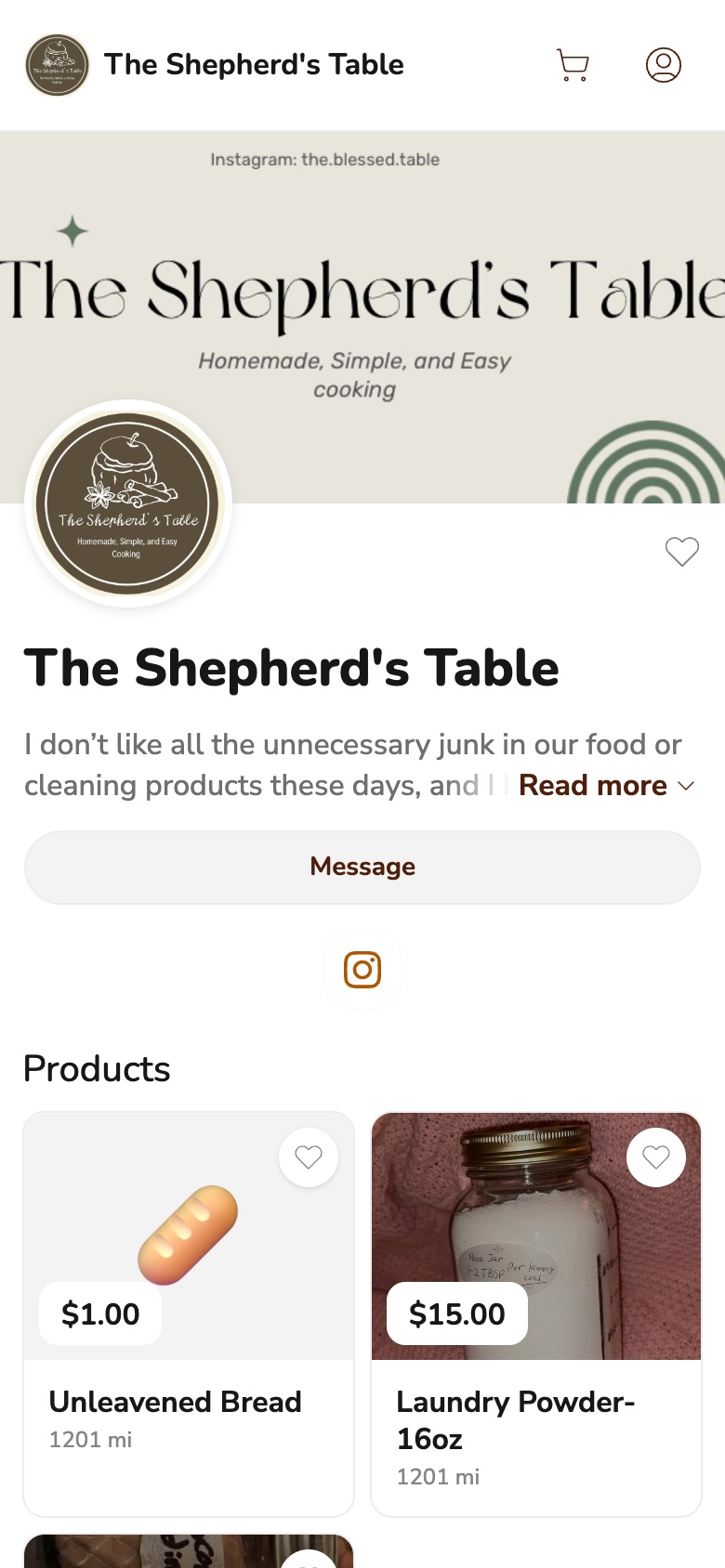
That store note sells the reason to buy homemade laundry soap, not the price, and it puts the laundry powder next to food from the same kitchen, which is a good reminder that one storefront can hold both.
Package laundry powder in a wide-mouth glass jar or a sturdy resealable bag, sealed so it stays dry, with the dose printed on the lid. Powder that gets damp clumps into a brick, and a customer with a brick does not come back.
What works for most home vendors:
Fill every jar to 16.2 ounces and print 16 ounces on the label. Scales drift, and a customer who weighs a jar at 15.8 ounces will tell people. Two tenths of an ounce of the classic powder costs you less than 3 cents a jar, which is cheap insurance.
Test every new recipe on at least 5 loads of your own laundry, in cold and warm water, before a single jar goes on your table. You are checking three things: that it dissolves, that it rinses clean, and that it does not leave white marks on dark clothes.
Keep your batch records in a notebook or a note on your phone, with the date and the weight of each ingredient. It takes a minute a batch and it is the first thing you will want if a customer asks what changed between this jar and the last one.
You can sell homemade laundry soap at farmers markets that accept non-food products, craft fairs and holiday markets, to neighbors and coworkers, and through a storefront link your regulars reorder from. Laundry soap sells best to people who already know you, because it is a product they run out of and buy again.
Where it fits:
Shipping works, but laundry powder is heavy for what it costs. A 16-ounce jar in glass weighs over a pound once packed, so most home vendors do better selling locally and saving shipping for customers who move away.
If your regulars are already texting you for refills, a Homegrown storefront gives them one link to pick a jar or a refill, pay, and choose a pickup time, so you mix for orders you already have. It is $10 a month on the annual plan, plus 2.9% + $0.30 card processing, paid by you, and you can set up your laundry soap storefront with each size as its own option.
On a $20 order, card processing takes about 88 cents on Homegrown or Shopify, 96 cents on Square's free plan online, and Etsy takes about $2.35 once its listing and transaction fees are added. The bigger differences are the monthly plan and what 50 orders a month add up to. The example order is $20, a round number close to one 16-ounce jar and a sample bag.
Scroll sideways for the full fee stack on each platform.
| Platform | Monthly plan | Trial period | Platform fee | Card processing | Customer pays for a $20 order | Vendor pays per order | Vendor pays for 50 orders a month |
|---|---|---|---|---|---|---|---|
| Homegrown | $10 billed annually ($12.50 monthly) | 7 days | $0, 0% commission | 2.9% + $0.30, paid by the vendor | $20.00 | $0.88 | $54.00 ($44.00 processing + $10 plan) |
| Shopify Basic | $29 billed yearly ($39 monthly) | 3 days, then $1 a month for 3 months | 0% with Shopify Payments, 2% with another provider | 2.9% + 30¢ online | $20.00 | $0.88 | $73.00 ($44.00 + $29 plan) |
| Square Free, online | $0 per location | Plan is free | $0 | 3.3% + 30¢ online (2.6% + 15¢ in person) | $20.00 | $0.96 | $48.00 |
| Etsy | $0 required (a one-time set-up fee may apply) | No plan to trial | $0.20 listing fee per sale + 6.5% transaction fee | 3% + $0.25, on the total with tax and shipping | $20.00 plus shipping | $2.35 before shipping | $117.50 before shipping and any ads |
We checked every row on the platform's own pricing page on September 27, 2026: findhomegrown.com/signup, shopify.com/pricing, squareup.com/us/en/pricing, and Etsy's Fees and Payments Policy and Etsy Payments Policy. Card processing is figured on the $20 price; a platform that charges it on the full total with shipping and tax runs a few cents higher. Etsy's 6.5% also applies to what you charge for shipping, and Etsy says a one-time set-up fee may be required at sign-up without publishing the amount.
At 50 orders a month, Square's free plan costs you the least, $48.00, and Homegrown is next at $54.00. Shopify is $73.00 because of its $29 plan, and Etsy is the most expensive at $117.50 before shipping. Etsy brings its own shoppers from other states, which can be worth the fees if you plan to ship. For a heavy jar sold mostly to people who live near you, you would be paying Etsy's percentage on customers you found yourself.
You take laundry soap orders without living in your DMs by putting your jars, refills and sample bags on one ordering page with pickup times, so regulars order and pay before you mix the next batch. Laundry soap is a reorder product, and the hard part is not the first sale but the fifth one, six weeks later, from a customer who has run out.
Homegrown is $10 per month billed annually ($12.50 month to month) with no percentage fees beyond standard payment processing, which is 2.9% + $0.30 per order, paid by you and never added to your customer's total. On a $14 jar that is 71 cents. Etsy would take about $1.78 on the same jar once its 20-cent listing fee, 6.5% transaction fee and its own processing are added, and it is built around shipping to buyers you have never met. Square's free plan costs less per month and works well if you mostly sell in person. Taking orders through Facebook Marketplace or Instagram messages costs nothing until you are tracking which jar, which refill and which pickup day across fifteen threads.
What fits laundry soap in particular:
What Homegrown does not do: Homegrown is built around pickup and local delivery, so if most of your laundry soap will ship to other states, Etsy or Shopify fit that better. Selling by weight is on Homegrown's roadmap, not live, so list fixed jar sizes. Customers create a Homegrown account to place their first order. There is no timed-release or drops feature. Your storefront appears in Homegrown's marketplace, but plan on most orders coming from people you send to your own link. And Homegrown does not write your label or tell you whether your mix needs a caution block; that part is yours.
You can go from a test batch to your first paid jar of laundry soap in about two weeks if you start the shelf test on day one and do the rest of these steps while it sits. Most of the time goes to testing and labels, not paperwork.
Once the first 12 are gone, look at who bought. If most were neighbors and market regulars, refills and a pickup day are your business. If people in other towns keep asking, that is the time to price shipping, not before.
New laundry soap vendors get the same five things wrong, and three of them are about the label, not the soap. Each one is easy to fix before your first market and expensive to fix after.
Pricing below $12 because the powder is cheap is a sixth mistake. The powder is about $2 a jar. The jar, the labels and 10 minutes of your time are what you are really selling, and they cost more than the soap.
Yes, it is legal to sell homemade laundry detergent in the United States as long as your label follows the federal household product rules and you make no germ-killing claims anywhere you sell it. The FTC's packaging rule asks for the product name, your name and place of business, and how much is inside by weight, in ounces and grams. If the mix can irritate eyes or is harmful if swallowed, the CPSC's rule adds a caution block, and your city may require a business license.
The federal rules we checked from the FTC, the CPSC and the EPA do not require a license or permit to sell a plain homemade laundry soap with no germ-killing claims. Your city or county may require a general business license or a home occupation permit, and your state may require a sales tax permit. Call your local business office and your state revenue department before your first sale, because these rules change from place to place.
No, homemade laundry soap does not fall under cottage food laws, because those laws cover food made in a home kitchen. Laundry soap is a household product. It follows the FTC's labeling rule for household products, or your state's matching weights and measures rule, and the CPSC's caution labeling rule if it contains irritants like washing soda.
No, you should not call homemade laundry soap antibacterial unless the product is registered with the EPA as a pesticide. Federal rules treat any claim that a product kills or stops bacteria, viruses, mold or other germs as a pesticide claim, and an unregistered pesticide cannot be sold. Describe what the soap does to clothes instead.
Price a 16-ounce jar of homemade laundry soap at $12 to $15, and start at $14. The one laundry powder on Homegrown in our September 27, 2026 pull was $15. At Walmart prices on September 27, 2026, a jar of the classic Fels-Naptha, washing soda and borax recipe costs about $3.59 for the powder, jar and labels, or $6.93 once your time is counted, so $14 leaves about $6.36 after card processing.
Making your own laundry soap is cheaper than the store powders we priced for your own house, at about 4.6 to 6.7 cents a load in ingredients against 23.5 and 27.2 cents for two Tide powders. The gap is small against Arm and Hammer powder, which was 9.8 cents a load on September 27, 2026, so homemade saves only 3 to 5 cents a load there. Once you sell homemade laundry soap at $14 a jar, it costs your customer about 44 cents a load.
These guides answer the questions that come right before and right after your first jar of laundry soap. Start with the first one if you also make bar soap, and come back to the others when you are choosing where to sell and how to price. Each one is written for home soap makers who sell at markets and through their own link.
Your laundry soap regulars should reorder from one link printed on the back of the jar, where they can pick a new jar, a refill or a sample bag, pay, and choose a pickup time. That way you mix for orders you already have, you buy washing soda for real demand instead of guesses, and the customer who runs out on a Tuesday does not wait until Saturday or switch back to the store brand.
A market table only sells while you are standing at it. Between markets, the questions come by text: do you have the unscented one, can I bring my jar back, can you drop two off on Thursday. A Homegrown storefront answers all three on one page for $10 a month billed annually ($12.50 month to month), with no commission on your jars, and 2.9% + $0.30 card processing paid by you. When your label is written and your first 12 jars are weighed, start your Homegrown storefront and list your laundry powder with a jar, a refill and a sample size tonight.



