
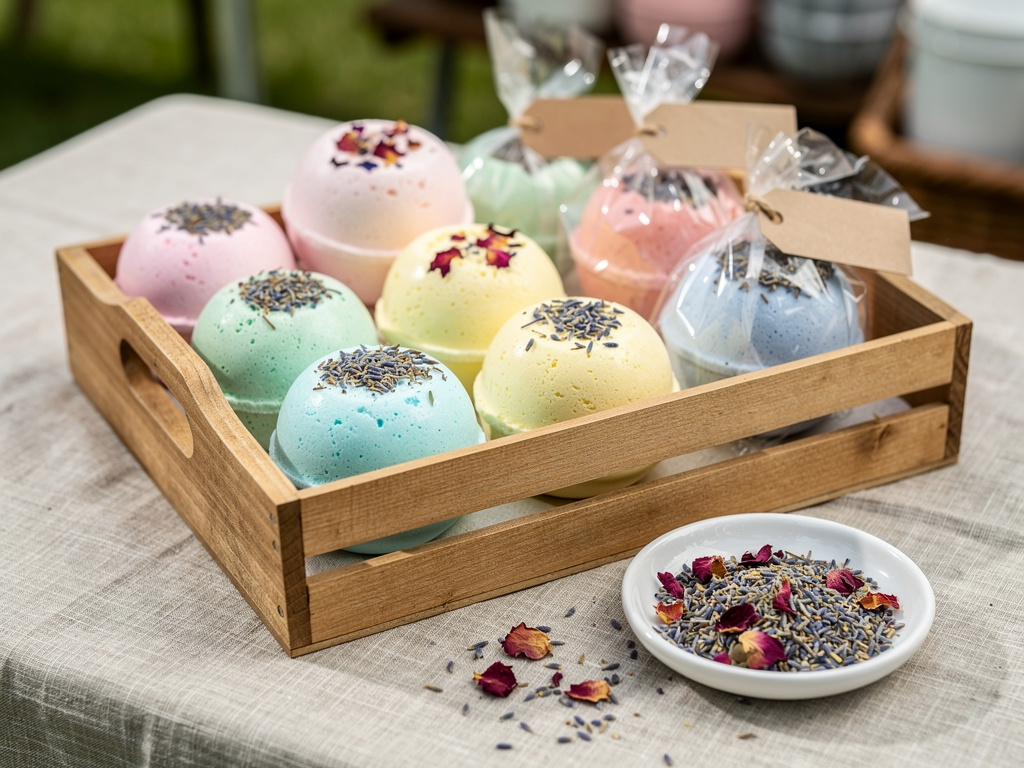


The short version: Bath bombs sell in seven places: a farmers market booth, craft fairs and holiday markets, your own storefront link with pickup or local delivery, Etsy and Amazon Handmade, boutiques and gift shops that buy at wholesale, consignment shelves, and bulk orders for showers, parties and gifts. A $7 bath bomb, the middle of one single-bomb price from each of nine small US shops we checked, reaches you as $7.00 in cash at a booth, $6.72 inside a four-bomb order on a Homegrown storefront, $5.95 on Amazon Handmade and $3.50 from a shop paying half of retail. Moisture decides more than fees do, because a bomb that sits in humid air or on a hot porch loses its fizz, so the best places are the ones where the bomb goes from your dry shelf to the customer's hands fast. Bath bombs are cosmetics, not food, so cottage food laws do not limit where they go, but the FDA's label rules follow them into every place on this list.
Checked October 5, 2026: on findhomegrown.com/signup, Homegrown costs $10 a month on the annual plan or $12.50 on the monthly plan, takes 0% commission, and charges the vendor 2.9% + $0.30 per card payment. Etsy, Amazon Handmade, Shopify, Square and Faire fees come from their own pages, the rules from FDA, the eCFR and the Florida Statutes, and the shop prices from each shop's own site, all loaded October 5 and 6. Verify your state's current rules before you sell. The limits: a customer makes a Homegrown account before a first order, Homegrown has no shipping and no timed release feature, and expect most orders to come from people you give your link to.
You pressed 40 bath bombs on Sunday, wrapped them on Monday, and now they sit in a bin on the dresser while you figure out who will buy them. Friends bought the first dozen. The next 40 need a real place to go, and the one after that needs a place that pays you enough to keep making them.
Bath bombs are a good product to place. They cost little to make, people buy them as gifts all year, and they photograph well. They are also moisture sponges with a shelf life of about six months, so where you sell matters more than it does for a bar of soap. This guide covers the seven places bath bomb vendors actually sell, what a real $7 bomb pays you in each one, and which places to skip in a humid July.
You can sell bath bombs in seven places, and a common setup for a part-time vendor is three of them at once: one booth, one link and one shop. Four of the seven put the bomb straight into the hands of the person who will drop it in the tub. Two sell through a shop, which pays you less per bomb, and one is custom orders from hosts and businesses who buy by the dozen.
Two places are left off on purpose. Grocery and chain store shelves want the same bomb in the same box every week at a price set for a factory, which is a production job, not a side business. And an open bin by a busy register, with no wrap and no one rotating stock, leaves bombs in the air for months, which is the fastest way to sell one that will not fizz.
Pick the place that matches how many bombs you make, how many free days you have and how humid your summers are, then add one place at a time. A vendor who presses 30 bombs a month at the kitchen table needs a very different start than one with a dehumidified spare room and 200 bombs curing on a rack. The table is the short way to choose.
Scroll sideways to see every column.
| Your situation | Start here | Add next | Why it fits |
|---|---|---|---|
| 30 to 60 bombs a month, Saturdays free | A farmers market booth | Your own storefront link for reorders | The booth finds people who like your scents, and the link lets them reorder in the weeks between |
| You can only sell a few weekends a year | Holiday markets and craft fairs | A card with your link in every bag | Gift shoppers buy sets in November and December, and the ones who loved a bomb need a way to find you in February |
| You like making, not selling | One boutique or salon | A second shop in the next town | A shop pays half of retail for a case and sells it for you at full price |
| You live somewhere humid | Your link with pickup or local delivery | Indoor winter markets | Bombs go from your dry shelf to the customer in a day instead of sitting in a damp tent or a mailbox |
| You love custom work | Shower, party and gift orders | A standing order from one local business | One order of 30 minis is a full batch sold before you press it |
These rows are planning guides built from the fee pages, supplier guides and catalog data in this article, all checked October 5, 2026. Your own costs, markets and shops decide the final mix.
You may never need the bottom three rows. A booth plus your own link keeps every bomb at the full $7 retail price, and that pair alone keeps a weekend vendor busy most of the year.
Humidity decides where bath bombs can go because baking soda and citric acid start reacting the moment they meet moisture, so a bomb left in damp air fizzes a little on the shelf and less in the tub. Bramble Berry, a soap and bath supply company, says moisture in the air can make bombs "puff up or crumble" and recommends using them within about 6 months.
Here is what it means for each kind of place:
Shrink wrap is the cheap fix that makes every other place possible. Bramble Berry calls it the method that protects bombs "from the elements" and the one that suits selling and shipping. Wrap every bomb that leaves the house, and put the pressing date on your own records so you know which ones to sell first.
A bath bomb that has been fizzing slowly in humid air can look fine and still disappoint in the tub. Selling one bad bomb to a gift buyer costs you more than the $7, because that buyer was your way to their friends. Keep a dehumidifier or a fan running where bombs cure, and sell oldest first. We checked Bramble Berry's storage and packaging advice on October 5, 2026.
A farmers market is a strong first place to sell bath bombs, because a $7 bomb sold for cash reaches you as the full $7.00 and every shopper can smell your scents before buying. Shoppers who came for eggs buy a bath bomb on impulse, and the ones who love it come back to the same table next week. That return trip is what builds a small business out of a hobby batch.
Our guide to selling soaps and bath products at a farmers market covers display, curing and what to bring to a first market, and the same table setup works for bombs. The USDA's farmers market directory (usdalocalfoodportal.com) lets you search markets within 10, 30, 100 or 250 miles of your ZIP code. Then ask each market manager these questions before you apply:
Bring a card reader too. Square's in-person rate, read on its pricing page October 5, 2026, is 2.6% + 15 cents, so a single $7 bomb paid by tap costs you 33 cents and $6.67 lands in your account. That beats losing the shopper who left her wallet in the car.
A small bowl of water with one mini bomb fizzing in it is the best sign you can put on the table. People stop to watch, and the ones who stop are the ones who buy.
Craft fairs and holiday markets pay off for bath bombs when you bring gift sets and enough stock, because November and December shoppers are buying presents and a bath bomb fits in a stocking. TheCraftMap's guide to selling bath bombs at craft fairs suggests bringing 100 to 150 bombs to your first few fairs, in 8 to 10 scents. That is two or three weekends of pressing, so plan backward from the fair date.
The table fee is paid once, so spread it across what you sell. As an example, a $75 table fee over 40 bombs sold is $1.88 a bomb, and over 120 bombs it is about 63 cents. That math is why fairs reward the vendor who brings more stock and a few higher-priced sets. What sells at a fair is different from what sells at a weekly market:
Juried fairs choose vendors from photos and an application, so a clean label and a tidy wrap are part of getting in. If you are weighing a fair against a weekly market, our comparison of craft fairs and farmers markets walks through which shoppers and crowds each one draws, and the same trade-offs apply to bath bombs. Indoor holiday markets have one more advantage for this product: dry, heated air keeps your bombs crisp all day.
You sell bath bombs from your own storefront link by listing each scent once with a price and a count, sending the link to the people who already bought from you, and letting them order and pay before they pick up. A regular uses a bomb in one bath, so the same person comes back every few weeks, and a link saves them from waiting for your next market Saturday.
A Homegrown storefront handles that reorder for a bath bomb vendor whose regulars keep messaging "do you still have the eucalyptus ones?" The plan is $10 per month billed annually with no percentage fees beyond standard payment processing of 2.9% + $0.30 per order, so a four-bomb, $28 order costs you $1.11. You choose the pickup days and spots (your porch, your booth, a farm stand), or you switch on local delivery out to anywhere from 1 to 25 miles with a fee and minimum you set, and the delivery fee is yours minus card processing. For a product that hates damp porches and delivery trucks, a same-day handoff is the point. Each scent can be its own listing or a variant with a count that drops as bombs sell, sales tax is worked out and filed for you, and the built-in QR code generator makes a printable code for your booth sign that can point at one scent's page.
Here is how it compares with what bath bomb vendors usually try first:
A first-time customer has to make a Homegrown account to check out, and there is no timed release or countdown feature. Homegrown has no shipping, so it serves pickup and local delivery, not a buyer in another state. Your storefront appears on the Homegrown marketplace, but most of your orders will come from the people you hand your link to. And Homegrown does not review your labels or make a health claim legal.
When the same people message you every few weeks for another lavender or eucalyptus bomb, give them a place to order instead. Set up a Homegrown storefront, list the bath bomb scents you already have wrapped, and pick a pickup day; they claim bombs from this week's batch and your Saturday table still catches the walk-up shoppers.
Shipping bath bombs through Etsy or Amazon Handmade is worth it when you want buyers outside your town and you can pack well, because both reach shoppers who search for bath bombs, but both take more per order than your own link and every box is a chance to crack one. On a four-bomb, $28 order, Etsy's fees come to $3.71 before shipping and Amazon Handmade's referral fee comes to $4.20, against $1.11 in card processing on a Homegrown storefront.
Each marketplace's own seller pages, read October 5, 2026, lay out the costs:
Bramble Berry's shipping advice is a box a few sizes larger than the order, soft packing material under, between and on top of the bombs, and a gentle shake before taping: if you hear them move, add more. Each bomb in its own small box or bubble wrap is safer still. Both marketplaces charge their percentage on the shipping you collect too, so selling sets of three or four keeps the shipping and the fee on it lower per bomb. If you want the full picture of what Etsy takes as your shop grows, our breakdown of Etsy fees adds up every fee on a real $25 order and on a month of 40 orders.
Getting bath bombs into a boutique, salon or gift shop starts with a short visit: three wrapped samples, one page of wholesale prices and case sizes, and a request to speak with whoever chooses new stock. Shops pay wholesale, which Bramble Berry and its Soap Queen blog both put at typically 50% of retail, so a $7 bomb sells to the shop for $3.50 and on its shelf for $7. In return, the shop pays for the whole case, on delivery or within 30 days, and does the selling.
Salons, nail spas and day spas are a good fit for bath bombs in particular, because their clients are already paying to relax and buy small treats at the front desk. Before you pitch any shop, make sure half your retail price still covers ingredients, wrap, label and your time.
Count it by the case. Twelve mixed bombs at $3.50 is a $42.00 invoice, and two salons or gift shops reordering monthly is 24 bombs and $84 a month from two short drop-offs. That is steady money for the slow weeks between markets, which is the job a shop account does best beside your booth.
A shop may ask if you sell on Faire, a wholesale marketplace stores use to buy from small brands. Faire's help page for North American brands, read October 5, 2026, lists $0 to join, a 15% commission on orders that come from its marketplace, a one-time $10 fee on a new store's first marketplace order, and 0% commission when a store you found yourself orders through your Faire Direct link. Payment processing runs 3.5% + $0.30 for payout the next day, 2.4% + $0.30 at 30 days and 1.9% + $0.30 at 60 days. Our Faire alternative guide for soap and candle vendors covers when that commission is worth paying.
Consignment works for bath bombs when a shop will only try you on a no-risk basis: it puts your bombs on its shelf without buying them, pays you after each sale, and keeps a share. Soap Queen's guide to selling handmade bath products on consignment says the split is generally 70/30 or 60/40, with the store keeping 30% or 40%. On a $7 bomb, that leaves you $4.20 to $4.90, which beats a straight wholesale sale at $3.50.
The cost is that unsold bombs are still yours, and bath bombs age on the shelf in a way soap does not. A bomb that sits five months at a slow shop is close to the six-month mark, and nobody wants to buy the one that barely fizzes. Settle these five points before any bomb goes on their shelf:
Keep your own count of every bomb you drop off and every one the shop reports sold, with the pressing month beside it. A shop that sells three bombs a month is holding stock that could sell at your booth for the full $7, so give each consignment shelf one season to prove itself.
Baby shower hosts, bridal parties, birthday party parents, teachers and small businesses order bath bombs by the dozen as favors and thank-you gifts, and one order of 30 minis is a whole batch. An order like that is sold before you press it, with no booth fee and no shelf time. Every bomb in the order is spoken for the day it is made, which is the best answer to the six-month clock.
As an example, a shower host who orders 30 mini bath bombs at $3 each is a $90 order. Taken through a Homegrown storefront, card processing is $2.91 (2.9% of $90 plus $0.30), so $87.09 reaches you, and the host picks up the whole box on one day. What these buyers want is different from what a market shopper wants:
Small businesses order the same way. A realtor's closing gift, a dental office's patient thank-you or a salon's holiday client gift can each be a standing order. List a "party favor pack" as its own product on your storefront with a count and the number of days you need, and the order arrives with the payment already in hand.
When a customer buys four $7 bath bombs for $28, the way you take the money costs you anywhere from $0 in cash to $4.20 on Amazon Handmade. The table shows every part of the fee stack for each option on that same order, plus what a month of 50 such orders costs, so you compare them on equal terms.
Scroll sideways to see all eight columns of the fee stack.
| Way to get paid | Subscription | Trial | Platform fee | Card processing | Customer pays on a $28 order | You pay on a $28 order | 50 orders a month, you pay |
|---|---|---|---|---|---|---|---|
| Cash at your booth | $0 | None needed | $0 | $0 | $28.00 | $0.00 | $0.00 |
| Square Free, card at your booth | $0 a month | None needed on a $0 plan | $0 | 2.6% + 15 cents | $28.00 | $0.88 | $43.90 |
| Square Free, online checkout | $0 a month | None needed on a $0 plan | $0 | 3.3% + 30 cents | $28.00 | $1.22 | $61.20 |
| Homegrown, billed annually | $10 a month | 7 days, no charge until day 8 | $0, 0% commission | 2.9% + $0.30, paid by you | $28.00 | $1.11 | $65.60 ($55.60 processing + $10 plan) |
| Homegrown, billed monthly | $12.50 a month | 7 days, no charge until day 8 | $0, 0% commission | 2.9% + $0.30, paid by you | $28.00 | $1.11 | $68.10 ($55.60 + $12.50 plan) |
| Etsy | $0 (possible one-time shop set-up fee) | None listed | $0.20 per listing + 6.5% transaction fee; 15% on Offsite Ads sales | 3% + $0.25 | $28.00 plus shipping | $3.71 before shipping | $185.50 before shipping |
| Amazon Handmade | $39.99 first month, then waived | None listed; approval required | 15% referral fee ($0.30 minimum per unit) | No separate fee listed | $28.00 plus shipping | $4.20 before shipping | $210.00 (plus $39.99 once) |
| Shopify Basic | $29 a month paid yearly, $39 monthly | 3 days free, then $1 a month for 3 months | $0 with Shopify Payments (2% otherwise) | 2.9% + 30 cents online (3.5% + 30 cents on premium cards) | $28.00 | $1.11 | $84.60 on the yearly plan |
We checked every fee on each company's own pricing or selling page on October 5 and 6, 2026: findhomegrown.com/signup, squareup.com pricing, etsy.com/sell, sell.amazon.com Handmade and pricing pages, and shopify.com/pricing. The Etsy row assumes four bombs from four listings at $0.20 each. Etsy's 6.5% and 3% and Amazon's 15% also apply to the shipping you charge, which is not shown. Homegrown adds no fee for the customer.
Square at the booth is the cheapest card option in this table, which is why it belongs on your market table. And the online gap is the marketplace percentages: Etsy and Amazon Handmade cost three to four times as much per order as a pickup link before a single box is packed, and shipping widens it.
One $7 bath bomb reaches you as anywhere from $7.00 in cash at your booth to $2.83 on a Faire marketplace reorder, or $1.99 on a new shop's first Faire order, depending on where it sells. The places at the top of this list pay you the most per bomb, and the ones at the bottom sell more bombs for less work. A steady business usually needs some of each.
What reaches you from one $7 bath bomb
Source: fee pages for Square, Homegrown, Etsy, Amazon Handmade and Faire, Soap Queen's consignment split and Bramble Berry's wholesale rule, all checked October 5, 2026. Shipping costs not included.
Scroll sideways for the whole payout table.
| Place | What reaches you per $7 bomb | How we got it | What you still pay for |
|---|---|---|---|
| Farmers market, cash | $7.00 | No fee | Booth fee, tent, table |
| Farmers market, card on Square | $6.67 | $7 minus 2.6% and 15 cents | Booth fee |
| Your storefront link, four-bomb order | $6.72 | $1.11 processing split over 4 bombs | The $10 a month plan, billed annually |
| Your storefront link, one bomb | $6.50 | $7 minus 2.9% and $0.30 | The $10 a month plan, billed annually |
| Etsy, four-bomb order | $6.07 | $3.71 in fees split over 4 bombs | Box, padding, label, fees on shipping |
| Amazon Handmade | $5.95 | $7 minus the 15% referral fee | Box, padding, label, fees on shipping |
| Consignment | $4.20 to $4.90 | Shop keeps 30% to 40% | Unsold bombs come back to you |
| Gift shop or salon wholesale | $3.50 | Half of retail | The drive to deliver |
| Faire Direct, 12-bomb case | $3.35 | $42 minus next-day processing of $1.77 | Shipping the case |
| Faire marketplace reorder, 12-bomb case | $2.83 | $42 minus 15% and $1.77 processing | Shipping the case; a first order also loses $10 |
Every row uses a $7 retail price, the middle of nine small shops' single bath bomb prices we checked October 5, 2026, and the fee pages loaded that day. A first Faire marketplace order from a new shop pays you about $1.99 a bomb after the one-time $10 fee.
The bottom rows are not bad deals. A gift shop that takes 12 bombs a month at $3.50 is $42 for one drop-off, and you never stood behind a table for it. The point is to know which number you are agreeing to before you say yes.
Zero bath bombs were listed on Homegrown on October 5, 2026: a pull of the catalog that day found 0 bath bombs and 0 shower steamers among 2,891 products from 310 vendors. That means a local bath bomb vendor who lists today has no other bath bomb on the Homegrown marketplace to compete with, though most orders on any storefront still come from the customers you point to it yourself.
We pulled all 2,891 products from 310 vendors on the Homegrown catalog on October 5, 2026, and none were bath bombs or shower steamers. To be sure a scent-named bomb was not hiding, we looked for fizz, fizzer, steamer, bath melt, bath salt, bath soak, bubble bar and citric acid in every non-bakery name and description, then opened all 40 shops that list any health, home or craft product and read each of their listings. The single bath product turned up was a rosemary bath soak for $4.50. Farm vendors already pair body care with food: a Florida homestead sells four sugar body scrubs for $12 to $14 alongside raw milk, eggs and butter, and a second homestead sells $8 goat milk soap bars next to its sourdough.
A shopper who comes to a farm storefront for eggs and bread can add a body scrub or a bar of soap to the same order, and a bath bomb fits the same basket. If you already sell bread, eggs or honey, three bath bomb scents on your existing storefront are a small test with no new booth.
If you sell only bath bombs, the same storefront gives your market regulars one place to reorder. Start your Homegrown storefront with the bath bomb scents you have wrapped and ready, set a pickup day, and put the QR code on your market sign this Saturday.
The FDA's cosmetic label rules follow your bath bombs into every place on this list, from your booth to a gift shop shelf to an Amazon listing. The FDA's page on whether a product is a cosmetic or a drug quotes the law's definition of a cosmetic as something "rubbed, poured, sprinkled, or sprayed on" the body for "cleansing, beautifying, promoting attractiveness", and a bath bomb dropped in a tub to soften and scent the water is sold for those reasons. The FDA's fact sheet for small businesses and homemade cosmetics says "It's not against the law to manufacture cosmetics in your home," and that "FDA does not license cosmetics firms," though state or local authorities may.
Here is what that means in practice, all checked October 5 and 6, 2026:
Florida requires a cosmetic manufacturer permit, and its $25,000 small-sales exemption in Florida Statutes 499.01(2)(p) lets an exempt manufacturer make and sell only "soaps, ... lotions, moisturizers, and creams" and sell only prepackaged, labeled cosmetics. Bath bombs are not on that list, so a Florida bath bomb vendor should expect to need the permit. We read the 2026 statute on October 5, 2026.
A small toy tucked inside a bath bomb sold for kids can make that toy a children's product. The CPSC says products designed or intended primarily for children 12 and younger that fall under a CPSC safety rule need third-party testing and a Children's Product Certificate, with some test relief for registered small batch manufacturers. Ask the CPSC before you sell a surprise-inside bomb at a kids' party. Checked October 5, 2026.
States add their own rules on top, so verify your state's current rules before your first sale. Our guide to whether you can sell homemade soap covers how state permits work for body care.
A year of selling bath bombs has two big gift peaks, Valentine's Day and the November to December holidays, with Mother's Day in between and a sticky, humid summer that rewards indoor and pickup sales. Plan each place around those dates, and press each batch no more than about two months before it needs to sell, so every bomb reaches a tub well inside its 6 months.
Scroll sideways for the moisture plan column.
| Months | What sells | Where to put your effort | Moisture plan |
|---|---|---|---|
| January and February | Valentine's sets, red and pink bombs, heart shapes | Your storefront link with a last pickup date; restocking gift shops after the holidays | Dry winter air helps; press in January |
| March to May | Spring florals, shower and wedding favors, Mother's Day boxes | Markets reopening, party orders, salons | Start using sealed bins at outdoor markets |
| June to August | Minis, citrus and ocean scents, kids' party favors | Morning markets, indoor markets, pickup orders over shipping | Hardest months: shrink wrap everything, silica gel in bins, no porch drop-offs |
| September and October | Fall scents, first holiday orders | Pitch gift shops and salons for holiday shelves; apply to holiday fairs | Press holiday stock in October and November, not August |
| November and December | Stocking stuffers, boxed sets, teacher and client gifts | Holiday markets, craft fairs, business gift orders, your link | Indoor heated venues keep bombs crisp all day |
A planning guide, not data. The six-month window comes from Bramble Berry's shelf-life advice and the humidity steps from TheCraftMap's bath bomb guide, both read October 5, 2026.
The habit that saves the most money is pressing to a date. A batch made in August for a December fair has spent four of its six months on your shelf before the first shopper sees it. Press in October for December, and the bombs you sell at the holiday fair still have most of their fizz when they get unwrapped on Christmas morning.
Bath bomb vendors who restock every week sell in two or three places that feed each other, press small batches often, and give every buyer a way to find them again. Their booth finds new customers, their link brings those customers back, and one shop or salon account sells a case while they work. Here is what they do that new vendors skip:
None of this needs more bombs. It needs the same 40 bombs a week sold through places that pay well and move them fast. If you sell at one market today, the next place to add is usually your own link, because it costs one evening to set up and it keeps every regular you already have.
The best local places to sell bath bombs are farmers markets, craft fairs and holiday markets, gift shops and boutiques, salons and spas, and consignment shops, plus bulk orders for showers and parties. A booth pays you the most per bomb, about $7.00 in cash on a $7 bomb, while a shop buying at wholesale usually pays half of retail. A common setup pairs a weekly booth with your own storefront link so regulars can reorder between market days.
Locally is usually better for a new vendor, because bath bombs are fragile and moisture sensitive, and every shipped box risks a cracked bomb. On a four-bomb, $28 order, Etsy's fees come to $3.71 before shipping, against $0.88 for a card at your booth on Square. Etsy makes sense once you can pack well and want buyers outside your town.
Gift shops usually pay wholesale, which Bramble Berry puts at typically 50% of retail, so a bath bomb that sells for $7 earns you $3.50. A 12-bomb case at that price is $42.00. Consignment pays more per bomb, $4.20 to $4.90 on a $7 bomb at a 70/30 or 60/40 split, but only after each one sells.
You do not need an FDA license to sell bath bombs, because the FDA says it does not license cosmetics firms, but state or local authorities may require one. Florida, for example, requires a cosmetic manufacturer permit, and its small-sales exemption covers soaps, lotions, moisturizers and creams, not bath bombs. Before deciding where to sell bath bombs, check your state's current rules and your city's business license rules.
Bath bombs keep their fizz for about six months, the window Bramble Berry recommends, and less in humid air. Shrink wrap each bomb, store stock in a cool, dry place, and put the pressing month on every case you drop at a shop. Rotate consignment stock every two or three months so no bomb sits past its prime.
Yes, you can list bath bombs beside bread, eggs or honey on one Homegrown storefront, and in the October 5, 2026 catalog pull a Florida homestead already sold sugar body scrubs next to its raw milk and farm butter. Keep body care and food apart at your booth and in your kitchen, and label the bath bombs as cosmetics. When you are choosing where to sell bath bombs, a storefront you already pay for is a cheap place to test three scents.
These five guides on the Homegrown blog go deeper on the places, prices and rules in this article. Each one is written for small vendors who sell body care, gifts or both at local markets and online.
Your bath bombs are at their best in the first weeks after you press them, so the places that move them fastest are the ones worth building first. For most part-time vendors that means a booth where people can smell every scent, a storefront link where regulars reorder, and one gift shop or salon that buys a case each month. Add a holiday fair or a few party orders when the calendar calls for them.
A Homegrown storefront is $10 a month billed annually, with no percentage fees beyond standard payment processing of 2.9% + $0.30 per order, and a 7-day trial with no charge until day 8. List your scents with a count, set your pickup days or a local delivery radius, and print the QR code for your booth. First-time customers make a Homegrown account before they order, and Homegrown does not ship, so it fits the pickup and local orders that keep bath bombs dry. Press your next batch to a date, wrap every bomb, and send the link to the people who already love your scents.



