
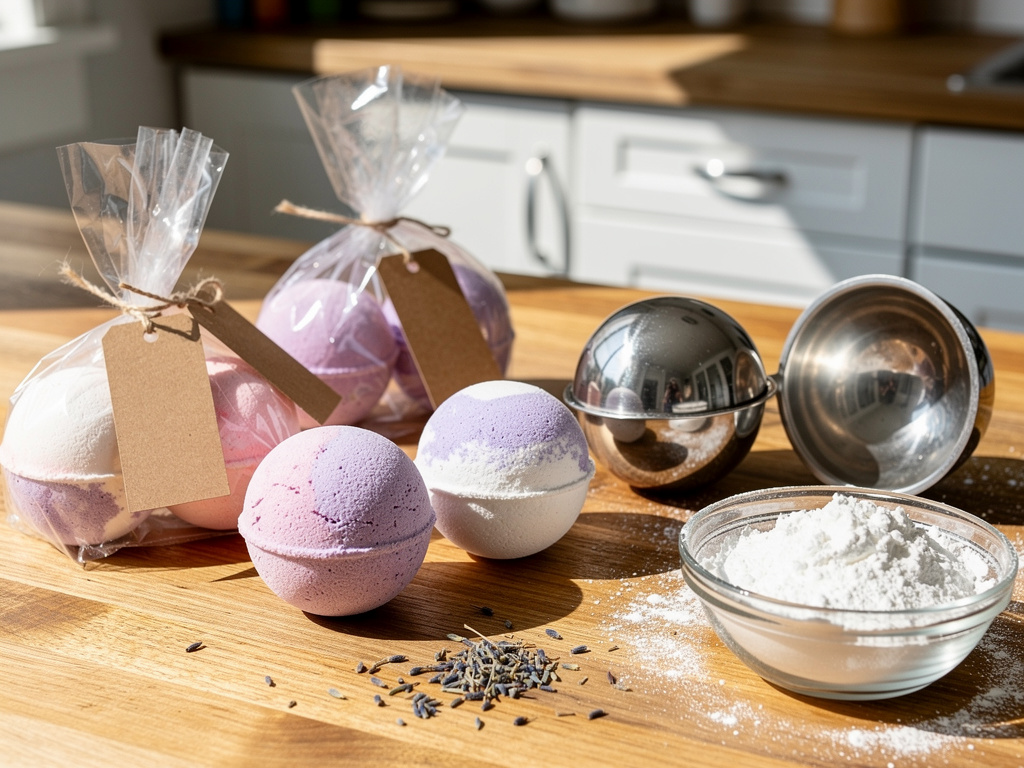


The short version: Yes, in most of the US you can sell bath bombs from home: a bath bomb is a cosmetic, the FDA says it is not against the law to make cosmetics at home, and the FDA does not license cosmetics businesses, though Florida and Nevada also require a state license or permit to make bath bombs. Press a mix of about 2 parts baking soda to 1 part citric acid, let the bombs harden 12 to 24 hours, fizz-test one from every batch, and seal each one with a label that gives the product name, net weight, ingredients from most to least, and your business name with a street address, plus a way for buyers to report a bad reaction. Keep your words to scent, color and fizz, because "helps you sleep" or "relieves sore muscles" turns a bath bomb into a drug, and add the bubble bath caution if your bomb foams and is not labeled for adults only. Then give buyers one link to order and pay: a $21 order of three bath bombs costs you $0.91 in card fees on Homegrown plus its $10-a-month plan (billed annually), against $2.45 in per-order fees on Etsy.
Checked on October 15, 2026: the FDA's cosmetics pages, 21 CFR 740.17, 21 U.S.C. 364e and 364h, Florida Statutes 499.01, Nevada's NRS 585, the Wholesale Supplies Plus bath bomb starter recipe, and the pricing pages of Homegrown, Etsy, Shopify, Square and Venmo. State, city and county permits differ, so verify your state's and city's current rules before your first sale. Homegrown customers create an account to place their first order, and Homegrown has no drops or countdown release feature.
You made a batch of bath bombs for gifts last December. Your sister asked for six more, a coworker asked where she could buy them, and now you are wondering whether this could pay for itself. It can, and you do not need a storefront on Main Street to do it. You need a recipe that holds together, a label that follows the federal rules, and a simple way for people to order.
This guide is for the part-time vendor selling from a home kitchen or craft room to neighbors, market regulars and friends of friends. It walks through every step from your first shopping list to your first paid order, with each federal rule linked to the government page that sets it.
In most of the US you can legally sell bath bombs from home, because a bath bomb sold to scent and color a bath is a cosmetic, and the FDA's small business fact sheet says "It's not against the law to manufacture cosmetics in your home." The same page says the FDA does not license cosmetics firms and does not approve cosmetic products before they go on sale, with one exception: color additives. What you take on instead is responsibility. Your bombs have to be safe when used the normal way, and they have to be labeled correctly. Federal registration only applies once a business averages $1,000,000 a year in US cosmetic sales over 3 years (adjusted for inflation), far above a weekend bath bomb table. A few states add their own license on top. Florida requires a cosmetic manufacturer permit, and the exemption in Florida Statutes 499.01(2)(p) for vendors with $25,000 or less in yearly sales lets them make only soap, lotion, moisturizer and cream, which leaves out bath bombs. Nevada's NRS 585.245 requires a license to make cosmetics at any location in the state, and a separate cottage cosmetics license for home vendors takes effect on July 1, 2027.
The federal law defines cosmetics as "articles intended to be rubbed, poured, sprinkled, or sprayed on, introduced into, or otherwise applied to the human body" for "cleansing, beautifying, promoting attractiveness" and similar uses. A fizzing ball of soda, acid, oil and scent dropped into bath water fits that description.
Three things follow from that:
Once your bombs are made and labeled, the next question is where people will buy them. Our guide to the seven places that actually sell bath bombs compares farmers markets, craft fairs, boutiques, consignment and online, so this page stays on getting your first batch ready to sell.
You can make your first five sellable bath bombs for about $30 in supplies plus fragrance and molds: the Wholesale Supplies Plus Bath Bomb Starter Recipe lists a shopping list that came to $29.66 on October 15, 2026. That $29.66 covers 1 pound of citric acid, 2 pounds of baking soda, 2 ounces of white kaolin clay, 2 ounces of Shea 50 (a water-friendly liquid form of shea butter) and a pair of nitrile gloves. The list also names five 2.75 inch ball molds, but the mold line was greyed out with no price that day, so the molds are not in the $29.66. Our bath bomb pricing guide found a 2.75 inch two-piece ball mold at Wholesale Supplies Plus for $25.34 for 50 sets on October 5, 2026, about 51 cents a set, on sale from $31.67. Fragrance is not in the list either, so add one bottle of a skin-safe fragrance oil or essential oil.
From your kitchen you also need:
Keep your bath bomb tools separate from your cooking tools. Citric acid and fragrance oil are not things you want in tomorrow's pancake batter, and it makes your setup easier to explain to anyone who asks.
Buy the starter sizes once, not the bulk sizes. That $29.66 list makes 5 big bath bombs once you add molds and fragrance, which is enough to learn the recipe, find the scent you like and see how long your bombs last in your own climate. Move to 5 pound bags only after you have sold your first 20.
A sellable bath bomb is mostly 2 parts baking soda to 1 part citric acid by weight, held together with a little oil and alcohol and packed hard into a mold. The Wholesale Supplies Plus starter recipe uses 25.80 ounces of baking soda, 13 ounces of citric acid, 0.40 ounces of kaolin clay, 0.40 ounces of Shea 50 and up to 1% fragrance, which is 0.40 ounces. That totals 40 ounces and makes 5 bombs in 2.75 inch molds, or about 8 ounces each.
Here is the recipe's process, step by step:
The 8 ounce size from that recipe is large. The eight small shops in our pricing guide sold single bombs of about 4 to 7 ounces, so if you want a smaller ball, use a smaller mold and the same mix. Keep the ratio the same and only the yield changes.
A few changes are common once you have the basics down. Some vendors add Epsom salt or cornstarch to change the texture, or a foaming powder so the bath gets bubbles. Each change means a new ingredient on the label, and adding a foaming agent can bring in an extra warning, which the label section covers.
Plan on 12 to 24 hours before you sell or wrap a new batch: the starter recipe says to leave bath bombs in the mold at least 2 hours, and that they "should be completely hardened after 12-24 hours." Sell or wrap a bomb before then and it can crumble in the bag or lose its round shape on the bottom. Setting them on bubble wrap or in an egg carton keeps a flat spot from forming while they finish hardening.
Drying is where weather starts to matter. Baking soda and citric acid react when they meet water, which is the whole point in a bathtub and the whole problem in a damp kitchen. A batch pressed on a muggy August afternoon can start to puff, crack or "sweat" before it ever hardens.
Moisture is what sets off the fizz, so a humid room can ruin a batch before anyone buys it. Press on dry days if you can, run a dehumidifier or the air conditioning in the room where bombs dry, and never leave a tray of fresh bombs next to a running dishwasher, a boiling pot or a steamy bathroom.
Once they are hard, a sealed wrapper is what keeps them that way until bath night. The packaging section covers which wrappers hold up.
Drop one bath bomb from every batch into a tub or a big bowl of warm water before you sell any of the rest. That one bomb tells you whether the batch fizzes, whether the color stains, whether the scent is strong enough and whether the oil leaves the tub slippery. The FDA's fact sheet also says the business whose name is on the label is "required to ensure adequate substantiation of safety" and to "maintain records that support substantiation", so writing down what you tested is part of the job, not a nice extra.
Here is a simple test routine that fits in 10 minutes:
Then write it down: the date, the batch size, every ingredient and the amount, the supplier and lot number if the bag has one, and what the test bomb did. If a customer ever reports a rash, that record is how you find which batch it came from.
Number every batch and write the number in small print on the back of the label, like "B-014." It takes two seconds per bomb, and if a buyer has a problem, you can pull every other bomb from that batch instead of guessing.
Use only colorants that the FDA has approved for cosmetics, because color additives are the one ingredient group the FDA must approve before a cosmetic is sold. The FDA's summary table of color additives lists each approved color and what it may be used for. Mica, for example, appears under 21 CFR 73.2496 for "cosmetics generally," while some other colors are listed only for food or only for drugs.
What that means when you shop:
The FDA's fact sheet also warns that a product can become unsafe through "microbial contamination" or "other contaminants," so keep botanicals dry and stored in sealed jars, the same as your powders.
A bath bomb label needs five things: what it is, how much is in it, the ingredients from most to least, the name and street address of your business, and a way for buyers to report a bad reaction. The FDA's Cosmetics Labeling Guide covers the first four, and a 2022 federal law, the Modernization of Cosmetics Regulation Act (MoCRA for short), added the fifth. On a 5 ounce bomb, the weight line reads "Net Wt. 5 oz," and it has to be accurate.
Swipe sideways to see all four label columns.
| Label part | What the rule says | On a bath bomb it looks like | Source |
|---|---|---|---|
| Product name (identity) | Say what the product is on the front panel | "Lavender Bath Bomb" | FDA Cosmetics Labeling Guide |
| Net quantity | Solid products are stated by weight, with "net wt." | "Net Wt. 5 oz (142 g)" | FDA Cosmetics Labeling Guide |
| Ingredients | Listed in descending order of predominance; fragrance can be listed as "fragrance" for now; MoCRA directs FDA to add fragrance allergen labeling, so check FDA's MoCRA page before a big label order | "Sodium Bicarbonate, Citric Acid, Kaolin, Fragrance, PEG-50 Shea Butter" | FDA Cosmetics Labeling Guide (21 CFR 701.3) |
| Name and place of business | Street address, city, state and ZIP; a P.O. box or website alone is not enough | "Made by [your business name], [street address], [city, state ZIP]" | FDA small business fact sheet (21 CFR 701.12) |
| Contact for bad reactions | A US address, phone number or electronic contact such as a website | "Questions or reactions: [your website or business email]" | 21 U.S.C. 364e |
| Bubble bath caution | Only for foaming bath products not labeled for adults only | The full caution text, below | 21 CFR 740.17 |
We read each rule on the FDA's labeling guide and small business fact sheet, the eCFR and the U.S. Code on October 15, 2026. The bracketed parts are where your own details go. The ingredient example is adapted from the label the Wholesale Supplies Plus starter recipe gives for its own formula, with baking soda written as sodium bicarbonate.
The address rule surprises many home vendors. The FDA's fact sheet says "A post office box or website address is not adequate," and that the label must include "the street address, city, state, and ZIP code," though you may leave off the street address "if your firm is listed in a current city or telephone directory." If you do not want your home address on every bomb, the same fact sheet gives two other routes: you "may use the main place of business instead of the actual place where the cosmetic was manufactured," or a distributor's name and address after a phrase such as "Distributed by" or "Manufactured for."
The reaction contact is easier. 21 U.S.C. 364e says each cosmetic label must include "a domestic address, domestic phone number, or electronic contact information, which may include a website." For most home vendors that is a website or a business email line.
Small labels make all of this hard to fit. A round bomb in a shrink bag usually gets a sticker on the bag or a tag tied to it, and the ingredient list can go on the back. Print a test sheet and stick one on a wrapped bomb before you order a few hundred.
If your bath bomb contains a foaming agent meant to make bubbles in the bath, federal rule 21 CFR 740.17 requires a caution on the label unless the product is labeled as intended for adults only. The rule covers "any product intended to be added to a bath for the purpose of producing foam that contains a surface-active agent serving as a detergent or foaming ingredient." A plain fizzing bomb of soda and citric acid makes no foam, so it does not fall under this rule. A "bubbling" bomb with a foaming powder in it does, so adding that powder to a $7 bomb also adds this caution to its label.
The caution, word for word, is:
> Caution: Use only as directed. Excessive use or prolonged exposure may cause irritation to skin and urinary tract. Discontinue use if rash, redness, or itching occurs. Consult your physician if irritation persists. Keep out of reach of children.
Your choices for a foaming bomb:
Kids' shapes, like dinosaurs or unicorns, make the adults-only route a hard sell. If you plan to make kids' bombs that foam, plan on the full caution.
Any word that promises to treat, relieve or change how the body works can turn a bath bomb into a drug, because the FDA decides cosmetic or drug by "a product's intended use," and what you say on the label and in your listings shows that use. The FDA's page Is It a Cosmetic, a Drug, or Both? gives two examples that apply directly to bath bomb wording: a scent sold with claims that it will "help the consumer sleep" is a drug, and a product meant for "relieving muscle pain" is a drug.
A drug has to follow drug rules that a home bath bomb business is not set up for: FDA approval or an over-the-counter drug monograph, drug manufacturing rules and drug registration. That is true for a $7 single bomb and a $21 gift set alike. So the words on your label, your table sign, your Instagram post and your storefront all need to stay on the cosmetic side.
Scroll right to compare both kinds of wording.
| Cosmetic wording (fine) | Drug wording (avoid) |
|---|---|
| "Smells like lavender fields" | "Lavender to help you fall asleep" |
| "A relaxing soak after a long day" | "Relieves sore, aching muscles" |
| "Leaves skin feeling soft" | "Heals dry, cracked or itchy skin" |
| "Eucalyptus and mint scent" | "Clears congestion and colds" |
| "Fizzes pink and smells like roses" | "Eases stress and anxiety" |
The drug column follows the FDA's own examples on its cosmetic or drug page, checked October 15, 2026: sleep claims and relief of muscle pain. The other rows apply the same intended use test; when you are unsure about a phrase, leave it out.
Watch the words you add in casual places too. A product photo caption that says "my go-to for sore muscles" counts as a claim about what the product does, even if the label itself is clean.
Most home bath bomb vendors do not, because MoCRA exempts small businesses with average US cosmetic sales under $1,000,000 a year over the previous 3 years, adjusted for inflation, from facility registration, product listing and the federal manufacturing practice rules. That is in 21 U.S.C. 364h. The exemption does not apply to a few product types, such as products used around the eye, injected, or meant for internal use, and a bath bomb is none of those.
What the exemption does not take away:
If you ever grow past the exemption, the FDA's MoCRA page is where registration starts. For most people reading this, batch records, a clean label, approved colors and a plan to report a serious reaction are the whole federal checklist.
Local rules are where bath bomb vendors differ the most: the U.S. Small Business Administration says the licenses and permits you need from "the state, county, or city will depend on your business activities and business location." The FDA's fact sheet says the same thing from the other side: the FDA does not license cosmetics firms, but "state or local authorities may require licensing or have other requirements." Your city hall or county clerk is the place to ask.
Before your first $21 sale, call your city hall or county clerk with this list, in the order most people run into it:
Our full guide to the license rules for selling skincare walks through state cosmetics permits and local registrations in more depth, and the same rules apply to bath bombs.
Seal every bath bomb in its own airtight wrapper the day it finishes hardening, because air and humidity slowly use up the fizz. A bomb sitting naked on a table in July can puff and crack in an afternoon. A sealed one keeps its shape and its scent until someone drops it in the tub.
The common choices, from cheapest to most giftable:
Store your finished stock in a sealed plastic bin in the coolest, driest room you have, and keep a silica gel packet in the bin. Bring only what fits on your table to a market, and keep the bin closed in your car between restocks.
Start a standard 4 to 5 ounce bath bomb at $6 to $8, the range our bath bomb pricing guide landed on when it checked eight small shops on October 5, 2026. That guide found a median of $7.50 for a single handmade bomb and put the materials and shrink bag in a 5 ounce bomb at about $1.10 at small-batch sale prices, or $1.34 at regular prices. It walks through minis, big balls, gift sets and wholesale prices, so this section only covers how pricing fits into your first month.
Two rules of thumb for a new vendor:
The rest of this guide uses that $21 set of three $7 bombs as the example order.
On a $21 order of three bath bombs, picked up locally, you pay $0.50 through a Venmo business profile, $0.91 on Homegrown or Shopify, $0.99 on Square's free plan, and $2.45 on Etsy before any shipping charge, all before any monthly plan. Over a month of 30 of those orders, that is $14.97, $27.27, $29.79 and $73.35 in per-order fees, and Homegrown and Shopify add their monthly plans on top. The cheapest row on fees is also the one where you take every order by hand.
Every row below shows the whole fee stack: the plan, any trial, any platform fee, card processing, and who pays each part.
Slide the table to the left for the full fee stack.
| Way to take orders | Monthly plan | Trial | Platform or listing fee | Card processing | Customer pays on a $21 order | Vendor pays on a $21 order | Vendor pays for 30 orders at $21 in a month |
|---|---|---|---|---|---|---|---|
| Instagram or text messages, paid through a Venmo business profile | $0 | None needed | None | 1.9% + $0.10 per payment, paid by the vendor | $21.00 | $0.50 | $14.97, plus every message you answer by hand |
| Etsy | $0 (Etsy Plus is an optional $10 a month) | None needed (a one-time set-up fee may apply) | $0.20 listing fee for each item sold (one gift set of three bath bombs here, $0.20) plus a 6.5% transaction fee ($1.37) | 3% + $0.25 through Etsy Payments ($0.88), paid by the vendor | $21.00 | $2.45 | $73.35 |
| Square Online, Square Free | $0 (Square Plus is $49 a month per location) | None needed | None | 3.3% + 30¢ online on Free, paid by the vendor | $21.00 | $0.99 | $29.79 |
| Shopify Basic | $29 billed yearly ($39 monthly) | 3 days, then $1 a month for 3 months | None with Shopify Payments | From 2.9% + 30¢ online, paid by the vendor | $21.00 | $0.91 plus the plan | $56.27 ($66.27 on monthly billing) |
| Homegrown storefront | $10 billed annually ($12.50 monthly) | 7 days, no charge until day 8 | None, 0% commission | 2.9% + $0.30, paid by the vendor | $21.00 | $0.91 plus the plan | $37.27 ($39.77 on monthly billing) |
Every price comes from the company's own page, loaded October 15, 2026: Venmo's fees page, Etsy's Fees and Payments Policy and Etsy Payments Policy, Square's pricing page, Shopify's pricing page and Homegrown's signup page. The math assumes local pickup with no shipping, and leaves out sales tax. Etsy is the exception to the pickup math: under its Payments Policy, sellers agree to ship sold items, and its 6.5% transaction fee also applies to whatever you charge for shipping. Monthly totals use the exact per-order fee before rounding, so they can differ from 30 times the rounded figure by a few cents. On Etsy, an order that came through Etsy's Offsite Ads adds a 15% fee ($3.15 here) for a shop under $10,000 a year in sales that has not opted out, or 12% ($2.52) with no opt-out once a shop reaches $10,000. Card fees are figured on the $21 price.
The Venmo row wins on fees. Venmo's fees page lists 1.9% + $0.10 when a payment goes to a business profile. What the row cannot show is the work: each order is a message thread, a payment request and a note about which scent and which pickup day.
Etsy is the most expensive row because three fees stack: a listing fee for each gift set sold, the 6.5% transaction fee and the payment fee. Etsy does bring shoppers who are already searching for bath bombs, and it is built for shipping to buyers across the country, which a local pickup link is not. For neighbors and market regulars who already know you, though, you would be paying Etsy's fees on buyers you found yourself.
If people already ask you for bath bombs, the fix is one link where they can pick a scent, pay and choose a pickup time without sending you a message. Homegrown gives you that storefront for $10 per month billed annually with no percentage fees beyond standard payment processing (2.9% + $0.30, paid by you and never added to your customer's total). On the $21 set of three, that is $0.91 an order.
How it compares for a bath bomb vendor:
The parts that fit bath bombs specifically:
Customers create a Homegrown account to place their first order. There are no drops or countdown releases. Homegrown's signup page lists pickup and local delivery, not shipping, so out-of-state buyers are still an Etsy job. Your storefront is listed on Homegrown's marketplace, but plan on most orders coming from people you send to your own link. You can set up your bath bomb storefront during the 7-day trial, with no charge until day 8.
Not yet: a pull of the Homegrown catalog on October 15, 2026 found 0 bath bombs among 2,927 products from 324 vendors. The closest products were 2 bath soaks: a $4.50 pound of rosemary bath soak and a $7.00 single-use bath salt blend sold in four scents.
We pulled all 2,927 products from 324 vendors on October 15, 2026, and searched every name, description and scent option for bath bomb, bomb, fizz, fizzer, steamer, bubble bar, bath melt, bath soak, bath salt and citric acid. Every "bomb" and "fizz" was a food or a scent name: freeze dried candy, kimchi, a cola jelly and one candle scent called "Bombshell type," and every "citric acid" was an ingredient in cookies or candy. The only bath soaks or fizzing bath products were the 2 bath soaks above, one from Elodie Handmade Soap and one from Aya's Garden Potions. Body care sellers on Homegrown today sell soap bars, sugar scrubs, lotions and tallow balms next to their eggs, bread and honey.
That cuts two ways. A bath bomb vendor who lists today is the only one on the marketplace, so nobody else's bombs sit next to yours. It also means a shopper browsing Homegrown today finds no bath bombs, so nobody is buying them there yet. Your first orders will come from the people you hand your link to: market regulars, coworkers, the parent group chat and the friend who asked for six more.
If you already sell soap, a sugar scrub or eggs from a farm storefront, adding three bath bomb scents to that same storefront is a small test. A buyer picking up a dozen eggs can add a gift set to the same order.
The most common first-month problems are bombs that crack or go flat in storage, labels that break a federal rule, and words that turn a bath bomb into a drug. Each one is cheap to avoid and expensive to fix after you have printed 200 labels or wrapped 60 bombs.
The list to check before your first sale:
If bath products are part of a bigger table, our guide on selling soaps and bath products at a farmers market covers booth setup, display and the market rules that apply to a whole bath and body line.
The FDA does not license cosmetics businesses or approve bath bombs before they are sold, so there is no federal license to get. Your state, county or city may still require a general business license, a home business zoning permit or a sales tax account, and a few states, such as Florida and Nevada, require a state cosmetic manufacturing permit or license. Check with your city hall or county clerk before your first sale, because these local rules vary by address.
No. Cottage food laws cover food made in a home kitchen, and a bath bomb is a cosmetic. South Carolina's home food law guide says the same about soap: it "is a cosmetic and not a food, so it is not covered." When you sell bath bombs from home, the federal cosmetic label and safety rules apply, along with any local business licenses.
Yes. Bath bombs sold to consumers need the ingredients listed in descending order of predominance, meaning the biggest amount first. For a standard recipe that usually starts with sodium bicarbonate (baking soda) and citric acid. For now, fragrance can be listed simply as "fragrance." MoCRA directs FDA to add fragrance allergen labeling, so check the FDA's MoCRA page before you order a big batch of labels.
Usually not. MoCRA exempts small businesses with average US cosmetic sales under $1,000,000 a year over the previous three years, adjusted for inflation, from facility registration and product listing. You still have to label correctly, keep safety records and report serious reactions to the FDA within 15 business days.
No, not if you want to sell bath bombs from home as a cosmetic. The FDA's examples say a scent sold to help someone sleep, or a product meant to relieve muscle pain, is a drug, and drugs follow approval, manufacturing and registration rules a home bath bomb business is not set up for. Describe scent, color, fizz and how the bath feels instead.
Bath bombs lose fizz as they pick up moisture from the air, so how long they last depends mostly on packaging and storage. Sealed in shrink wrap and kept in a cool, dry place, they hold up far longer than unwrapped bombs on a shelf. Test a bomb from your oldest stock every few weeks, and stop selling any batch that no longer fizzes well.
These guides cover the next steps once your first batch is labeled: where to sell, what to charge and how the rules work for other bath and body products. If you only read one, start with the where-to-sell guide, because the place you sell decides your packaging, your label size and how many bombs you press each week. The pricing guide is the one to open before you print a price on anything.
Your first sellable batch takes about 24 hours from mixing bowl to wrapped bomb, and about $30 in starter supplies plus fragrance and molds. It does not need a storefront on Main Street. It needs a recipe that holds together, a full day to harden, one test bomb, a sealed wrapper and a label with the five parts the FDA asks for. After that, the work is getting the people who already asked for your bath bombs to order without a dozen messages.
Here is the short list for this week:
Homegrown is $10 a month billed annually ($12.50 monthly), with 0% commission and card fees of 2.9% + $0.30 that you pay, so a $21 set of three bath bombs costs you $0.91 plus the plan. Build your Homegrown storefront tonight, add your first three scents, and text the link to everyone who asked for more.



