
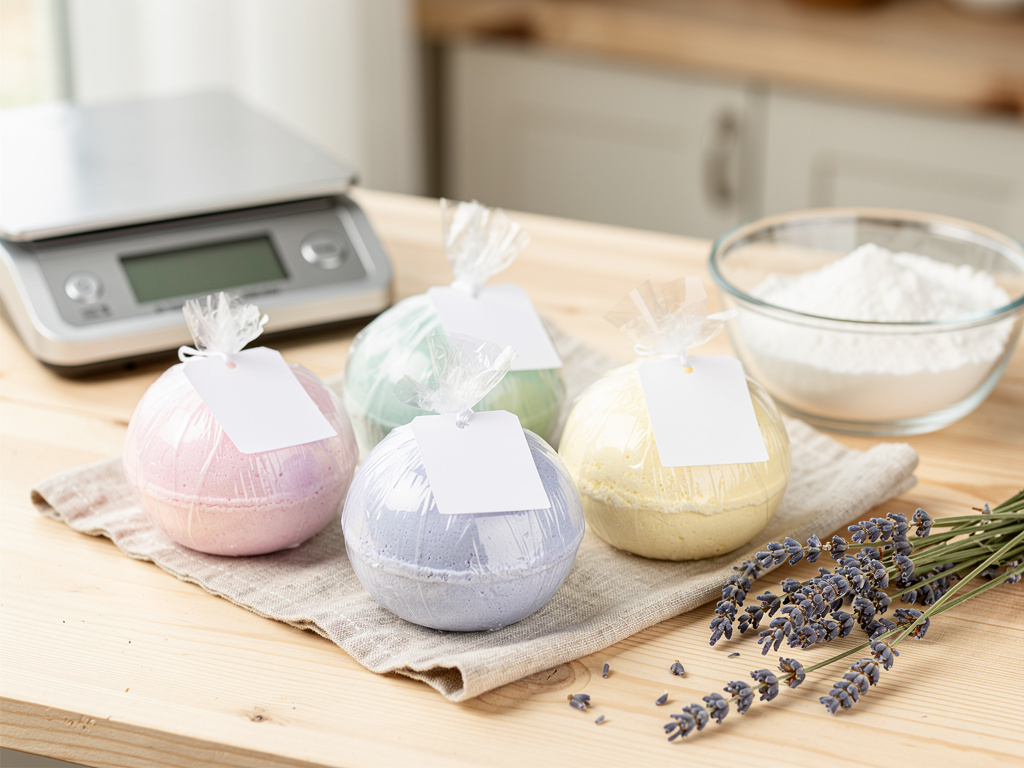


The short version: Sell a standard 4 to 5 ounce handmade bath bomb for $6 to $8, a 2 ounce mini for about $4 on its own, or $3 to $3.20 each in a bag of five, and a big 6.5 ounce ball for $8 to $10. Eight small shops we checked that sell their own bombs charge a median of $7.50 for a single bath bomb, and the seven that state one weight charge a median of $1.33 an ounce. The baking soda, citric acid, clay, oil, fragrance and shrink bag in one 5 ounce bomb cost about $1.10 at small-batch supply prices, so the rest of the price pays for your pressing time, the bombs that crack and your booth. On a Homegrown storefront the only per-order cost on a $7.50 bomb is 52 cents of card processing, on a plan of $10 a month billed annually.
Checked on October 5, 2026: Wholesale Supplies Plus supply prices and its starter recipe, eight small shops' own product pages, Da Bomb and SALUS, and the pricing pages of Homegrown, Etsy, Shopify and Square. At regular Wholesale Supplies Plus prices, without that day's sale on soda, acid and clay, the same 5 ounce bomb is about $1.34. Homegrown customers create an account to place their first order, and Homegrown has no drops or countdown release feature.
A bath bomb is mostly baking soda and citric acid, two powders that cost pennies an ounce. That makes the price feel like a guess. Charge $4 and you look like a bargain bin. Charge $10 and you wonder whether anyone at the farmers market will pay it.
This guide works it out with numbers loaded on one day. It runs a supplier's own recipe through that supplier's live prices, lists what eight small shops charge right now, compares two established brands by the ounce, and shows what each way of selling takes off a $7.50 bomb. By the end you will have a price for every size you press.
Price a standard 4 to 5 ounce bath bomb at $6 to $8, which sits inside the $5 to $9 that the four shops selling a 4 to 5 ounce bomb charged on October 5, 2026, brackets the $7.50 median across all eight shops we checked, and is 5.5 to 7.3 times the $1.10 of materials in a 5 ounce bomb. That multiple looks high, and it should be. The powder is cheap, and the work is in the pressing.
If you are still deciding whether bath products belong on your table at all, the companion guide on how to sell soaps and bath products at a farmers market covers permits, making and display. This page is only about the price.
Swipe the table to see every size.
| Size | Typical weight | Your materials at small-batch prices | Suggested price | Multiple of materials |
|---|---|---|---|---|
| Mini | About 2 oz | $0.46 | About $4 alone, $15 to $16 per bag of five | 6.5x to 8.7x |
| Standard | 4 to 5 oz (5 oz figured) | $1.10 | $6 to $8 | 5.5x to 7.3x |
| Large 2.75 inch ball | About 6.5 oz | $1.42 | $8 to $10 | 5.6x to 7.0x |
| Three standard bombs as one set | 15 oz | $3.30 | $18 to $21 | 5.5x to 6.4x |
Materials come from Wholesale Supplies Plus product pages on October 5, 2026, run through its Bath Bomb Starter Recipe at 5 pound bags of soda and acid, a 1 pound bag of kaolin clay and Shea 50, a 16 ounce fragrance bottle and a 200-count pack of 6 by 6 inch shrink bags. Your printed label is not included. The large row is figured at Da Bomb's 6.5 ounce ball; the starter recipe itself says its 40 ounces make 5 bombs in 2.75 inch molds, which works out to about 8 ounces each and about $1.74 of materials a bomb.
Where you land inside each range comes down to what a customer can see and smell:
The median price of a single handmade bath bomb is $7.50 across eight small US shops that sell their own bombs on their own websites, with prices from $5.00 to $10.00 on October 5, 2026. By the ounce, the median of the seven shops that state one weight was $1.33. Five of the eight charge $7 or more, so $7.50 is an ordinary price, not a bold one.
Slide the table sideways to see all eight shops.
| Shop | Bath bomb | Weight the shop states | Price | Price per ounce |
|---|---|---|---|---|
| Monticello Soap Company, Monticello, FL | Lavender, natural | About 4.5 oz | $5.00 | $1.11 |
| Lynchburg Soap Company, middle Tennessee | Beach, goat milk | 4.0 oz | $5.00 | $1.25 |
| Quarry Life LLC | Single bath bomb, ten scents | 6 oz | $5.95 | $0.99 |
| Latika Beauty, Texas | Naturally Crafted, essential oils | 4.5 oz | $7.00 | $1.56 |
| Artesana Soaps | Lavender Spa | 6.0 oz | $8.00 | $1.33 |
| Southern E-Scentuals | Blush, round, sold singly | About 5 to 7 oz | $8.99 | $1.28 to $1.80 |
| Beachy Bubbles Bath Co | Blooming Romance, heart topped with rose petals | 5 oz | $9.00 | $1.80 |
| Ginger June Candle Co. | Renewal, herb and flower botanical | 5.5 oz | $10.00 | $1.82 |
We read every price off the shop's own site on October 5, 2026, and every bomb was in stock. Weights are as each shop states them; "about" stands in for the shop's own "approx." or "average". We found the shops with a web search for small US vendors selling single bath bombs on their own sites and kept the ones whose page stated a weight. Two shops were dropped because the bomb we found had sold out, and resellers of another brand's bombs were left out, including a hair salon and a multi-seller marketplace whose listings named a different maker. Two bombs we first found in gift shops turned out to be made by other small shops, so we priced those makers on their own sites instead: Beachy Bubbles Bath Co and Ginger June Candle Co. This is a sample of eight, not a national survey.
What eight small shops charge for one bath bomb
Source: each shop's own product page, October 5, 2026, eight in-stock single bath bombs.
Three things stand out in that list:
Da Bomb, a brand sold nationally, lands at $1.31 an ounce, and SALUS, a Colorado maker that handcrafts in small batches and runs two stores, lands at $1.80. That is one just below the $1.33 small-shop median and one well above it, so a handmade 5 ounce bomb at $7.50, or $1.50 an ounce, sits between the two: above Da Bomb and below SALUS. We loaded both on October 5, 2026.
Swipe left to see the brands side by side.
| Brand | Product | Weight | Price | Price per ounce |
|---|---|---|---|---|
| Da Bomb Bath Fizzers | Beach Bomb, 2.75 inch | 6.5 oz | $8.50 | $1.31 |
| SALUS | Lavender bath bomb | 2.2 oz | $3.95 | $1.80 |
| Small-shop median (table above) | Eight single bath bombs | 4 to 7 oz | $7.50 | $1.33 |
Prices from dabombfizzers.com and shopsalus.com on October 5, 2026. SALUS sells its bomb at $3.95 one at a time, $23.70 for six and $118.50 for thirty, the same $3.95 each at every count. Lush's US site blocked our page load that day, so it is not in the table.
Here is what that means at your table. A shopper who has paid $8.50 for a Da Bomb knows what a 2.75 inch ball costs, and that number is the price your plain round bomb of the same size gets measured against. You get past it with what the brands do not have: your own scents, a botanical top, or a customer who knows your name.
One 5 ounce bath bomb costs $1.83 in materials when you buy starter sizes, $1.10 at small-batch sizes and $0.88 in bulk, using the Wholesale Supplies Plus Bath Bomb Starter Recipe and the same company's prices on October 5, 2026. The recipe is 25.8 ounces of baking soda, 13 ounces of citric acid, 0.4 ounces each of kaolin clay and Shea 50 (a liquid, water-dispersible form of shea), and up to 1% fragrance, which makes 40 ounces of mix.
Swipe left for all three buying levels.
| Buying level | What you buy | 40 oz batch | Per ounce of mix | 5 oz bomb with shrink bag |
|---|---|---|---|---|
| Starter | 1 lb baking soda and citric acid, 2 oz clay and Shea 50, 2 fl oz fragrance, 50 bags | $14.02 | $0.35 | $1.83 |
| Small batch | 5 lb bags of soda and acid, 1 lb clay and Shea 50, 16 fl oz fragrance, 200 bags | $8.55 | $0.21 | $1.10 |
| Bulk | 50 lb baking soda, citric acid still in 5 lb bags, 5 lb clay, 7 lb Shea 50, 25 lb fragrance, 1,000 bags | $6.88 | $0.17 | $0.88 |
Prices from Wholesale Supplies Plus product pages on October 5, 2026, using its Lavender Fragrance Oil 91 and Shrink Wrap Flat Bags, 6 by 6 inch. We treated a fluid ounce of fragrance as an ounce of weight, which is close for most oils. The rubbing alcohol you spritz on the mix is not priced. Baking soda, citric acid and kaolin clay were on sale that day, 5% to 25% off depending on size. At regular prices the same 5 ounce bomb is about $2.32 at starter sizes, $1.34 at small-batch sizes and $0.95 in bulk, where the 50 pound citric acid bag becomes the cheaper buy.
At small-batch prices, here is where the $1.10 goes in a 5 ounce bomb:
Those lines add to $1.11 because each one is rounded to the cent.
The molds can add more than you expect. A 2.75 inch two-piece ball mold was $25.34 for 50 sets that day, about 51 cents a set, on sale from $31.67. Wholesale Supplies Plus sells these clamshells as packaging too, and its starter recipe suggests leaving the bombs to harden in them and using the clamshells as the package. If you unmold and press again, that 51 cents is spread over every bomb the mold makes. If you sell each bomb in its clamshell, it adds about 51 cents a bomb, which takes the 6.5 ounce ball that mold makes from $1.42 to about $1.93.
Citric acid is 43% of the batch cost at small-batch prices even though it is only a third of the weight, and a sale can change which bag size is cheapest. On October 5, 2026, with a sale running, Wholesale Supplies Plus charged $0.40 an ounce for a 1 pound bag, $0.28 for a 5 pound bag and $0.30 for a 50 pound bag. At its regular prices those were $0.53, $0.35 and $0.32.
A sale can flip which bag is cheapest per ounce. We checked Wholesale Supplies Plus on October 5, 2026: the 5 pound bag of citric acid was 20% off at $22.62 and the 50 pound bag was 5% off at $240.83, so ten 5 pound bags came to $226.20, less than the one big bag. At the regular prices of $28.27 and $253.50, the 50 pound bag is the cheaper one, $0.32 an ounce against $0.35. Divide every size by its ounces before you buy, every time, because supplier prices move.
Baking soda behaves the way you expect. It fell from $0.23 an ounce in a 1 pound bag to under $0.10 in a 50 pound bag. That is why the bulk column above saves 22 cents a bomb mostly on soda, while citric acid stays put.
Three practical rules come out of this:
Doubling or tripling the fragrance in a 5 ounce bomb adds only 7 to 13 cents at small-batch prices, so scent strength is not where your margin goes. The starter recipe uses up to 1%, and you may want a stronger smell in the tub.
Drag the table sideways for each fragrance level.
| Fragrance load | Fragrance in a 5 oz bomb | Fragrance cost | Whole bomb with shrink bag |
|---|---|---|---|
| 1% (the recipe's top level) | 0.05 oz | $0.08 | $1.10 |
| 2% | 0.10 oz | $0.15 | $1.17 |
| 3% | 0.15 oz | $0.23 | $1.23 |
Figured at the 16 ounce bottle of Wholesale Supplies Plus Lavender Fragrance Oil 91, $24.10 on October 5, 2026, with the rest of the 5 ounces made up of the recipe's other ingredients in the same proportions.
Cost is not the only limit on scent. Good suppliers publish usage guidelines and a safety data sheet for each fragrance oil. Check those for bath products before you go above the recipe's 1%, because a bath bomb dissolves into the water your customer sits in.
Add up materials, your time and your selling costs, then make sure the price clears four times materials and lands near what shops charge. Here is the order to do it in, with one example worked through.
The example lines are where your price really gets decided. A vendor who presses 40 bombs an hour has a time cost of 50 cents, not $1. A vendor at a $60 market needs to sell twice as many bombs to spread the fee. Put your own numbers in, and treat $3.10 as a floor rather than the full cost.
Every bomb that cracks or crumbles raises the cost of the ones you can sell, so a 10% loss rate adds about 12 cents of materials and 11 cents of time to each good bomb. Bath bombs can stick in the mold, split at the seam or flatten on one side while they dry, and a cracked bomb is not one you can sell at full price.
Here is the math on one pressing day of 40 bombs, at small-batch prices:
That is why the four-times-materials floor exists. It leaves room for the bad days. The starter recipe says to leave bombs in the mold for at least 2 hours and that they are fully hardened after 12 to 24 hours, so build drying time into your schedule and never press the night before a market.
Track pressed against sellable for your first five batches. If more than 4 of every 40 crack, fix the recipe or your drying spot before you raise the price. A bath bomb vendor who loses 1 in 10 is paying about 23 cents a bomb for it, and that money is easier to save than to charge for.
Price a single mini at about $4, a bag of five minis at $15 to $16, big 6.5 ounce balls at $8 to $10, and shaped or decorated bombs at the top of your range or above it, because shape and decoration cost you time, not powder. Materials scale with weight, but your time per bomb barely does.
A three-pack earns you more per order and less per bomb, and that is a good trade when your bombs are $7.50 and each order carries a fixed 30 cent card fee. One shop on our list shows how far a bundle ladder can go.
Swipe to see the full ladder.
| Southern E-Scentuals quantity | Price | Price per bomb |
|---|---|---|
| 1 bath bomb | $8.99 | $8.99 |
| 5 bath bombs | $35.00 | $7.00 |
| 10 bath bombs | $60.00 | $6.00 |
| 15 bath bombs | $82.00 | $5.47 |
| 20 bath bombs | $100.00 | $5.00 |
From the Southern E-Scentuals bath bomb page on October 5, 2026. Not every shop does this: SALUS charged the same $3.95 a bomb whether you bought one, six or thirty.
For a farmers market table, a simpler ladder works better than five steps:
List the three-pack as its own product with its own price. On Homegrown a $20 three-pack carries 88 cents of card processing, or 29 cents a bomb. Sold as three separate $7.50 orders, the same three bombs carry $1.55.
Selling fees take 35 cents to $1.16 off a $7.50 bath bomb, depending on where the sale happens, and the 30 cents that most card processors add to every order is the part that bites on a small item. Here is the full stack for one bomb, checked on each platform's own page.
Scroll sideways to see every fee column.
| Way of selling | Monthly plan | Trial | Platform fee | Card processing | Customer pays | You pay on one $7.50 bomb | You pay in a month of 50 one-bomb orders |
|---|---|---|---|---|---|---|---|
| Homegrown | $10 billed annually ($12.50 monthly) | 7 days, no charge until day 8 | None, 0% commission | 2.9% + $0.30, paid by you | $7.50 | $0.52 | $35.88 |
| Etsy | $0 | No plan to try | $0.20 listing fee plus 6.5% transaction fee (15% Offsite Ads fee when an ad made the sale) | 3% + $0.25 | $7.50 plus any shipping you charge | $1.16 | $58.13 |
| Shopify Basic | $29 billed yearly ($39 monthly) | 3 days free, then $1 a month for 3 months | None with Shopify Payments (2% with another provider) | 2.9% + 30¢ online | $7.50 | $0.52 | $54.88 |
| Square Free, card at your table | $0 | No plan to try | None | 2.6% + 15¢ in person | $7.50 | $0.35 | $17.25 |
| Square Free, online order | $0 | No plan to try | None | 3.3% + 30¢ online | $7.50 | $0.55 | $27.38 |
Every fee read off the platform's own page on October 5, 2026: findhomegrown.com/signup, etsy.com/sell, shopify.com/pricing and squareup.com/us/en/pricing. Figured on a $7.50 price with no tax or shipping and rounded to the cent. The monthly column adds the plan, billed annually where there is a choice, to 50 times the per-bomb cost. Etsy's page also says you may be charged a one-time shop set-up fee, shown before your shop opens; it is not in the table.
The cheapest row is cheap only at your table. Square's 2.6% plus 15 cents is its rate when the card is present. The same bomb ordered online through Square's free plan on Tuesday for pickup Saturday pays 3.3% plus 30 cents, or 55 cents. Etsy's cost climbs when you charge shipping, because its 6.5% transaction fee also applies to the shipping price you set, and bath bombs are heavy for their price. We checked all of these on October 5, 2026.
Bath bombs get used up, so a regular who likes one of your scents comes back for it, and she runs out between markets. A regular who loved your lavender bomb in April wants three more in May, and without a link to order from, she messages you, waits or buys a bath bomb somewhere else.
Homegrown is $10 per month billed annually with no percentage fees beyond standard payment processing. On a $7.50 bomb that processing is 52 cents, with no platform commission and no fee added to your customer's total. Here is what fits bath bombs in particular:
How it compares to what bath bomb vendors usually try first. Etsy is the right tool if your bombs ship to strangers across the country, but it takes $1.16 of every $7.50 bomb sold there, in listing, transaction and processing fees, before shipping. Square is excellent at your table at 35 cents a bomb, and on its free plan an online order for the same bomb costs 55 cents in processing, three cents more than Homegrown's 52 cents before Homegrown's monthly plan. Shopify handles shipping and in-person sales well, at $29 a month billed yearly plus 2.9% and 30 cents online processing, before any apps.
What Homegrown does not do, said plainly. Your customer creates a Homegrown account to place a first order, which is one extra step. There is no drop or countdown release feature, so a vendor who launches seasonal bombs in timed drops will not find that here. Homegrown is built for pickup and local delivery, so if most of your bombs ship across the country, Etsy or Shopify fits better. Your storefront is listed on the marketplace, but plan on most orders coming from people you send to your own link. And the 2.9% plus 30 cents of card processing is paid by you, with nothing passed on to the customer.
If your regulars already ask when you will be back, set up a Homegrown storefront for your bath bombs and put the link on your table sign. The 7-day trial means you are not charged until day 8, which is enough time to list your scents and take a first order.
No vendor on Homegrown listed a bath bomb or a shower steamer on October 5, 2026, so a vendor who adds them would have the category to themselves. Soap, on the other hand, is well covered.
In a pull of the Homegrown catalog on October 5, 2026, 0 of the 2,890 products listed by 310 vendors were bath bombs or shower steamers. We searched every listing's name and full description for bath bomb, fizzer, fizzie, shower steamer, bath melt, bath salt, bath soak, bubble bar and citric acid, then read every listing from each body-care, home and craft vendor by hand. The one bath product was Elodie Handmade Soap's 1 pound Organic Rosemary Bath Soak at $4.50. Six vendors list handmade bar soap, mostly at $5 to $8.50 a bar.
That matters for pricing in two ways:
If you sell soap or bath bombs at a market and want one ordering page for all of it, start a Homegrown storefront and list your bath bombs next to your bars. Customers order ahead and pick up at your next market.
A bath bomb sold to clean, soften or scent the bath is a cosmetic under federal law, so its label needs the product's name, the net weight, your business name and place of business, an ingredient list in descending order of predominance (most first), and a US address, US phone number or website where customers can report a bad reaction. The place of business is its own line: the FDA fact sheet says it means your street address, city, state and ZIP code, that "a post office box or website address is not adequate," and that you may leave off the street only if your business is listed in a current city or phone directory. Our step-by-step on selling bath bombs from home lays every label part out in one table, with the reaction contact MoCRA added and the bubble bath caution a foaming bomb needs. The FDA's fact sheet for small businesses and homemade cosmetics says, "It's not against the law to manufacture cosmetics in your home," and that cosmetics need no FDA approval before sale, except for color additives. We loaded it on October 5, 2026.
Four rules hit bath bombs harder than soap:
Under the 2022 cosmetics law, the Modernization of Cosmetics Regulation Act (MoCRA), FDA's guidance on cosmetic registration and listing says a business whose US cosmetic sales averaged under $1,000,000 a year over the past 3 years, adjusted for inflation, is exempt from facility registration and product listing, unless it makes certain products, such as products that regularly touch the eye's mucous membrane, are injected, are meant for internal use or change appearance for more than 24 hours. Labeling and safety rules still apply to everyone. That includes the contact line: the same guidance notes that under section 609(a) every cosmetic label must include "a domestic address, domestic phone number, or electronic contact information, which may be a website," through which the business can receive adverse event reports. The guide to whether you can sell homemade soap walks through registration, the small-business exemption and state permits in full. Rules change and states differ, so verify your state's current rules before your first sale.
Charge a shop about half your retail price, which is $3.75 for a bomb you sell at $7.50, and only if that still covers your materials and your time. At $3.75 a 5 ounce bomb leaves you $1.65 after $1.10 of materials and $1.00 of time.
For a real wholesale number, Spa Pure, a wholesale bath bomb supplier that also offers private label, sold 100 wholesale 5 ounce bath bombs for $270 on October 5, 2026. That is $2.70 a bomb, each wrapped in a cello bag with a hang tag and ribbon. That is the price a shop can buy at, and what you compete against when you pitch a store. Against your $2.10 of materials and time, $2.70 leaves 60 cents a bomb, and that is before you pay for a tag, a ribbon and a label to match theirs. That is thin for a small vendor.
Before you say yes to a shop, run through this:
If shops find you on Faire, a wholesale marketplace, the guide to Faire alternatives for soap and candle makers covers selling straight to customers instead.
One easy mistake is pricing off the powder, which leads a new vendor to charge $4 for a bomb that costs at least $3.10 to make and sell. The soda and acid look free, but your time and the booth fee are counted too. Others to watch for:
For more on pricing body-care products, the lip balm pricing guide uses the same cost-and-fees method on a $5 tube, and the cost-per-bar soap math works through a soap batch the same way.
Charge $6 to $8 for a 5 ounce handmade bath bomb. The four small US shops we checked that sell a bomb of 4 to 5 ounces charged $5.00 to $9.00 on October 5, 2026, against a $7.50 median across all eight. The materials in a 5 ounce bomb cost about $1.10 at small-batch supply prices. Go higher for foaming, botanical or shaped bombs.
A 5 ounce bath bomb costs about $1.83 in materials at starter supply sizes, $1.10 at small-batch sizes and $0.88 in bulk, based on Wholesale Supplies Plus prices and its starter recipe on October 5, 2026. The soda, acid and clay were on sale that day; at regular prices the small-batch figure is about $1.34. Citric acid and baking soda make up most of that. Your label and your time are extra.
No, not for a decorated, botanical or large bomb. Two of the eight small shops we checked charged $9.00 for a heart topped with rose petals and $10.00 for an herb and flower botanical, and a 6.5 ounce shaped bomb from Rusted Acre Soap Co. sold for $10.50. For a plain 4 ounce round bomb, $10 is a stretch: none of the plain 4 to 4.5 ounce bombs we checked was above $7.00.
Aim for a retail price of at least four times your materials, and closer to six or seven when you sell them yourself. That floor is where your price starts: a $7.50 bomb with $1.10 of materials is 6.8 times. After an example $1.00 of time, $1.00 of booth fee and 52 cents of card processing, about $3.88 is left. That $3.88 is about 52% of the price.
There is no federal license for cosmetics businesses, according to the FDA's small business fact sheet, but your state or city may require one. Florida, for example, exempts cosmetics businesses with $25,000 or less in yearly sales from its permit, but only for soaps, lotions, moisturizers and creams. Check with your state before your first sale, and label every bomb with its name, its ingredients, its net weight, your business name with its street address, city, state and ZIP (a P.O. box or website is not enough), a US address, phone number or website for reporting a bad reaction, and, if it foams with a detergent such as SLSa, the federal caution statement.
Sell on Etsy if most of your buyers are strangers who want bombs shipped. On Etsy, count $1.16 in listing, transaction and processing fees on a $7.50 bomb, checked October 5, 2026, before shipping. For local regulars, a pickup storefront or a card reader at your table keeps more of each sale.
These guides answer the questions that come right before and right after setting a bath bomb price. Each one is about making or selling body-care products.
A price only works if people can find it between market days. Once you have settled on $7.50 for a standard bomb, $20 for a three-pack and $16 for a bag of five minis, put all three where your regulars can order them on a Tuesday and pick them up on Saturday.
A Homegrown storefront costs $10 a month billed annually, or $12.50 billed monthly, with 0% commission and 2.9% plus 30 cents of card processing paid by you. You list each bomb, set a pickup spot at your market or your porch, and share one link on your table sign, your bags and your social posts. Your customers create an account the first time they order. There are no drops, and the marketplace listing is a bonus, not a promise of traffic, so plan on most orders coming from people you send to your link.
When your scents are ready, build your bath bomb storefront on Homegrown. You are not charged until day 8 of the trial.



