
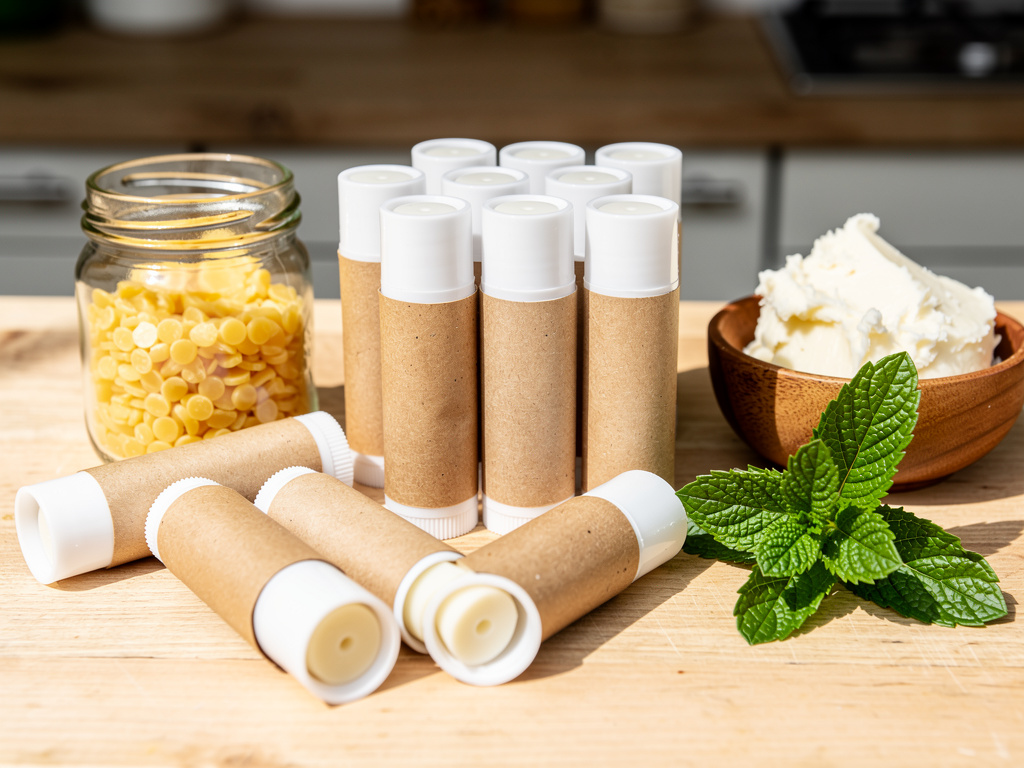


The short version: Sell a standard 0.15 ounce tube of handmade lip balm for $4 to $6, and a set of three for $12 to $15. Eight US small shops we checked charge a median of $4.50 a tube, and Burt's Bees lists its own beeswax lip balm at $3.99 for the same 0.15 ounces. The balm, tube and label in one tube cost about $0.44 at small-batch supply prices, and the empty tube is $0.31 of that, so price the tube before you price the wax. On a Homegrown storefront the only per-order cost on a $5 tube is 45 cents of card processing, on a plan of $10 a month billed annually, and a set of three at $12 cuts that to 22 cents a tube.
Checked on September 30, 2026: Wholesale Supplies Plus supply prices (most were on sale that day, and at its regular prices the same tube costs about $0.51) and its lip balm recipe, OnlineLabels, eight US small shops' own product pages, the Burt's Bees and ChapStick product pages, FDA's cosmetics pages, and the pricing pages of Homegrown, Etsy, Shopify and Square. Homegrown customers create an account to place their first order, and Homegrown has no drop or countdown release feature.
Lip balm is often the cheapest thing on a soap, honey or candle table, and it is easy to price by guess. One vendor charges $3, the booth across the aisle charges $6, and neither can tell you why.
This guide works it out from numbers loaded on one day. It uses live supply prices for one standard recipe, what eight US small shops charge for the same 0.15 ounce tube, what Burt's Bees and ChapStick charge, what each way of selling takes off a $5 sale, and the FDA rules that decide what your label and your claims can say. By the end you will have a price for every size you pour.
Price a standard lip balm tube at $4 to $6 for 0.15 ounces, which brackets the $4.50 median that eight US small shops charged on September 30, 2026 and sits 9 to 14 times above the $0.44 of materials inside it. That multiple sounds greedy until you see where the rest goes: your time, your booth, the card fee, and the tubes that dent, leak or never sell.
If you also make candles, wraps or salves from the same beeswax, how to sell beeswax products at a farmers market covers the process and the table setup. This page is only about the number on the tube.
Scroll sideways to see every format.
| Format | Balm inside | Your materials at small-batch prices | Suggested price | Multiple of materials |
|---|---|---|---|---|
| Standard 0.15 oz twist-up tube | 0.15 oz | $0.44 | $4 to $6 | 9.1x to 13.6x |
| 0.07 oz slim tube | 0.07 oz | $0.51 | $3 to $4 | 5.9x to 7.8x |
| 0.3 oz paper push-up tube | 0.3 oz | $1.68 | $7 to $9 | 4.2x to 5.4x |
| Three standard tubes sold as one set | 0.45 oz | $1.33 | $12 to $15 | 9.0x to 11.3x |
Supply prices come from Wholesale Supplies Plus product pages on September 30, 2026, figured at the 1 pound ingredient bags, the 4 ounce flavor oil bottle and the 100-tube pack (48-pack for paper tubes). Most of those were sale prices that day; at the site's regular prices the standard tube costs about $0.51 and the paper tube about $1.71. The label is one OnlineLabels lip balm label at about 3.5 cents, held the same for every format.
Where you land inside each range depends on things only you know:
Eight US small shops charged between $3.50 and $6.00 for a 0.15 ounce tube of lip balm on their own websites on September 30, 2026, with a median of $4.50 and an average of $4.56. Three of the eight sat exactly at $5.
Slide the table sideways to see all eight shops.
| Shop | Product | Size stated | Price | Price per ounce |
|---|---|---|---|---|
| Daisy Hollow Farm | Beeswax Lip Balm Tubes | 0.15 oz | $3.50 | $23.33 |
| ShadyAcreHomestead | Beeswax Lip Balm | 0.15 oz | $3.95 | $26.33 |
| Chilton Bee Company | Lip Balm Tube, 100% Natural | 0.15 oz | $4.00 | $26.67 |
| Zax Beeswax | Natural & Organic Beeswax Lip Balms | 0.15 oz | $4.00 | $26.67 |
| Beverly Bees | Organic Beeswax Lip Balm | 0.15 oz | $5.00 | $33.33 |
| Citrus and Moss | All-Natural Beeswax Lip Balm, Peppermint | 0.15 oz | $5.00 | $33.33 |
| SAVAGE BEE-CHES | Beeswax Lip Balm | 0.15 oz | $5.00 | $33.33 |
| Treesnail Wellness | Lavender Organic Lip Balm | 0.15 oz | $6.00 | $40.00 |
Each price was read on the shop's own product page on September 30, 2026, for a product in stock that day. Price per ounce is the price divided by 0.15. We found the shops with a web search for handmade 0.15 ounce lip balm tubes and kept every US shop whose page stated the size, so this is a sample of eight, not the whole market. We left out one Ontario shop because its page priced the tube in Canadian dollars.
Price of one 0.15 ounce tube at eight US small shops
Source: each shop's own product page, September 30, 2026, eight US shops, one 0.15 ounce tube each.
Three things stand out in that list:
Measured by the ounce, a $5 tube is $33.33 an ounce against about $2.95 an ounce of materials, which is why lip balm can be a cheap impulse buy and still carry one of the widest margins on your table.
Burt's Bees lists its Beeswax Lip Balm at $3.99 for 0.15 ounces on its own site, so the $4.50 small-shop median runs about 13% above the national beeswax brand. ChapStick sells its Mint Favorites three-stick pack on its own site for $5.99, about $2.00 a stick.
Drag the table left to compare the brands.
| Product | Where the price was read | Size | Price | Price per tube or stick |
|---|---|---|---|---|
| Burt's Bees Beeswax Lip Balm | burtsbees.com product page | 0.15 oz (4.2 g) | $3.99 | $3.99 ($26.60 an ounce) |
| ChapStick Mint Favorites 3 Pack | chapstick.com product page | 3 sticks, 0.15 oz each | $5.99 | $2.00 ($13.31 an ounce) |
| Small-shop median, handmade | Eight US shops' own pages | 0.15 oz | $4.50 | $4.50 ($30.00 an ounce) |
We checked both brand pages on September 30, 2026. The ChapStick page says each stick in the pack contains 0.15 oz, the same size as a standard tube.
You are not going to beat ChapStick on price, and you should not try. A customer who buys lip balm at a farmers market is paying for a flavor they cannot get at the pharmacy, a person they can talk to, and something small that feels like a treat.
The useful comparison is Burt's Bees. It sells the same 0.15 ounce beeswax tube you do, and $3.99 is a price any shopper can check on a phone at your table. Pricing at $4 to $5 puts you level with it or one step above, which reads as "handmade, a little better". Pricing at $3 puts you under the brand, which reads as "cheaper", and gives up a dollar on every tube.
A standard tube of lip balm costs about $0.44 to make, for 0.15 ounces of balm, when you buy supplies in 1 pound bags and 100-tube packs: $0.10 of balm, $0.31 for the empty tube and cap, and $0.03 for the label. Buy the smallest bags and a 12-pack of tubes and the same tube costs $0.66.
The recipe behind these numbers is the basic lip balm formula from Wholesale Supplies Plus, which is 20% beeswax, 15% coconut oil, 10% shea butter, 15% cocoa butter and 40% sweet almond oil, with flavor oil added at 1% to 3%, 2% lip balm sweetener and optional mica. We used 2% flavor oil, left the sweetener and mica out of the costing, and priced every ingredient from the same supplier on the same day, so the rows below compare like with like.
Swipe the table to see every buying level.
| How you buy | Balm in one tube | Tube and cap | Label | Total per tube |
|---|---|---|---|---|
| Starter: 2 oz bags, 2 oz flavor oil, 12 tubes for $5.04 | $0.21 | $0.42 | $0.03 | $0.66 |
| Small batch: 1 lb bags, 4 oz flavor oil, 100 tubes for $31.13 | $0.10 | $0.31 | $0.03 | $0.44 |
| Bulk: 5 to 8 lb bags, 16 oz flavor oil, 2,500 tubes for $734.19 | $0.08 | $0.29 | $0.03 | $0.41 |
| Premade lip balm base: 1 lb for $16.42, 4 oz flavor oil, 100 tubes | $0.16 | $0.31 | $0.03 | $0.50 |
Prices from Wholesale Supplies Plus product pages and OnlineLabels on September 30, 2026. Each tube holds 0.15 ounces. Flavor oil is sold by the fluid ounce and counted here as about an ounce of weight. The bulk row adds to $0.40 on screen and $0.41 in full because of rounding. Most of these Wholesale Supplies Plus prices were sale prices that day. At its regular prices the four rows come to about $0.81, $0.51, $0.44 and $0.60 a tube.
What that table tells you:
Your real batches lose some balm to what sticks to the pot and the pipette. At the recipe's 10 tubes per 2 ounces, that is about a quarter fewer tubes than the math says, and it adds about 3 cents of balm to a small-batch tube ($0.47 instead of $0.44) and about 7 cents to a starter tube ($0.73 instead of $0.66). The table above counts only the 0.15 ounces that ends up in the tube.
The empty tube and cap cost $0.31 at small-batch prices, three times the $0.10 of balm inside it, which makes the tube and cap about 70% of what a tube of lip balm costs you.
The tube price falls with the size of the pack, but not by much:
Scroll sideways for every pack size.
| Pack of 0.15 oz tubes and caps | Pack price | Per tube |
|---|---|---|
| 12 sets | $5.04 | $0.42 |
| 48 sets | $17.52 | $0.37 |
| 100 sets | $31.13 | $0.31 |
| 2,500 sets | $734.19 | $0.29 |
Natural 0.15 oz lip tube and cap sets, Wholesale Supplies Plus, checked September 30, 2026. These were sale prices that day; the regular prices were $6.30, $21.90, $36.62 and $772.83.
This changes how you think about waste. A tube you overfill, dent or pour with an air pocket is a lost 31 cents of plastic, not a lost 10 cents of balm. A flavor that does not sell is mostly unsold tubes.
Supply prices move, and most of the prices in this guide were sale prices on the day we checked. The 100 natural tubes were $31.13 against a regular $36.62, and a pound of beeswax was $10.17 against $12.71. At regular prices the small-batch tube costs about $0.51 instead of $0.44, and the starter tube about $0.81 instead of $0.66. The same supplier also listed its white tubes at a very different price from its natural ones: 100 white sets were $55.61 (regular $74.15) against $31.13 for natural. Check the color you actually want before you price, and recheck when you reorder. We checked these prices on Wholesale Supplies Plus on September 30, 2026.
Add up materials, time, a share of your booth and the card fee, then round up to a price between $4 and $6 that sits near what shoppers already see. Here is the whole process with one worked example, labeled as an example so you can swap in your own numbers.
In the example, your true cost is $0.44 plus $0.40 plus $0.25, or $1.09 a tube. At $5 you keep $3.46 after the 45 cent card fee. At $4 you keep about $2.49. Either works, and that is the point: lip balm is forgiving on price as long as you do not go below the band shoppers expect.
If your time is worth more, or your batches are smaller, redo step 2 with your own numbers. A vendor pouring 12 tubes an hour at $20 an hour carries $1.67 of labor per tube, and $4 starts to feel thin.
A slim tube costs about $0.51 to fill for 0.07 ounces and fits a $3 to $4 price, while a 0.3 ounce paper push-up tube costs about $1.68 and fits $7 to $9, or $23.33 to $30.00 an ounce, the lower part of what the eight small shops charge per ounce for a standard tube. Both cost more to make per ounce than a standard tube, because the container is the expensive part. Sugar scrub follows the same rule: in an 8 ounce jar the container and lid are $0.99 of about $2.18, which is why a 4 ounce jar of sugar scrub should not sell for half the 8 ounce price.
Slide sideways to compare the three tube sizes.
| Format | Container price | Balm | Label | Total | Suggested price |
|---|---|---|---|---|---|
| 0.07 oz slim tube and cap | $0.43 (100 for $42.71) | $0.04 | $0.03 | $0.51 | $3 to $4 |
| 0.15 oz standard tube and cap | $0.31 (100 for $31.13) | $0.10 | $0.03 | $0.44 | $4 to $6 |
| 0.3 oz kraft paperboard push-up tube | $1.45 (48 for $69.55) | $0.19 | $0.03 | $1.68 | $7 to $9 |
Container prices from Wholesale Supplies Plus on September 30, 2026. Balm figured at $0.64 an ounce, the small-batch cost of the recipe above. Label cost held at about 3.5 cents; slim and paper tubes may need a different label size. Totals use unrounded parts, so a row can differ by a cent from its columns.
A few notes on each:
Yes: a set of three at $12 to $15 raises the average sale, and at $12 it cuts the card fee per tube from 45 cents to about 22 cents, because the 30 cent fixed part of the fee is charged once per order. Both Homegrown vendors who sell lip balm today sell it in sets.
The math on one order through Homegrown:
Treesnail Wellness shows how a set ladder looks on a real shop page: $6 for one, $16 for three, $25 for five, $30 for six. The single tube is the anchor, and every set is a better deal per tube without the shop ever cutting its single price.
List the set as its own product with its own price, like "3 flavors for $12", instead of a single tube with a quantity box. The customer sees one simple number, you pay one 30 cent fee instead of three, and your three slowest flavors ride along with your best one.
Sets also make an easy gift. One $12 price covers three small presents, and the shopper does not have to pick three tubes one at a time.
Selling fees take 23 cents to 93 cents off a $5 tube depending on where you sell, and that is 5% to 19% of the sale before any monthly plan or Etsy ad fee. On four of the six options below, the fixed per-order part is the bigger share of the fee on a $5 tube: 30 of Homegrown's 45 cents, for example.
Drag the table left to see every platform's full fee stack.
| Platform | Monthly plan | Trial | Platform or listing fee | Card processing | Customer pays on a $5 tube | You pay on a $5 tube | You pay in a month of 50 tubes at $5 |
|---|---|---|---|---|---|---|---|
| Homegrown | $10 billed annually ($12.50 billed monthly) | 7 days, no charge until day 8 | None, 0% commission | 2.9% + $0.30, paid by you | $5.00 | $0.45 plus the plan | $32.25 |
| Etsy | $0 | No plan to try | $0.20 listing fee plus 6.5% transaction fee (15% more when an Offsite Ad made the sale) | 3% + $0.25 | $5.00 plus any shipping you charge | $0.93 | $46.25 |
| Shopify Basic, online | $29 billed yearly ($39 billed monthly) | 3 days free, then $1 a month for 3 months | None with Shopify Payments (2% with another provider) | 2.9% + 30 cents online | $5.00 | $0.45 plus the plan | $51.25 |
| Shopify Basic, card at your booth | $29 billed yearly ($39 billed monthly) | 3 days free, then $1 a month for 3 months | None with Shopify Payments | 2.6% + 10 cents in person | $5.00 | $0.23 plus the plan | $40.50 |
| Square Free, card at your booth | $0 | No plan to try | None | 2.6% + 15 cents in person | $5.00 | $0.28 | $14.00 |
| Square Free, online | $0 | No plan to try | None | 3.3% + 30 cents online | $5.00 | $0.47 | $23.25 |
Fees from the pricing pages of Homegrown, Etsy, Shopify and Square, checked September 30, 2026, figured on a $5 price with no tax or shipping and rounded to the cent. The monthly column is 50 one-tube orders plus the annual-billing plan price. Etsy may also charge a one-time shop set-up fee, shown before your shop opens.
Etsy's Offsite Ads fee is 15% of a sale that an Etsy ad brought in, which adds 75 cents to a $5 tube. With it, one tube can cost you $1.68 in fees, a third of the price. We checked that fee on Etsy's selling page on September 30, 2026.
Two things follow from the table:
A lip balm customer who loves your peppermint will run out, often on a weekday when your booth is packed away. That is the gap Homegrown fills: a storefront with one link, where every flavor and set you make is listed and paid for before pickup, for $10 a month billed annually ($12.50 billed monthly) with no percentage fees beyond standard payment processing of 2.9% plus 30 cents, paid by you and never added to your customer's total.
Compare the alternatives on a $5 tube. Etsy keeps about 93 cents of it and shows your balm next to other shops' lip balm in its search. Shopify Basic matches Homegrown's online card rate but costs $29 a month billed yearly once its $1-a-month intro ends. Square Free is the cheapest card reader with no monthly plan and a sensible pick at your table, but its online rate is 3.3% plus 30 cents.
What Homegrown does for a lip balm vendor:
What it does not do: customers create a Homegrown account to place their first order, there is no drop or countdown release feature, and while your storefront is listed on the Homegrown marketplace, plan on most orders coming from people you send to your own link. It also does not print your labels or file anything with the FDA. If a set of three lip balm flavors is what your regulars keep asking for, set up a Homegrown storefront and list it this week.
Only 2 of 2,761 products on Homegrown were lip balm on September 30, 2026, and both were sold as sets rather than one at a time. That is a thin catalog, which means little competition for a vendor who lists one.
In a pull of the Homegrown catalog on September 30, 2026, 2 of the 2,761 products listed by 311 vendors were lip balm. Mixtapes and Tallow sells a bundle of 4 retractable tubes in a drawstring bag for $16.00, or $4.00 a tube. Blissful Body Essence sells a set of two 5 gram jars for $1.50. How we counted: we searched every product's name and full description for lip, chapstick, balm, salve, lotion, beeswax, shea and similar words, read all 96 matches, then read every health and wellness product from the 10 body-care and herbal vendors by hand.
One listing sits inside the small-shop band and one far below it. Mixtapes and Tallow's $4.00 a tube is near the low end of the small-shop band, though its listing does not state the tube size. Blissful Body Essence lists two small jars at $1.50, or 75 cents each, while its own description says "Price: $1.00 each", and either figure is far below any tube price we saw on a small shop's own site. We did not cost a 5 gram jar, so this guide cannot say how close that price sits to what the jar costs to fill.
If you are the only lip balm vendor near your customers, you do not need to undercut anyone. Price at $4 to $6 a tube, lead with a set, and let the flavors do the selling.
Lip balm is a cosmetic under federal law as long as it is made and marketed only for cosmetic uses, and the federal rules ask for five things on the package: what the product is, the net weight, your name and address, the ingredients in order of amount, and a way to reach you about a bad reaction. None of that needs FDA approval before you sell, but all of it has to be right.
Here is the list, with where each rule comes from:
Size matters on a tube. A lip balm tube has far less than 12 square inches of surface to label (a standard lip balm label is about 2.1 by 1.7 inches), so FDA allows ingredient type as small as 1/32 inch instead of 1/16 inch. Bought as a 100-sheet pack of 1,500 labels, each label costs about 3.5 cents.
For the fuller picture on what makes a product a cosmetic, the label rules and state licenses, the rules for selling homemade soap covers the same federal law from the soap side. Your state or city may add a business license on top, so verify your state's current rules before your first sale.
A home lip balm vendor does not have to register with the FDA if sales are small, because the 2022 cosmetics law exempts small businesses with under $1,000,000 in average yearly U.S. cosmetic sales over the prior three years, adjusted for inflation. The exemption covers facility registration, product listing and the manufacturing practice rules FDA is still writing.
The exemption is written in the small business section of the cosmetics law, 21 U.S.C. 364h. The exemption is lost by any business that makes one of four kinds of product: ones that regularly touch the eye, ones that are injected, ones meant for internal use, and ones meant to change your appearance for more than 24 hours. The test covers everything the business makes, not just the lip balm, so a vendor who also makes any product in one of those four groups loses the exemption for the lip balm too. If you make only plain lip balm and other products outside those four kinds, it applies.
What a small vendor still owes, even when exempt:
For a small vendor using supplier safety data, these duties are mostly record keeping, so they do not change the price math above. They do change what you should write on your label and your table sign, which is the next question.
Any claim that your lip balm treats, heals or prevents something, or protects from the sun, can make it a drug under federal law, and drugs must meet drug requirements such as drug registration that go far beyond a $5 tube. FDA decides by intended use, which it reads from claims on the label, in advertising, on the internet and in other promotional materials, from what consumers expect the product to do, and from ingredients with a well-known therapeutic use, a principle FDA says also holds for essential oils. Treat your table sign like your label.
FDA's own examples make the line clear. A product meant to make someone more attractive or to moisturize is a cosmetic. A product meant to "treat or prevent disease" or to "affect the way a person's body works" is a drug, and "moisturizers and makeup marketed with sun-protection claims are cosmetic/drug products." Sunscreens sit under FDA's over-the-counter drug rules, and products that are drugs, or both cosmetics and drugs, "must meet the requirements for drug registration."
Words that keep you in cosmetic territory, and words that can pull you out:
Adding an SPF number is not a pricing decision, it is a category change. Some small shops do sell SPF lip balm at the same price as their plain tubes, but under FDA's rules a sun-protection claim makes it a drug product with its own rules. If you want to sell SPF, read FDA's drug requirements first and verify your state's current rules. We checked FDA's cosmetic and drug pages on September 30, 2026.
"Natural" is a softer case. FDA has not defined "natural" for cosmetics, so it is allowed if it is truthful, but it cannot go inside the ingredient list as a description. Write "beeswax", not "natural beeswax", in the ingredients.
"Organic" is USDA's word, not FDA's. FDA has no rules for "organic" on cosmetics, and USDA regulates the term under its National Organic Program. If you put "organic" on the label, check USDA's rules first.
A wholesale price of half to three quarters of your retail price is a workable range for lip balm: a $5 tube goes to a shop at $2.50 to $3.75, and even $2.50 is still 5.7 times the $0.44 it costs you. Lip balm's high margin is what makes wholesale workable at all.
One small shop publishes its volume ladder, which is a useful reference: Zax Beeswax charges $4.00 for one tube, $3.80 each for 5 to 10, $3.40 each for 11 to 20, $3.20 each for 21 to 30, and $3.00 each for 31 or more. That is a 25% cut at the top tier, and it is offered to anyone buying in volume.
Before you quote a boutique or a gift shop, work out three numbers:
Wholesale also changes your label. The shop is not the name on the package, you are, so your address and contact line stay on every tube. Which shops to pitch is its own question, and where to sell lip balm lists the gift shops, salons and cafes that stock it, with a $5 tube paying you $2.50 at wholesale against $3.00 to $3.50 on consignment.
A common mistake is pricing from the cost of the balm alone, which makes a $0.44 tube look like a 10 cent product and leads to $2 and $3 prices. The next ones follow from that:
The fix for most of these is to write down your cost per tube once, with the tube and label in it, and price from that number every time a supplier price changes.
A standard 0.15 ounce tube of homemade lip balm costs about $0.44 when you buy ingredients in 1 pound bags and tubes in packs of 100, based on Wholesale Supplies Plus prices on September 30, 2026. That is $0.10 of balm, $0.31 for the tube and cap, and $0.03 for the label. Starting with 2 ounce bags and 12 tubes raises it to about $0.66.
For a 0.15 ounce tube, $3 is below every one of the eight US small shops we checked, which ranged from $3.50 to $6.00, and below Burt's Bees at $3.99. When you work out how much to sell lip balm for, start at $4 to $5 unless your costs are unusually low and your market is price sensitive.
Price a set of three standard tubes at $12 to $15, or $4 to $5 a tube. The one small-shop three-pack we found, from Treesnail Wellness, was $16 for three on its own site, against $6 for one tube. A set also cuts the card fee per tube, because the 30 cent part of the fee is charged once per order.
No. FDA does not approve cosmetics or their ingredients before sale, except color additives, and it is not against the law to make cosmetics at home. You are still responsible for a safe product and a correct label, and vendors under $1,000,000 in average yearly U.S. cosmetic sales over the prior three years, adjusted for inflation, are exempt from FDA facility registration and product listing, as long as the business makes none of the four kinds of product the law excludes: ones that regularly touch the eye, are injected, are meant for internal use, or change your appearance for more than 24 hours. Check with your state and city for any local license.
One pound of finished lip balm fills about 80 to 106 standard 0.15 ounce tubes, depending on how full you pour and how much stays in the pot. By weight a pound is 106 tubes and a 2 ounce test batch is 13, while the Wholesale Supplies Plus recipe says 2 ounces fills about 10 tubes in practice. Plan on the lower number when you work out how much balm to make.
Yes, per tube: at $5, a tube that costs $0.44 in materials leaves $3.46 after an example $0.40 of labor, $0.25 of booth fee and a 45 cent card fee. The limit is volume, since each sale is small. That is why it pays to set a price for a set of three too, and to sell it next to soap, candles or honey.
More on pricing and selling handmade body care:
You now have a price for every lip balm tube and set you pour: about $0.44 of materials in a standard tube, $4 to $6 on the table, and $12 to $15 for a set of three. The next step is giving regulars a place to reorder their flavor between markets, so a customer who runs out on a Tuesday does not have to wait until Saturday to buy another.
A simple first listing looks like this:
List your lip balm flavors and a three-tube set on a Homegrown storefront for $10 a month billed annually, with 2.9% plus 30 cents of card processing on each order and no commission. You decide how much to sell lip balm for. Your customer pays that price plus any sales tax and any delivery fee you set. Homegrown calculates the sales tax at checkout and remits it for you, and the card fee is never added to their total.



