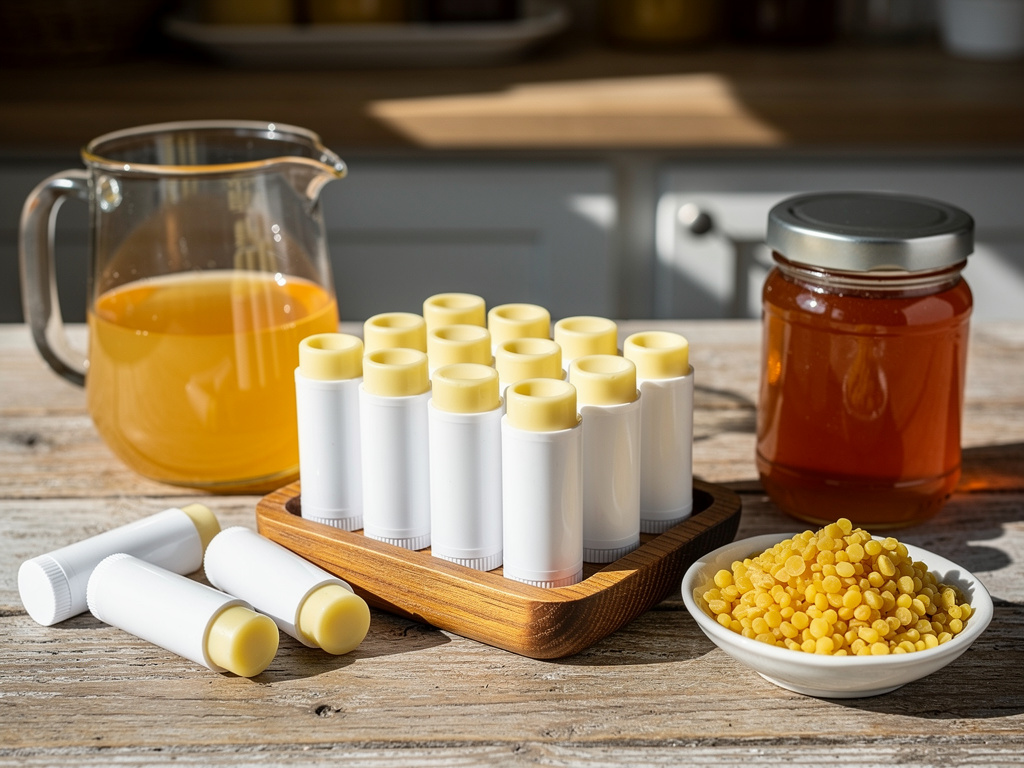


The short version: To sell lip balm from home, make a simple wax, butter and oil balm, pour it into 0.15 ounce tubes, label each tube the way FDA requires for a cosmetic, and start at a booth or with people who already buy from you. One 10 ounce batch of a basic beeswax recipe fills one 48-tube tray, and at supplier prices we loaded on October 19, 2026 each tube cost about $0.73 to make from your first tray of supplies and $0.56 once ingredients come by the pound and tubes come 100 at a time (counting the whole batch, including balm that stays in the cup). Eight small US shops charged $3.50 to $6.00 for a single tube that day, with $4.50 in the middle, so even a beginner batch leaves room after costs. Keep words like "SPF," "heals" or "treats" off the tube and your posts, because those claims turn a lip balm into a drug with its own rules.
Checked on Wholesale Supplies Plus, eight shop pages, FDA's cosmetics pages and the Homegrown signup page, October 19, 2026: supply prices and fees change, so recheck before you buy. Counting only the 0.15 ounce of balm that ends up in each tube, the restock tube is $0.51, the figure our lip balm pricing guide uses. Lip balm is a cosmetic, not a cottage food, and your state or city may add its own rules. If you take orders on Homegrown, customers create an account to place a first order, there is no drops or countdown release feature, and plan on most orders coming from people you send to your own link.
You already know how to make lip balm, or you are about to learn, and the question is how to turn a few good tubes into something people pay for. Maybe you keep bees and have wax left over from the honey harvest. Maybe you sell bread or jam at a Saturday market and want a small, cheap product for the front of the table.
Lip balm is one of the easiest body care products to start with. It has no water in it, so it needs no preservative, the supplies for a first batch cost about $62 before labels, and a tube weighs almost nothing. If you searched for how to make lip balm to sell, this guide covers both halves, in order: what to buy, a recipe sized to one filling tray, how to pour and test it, what a tube costs, what to charge, what the label needs, and how to take orders once regulars want their flavor again.
When your first tray is labeled, you can set up a Homegrown storefront so buyers order tubes ahead and pick them up or get them delivered locally.
Starting to sell lip balm from home takes four things: a tested recipe, tubes and labels that meet federal cosmetic labeling rules, a price that covers your costs, and one place to sell. FDA does not require a commercial kitchen or a federal license, though state and local rules can add requirements of their own. FDA's fact sheet for small businesses making cosmetics at home says, "It's not against the law to manufacture cosmetics in your home," and adds that "FDA does not license cosmetics firms."
Lip balm counts as a cosmetic, not a food, even though people put it on their mouths. FDA's page on whether a product is a cosmetic, a drug or both names "skin moisturizers" and "lipsticks" among the products the cosmetic definition covers, and a plain lip balm sold to soften lips sits in that group. That means the cottage food permit that covers your cookies does not cover your lip balm, and the rules you follow are cosmetic rules. Our guide on whether you can sell homemade lip balm goes through those rules in full, with notes on two states, the lip-safe color list and what to do about SPF. This guide is about the work itself.
Here is the path this guide follows, so you can see the whole job before you buy anything:
Your first batch needs about $62.27 in supplies from one craft supplier, plus labels, a kitchen scale and a microwave-safe glass measuring cup you probably already own. We priced everything at Wholesale Supplies Plus, a large US supplier of soap and cosmetic ingredients, on October 19, 2026, and picked the smallest bag that covers one 48-tube batch.
Swipe the table to see each supply and its price.
| Supply | What you need for 48 tubes | Smallest pack that covers it | Price |
|---|---|---|---|
| Yellow beeswax pastilles | 2 oz | 2 oz bag | $1.59 |
| Coconut oil (76 degree melt) | 1.5 oz | 2 oz bag | $2.97 |
| Refined shea butter | 1 oz | 2 oz bag | $4.64 |
| Deodorized cocoa butter | 1.5 oz | 2 oz bag | $4.95 |
| Refined sweet almond oil | 4 oz | 1 lb bottle (cheaper than two 2 oz bags at $6.26) | $4.65 |
| Lip-safe flavor oil (sweetened peppermint) | About 0.1 fl oz | 2 fl oz bottle | $10.95 |
| 0.15 oz oval lip tubes with caps | 48 | 48 sets | $21.90 |
| Oval silicone lip tube filling tray | 1 | 1 tray (holds up to 48) | $10.62 |
| Total before labels and shipping | $62.27 |
Prices from each product page on Wholesale Supplies Plus, loaded October 19, 2026; every price matched the site's regular price, with no sale markdown. Labels are extra: a 100-sheet pack of 2.125 by 1.6875 inch white gloss laser lip balm labels from OnlineLabels (item OL421WS, made for laser printers, so match the label material to your printer) was $51.94 that day, which is 1,500 labels at about 3.5 cents each. At 1% flavor, the 2 fluid ounce bottle covers about 20 batches. The supplier's sweetened vanilla flavor oil, $8.45 for 2 fluid ounces, was sold out in every size that day, so this list uses its sweetened peppermint.
A few things you will want that are not on the bill:
A good first lip balm to sell is 20% beeswax, 15% coconut oil, 10% shea butter, 15% cocoa butter and 40% sweet almond oil, with 1% to 3% lip-safe flavor oil. That is the basic formula on Wholesale Supplies Plus's recipe page, How to Formulate a Basic Lip Balm, written for 2 ounces of base. We multiplied it by five so it fills one tray.
For 10 ounces of base (283.5 grams):
The supplier says 2 ounces of base "will fill about 10 lip balm tubes," so 10 ounces fills about 50 in practice. By weight, 48 full tubes hold only 7.2 ounces between them (48 times 0.15). That leaves a little under 3 ounces of the batch that never ends up in a tube. The supplier's yield of about 10 tubes per 2 ounces builds most of that in: balm left in the cup and pipette, and the extra you use topping off tubes as they shrink. If you have balm left over, pour it into a tin and keep it as your own test jar. One 48-cavity tray is the right size for one batch.
Why 1% flavor and not more: the recipe page says to start flavor oil at 1% and adjust "up to 3%," but each flavor oil's own product page lists a maximum for lip products, and that number wins. On October 19, 2026 the supplier's sweetened peppermint flavor oil listed 1.2% for lip products and its sweetened vanilla listed 2.0%. Check that line on every bottle before you go stronger.
Why this formula works for a beginner: beeswax gives the stick its shape, the two butters make it feel rich on the lips, and the almond oil makes it glide. The recipe page says it plainly: "For a harder lip balm, increase the beeswax and reduce the butters." If you keep bees, your own wax can replace the pastilles once it is clean and filtered. Our guide to selling beeswax products at a farmers market covers what else that wax can turn into.
Make your first batch unflavored, or with just one flavor at 1%. Flavor oils are the most expensive thing per ounce in the recipe ($10.95 for 2 fluid ounces of peppermint, against $1.59 for 2 ounces of beeswax), and a plain balm tells you whether the texture is right before you spend money on six flavors.
Plan on about an hour and a half of hands-on time for 48 tubes, plus at least an hour of setting before you cap them: weigh, melt the wax and butters, stir in the oil and flavor, pour into the tray, then cap and label once the balm has set. These steps follow the supplier's recipe page, sized up to 10 ounces.
If a batch sets too soft or too hard, change one thing at a time. More beeswax makes it firmer, more almond oil makes it softer, and the recipe page's last tip is the one that matters most: "Take good notes on your adjustments to replicate successful recipes."
A standard twist-up tube is the best first container: it costs about $0.46 in a 48-pack, it holds 0.15 ounce, the size all eight small shops in our price check sold, and filling trays are made for it. Other formats cost more per tube or hold a different amount, which changes your price.
Slide sideways to compare all four containers.
| Container | Holds | Pack price | Cost per container | Good for |
|---|---|---|---|---|
| Oval twist-up tube, natural | 0.15 oz | 48 for $21.90; 100 for $36.62 | $0.46; $0.37 | Your everyday single tube |
| Slimline twist-up tube, natural | 0.07 oz | 48 for $23.85; 100 for $42.71 | $0.50; $0.43 | Samples, favors, a cheaper mini |
| Kraft paperboard push-up tube | 0.3 oz | 12 for $17.35; 48 for $69.55 | $1.45 | A plastic-free option at a higher price |
| Slide tin, silver | 0.25 oz | 24 for $19.95; 48 for $20.35 | $0.83; $0.42 | A softer balm you dab on with a finger |
Pack prices from Wholesale Supplies Plus product pages, loaded October 19, 2026. The supplier lists the 0.15 ounce tube in an oval shape only, and also sells it in a 12-pack for $6.30, which is $0.53 a tube. The paperboard tube holds twice the balm of a standard tube, so a 0.3 ounce paper tube needs about 48 cents of balm at first-tray prices, twice the 24 cents in a standard tube, counting what stays in the cup the same way.
Start with one container. A table with three tube shapes, four flavors and two sizes is 24 choices for a customer who wanted to spend $5. Once a flavor sells out twice, that is the one to try in a paper tube or a gift box.
Test every new recipe for at least 7 days before you sell it: wear it yourself, give a few tubes to people who will tell you the truth, and leave one tube somewhere warm to see how it holds up. FDA's fact sheet says the business whose name is on the label is "required to ensure adequate substantiation of safety" and to keep records that support it, and it adds that "Animal testing is not a requirement." For a beginner, that starts with using ingredients sold for lip products and keeping the supplier's safety information on file.
Lip balm does not need a preservative, which is a big part of why it is a good first product. Marie at Humblebee and Me, a formulating blog, explains in her guide to when a recipe needs a preservative that a product with no water that will not come into contact with water does not need one. Mold needs water to grow, and this recipe has none.
What to check on your test tubes:
Only use flavor and essential oils the supplier sells for lip products, and only colors FDA has approved for use on lips. FDA's summary of color additives lists which colors are allowed in lip products, and our guide on whether you can sell homemade lip balm walks through them. A candle fragrance or a soap colorant can smell and look fine and still not be meant for the mouth. FDA's fact sheet notes that "Cosmetic ingredient suppliers often have safety data on their products." Ask for it, and keep a copy for every ingredient you use.
Lip balm made from this recipe is good for one year, because Wholesale Supplies Plus rates the sweet almond oil that makes up 40% of the balm at "One year from manufacturing date" once it is used in a product, on its sweet almond oil page loaded October 19, 2026. Oil-only balms in general can last a few years before the oils go rancid, and you can tell when that happens because the balm starts to smell off. Humblebee and Me says that for products made only from oils, like lip balms and body butters, "rancidity is what you're worried about, and you'll generally have a few years before that sets in."
A few habits keep your tubes fresh and make it easy to stand behind them:
A best-by date is your call, not a federal rule. FDA's page on cosmetic shelf life says "There are no U.S. laws or regulations that require cosmetics to have specific shelf lives or have expiration dates on their labels," and adds that working out shelf life is part of the business's job. A best-by date 12 months from the day you pour gives a customer a clear answer, and it matches the one year Wholesale Supplies Plus gives for products made with its sweet almond oil. Pour from ingredients you bought within the past year, since the supplier rates its sweet almond oil, coconut oil and cocoa butter each as best used within one year of purchase on their product pages, loaded October 19, 2026.
From your first tray of supplies you pay about $0.73 for one tube's balm, tube and label, and about $0.56 once you buy ingredients by the pound and tubes by the hundred. The empty tube is the biggest single cost at both levels, more than all the balm inside it.
Drag the table left to see both cost levels.
| Cost line | First tray (2 oz packs, 1 lb almond oil, 2 fl oz flavor, 48 tubes) | Restock (1 lb bags, 4 fl oz flavor, 100 tubes) |
|---|---|---|
| Balm for a 10 ounce batch | $11.56 | $7.50 |
| Balm that ends up in each tube (0.15 oz) | $0.17 | $0.11 |
| Rest of the batch, spread over 48 tubes | $0.07 | $0.04 |
| Tube and cap | $0.46 | $0.37 |
| Label | $0.03 | $0.03 |
| Total per tube | $0.73 | $0.56 |
Worked from Wholesale Supplies Plus prices loaded October 19, 2026, with 1% sweetened peppermint flavor oil, and the OnlineLabels sheet price for labels, checked the same day. Totals are worked from unrounded parts ($0.732 and $0.557), so a column can differ by a cent from its rounded lines. Cocoa butter is the most expensive ingredient line in both columns: $3.71 a batch at first-tray prices and $3.23 at restock prices.
Two numbers you may see elsewhere, and why they differ from these. Leave out the "rest of the batch" line and the restock tube costs $0.51, the figure our guide to how much to sell lip balm for leads with, because it counts only the 0.15 ounce in the tube. With the balm left in the cup counted at the supplier's yield of about 10 tubes per 2 ounces, that guide gets $0.55; one tray holds 48, which gives $0.56 here. Its starter tube, $0.81, buys tubes in the 12-pack and every ingredient, almond oil included, in 2 ounce bags, and counts only the balm in the tube. All of these come from the same supplier and the same base recipe.
Where $35.12 goes in your first tray of 48 tubes
Source: Wholesale Supplies Plus and OnlineLabels prices, October 19, 2026. The $10.62 tray and leftover ingredients are not counted, since they carry over to the next batch.
That table leaves out your time, and your time is real. As an example, if melting, pouring, capping and labeling 48 tubes takes you 90 minutes and you value an hour at $20, that adds $30 to the batch, or about $0.63 a tube. A first-tray tube then costs you about $1.36 all in, still well under the $3.50 the cheapest shop in our check charged.
Charge $4 to $5 for a single 0.15 ounce tube to start, and offer a three- or four-tube set for a little less per tube. On October 19, 2026, eight small US shops selling handmade lip balm on their own websites charged $3.50 to $6.00 for one standard tube, and the middle price was $4.50.
Scroll right to see the multi-tube prices.
| Shop | One 0.15 oz tube | Multi-tube price shown |
|---|---|---|
| Daisy Hollow Farm (New York) | $3.50 | None listed |
| ShadyAcreHomestead | $3.95 | None listed |
| Chilton Bee Company | $4.00 | None listed |
| Zax Beeswax | $4.00 | Down to $3.00 a tube at 31 or more |
| Beverly Bees | $5.00 | None listed |
| Citrus and Moss | $5.00 | None listed |
| SAVAGE BEE-CHES | $5.00 | None listed |
| Treesnail Wellness (Missouri) | $6.00 | 3 for $16, 5 for $25, 6 for $30 |
Read from each shop's own product page on October 19, 2026. All eight were in stock in at least one flavor. Mean $4.56, middle $4.50.
What that means for your margin, using the first-tray cost of $0.73 a tube and the 2.9% + $0.30 card fee you pay on a Homegrown order:
The 30 cent part of the card fee is charged once per order, not once per tube, which is why sets are worth offering. Our lip balm pricing guide goes deeper on wholesale prices, slim tubes and paper tubes, and how to compare against Burt's Bees on the same shelf.
A lip balm label needs five things: what the product is, the net weight, the ingredients from most to least, your business name and address, and a way for people to report a reaction. FDA's Cosmetics Labeling Guide lays out each one, and a 0.15 ounce tube has room for all of them if you plan the label before you print.
Small containers get a little help. The guide allows ingredient type as small as 1/32 inch when the labeling surface is under 12 square inches, and says the ingredient list "may also appear on a tag, tape or card firmly affixed to a decorative or small size container." That is how some vendors fit everything on a tube: front label for the name and weight, the rest of the label wrapped around the tube, and the ingredient list on a tag if it will not fit.
Print OnlineLabels' free blank OL421 template on plain paper, cut out one label and wrap it around a filled tube before you order 100 sheets. The 2.125 by 1.6875 inch label we priced at OnlineLabels is sold to match a round 0.15 ounce tube, and the supplier we priced only sells that size in an oval shape. One test sheet costs you a few minutes and saves you $51.94 of labels that do not fit.
Words like "natural" and "organic" need care. FDA's fact sheet says it "has not defined the term 'natural'" and does not have regulations for "organic" on cosmetics, which the U.S. Department of Agriculture regulates for agricultural products. Our guide to the rules for homemade lip balm covers both words and the label rules in full.
Plain words like "softens," "moisturizes" and "smooth" keep a lip balm a cosmetic, while words like "SPF," "sun protection," "heals" or "treats cold sores" make it a drug or a cosmetic and drug at once. FDA's page on that line says claims count wherever you make them: "Claims stated on the product labeling, in advertising, on the Internet, or in other promotional materials."
That last part matters for a home vendor. Your label might be careful, but an Instagram caption that says "heals cracked lips overnight" is promotional material too. Here is a quick sort:
A drug or a cosmetic that is also a drug has to meet drug rules, which include "Drug Facts" labeling and stability testing, and FDA's shelf-life page says drugs "are required to have expiration dates printed on the labels." That is far more than a home vendor needs for one product. Leave SPF out of your first line and say what the balm feels like, not what it fixes.
Flavors can trip you up the same way. A peppermint balm that "smells fresh" is fine. A peppermint balm that "numbs and soothes sore lips" is making a drug claim. Get the wording right before you print, because rewriting a caption costs nothing and reprinting 1,500 labels costs $51.94.
You do not need a federal license to sell lip balm, but your state or city may require one, and a small business exemption keeps most home vendors out of FDA's registration, product listing and manufacturing practice rules while their average yearly US cosmetic sales over the previous three years stay under $1,000,000, adjusted for inflation. FDA's fact sheet says "state or local authorities may require licensing or have other requirements," and tells small businesses to contact them directly.
The federal small business line is in 21 U.S.C. 364h: a business whose US cosmetic sales averaged less than $1,000,000 a year over the previous three years, adjusted for inflation, does not have to register its facility, list its products or meet the law's good manufacturing practice section. Lip balm is not one of the product kinds the law carves out of that exemption, which are things like eye products and injected products. A few duties still apply to every size of business:
Outside cosmetic rules, the usual small business steps apply in most places:
Insurance for a lip balm maker is a yearly policy or a per-event one. On October 19, 2026, ACT's insurance page for soap makers listed "ACT Pro for Handmade Beauty Businesses" at $515 per year, described as coverage for beauty and cosmetics, soap and candle makers, and its ACT Pro policy includes general and product liability. Its ACT Go policy starts at $49 per event and is labeled "Basic general liability coverage," the kind that covers a trip and fall at your booth, but the page lists ACT Go's products coverage as "Excluded," so it does not cover a claim about a tube after you sell it. ACT's page says ACT Pro is the one to pick if you "need protection for the products you make," and it names a skin reaction as one kind of claim this insurance is for, so ask which policy covers your products before you buy. ACT also posts a list of products its handmade beauty policy does not cover; read it against your ingredient list.
Florida is one state where a home lip balm maker has to read the state law closely. Under Florida Statutes 499.01(2)(p), anyone who makes cosmetics in the state needs a cosmetic manufacturer permit unless their annual gross sales are $25,000 or less, and an exempt maker may only make and sell "soaps, not otherwise exempt from the definition of cosmetics, lotions, moisturizers, and creams." Lip balm is not named, so ask the state's Division of Drugs, Devices and Cosmetics before you sell. The answer matters most for a home maker: the division's permit FAQ says "an establishment that is a place of residence may not receive a permit," so if lip balm falls outside the exemption, you cannot get the permit for a workspace in your home instead. An exempt maker must also print "Made by a manufacturer exempt from Florida's cosmetic manufacturing permit requirements." on each unit in contrasting color and at least 10-point type, which takes real room on a 0.15 ounce tube. We read the 2026 statute and the division's permit FAQ on October 19, 2026. Florida's permit fee and its rule for home workspaces are in our lip balm rules guide.
Verify your state's current rules before your first sale. Rules for home cosmetics change, and a market manager may have requirements of their own.
The easiest first sales for a new lip balm vendor come from people who already know them: friends, coworkers, and customers who buy their bread, eggs or honey at a farmers market. A $4 or $5 tube is an easy add-on at a booth, and people can pick a flavor by smelling an open tester.
The places that tend to work first, roughly in the order a beginner reaches them:
Our guide to where to sell lip balm walks through seven places with what you keep from a $5 tube in each, including Etsy, consignment and bulk favor orders. If you already sell honey, the guide to selling honey covers the booth and pricing side of the product your lip balm will sit beside.
Bring one open tester per flavor on a tray with a sign that says "smell only," and keep sealed tubes for sale. With a shrink band on each sealed tube (about 6 cents each in a 100-pack), a customer can see that nobody has opened the one they are buying.
A single tube needs only its label and a shrink band, and a set of four fits a small kraft box made for lip tubes. At Wholesale Supplies Plus on October 19, 2026, clear shrink bands sized for 0.15 ounce round or oval tubes were $6.30 for 100, about 6 cents each, and a kraft lip tube box that "fits 4 - 0.15 oz tubes" was $11.95 for 50, about 24 cents a box.
Here is what each kind of order needs:
The tubes priced in this guide are oval, and the 4-tube box is a tight fit for them. One reviewer on the box's product page said oval tubes were "SUPER tight" and hard to take out, and the supplier's own answer on the same page says four oval tubes fit only "at an angle so the labels might not be easily read." Buy the 50-pack and test one box with four filled, labeled tubes before you promise a set to anyone. We read the page on October 19, 2026.
Our guide to where to sell lip balm covers who orders favors by the dozen, with a worked 60-tube favor order and the lead time and deposit rules to set. Keep favor orders to a size you can pour from one or two trays until you know how long a batch takes you.
Once regulars want their flavor again between markets, give them one link where they pick a flavor, pay, and choose a pickup time, instead of trading messages about who wants vanilla and who still owes you $10. A Homegrown storefront is $10 a month billed annually ($12.50 billed monthly) with 0% commission and no percentage fees beyond standard payment processing of 2.9% + $0.30 per order, checked on the signup page October 19, 2026.
Each flavor can be its own option under one Lip Balm listing, with its own price, and you can add a set like "one of each" next to the singles. Customers pick up at your porch, your farmstand or your market booth, or you deliver locally within a radius you choose. Homegrown calculates sales tax at checkout and files and remits it for you on storefront orders, and you list your ingredients on every listing, which matters for a product with almond oil and beeswax in it. A 7-day trial runs with no charge until day 8.
How that compares with what most home lip balm vendors try first:
What Homegrown does not do: it does not help you formulate, test or label your lip balm, and it is built for pickup and local delivery, so a vendor who mostly ships tubes across the country is better served by Etsy or Shopify. There is no drops or countdown release feature for launching a holiday flavor at a set time. Customers create a Homegrown account to place their first order. Your storefront is listed on the Homegrown marketplace, but plan on most orders coming from regulars you send to your own link. The 2.9% + $0.30 card fee is paid by you, not added to the customer's total.
On a $10 order of two $5 tubes, you pay between $0.29 and $1.60 to get paid, depending on how the customer pays, and a monthly plan on top for a storefront. Small orders make the fixed part of each fee, the 10 to 30 cents per order (65 cents on Etsy once its 20 cent renewal fee for each tube sold is counted), a bigger share of the sale than it is on a $40 order.
Move the table sideways for every fee column.
| Way to get paid | Monthly plan | Trial | Platform or listing fee | Card processing | Customer pays on a $10 order | You pay on a $10 order | 50 orders a month |
|---|---|---|---|---|---|---|---|
| Venmo business profile | $0 | None | $0 | 1.9% + $0.10 | $10.00 | $0.29 | $14.50 |
| Square Free, card reader at a booth | $0 | None | $0 | 2.6% + $0.15 | $10.00 | $0.41 | $20.50 |
| Homegrown storefront | $10 billed annually or $12.50 monthly | 7 days, no charge until day 8 | $0, 0% commission | 2.9% + $0.30 | $10.00 | $0.59 | $39.50 annual plan, $42.00 monthly |
| Shopify Basic | $29 paid yearly or $39 monthly | 3 days, then $1 a month for 3 months | $0 with Shopify Payments (2% without) | 2.9% + $0.30 online (3.5% + $0.30 on premium cards) | $10.00 | $0.59 | $58.50 yearly plan, $68.50 monthly |
| Square Online, Free plan | $0 | None | $0 | 3.3% + $0.30 online | $10.00 | $0.63 | $31.50 |
| Etsy (two tubes from one listing) | $0, possible one-time set-up fee | None | $0.20 per tube sold, plus 6.5% transaction fee | 3% + $0.25 | $10.00 plus any shipping | $1.60 before shipping and any Offsite Ads fee | $80.00 |
Fees from each company's own pricing or fee page, checked October 19, 2026: findhomegrown.com/signup, venmo.com fees page, squareup.com pricing, shopify.com pricing, and Etsy's sell page and Fees and Payments Policy. Etsy renews a multi-quantity listing at $0.20 after each unit sells, charges its 6.5% transaction fee on shipping too, and charges a 15% Offsite Ads fee when one of its ads leads to the sale. Sales tax is extra on every row where it applies.
Square's free online store costs less than Homegrown at 50 small orders a month ($31.50 against $39.50), and only falls behind past about 250 orders a month on Homegrown's annual plan (about 312 on the monthly plan). Venmo and a card reader cost the least of all, but neither lets customers pick a flavor and a pickup time ahead of time, so reorders between market days still come in by message and you keep track of them by hand. Our breakdown of Etsy's fees for small food vendors walks through what a real order and a full month of orders cost on Etsy.
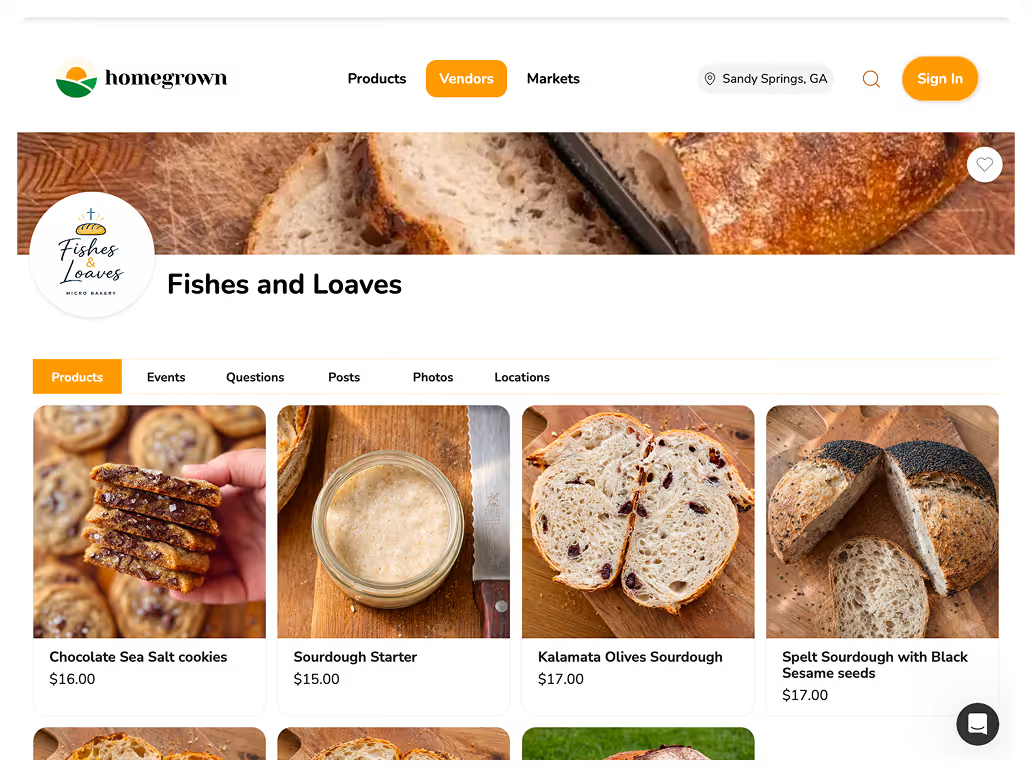
Lip balm is close to an empty shelf on Homegrown today: one listing from one vendor, against 2,921 products from 327 vendors in the catalog.
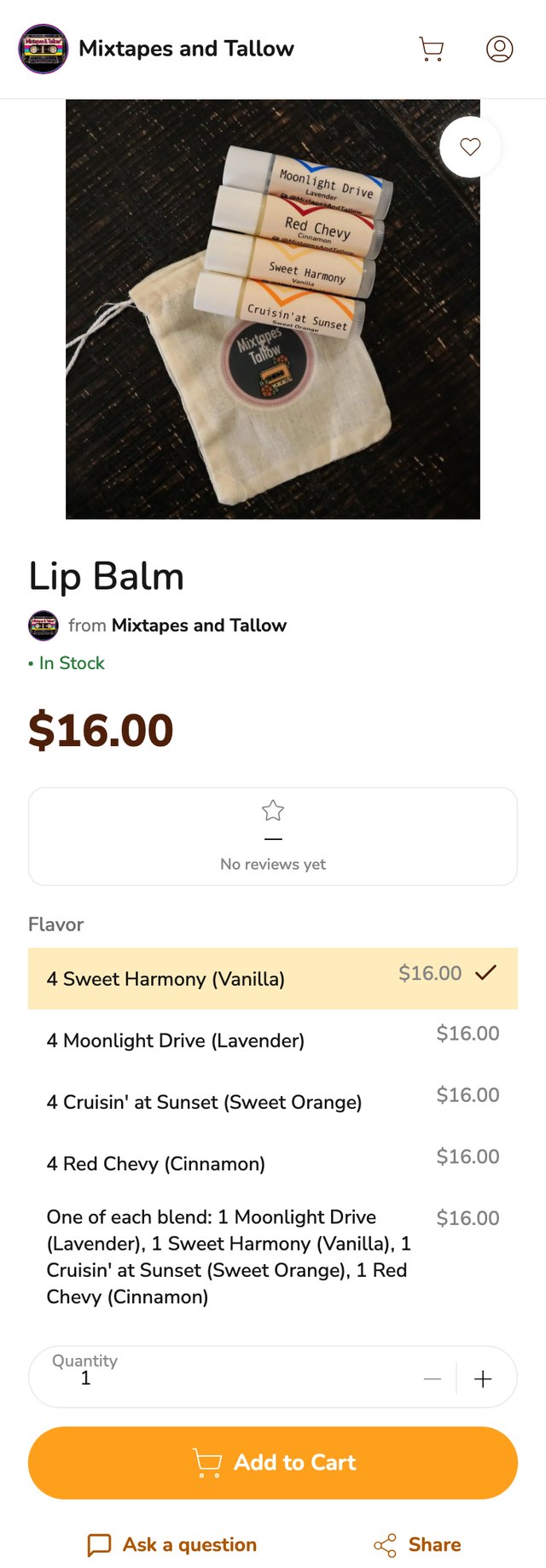
In a pull of the Homegrown catalog on October 19, 2026, 1 of the 2,921 products listed by 327 vendors was lip balm: Mixtapes and Tallow's Lip Balm, $16.00 for a bundle of four tubes in five flavor choices. We searched every product name, full description and option name for lip, lips, chapstick, chap stick, balm, beeswax and bee wax, read all 22 matches, then read all 261 Health and Wellness, Arts and Crafts and Home Goods listings from their 36 vendors one vendor at a time. Tallow body balms, salves, a lotion bar, a lemon balm soap, lemon balm or bee balm teas, tinctures and honeys, raw beeswax, a dog treat and a ChapStick keychain were left out.
The same pull shows where a lip balm vendor can come from. Country Apple Orchard Farm Stand lists "100% Pure Bee Wax" at $3.00 for 2 ounces and $4.00 for 3 ounces, "from the same hives that we get our honey from," right beside its 8 ounce, pint and quart honey and its comb honey. A beekeeper in that spot already has the beeswax for a 48-tube batch on the shelf: the recipe takes 2 ounces, which that farm stand lists at $3.00.
What one listing in the catalog means for you: if you start selling lip balm on Homegrown, you will not be competing with ten other vendors on the same page, and you also cannot count on shoppers finding lip balm there on their own. The orders will come from the people you hand your link to. If you already have those people at a booth or a farm stand, you can set up a lip balm storefront with each flavor as its own option and send them one link for reorders.
First-month problems include buying too much, pouring too many flavors, printing labels that do not fit, and writing a claim that turns the balm into a drug. Each one is cheap to avoid if you know it is coming.
Federally, yes. FDA's fact sheet for small businesses says "It's not against the law to manufacture cosmetics in your home," and FDA does not license cosmetic businesses. Your state can add limits: Florida's small-maker exemption names only soaps, lotions, moisturizers and creams, not lip balm, so check your state's rules before your first sale. You still need a compliant label, safety records, and any license your state or city requires, and you must avoid drug claims like SPF or "heals" unless you are ready to meet drug rules too.
A first batch of 48 tubes cost $62.27 in supplies and a filling tray at Wholesale Supplies Plus prices loaded October 19, 2026, before labels and shipping. Add about $52 for 1,500 printable labels. Each tube costs about $0.73 to make from that first tray of supplies and about $0.56 at restock sizes (ingredients bought by the pound, tubes bought 100 at a time), counting the whole batch, including balm that stays in the cup.
No, a lip balm made only of waxes, butters and oils does not need a preservative, because there is no water for mold or bacteria to grow in. The oils can still go rancid, and the supplier rates the sweet almond oil in this recipe at one year once it is made into a product, so date your tubes no more than 12 months out. An antioxidant like vitamin E slows that down, but it is not a preservative, so never add water, aloe juice or hydrosols to this recipe without changing your whole approach.
About 10 ounces of balm fills around 48 standard 0.15 ounce tubes, which is one silicone filling tray. Wholesale Supplies Plus says 2 ounces of its basic base fills about 10 tubes, so scale the recipe by five for one tray. Some balm always stays in the cup and goes to topping off tubes as they settle.
You can, but an SPF lip balm is a cosmetic and a drug at once, so it must meet drug rules such as a Drug Facts label and an expiration date. FDA says products "marketed with sun-protection claims are cosmetic/drug products." Seven of the eight small shops in our price check sold no SPF version on the product pages we read on October 19, 2026, and a plain moisturizing balm is the simpler first product.
Start with one or two flavors you can make well, such as vanilla or peppermint, plus an unflavored tube for people who do not want any scent. Flavor oil is the costliest ingredient per ounce in a basic recipe: on October 19, 2026 Wholesale Supplies Plus charged $10.95 for 2 fluid ounces of sweetened peppermint, and its $8.45 sweetened vanilla was sold out. Each flavor oil page lists its own maximum for lip products (1.2% for that peppermint, 2.0% for that vanilla), so check it before you go above 1%. Add a third flavor when customers start asking for one by name.
To make lip balm to sell, weigh a tested recipe, pour it into tubes, label each tube the way FDA requires for a cosmetic, and keep a batch record. The basic Wholesale Supplies Plus formula is 20% beeswax, 15% coconut oil, 10% shea butter, 15% cocoa butter and 40% sweet almond oil, with flavor oil starting at 1%, and 10 ounces fills one 48-tube tray. Test it for 7 days before your first sale and keep the claims to how it feels, not what it heals.
These 6 guides pick up where this one stops, from the FDA rules to the $3.50 to $6.00 price range to the places your first tubes can go. The first three finish the lip balm set, one guide each for the labeling rules, the price math and the markets and shops that suit a 48-tube batch. The last three cover what else your wax can become, the next body care product to add, and how to set up the table you will sell from:
Your first tray of 48 tubes is the hard part, and it costs about $62 in supplies, plus labels, to find out whether people love your balm. After that, the job is making sure the person who liked the vanilla can buy it again without texting you. Here is the short list to get from a test batch to steady orders:
Open your lip balm storefront on Homegrown for $10 a month billed annually ($12.50 monthly) with no commission on your sales, list each flavor with its own price, and hand regulars one link for pickup at your porch or your booth.