


The short version: Lip balm sells in seven places: a farmers market booth, craft fairs and holiday markets, your own storefront link with pickup or local delivery, Etsy and Amazon Handmade, local shops that buy at wholesale, consignment shelves, and bulk orders for favors and gifts. A $5 tube, the most common single-tube price among eight small US shops we checked, reaches you as $5.00 in cash at a booth, $4.78 inside a four-tube order on a Homegrown storefront, $4.25 on Amazon Handmade and $2.50 from a shop paying half of retail. Because a tube is so cheap, fixed per-order fees hit it harder than they hit a candle or a cake, so sell lip balm in sets of three or four wherever a card is involved. Heat is the other limit: keep tubes out of hot cars, sunny booth fronts and summer mailboxes, and each place on this list can work.
Checked October 8, 2026: on findhomegrown.com/signup, Homegrown costs $10 a month on the annual plan or $12.50 on the monthly plan, takes 0% commission, and charges the vendor 2.9% + $0.30 per card payment. Etsy, Amazon Handmade, Shopify, Square, Venmo and Faire fees come from their own pages, the shop prices from each shop's own site, and the rules from FDA pages and federal law (21 USC 364h and 21 CFR 70.3), all loaded October 8. Verify your state's current rules before you sell. The limits: a customer makes a Homegrown account before a first order, Homegrown has no shipping and no timed release feature, and expect most orders to come from people you give your link to.
You poured 60 tubes on Sunday night, and by Wednesday your sister, two coworkers and the neighbor have each taken a few. Now 40 tubes sit in a shoebox, and the question is where the next 40 go, and the 40 after that.
Lip balm is one of the easiest handmade products to place. It is small, cheap to make, sells for about $5, and almost everyone uses it. That low price is also the catch. A 30-cent card fee barely dents a $30 candle, but it takes 6% of a $5 tube before any percentage fee kicks in. This guide covers the seven places lip balm vendors actually sell, what one $5 tube pays you in each, and how to keep both fees and heat from eating the profit.
You can sell lip balm in seven places, and a simple setup runs two or three of them at once: one in-person spot, one link for reorders, and maybe one shop. Four of the seven put the tube straight into the hand of the person who will use it. Two sell through a local shop, one that buys your tubes outright and one that pays you a share after each sale, and one is bulk orders from people who buy by the dozen.
Two places are left off on purpose. National drugstore and grocery chains usually want a barcode, a fixed case price and steady supply at a factory scale, which is a different business from a kitchen-table batch. And a cash jar on an unattended farm stand works for eggs but not for a product that melts in a sunny box. If you sell honey too, the guide to where to sell honey covers selling from a driveway or porch stand, where a jar holds up far better than a tube.
Your first hundred tubes should go where people can smell the flavors and buy on the spot, which means a booth or a fair, plus one link where they can buy again. After that, add one place at a time based on how many tubes you pour and how many free days you have. The table is the short way to choose.
Scroll sideways to see where to start and what to add.
| Your situation | Start here | Add next | Why it fits |
|---|---|---|---|
| You pour 50 to 100 tubes a month and have Saturdays free | A farmers market booth | Your own storefront link for reorders | The booth finds people who like your flavors, and the link keeps them buying in the weeks between |
| You already sell honey, soap or candles | Lip balm as an add-on at your existing table | A three-tube set on your link | The shoppers are already at your table, so the tube is a second sale, not a new customer |
| You can only sell a few weekends a year | Holiday markets and craft fairs | A card with your link in every bag | Gift shoppers buy sets in November and December, and the ones who liked a flavor need a way to find you in March |
| You like making more than selling | One gift shop, salon or cafe at wholesale | A second shop in the next town | A shop pays half of retail for a case and sells it for you |
| You live somewhere very hot | Your link with pickup or local delivery | Indoor or evening markets | The tube goes from your cool shelf to the customer the same day instead of sitting in a mailbox |
These rows are planning guides built from the fee pages, shop prices and catalog data in this article, all checked October 8, 2026. Your own costs, markets and shops decide the final mix.
You may never need the bottom two rows. A booth plus your own link keeps every tube at or near the full $5 retail price, which the payout table further down shows is the most you can keep per tube.
Heat can rule out a place because lip balm is built to soften at lip temperature, so a tube left in a parked car, a summer mailbox or the sunny front edge of a booth turns soft, oily or misshapen before anyone buys it. Beeswax itself melts at about 145°F, but the oils and butters in a balm give way well before that.
Marie Rayma, who writes the formulating site Humblebee & Me, says in her guide to whether a product will melt in hot weather that products with at least 15 to 20% wax held up in her hot car: "They soften, but they don't liquify." She also notes that some Etsy shops and small skin care brands won't ship certain products during the summer. Here is what heat means for each place:
A firmer summer recipe helps too. Rayma's 15 to 20% wax rule of thumb points the same way: more wax makes a firmer tube. Test a batch by leaving one tube in a warm spot for an afternoon before you sell the rest.
A tube that melted and set again can look fine from the outside and come out grainy or sunken. Selling one to a gift buyer costs more than $5, because that buyer was your way to their friends. Never store market stock in the car between stops, and pull any tube that has gone soft. We checked the Humblebee & Me melting guidance on October 8, 2026.
A farmers market booth is the easiest start, because a $5 tube sold for cash reaches you as the full $5.00 and shoppers can smell every flavor before they pay. Lip balm also rides along with other products. A shopper buying a jar of honey or a bar of soap adds a tube without thinking about it.
Price is the first thing to settle. Our guide to how much to sell lip balm for works out the cost of one tube and checks what small shops charge, so this guide sticks to where the tubes go. If you keep bees, the guide to selling beeswax products at a farmers market covers putting lip balm next to candles and wax on one table.
To find markets near you, the USDA's farmers market directory (usdalocalfoodportal.com, checked October 8, 2026) searches by ZIP code within 10, 30, 100 or 250 miles. Not every market on it takes body care vendors, so ask the market manager these questions before you apply:
Our guide to selling non-food products at a farmers market covers which markets welcome crafts and body care. If a full booth is too much, Treesnail Wellness, a small skin care shop that sells lip balm, suggests sharing a booth with a complementary vendor or renting a corner of someone else's table.
Bring a card reader. Square's in-person rate on its Free plan, read on its pricing page October 8, 2026, is 2.6% + 15 cents, so a single $5 tube paid by tap costs you 28 cents and $4.72 lands in your account. That beats losing the shopper who left her wallet in the car.
Pack 80 to 150 tubes for a small fair of 200 to 500 people, 200 to 400 for a mid-size fair of 1,000 to 3,000, and 500 to 800 for a large festival of 5,000 or more, the counts TheCraftMap's 2026 lip balm guide gives. That guide starts from one to two tubes for every shopper the organizer expects, capped by your booth size and budget, so plan around the fair-size counts rather than the per-shopper rule.
Craft fairs reward different stock than a weekly market:
Our comparison of craft fairs and farmers markets covers the key differences between the two, written for food vendors. A fair shopper who liked your tube may never find your booth again, and the next section is about keeping that buyer after the fair ends.
Regulars reorder easily when they have one link where they can pick their flavor, pay, and choose a pickup time, instead of sending you a message and waiting. Lip balm is a repeat purchase. Someone who loved your peppermint in October wants three more in January, when the market is closed. Without a way to order, that sale goes to the drugstore.
Homegrown gives lip balm vendors that link for $10 a month billed annually ($12.50 billed monthly) with no percentage fees beyond standard payment processing. You list each flavor or each set, customers pay when they order, and they pick up at your porch, your farm stand or your market booth, or you deliver within a radius you choose for a fee you set. The built-in QR code tool can point to one product, so a card in every craft fair bag can open straight to your three-tube set. Sales tax is calculated at checkout and remitted for you, and the customer list stays yours.
How it compares to what lip balm vendors usually use:
The honest bounds: Homegrown has no shipping, so it fits local regulars, not customers three states away. Customers create a Homegrown account before a first order. There is no timed release feature that opens orders at a set hour. Your storefront is listed on the Homegrown marketplace, but plan on most orders coming from people you send to your own link.
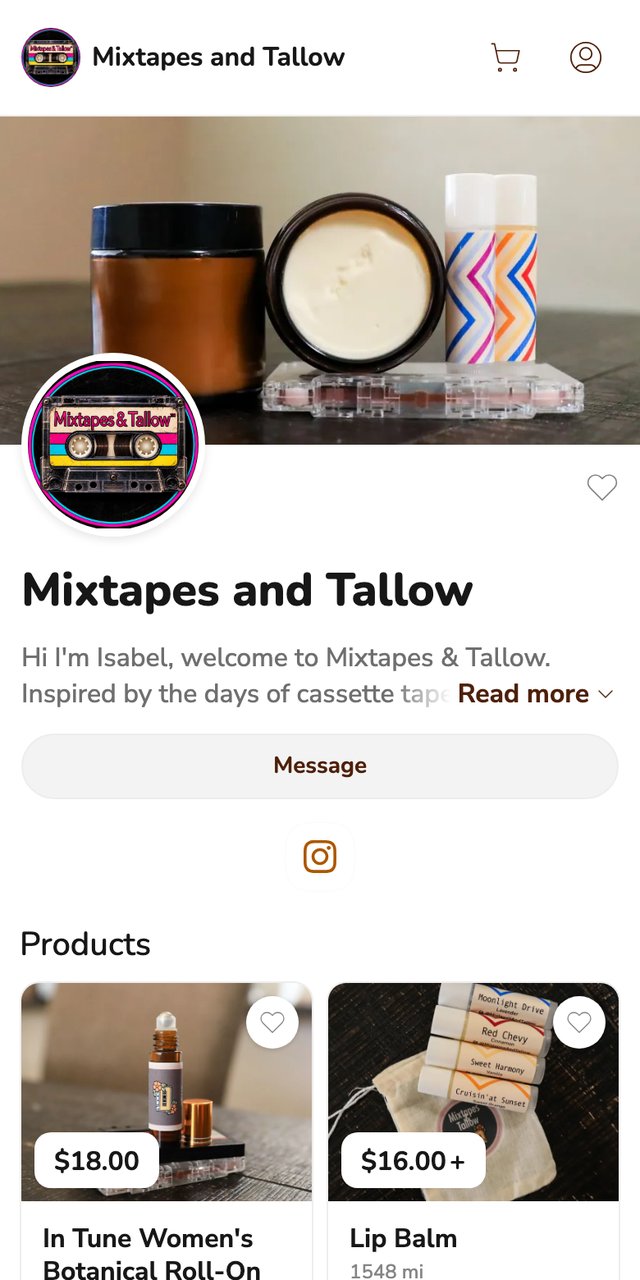
Mixtapes and Tallow sells its lip balm as a bundle of four tubes for $16, with pickup at a Tucson shopping center on Tuesdays from noon to 1 PM and delivery within 20 miles for a $5 flat fee on orders of $16 or more, as shown on its storefront on October 8, 2026. A weekly pickup hour like that keeps tubes out of mailboxes in an Arizona summer. If your regulars keep asking how to get more between markets, you can set up your lip balm storefront on Homegrown with a 7-day trial (no charge until day 8).
A $5 tube can make money on Etsy or Amazon Handmade only when it sells inside a set, because the fees on one tube take 15% to 19% of the price before shipping. On Etsy, a single $5 tube costs you a $0.20 listing fee, a 6.5% transaction fee ($0.33) and 3% + $0.25 payment processing ($0.40), or about $0.93 in all, which is 18.5% of the sale. Amazon Handmade takes a 15% referral fee, or 30 cents if that is more, so 75 cents on a $5 tube.
Sell the same flavors as a four-tube set and the math gets better. A $20 four-pack on Etsy costs about $2.35 in fees, or 59 cents a tube, before shipping. Etsy's 6.5% also applies to the shipping price you charge, and an Offsite Ads fee applies when an ad Etsy runs brings the sale. Etsy's fees policy, read October 8, 2026, sets that fee at 15% for shops under $10,000 in sales over the prior 365 days, which can opt out, and at 12% for shops at $10,000 or more, which must take part.
What to know before you list:
For the full Etsy fee picture, our breakdown of Etsy fees for small vendors adds up every line on a real order.
Gift shops, boutiques, hair salons, coffee shops and orchards stock handmade lip balm, because a $5 tube is an easy add-on at their register. The Balm Diggity, a lip balm business profiled in the Handmade to 100K newsletter in 2025, is carried by boutiques, coffee shops, hair salons, gift shops, bridal boutiques, drugstores and a seasonal orchard.
Shops buy at wholesale. Soap Queen, the education blog of the soap supply company Bramble Berry, says wholesale pricing "is typically 50% of retail pricing." So a $5 tube pays you $2.50, and a 12-tube case pays $30. That is half the money per tube, but it is one sale, one drop-off and no booth day.
How to land the first shop:
Two shops that each reorder one 12-tube case a month pay you $60 at $2.50 a tube, with no table fee and no Saturday. Put your price sheet and pour date in every case so the owner knows which tubes to sell first.
Faire, a wholesale marketplace where shops order from small brands, is another route. Its help page, read October 8, 2026, lists a 15% commission on orders from shops it finds for you, a one-time $10 fee on a shop's first order, 0% commission on Faire Direct orders from shops you bring yourself, and a payment processing fee from 1.9% + $0.30 to 3.5% + $0.30 depending on how fast you want to be paid. Our look at Faire alternatives for soap and candle vendors compares Faire with selling straight to your own customers.
Consignment makes sense for lip balm when a shop will not buy outright but will give you counter space, because you keep more of each sale than at wholesale. Soap Queen's guide to selling on consignment says the split is "generally a 70/30 or a 60/40 split with the store getting 30% or 40%." On a $5 tube, that is $3.00 to $3.50 for you.
The trade is risk. You still own the tubes while they sit in the shop, you restock the shelf, and you get paid only after each one sells. Soap Queen recommends a written contract. For lip balm, that contract should cover these points:
Consignment works best at shops with steady foot traffic and a counter near the register. A slow shop with your tubes in a back corner ties up stock you could sell at a booth for the full $5.
Wedding couples, shower hosts, teams and local businesses order lip balm by the dozen, mostly as favors or thank-you gifts with a custom label. Etsy Margin's 2026 lip balm guide names wedding favors and holiday gifts as the buyers who order in volume. One order of 60 tubes is a whole batch sold before you pour it.
Bulk orders come from a few places:
As an example, 60 favor tubes at $3 each is a $180 order. Through a Homegrown storefront, the card fee on that one order is $5.52, and the customer pays before you pour. Set a minimum order, a lead time of two to three weeks and a deposit rule, because custom labels take time and you cannot sell a tube with someone else's wedding date on it.
On a $20 order of four $5 tubes, the way you get paid costs you anywhere from nothing in cash to $3.00 on Amazon Handmade. A Homegrown storefront costs $0.88 in card processing plus the $10 monthly plan, and Etsy costs about $2.35 before shipping. The table puts every fee on every row, with the customer's total and a month of 50 orders.
Swipe the table to see all seven columns.
| Way to get paid | Monthly plan | Platform fee | Card or payment processing | Customer pays on a $20 order | Vendor pays on a $20 order | Vendor pays on 50 orders a month |
|---|---|---|---|---|---|---|
| Cash at your booth | $0 | None | None | $20.00 | $0.00 | $0.00 |
| Square reader at your booth (Free plan) | $0 | None | 2.6% + 15¢, paid by the vendor | $20.00 | $0.67 | $33.50 |
| Venmo business profile | $0 | None | 1.9% + $0.10, paid by the vendor | $20.00 | $0.48 | $24.00 |
| Homegrown storefront | $10 billed annually ($12.50 monthly); 7-day trial, no charge until day 8 | None, 0% commission | 2.9% + $0.30, paid by the vendor | $20.00 | $0.88 plus the plan | $54.00 on the annual plan ($56.50 monthly) |
| Square Online (Free plan) | $0 | None | 3.3% + 30¢, paid by the vendor | $20.00 | $0.96 | $48.00 |
| Shopify Basic | $29 billed yearly ($39 monthly); 3 days, then $1 a month for 3 months | None with Shopify Payments (2% with another provider) | 2.9% + 30¢ online, paid by the vendor | $20.00 | $0.88 plus the plan | $73.00 on the yearly plan ($83.00 monthly) |
| Etsy, one four-pack listing | $0 (a one-time shop set-up fee may apply) | $0.20 listing fee + 6.5% transaction fee | 3% + $0.25, paid by the vendor | $20.00 plus shipping | $2.35 before shipping | $117.50 before shipping |
| Amazon Handmade | $39.99 the first month, then waived | 15% referral fee (30¢ minimum) | No separate fee listed | $20.00 plus shipping | $3.00 | $150.00 (plus $39.99 in the first month) |
All fees read on each company's own pricing page on October 8, 2026: findhomegrown.com/signup, squareup.com, venmo.com, shopify.com, etsy.com/sell and sell.amazon.com. Card fees are figured on the $20 price; a platform that charges on the total with tax or shipping runs a few cents higher. Venmo's personal account charges 2.99% ($0.60 here) when the sender marks a payment as goods and services.
Two honest readings of this table. Square Online's Free plan costs less than Homegrown at 50 orders a month ($48.00 against $54.00), and Homegrown only pulls ahead at about 125 orders a month with the annual plan, where Square's extra 8 cents per order covers the $10 plan (about 156 orders on the $12.50 monthly plan). And Venmo is cheapest of all, but it is a payment, not an order: no flavor list, no pickup time, no record.
You keep the full $5.00 from a cash sale at your booth, about $4.78 when the tube sells inside a four-tube order on your Homegrown link, $4.25 on Amazon Handmade and $2.50 from a shop that buys at wholesale. The gap between a booth and a shop is half the price, so shops make sense for volume and your own table and link make sense for margin.
What reaches you from one $5 tube
Source: fee pages of Square, Homegrown, Etsy, Amazon Handmade and Faire, and Soap Queen's wholesale and consignment guides, all loaded October 8, 2026. Monthly plans and shipping not included.
Swipe for the math behind each payout.
| Place | Reaches you from one $5 tube | How we got it |
|---|---|---|
| Cash at your booth | $5.00 | No fee |
| Square tap, one tube alone | $4.72 | 2.6% + 15¢ = $0.28 |
| Homegrown, one tube alone | $4.56 | 2.9% + $0.30 = $0.445, before the plan |
| Homegrown, inside a four-tube $20 order | $4.78 | $0.88 split four ways, before the plan |
| Etsy, one tube alone | $4.08 | $0.20 + 6.5% + 3% + $0.25 = $0.925, before shipping |
| Amazon Handmade | $4.25 | 15% referral fee |
| Consignment | $3.00 to $3.50 | Shop keeps 30% to 40% |
| Wholesale to a shop | $2.50 | Half of retail |
| Faire, 12-tube case at $30 | $2.39 Faire Direct; $2.01 on a marketplace reorder; $1.18 on a shop's first marketplace order | 15% commission, $10 first-order fee, 3.5% + $0.30 next-day payout |
Math on each fee page as loaded October 8, 2026. Faire figures assume its next-day payout option; slower payouts cost less.
The single-tube rows show why sets matter. On a Homegrown storefront, one $5 tube costs 44.5 cents to take payment on, 8.9% of the price, while the same tube inside a four-tube order costs 22 cents, or 4.4%.
One Homegrown vendor lists lip balm today, which means a local lip balm vendor has very little company on the marketplace. Most of the catalog is baked goods and pantry food, and body care sits beside it in a small way.
In a pull of the Homegrown catalog on October 8, 2026, 1 of the 2,912 products listed by 313 vendors was lip balm: Mixtapes and Tallow's Lip Balm, a bundle of four retractable tubes for $16.00, sold in four single-flavor bundles or one of each. To count, we searched every product name and description for "lip," "chapstick" and "balm," read each of the 19 matches, and read all 320 health, craft and home products by hand. Tallow body balms, salves and lemon balm teas were left out. Bakery products made up 1,484 of the 2,912.
Two things stand out. The only lip balm listed is sold as a set, not a single tube, which matches the fee math above. And body care vendors on Homegrown sit next to farm food: a beekeeper lists a lotion bar beside honey, and a homestead lists goat milk soap beside its sourdough loaves. Counts like this move as vendors join and leave, so treat it as a snapshot of one day.
If you pour lip balm and sell at a market already, a storefront gives your regulars the one link they are missing. You can list your lip balm flavors and sets on Homegrown and share the link at your next market.
Under federal law, a plain moisturizing lip balm is a cosmetic, not a food, so the same FDA label rules follow it to all 7 places in this guide, from a booth to a shop shelf to a wedding favor table. FDA lists "skin moisturizers, perfumes, lipsticks" among the products the law's cosmetic definition covers, and the FDA's fact sheet for small businesses and homemade cosmetics says, "It's not against the law to manufacture cosmetics in your home."
The rules that matter most for where you sell, all from FDA pages loaded October 8, 2026:
Our guide to whether you can sell homemade lip balm covers the full label, state permits, sales tax, lip-safe colors and SPF in detail. Verify your state's current rules, and ask your market manager what they want to see, before your first sale.
Your places should shift with the weather: outdoor markets and pickup in spring and fall, shade and local orders in the heat of summer, and fairs, gift sets and shops in the holiday months. TheCraftMap's 2026 skincare guide says November and December are when a vendor can do 40% to 50% of a year's craft fair sales if they plan for it.
Slide the table to see the full seasonal plan.
| Season | Where to focus | What to stock | Watch for |
|---|---|---|---|
| Spring (March to May) | Outdoor markets reopen; pitch shops for summer stock | Singles in mint and citrus, testers | Application deadlines for summer markets |
| Summer (June to August) | Morning and evening markets, your link with pickup | A firmer summer recipe, fewer tubes out at once | Heat in cars, booths and mailboxes; pause or slow shipping |
| Fall (September to October) | Markets, wedding favor orders, shop reorders | Warm flavors, custom label orders | Holiday fair deadlines, often set months ahead |
| Holiday (November to December) | Craft fairs, holiday markets, office gift orders | Sets of three and four, stocking stuffer baskets | Running out of your best flavor in mid-December |
| Winter (January to February) | Your link, indoor markets, shop restocks | Unflavored and honey tubes for dry winter lips | Regulars who cannot find you while markets are closed |
A planning guide, not measured sales data. Fair deadlines and market seasons vary by town; check each one directly.
The winter row is where your own link earns its keep. A regular who bought peppermint at the September market has nowhere to buy a refill in February unless you gave her one.
The mistakes that cost lip balm vendors the most are selling single tubes where every order pays a fixed fee, losing stock to heat, and handing a shop a case with no plan to follow up. Each one is cheap to fix.
A vendor who fixes the first two alone keeps more of every tube and loses fewer of them. The rest come with a season of practice.
You can sell homemade lip balm locally at farmers markets that accept non-food vendors, craft fairs and holiday markets, gift shops, salons and cafes that buy at wholesale or on consignment, and through your own ordering link for porch pickup or nearby delivery. Bulk favor and gift orders from couples, teams and businesses are a fifth local option. A good start is one booth and one link.
Yes, lip balm is a good farmers market product because it is cheap, small and an easy add-on for shoppers already buying honey, soap or candles. In our check of eight small US lip balm shops on October 8, 2026, a single 0.15 oz tube sold for $3.50 to $6.00, with $4.50 in the middle. Check that the market accepts body care vendors before you apply.
Gift shops usually pay about half of the retail price for handmade lip balm, which Soap Queen describes as the typical wholesale price. For a $5 tube, that is $2.50, or $30 for a 12-tube case. On consignment, where the shop pays only after a tube sells, the vendor usually keeps 60% to 70%, or $3.00 to $3.50 per $5 tube.
You can ship lip balm in summer, but heat in delivery trucks and mailboxes can soften or melt it, so some small brands use a firmer summer recipe or stop shipping balms in the hottest weeks. Local pickup avoids the problem entirely. Marie Rayma of Humblebee & Me says products with at least 15% to 20% wax soften in a hot car but do not turn liquid.
Selling lip balm on Etsy works best as sets, not single tubes. On one $5 tube, Etsy's listing, transaction and processing fees come to about $0.93, or 18.5% of the price, while a $20 four-pack costs about $2.35 in fees before shipping, according to Etsy's fee page on October 8, 2026. Etsy suits shipping to strangers; a local link suits regulars.
Selling lip gloss works much like selling lip balm: both are cosmetics under FDA rules, and both fit the same seven places in this guide. Colored glosses add one more check, because FDA approves each color additive for specific uses. Ultramarines, for example, are listed only for "externally applied cosmetics," which federal rules define as not for the lips. Our guide to selling homemade lip balm covers lip-safe colors.
These six guides cover the questions this one leaves out, from what to charge for a tube to what has to be on its label. Each one is about a product or a decision a lip balm vendor runs into within the first few months of selling.
Your booth and your fairs find the people who love your flavors, and a storefront link keeps them buying when the market is closed. A regular who picked up peppermint in October can order a three-tube set in January, pay when she orders, and grab it from your porch on the day you choose. You pour to a real order count instead of guessing, and the tubes go straight from your cool shelf to her hand.
Homegrown is $10 a month on the annual plan, or $12.50 billed monthly, with no percentage fees beyond standard payment processing of 2.9% + $0.30 per order. You get pickup and local delivery, a QR code that can open straight to one product, sales tax handled at checkout, and a customer list that stays yours. There is no shipping and no timed release feature that opens orders at a set hour, and customers make an account before a first order.
If that fits how you sell, you can start your lip balm storefront with a 7-day trial (no charge until day 8) and share the link at your next market day.



