
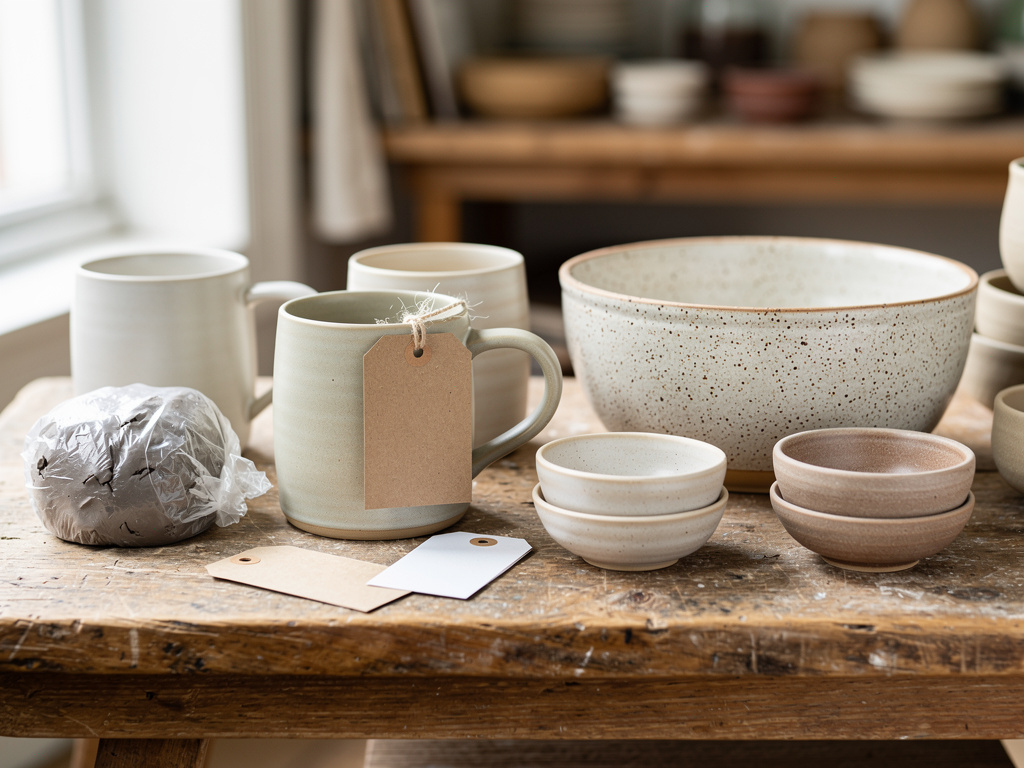


The short version: Yes, you can sell homemade pottery, and no cottage food permit or federal license applies, because pottery is not food and the SBA's list of federally licensed business activities does not include it. The one food rule that does follow you is FDA's: a mug, bowl or plate that looks usable for food is treated as food ware unless it carries the two-part "Not for Food Use" marking or a hole drilled through it, and FDA's lead guideline for cups and mugs is 0.5 micrograms per mL of test solution. Past that, your paperwork is what any vendor files: a sales tax registration in states with a sales tax, a city or county business license where your town requires one, and self-employment tax once your net earnings from self-employment are $400 or more in a year. Your town's home business rules decide whether you can fire a kiln in the garage, and each farmers market or craft fair decides whether it takes pottery at all.
Checked on October 8, 2026: FDA's pottery guides and 21 CFR 109.16 on fda.gov and ecfr.gov, CPSC's lead pages, California Health and Safety Code 25249.11, the IRS, the Texas Comptroller, four 2026 market handbooks, and the Etsy, Shopify and Homegrown pricing pages. These are federal rules plus examples, so verify your state's current rules before your first sale. Homegrown is built for pickup and local delivery, not shipping, customers create a Homegrown account to place a first order, and there is no drops feature.
You have a shelf of mugs from the last glaze firing and a neighbor who wants four of them. Before you take her money, you want to know whether a home potter needs a permit, a license or a lab report. The answer is mostly good news. Pottery skips the cottage food rules that bakers deal with, and there is no federal pottery license.
The catch is the glaze. A mug holds coffee, so the law treats it a lot like a food container, and that is where a home potter can sell something that breaks the rules without knowing it. This guide sorts every rule that touches a home potter into what is law, what is local, and what is just a market's house rule, with the numbers and the date we checked each one.
If you already know the rules and want to compare where to sell, the guide to where to sell pottery walks through craft fairs, studio sales, Etsy, shops and cafes, and what one $36 mug pays you in each. This guide is about whether, and what paperwork comes first.
Yes, you can sell homemade pottery without a federal license or a cottage food permit, as long as the pieces meant for food meet FDA's lead and cadmium guidelines and the decorative pieces are marked the way federal rules require. The SBA's list of business activities that need a federal license covers things like agriculture, alcohol, firearms, fish and wildlife, mining and transportation. Pottery is not on it, which we checked on October 8, 2026.
Here is what that means for a part-time potter:
So the honest answer is yes, with one real rule and a short stack of paperwork. The rest of this guide takes them one at a time.
No, pottery does not need a cottage food permit, because cottage food laws cover food you cook or bake at home, and a mug, bowl or vase is not food. Cottage food programs license home kitchens and the food made in them, not pottery studios or the pieces that come out of a kiln.
The confusion is easy to understand. The same rule book that covers your pottery's glaze is FDA's food law, because a glaze that touches food can put lead into it. But FDA's pottery rules apply to the finished piece, not to where you made it. There is no kitchen inspection, no food handler class and no annual sales limit tied to a pottery studio, so a potter who sells $500 of mugs a year and one who sells $5,000 work under the same rules.
What this means if you also sell food:
For the rules on selling soap, candles and other non-food products at a market booth, the guide on selling non-food products at farmers markets covers pricing and setup. Pottery follows the same booth logic with one difference: the glaze rules below.
Of the 10 rules in the table below, 5 come from federal agencies, 1 from California, 3 from your town or state, and 1 from whichever market or fair you apply to. Knowing which is which tells you who to ask when something is unclear.
Scroll sideways to see every column.
| Rule | Who sets it | When it applies to you | What to do |
|---|---|---|---|
| Lead leaching guideline for food ware | FDA, Compliance Policy Guide 545.450 | Any mug, bowl, plate or pitcher suitable for food | Use glazes labeled food safe, fired as directed, or lab test your recipe |
| Cadmium leaching guideline | FDA, Compliance Policy Guide 545.400 | Pieces suitable for liquid foods | Same as lead: a food-safe label fired as directed, or a lab test |
| "Not for Food Use" marking | FDA, 21 CFR 109.16 | Decorative pieces that look usable for food | Stick-on label plus a fired statement on the base, or a drilled hole |
| "Lead Free" claims | FDA guidance on lead free labeling | Any piece you call lead free | Only say it if testing found no extractable lead |
| Children's product lead limit, certificate and tracking label | CPSC, 15 U.S.C. 1278a and 2063 | Pieces designed mainly for kids 12 and under | Skip kid-themed pieces, or plan for a third-party lab test (or Small Batch Manufacturer registration), a Children's Product Certificate and a permanent tracking label |
| Prop 65 warnings | California | Businesses with 10 or more employees | Most home potters are outside it |
| Home occupation and zoning | Your city or county | Making or firing pottery at home | Read your town's home business rules before installing a kiln; some towns, such as Huntersville, North Carolina, require a zoning use permit with a review fee |
| Sales tax registration | Your state | Retail sales in a state with a sales tax | Register before the first sale |
| Local business license | Your city or county | Where your town requires one | Call the clerk's office or check its website |
| Craft rules, fees and handmade checks | Each market or fair | When you apply for a booth | Read the handbook; some markets bar pottery |
Federal rules loaded from fda.gov, ecfr.gov, cpsc.gov and law.cornell.edu on October 8, 2026. Prop 65 from section 25249.11 of California's health and safety law, loaded the same day. Local and market rules vary; the examples below name the town and the handbook.
The federal rows are the ones that carry the most risk, because a piece that leaches lead can hurt someone and FDA can treat it as adulterated. The local and market rows mostly cost you a fee or a booth if you miss them, such as Kingsport's $10 Saturday booth or Fredericksburg's $25 craft application.
A mug counts as food ware because federal rules treat any ceramic piece that "appears to be suitable for food use" as food ware unless it is marked otherwise. That wording comes from 21 CFR 109.16, the federal rule on ornamental and decorative ceramicware, which we read on October 8, 2026.
The reason is lead. The rule itself says lead is used in some glazes and decals, and using a decorative piece to "prepare, serve, or hold food may result in the leaching of lead from the glaze or decoration into the food." A buyer who takes home your vase does not know what is in your glaze. If it looks like a bowl, they may serve salsa in it.
Here is how that sorts your shelf:
If 20 products on your shelf are mugs, bowls and plates, all 20 products count as food ware unless you mark them. If a piece could be mistaken for food ware and you are not sure your glaze is safe, either test it or mark it. The next two sections cover both.
Under FDA's pottery guidelines, cups, mugs and pitchers have the strictest lead line and plates the loosest, at 0.5 and 3.0 micrograms per mL of test solution. The mug line is about 17% of the plate line, which is why a glaze that is fine on a plate can still fail on a mug. These numbers come from FDA's Compliance Policy Guide 545.450 for lead and the matching guide 545.400 for cadmium, both loaded on October 8, 2026.
The guides tell FDA staff when to recommend legal action against a piece or detain an import. A lab measures how much metal leaches from the piece into a test solution, using methods such as ASTM C738, and FDA's guide examines 6 units of the same piece.
Swipe sideways for the lead and cadmium columns.
| Piece | How FDA defines it | Lead guideline (µg/mL) | Cadmium guideline (µg/mL) |
|---|---|---|---|
| Plates and saucers (flatware) | Inside depth 25 mm or less | 3.0, average of 6 units | 0.5, average of 6 units |
| Bowls and small dishes | Deeper than 25 mm, holds less than 1.1 liters | 2.0, any one of 6 units | 0.5, any one of 6 units |
| Cups and mugs | Drinking vessels, usually about 8 fl. oz. with a handle | 0.5, any one of 6 units | 0.5, any one of 6 units |
| Serving bowls and casseroles | Holds 1.1 liters or more, not a pitcher | 1.0, any one of 6 units | 0.25, any one of 6 units |
| Pitchers | Large, with a handle and a spout | 0.5, any one of 6 units | 0.25 at 1.1 liters or more |
From FDA CPG Sec. 545.450 (lead) and Sec. 545.400 (cadmium), loaded from fda.gov on October 8, 2026. The cadmium guide groups pieces only as flatware, small hollowware and large hollowware, so a small pitcher falls under the 0.5 small hollowware line. FDA's lead guide says creamers, coffeepots and teapots are not pitchers; they count as small or large hollowware by size, so their lead line is 2.0 or 1.0.
What that means at your wheel:
The federal marking rule is written for ceramicware moving in interstate commerce, and FDA's guides describe when its staff act. That is not a loophole for porch sales: a lead-leaching mug is just as harmful across the street, and a buyer can carry it anywhere. Treat these numbers as the bar for every food piece you sell, and ask your state health or agriculture department whether your state has its own ceramicware rule.
To mark a decorative piece the legal way, you need two things at once: a stick-on label people can see, and the same warning fired, molded or permanently painted onto the base, both in letters at least 3.2 mm (0.125 inch) tall. The other option is a hole bored through the surface that would hold food. A sticker on the box alone does not count.
FDA's own guidance calls out that exact mistake: pottery with the warning only on a removable sticker or on the packaging, which the buyer throws away. Under 21 CFR 109.16, the label must use one of three messages, word for word.
The rule also allows an optional symbol showing the piece is not for food, with a circle at least 1 inch (2.54 cm) across. For a potter, an underglaze stamp or lettering carved near the foot ring is one way to get the permanent statement onto the base before the final firing.
You can call pottery "lead free" only if testing by FDA's methods found no extractable lead, because FDA says ceramicware that leaches any lead "should not be labeled as 'Lead Free'" and may be treated as misbranded. That line comes from FDA's guidance on the use of "Lead Free" in pottery labeling, loaded October 8, 2026.
The guidance was written after state and local agencies reported, and FDA's own checks confirmed, imported pottery labeled lead free that leached lead at levels comparable to lead-glazed pottery. Its point applies to any studio: the claim has to match the test, and lead can get into a lead-free glaze through tools used with lead glazes or a kiln that once fired them, both sources FDA's guidance names. FDA also says it considers its lead guide to apply to all forms of ceramicware, including pottery made without lead glazes.
Safer ways to describe your work:
Each glaze needs its own result, so a potter selling mugs in 4 glazes needs a clean test for each before calling all 4 products lead free.
None of the FDA pottery pages loaded on October 8, 2026, defines "food safe," so the phrase means whatever your glaze's manufacturer and your own testing support. Say what you did, such as which glaze and which cone, instead of making a promise you cannot back with a report.
Pottery made mainly for kids 12 and under becomes a "children's product" under federal law, which brings a 100 ppm total lead limit on every reachable part, or 0.01% by weight, on top of FDA's food rules. It also brings a Children's Product Certificate based on test results from a CPSC-accepted third-party lab, and a permanent tracking label on the piece and its packaging, where practicable, that gives your business name, where and when the piece was made, and a batch number. CPSC's tracking label FAQ says hangtags and stick-on labels are not permanent, and that small businesses get no exemption from the label. A maker who qualifies and registers with CPSC each year as a Small Batch Manufacturer (one of the two tests is making no more than 7,500 units of that product in the previous year) may be able to show it meets the lead limit without the third-party lab, such as by testing in house, but still has to issue the certificate and add the tracking label. The definition is in 15 U.S.C. 2052: a product "designed or intended primarily for children 12 years of age or younger." The lead limit is in 15 U.S.C. 1278a, which we read on October 8, 2026.
CPSC's Total Lead Content page says a children's product with more than 100 ppm lead in an accessible component is a banned hazardous substance, and that manufacturers and importers of children's products must certify compliance by issuing a Children's Product Certificate. CPSC's lead paint page adds a detail that matters for potters: ceramic glazing is not "paint" under its lead paint rule, so the glaze is not judged under that rule.
The law weighs factors such as your own statements and labels, how the piece is packaged, displayed and advertised, and whether people commonly see it as meant for kids. In pottery terms:
The simple path for a part-time potter is to sell general tableware and leave kid-themed lines alone until you are ready for the certificate work. If you want to make a kids' line, CPSC's Small Business Ombudsman takes questions at (888) 531-9070, per CPSC's Total Lead Content page.
California's Prop 65 warning law does not cover a business with fewer than 10 employees, so a one-person or family pottery studio is outside it. The exemption is written into California Health and Safety Code 25249.11(b), which says a "person in the course of doing business" does not include "any person employing fewer than 10 employees in his or her business." We loaded it on October 8, 2026.
Prop 65 requires covered businesses to warn about exposure to listed chemicals. Health and Safety Code 25249.11(b) leaves out businesses with fewer than 10 employees. The exemption belongs to each business, so a store with 10 or more employees that carries your mugs does not share yours. Ask any store that size how it handles Prop 65 before you sign.
A studio with 9 people on payroll is outside the law, and the 10th employee brings it inside. Being outside Prop 65 does not change the FDA lead guidelines above. It only means you are not required to post Prop 65 warnings. Two things to watch as you grow:
Whether you need a permit to fire a kiln at home depends on your city or county's home occupation rules, and those range from no permit at all for pottery in Sanford to a zoning use permit with a review fee in Huntersville, which also sets screening and setback rules for outdoor kilns. Two North Carolina towns, checked on October 8, 2026, show the range.
The City of Sanford's home occupation page lists "Craft work, such as jewelry-making and pottery, with no sales on the premises" as an exempt home occupation, and it tells residents to check their homeowners association rules. In Huntersville, a home occupation needs a zoning use permit, signed by the property owner and filed with a review fee, and Article 9.19 of the town's home occupation rules says outdoor kilns used to fire pottery need a semi-opaque screen, a secured work area, and at least 10 feet from abutting property lines.
Questions to answer before you buy or move a kiln:
Read the kiln manual's electrical requirements before you install it, and ask a licensed electrician whether your town requires an electrical permit for any new circuit.
In a state with a sales tax, you generally need a sales tax registration before your first retail sale, and many towns also require a general business license, with fees set locally. Pottery is a physical product sold at retail, so expect it to be taxable. In Texas, the Comptroller's sales tax page lists a 6.25 percent state rate plus up to 2 percent local, for a maximum combined rate of 8.25 percent, as loaded on October 8, 2026.
On a $40 serving bowl sold in a Texas city at the full 8.25 percent, the tax is $3.30, so the buyer pays $43.30 and you send $3.30 to the state.
The paperwork most part-time potters end up with:
Sales you ring up at a market booth are yours to report. The guide to sales tax at farmers markets covers how to handle the cash box and card reader side. Online orders are different if the platform collects for you: Homegrown's signup page, checked October 8, 2026, says sales tax is calculated and remitted for vendors in all 50 states.
Some farmers markets welcome pottery, some limit crafts to a small share of booths or a few months, and some ban it outright, so the market's own handbook is the only answer that counts. Four 2026 handbooks, each checked on October 8, 2026, show how different the rules are:
Apply early next season. Fredericksburg's 2026 craft application fee was $25 if paid by March 23 and $35 after that date, and it is charged before anyone reviews your application. Watch for the early date when next year's handbook comes out, because paying by it saves $10 before you have sold a single mug.
What a market manager usually wants from a potter is proof you made the work and a full list of what you will sell. Fredericksburg has craft vendors declare every product on the application, Kingsport wants pictures of the items to be sold with the application, and Bloomington has crafters bring representative samples of each type of craft item for review. None of the four 2026 handbooks we read asks for a glaze test report, but keep yours with you in case a manager or a customer asks. Juried craft fairs also review photos of your work. The guide to getting into a juried craft fair is written for food vendors, and its sections on how juried fairs work and what juries look for cover that review.
Pottery income is reportable from the first sale, and self-employment tax starts once your net earnings from self-employment reach $400 in a year. The IRS states that $400 line on its self-employment tax page, loaded October 8, 2026.
Net profit means what is left after costs. A potter who sells $3,000 of work in a year and spends $1,800 on clay, glaze, kiln electricity, booth fees and platform fees has $1,200 of net profit. The $400 test uses 92.35% of that profit, per line 4a of Schedule SE, so this potter has about $1,108 of net earnings from self-employment ($1,200 x 0.9235), which is over the $400 line.
Records worth keeping from day one:
Payment apps and online marketplaces must send a Form 1099-K when your payments for sales top $20,000 in more than 200 transactions, per the IRS 1099-K page loaded October 8, 2026, and they may send one for less. No form does not mean no tax. The 1099-K threshold guide covers what to do when a form arrives.
There is no legal cap on what you can charge for handmade pottery, so the price is yours to set, and it has to cover clay, glaze, firings, fees and your time with room left over. Unlike some home bakers, potters face no state sales limit tied to a home permit.
Clay is the easiest cost to pin down. A 25-pound bag of Standard 266, a mid-range dark brown clay, was listed at $33.50 at Blue Ridge Clay (sold out that day) and $35.10 at The Potter's Shop, before shipping and tax, when we checked both pages on October 8, 2026. That works out to $1.34 to about $1.40 a pound.
A simple way to build a price for one form:
The where-to-sell guide uses a $36 mug as its example because it compares channels at one price. Whatever your number is, charge the same price everywhere, because a shop that sees your mug cheaper online has a reason to stop stocking you.
On a $40 serving bowl, Etsy's listing, transaction and processing fees take $4.25 before shipping, while Homegrown takes $1.46 in card processing and Shopify Basic takes $1.46 on a standard card ($1.70 on a premium card), plus their monthly plans. Over 15 orders in a month, that is $63.75 on Etsy, $50.90 on Shopify Basic billed yearly, and $31.90 on Homegrown billed annually.
Swipe sideways for each platform's full fee stack.
| Platform | Monthly plan | Trial | Platform fee | Card processing | Customer pays on a $40 bowl | Vendor pays on a $40 bowl | Vendor pays in a month of 15 orders |
|---|---|---|---|---|---|---|---|
| Homegrown | $10 billed annually ($12.50 billed monthly) | 7 days, no charge until day 8 | None, 0% commission | 2.9% + $0.30, paid by the vendor | $40.00 | $1.46 plus the plan | $31.90 ($34.40 billed monthly) |
| Etsy | None (a one-time set-up fee may apply when you open a shop) | None | $0.20 listing fee plus 6.5% transaction fee on price and shipping | 3% + $0.25, on the total including tax and shipping | $40.00 plus shipping | $4.25 before shipping and ads | $63.75 |
| Shopify Basic | $29 billed yearly ($39 billed monthly) | 3 days, then $1 a month for 3 months | None with Shopify Payments (2% with another provider) | 2.9% + 30¢ online on standard cards (3.5% + 30¢ on premium cards, plus 1% on international cards) | $40.00 | $1.46 plus the plan | $50.90 ($60.90 billed monthly) |
Card processing is figured on the $40 price with no tax or shipping. The Shopify figures use its standard online card rate; a premium card costs 3.5% + 30¢, or $1.70 on a $40 bowl. We checked Etsy's fees and payments policies, Shopify's pricing page and findhomegrown.com/signup on October 8, 2026. Etsy's Offsite Ads fee of 15% (12% once a shop passes $10,000 in sales over 365 days) applies only to orders that come from its ads and is not included.
What a potter pays for 15 orders of a $40 bowl in a month
Source: Etsy, Shopify and Homegrown pricing pages, checked October 8, 2026. Yearly or annual billing, no shipping, tax or ads.
The bigger difference for pottery is shipping. Etsy charges its 6.5% on the shipping you collect too, and a serving bowl needs careful packing to arrive whole. Selling for local pickup takes the box out of the math entirely.
In a pull of the Homegrown catalog on October 8, 2026, 1 of the 2,920 products listed by 313 vendors was described as ceramic: "Ceramic red chili peppers on a wood paddle," a $45 piece from Jody's Glass & Resin Art. None was a handmade mug, bowl, plate, vase or planter. We searched every product name and description for pottery, ceramic, stoneware, porcelain, earthenware, terra cotta, kiln, wheel thrown, hand built and clay, then read all 95 Arts and Crafts listings and all 87 home goods listings by name.
Once your glazes are tested and your paperwork is in order, the hard part is getting the buyer who loved your speckled mug in May to order the matching bowl in November without a shipping box. Homegrown is $10 a month billed annually ($12.50 billed monthly) with no percentage fees beyond standard payment processing of 2.9% + $0.30, which the vendor pays.
Compared with the options potters usually try:
What Homegrown does that fits a home potter:
The honest limits: Homegrown is built for pickup and local delivery and does not ship pottery across the country. Customers create a Homegrown account to place their first order. There is no drops or timed-release feature. Your storefront is listed on the Homegrown marketplace, but plan on most orders coming from people you send to your own link, such as the card that goes in every bag. If that fits how you sell, you can set up your pottery storefront on Homegrown in about 15 minutes, per the signup page, with 7 days before any charge.
Going from first firing to first legal sale takes about seven steps, and most of them are a single form or a single test. Do them in this order so nothing you buy depends on a permit you cannot get.
The whole list costs most potters a sales tax registration, a local license fee where one applies, a booth fee, and the price of any glaze tests. None of it requires a commercial studio or a food permit. Registering before the first sale also means the $3.30 of Texas tax on a $40 bowl comes from the buyer at checkout, not out of your pocket months later.
This guide covers federal rules, California's Prop 65 and examples from specific towns and markets as of October 8, 2026. Sales tax, business licenses, zoning and any state rule on ceramicware vary by state and city, so verify your state's current rules before your first sale.
You do not need a federal license or a cottage food permit to sell homemade pottery, because the SBA's list of federally licensed activities does not include it and cottage food permits cover only food. States with a sales tax generally require a registration before retail sales, and many cities require a general business license. Check your state revenue department and your city clerk before your first sale.
You can sell pottery at many farmers markets, but each market sets its own craft rules. Fredericksburg, Virginia, bars pottery from its 2026 farmers market and sends potters to its separate craft events, while Bloomington, Indiana, lets only its existing farm and food vendors add registered crafts, and only in April, May, October and November, so a potter with nothing else to sell cannot get a booth there. Read the handbook of the market you want before applying.
Yes, if the finished piece stays under FDA's lead guidelines, because what counts is how much lead the fired piece leaches, not whether you ran a test. A mug or bowl that leaches lead above those guidelines can be treated as adulterated food ware whether or not you tested it. A commercial glaze labeled food safe and fired as directed is the usual way potters stay under them. For mugs, FDA's line is 0.5 µg/mL of leaching solution, its strictest. If you mix your own glaze, a lab test is the only way to know where you stand.
You can sell a decorative piece with a lead glaze that looks like a dish only if it is marked the way 21 CFR 109.16 requires: a visible stick-on label plus a permanent fired or molded statement on the base, both in letters at least 3.2 mm tall, or a hole drilled through the food surface. A sticker alone, or a warning only on the box, does not meet the rule.
Usually yes, because pottery is a physical product sold at retail. Texas, for example, charges 6.25 percent state tax plus up to 2 percent local, and at the full 8.25 percent that is $3.30 on a $40 bowl. Rates and exemptions differ, so check your own state's revenue department. Register with your state before your first sale and keep records of every sale, including cash at a booth.
You can sell a handmade mug for any price you choose, because no law caps what potters charge. Build the price from clay (Standard 266 clay ran $1.34 to about $1.40 a pound on October 8, 2026), glaze, firings, selling fees and your time, then check it against similar local work and charge the same price everywhere you sell.
These guides pick up where this one stops. The first two cover selling, the next two cover rules for crafts that often share a table with pottery, the fifth covers the tax side of booth sales, and the last covers the insurance question many market managers ask before a first booth:
Pottery is one of the friendliest crafts to sell legally from home: no cottage food permit, no federal license and no sales cap. A potter who sells 30 mugs a year and one who sells 300 face the same short list. The rules that matter are the glaze, the marking on decorative pieces and the ordinary sales tax and local license paperwork, and every one of them can be settled before your first market.
After that, the potters who keep selling are the ones whose buyers can order again easily. If most of your buyers live within a short drive, start your pottery storefront on Homegrown and put the link on the card that goes home with every mug. It is $10 a month billed annually, with 2.9% + $0.30 card processing on each order and no commission, and the next bowl can be picked up at your porch on Saturday.



