

The short version: Yes, you can sell homemade wax melts from your kitchen, and because a melt is not food, no cottage food permit applies to it, and we found no health inspection rule that covers a non-food melt. There is also no wick, so the only federal rule written just for candles, the lead limit for metal-cored wicks, has nothing to apply to. What does apply is a label with the product name, your business name and place, and the net weight of the wax in ounces and grams, plus extra federal warnings only if your melt counts as a hazardous substance, a test that looks at what a child might reasonably do with it, including eat it. Most "CLP compliant" advice online is UK and EU law, but in the US the FTC packaging rule and the federal hazardous substance test set the label, so verify your state's current rules before you print labels.
Checked October 5, 2026: the rules here come from the CPSC's candle guidance, the federal regulations at 16 CFR 1500.3, 1500.13 and 1200.2, the FTC's packaging rule page, and the Missouri Department of Revenue, all loaded that day. Fees come from Homegrown's signup page and the Etsy, Shopify and Square pricing pages the same day. Homegrown customers create an account to place their first order, there is no drop or countdown release feature, and most orders come from people you send to your own link.
You poured a test batch of strawberry cream melts for your sister, she gave half to her coworkers, and now three of them want a clamshell every month. The Saturday market has a craft table open. Before you order 200 clamshells, you want to know whether any of this needs a permit.
It mostly does not, and that is the good news. Wax melts sit in a gap between food law, which does not cover them, and candle rules, which mostly cover wicks. The few rules that do reach a melt are about the label, the warning, the shape and the scent, and they are easy to get right once you know where they come from.
Yes, you can sell homemade wax melts from your own kitchen, because they are a household product, not a food. Cottage food laws, the state rules that let you sell cookies and jam from home, are written for food, so a wax melt never needed them in the first place. The FDA's aromatherapy page says some fragrance products, such as "air fresheners, scented candles," are regulated by the Consumer Product Safety Commission, and a melt is the same kind of scented household product. Homegrown's own signup page puts it in one line: "No food license required for non-food products." A clamshell of 2.5 to 3 ounces of wax, which the small shops in our wax melt pricing guide sold for $5.00 to $9.99 on September 30, 2026, is a household product from start to finish.
That does not mean there are zero rules, and your city's zoning or home business rules can still limit a business run from a house. It means the rules come from different places:
If you also pour jar candles, the guide to whether you can sell homemade candles covers the wick rule and the candle label in full, and the wax melt pricing guide covers what to charge for a clamshell once you are legal. This page covers what is different about a melt.
Mostly yes, with one big difference: a wax melt has no wick, so the only federal rule written just for candles does not touch it. The CPSC's candle guidance, loaded October 5, 2026, says metal-cored wicks "must not contain lead in the metal core in excess of 0.06% by weight." The same page says there is "no certification requirement" for candles with nonmetal wicks. A melt has no wick at all, so there is no certificate to issue.
Beyond the wick rules and the warning label for a hazardous substance, the rest of that CPSC page is voluntary. It lists six industry standards from ASTM International, a private group that writes product standards, and calls them "industry consensus standards (also known as voluntary standards)." The page never uses the words "wax melt." Here is how the candle rules sort out for a melt:
Swipe the table to see all four columns.
| Rule | Who sets it | Required for a candle? | Does it reach a wax melt? |
|---|---|---|---|
| Lead limit of 0.06% in metal wick cores | CPSC, 16 CFR 1500.17(a)(13) | Yes, if the wick has a metal core | No, a melt has no wick |
| Certificate of compliance for metal-cored wicks | CPSC | Yes, for metal-cored wicks only | No |
| Cautionary label if the product is a hazardous substance | CPSC, Federal Hazardous Substances Act | Only if hazardous | Yes, same test; it counts a child eating the product, which a dessert-scented melt invites |
| Product name, business name and place, net weight on the label | FTC for sales across state lines; your state's packaging rule for local sales | Yes | Yes |
| Fire safety warning wording (ASTM F2058) | ASTM International | Voluntary | Voluntary; its title names candles, not melts |
| Fire safety for candle accessories (ASTM F2601) | ASTM International | Voluntary | Voluntary; its title names candle accessories, not the wax |
We checked the CPSC's Candles Business Guidance page and the eCFR on October 5, 2026. The CPSC lists the ASTM standards as voluntary; we have not read the paid standards themselves, so the last column says only what the CPSC page supports.
So of the candle rules, two reach a melt as law (the label, and the hazardous substance test), and the rest are voluntary. The hazardous substance test is where melts and candles part ways.
A wax melt is a scented, colored block that often smells like dessert, and federal law judges a household product partly by what a child might do with it. The Federal Hazardous Substances Act (FHSA), the law behind the CPSC's warning label rules, defines a hazardous substance in 16 CFR 1500.3 as something that is toxic, corrosive, an irritant, a strong sensitizer, flammable or combustible, or generates pressure through decomposition, heat or other means, if it "may cause substantial personal injury or substantial illness during or as a proximate result of any customary or reasonably foreseeable handling or use, including reasonably foreseeable ingestion by children."
Read that last phrase twice. Ingestion by children is the one use the definition names outright. A jar candle sits in glass on a shelf. A $5 clamshell of strawberry-scented pink cubes sits in clear plastic that looks a lot like a candy box. A child biting into one is the kind of "reasonably foreseeable" event the law asks you to think about.
Both halves of the test have to be true. The CPSC's FHSA guidance points to test methods for corrosivity and irritation (16 CFR 1500.41 and 1500.42) and flammability (16 CFR 1500.43 to 1500.46); toxicity tests sit in 16 CFR 1500.3(c), and there is no codified test for a strong sensitizer, only the list in 16 CFR 1500.13. Your supplier's safety data sheets are where that check starts. A plain soy melt that is not toxic, irritating or flammable under the FHSA's definitions is not a hazardous substance just because a child might chew it. If your finished melt meets both halves of that test, the federal label has to carry:
If you are not sure which side of the line your scent lands on, the CPSC's Small Business Ombudsman takes questions at (888) 531-9070, a number listed on its candle guidance page on October 5, 2026.
Yes, food-shaped wax melts are sold legally in the US, but the more a melt looks and smells like a treat, the more the warning and the design have to work. No federal rule we found bans a cookie-shaped melt, and a shop on Homegrown, Forever Red Candle Co., lists a $4.00 jumbo cookie melt. Two federal lines still matter.
First, the hazardous substance test above, which already counts "reasonably foreseeable ingestion by children." Second, the CPSC's rule on what counts as a children's product, 16 CFR 1200.2. That rule says candles are among the products "not subject to" the stricter children's product testing. It also says a label stating a product is not for children "does not preclude a product from being regulated as a children's product if the primary appeal of the product is to children 12 years of age or younger," for example through "decorations or embellishments that invite use by the child."
A cereal-bowl melt with cartoon colors, sold in a kid-sized box and marketed to children, starts to look like a children's product under 16 CFR 1200.2, and children's products need third-party lab testing. And if a children's product is or contains a hazardous substance, federal law treats it as banned outright (FHSA section 2(q)(1), per the CPSC's FHSA guidance), so a scent that needs a warning label cannot go into a kid-styled melt at all. Keep food-shaped designs aimed at adults: adult scents, adult packaging, adult photos, and a clear "For wax warmers only. Do not eat." line. We read that rule on the eCFR on October 5, 2026.
Across the Atlantic the line is drawn harder. Lincolnshire Trading Standards in England warns wax melt businesses that melts "made in the shape of food items, such as chocolate bars, sweets or cakes" can be "very tempting to young children who are at risk of choking or asphyxiation." That is UK advice, not US law, but the safety point travels. A design that passes the law and still ends up in a toddler's mouth is a bad day for everyone.
Practical choices that keep a dessert melt on the right side:
Yes, two fragrance materials are named outright in federal law: oil of bergamot, the citrus oil that flavors Earl Grey tea, at 2% or more, and powdered orris root, the ground iris root used in potpourri and sachets, in any amount. The CPSC's list of "strong sensitizer" substances in 16 CFR 1500.13 includes "Oil of bergamot and products containing 2 percent or more of oil of bergamot" and "Powdered orris root and products containing it." A strong sensitizer is something that can cause an allergic skin reaction that shows up again on repeat contact.
Being on that list covers only the first half of the hazardous substance test. A melt with 2% or more bergamot oil still has to be able to cause substantial injury or illness in normal or foreseeable use before the full warning label applies. Our reading is that a solid melt set in a warmer touches skin far less than a lotion does, but people do handle melts with bare hands. That call is one to make with your supplier's documents in hand, or with the CPSC's small business help line.
Do the bergamot math before you name a scent "Earl Grey." If fragrance oil is 10% of your melt by weight and bergamot oil is 20% of that fragrance blend, the finished melt is 0.10 x 0.20 = 2% bergamot, right at the federal line. Ask your supplier for the safety data sheet (SDS), the sheet that lists what is in the oil, and keep it in a folder with the batch.
The other three substances on the list, paraphenylenediamine, certain epoxy resin systems and formaldehyde at 1% or more, are not fragrance materials. If you add botanicals to a melt, check that none of them is powdered orris root.
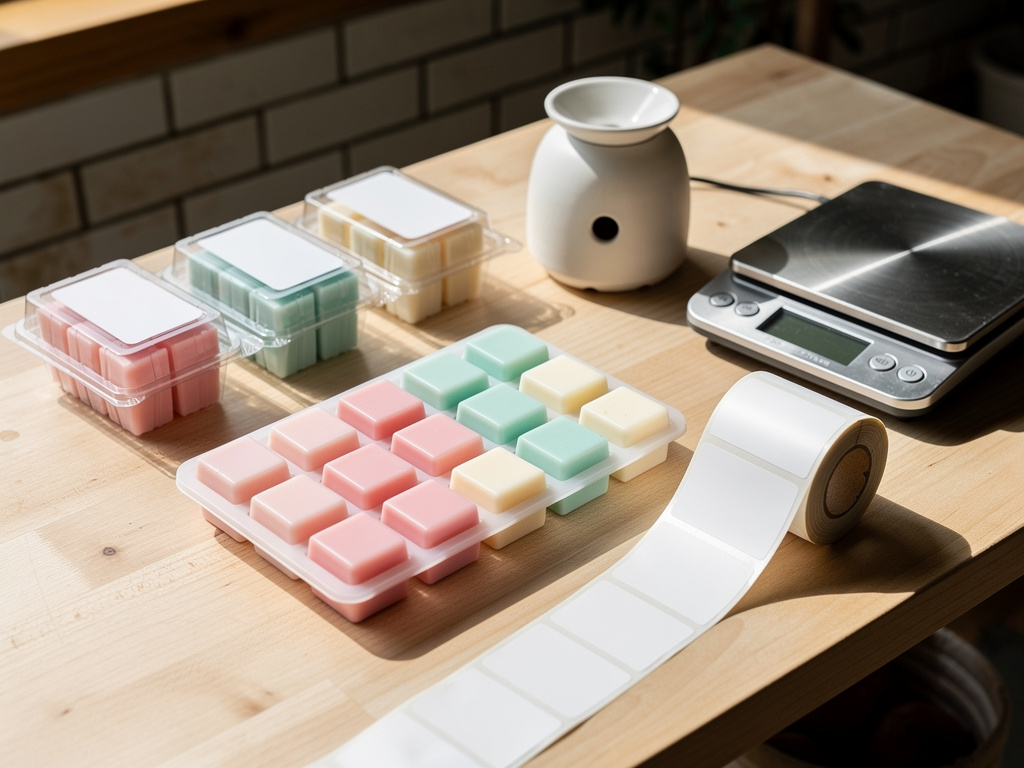
A wax melt label needs three things: what the product is, who made it and where, and the net weight of the wax in both ounces and grams. The FTC's page on the Fair Packaging and Labeling Act, the federal law for household product labels, lists those three and says the measurement must be "in both metric and inch/pound units." That page was checked on October 5, 2026.
That federal rule covers products sold across state lines. Melts you sell only in your own state fall under your state's packaging rule. NIST, the federal agency that writes the model rule states copy, says its packaging rule "has been adopted into law in 45 of the 50 U.S. states," and it asks for the same three lines. Here is what a clamshell label looks like line by line:
Slide this table sideways to read each label line.
| Label line | Required? | Example on a clamshell |
|---|---|---|
| What it is | Yes, FTC rule or your state's packaging rule | Soy Wax Melts |
| Who made it and where | Yes | Poured by Your Shop Name, Columbia, MO 65201 (plus the street, unless your address is published, such as on your website) |
| Net weight of the wax, both units | Yes | Net Wt. 2.5 oz (71 g) |
| Signal word, hazard statement and a children warning | Only if the melt meets the FHSA hazard test | WARNING: Contains oil of bergamot. May cause skin reaction. Avoid prolonged skin contact; wash hands after handling. Keep out of the reach of children. |
| "Do not eat" line | Not named in federal law; strongly advised on food-scented or food-shaped melts | For wax warmers only. Do not eat. |
| Warmer and fire safety directions | Customary, not required by a federal rule for melts | Use only in warmers made for wax melts. Never leave a warmer on unattended. |
| Scent name and wax type | Optional | Strawberry Cream, soy wax |
Requirements checked on the FTC's FPLA page, NIST's packaging FAQ and 16 CFR 1500.3 on October 5, 2026. 2.5 ounces is 70.9 grams, rounded to 71.
Two placement details trip people up. The FTC's regulation at 16 CFR 500.5 asks for the street address, city, state and ZIP code, and lets you leave off the street only if it is listed in a "readily accessible, widely published, and publicly available resource," such as your website. And 16 CFR 500.6 puts the net weight on the front panel, in the bottom 30% of the label, unless that front panel is 5 square inches or smaller. Measure the top of your clamshell before you design the label; both sections were checked October 5, 2026.
The net weight is the wax, fragrance and dye only. Weigh an empty clamshell, weigh a full one, and print the difference. A label that lists the weight of the plastic too is overstating what the customer gets.
The warning most melt vendors use is a small sticker that covers the warmer, children and pets, and you should add "do not eat" to it yourself. CandleScience, a large US candle supply company, sells a stock wax melt warning label that is 1.75 by 1.5 inches and "fits on the inside or outside cover" of its standard clamshell, at $4.15 for a roll of 100 on October 5, 2026. Its text reads, in part: "Use only in tea-light warmers or UL listed electric warmers approved for wax melts," "Do NOT leave melter unattended while in use" and "Keep out of reach of children and pets."
That stock label has no "do not eat" line. If your melts smell like cake or look like candy, that is the one line worth adding. A good wax melt warning covers five things:
If your melt does meet the FHSA test, the federal label elements in the section above replace guesswork, and they have to be "located prominently" and in "conspicuous and legible type," per 16 CFR 1500.3. A sticker hidden under the lid may not meet that, so put a federal warning on the outside.
No, CLP is British and European law, so a melt you make and sell in the US does not need a CLP label. The EU rule behind it, Regulation (EC) No 1272/2008, came into force on January 20, 2009, and Great Britain kept its own copy after leaving the EU. CLP stands for Classification, Labelling and Packaging, the rule that sets hazard labels for chemical mixtures, which UK wax melt guides apply to melts. The UK's Health and Safety Executive says the GB version "applies to GB-based manufacturers, importers, downstream users and distributors supplying the GB market." We read that page on October 5, 2026.
This matters because much of what you find when you search for wax melt rules is British. In our search on October 5, 2026, at least 6 of the top 10 results, or 60% or more, for "can you sell homemade wax melts" were UK sites or UK councils.
If you ship melts to customers in the UK or EU, their rules can apply to that sale, so do not take "CLP is not a US rule" to mean "CLP never matters." For melts sold at your US market or to US customers, the US rules on this page are the ones that count. Checked on the HSE's GB CLP page, October 5, 2026.
You can name a scent, but calling a melt a sleep aid or an anxiety fix turns a household product into a claimed drug. The FDA's aromatherapy page says claims that a product will "treat depression or anxiety, or help you sleep are drug claims," and adds that some fragrance products, "such as air fresheners, scented candles," are regulated by the CPSC instead of the FDA. That page was current as of September 8, 2023 when we loaded it on October 5, 2026.
Here is the difference in practice:
Describe the smell and the mood. Leave the health effect to the customer.
The same test covers the captions and posts that sell your melts. A listing titled "Lavender Fields soy melts, $6" is a product description. The same listing captioned "melt one cube before bed for deeper sleep" is a sleep claim, even though the product name never changed. Read your product names, table signs and recent social posts with that test in mind, and rewrite any line that promises a result in the body instead of a scent in the room.
You do not need a special wax melt license, but you usually need the same registrations as any small vendor: a state sales tax permit, and a business license or home business permit if your city or county asks for one. Expect a melt to be taxable: it is not food, so the food exemptions many states give bakers do not cover it.
The Missouri Department of Revenue's farmers market tax guide is a clear example. Its table marks "Candles" and "Hand crafted items" as taxable at farmers markets, while many farm products on the same table are exempt. A melt is neither food nor farm produce, so plan on charging tax on it.
The Department of Revenue's farmers market tax matrix, effective March 27, 2023, lists candles and hand crafted goods as taxable. It does not name wax melts, so plan on collecting sales tax on them and confirm with the department. Read in the guide on October 5, 2026.
Three registration steps cover most new melt vendors:
Online orders are simpler. Homegrown's signup page, checked October 5, 2026, says sales tax is "Calculated & remitted" in all 50 states for orders placed through your storefront, so the tax you collect and file yourself is mostly on the cash and card sales at your booth. Set up your Homegrown storefront once your permit is in hand, and the tax on your online clamshell orders is handled for you.
Yes, many farmers markets and craft fairs take wax melts, but the market's own rules decide whether you get a table and what you can do at it. In the handbooks we read, markets file melts under crafts or "candles and wax products." Two real vendor handbooks show the kinds of rules you will meet:
Drag the table left to compare both markets.
| Market | What it says about melts | Other rule that affects you |
|---|---|---|
| Nashville Farmers' Market (handbook revised March 14, 2024) | Craft vendors may sell "candles and wax products" | General and product liability insurance of at least $1 million, naming Metro Nashville Government |
| NPR Fourth Friday market in New Port Richey, Florida (vendor handbook, PDF dated September 2024) | Allows "Candles, Wax Melts, Incense and sage" | None of them may be "lit up or actively burning" during the market; vendors also need a general liability policy naming Unik Collective LLC as additional insured |
Both handbooks loaded October 5, 2026. Your market's rules may differ; ask for the current vendor packet before you apply.
That second rule matters more for melts than for most crafts, because a customer wants to smell the scent. Bring open sample jars or a sniff tray of loose cubes instead of a running warmer. Ask before you plug anything in, since some outdoor markets have no power at the booth.
The insurance line is the other one to plan for. Both handbooks require coverage, and only Nashville names a figure: $1 million in product liability, a policy you buy before the season, not a box you tick at the gate. If you already sell candles or soap, ask your insurer whether melts fit under the same policy; the guide to selling non-food products at farmers markets covers booth setup and the other permits non-food vendors deal with.
You can, but a warmer is an electrical or open-flame product with its own safety history, so buy them from a supplier you trust and check them against recalls. The CPSC's guide for resellers says, plainly, "It is illegal to sell any recalled product," and points to Section 19 of the Consumer Product Safety Act. We read that guide on October 5, 2026.
Warmers do get recalled. In November 2015, the CPSC announced a Family Dollar recall of ceramic wax warmer sets, sold with four vanilla wax cubes and an opening for a tea light, because they "can produce high flames." The recall listed 11 reports, including 2 burn injuries and 3 reports of property damage.
Forever Red Candle Co., the one Homegrown shop selling melts, lists six candle warmer lamps priced from $24.99 to $48.00, and one of them, the $24.99 Versatile Candle Warmer Lamp, says it also takes wax melts, so warmers already sit next to melts on Homegrown. Before you add warmers to your table:
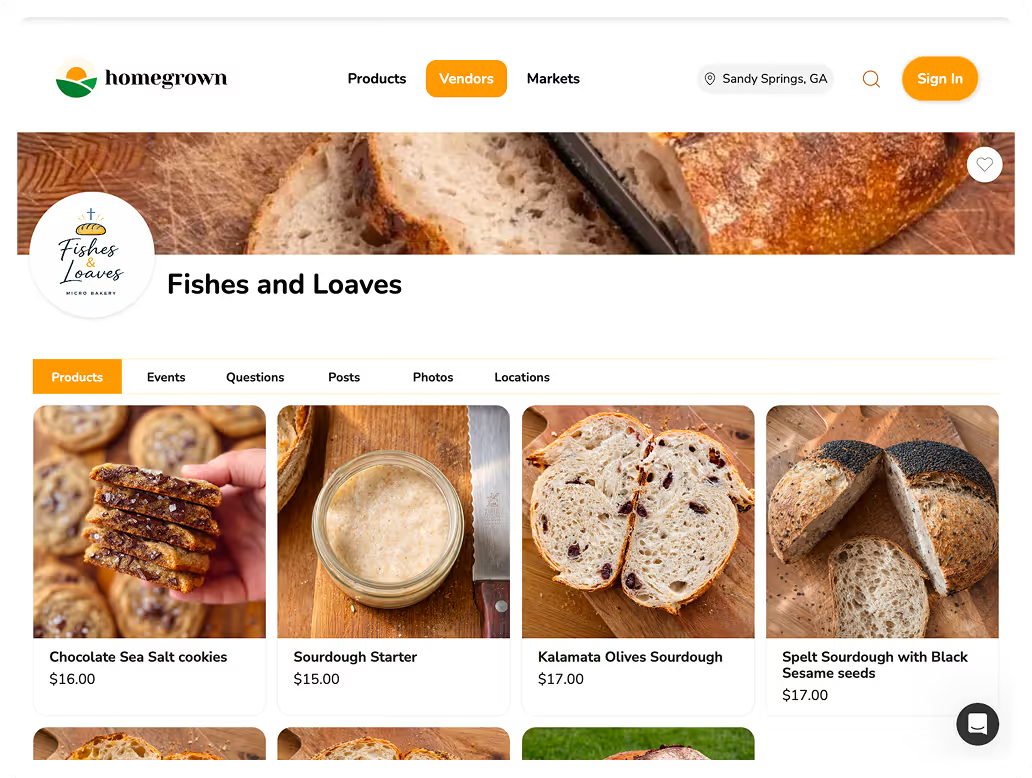
Once your labels are right, the next problem is that melts are a refill product: the same person wants a new clamshell every few weeks, and you cannot be at a market every time they run out. You need a place where regulars can reorder their scent and pay, without you trading messages for every $6 sale. Wax melt orders are small, so the fixed per-order fee matters more than the percentage.
Homegrown is $10 a month billed annually, or $12.50 billed monthly, with no percentage fees beyond standard payment processing of 2.9% + $0.30, paid by you. Your customer pays your price and nothing extra. Here is the full fee stack on a $12 order, two $6 clamshells picked up from your porch:
This one is wide. Drag it sideways to read every fee.
| Platform | Monthly plan | Trial | Platform or transaction fee | Card processing | Customer pays on a $12 order | Vendor pays on a $12 order | Vendor pays for 50 orders a month |
|---|---|---|---|---|---|---|---|
| Homegrown | $10 billed annually ($12.50 monthly) | 7 days, no charge until day 8 | $0, no commission | 2.9% + $0.30, paid by the vendor | $12.00 | $0.65 plus the plan | $42.40 ($44.90 on the monthly plan) |
| Etsy | $0 (possible one-time shop set-up fee) | None | $0.20 listing fee per item sold (two on this order) plus 6.5% transaction fee; Offsite Ads fee on ad-driven sales | 3% + $0.25 | $12.00 (plus shipping if shipped) | $1.79 | $89.50 |
| Shopify Basic | $29 billed yearly ($39 monthly) | 3 days, then $1 a month for 3 months | $0 with Shopify Payments (2% with another provider) | 2.9% + 30¢ online | $12.00 | $0.65 plus the plan | $61.40 ($71.40 monthly) |
| Square Online, Free plan | $0 | None | $0 | 3.3% + 30¢ online (2.6% + 15¢ in person) | $12.00 | $0.70 | $34.80 |
Fees from Homegrown's signup page and the Etsy, Shopify and Square pricing pages, all checked October 5, 2026. Figured on a $12 order before sales tax and shipping; Etsy charges its processing fee on the full total including tax and shipping, so real Etsy orders run a little higher. Etsy's listing fee renews at $0.20 for each item sold, so a two-clamshell order pays it twice.
What you pay in a month of 50 wax melt orders at $12
Source: each platform's pricing page, checked October 5, 2026, with plans billed yearly where offered, before sales tax and shipping.
Square's free online store costs less than Homegrown at 50 orders a month, by $7.60. Square's online rate runs 0.4 points higher, about 5 cents more on each $12 order, and those cents only pass Homegrown's $10 plan fee at about 208 orders a month. If you sell fewer than that and only want a checkout, Square is the cheaper tool.
Homegrown fits a melt vendor who sells locally:
What it does not do: customers create a Homegrown account to place their first order, there is no drop or countdown release feature for a limited scent, and it is built for pickup and local delivery, so it is not the tool for shipping melts across the country. Etsy is set up for shipping to buyers who search for melts; it also keeps $1.79 of a $12 two-clamshell order.
Very few, which means a melt vendor on Homegrown is one of a handful, not one of hundreds.
In a pull of the Homegrown catalog on October 5, 2026, 2 of the 2,896 products listed by 310 vendors were standalone wax melt listings, both from Forever Red Candle Co.: a Cookie wax melt at $4.00 in three scents, and a Mystery wax melt cookie box at $10.00 holding 3 jumbo cookie melts. A third product, a $30.00 home fragrance set, includes a wax shot with a 10 ounce candle and a 1 ounce room spray. On our September 30, 2026 pull there were no standalone melt listings at all. We counted by searching every listing's name and full description outside the bakery aisle for melt, tart, snap bar, clamshell, wax cube and wax warmer, reading each match, and then opening all 19 listings from the one home fragrance shop that matched.
Those two listings show the "do not eat" line in real use. The cookie melt's description says the melts "look good enough to eat" and ends with "For wax warmers only. Do not eat." The mystery box says "not edible." A dessert-shaped melt with a clear warning in its listing is exactly the pairing this guide recommends.
The mistakes that cause real trouble are a wrong net weight, a missing warning on a food-looking melt, and a health claim, not the lack of a special permit. The ones to watch for:
Seven steps take a home melt vendor from a test batch to a legal first sale, and most take an afternoon:
When you reach step seven, create your Homegrown storefront and list your three best-selling scents with a pickup time. Your next refill order can come in before you have packed up the booth.
We found no federal or state license written just for wax melts, and no cottage food permit applies because a melt is not food. You do usually need a state sales tax permit, and some cities and counties require a general business license or a home business permit. Call your city clerk and your state revenue department before your first sale.
Federal law requires a full cautionary label only when the melt counts as a hazardous substance under the Federal Hazardous Substances Act, a test that includes what happens if a child eats it. A plain melt that is not toxic, irritating or flammable under that act does not need one. Adding a warmer and children warning anyway costs about 4 cents a clamshell with a stock sticker, and dessert-scented melts should say "Do not eat."
Yes, you can sell homemade wax melts online, and once a melt crosses state lines the FTC's packaging rule applies to its label: product name, your name and place of business, and net weight in ounces and grams. Pack for heat in summer, since melts can soften in a hot delivery truck. If most of your buyers are local, pickup or local delivery skips the shipping problem.
No. CLP is the EU rule for hazard labels, and Great Britain's copy of it applies to GB-based businesses supplying the British market. A melt sold at a US market or to US customers follows US rules instead. If you ship to the UK or EU, check their rules for those orders.
Yes, you can sell homemade wax melts made with essential oils, as long as you describe the scent and not a health benefit. The FDA treats "help you sleep" and "treat anxiety" as drug claims. Keep the supplier's safety data sheet for each oil, and watch bergamot: federal rules list products with 2% or more oil of bergamot as strong sensitizers.
No federal rule we found requires insurance for a home wax melt vendor, but markets often do. The Nashville Farmers' Market handbook, for example, asks craft vendors for at least $1 million in general and product liability coverage. Ask your insurer whether melts fit on a policy you already carry for candles or soap.
These guides cover the parts of a melt business this one only touches:
A clamshell with the right label, a checked scent list and a clear "do not eat" line is ready for a market table. The step after that is a place for regulars to reorder, and a Homegrown storefront gives you one link for $10 a month billed annually.