


The short version: Pitch local businesses that already give gifts, such as realtors, dental offices, insurance agents and small firms, by reaching the person who orders them, usually the office manager, in September or October for December gifts. Send a one-page sheet with three boxes, one of them under $25, because IRS Publication 463 lets a business deduct no more than $25 per person per year for gifts, and put your minimum, lead time and delivery area on the same page. Drop off a sample box, follow up twice over two weeks, and confirm the whole order in writing before you bake. All 7 of the bakery gift programs we read publish a lead time and 5 state a minimum, so set both before you pitch.
Checked October 14, 2026: Homegrown is $10 a month billed annually or $12.50 billed monthly, with 0% commission and 2.9% + $0.30 card processing that you pay (findhomegrown.com/signup). Square's and PayPal's invoice fees, IRS Publication 463, the Texas cottage food page and the corporate gift pages of 7 bakeries were loaded the same day. Honest bounds: customers create a Homegrown account to place a first order, Homegrown does not send invoices, does not ship and has no drops feature, and your storefront is listed on the marketplace, but plan on most orders coming from people you send to your own link.
Last December you made a dozen cookie boxes for your sister's office, and three people asked her where they came from. That is how a corporate gift order can start: someone at a business tastes your food and wants to give it to their clients or their team. The trick is turning that luck into a plan, so you are not waiting for the next lucky December.
Businesses buy gifts on a schedule. Many realtors give a gift at closing. Insurance agents and financial advisors thank clients every year. Offices with 10 or 20 people buy something for the whole staff in December. If you send a clear offer to the right person a few weeks before they shop, you can land an order for 10 to 50 boxes from one email.
This guide is about the pitch itself: who to contact, when, what to send, what to say and how to get paid. We read the published corporate gift pages of 7 established bakeries to see what buyers are used to seeing, and we ran the fees on a 25-box order. The guide to bulk pricing tiers for corporate gifting covers how to set quantity price breaks, so this one only uses them.
The businesses most likely to buy gift boxes from a home vendor are small, local ones that live on referrals and repeat clients: realtors, title companies, mortgage brokers, insurance agents, financial advisors, dentists, small law and accounting firms, and offices with 10 or more people. They give gifts for a reason they can name, and they would rather hand a client something local than another gift card.
Here are the buyers worth your first list, and the occasion each one buys for:
Start with the ones where you already know a person. Your dentist, the agent who sold your neighbor's house, the friend who runs an insurance office. A warm name gets read. A cold "info@" address usually does not.
In a pull of the Homegrown catalog on October 14, 2026, 68 of the 2,914 listings mentioned gifts or gifting in the name or description, and they came from 29 of the 321 vendors. Only 1 listing used the word corporate (a custom edible-image cake that lists "corporate events"), and none mentioned clients, employees, realtors or closing gifts. We matched whole words in the name and description and read every match by hand. Almost nobody on the platform is asking local businesses for this work yet.
Pitch the person who places the gift order, which in a small business is usually the office manager, the executive assistant or the owner, and in a larger office may be someone in HR. The owner signs off, but the office manager is the one who searches for a gift vendor, collects the list of names and pays the bill.
Who to ask for, by the size of the business:
If you do not know the name, call the front desk and ask one plain question: "Who orders client gifts or staff gifts for the office?" Write the name down. Every later message goes to that person by name, and a sample box addressed to "Jenna, office manager" gets opened by Jenna.
A pitch to the wrong person is not wasted, though. Ask them to pass your sheet along, and ask who you should follow up with. One referral inside the company beats three cold emails.
Pitch December gifts in September and October, because the office manager picks a vendor weeks before the boxes are handed out, and the established bakeries we read ask for 4 days to 4 weeks of notice on domestic custom or corporate orders, before shipping time. If your sheet lands in early December, the order has usually gone to whoever showed up first.
A simple pitching calendar for a part-time vendor:
Think about your own capacity before you pitch, too. Two orders of 25 boxes in the same week can mean 300 cookies, 50 jars and 50 boxes to fill, on top of your market weekend. Decide how many boxes you can make in one week and stop selling when you hit it.
Established bakeries tell corporate buyers four things up front: the minimum order, the lead time, the price and how the gifts get delivered. We read the corporate gift pages of 7 bakeries on October 14, 2026. All 7 published a lead time, 5 stated a minimum and 4 showed a lower price for larger orders. These are licensed bakeries, and 6 of the 7 ship, so they are the bar your office manager has seen, not a model you have to copy.
Scroll sideways to see every column.
| Bakery | Smallest order | Notice needed | Price shown | Lower price at volume | Delivery |
|---|---|---|---|---|---|
| JoJo's Cookie Co., Petoskey, Michigan | None stated | At least 2 weeks; 3 to 4 weeks for holiday orders of 25+ dozen | Starting at $48 a dozen, custom note card with every order | 5% off 10+ dozen, up to 15% off 50+ dozen | Ships nationwide by FedEx to a recipient list; pickup saves $10; local delivery |
| Sweet E's Bake Shop, Los Angeles | 6 to 12 pieces | 5 days for custom orders, with full payment | Logo cookies from $39; logo cookie gift box from $45 | Bulk options offered | Hand delivered in Los Angeles, shipped nationwide |
| Southern Sugar Bakery, Raleigh, North Carolina | None stated | One week minimum | Logo cookie set from $60; 6 logo and 6 drop cookies for $40 | $4 off per dozen at 15 dozen, $6 off at 25+ dozen | Ships; the buyer picks the ship date |
| Carol's Cookies, Northbrook, Illinois | No minimum online; 100 gift boxes for a logo imprint | 2 to 4 weeks from artwork approval | Based on quantity; $50 one-time screen charge for a logo | Not published | Ships to one address or to each recipient |
| My Baking Creations, Daly City, California | 1 dozen and $150 | 1 to 2 weeks; 2 to 3 weeks for 100+ pieces | $5 to $6 a printed cookie, $6 to $8 hand piped | None, by its own policy | Bay Area delivery and pickup; calls itself local |
| Collin Street Bakery, Corsicana, Texas | $500 and a business tax ID for corporate pricing | At least 2 weeks | Not listed on this page | 5% off $500 to $999.99, up to 15% off $5,000+ | Ships nationwide, one address or many |
| 1-800-Bakery, employee logo cookie box | 25 boxes | 4 to 5 days plus shipping time | $19 a box of 4 printed cookies | $18 at 50, $17 at 100, $16 at 250, $15 at 500 | Ships to multiple addresses |
We read each bakery's own corporate gift or logo cookie page on October 14, 2026. Prices and lead times are theirs, not Homegrown's, and they can change. Four other bakeries were left out: one said it was not taking custom orders, one page did not load its corporate details for us, and two were in Canada.
Notice each bakery asks for on a custom or corporate order, in days
Source: each bakery's corporate gift page, read October 14, 2026. The shortest notice listed for a custom or corporate order; one week counted as 7 days, two weeks as 14. Sweet E's bar is its custom-order notice; it lists next-day for website items of up to 500 cookies. Carol's bar is its logo imprint; it asks one week for orders over 100 plain gift boxes. 1-800-Bakery's 4 to 5 days is before shipping time.
What this means for your pitch: the office manager expects a minimum, a lead time and a delivery answer before they ask. A home vendor who writes "10 boxes minimum, order by November 20, delivered within 15 miles" looks like the bakeries above. One who writes "just message me" looks like a hobby.
Your one-page sheet needs three boxes with photos and fixed prices, your minimum order, your order deadline, your delivery area, your allergen note and how to order, and nothing else. The buyer will read it in under a minute and forward it to the owner. Every line that is not a decision they have to make can come off.
Leave off your life story, your full menu and your Instagram handle in big letters. A full menu makes the buyer design the gift. Three boxes let them pick one and get it approved by lunch.
Print the sheet and save it as a PDF. The printed copy goes in every sample box, and the PDF goes in every email. A buyer who loses one usually still has the other, and an office manager forwarding a PDF to an owner is how the order gets approved.
Build one box under $25, because a business can deduct no more than $25 for gifts to each person in a tax year, and a buyer giving 30 client gifts may watch that number. The exact wording in IRS Publication 463 is: "You can deduct no more than $25 for business gifts you give directly or indirectly to each person during your tax year." The same chapter says packaging and mailing are generally not counted toward the $25, unless the packaging adds real value. In its words, "A cost is incidental only if it doesn't add substantial value to the gift," and "the purchase of an ornamental basket for packaging fruit isn't an incidental cost if the value of the basket is substantial compared to the value of the fruit." So a keepsake tin or basket can count toward the $25.
That rule is the buyer's, not yours. You can charge $60 for a box and the business can still buy it; it just cannot deduct all of it. You are not giving tax advice by having a $22 box on the sheet. You are making the easy choice easy.
A sample set of three, using example prices you would replace with your own costs:
At those prices, 10 desk boxes are $220, 25 client boxes are $875 and 10 thank-you boxes are $600. Price from your real cost per box, and only lower the price on big orders when your cost per box really drops. The bulk pricing tiers guide shows how to set those breaks, and the gift basket ideas guide prices the packaging.
Your first pitch email should be five or six short sentences: who you are and that you are local, what you make, that you are booking holiday client and staff gifts now, your three boxes with prices, and one easy question. Attach your one-page PDF. Do not attach a menu, a price list for your market table or a link to every social account.
Here is a template to adapt:
> Subject: Local gift boxes for your clients this December
>
> Hi Jenna,
>
> I'm Maria, and I bake from home in Maple Grove, about 10 minutes from your office. I'm booking holiday gift boxes for local offices now: a $22 desk box, a $35 client box with cookies and a jar of jam, and a $60 thank-you box. The minimum is 10 boxes, and I deliver to your office. My one-page sheet with photos is attached. Would it help if I dropped off a sample box next Tuesday?
>
> Maria, Maple Grove Kitchen, 555-0142
Why this works:
Send 5 to 10 of these in your first week, not 100. You will follow up on every one, because a buyer who missed the first email may still answer the second.
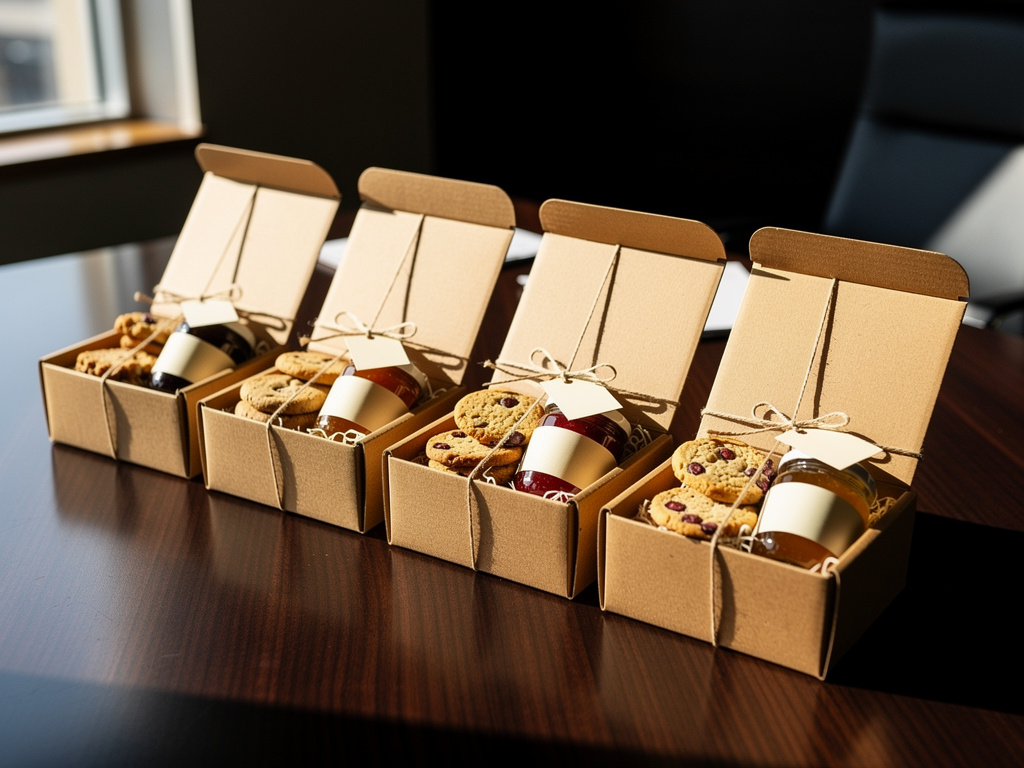
Drop off one small box of your best 4 to 6 pieces, labeled with your name, your sheet and the buyer's name, to the office before 10 a.m. on a Tuesday, Wednesday or Thursday, and keep the cost of each sample box near $10. A sample sits on a desk where coworkers see it and ask about it. An email sits in an inbox.
How to put the box together:
If you are pitching 8 offices, that is about $80 in samples. One 25-box order at $35 brings in $875, more than 10 times what the samples cost. If a business asks for samples for the whole staff, offer one box for the buyer and a second for the break room, and stop there.
For the face-to-face part, the guide to getting a chef to say yes to a tasting covers how to hand over a sample without sounding pushy, and the same habits work at an office front desk.
Follow up twice over about two weeks, once 2 or 3 days after the sample drop and once a week after that, then stop and put the business on your list for next season. Each follow-up is short, names the sample and asks one easy question.
A follow-up schedule that respects the buyer's time:
What not to do:
When someone says no, ask one question: "Is there someone else in the building who buys gifts?" Office parks and shared buildings are full of businesses that never got a sample.
Before saying yes, the buyer will usually ask about allergens, the exact delivery day, how they pay, whether you can add their logo or a note, and what happens if a box arrives damaged. Have a one-sentence answer ready for each of the 6 questions below, because a buyer who has to wait for an answer may pick someone else.
The questions to prepare for:
Write the answers into a short email you can paste. The guide to quotes and invoices for custom food orders has a quote layout you can reuse for the written confirmation.
A small business will pay for a 25-box gift order by company card, by invoice or by check, and on an $875 order the fee you pay on the methods below ranges from $0 for a check to $31.03 when the business pays a PayPal invoice from its PayPal or Venmo account. Ask the buyer how they pay before you quote, then pick the method that fits.
Here is what each way to get paid costs on 25 client boxes at $35, or $875, before any sales tax. We loaded each company's own pricing page on October 14, 2026.
Scroll sideways to see every column.
| How the business pays | Monthly plan | Trial | Platform fee | Payment processing | Business pays | You pay on $875 |
|---|---|---|---|---|---|---|
| Homegrown storefront, company card | $10 billed annually ($12.50 monthly) | 7 days, no charge until day 8 | $0, 0% commission | 2.9% + $0.30, paid by you | $875.00 | $25.68 plus the plan |
| Square invoice, card (Free plan) | $0 per location | None needed on the $0 plan | None listed | 3.3% + 30¢, paid by you | $875.00 | $29.18 |
| Square invoice, bank transfer (Free plan) | $0 per location | None needed on the $0 plan | None listed | 1%, $1 minimum, paid by you | $875.00 | $8.75 |
| PayPal invoice, card | $0, free sign-up | None needed, no plan | None listed | 2.99% + $0.49, paid by you | $875.00 | $26.65 |
| PayPal invoice, paid with PayPal or Venmo | $0, free sign-up | None needed, no plan | None listed | 3.49% + $0.49, paid by you | $875.00 | $31.03 |
| PayPal invoice, bank transfer | $0, free sign-up | None needed, no plan | None listed | 1%, capped at $10, paid by you | $875.00 | $8.75 |
| Paper check | $0 | Not applicable | $0 | $0 | $875.00 | $0, but you wait for it to clear |
Sources: findhomegrown.com/signup, squareup.com/us/en/pricing (Free plan column) and PayPal's business fees page (last updated October 1, 2026) and invoicing page, all loaded October 14, 2026. PayPal bills a card paid through PayPal Guest Checkout on an invoice at 3.49% + $0.49, the same as the PayPal or Venmo row. Square's Plus and Premium plans cap the bank transfer fee at $10 but cost $49 and $149 a month per location. Sales tax is not included in any row.
The math, so you can check it: 2.9% of $875 is $25.38, plus $0.30 is $25.68. Square's 3.3% of $875 is $28.88, plus $0.30 is $29.18. PayPal's 2.99% of $875 is $26.16, plus $0.49 is $26.65. PayPal's 3.49% of $875 is $30.54, plus $0.49 is $31.03. Both bank transfer options are 1% of $875, or $8.75.
Ask for half up front on any order over $300, whatever the payment method. You are buying jars, boxes and butter for 25 gifts before the business has eaten one cookie.
A corporate gift order goes smoothest when the buyer can see your three boxes, pick a quantity and pay by company card in one place, and a Homegrown storefront does that for $10 a month billed annually, with no percentage fees beyond standard payment processing of 2.9% + $0.30. You list the desk box, the client box and the thank-you box, add sizes such as "box of 10" or "box of 25" as variants with their own prices, and send the office manager one link instead of a PDF and a phone number.
How it compares with two common tools for business orders:
What helps on a gift order: a delivery radius you set from 1 to 25 miles, with one flat fee and a minimum, an order prep time so nobody orders 25 boxes for tomorrow, pickup days you control, and a customer list you keep for next year's pitch.
The honest limits. Homegrown does not send invoices or offer payment terms like "net 30," so a business that can only pay an invoice should get one from Square or PayPal. Homegrown does not ship, and each order goes to one pickup spot or one delivery address, so 25 boxes going to 25 homes is your own delivery route. The buyer creates a Homegrown account to place the first order. Homegrown holds 20% of each order for 30 days before it reaches your bank, which is $175 on an $875 order. There is no drops feature, and your storefront is listed on the marketplace, but plan on most orders coming from people you send to your own link.
Whether a home kitchen can deliver gift boxes to a business's clients, or ship them, depends on your state's cottage food law, so check it before you promise "we deliver to your 25 clients." Each state decides where cottage food can be sold, who can deliver it and whether it can be mailed.
Texas is one example. The Texas Department of State Health Services cottage food page says cottage food can be sold online when "The consumer purchased the food online from the operator," "The operator, an employee, or a household member personally delivers the food to the consumer," and, "Before the operator accepts payment for the food, the operator provides all labeling information required by the Cottage Food Production Operations rules to the consumer by posting a legible statement on the cottage food production operation's internet website." After payment, your address or your unique identification number goes on the label. The same page says SB 541 raised the yearly gross income limit to $150,000, and its label list includes a line saying the product was produced in a private residence that is not subject to governmental licensing or inspection. A Homegrown listing shows allergens and a written description before checkout, so you can paste the full label statement into each gift box listing's description, including your business name, the product's common name, the allergens and that private-residence line. DSHS does not say whether a marketplace listing counts as your cottage food operation's own website, so ask DSHS before you rely on one.
What to check in your own state before you pitch:
The cottage food laws by state guide is a starting point, and your state health or agriculture department has the final word.
Gift boxes reach people you will never meet, so label every allergen. The FDA lists nine major food allergens: milk, eggs, fish, crustacean shellfish, tree nuts, peanuts, wheat, soybeans and sesame (FDA food allergies page, checked October 14, 2026). The guide to the big 9 allergens on a cottage food label shows how to list them.
Plan a 25-box order as a two-day job: bake and cool on day one, pack, label and deliver on day two, with 1 or 2 spare boxes in the car. A late or damaged box hurts a gift order more than an average cookie does, and the office manager remembers a late box longer than a great cookie.
A delivery checklist for one office order:
If the business wants boxes at 25 homes, price the route separately. At 15 minutes a stop, 25 stops is more than six hours of driving. The cottage food delivery playbook covers how to set a delivery fee that pays for that time.
Turn a first order into a yearly account by thanking the buyer within 2 days, asking how the gifts went over, and asking if you can hold the same week next year, all before January 15. A business that liked its gifts has little reason to search for a new vendor the following September.
What to do after the delivery:
Keep a simple list of every business that ordered, how many boxes, which box and the delivery date. If 3 offices each order 25 client boxes at $35, that is $2,625 in December from three emails you already know how to write, and next year it starts with a reorder, not a pitch.
Repeat buyers are also how you grow without more pitching. A realtor who gives a $35 box at each of 12 closings a year is $420 of steady orders spread across the calendar, not just in December.
Make a list of 10 local businesses that already give gifts, such as realtors, dentists and insurance agents, and find the name of the person who orders them. Send each one a short email with a one-page sheet of three boxes and prices, then drop off a sample box and follow up twice. September and October are the best months to pitch December gifts.
A corporate gifting pitch from a food vendor should include three gift boxes with photos and fixed prices, a minimum order, an order deadline, your delivery area, allergen information and how to pay. Keep it to one page. Office managers want to make one choice and get it approved, not design a gift from a full menu.
Offer a range, such as $22, $35 and $60, based on your real costs. Include one box under $25, because IRS Publication 463 limits a business's deduction for gifts to $25 per person per year, and some buyers plan around that. Businesses can still buy a pricier box; they just cannot deduct all of it.
Yes, one small box per business, aimed at the person who orders gifts. Keep each sample near $10 in cost and package it the way the real gift will look, with your sheet inside. Eight sample boxes at about $10 each cost $80, and one 25-box order at $35 brings in $875.
An office manager who gives December gifts has to pick a vendor weeks ahead to meet bakery lead times, so pitch in September and October. The 7 established bakeries we checked on October 14, 2026 asked for 4 days to 4 weeks of notice on domestic custom or corporate orders, before shipping time, depending on the order. Give yourself at least 2 weeks of notice for a 25-box order and write the deadline on your sheet.
It depends on your state's cottage food law. Some states limit online sales to food you, an employee or a household member deliver in person; Texas's cottage food page lists that condition. Check your state health or agriculture department before you offer shipping or delivery to a business's clients.
These guides cover the parts of a corporate gift order this one only touches: setting quantity prices, building the box itself, other places that buy gifts in bulk and the face-to-face side of a sample. Each one is written for small, part-time vendors working from a home kitchen, and each is live on the Homegrown blog today.
A corporate gift pitch works when the buyer can say yes in one step, and a storefront link with your three gift boxes, prices and allergens on it is that step. Your sheet gets the meeting. The link gets the order placed without a back-and-forth about sizes, prices and dates. It also gives the office manager something to forward to the owner for approval, and something to find again next September when the gift list comes around.
A Homegrown storefront costs $10 a month billed annually, with 0% commission and 2.9% + $0.30 card processing that you pay. List your desk, client and thank-you boxes, set your delivery area and prep time, and put the link at the bottom of every pitch email you send this fall. Start with 5 businesses where you already know someone, drop off 5 sample boxes, and follow up twice. If even one office orders 25 client boxes at $35, that is $875 for one week of baking, and a buyer you can ask about next year in January.



